Juan de Plasencia:
Las Costumbres de los
Indios Tagalos de Filipinas
Presented by: Joshua Simon-Bernabe Jimenez, LPT
CUSTOMS OF THE TAGALOGS
WHAT TO EXPECT?
2
Examine the context and perspective of
the document
Explain the relationship among the
members of a barangay
Discuss the religious and spiritual
practices and beliefs of early Filipinos
Determine the significance of the
document to Philippine History
BACKGROUND OF THE AUTHOR?
3
✣ Born to the illustrious family of Portocarreros
in Plasensia in the region of Extremadura,
Spain in the early 16th century. He was one of
the seven children of Pedro Portocarrero, a
captain of a Spanish schooner.
✣ Juan de Plasencia grew up during the period
known as the Siglo de Oro, a Golden Age
when arts and literature flourished in many
parts of Spain, among them his native
Extremadura.
✣ Fray Joan de Puerto Carrero, del
convento de
Villanueva de la Serena. Was his real
name.
ARRIVAL IN THE PHILIPPINES
4
✣ Fray Juan de Plasencia came
together with the first batch
of Franciscan missionaries in
the Philippines.
✣ Arrived at a port in Cavite, a few
kilometers south of Manila on the
2nd of July 1578.
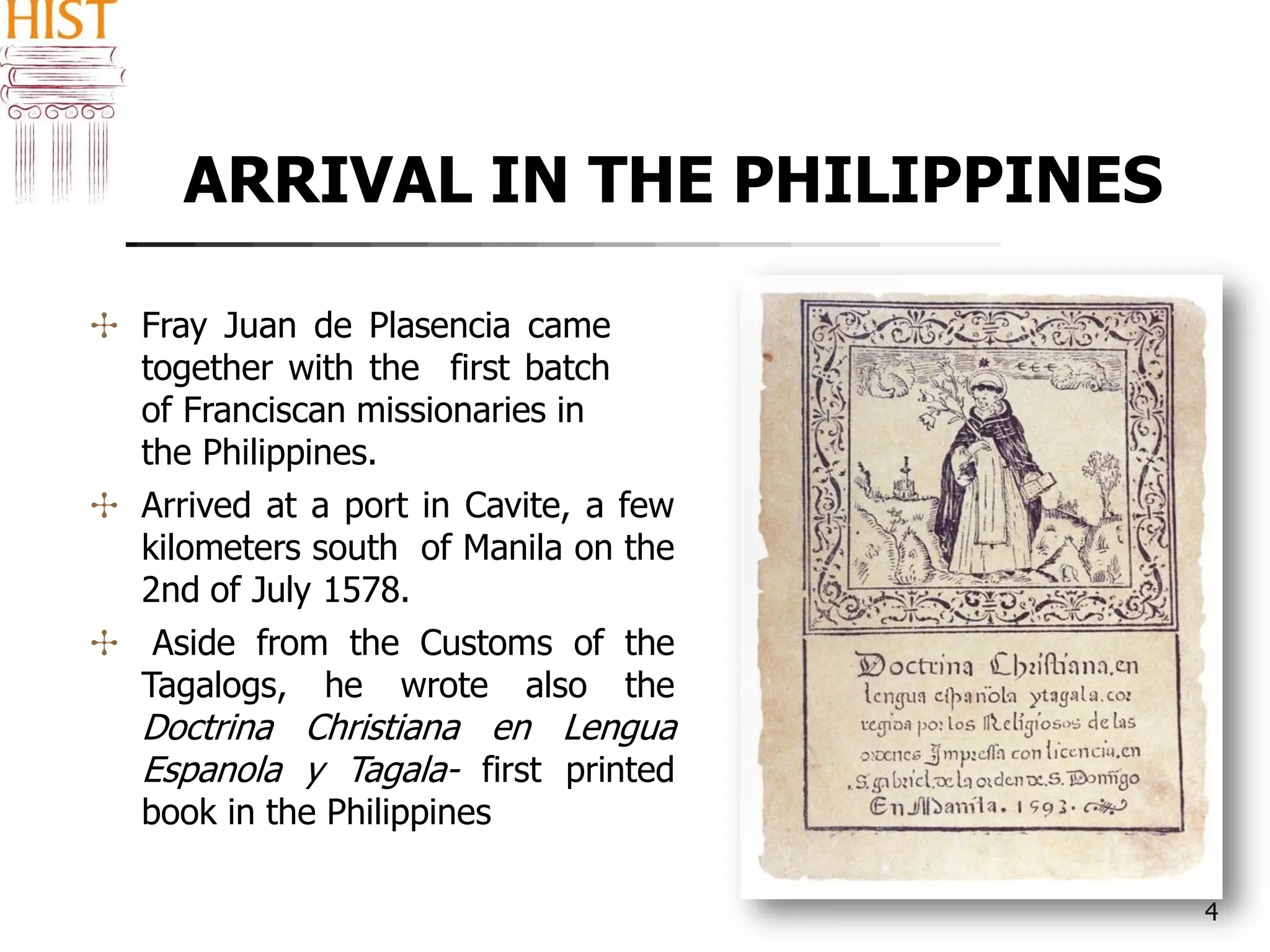
✣ Aside from the Customs of the
Tagalogs, he wrote also the
Doctrina Christiana en Lengua
Espanola y Tagala- first printed
book in the Philippines
ABOUT THE TEXT?
5
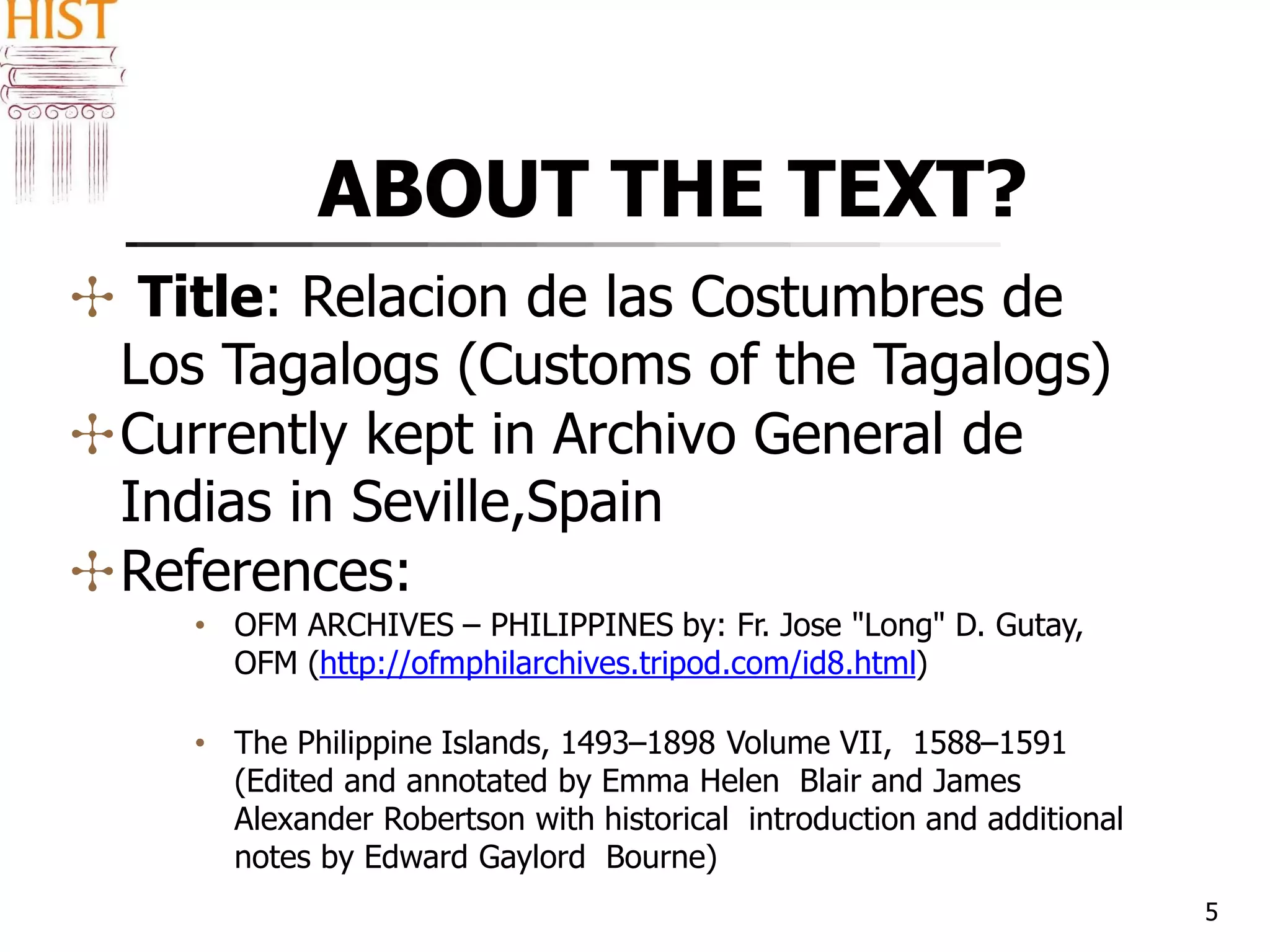
✣ Title: Relacion de las Costumbres de
Los Tagalogs (Customs of the Tagalogs)
✣Currently kept in Archivo General de
Indias in Seville,Spain
✣References:
• OFM ARCHIVES – PHILIPPINES by: Fr. Jose "Long" D. Gutay,
OFM (http://ofmphilarchives.tripod.com/id8.html)
• The Philippine Islands, 1493–1898 Volume VII, 1588–1591
(Edited and annotated by Emma Helen Blair and James
Alexander Robertson with historical introduction and additional
notes by Edward Gaylord Bourne)
HISTORICAL BACKGROUND
OF THE DOCUMENT?
6
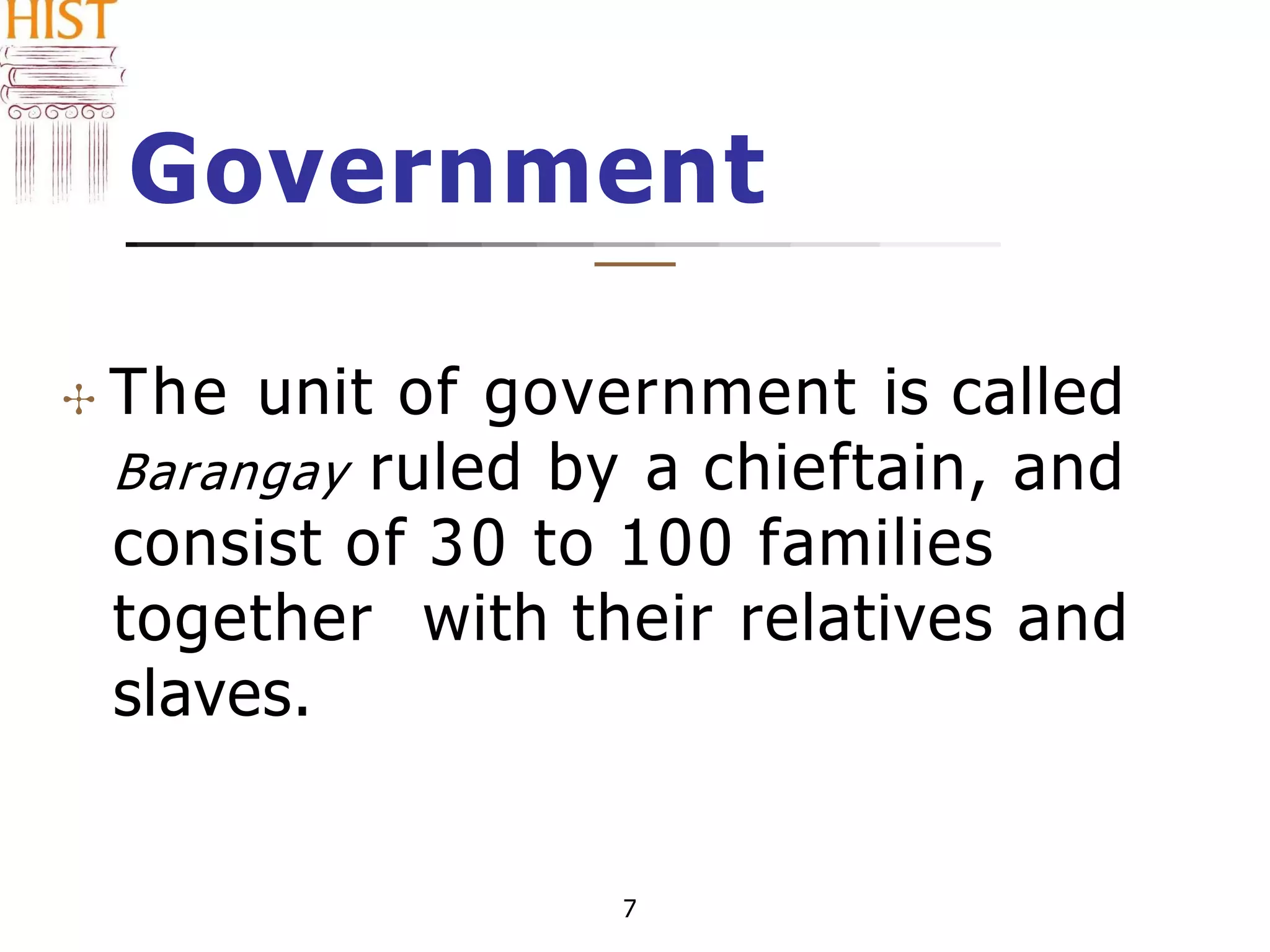
Government
✣ The unit of government is called
Barangay ruled by a chieftain, and
consist of 30 to 100 families
together with their relatives and
slaves.
7
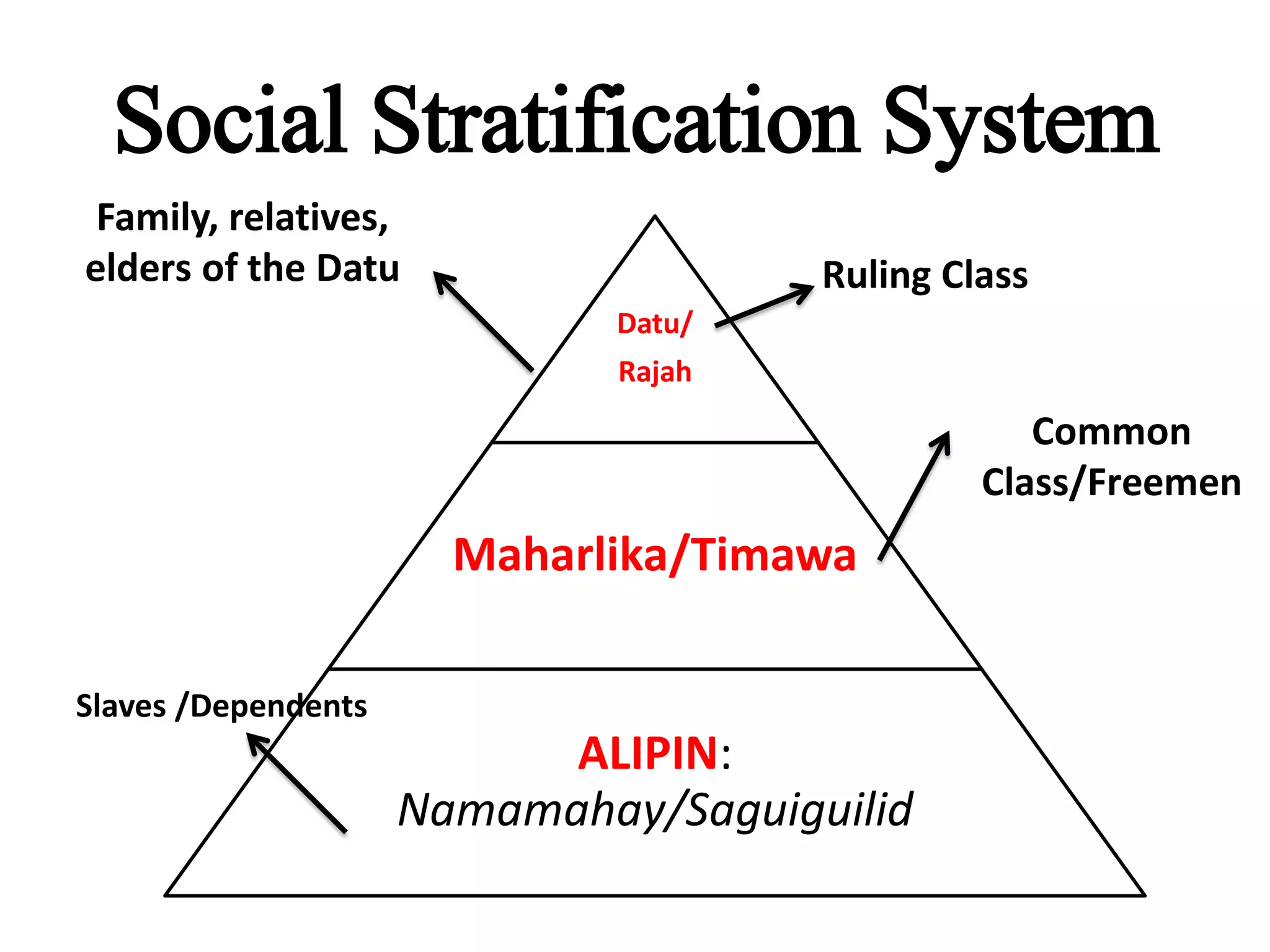
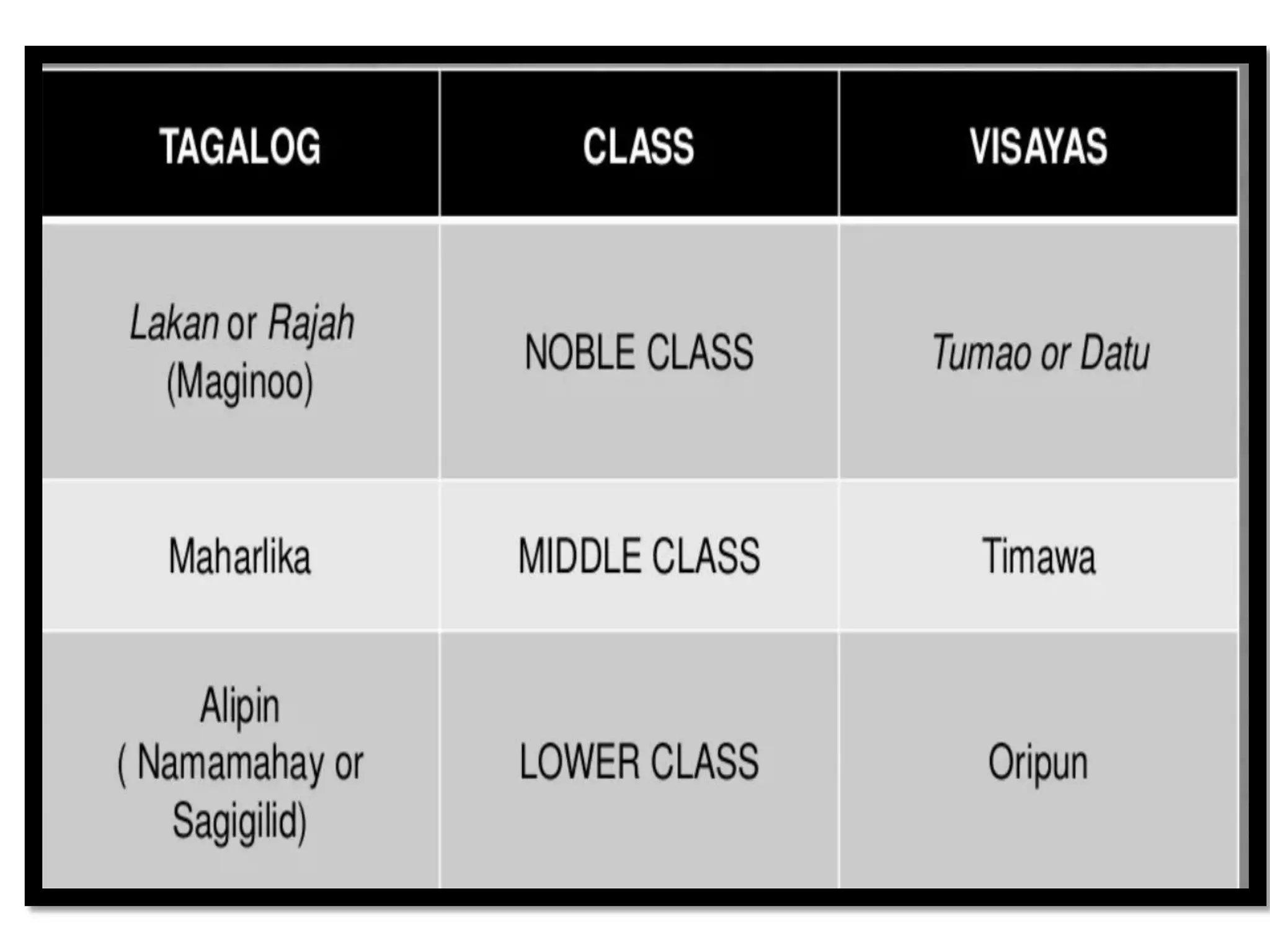
Social Stratification System
Datu/
Rajah
Maharlika/Timawa
ALIPIN:
Namamahay/Saguiguilid
Ruling Class
Family, relatives,
elders of the Datu
Common
Class/Freemen
Slaves /Dependents
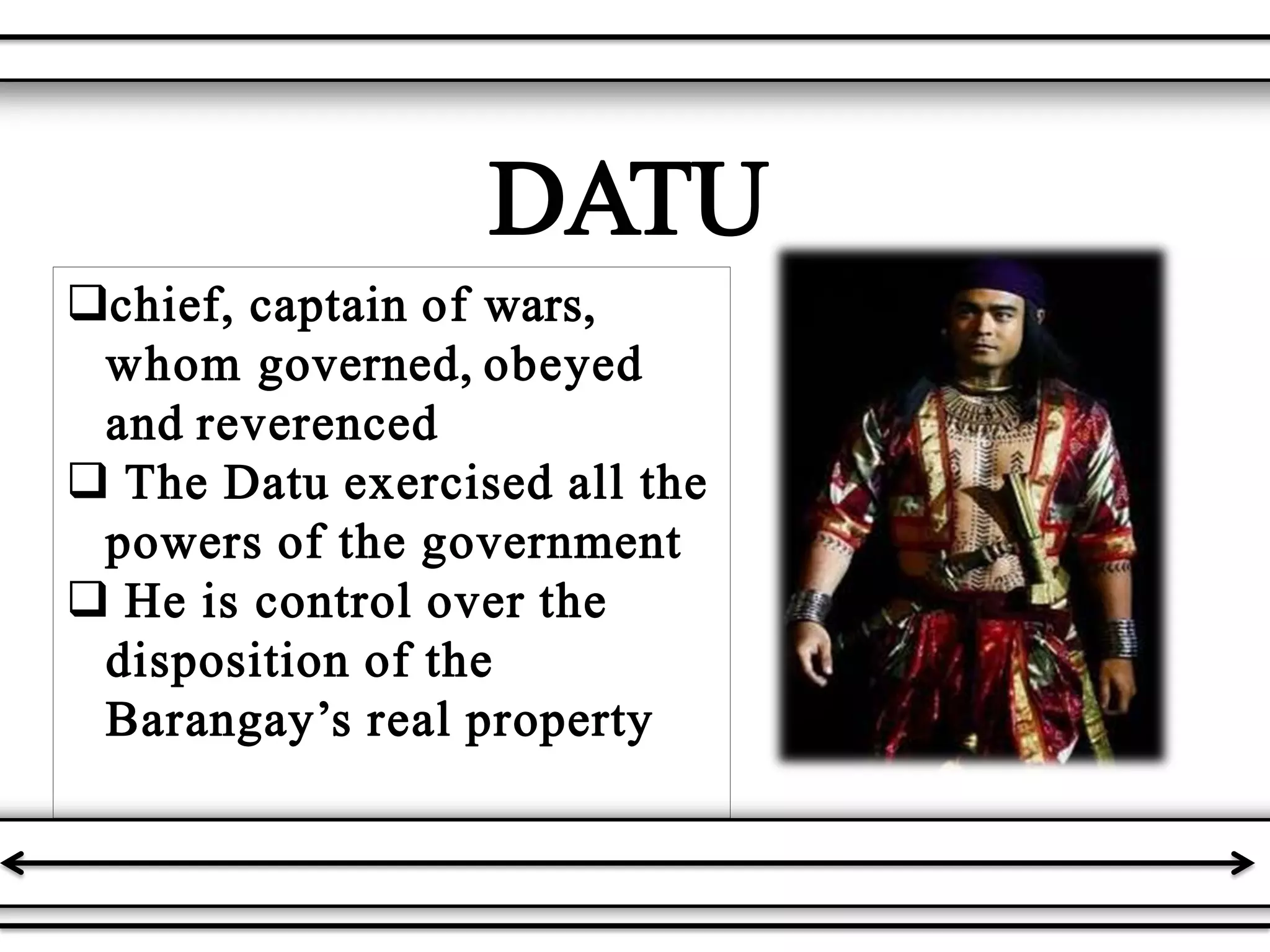
chief, captain of wars,
whom governed, obeyed
and reverenced
 The Datu exercised all the
powers of the government
 He is control over the
disposition of the
Barangay’s real property
DATU
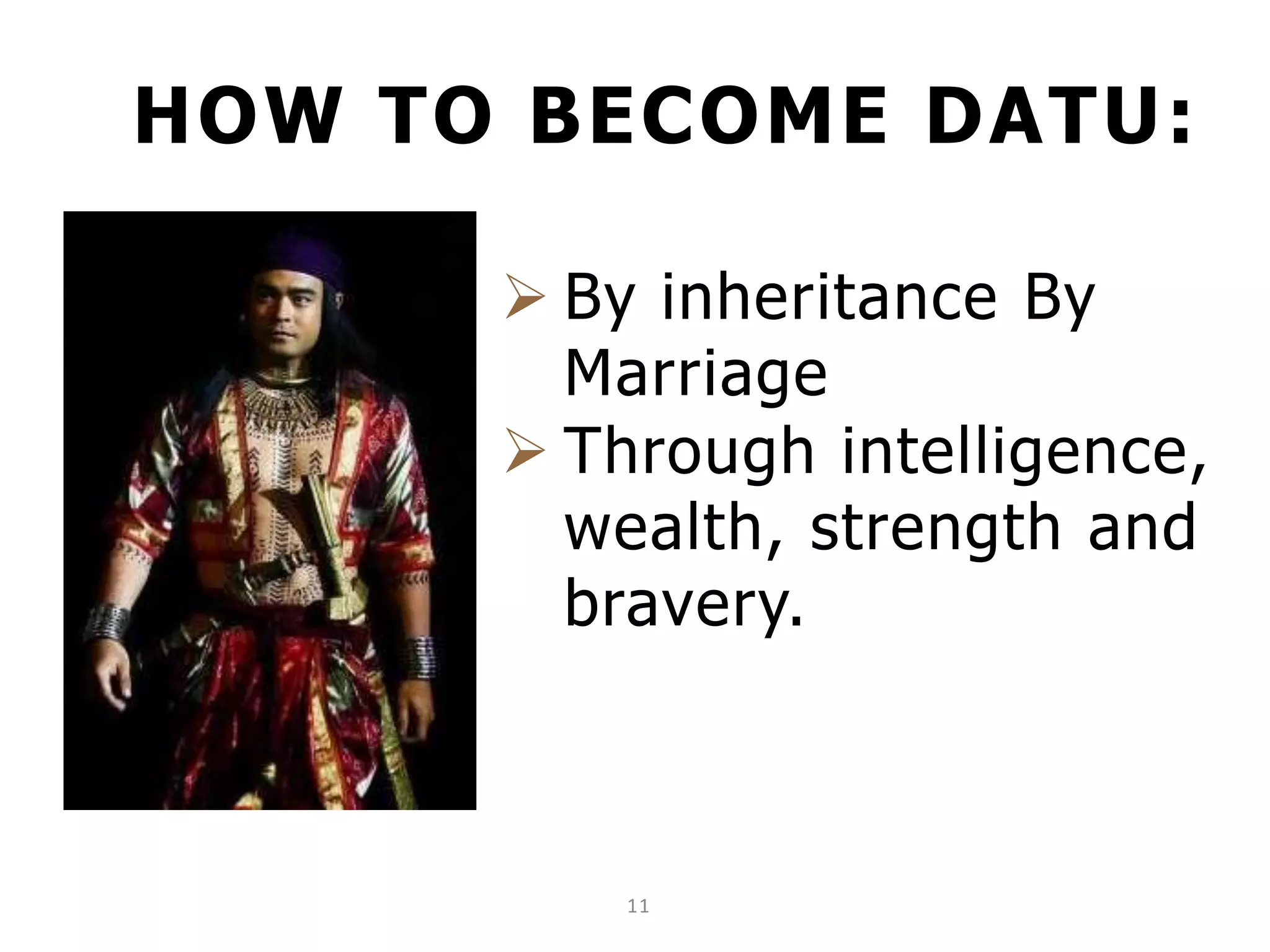
HOW TO BECOME DATU:
11
 By inheritance By
Marriage
 Through intelligence,
wealth, strength and
bravery.
Inheritance
✣ The 1st son of the barangay
chieftain inherits his father’s
position; if the 1st son dies, the 2nd
son succeeds their father; in the
absence of male heirs, it is the
eldest daughter that becomes the
chieftain.
12
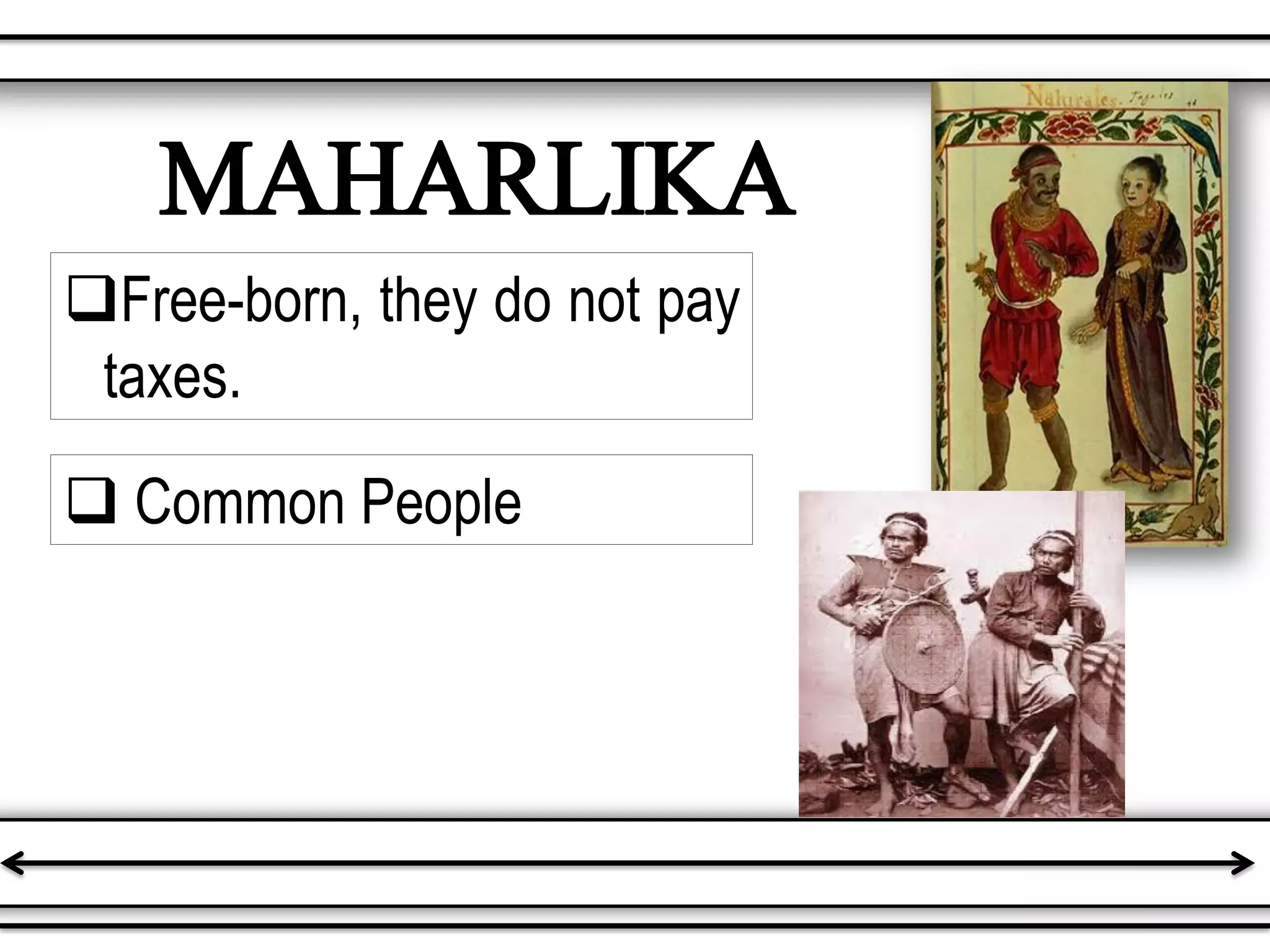
Free-born, they do not pay
taxes.
MAHARLIKA
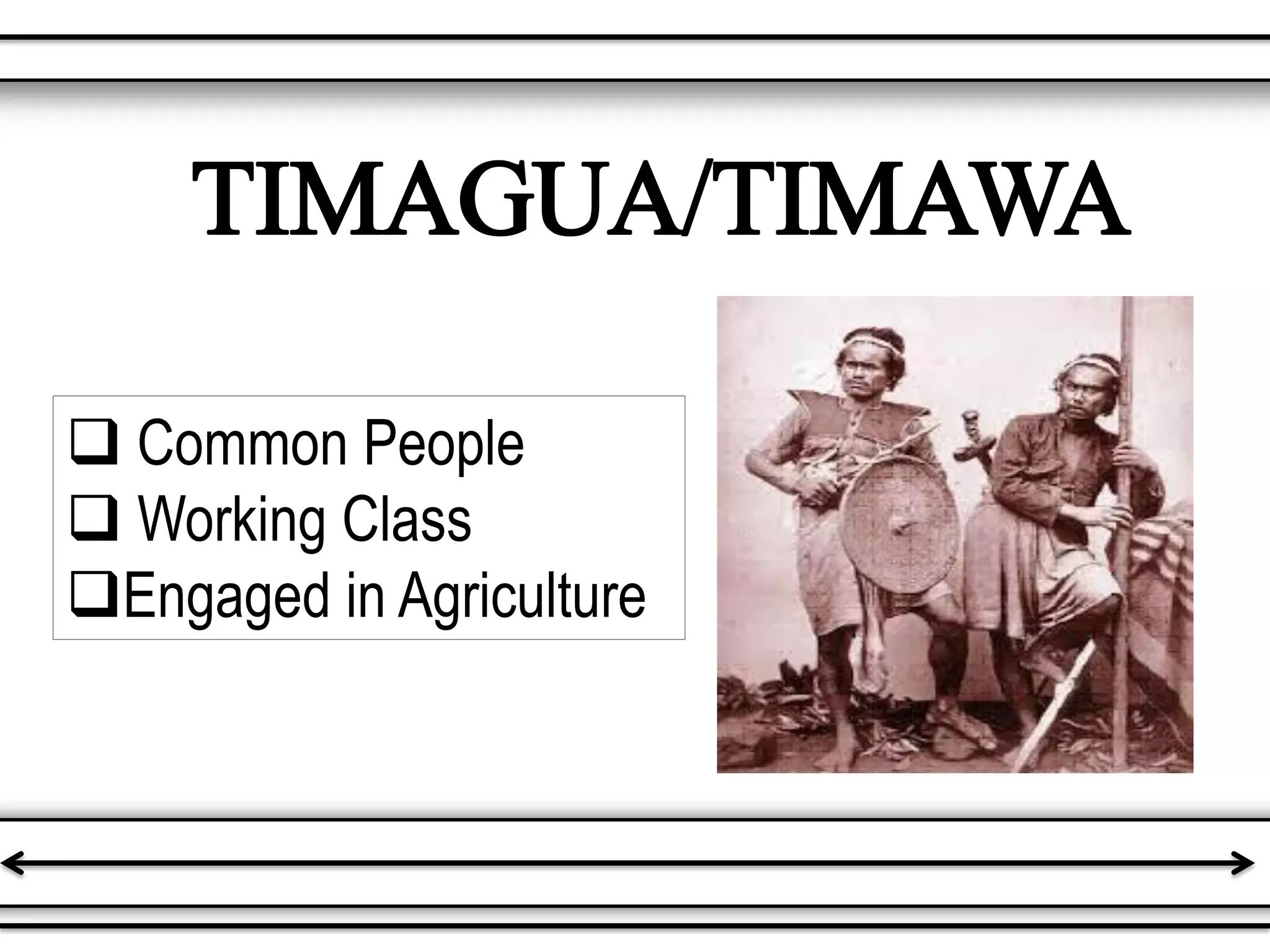
 Common People
 Common People
 Working Class
Engaged in Agriculture
TIMAGUA/TIMAWA
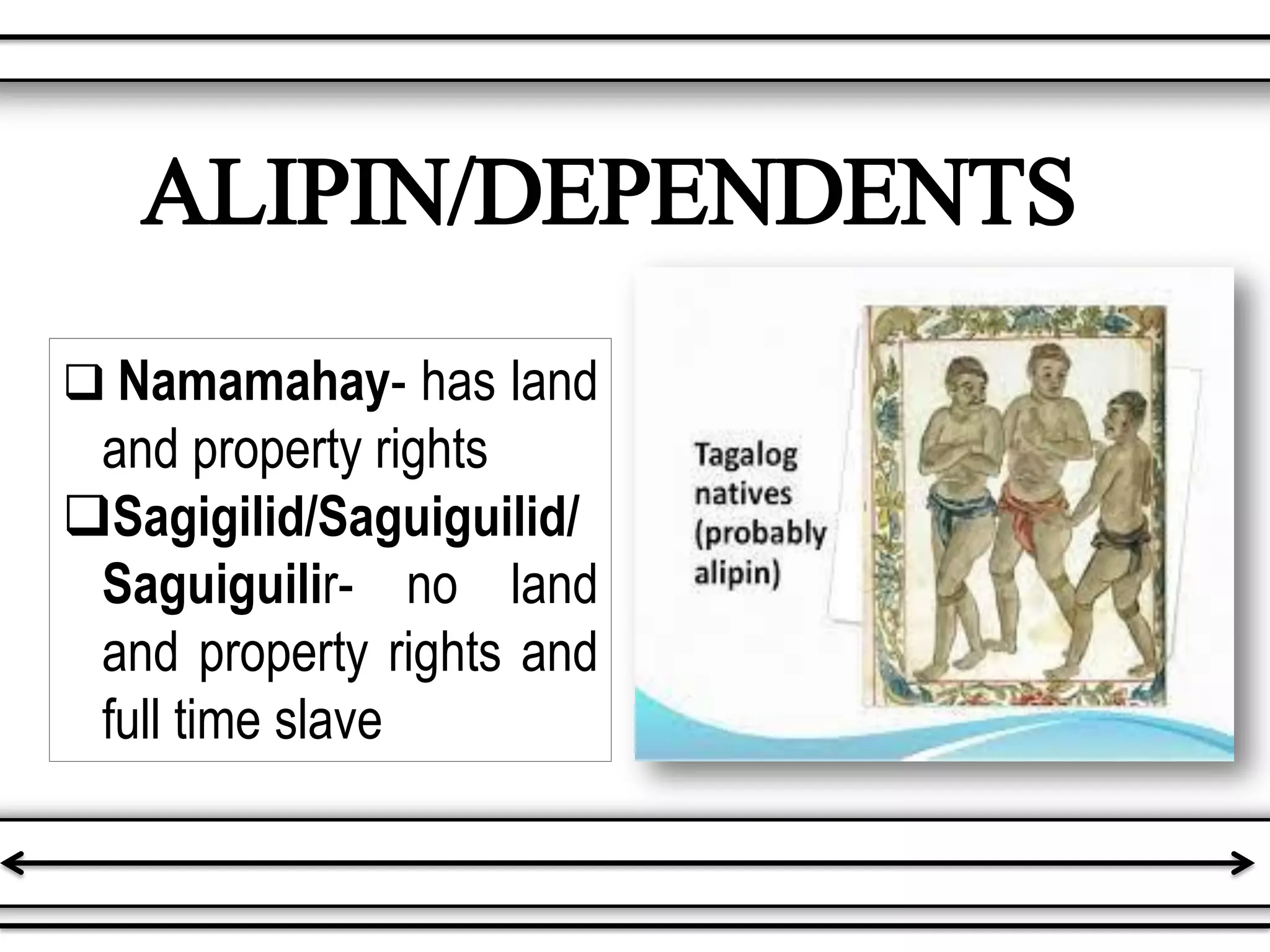
 Namamahay- has land
and property rights
Sagigilid/Saguiguilid/
Saguiguilir- no land
and property rights and
full time slave
ALIPIN/DEPENDENTS
TRIVIA: Slaves (Visayan)
Tumataban- worked for his master when
summoned to do so
Tumarampuk- worked one day for his
master
Ayuey- worked three days for his master
Slaves
✣ A person becomes slave by: (1) by captivity in
war, (2) by reason of debt,
(3) by inheritance, (4) by purchase, and
(5) by committing a crime.
✣ Slaves can be emancipated through: (1) by
forgiveness, (2) by paying debt, (3) by
condonation, and (4) by bravery (where a slave
can possibly become a Datu) or by marriage
Administration of Justice
18
✣ The chieftain’s executive function
includes implementing laws, ensuring
order and giving protection to his
subject.
✣ Disputes between individuals were
settled by a court made up of the
chieftain and council of elders.
TRIAL BY ORDEAL
19
• Right to punish disobedience
• Trial by suffering in public as their judicial
process
• Trial by combat
TRIAL BY ORDEAL
20
• Each suspect has witnesses to defend their
side.
• To prove the honesty and sincerity of the of
witnesses, the witnesses took an oath to this
effect:
• “Kainin na lang ako ng buwaya kung ako’y nagsisinungaling”
• “Nawa’y tamaan na lang ako ng kidlat kung hindi ako
nagsasabi ng katotohan. Kahit magalit man sa akin ang
kalangitan, araw at buwan kung ako’y nagsisinungaling.”
• Kahit mamatay na ako ngayon, kung ako’y nagsisinungaling.
 The Barangay had both oral and written laws
 Umalohokan- announcer especially on written
laws
How Laws were made?
22
• If a Datu wants to enact /make a law and/or want to
stop/prevent a law , he must call the council of elders
for their approval since they knows what’s best for the
society, they are most experienced and well off.
• If there are new laws, the Umalohokan who is the
public announcer was summoned and ordered to go
around the barangay to announce the new rules and
regulations in the society
Subjects of their Customary Laws
23
• Inheritance(mana), divorce, usury (lending/interest),
partnership, crime and punishment, property rights, family
relations, adoption, and loans
• Major Crimes: rape, incest(pakikipagrelasyon sa
magkapamilya or magkamag-anak), murder, withcraft
(gamod), insult, trespassing, sacrilegious acts
(disrespect/violation of religious beliefs and practices) &
Larceny (pagnanakaw)- punished by death and heavy fine
• Minor Crimes: Adultery (pangangabit), cheating, petty theft,
perjury (dishonesty), disturbance of peace at night,
destroying documents owned by a chief- punished by
exposure or ant bullets, small fine, beating, cutting fingers,
swimming for a number of hours.
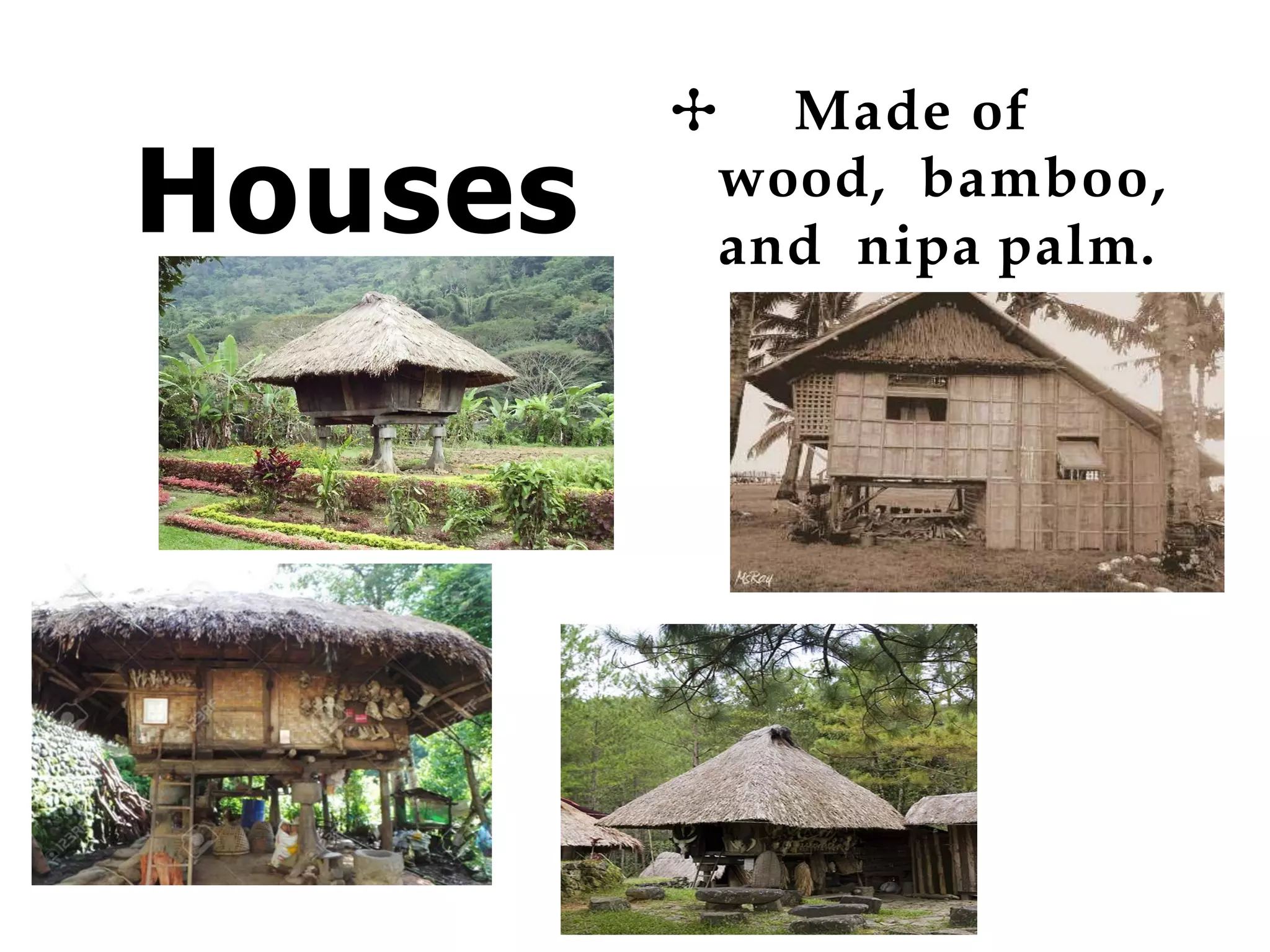
Houses
24
✣ Made of
wood, bamboo,
and nipa palm.
Mode of Dressing
25
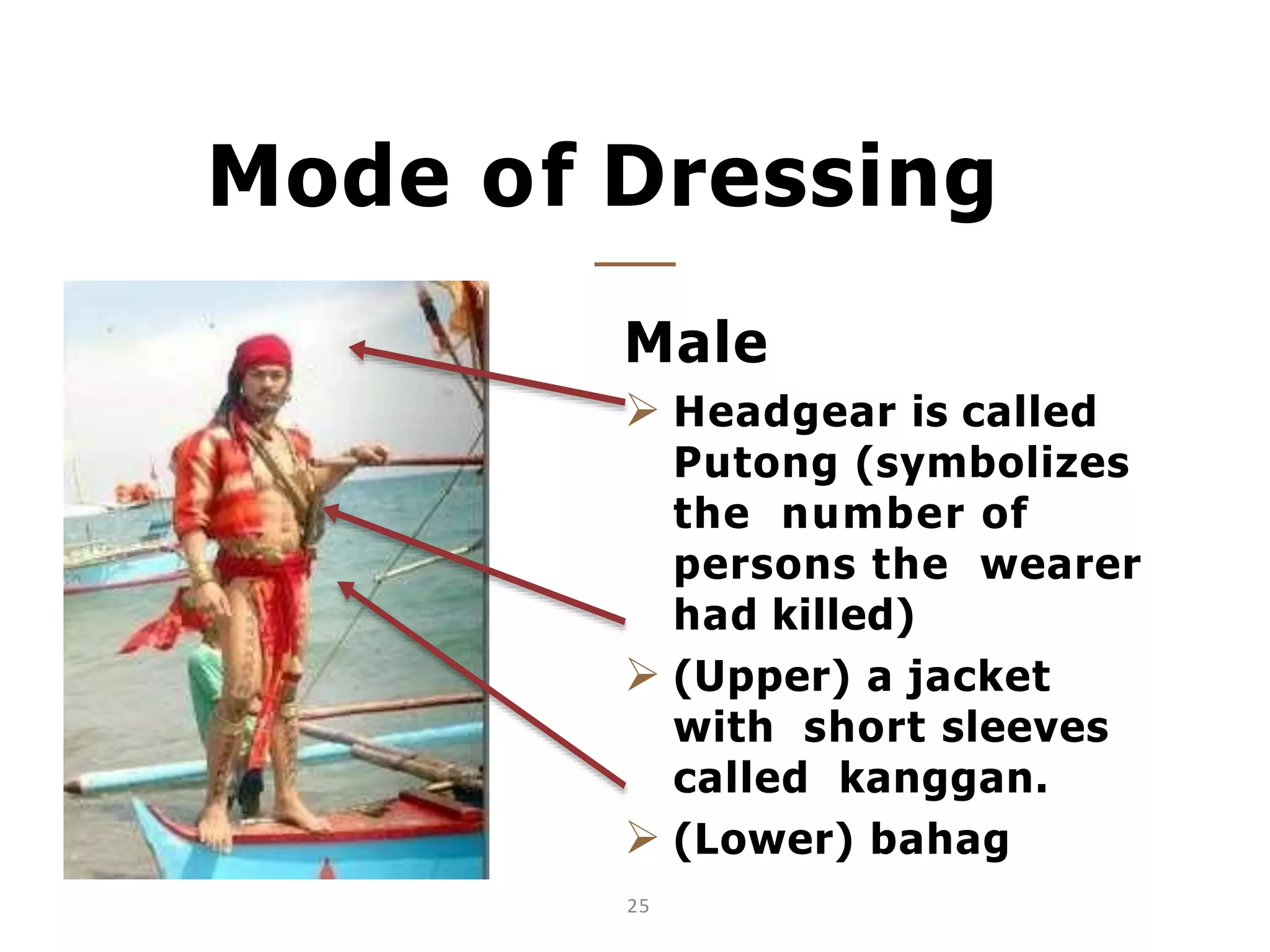
Male
 Headgear is called
Putong (symbolizes
the number of
persons the wearer
had killed)
 (Upper) a jacket
with short sleeves
called kanggan.
 (Lower) bahag
Mode of Dressing
26
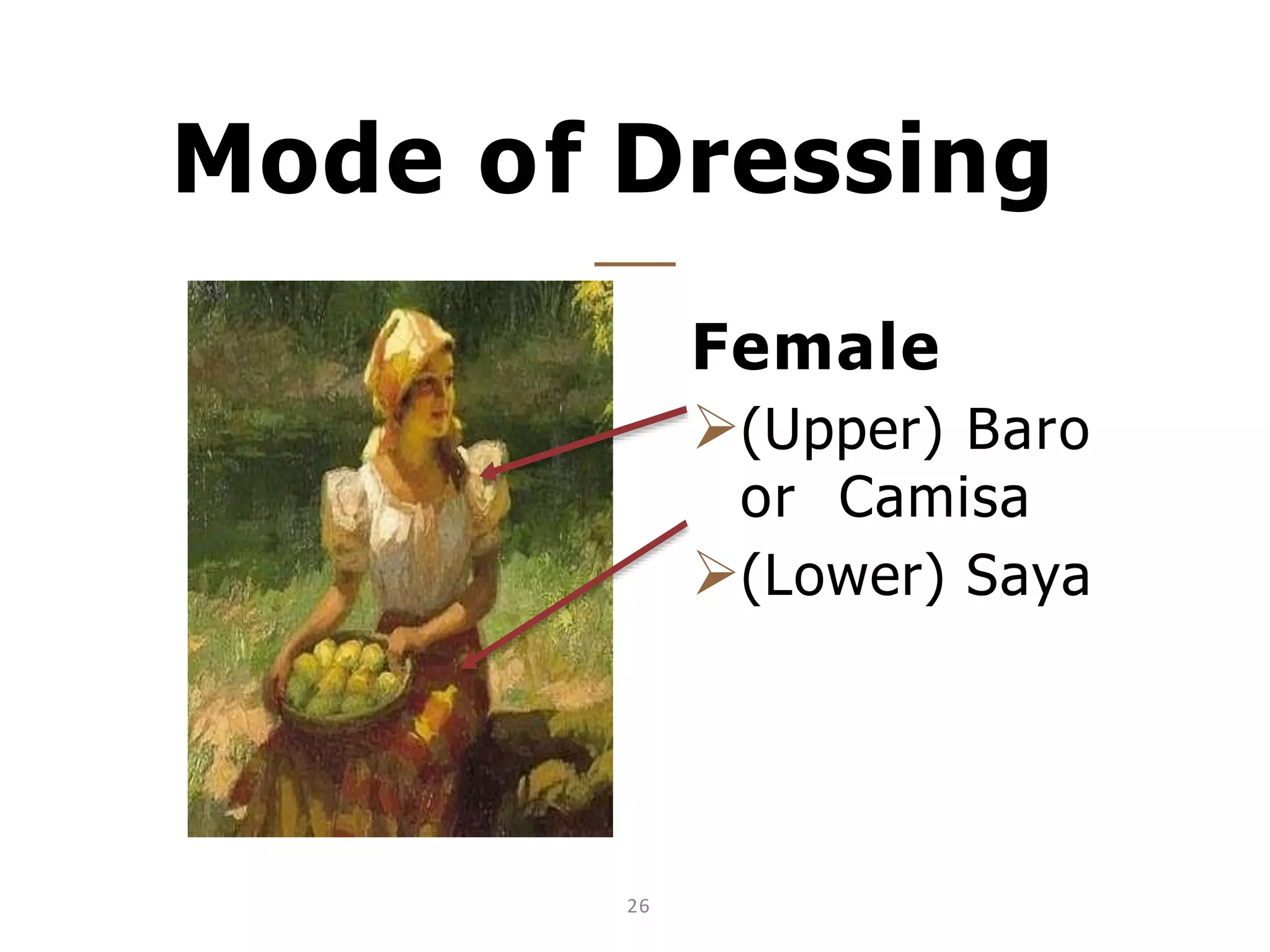
Female
(Upper) Baro
or Camisa
(Lower) Saya
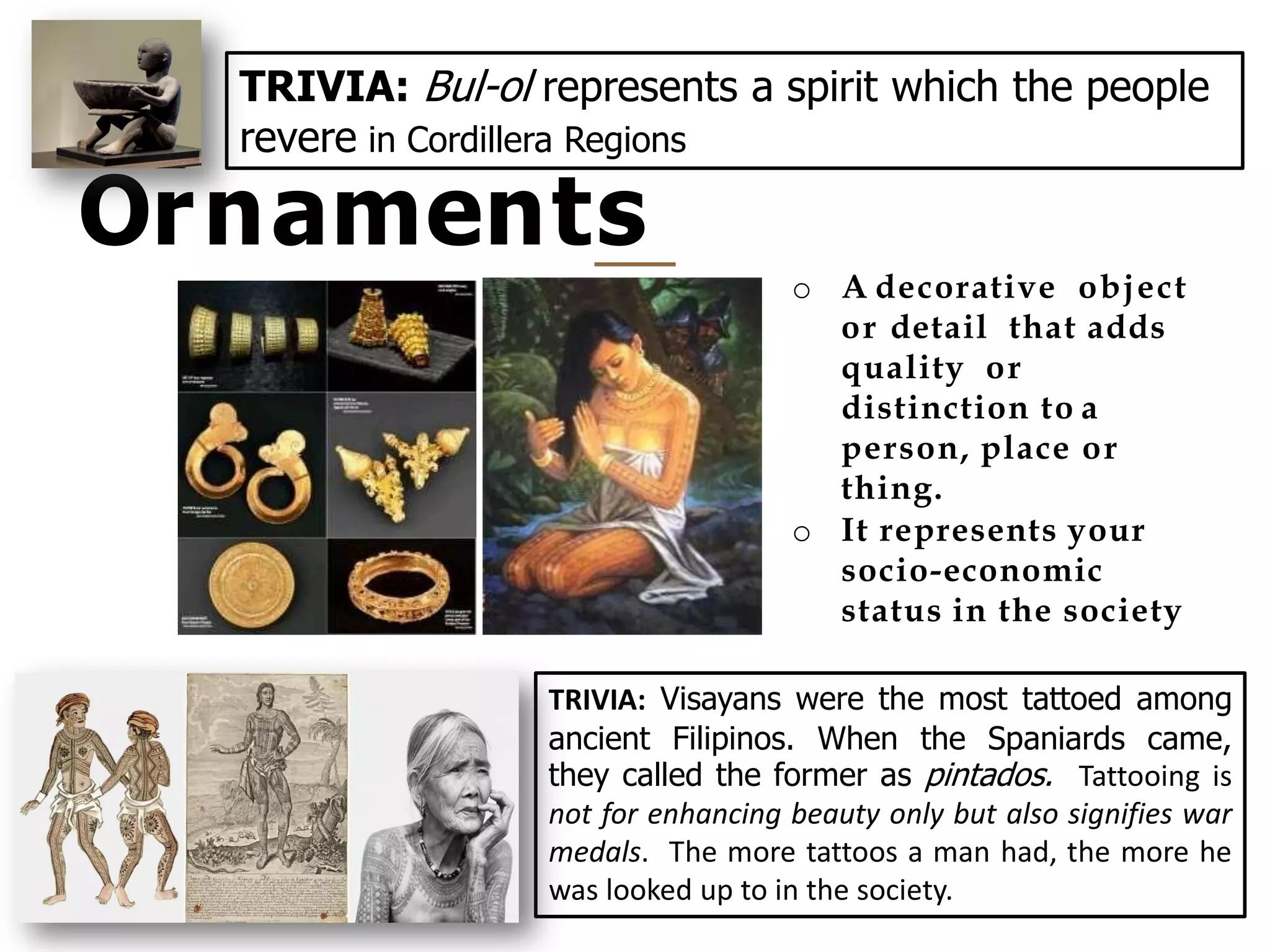
Ornaments
27
o A decorative object
or detail that adds
quality or
distinction to a
person, place or
thing.
o It represents your
socio-economic
status in the society
TRIVIA: Visayans were the most tattoed among
ancient Filipinos. When the Spaniards came,
they called the former as pintados. Tattooing is
not for enhancing beauty only but also signifies war
medals. The more tattoos a man had, the more he
was looked up to in the society.
TRIVIA: Bul-ol represents a spirit which the people
revere in Cordillera Regions
Marriage Customs
28
✣ Men were in general, monogamous; while their wives are
called Asawa.
✣ Courtship begins with Paninilbihan:
• *the man serve the girl’s parents for months or years such as chopped
wood, fetched water, and did chores required of him
• *In this situation, the man was not supposedly to talk with the lady,
only their eyes met to show love
• * If the man satisfied the parents, they will give their consent to the
marriage
 Prior to marriage the man requires to give a dowry: (1)
Bigay- kaya ( the man will give a piece of land or gold, and
dependents or slaves); (2) Panghihimuyat (a gift for the brides
parents); (3) Bigay-suso (for brides wet nurse) Himaraw
(another sum of money)
Marriage Customs
29
✣ Marriage between couples belonging to defferent social
classes were not common
✣ Several grounds (dahilan) of divorce (paghihiwalay) are:
(1) Adultery, (2) Abandonment
(3) Cruelty, and (4) Insanity
TRIVIA: Pamumulungan/Pamamalae- A courtship
(pamamanhikan) right before marriage
 Muslims: Panalanguni (betrothal/engagement), pedsungad
(settlement of dowry), pegkawing (wedding
festival/Ceremony)
 Bigay-kaya/dowry consists of land, gold, or dependents
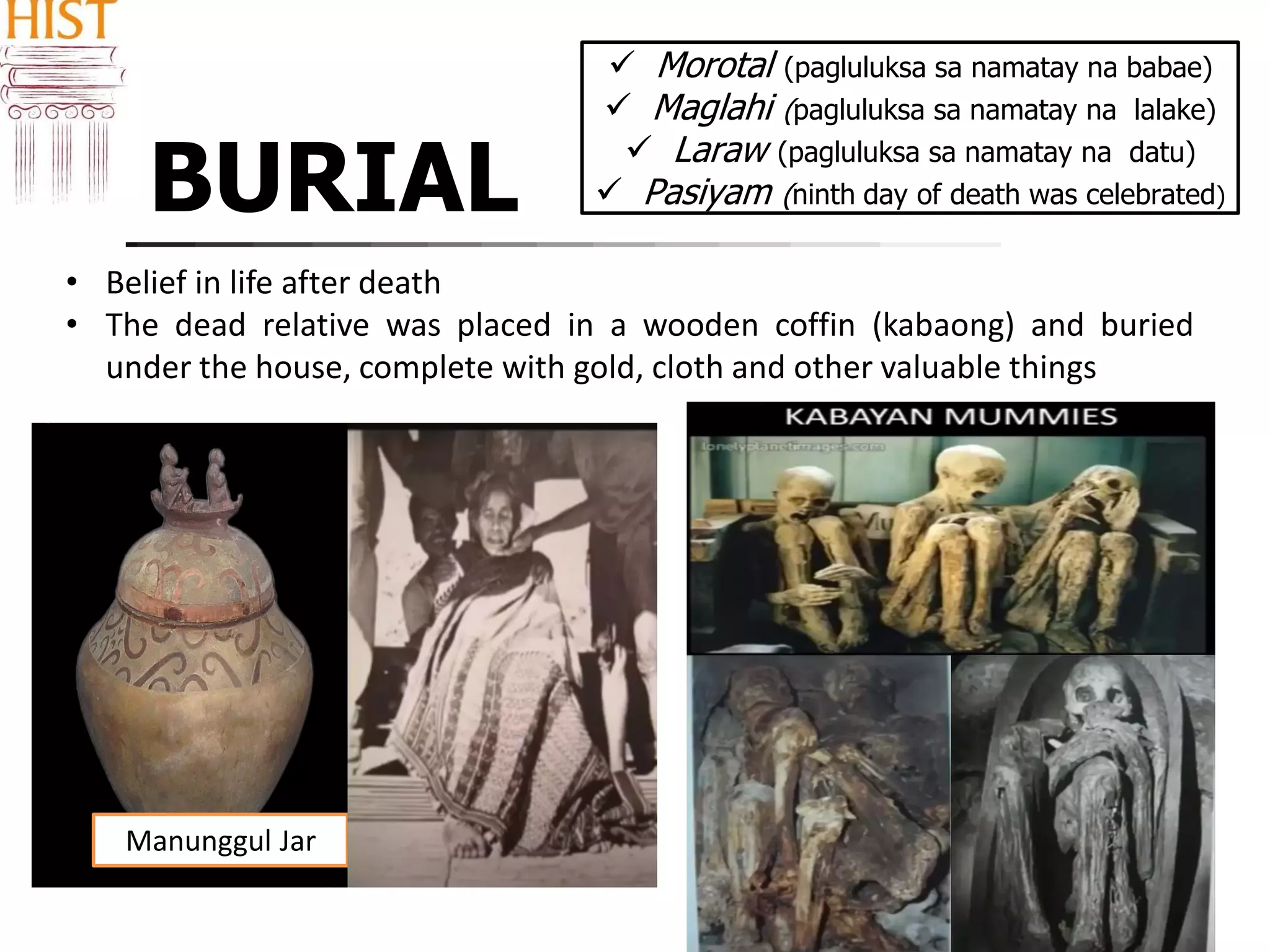
BURIAL
 Morotal (pagluluksa sa namatay na babae)
 Maglahi (pagluluksa sa namatay na lalake)
 Laraw (pagluluksa sa namatay na datu)
 Pasiyam (ninth day of death was celebrated)
• Belief in life after death
• The dead relative was placed in a wooden coffin (kabaong) and buried
under the house, complete with gold, cloth and other valuable things
Manunggul Jar
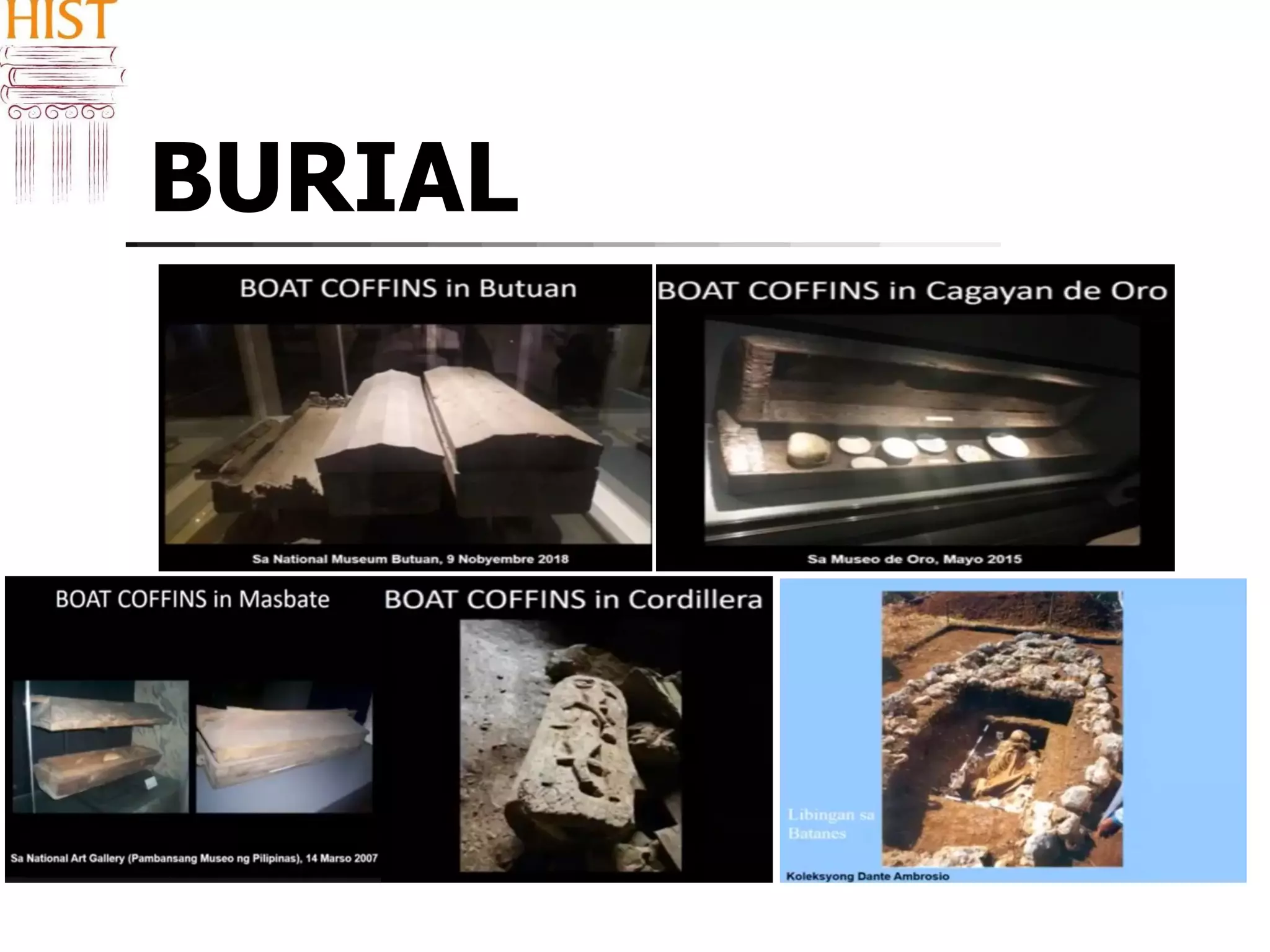
BURIAL
Religious Belief
32
✣They worship many gods and goddesses:
(1)Bathala/Bathalang Maykapal, supreme being; the creator
(2)Idianale & Lacapati god of agriculture; husbandry
(3)Sidarapa/Sidapa, god of death;
(4) Agni, god of fire;
(5)Balangaw,god of rainbow
(6) Mandarangan, god of war;
(7) Lalahon, god of harvest; and
(8) Siginarugan, god of hell.
(9) Dian Masalanta, patron of lovers and generations
(10)Buaya (water-lizards), they paid reverence/devotion
✣ Also believe in sacred animals, trees and many more
which believed to be holy and place of unseen spirits
(animism)
TRIVIA:
• Bathala (Tagalog)
• Abba (Cebuano)
• Laon (Bisaya)
Religious Belief
33
 Believed in the immortality of the soul and life after death
 Disease or illness was cause by the environmental spirits and
the soul-spirits of the dead relatives
 The Filipinos adored the sun, moon, animals, birds for they are
objects of nature to be respected
• The Filipinos adored idols called Anito (Tagalog) and Diwata
(Visayan). Offerings are officiated by ritual leaders ,
Babaylana/Babaylan (Tagalogs) at Katalona/Katalonan
(Visayans).
Superstitious Beliefs
34
✣Believe in Aswang, Dwende, Kapre,
Tikbalang, Patyanak/Tiyanak.
✣They also believe in magical power
of amulet and charms such as
anting-anting, kulam and gayuma or
love potion.
PRIEST AND PRIESTESS Of Good
and the Devil
35
• They are those rituals leaders and those who have
unique and unusual power or magic :
*Catalonan
*Mangangauay
*Manyisalat
*Mancocolam
*Hocloban
*Silagan
*Magtatanggal
*Osuang
*Mangagayoma
*Sonat
*Pangatahojan
*Bayoguin
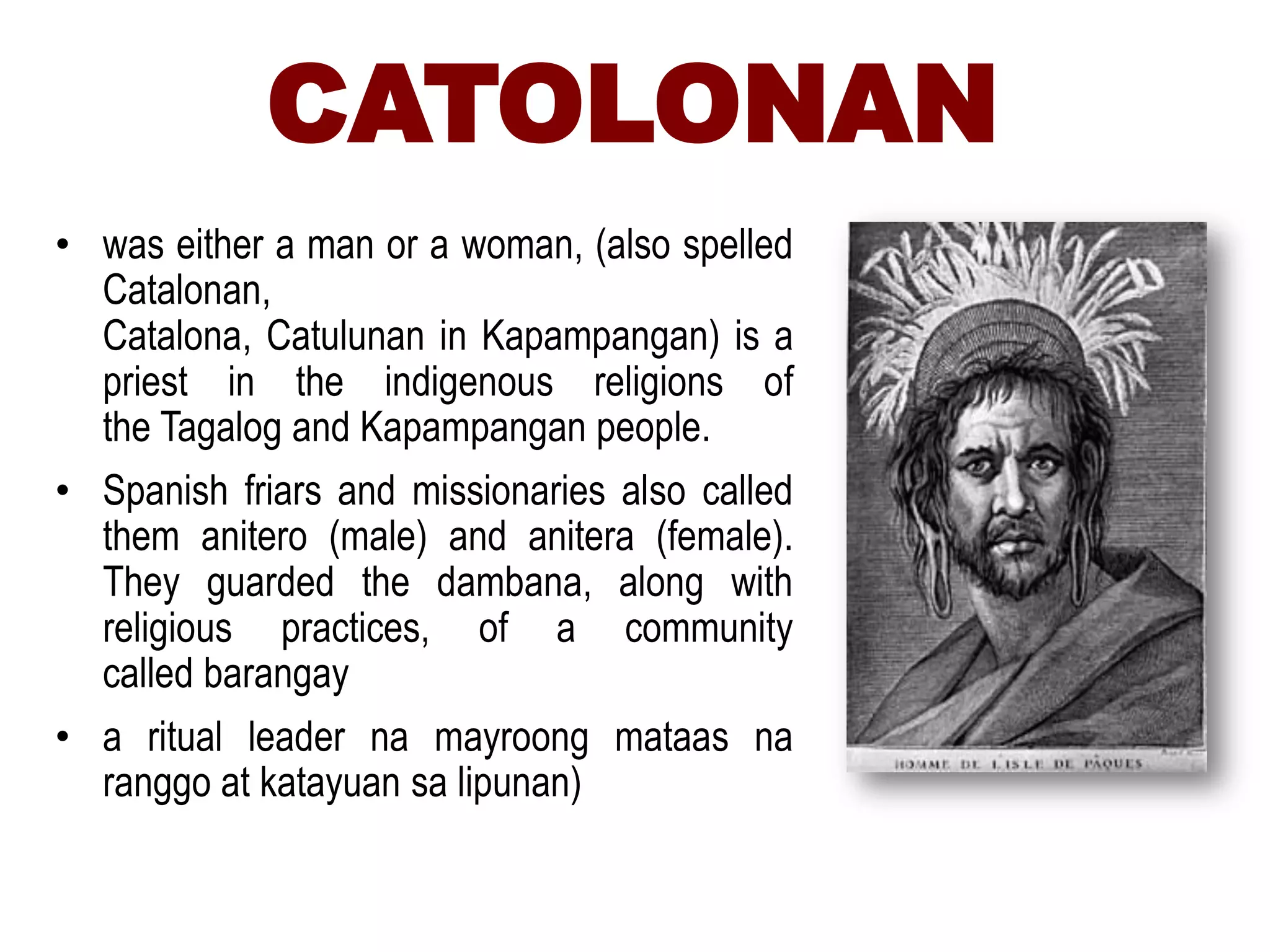
CATOLONAN
• was either a man or a woman, (also spelled
Catalonan,
Catalona, Catulunan in Kapampangan) is a
priest in the indigenous religions of
the Tagalog and Kapampangan people.
• Spanish friars and missionaries also called
them anitero (male) and anitera (female).
They guarded the dambana, along with
religious practices, of a community
called barangay
• a ritual leader na mayroong mataas na
ranggo at katayuan sa lipunan)
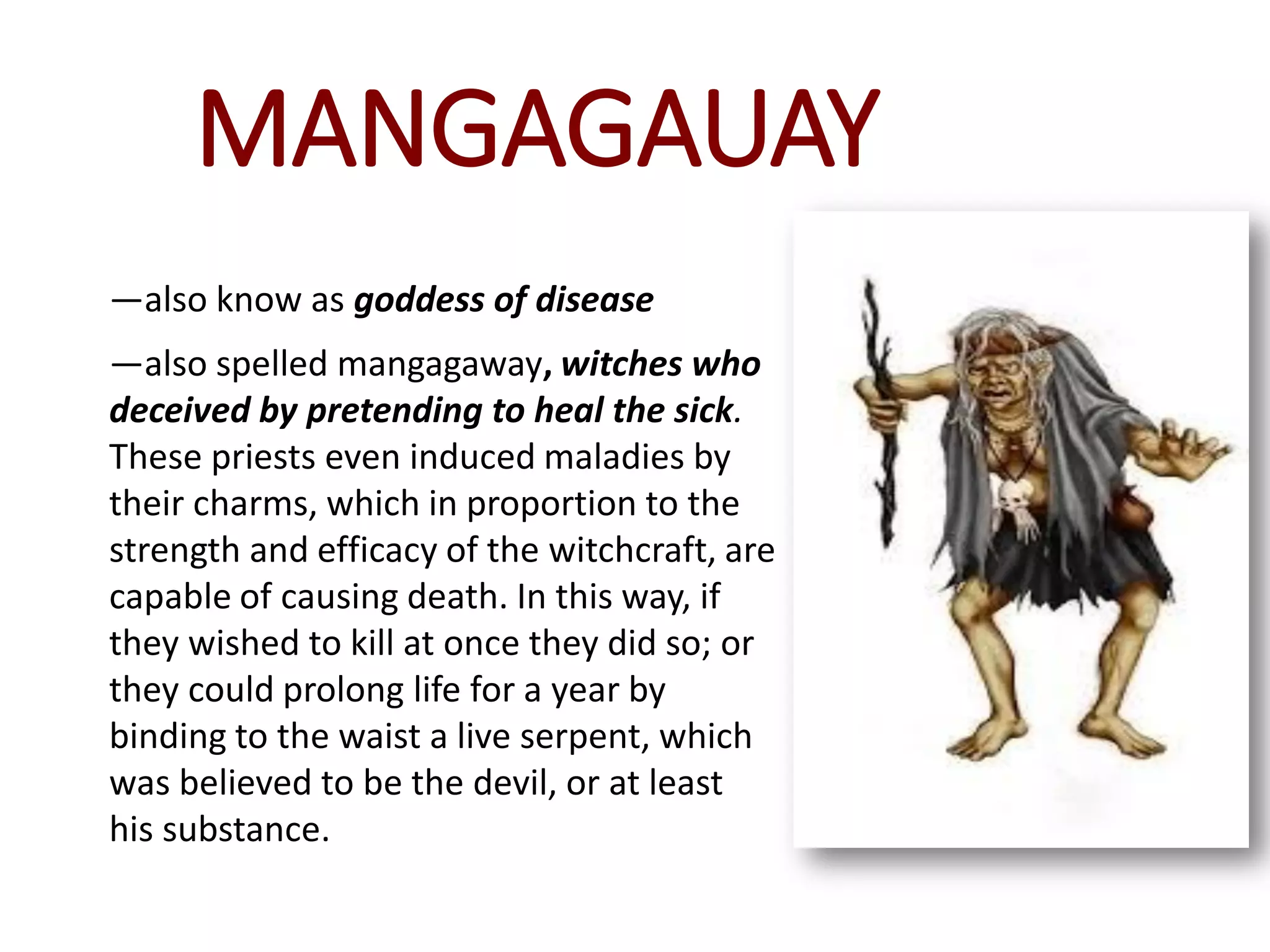
MANGAGAUAY
—also know as goddess of disease
—also spelled mangagaway, witches who
deceived by pretending to heal the sick.
These priests even induced maladies by
their charms, which in proportion to the
strength and efficacy of the witchcraft, are
capable of causing death. In this way, if
they wished to kill at once they did so; or
they could prolong life for a year by
binding to the waist a live serpent, which
was believed to be the devil, or at least
his substance.
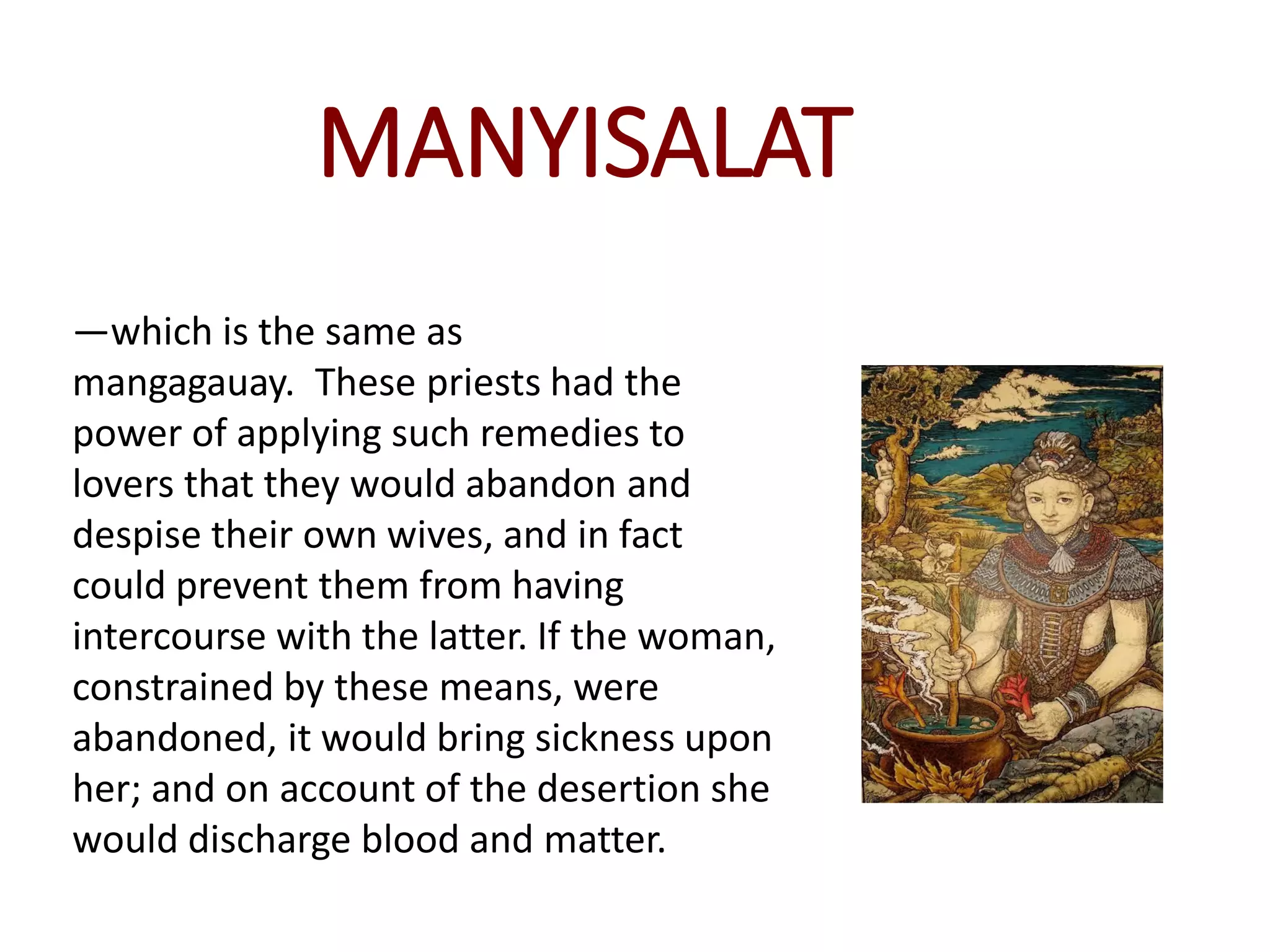
MANYISALAT
—which is the same as
mangagauay. These priests had the
power of applying such remedies to
lovers that they would abandon and
despise their own wives, and in fact
could prevent them from having
intercourse with the latter. If the woman,
constrained by these means, were
abandoned, it would bring sickness upon
her; and on account of the desertion she
would discharge blood and matter.
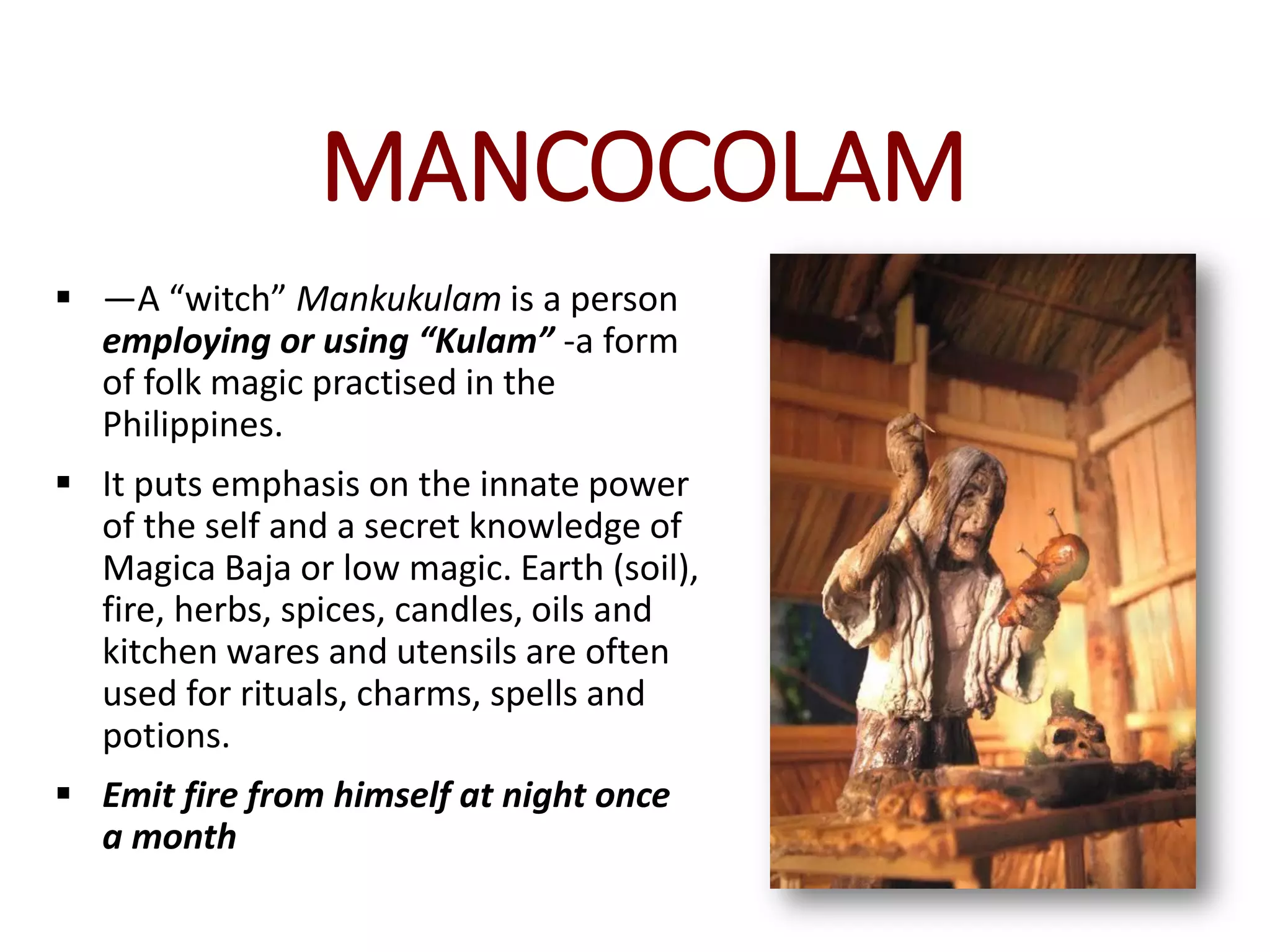
MANCOCOLAM
 —A “witch” Mankukulam is a person
employing or using “Kulam” -a form
of folk magic practised in the
Philippines.
 It puts emphasis on the innate power
of the self and a secret knowledge of
Magica Baja or low magic. Earth (soil),
fire, herbs, spices, candles, oils and
kitchen wares and utensils are often
used for rituals, charms, spells and
potions.
 Emit fire from himself at night once
a month
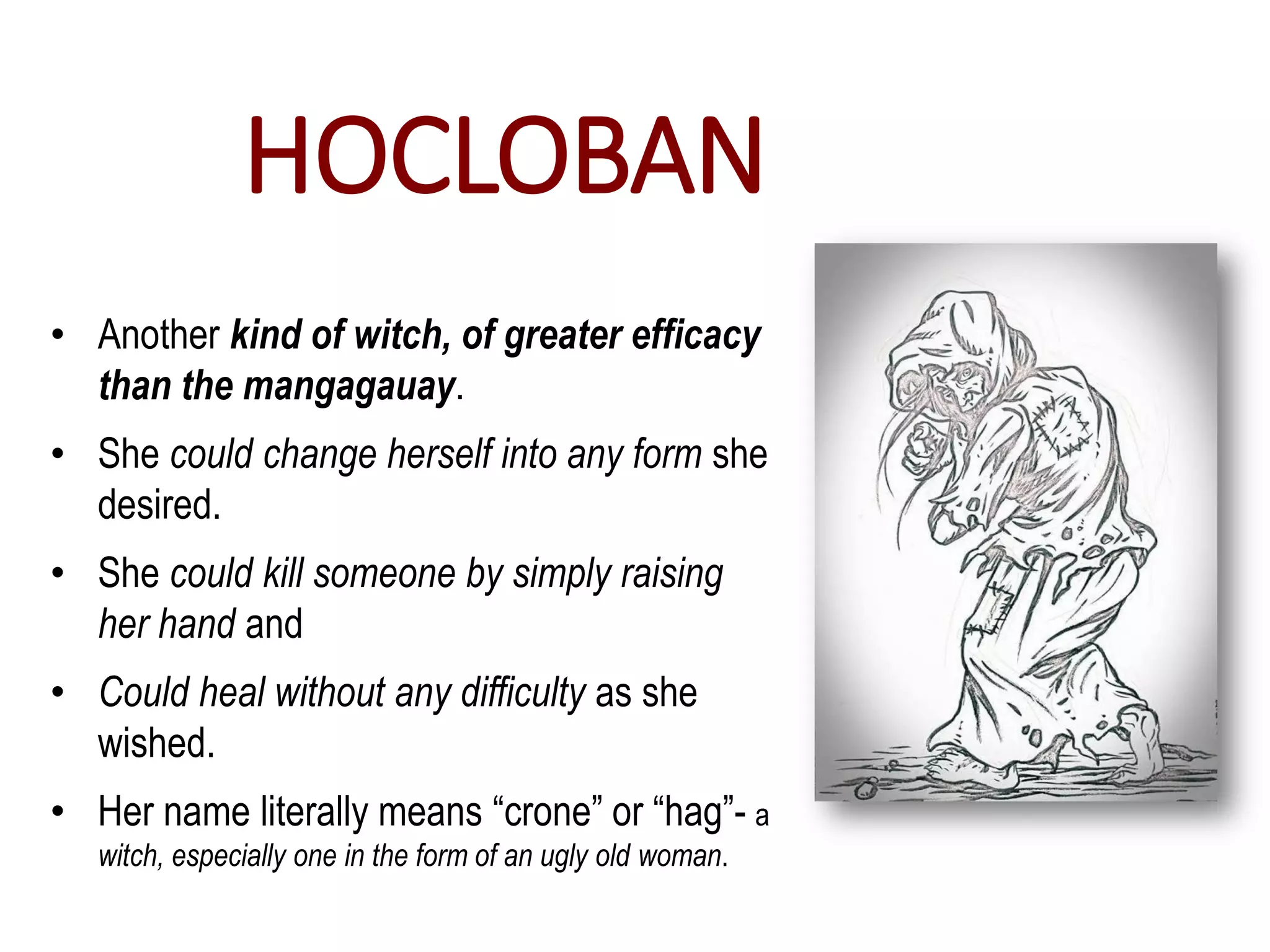
HOCLOBAN
• Another kind of witch, of greater efficacy
than the mangagauay.
• She could change herself into any form she
desired.
• She could kill someone by simply raising
her hand and
• Could heal without any difficulty as she
wished.
• Her name literally means “crone” or “hag”- a
witch, especially one in the form of an ugly old woman.
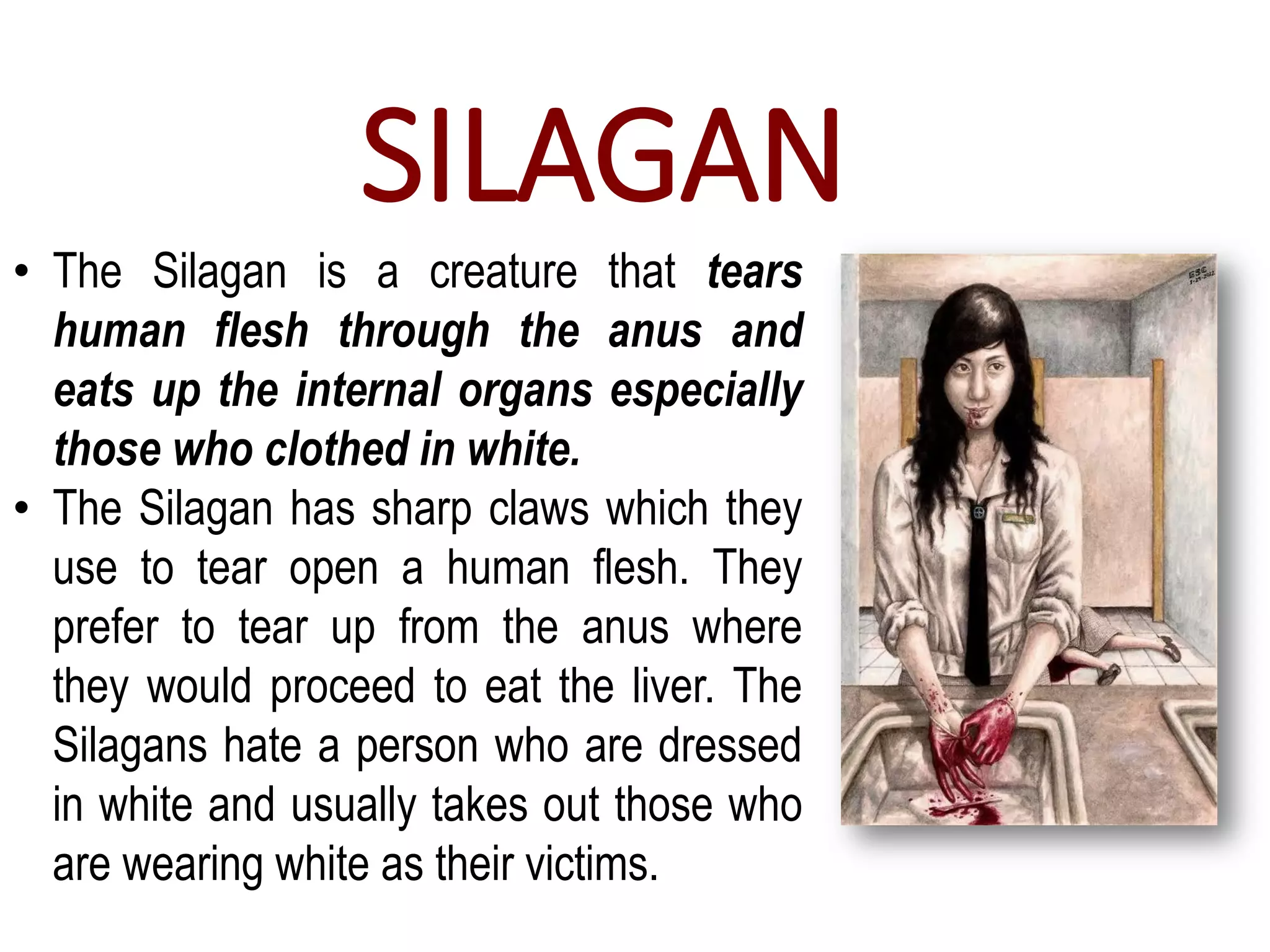
SILAGAN
• The Silagan is a creature that tears
human flesh through the anus and
eats up the internal organs especially
those who clothed in white.
• The Silagan has sharp claws which they
use to tear open a human flesh. They
prefer to tear up from the anus where
they would proceed to eat the liver. The
Silagans hate a person who are dressed
in white and usually takes out those who
are wearing white as their victims.
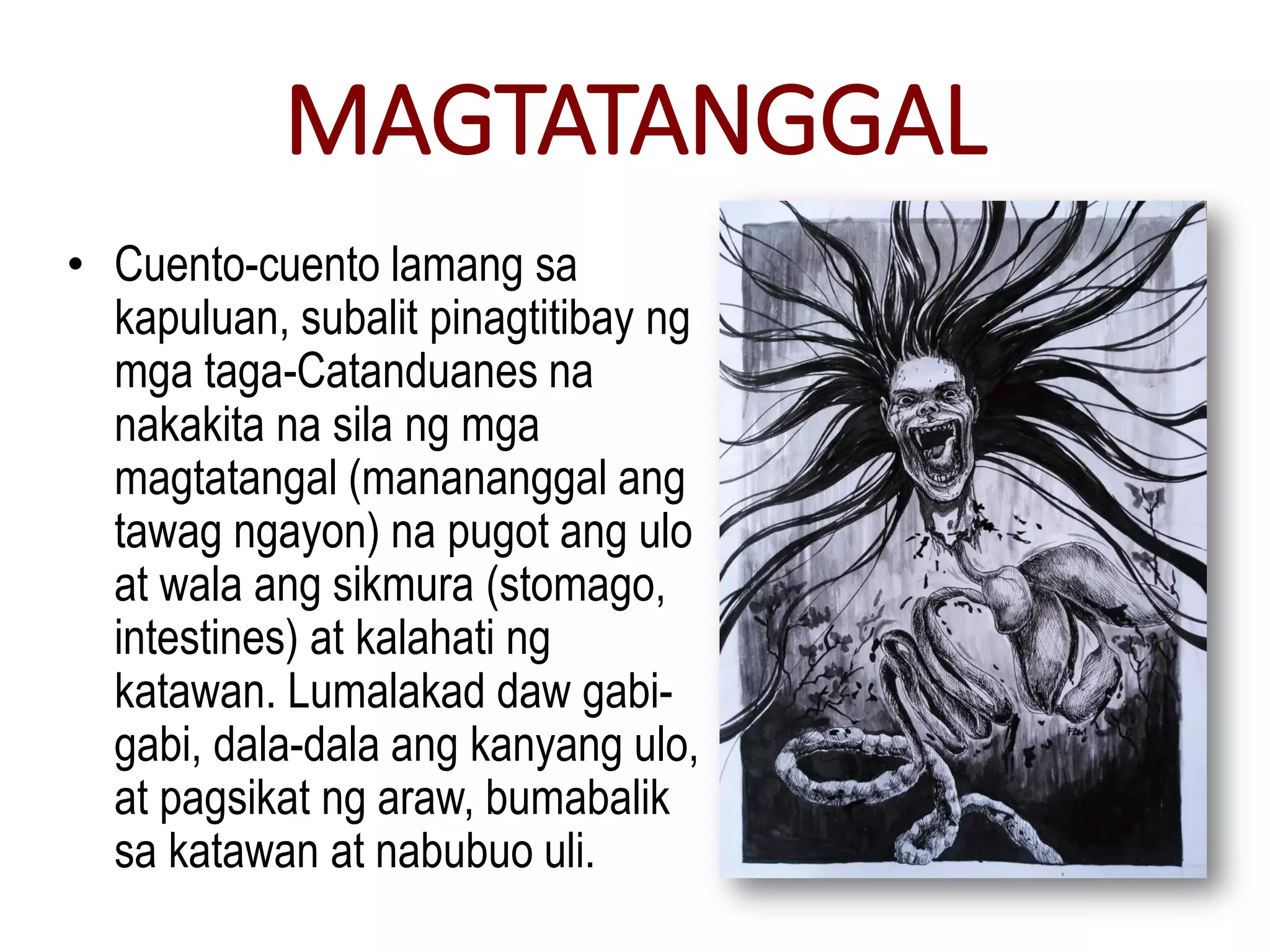
MAGTATANGGAL
• Cuento-cuento lamang sa
kapuluan, subalit pinagtitibay ng
mga taga-Catanduanes na
nakakita na sila ng mga
magtatangal (manananggal ang
tawag ngayon) na pugot ang ulo
at wala ang sikmura (stomago,
intestines) at kalahati ng
katawan. Lumalakad daw gabi-
gabi, dala-dala ang kanyang ulo,
at pagsikat ng araw, bumabalik
sa katawan at nabubuo uli.
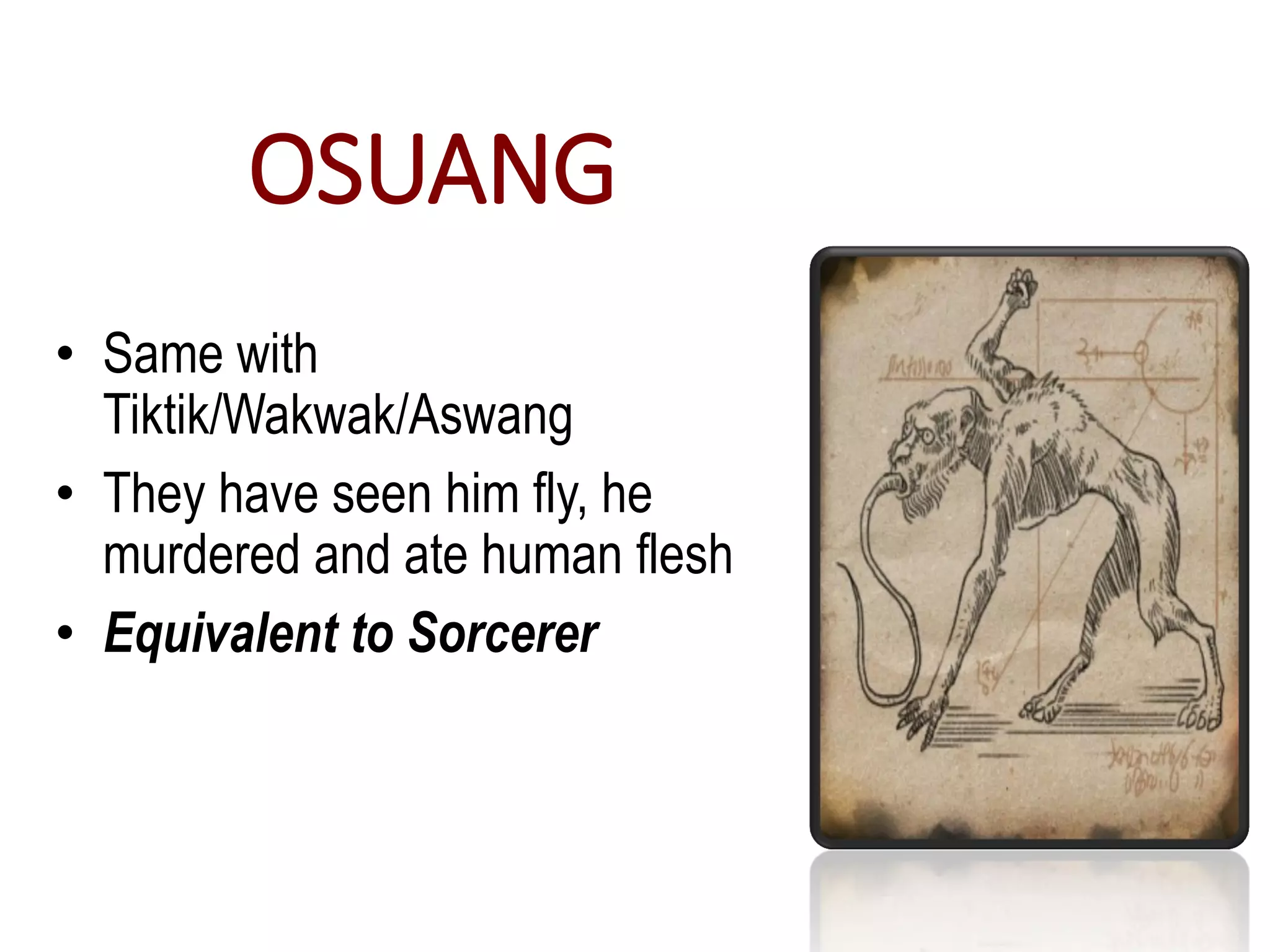
OSUANG
• Same with
Tiktik/Wakwak/Aswang
• They have seen him fly, he
murdered and ate human flesh
• Equivalent to Sorcerer
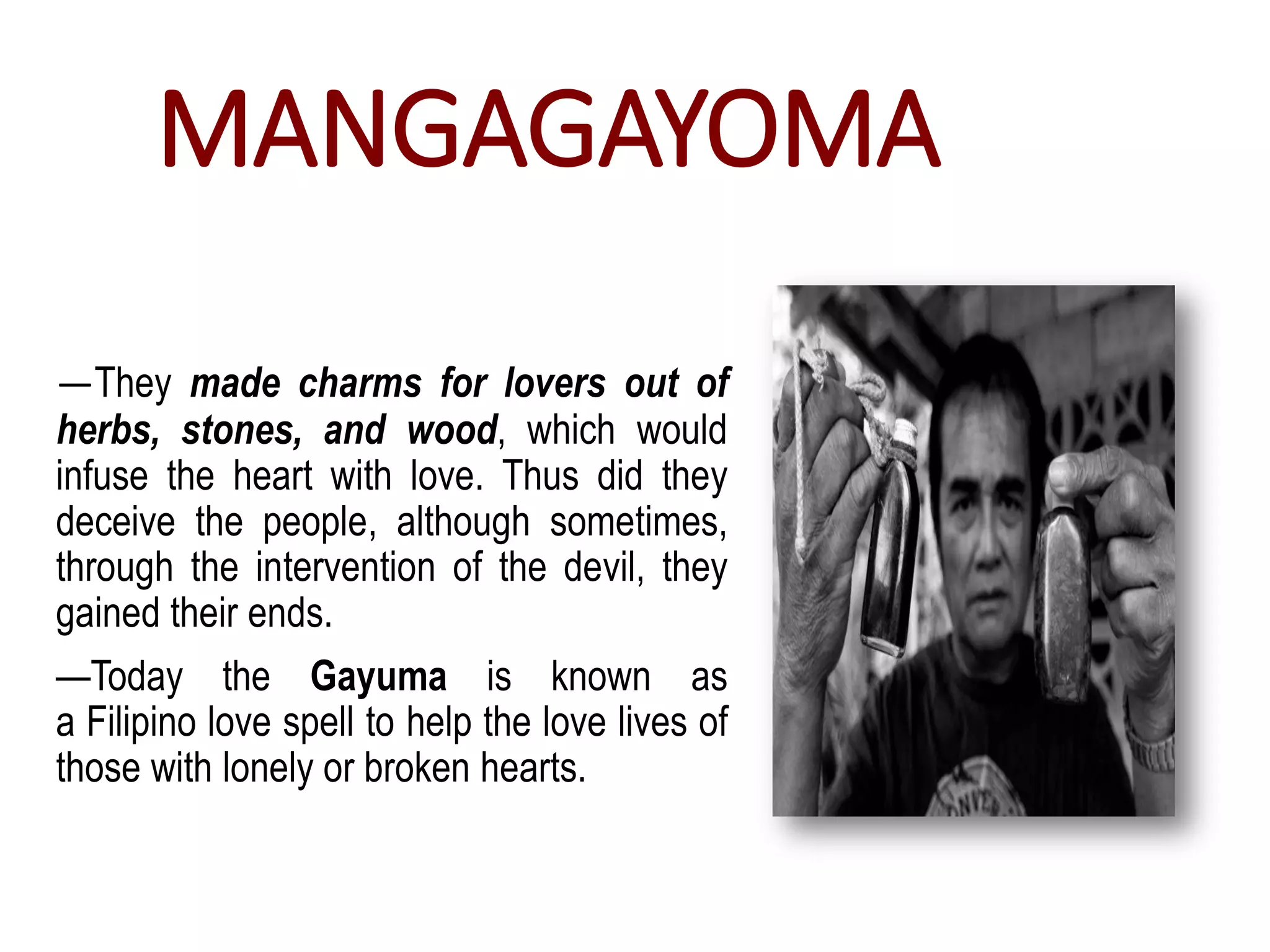
MANGAGAYOMA
—They made charms for lovers out of
herbs, stones, and wood, which would
infuse the heart with love. Thus did they
deceive the people, although sometimes,
through the intervention of the devil, they
gained their ends.
—Today the Gayuma is known as
a Filipino love spell to help the love lives of
those with lonely or broken hearts.
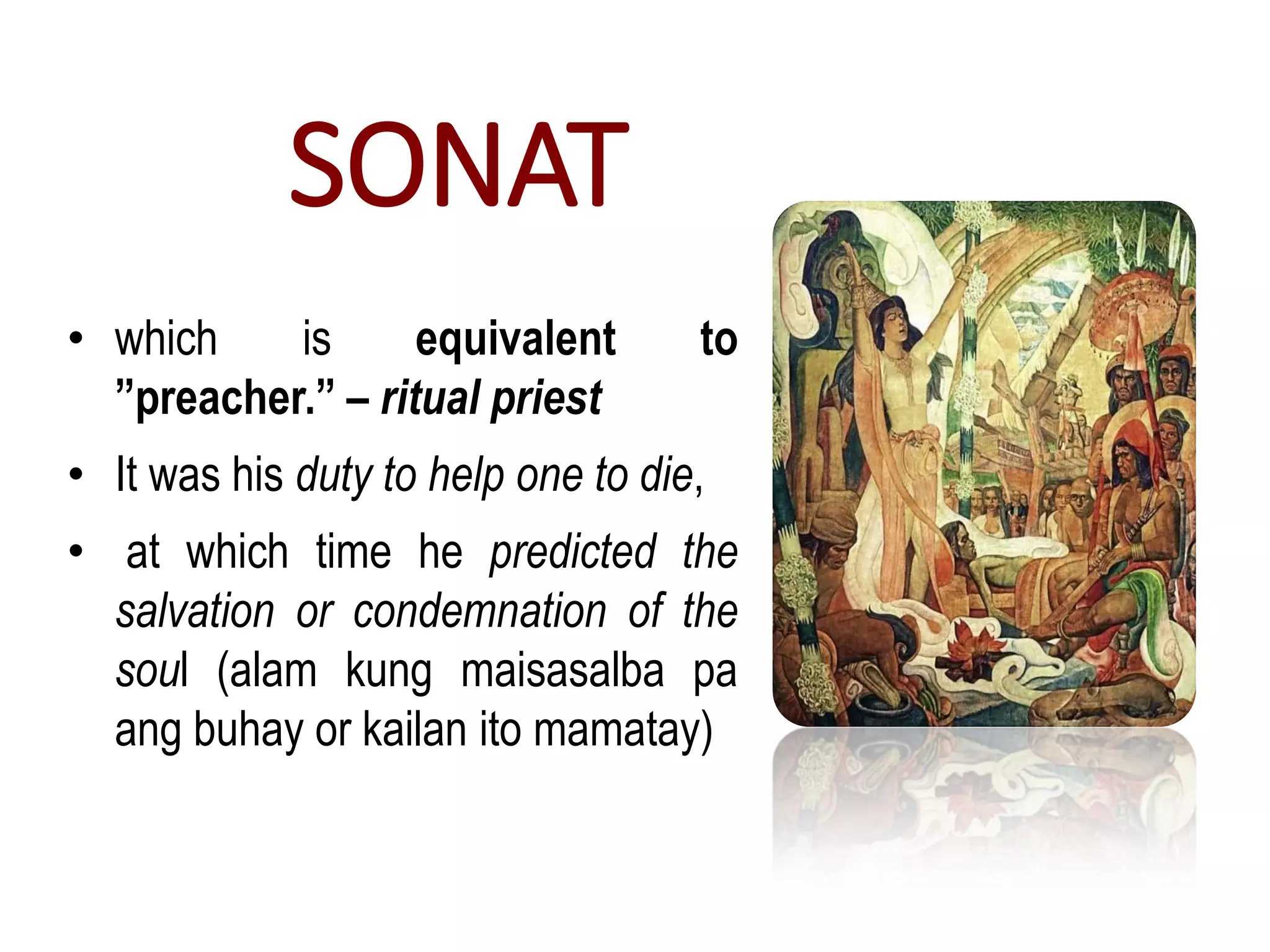
SONAT
• which is equivalent to
”preacher.” – ritual priest
• It was his duty to help one to die,
• at which time he predicted the
salvation or condemnation of the
soul (alam kung maisasalba pa
ang buhay or kailan ito mamatay)
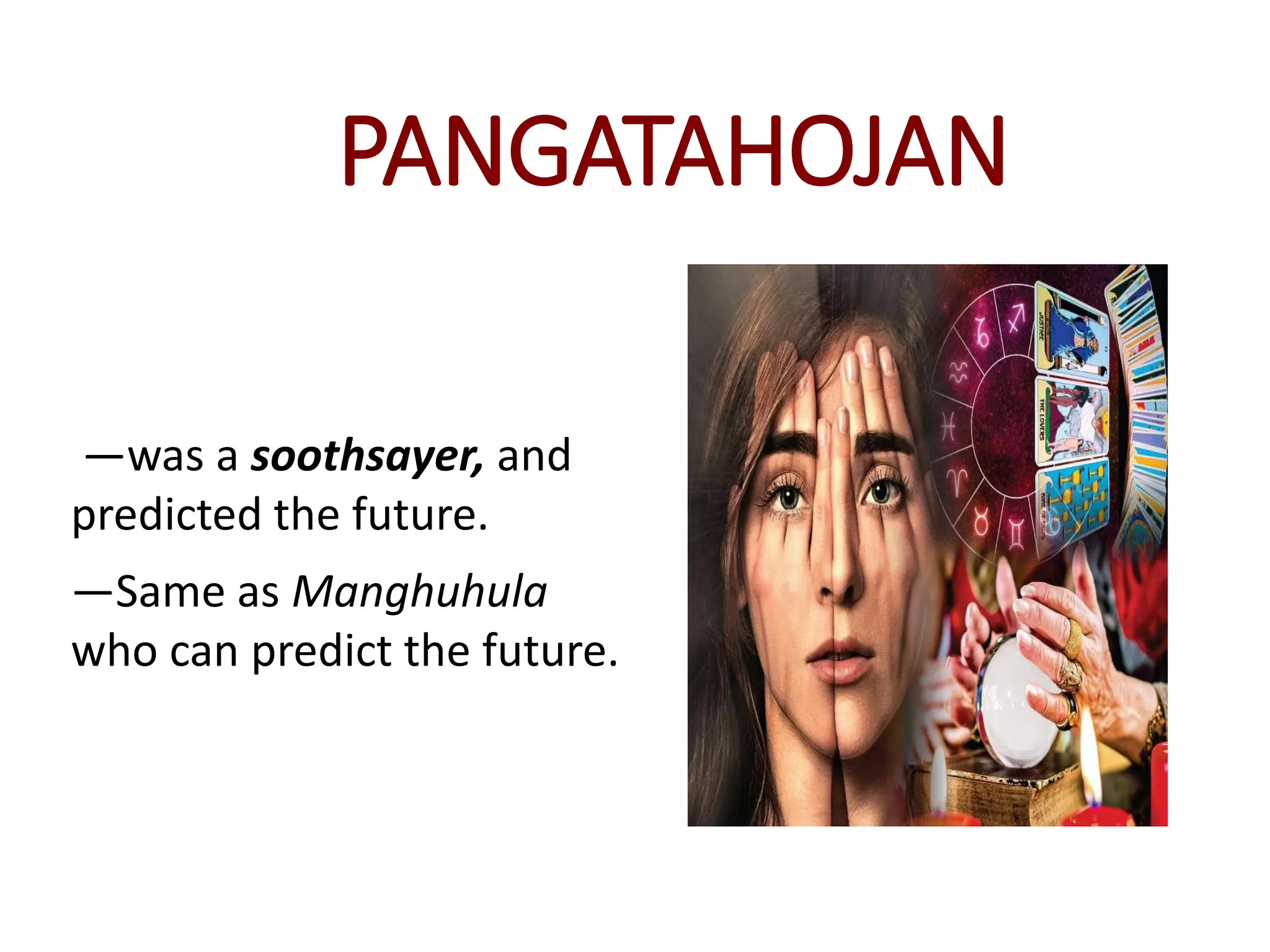
PANGATAHOJAN
—was a soothsayer, and
predicted the future.
—Same as Manghuhula
who can predict the future.
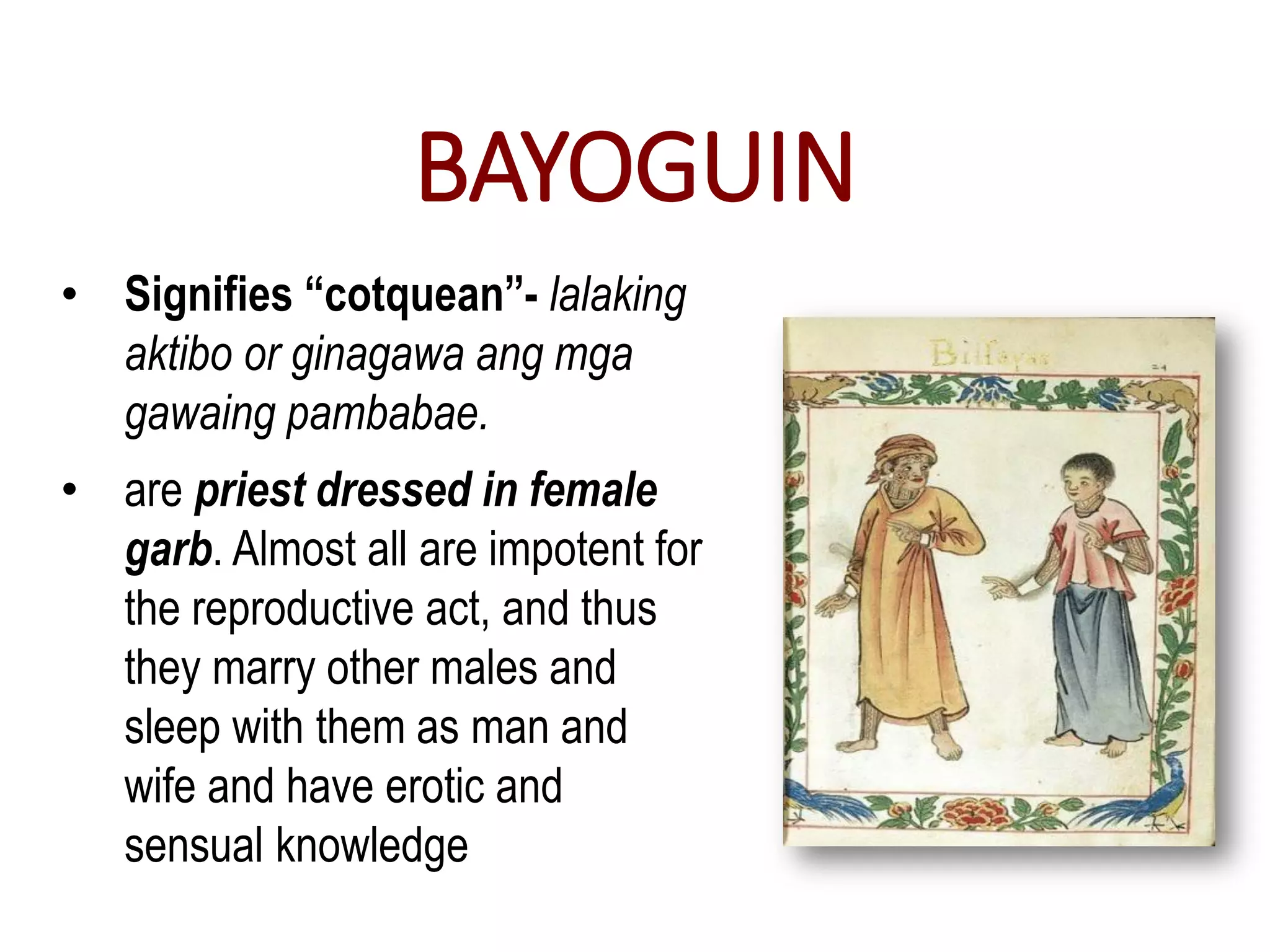
BAYOGUIN
• Signifies “cotquean”- lalaking
aktibo or ginagawa ang mga
gawaing pambabae.
• are priest dressed in female
garb. Almost all are impotent for
the reproductive act, and thus
they marry other males and
sleep with them as man and
wife and have erotic and
sensual knowledge
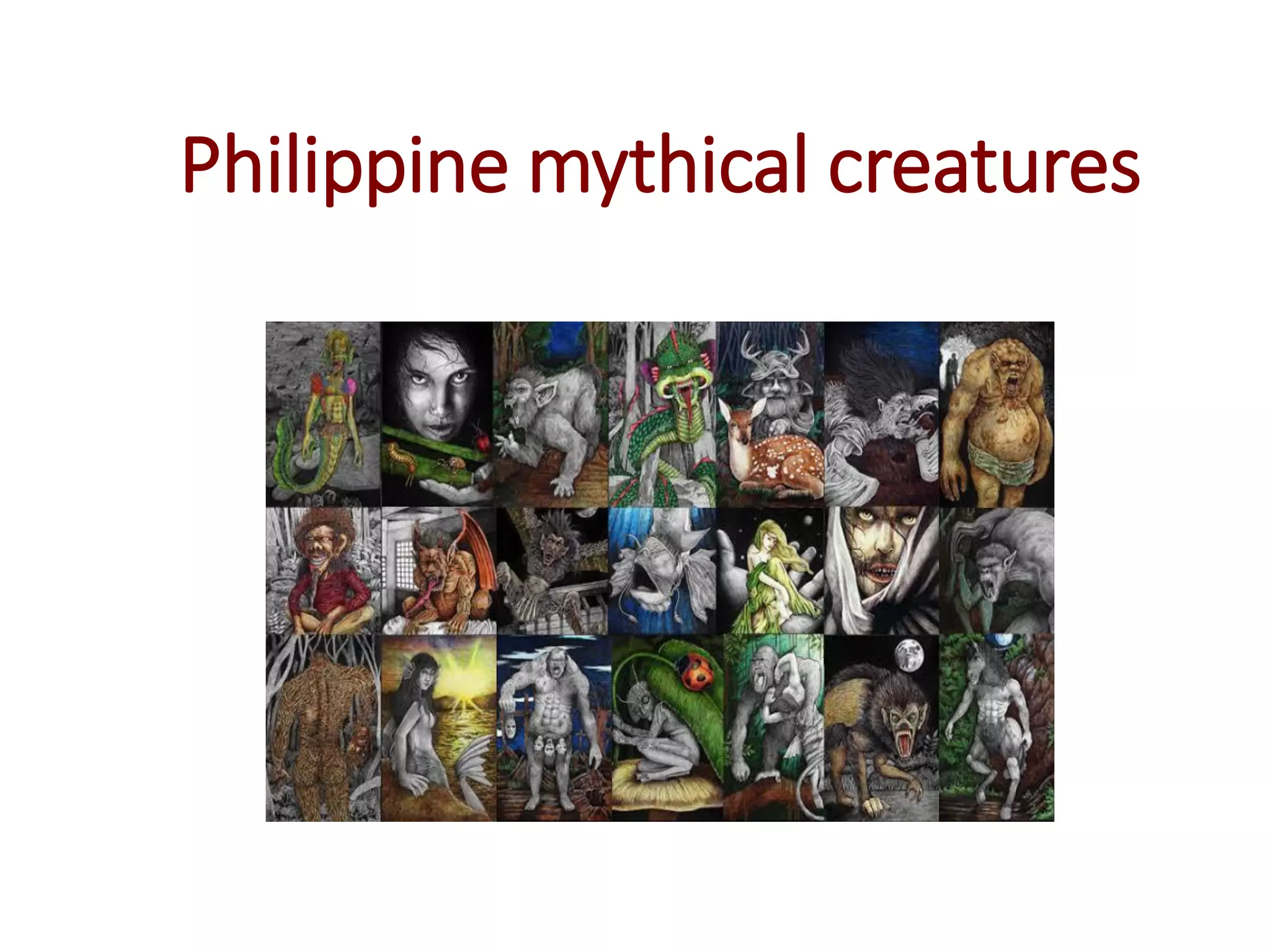
Philippine mythical creatures
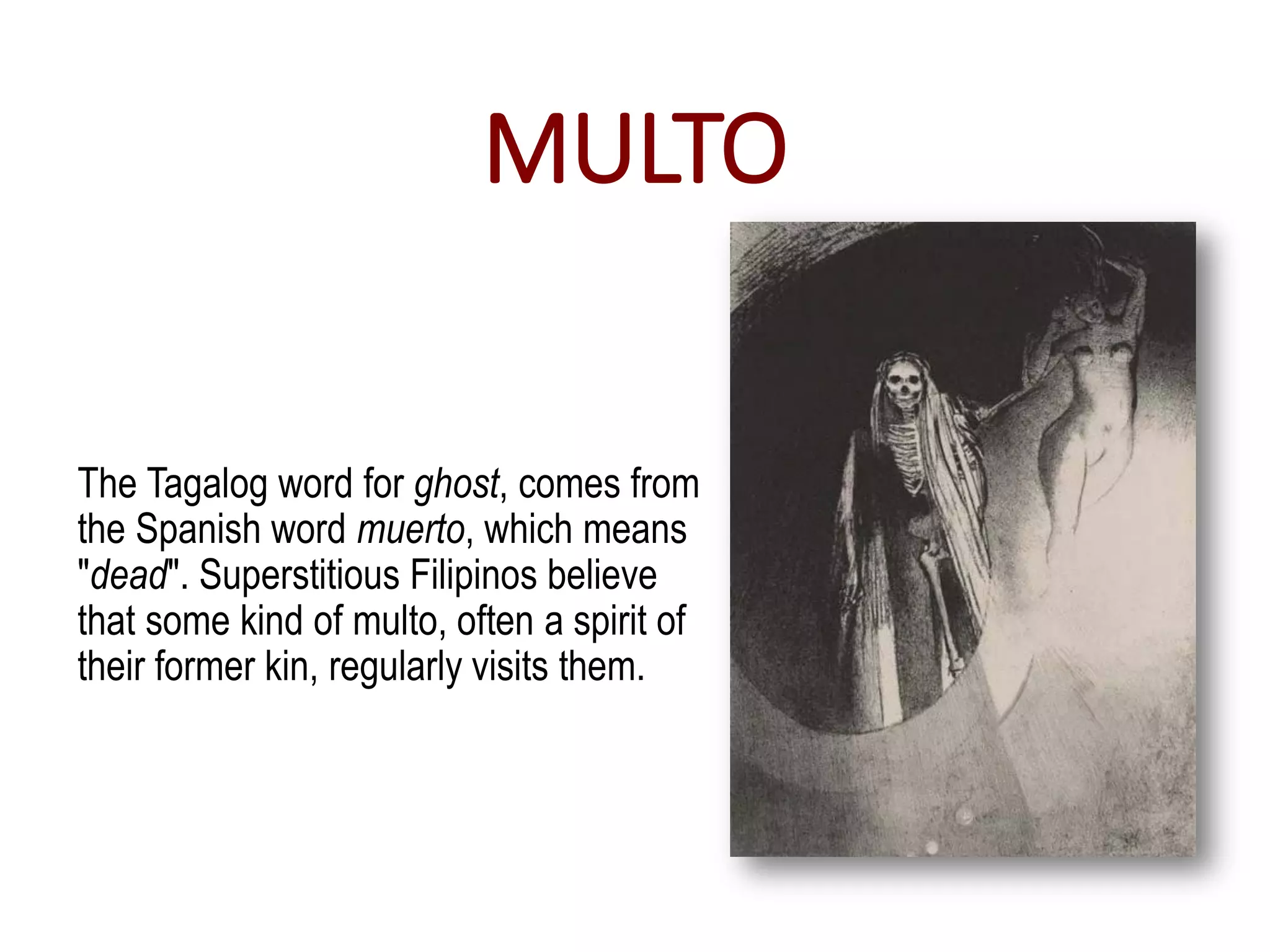
MULTO
The Tagalog word for ghost, comes from
the Spanish word muerto, which means
"dead". Superstitious Filipinos believe
that some kind of multo, often a spirit of
their former kin, regularly visits them.
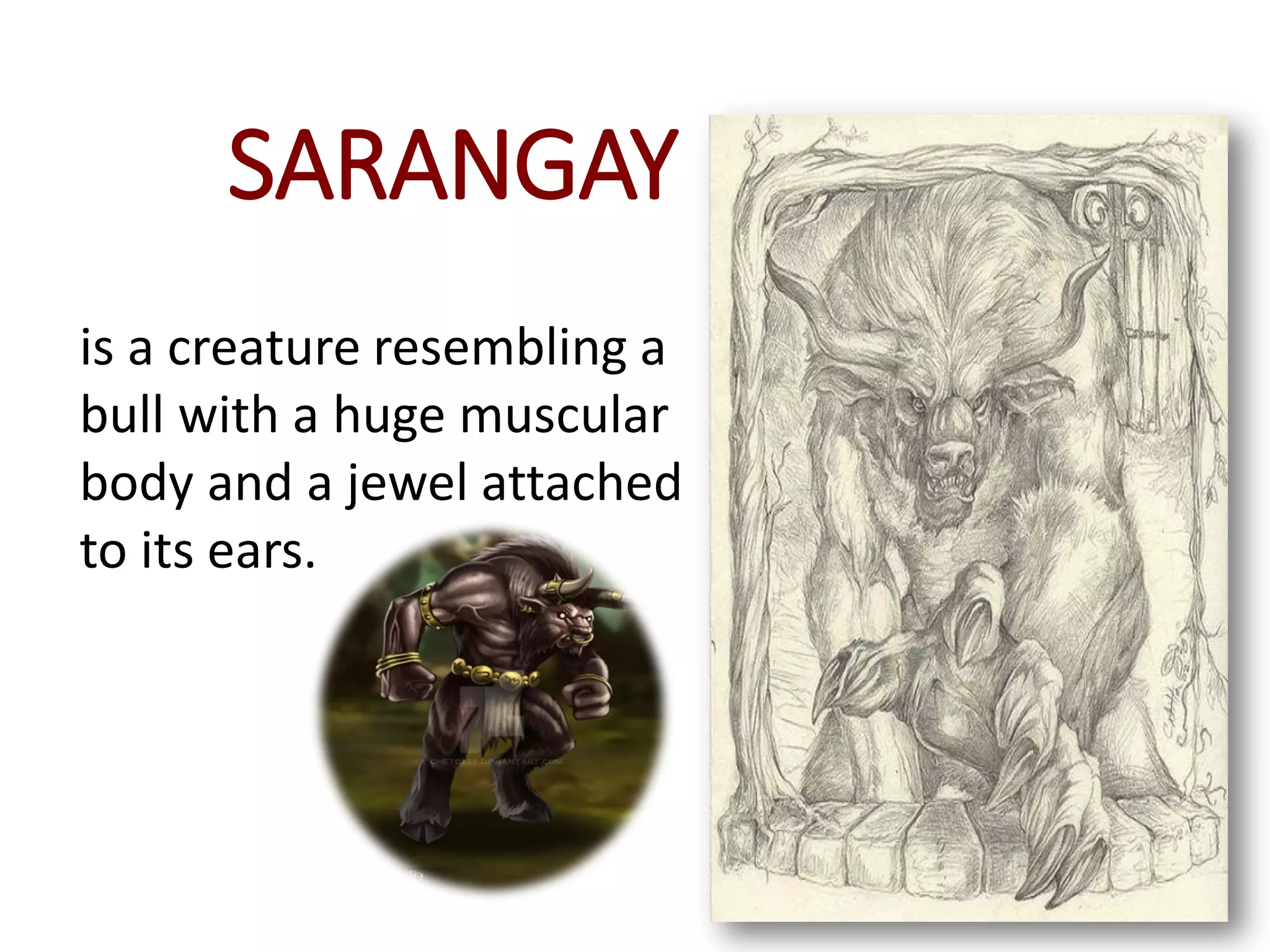
SARANGAY
is a creature resembling a
bull with a huge muscular
body and a jewel attached
to its ears.
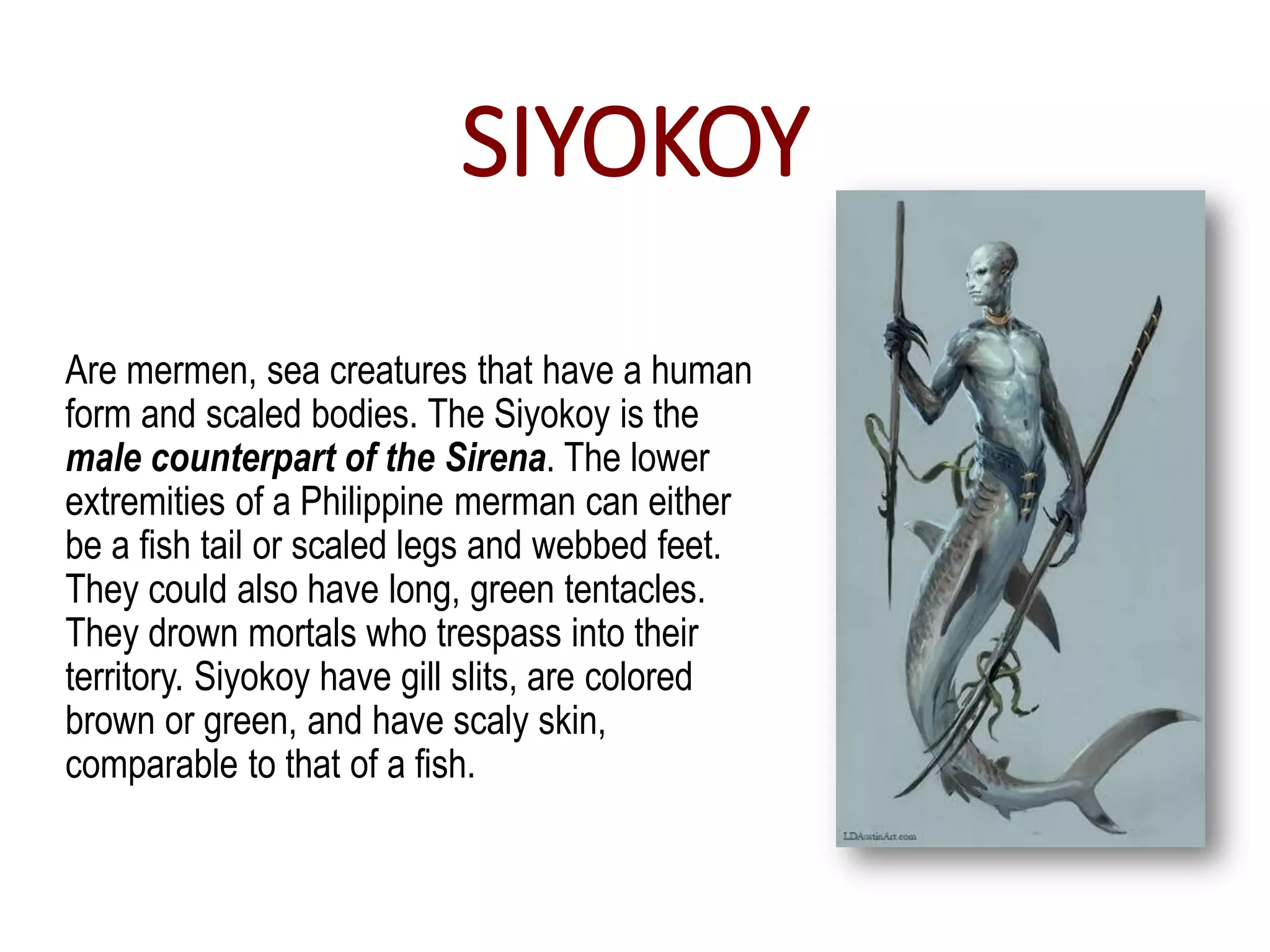
SIYOKOY
Are mermen, sea creatures that have a human
form and scaled bodies. The Siyokoy is the
male counterpart of the Sirena. The lower
extremities of a Philippine merman can either
be a fish tail or scaled legs and webbed feet.
They could also have long, green tentacles.
They drown mortals who trespass into their
territory. Siyokoy have gill slits, are colored
brown or green, and have scaly skin,
comparable to that of a fish.
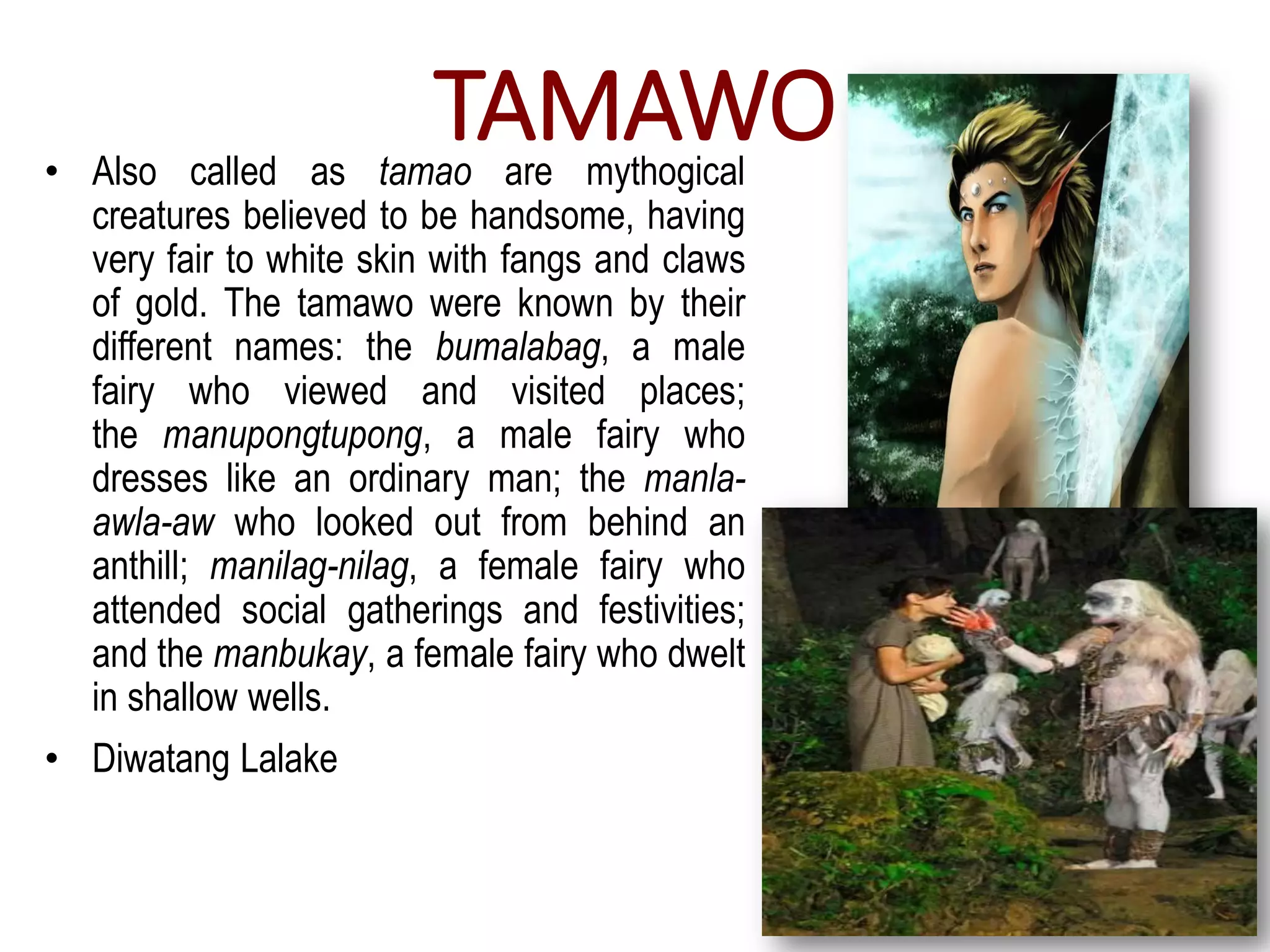
TAMAWO
• Also called as tamao are mythogical
creatures believed to be handsome, having
very fair to white skin with fangs and claws
of gold. The tamawo were known by their
different names: the bumalabag, a male
fairy who viewed and visited places;
the manupongtupong, a male fairy who
dresses like an ordinary man; the manla-
awla-aw who looked out from behind an
anthill; manilag-nilag, a female fairy who
attended social gatherings and festivities;
and the manbukay, a female fairy who dwelt
in shallow wells.
• Diwatang Lalake
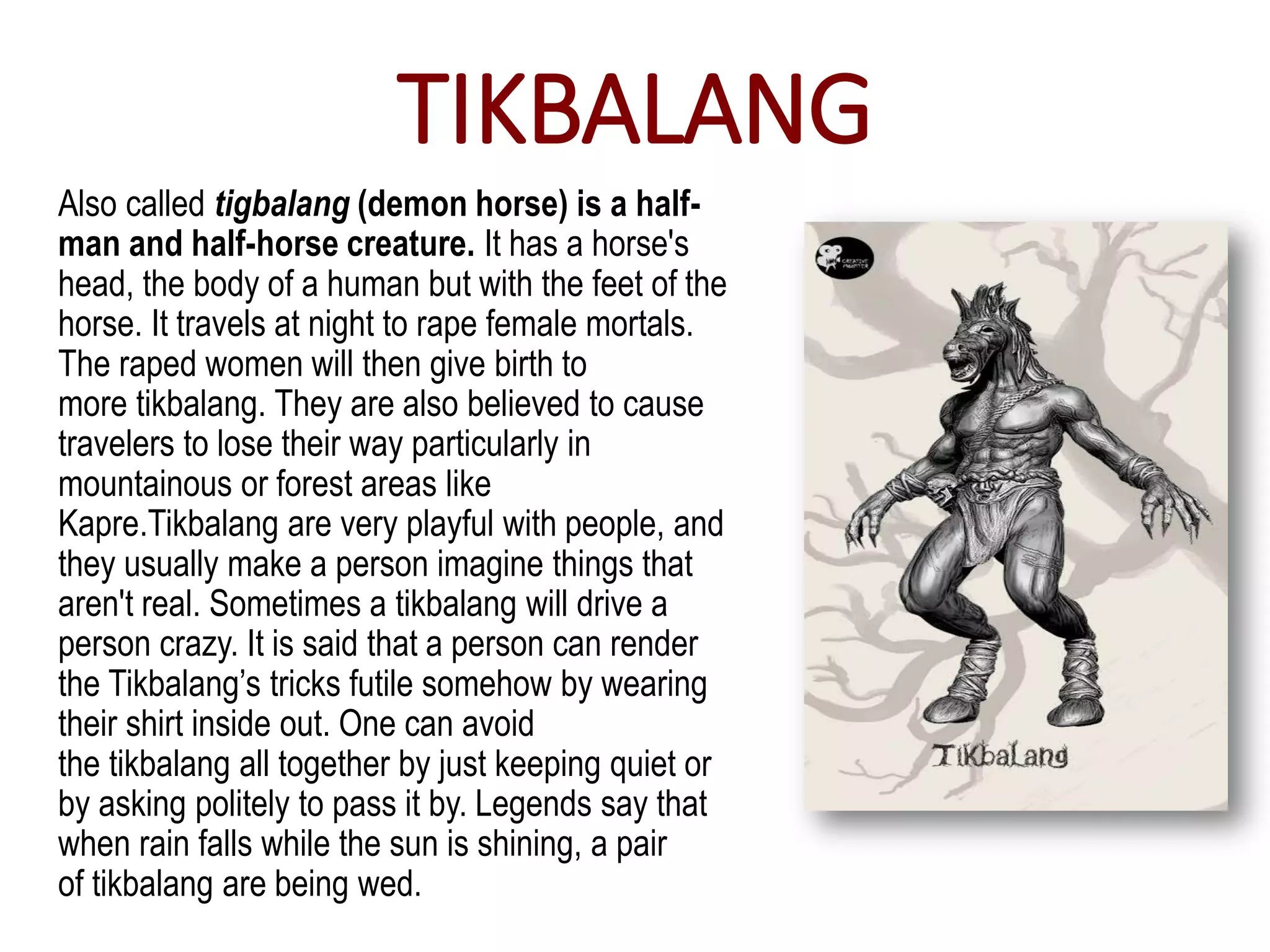
TIKBALANG
Also called tigbalang (demon horse) is a half-
man and half-horse creature. It has a horse's
head, the body of a human but with the feet of the
horse. It travels at night to rape female mortals.
The raped women will then give birth to
more tikbalang. They are also believed to cause
travelers to lose their way particularly in
mountainous or forest areas like
Kapre.Tikbalang are very playful with people, and
they usually make a person imagine things that
aren't real. Sometimes a tikbalang will drive a
person crazy. It is said that a person can render
the Tikbalang’s tricks futile somehow by wearing
their shirt inside out. One can avoid
the tikbalang all together by just keeping quiet or
by asking politely to pass it by. Legends say that
when rain falls while the sun is shining, a pair
of tikbalang are being wed.
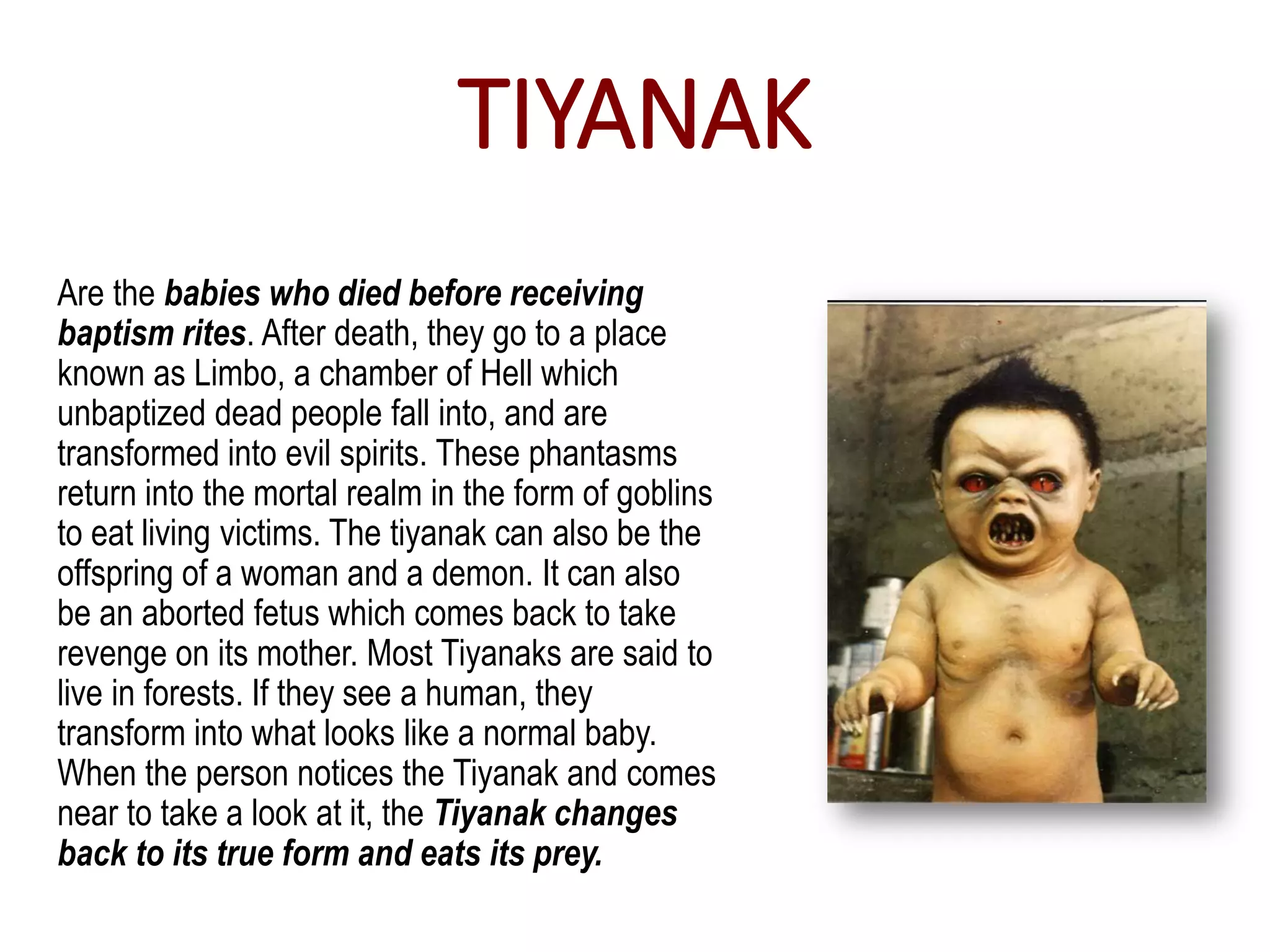
TIYANAK
Are the babies who died before receiving
baptism rites. After death, they go to a place
known as Limbo, a chamber of Hell which
unbaptized dead people fall into, and are
transformed into evil spirits. These phantasms
return into the mortal realm in the form of goblins
to eat living victims. The tiyanak can also be the
offspring of a woman and a demon. It can also
be an aborted fetus which comes back to take
revenge on its mother. Most Tiyanaks are said to
live in forests. If they see a human, they
transform into what looks like a normal baby.
When the person notices the Tiyanak and comes
near to take a look at it, the Tiyanak changes
back to its true form and eats its prey.
Economic Life
55
• Agriculture in the plane lands: planting of rice, corn,
banana, coconut, sugar canes and other kinds of
vegetable and fruits.
• Hunting in high lands.
• Fishing in river banks and sea.
• Shipbuilding, weaving, poultry, mining and lumbering.
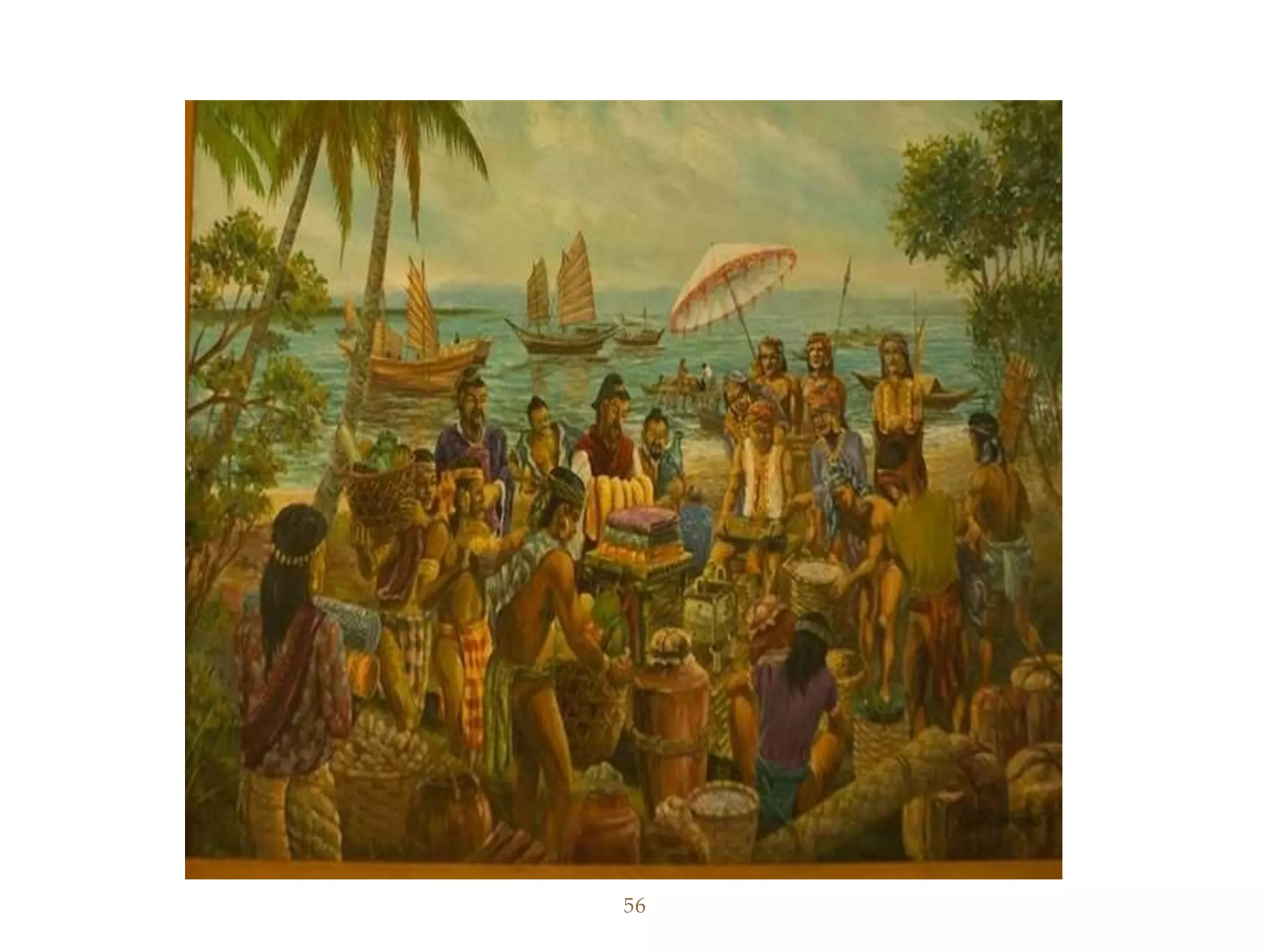
• Domestic trade of different barangays by boat.
• Foreign trade with countries like Borneo, China, Japan,
Cambodia, Java, and Thailand through barter system
(exchange (goods or services) for other goods or services
without using money)
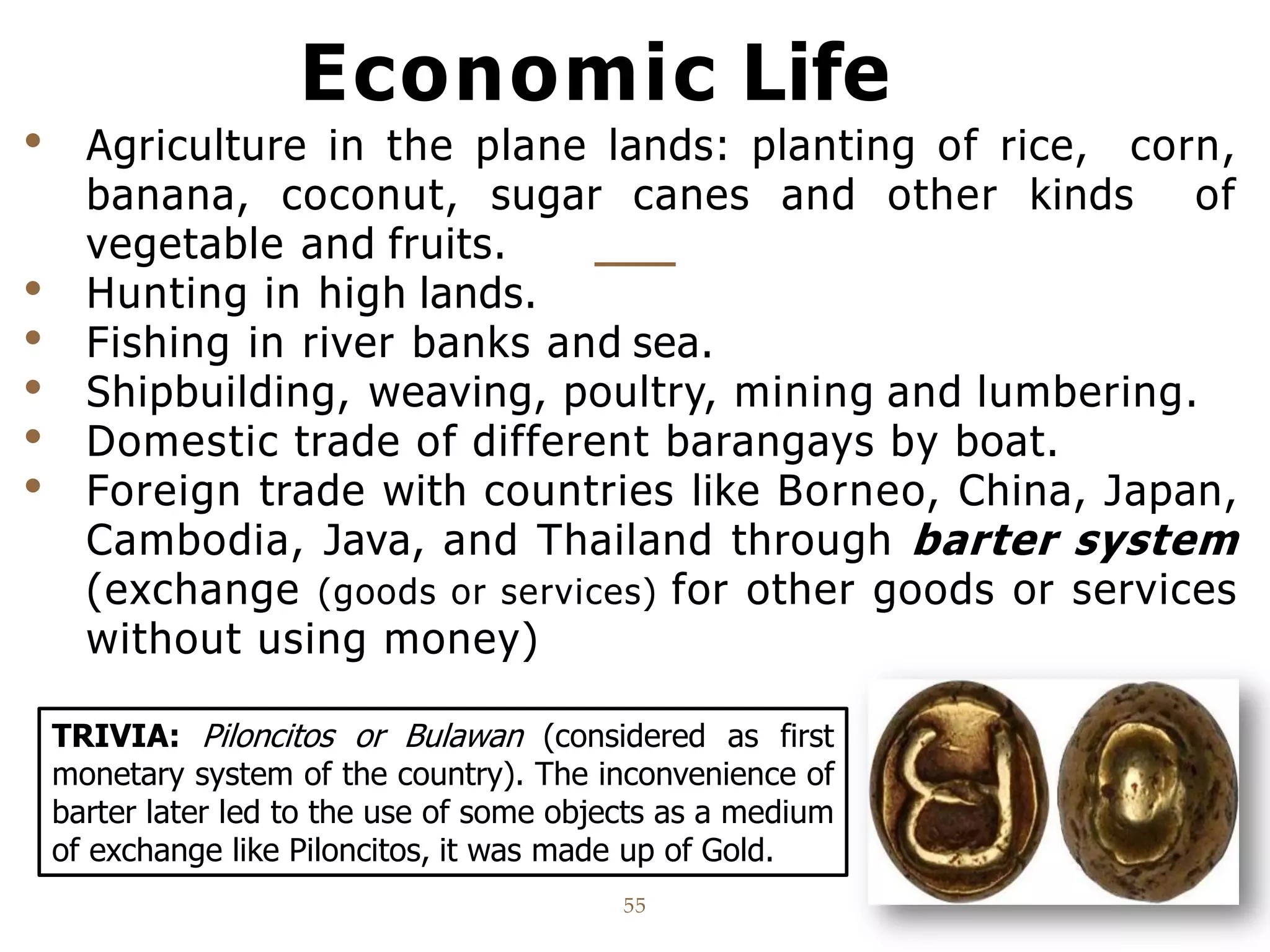
TRIVIA: Piloncitos or Bulawan (considered as first
monetary system of the country). The inconvenience of
barter later led to the use of some objects as a medium
of exchange like Piloncitos, it was made up of Gold.
56
Language and System of
Writing
57
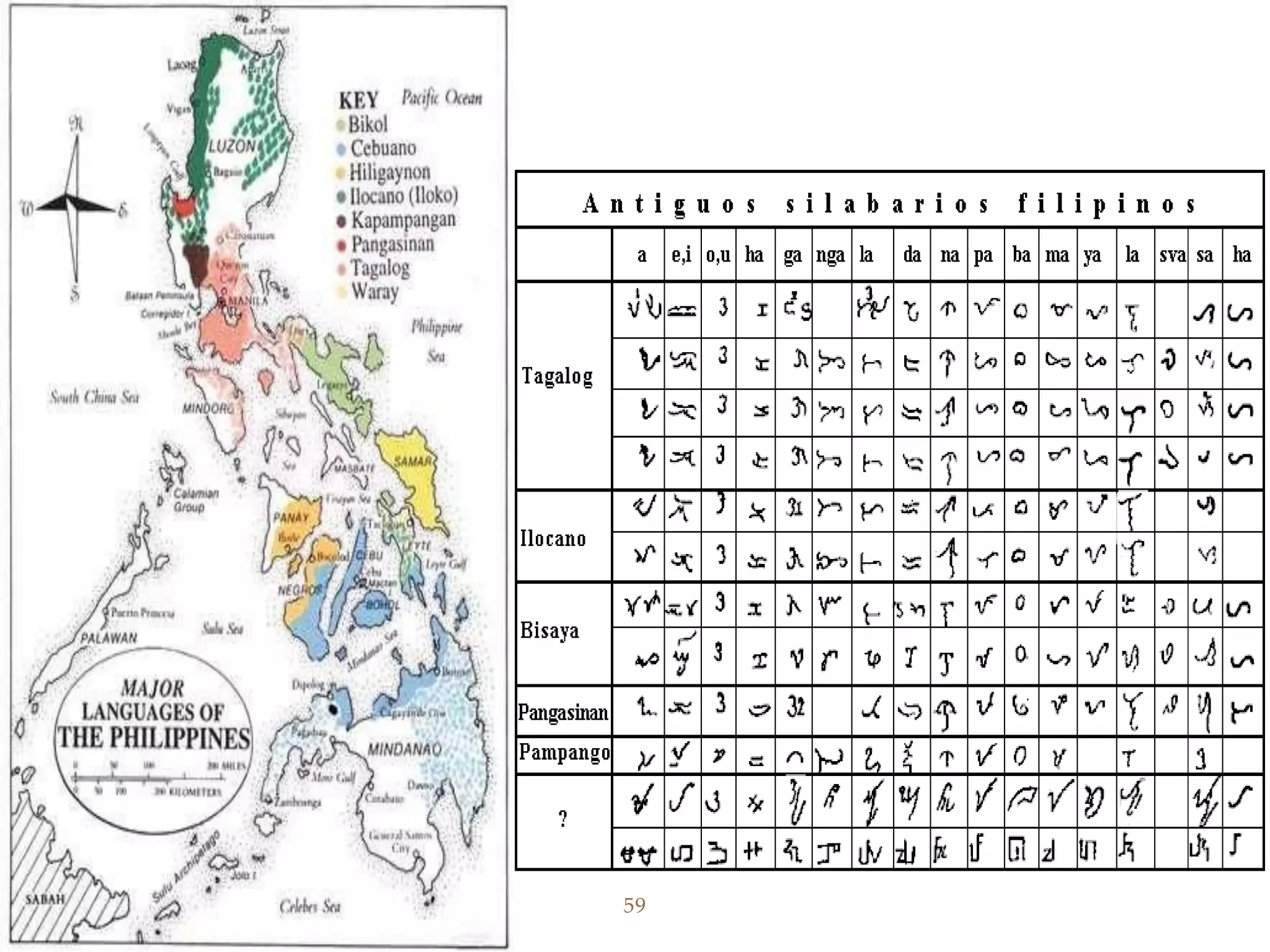
✣Major languages: Tagalog, Ilocano,
Pangasinan, Pangpangan, Sugbuhanon,
Hiligaynon, Magindanaw and Samarnon this
languages is originated from the Malayo-
Polenisian language.
✣System of writing: the alphabets consisted of 3
vowels and 14 consonants called Baybayin.
✣They used tap of tress as ink and pointed stick as
pencil.
✣They wrote on large plant leaves, bark of a tree
or bamboo tubes.
Baybayin is an old writing system that was used in the Philippines.
59
RELEVANCE/IMPORTANCE OF THE DOCUMENT
60
 Ang dokumentong ay nagbibigay katunayan na ang Pilipinas bago
pa man dumating ang mga mananakop ay mayroon na tayong
sariling sistema ng pamamahala, pamumuhay at mayaman na
kultura. Pinapasinungalingan nito ang paniniwala ng mga Kastila na
ang Pilipinas bago sila dumating ay hindi sibilisado at walang
kulturang nananalaytay sa ating mga sinaunang ninuno.
 Maaring itong gamitin sa pag-aaral ng kasaysayan lalo na kapag
Pre-Colonial Philippines ang pokus o interes kaya nga natin ito
pinag-aaralan. Maaring din itong gamitin sa Larangan ng Political
Science dahil laman nito ang pinakaunang straktura ng pulitika sa
Pilipinas and legal na sistema na ginagamit noon.
TAKE NOTE: Filipinos were already civilized and maintained an organized
lifestyle that was on par or better than that of the people from other countries
in South East Asia.

CUSTOMS-OF-THE-TAGALOGS-22-1.pdf

  • 1.
    Juan de Plasencia: LasCostumbres de los Indios Tagalos de Filipinas Presented by: Joshua Simon-Bernabe Jimenez, LPT CUSTOMS OF THE TAGALOGS
  • 2.
    WHAT TO EXPECT? 2 Examinethe context and perspective of the document Explain the relationship among the members of a barangay Discuss the religious and spiritual practices and beliefs of early Filipinos Determine the significance of the document to Philippine History
  • 3.
    BACKGROUND OF THEAUTHOR? 3 ✣ Born to the illustrious family of Portocarreros in Plasensia in the region of Extremadura, Spain in the early 16th century. He was one of the seven children of Pedro Portocarrero, a captain of a Spanish schooner. ✣ Juan de Plasencia grew up during the period known as the Siglo de Oro, a Golden Age when arts and literature flourished in many parts of Spain, among them his native Extremadura. ✣ Fray Joan de Puerto Carrero, del convento de Villanueva de la Serena. Was his real name.
  • 4.
    ARRIVAL IN THEPHILIPPINES 4 ✣ Fray Juan de Plasencia came together with the first batch of Franciscan missionaries in the Philippines. ✣ Arrived at a port in Cavite, a few kilometers south of Manila on the 2nd of July 1578. ✣ Aside from the Customs of the Tagalogs, he wrote also the Doctrina Christiana en Lengua Espanola y Tagala- first printed book in the Philippines
  • 5.
    ABOUT THE TEXT? 5 ✣Title: Relacion de las Costumbres de Los Tagalogs (Customs of the Tagalogs) ✣Currently kept in Archivo General de Indias in Seville,Spain ✣References: • OFM ARCHIVES – PHILIPPINES by: Fr. Jose "Long" D. Gutay, OFM (http://ofmphilarchives.tripod.com/id8.html) • The Philippine Islands, 1493–1898 Volume VII, 1588–1591 (Edited and annotated by Emma Helen Blair and James Alexander Robertson with historical introduction and additional notes by Edward Gaylord Bourne)
  • 6.
  • 7.
    Government ✣ The unitof government is called Barangay ruled by a chieftain, and consist of 30 to 100 families together with their relatives and slaves. 7
  • 8.
    Social Stratification System Datu/ Rajah Maharlika/Timawa ALIPIN: Namamahay/Saguiguilid RulingClass Family, relatives, elders of the Datu Common Class/Freemen Slaves /Dependents
  • 10.
    chief, captain ofwars, whom governed, obeyed and reverenced  The Datu exercised all the powers of the government  He is control over the disposition of the Barangay’s real property DATU
  • 11.
    HOW TO BECOMEDATU: 11  By inheritance By Marriage  Through intelligence, wealth, strength and bravery.
  • 12.
    Inheritance ✣ The 1stson of the barangay chieftain inherits his father’s position; if the 1st son dies, the 2nd son succeeds their father; in the absence of male heirs, it is the eldest daughter that becomes the chieftain. 12
  • 13.
    Free-born, they donot pay taxes. MAHARLIKA  Common People
  • 14.
     Common People Working Class Engaged in Agriculture TIMAGUA/TIMAWA
  • 15.
     Namamahay- hasland and property rights Sagigilid/Saguiguilid/ Saguiguilir- no land and property rights and full time slave ALIPIN/DEPENDENTS
  • 16.
    TRIVIA: Slaves (Visayan) Tumataban-worked for his master when summoned to do so Tumarampuk- worked one day for his master Ayuey- worked three days for his master
  • 17.
    Slaves ✣ A personbecomes slave by: (1) by captivity in war, (2) by reason of debt, (3) by inheritance, (4) by purchase, and (5) by committing a crime. ✣ Slaves can be emancipated through: (1) by forgiveness, (2) by paying debt, (3) by condonation, and (4) by bravery (where a slave can possibly become a Datu) or by marriage
  • 18.
    Administration of Justice 18 ✣The chieftain’s executive function includes implementing laws, ensuring order and giving protection to his subject. ✣ Disputes between individuals were settled by a court made up of the chieftain and council of elders.
  • 19.
    TRIAL BY ORDEAL 19 •Right to punish disobedience • Trial by suffering in public as their judicial process • Trial by combat
  • 20.
    TRIAL BY ORDEAL 20 •Each suspect has witnesses to defend their side. • To prove the honesty and sincerity of the of witnesses, the witnesses took an oath to this effect: • “Kainin na lang ako ng buwaya kung ako’y nagsisinungaling” • “Nawa’y tamaan na lang ako ng kidlat kung hindi ako nagsasabi ng katotohan. Kahit magalit man sa akin ang kalangitan, araw at buwan kung ako’y nagsisinungaling.” • Kahit mamatay na ako ngayon, kung ako’y nagsisinungaling.
  • 21.
     The Barangayhad both oral and written laws  Umalohokan- announcer especially on written laws
  • 22.
    How Laws weremade? 22 • If a Datu wants to enact /make a law and/or want to stop/prevent a law , he must call the council of elders for their approval since they knows what’s best for the society, they are most experienced and well off. • If there are new laws, the Umalohokan who is the public announcer was summoned and ordered to go around the barangay to announce the new rules and regulations in the society
  • 23.
    Subjects of theirCustomary Laws 23 • Inheritance(mana), divorce, usury (lending/interest), partnership, crime and punishment, property rights, family relations, adoption, and loans • Major Crimes: rape, incest(pakikipagrelasyon sa magkapamilya or magkamag-anak), murder, withcraft (gamod), insult, trespassing, sacrilegious acts (disrespect/violation of religious beliefs and practices) & Larceny (pagnanakaw)- punished by death and heavy fine • Minor Crimes: Adultery (pangangabit), cheating, petty theft, perjury (dishonesty), disturbance of peace at night, destroying documents owned by a chief- punished by exposure or ant bullets, small fine, beating, cutting fingers, swimming for a number of hours.
  • 24.
    Houses 24 ✣ Made of wood,bamboo, and nipa palm.
  • 25.
    Mode of Dressing 25 Male Headgear is called Putong (symbolizes the number of persons the wearer had killed)  (Upper) a jacket with short sleeves called kanggan.  (Lower) bahag
  • 26.
    Mode of Dressing 26 Female (Upper)Baro or Camisa (Lower) Saya
  • 27.
    Ornaments 27 o A decorativeobject or detail that adds quality or distinction to a person, place or thing. o It represents your socio-economic status in the society TRIVIA: Visayans were the most tattoed among ancient Filipinos. When the Spaniards came, they called the former as pintados. Tattooing is not for enhancing beauty only but also signifies war medals. The more tattoos a man had, the more he was looked up to in the society. TRIVIA: Bul-ol represents a spirit which the people revere in Cordillera Regions
  • 28.
    Marriage Customs 28 ✣ Menwere in general, monogamous; while their wives are called Asawa. ✣ Courtship begins with Paninilbihan: • *the man serve the girl’s parents for months or years such as chopped wood, fetched water, and did chores required of him • *In this situation, the man was not supposedly to talk with the lady, only their eyes met to show love • * If the man satisfied the parents, they will give their consent to the marriage  Prior to marriage the man requires to give a dowry: (1) Bigay- kaya ( the man will give a piece of land or gold, and dependents or slaves); (2) Panghihimuyat (a gift for the brides parents); (3) Bigay-suso (for brides wet nurse) Himaraw (another sum of money)
  • 29.
    Marriage Customs 29 ✣ Marriagebetween couples belonging to defferent social classes were not common ✣ Several grounds (dahilan) of divorce (paghihiwalay) are: (1) Adultery, (2) Abandonment (3) Cruelty, and (4) Insanity TRIVIA: Pamumulungan/Pamamalae- A courtship (pamamanhikan) right before marriage  Muslims: Panalanguni (betrothal/engagement), pedsungad (settlement of dowry), pegkawing (wedding festival/Ceremony)  Bigay-kaya/dowry consists of land, gold, or dependents
  • 30.
    BURIAL  Morotal (pagluluksasa namatay na babae)  Maglahi (pagluluksa sa namatay na lalake)  Laraw (pagluluksa sa namatay na datu)  Pasiyam (ninth day of death was celebrated) • Belief in life after death • The dead relative was placed in a wooden coffin (kabaong) and buried under the house, complete with gold, cloth and other valuable things Manunggul Jar
  • 31.
  • 32.
    Religious Belief 32 ✣They worshipmany gods and goddesses: (1)Bathala/Bathalang Maykapal, supreme being; the creator (2)Idianale & Lacapati god of agriculture; husbandry (3)Sidarapa/Sidapa, god of death; (4) Agni, god of fire; (5)Balangaw,god of rainbow (6) Mandarangan, god of war; (7) Lalahon, god of harvest; and (8) Siginarugan, god of hell. (9) Dian Masalanta, patron of lovers and generations (10)Buaya (water-lizards), they paid reverence/devotion ✣ Also believe in sacred animals, trees and many more which believed to be holy and place of unseen spirits (animism) TRIVIA: • Bathala (Tagalog) • Abba (Cebuano) • Laon (Bisaya)
  • 33.
    Religious Belief 33  Believedin the immortality of the soul and life after death  Disease or illness was cause by the environmental spirits and the soul-spirits of the dead relatives  The Filipinos adored the sun, moon, animals, birds for they are objects of nature to be respected • The Filipinos adored idols called Anito (Tagalog) and Diwata (Visayan). Offerings are officiated by ritual leaders , Babaylana/Babaylan (Tagalogs) at Katalona/Katalonan (Visayans).
  • 34.
    Superstitious Beliefs 34 ✣Believe inAswang, Dwende, Kapre, Tikbalang, Patyanak/Tiyanak. ✣They also believe in magical power of amulet and charms such as anting-anting, kulam and gayuma or love potion.
  • 35.
    PRIEST AND PRIESTESSOf Good and the Devil 35 • They are those rituals leaders and those who have unique and unusual power or magic : *Catalonan *Mangangauay *Manyisalat *Mancocolam *Hocloban *Silagan *Magtatanggal *Osuang *Mangagayoma *Sonat *Pangatahojan *Bayoguin
  • 36.
    CATOLONAN • was eithera man or a woman, (also spelled Catalonan, Catalona, Catulunan in Kapampangan) is a priest in the indigenous religions of the Tagalog and Kapampangan people. • Spanish friars and missionaries also called them anitero (male) and anitera (female). They guarded the dambana, along with religious practices, of a community called barangay • a ritual leader na mayroong mataas na ranggo at katayuan sa lipunan)
  • 37.
    MANGAGAUAY —also know asgoddess of disease —also spelled mangagaway, witches who deceived by pretending to heal the sick. These priests even induced maladies by their charms, which in proportion to the strength and efficacy of the witchcraft, are capable of causing death. In this way, if they wished to kill at once they did so; or they could prolong life for a year by binding to the waist a live serpent, which was believed to be the devil, or at least his substance.
  • 38.
    MANYISALAT —which is thesame as mangagauay. These priests had the power of applying such remedies to lovers that they would abandon and despise their own wives, and in fact could prevent them from having intercourse with the latter. If the woman, constrained by these means, were abandoned, it would bring sickness upon her; and on account of the desertion she would discharge blood and matter.
  • 39.
    MANCOCOLAM  —A “witch”Mankukulam is a person employing or using “Kulam” -a form of folk magic practised in the Philippines.  It puts emphasis on the innate power of the self and a secret knowledge of Magica Baja or low magic. Earth (soil), fire, herbs, spices, candles, oils and kitchen wares and utensils are often used for rituals, charms, spells and potions.  Emit fire from himself at night once a month
  • 40.
    HOCLOBAN • Another kindof witch, of greater efficacy than the mangagauay. • She could change herself into any form she desired. • She could kill someone by simply raising her hand and • Could heal without any difficulty as she wished. • Her name literally means “crone” or “hag”- a witch, especially one in the form of an ugly old woman.
  • 41.
    SILAGAN • The Silaganis a creature that tears human flesh through the anus and eats up the internal organs especially those who clothed in white. • The Silagan has sharp claws which they use to tear open a human flesh. They prefer to tear up from the anus where they would proceed to eat the liver. The Silagans hate a person who are dressed in white and usually takes out those who are wearing white as their victims.
  • 42.
    MAGTATANGGAL • Cuento-cuento lamangsa kapuluan, subalit pinagtitibay ng mga taga-Catanduanes na nakakita na sila ng mga magtatangal (manananggal ang tawag ngayon) na pugot ang ulo at wala ang sikmura (stomago, intestines) at kalahati ng katawan. Lumalakad daw gabi- gabi, dala-dala ang kanyang ulo, at pagsikat ng araw, bumabalik sa katawan at nabubuo uli.
  • 43.
    OSUANG • Same with Tiktik/Wakwak/Aswang •They have seen him fly, he murdered and ate human flesh • Equivalent to Sorcerer
  • 44.
    MANGAGAYOMA —They made charmsfor lovers out of herbs, stones, and wood, which would infuse the heart with love. Thus did they deceive the people, although sometimes, through the intervention of the devil, they gained their ends. —Today the Gayuma is known as a Filipino love spell to help the love lives of those with lonely or broken hearts.
  • 45.
    SONAT • which isequivalent to ”preacher.” – ritual priest • It was his duty to help one to die, • at which time he predicted the salvation or condemnation of the soul (alam kung maisasalba pa ang buhay or kailan ito mamatay)
  • 46.
    PANGATAHOJAN —was a soothsayer,and predicted the future. —Same as Manghuhula who can predict the future.
  • 47.
    BAYOGUIN • Signifies “cotquean”-lalaking aktibo or ginagawa ang mga gawaing pambabae. • are priest dressed in female garb. Almost all are impotent for the reproductive act, and thus they marry other males and sleep with them as man and wife and have erotic and sensual knowledge
  • 48.
  • 49.
    MULTO The Tagalog wordfor ghost, comes from the Spanish word muerto, which means "dead". Superstitious Filipinos believe that some kind of multo, often a spirit of their former kin, regularly visits them.
  • 50.
    SARANGAY is a creatureresembling a bull with a huge muscular body and a jewel attached to its ears.
  • 51.
    SIYOKOY Are mermen, seacreatures that have a human form and scaled bodies. The Siyokoy is the male counterpart of the Sirena. The lower extremities of a Philippine merman can either be a fish tail or scaled legs and webbed feet. They could also have long, green tentacles. They drown mortals who trespass into their territory. Siyokoy have gill slits, are colored brown or green, and have scaly skin, comparable to that of a fish.
  • 52.
    TAMAWO • Also calledas tamao are mythogical creatures believed to be handsome, having very fair to white skin with fangs and claws of gold. The tamawo were known by their different names: the bumalabag, a male fairy who viewed and visited places; the manupongtupong, a male fairy who dresses like an ordinary man; the manla- awla-aw who looked out from behind an anthill; manilag-nilag, a female fairy who attended social gatherings and festivities; and the manbukay, a female fairy who dwelt in shallow wells. • Diwatang Lalake
  • 53.
    TIKBALANG Also called tigbalang(demon horse) is a half- man and half-horse creature. It has a horse's head, the body of a human but with the feet of the horse. It travels at night to rape female mortals. The raped women will then give birth to more tikbalang. They are also believed to cause travelers to lose their way particularly in mountainous or forest areas like Kapre.Tikbalang are very playful with people, and they usually make a person imagine things that aren't real. Sometimes a tikbalang will drive a person crazy. It is said that a person can render the Tikbalang’s tricks futile somehow by wearing their shirt inside out. One can avoid the tikbalang all together by just keeping quiet or by asking politely to pass it by. Legends say that when rain falls while the sun is shining, a pair of tikbalang are being wed.
  • 54.
    TIYANAK Are the babieswho died before receiving baptism rites. After death, they go to a place known as Limbo, a chamber of Hell which unbaptized dead people fall into, and are transformed into evil spirits. These phantasms return into the mortal realm in the form of goblins to eat living victims. The tiyanak can also be the offspring of a woman and a demon. It can also be an aborted fetus which comes back to take revenge on its mother. Most Tiyanaks are said to live in forests. If they see a human, they transform into what looks like a normal baby. When the person notices the Tiyanak and comes near to take a look at it, the Tiyanak changes back to its true form and eats its prey.
  • 55.
    Economic Life 55 • Agriculturein the plane lands: planting of rice, corn, banana, coconut, sugar canes and other kinds of vegetable and fruits. • Hunting in high lands. • Fishing in river banks and sea. • Shipbuilding, weaving, poultry, mining and lumbering. • Domestic trade of different barangays by boat. • Foreign trade with countries like Borneo, China, Japan, Cambodia, Java, and Thailand through barter system (exchange (goods or services) for other goods or services without using money) TRIVIA: Piloncitos or Bulawan (considered as first monetary system of the country). The inconvenience of barter later led to the use of some objects as a medium of exchange like Piloncitos, it was made up of Gold.
  • 56.
  • 57.
    Language and Systemof Writing 57 ✣Major languages: Tagalog, Ilocano, Pangasinan, Pangpangan, Sugbuhanon, Hiligaynon, Magindanaw and Samarnon this languages is originated from the Malayo- Polenisian language. ✣System of writing: the alphabets consisted of 3 vowels and 14 consonants called Baybayin. ✣They used tap of tress as ink and pointed stick as pencil. ✣They wrote on large plant leaves, bark of a tree or bamboo tubes.
  • 58.
    Baybayin is anold writing system that was used in the Philippines.
  • 59.
  • 60.
    RELEVANCE/IMPORTANCE OF THEDOCUMENT 60  Ang dokumentong ay nagbibigay katunayan na ang Pilipinas bago pa man dumating ang mga mananakop ay mayroon na tayong sariling sistema ng pamamahala, pamumuhay at mayaman na kultura. Pinapasinungalingan nito ang paniniwala ng mga Kastila na ang Pilipinas bago sila dumating ay hindi sibilisado at walang kulturang nananalaytay sa ating mga sinaunang ninuno.  Maaring itong gamitin sa pag-aaral ng kasaysayan lalo na kapag Pre-Colonial Philippines ang pokus o interes kaya nga natin ito pinag-aaralan. Maaring din itong gamitin sa Larangan ng Political Science dahil laman nito ang pinakaunang straktura ng pulitika sa Pilipinas and legal na sistema na ginagamit noon. TAKE NOTE: Filipinos were already civilized and maintained an organized lifestyle that was on par or better than that of the people from other countries in South East Asia.