
CUSTOMS AND PRACTICES
PRE-COLONIAL
PHILLIPINES
CUSTOMS AND PRACTICES
Philippine Wedding Customs and Superstitions
- Brides shouldn’t try on her wedding dress before the wedding day
or the wedding will not push through
- Knives and other sharp and pointed objects are said to be a bad
choice for wedding gifts for this will lead to a broken marriage.
- Giving arinola (chamberpot) as wedding gift is believed to bring
good luck to newlyweds.
- Altar-bound couples are accident-prone and therefore must avoid
long drives or traveling before their wedding day for safety.
- Dropping the wedding ring, the veil or the arrhae during the
ceremony spells unhappiness for the couple.
Barangay
• Before the arrival of the Spanish colonizers in the Philippines in the
16th century, the Barangays were well-organized independent
villages - and in some cases, cosmopolitan sovereign principalities,
which functioned much like a city-state. The Barangay was the
dominant organizational pattern among indigenous communities in
the Philippine archipelago. The name barangay originated from
balangay, a Malay word meaning "sailboat
• Historically, the first barangays started as relatively small
communities of around 50 to 100 families. Most villages have only
thirty to one hundred houses and the population varies from one
hundred to five hundred persons. When the Spaniards came, they
found communities with twenty to thirty people only. They also
encountered large and prestigious principalities.
Harana
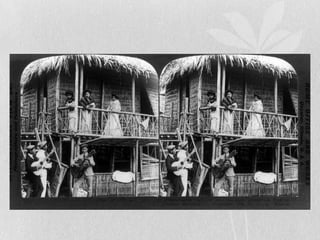
• The Harana first gained popularity in the early part of the Spanish
occupation of the Philipines. It's influence comes from folk Music of
Spain and the Mariachi sounds of Mexico. It is a traditional form of
courtship music in which a man woos a woman by singing
underneath her window at night. It is (was) widely practiced in
many parts of the Philippines with a set of protocols, a code of
conduct, and a specific style of music. Harana itself uses mainly
Hispanic protocols in music, although its origins lie in the old pre-
colonial Philippine musical styles which still practiced around the
country. The main instrument used for Harana is the Guitar, played
by the courter, although other string instruments such as the
Ukulele and less frequently, the Violin and Trumpets are also used.
PRE- COLONIAL CLOTHING AND FASHION

Pre colonial phillipines

  • 1.
  • 2.
  • 3.
    Philippine Wedding Customsand Superstitions - Brides shouldn’t try on her wedding dress before the wedding day or the wedding will not push through - Knives and other sharp and pointed objects are said to be a bad choice for wedding gifts for this will lead to a broken marriage. - Giving arinola (chamberpot) as wedding gift is believed to bring good luck to newlyweds. - Altar-bound couples are accident-prone and therefore must avoid long drives or traveling before their wedding day for safety. - Dropping the wedding ring, the veil or the arrhae during the ceremony spells unhappiness for the couple.
  • 5.
    Barangay • Before thearrival of the Spanish colonizers in the Philippines in the 16th century, the Barangays were well-organized independent villages - and in some cases, cosmopolitan sovereign principalities, which functioned much like a city-state. The Barangay was the dominant organizational pattern among indigenous communities in the Philippine archipelago. The name barangay originated from balangay, a Malay word meaning "sailboat • Historically, the first barangays started as relatively small communities of around 50 to 100 families. Most villages have only thirty to one hundred houses and the population varies from one hundred to five hundred persons. When the Spaniards came, they found communities with twenty to thirty people only. They also encountered large and prestigious principalities.
  • 7.
    Harana • The Haranafirst gained popularity in the early part of the Spanish occupation of the Philipines. It's influence comes from folk Music of Spain and the Mariachi sounds of Mexico. It is a traditional form of courtship music in which a man woos a woman by singing underneath her window at night. It is (was) widely practiced in many parts of the Philippines with a set of protocols, a code of conduct, and a specific style of music. Harana itself uses mainly Hispanic protocols in music, although its origins lie in the old pre- colonial Philippine musical styles which still practiced around the country. The main instrument used for Harana is the Guitar, played by the courter, although other string instruments such as the Ukulele and less frequently, the Violin and Trumpets are also used.
  • 9.