Pre term labour
DEFINITION
 Preterm labour is defined as one where the labour
starts before the 37th
completed weeks counting from
the first day of the last menstrual period
INCIDENCE
 5 – 10%
ETIOLOGY
HISTORY
Abortion
Bacteriuria or recurrent UTI
Smocking
Low socio-economic and nutritional status
COMPLICATIONS IN THE PRESENT
PREGNANCY
 Maternal
 Pregnancy complications
• Pre eclampsia
• APH
• PROM
• Polyhydramnios
 Uterine anomalies
• Cervical incompetence
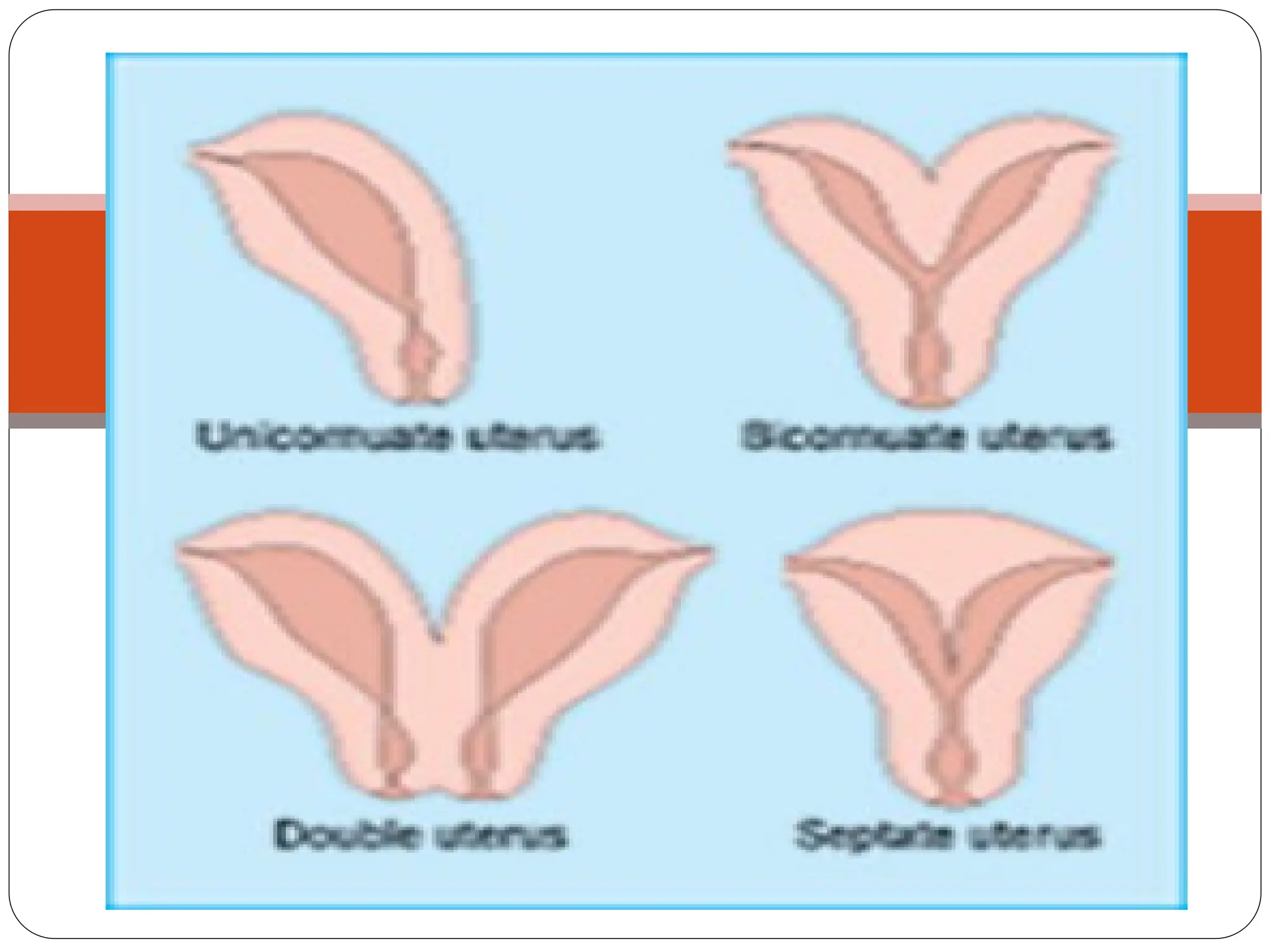
• Malformations of the uterus
Contd...
 Medical and surgical illness
• Acute fever
• Acute pyelonephritis
• Diarrhoea
• Acute appendicitis
• Toxoplasmosis
• Abdominal operations
 Genital tract infection
• Bacterial vaginosis
• Chlamydia
• Mycoplasma
Contd…
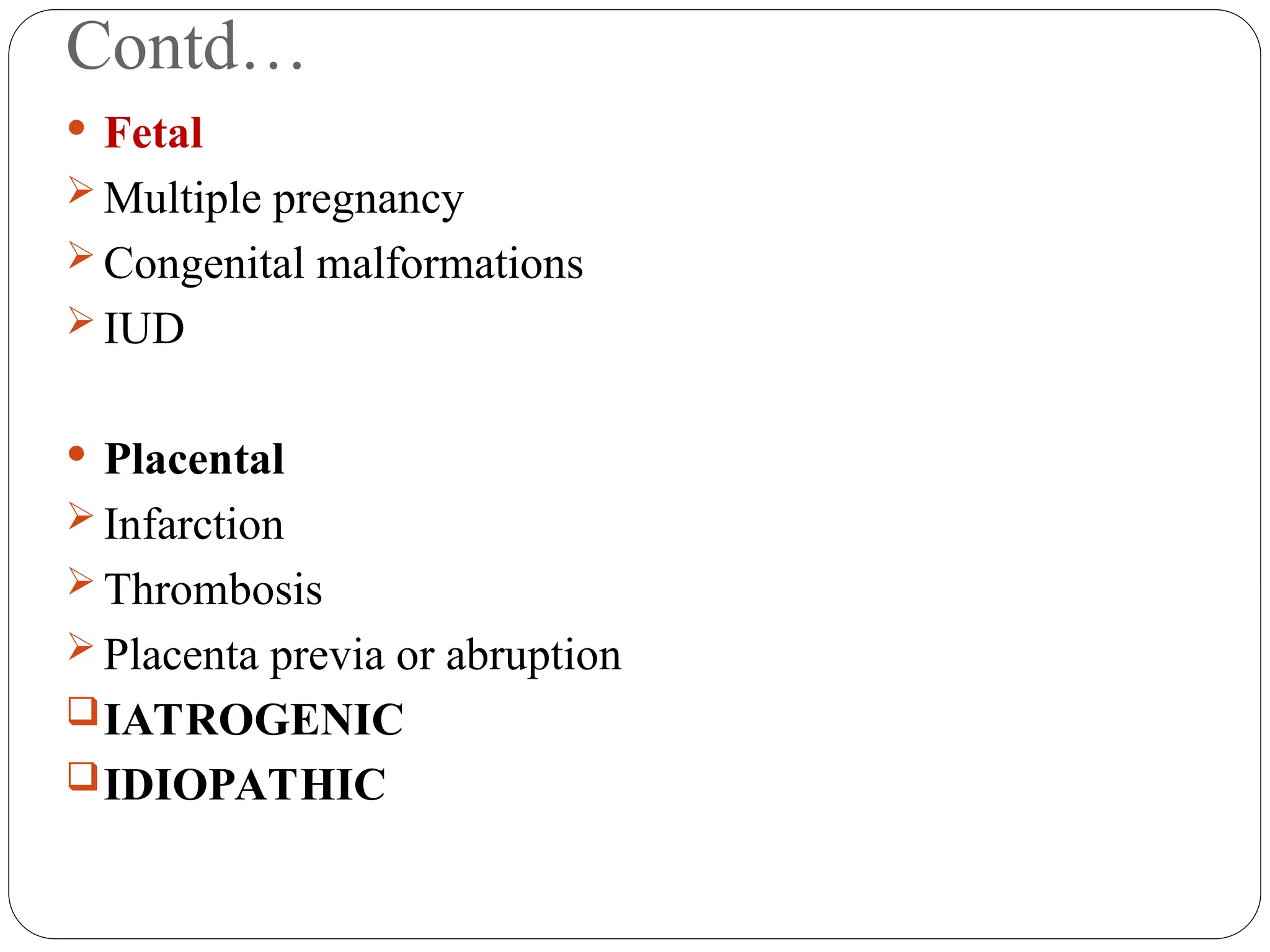
 Fetal
 Multiple pregnancy
 Congenital malformations
 IUD
 Placental
 Infarction
 Thrombosis
 Placenta previa or abruption
IATROGENIC
IDIOPATHIC
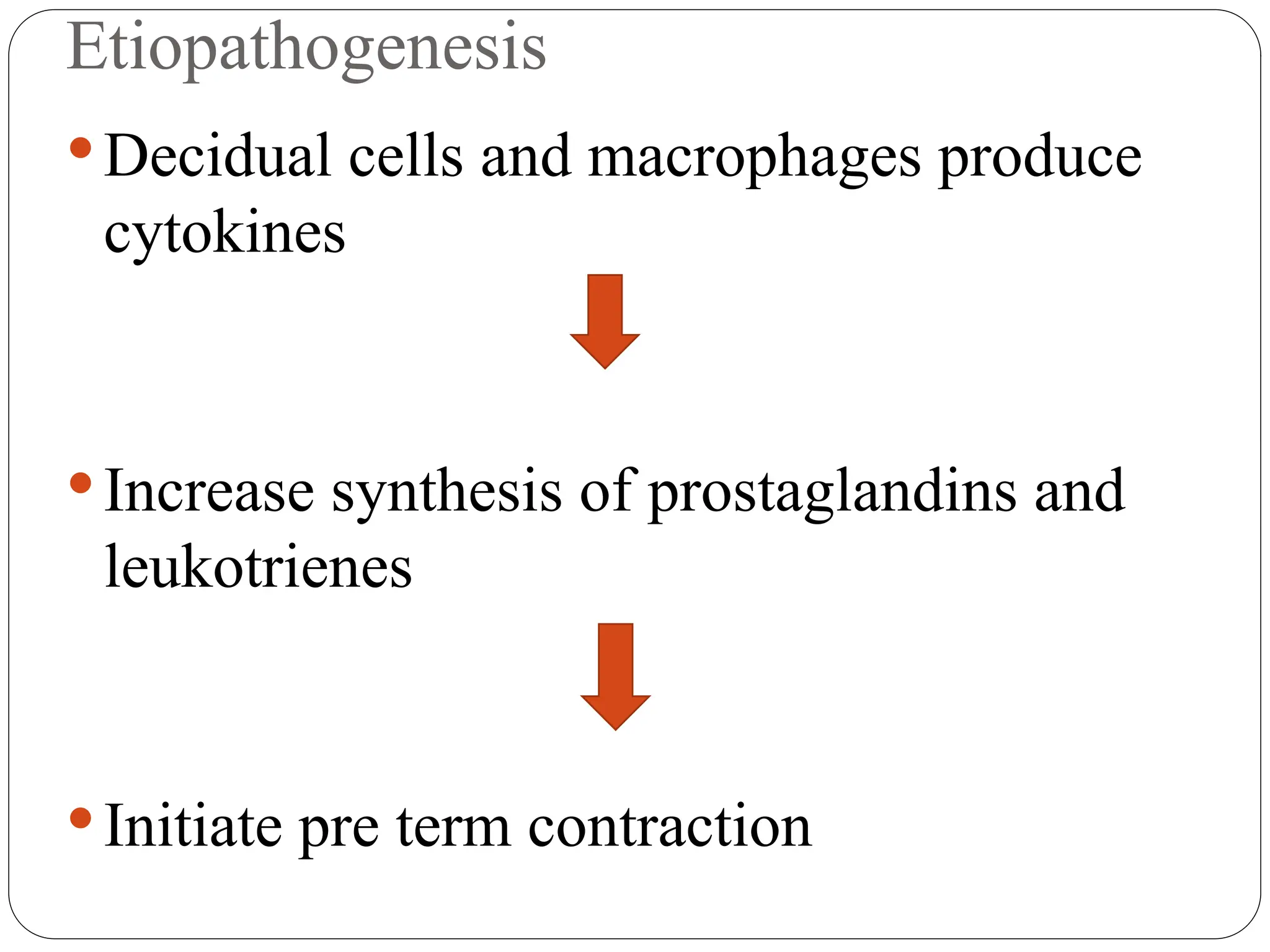
Etiopathogenesis
Decidual cells and macrophages produce
cytokines
Increase synthesis of prostaglandins and
leukotrienes
Initiate pre term contraction
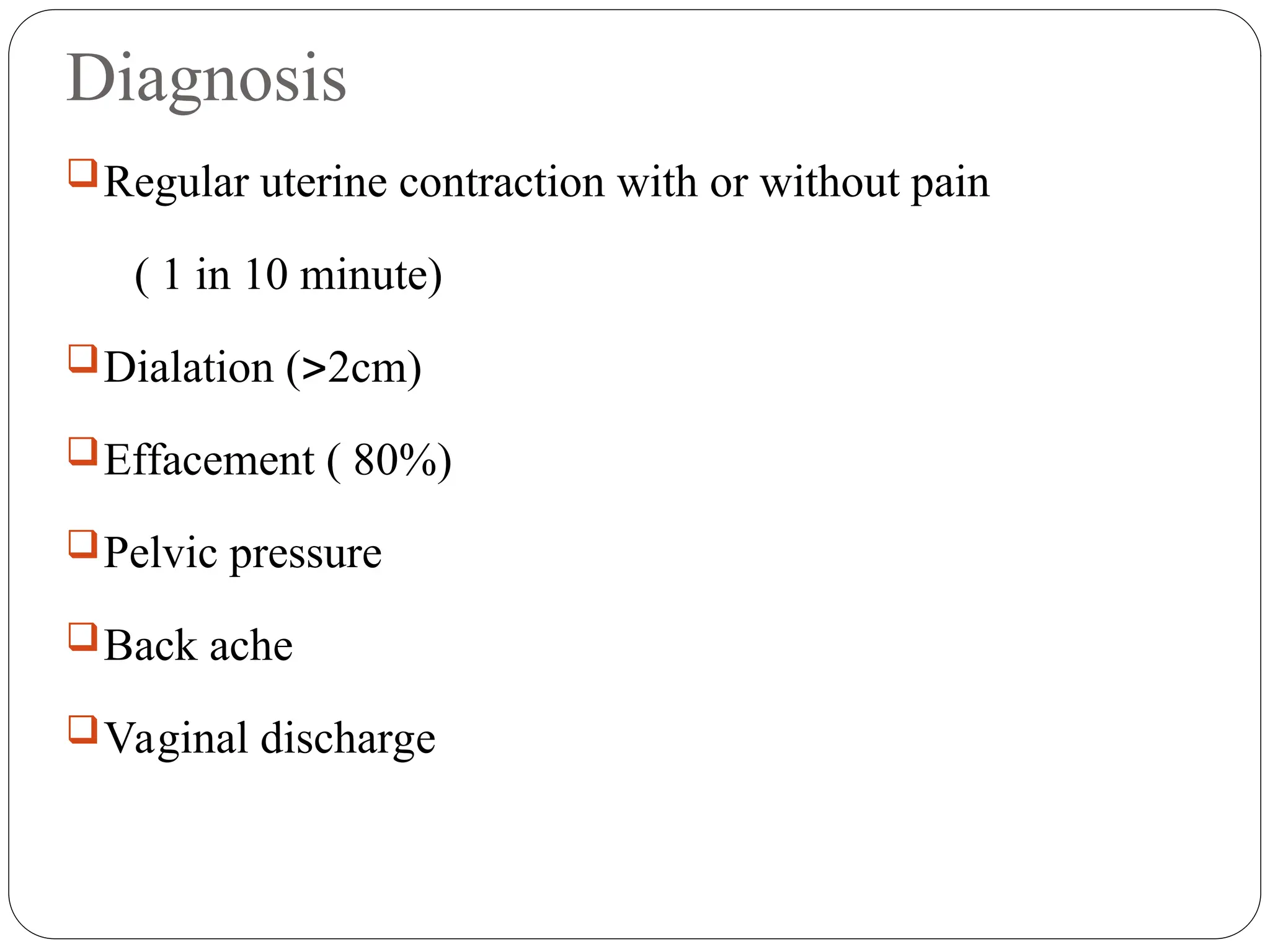
Diagnosis
Regular uterine contraction with or without pain
( 1 in 10 minute)
Dialation (2cm)
Effacement ( 80%)
Pelvic pressure
Back ache
Vaginal discharge
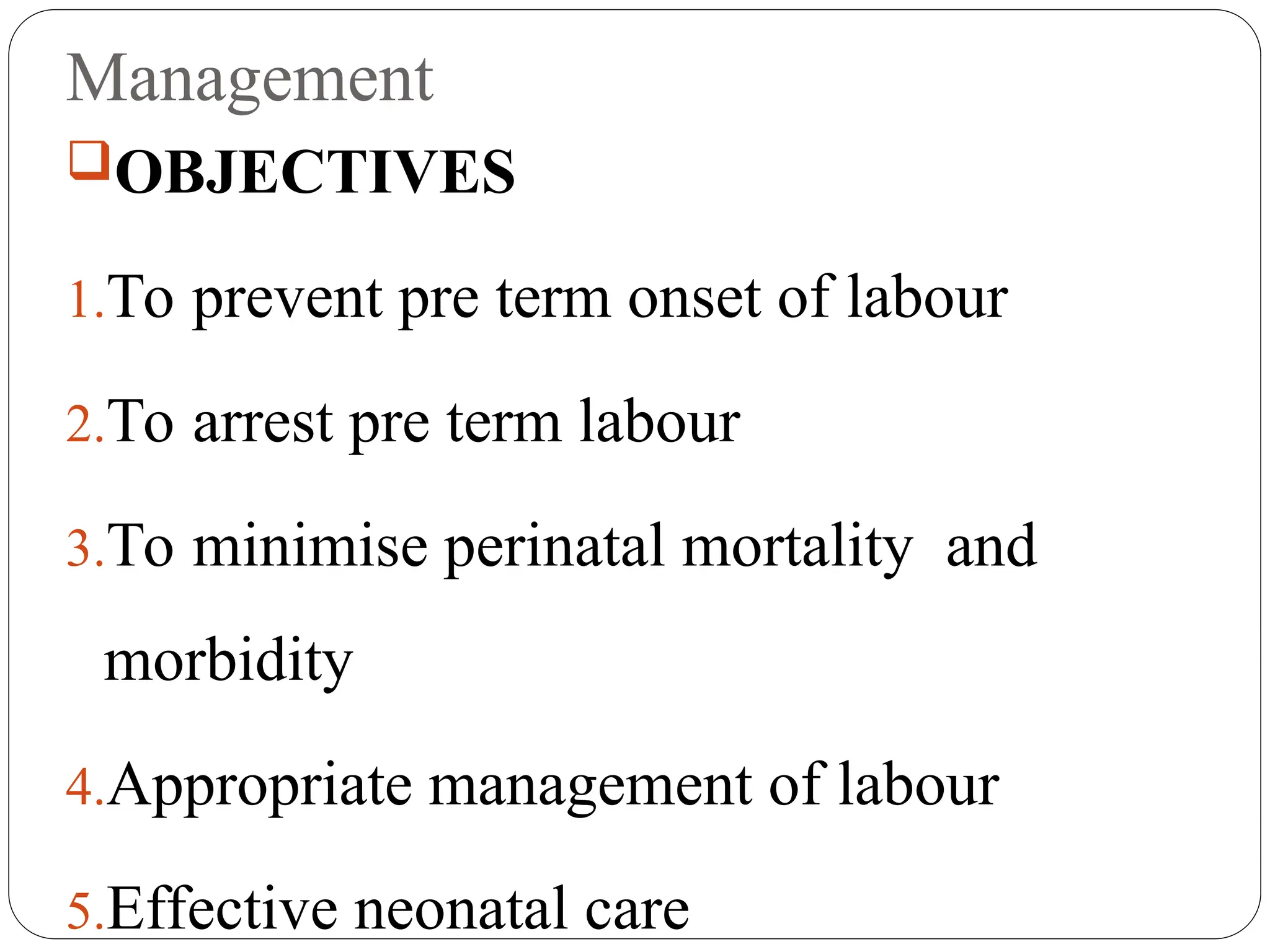
Management
OBJECTIVES
1.To prevent pre term onset of labour
2.To arrest pre term labour
3.To minimise perinatal mortality and
morbidity
4.Appropriate management of labour
5.Effective neonatal care
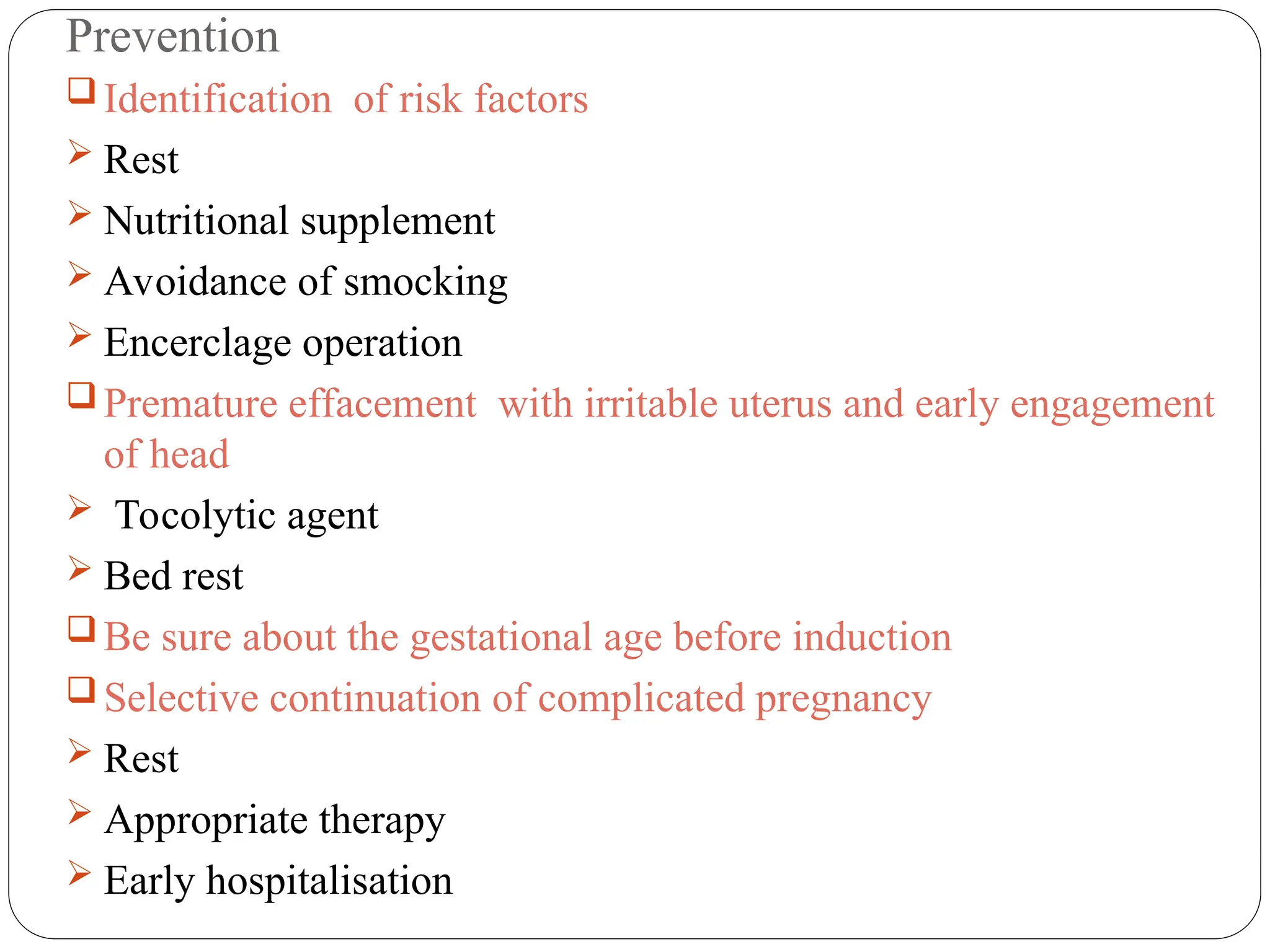
Prevention
 Identification of risk factors
 Rest
 Nutritional supplement
 Avoidance of smocking
 Encerclage operation
 Premature effacement with irritable uterus and early engagement
of head
 Tocolytic agent
 Bed rest
 Be sure about the gestational age before induction
 Selective continuation of complicated pregnancy
 Rest
 Appropriate therapy
 Early hospitalisation
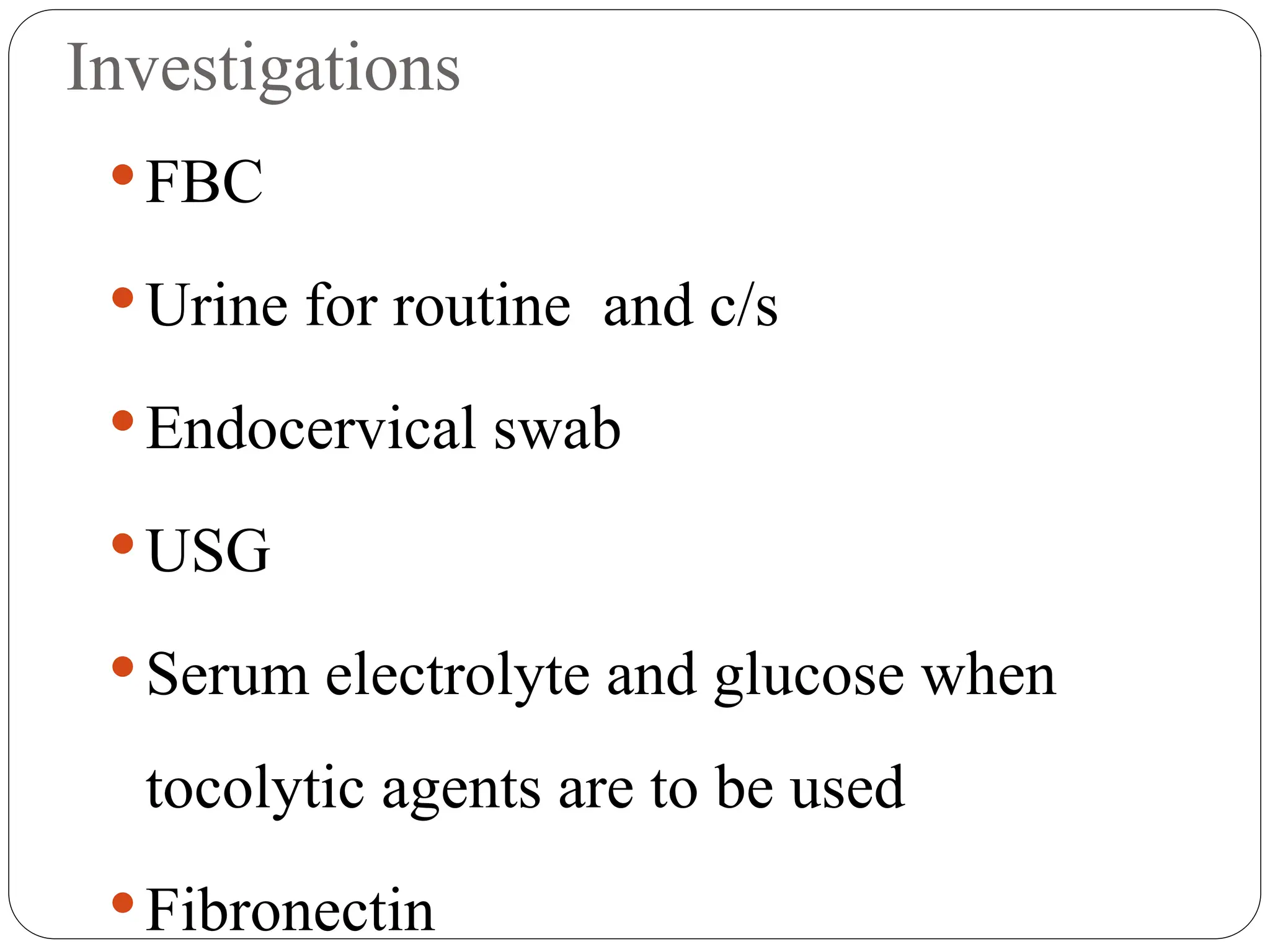
Investigations
FBC
Urine for routine and c/s
Endocervical swab
USG
Serum electrolyte and glucose when
tocolytic agents are to be used
Fibronectin
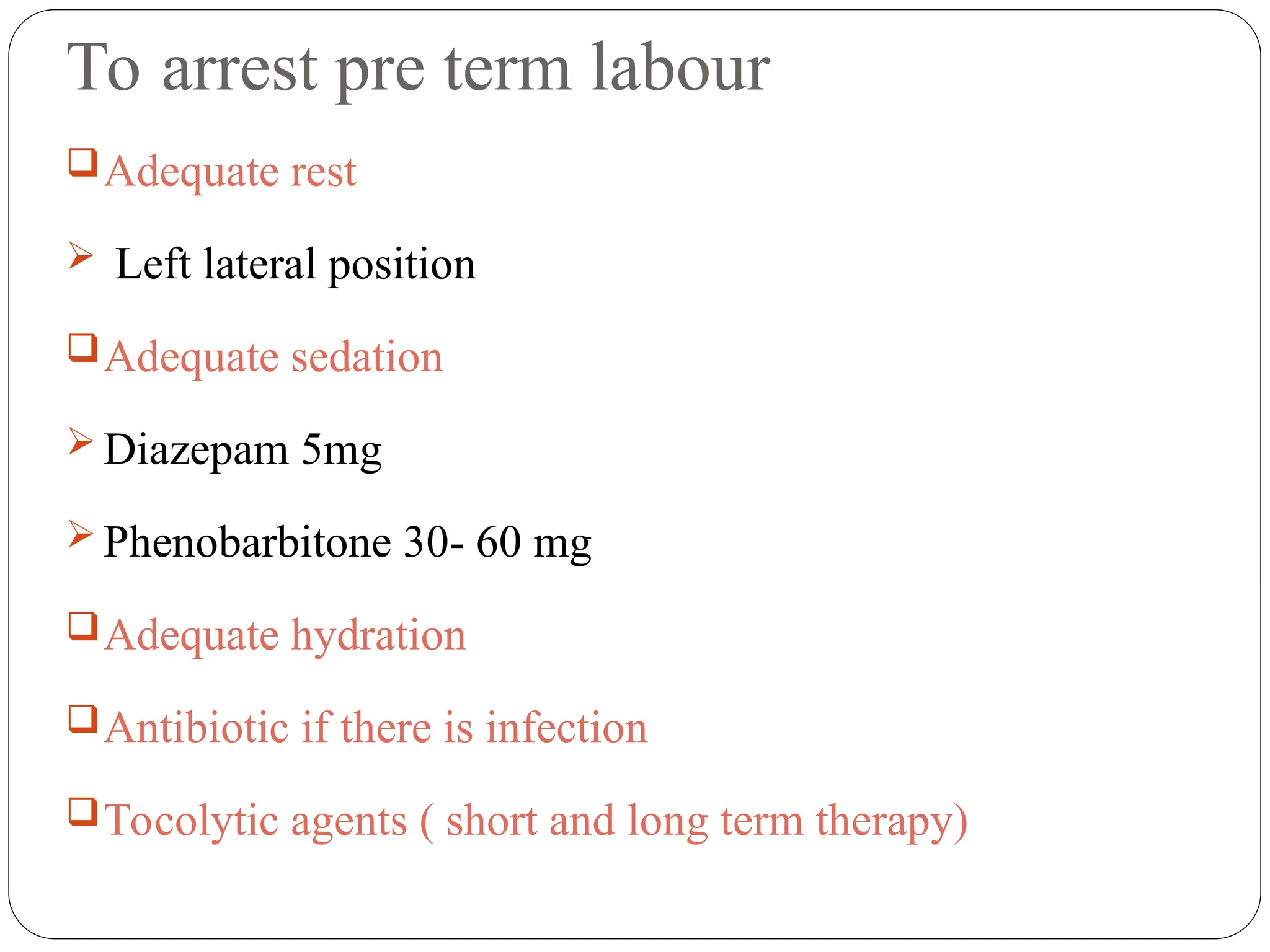
To arrest pre term labour
Adequate rest
 Left lateral position
Adequate sedation
 Diazepam 5mg
 Phenobarbitone 30- 60 mg
Adequate hydration
Antibiotic if there is infection
Tocolytic agents ( short and long term therapy)
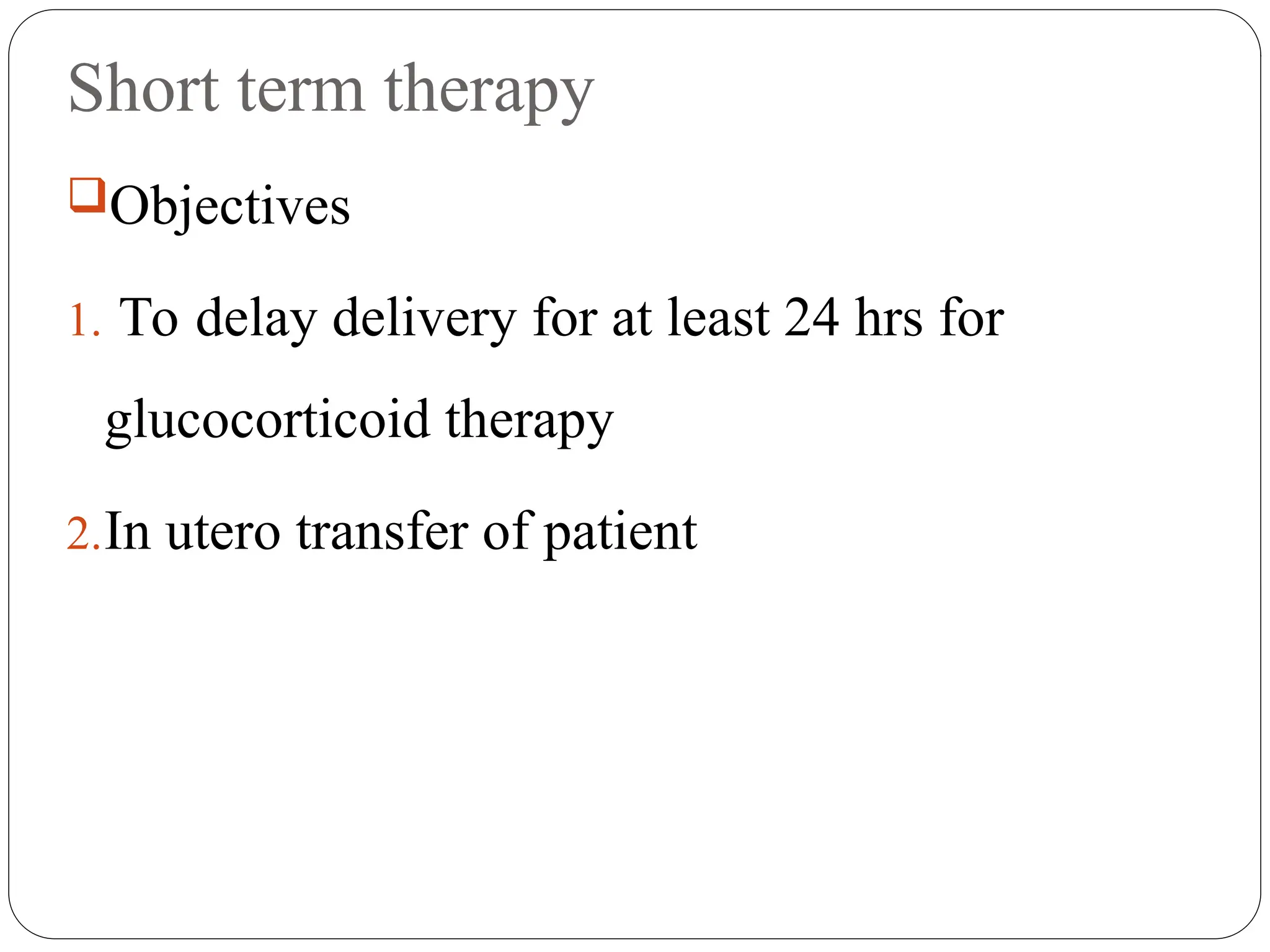
Short term therapy
Objectives
1. To delay delivery for at least 24 hrs for
glucocorticoid therapy
2.In utero transfer of patient
Contd…
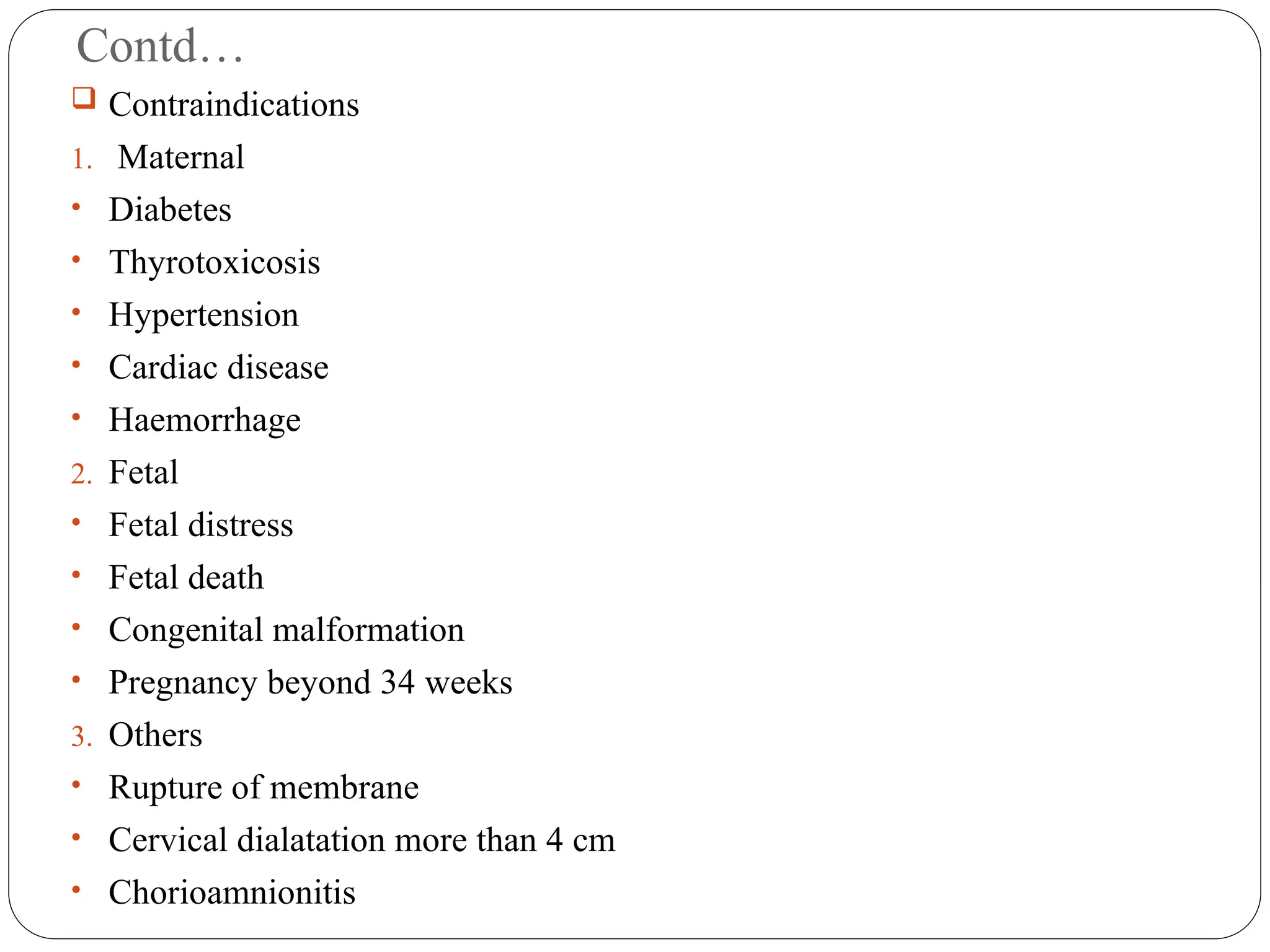
 Contraindications
1. Maternal
• Diabetes
• Thyrotoxicosis
• Hypertension
• Cardiac disease
• Haemorrhage
2. Fetal
• Fetal distress
• Fetal death
• Congenital malformation
• Pregnancy beyond 34 weeks
3. Others
• Rupture of membrane
• Cervical dialatation more than 4 cm
• Chorioamnionitis
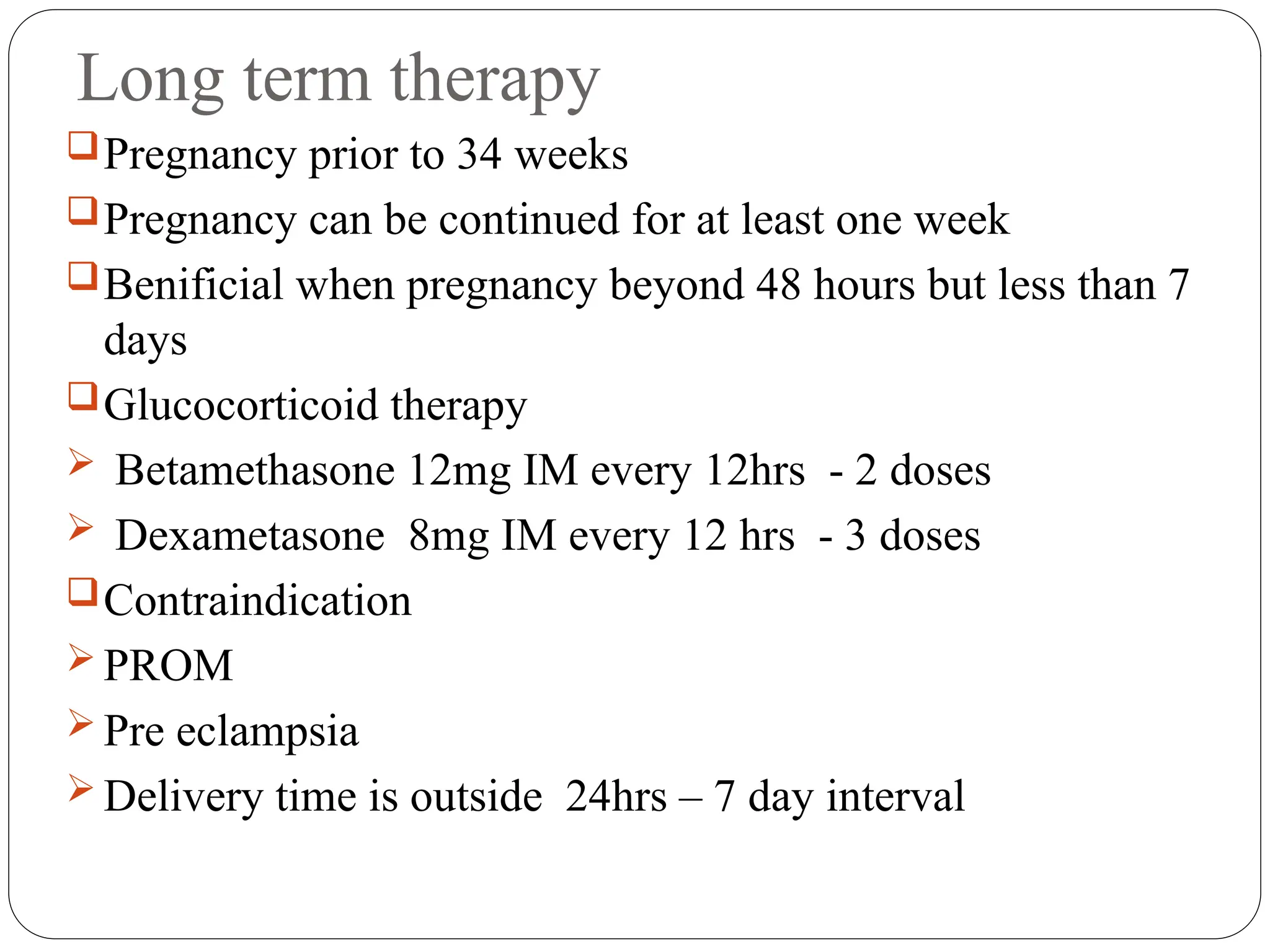
Long term therapy
Pregnancy prior to 34 weeks
Pregnancy can be continued for at least one week
Benificial when pregnancy beyond 48 hours but less than 7
days
Glucocorticoid therapy
 Betamethasone 12mg IM every 12hrs - 2 doses
 Dexametasone 8mg IM every 12 hrs - 3 doses
Contraindication
 PROM
 Pre eclampsia
 Delivery time is outside 24hrs – 7 day interval
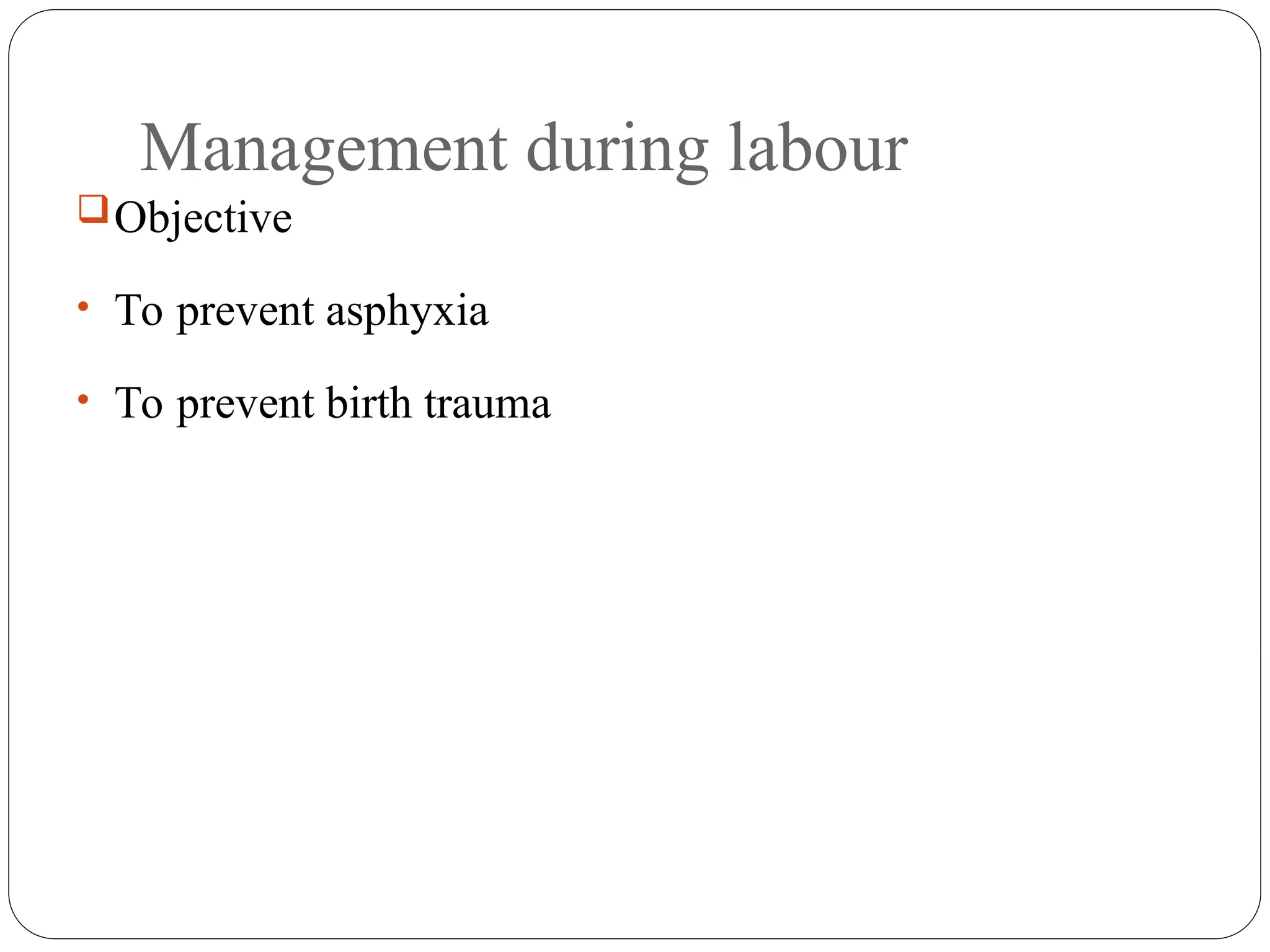
Management during labour
Objective
• To prevent asphyxia
• To prevent birth trauma
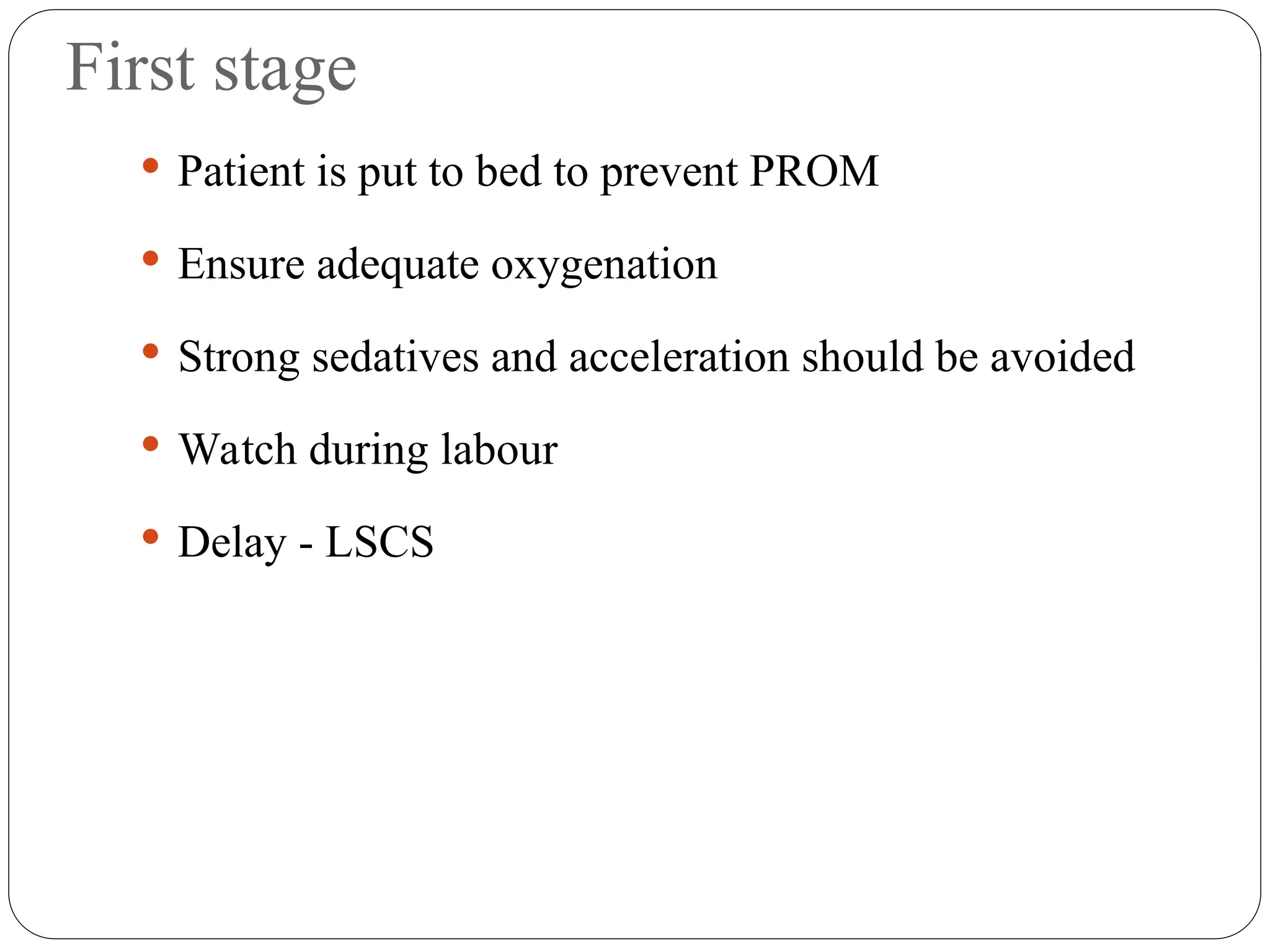
First stage
 Patient is put to bed to prevent PROM
 Ensure adequate oxygenation
 Strong sedatives and acceleration should be avoided
 Watch during labour
 Delay - LSCS
Second stage
 Birth should be gentle and slow
 Liberal episiotomy
 Tendency to delay curtailed by forceps
 Cord is to be clamped immediately to prevent hypervolemia
and hyperbilirubinemia
 Place baby in NICU
LSCS
 Before 34 wks with breech
 Lower segment or j shaped incision is preferred
Nursing Diagnosis
1. Altered cardiopulmonary tissue perfusion related to the
effects of tocolytic agents
2. Fear related to the uncertainity of outcome and effects of
preterm labour on fetus
3. Impaired gas exchange related to lung immaturity
4. Pain related to uterine contraction
5. Ineffective management of therapeutic regimen related to
the lack of knowledge and complexity of therapy
6. Diversional activity deficit related to the imposed bed rest
Contd…
7. Constipation related to decreased gastrointestinal motility
from prolonged bed rest / adverse effect of tocolytic agent
8. Situational low self esteem related to the feeling of
inadequacy from pre term labour complications
9. Knowledge deficit related to the treatment of preterm labour
Premature Rupture of Membranes
(PROM)
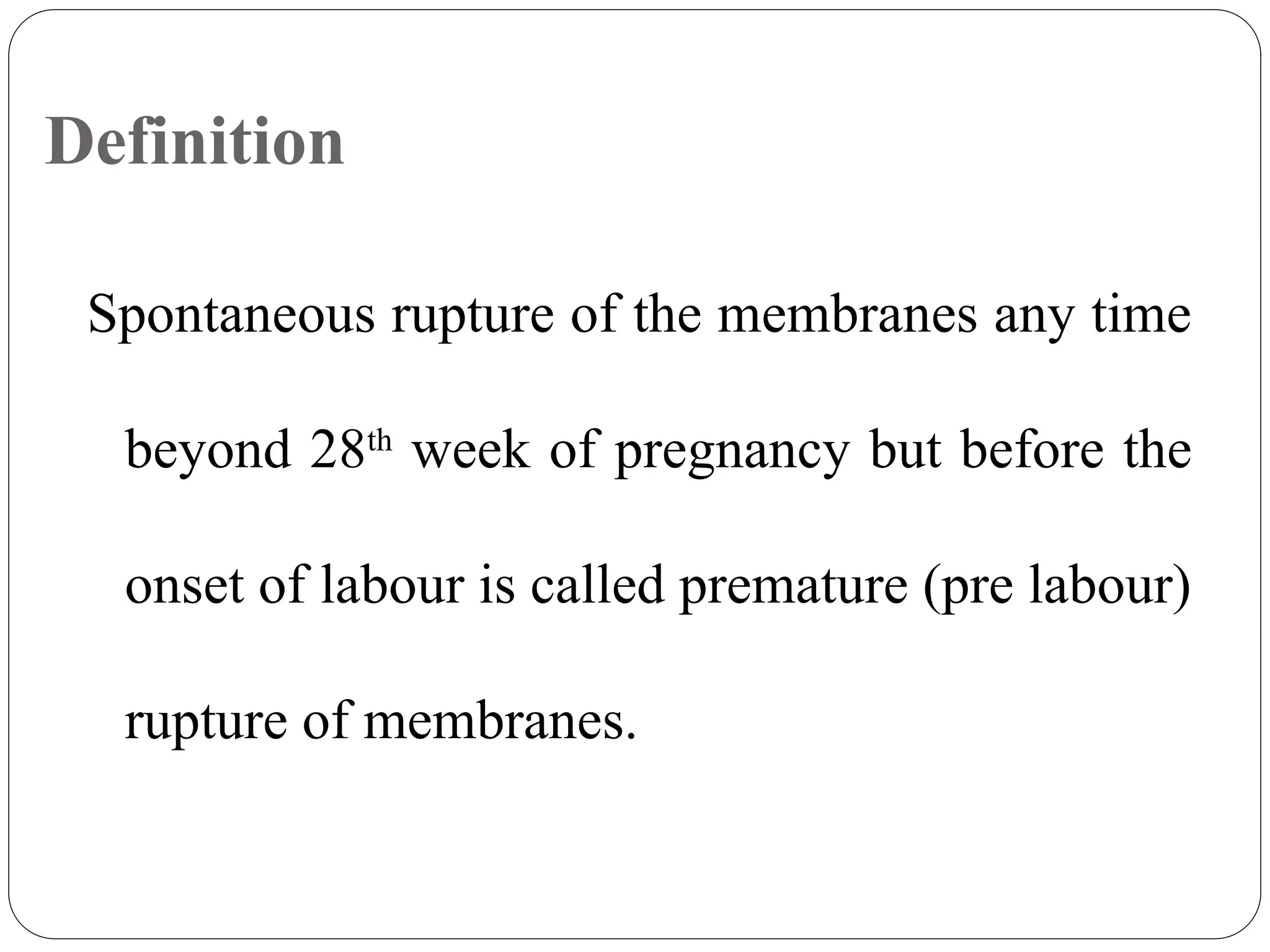
Definition
Spontaneous rupture of the membranes any time
beyond 28th
week of pregnancy but before the
onset of labour is called premature (pre labour)
rupture of membranes.
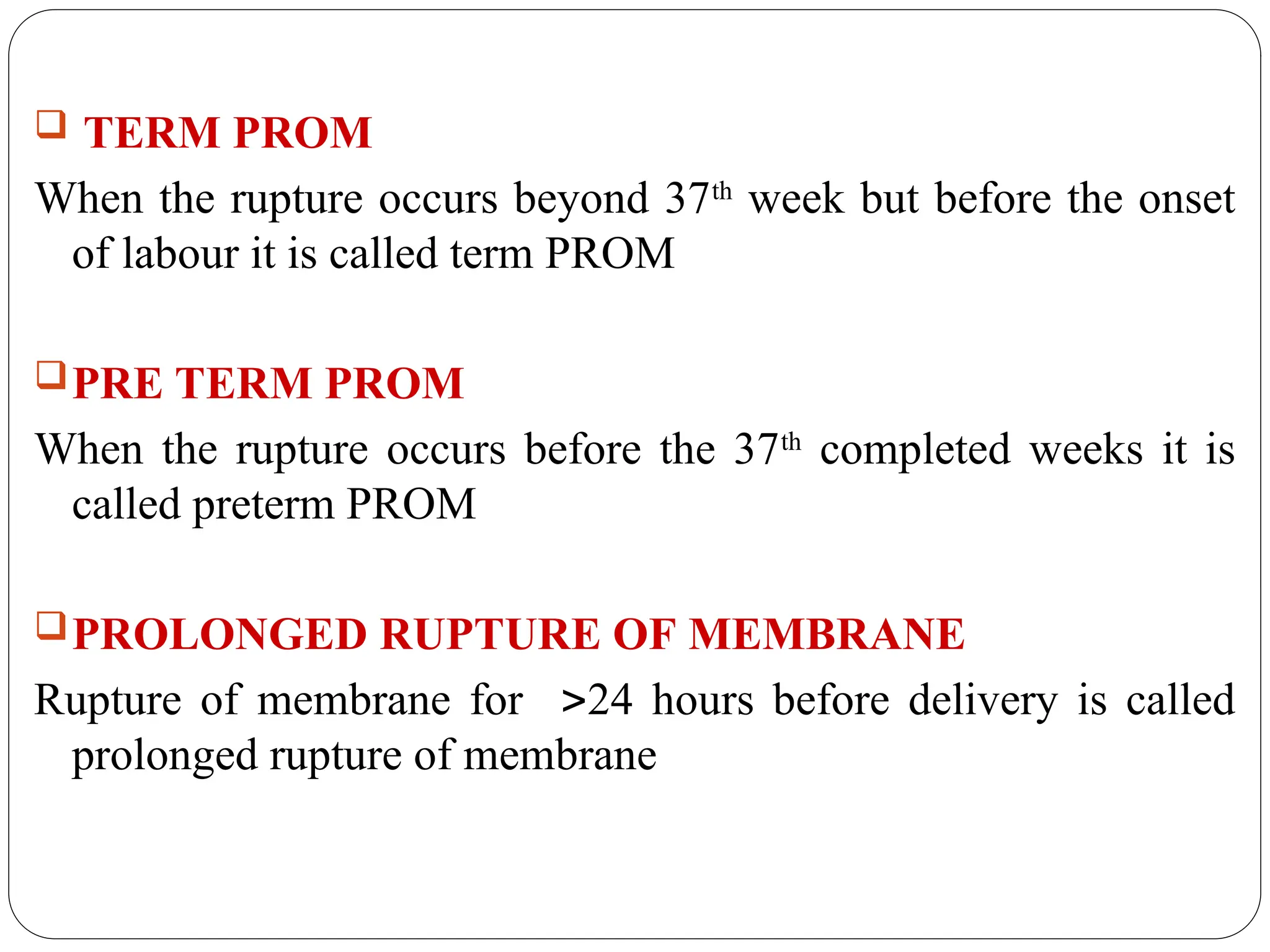
 TERM PROM
When the rupture occurs beyond 37th
week but before the onset
of labour it is called term PROM
PRE TERM PROM
When the rupture occurs before the 37th
completed weeks it is
called preterm PROM
PROLONGED RUPTURE OF MEMBRANE
Rupture of membrane for 24 hours before delivery is called
prolonged rupture of membrane
INCIDENCE
10 % of all pregnancies
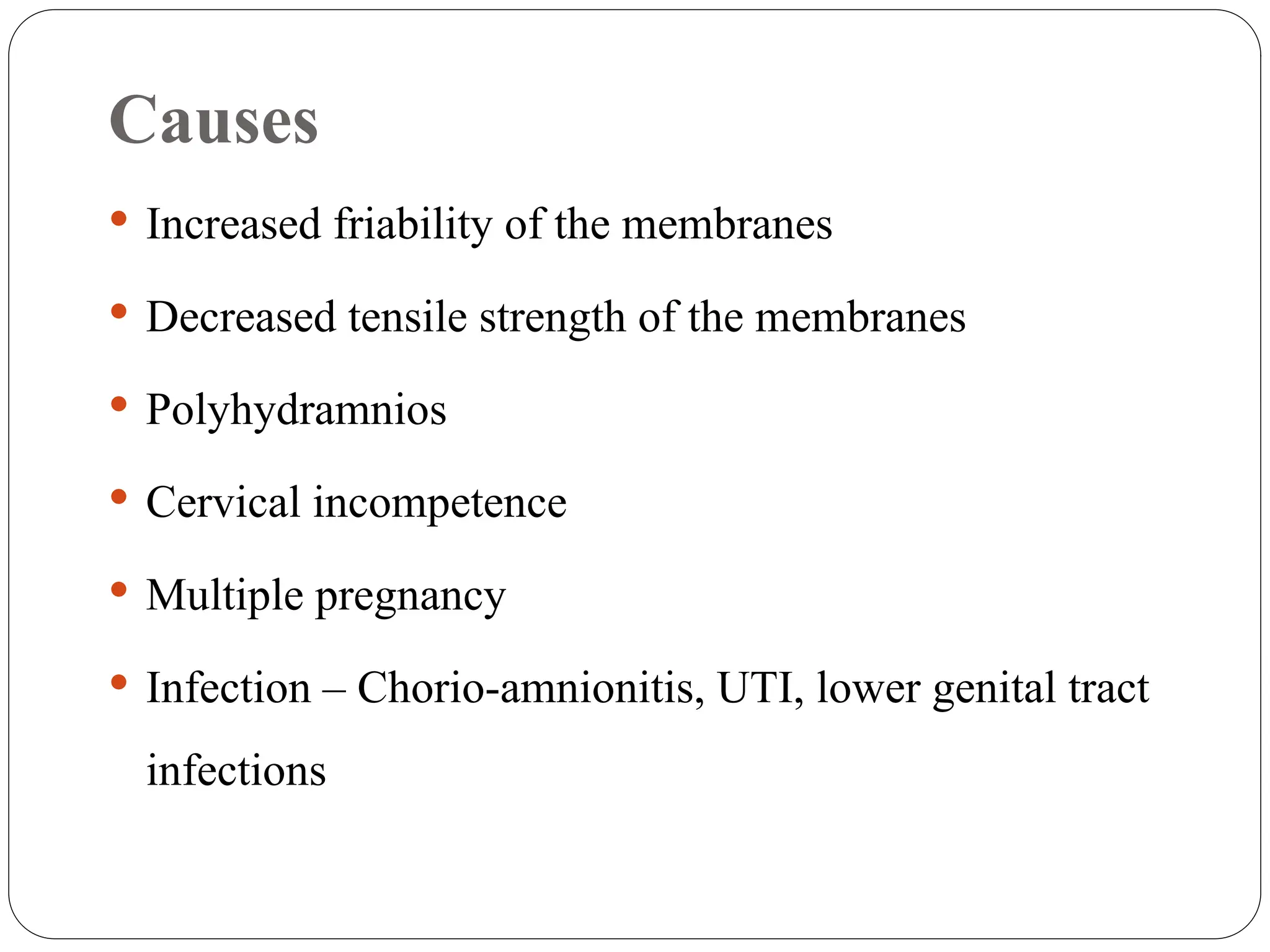
Causes
 Increased friability of the membranes
 Decreased tensile strength of the membranes
 Polyhydramnios
 Cervical incompetence
 Multiple pregnancy
 Infection – Chorio-amnionitis, UTI, lower genital tract
infections
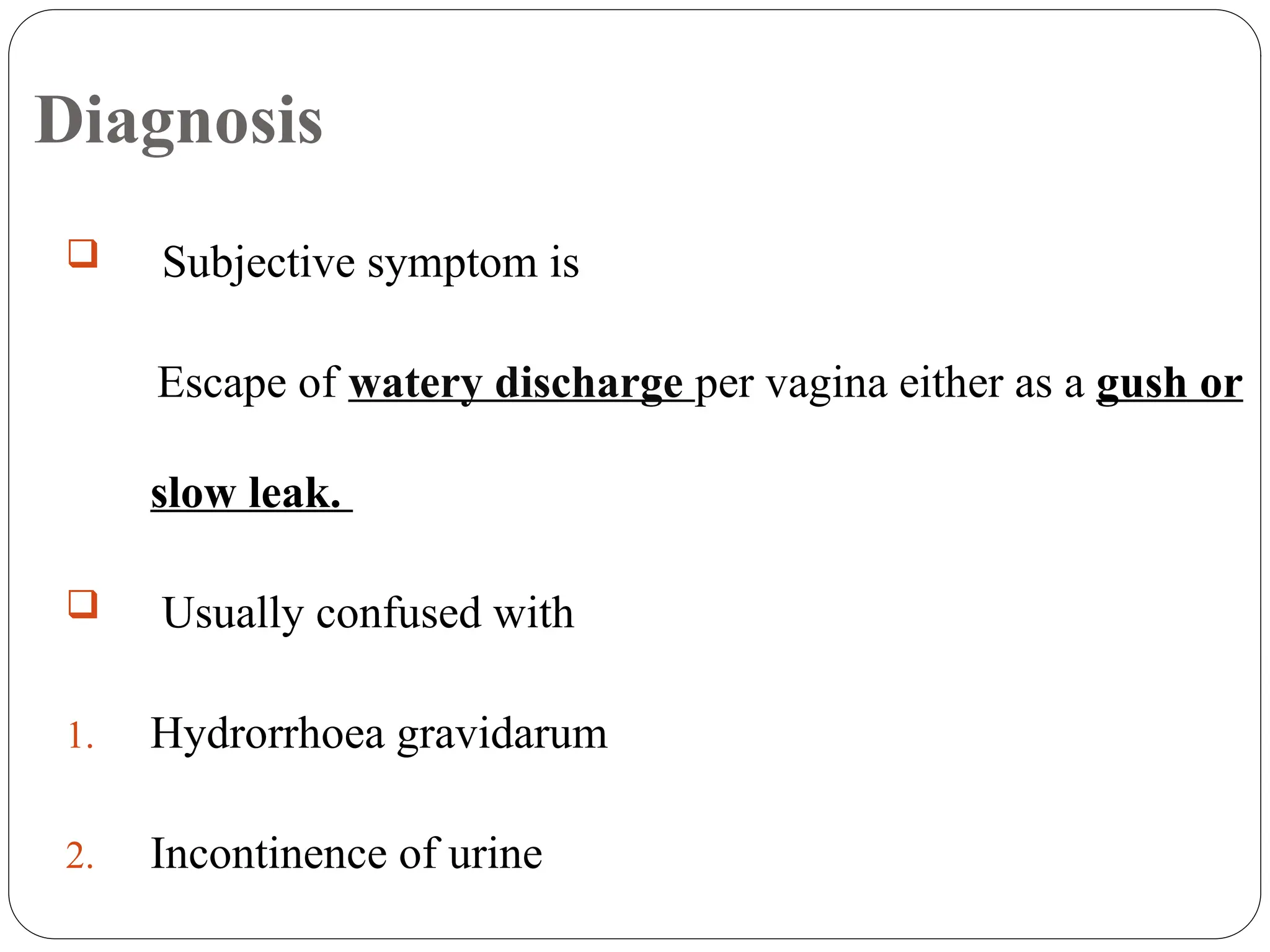
Diagnosis
 Subjective symptom is
Escape of watery discharge per vagina either as a gush or
slow leak.
 Usually confused with
1. Hydrorrhoea gravidarum
2. Incontinence of urine
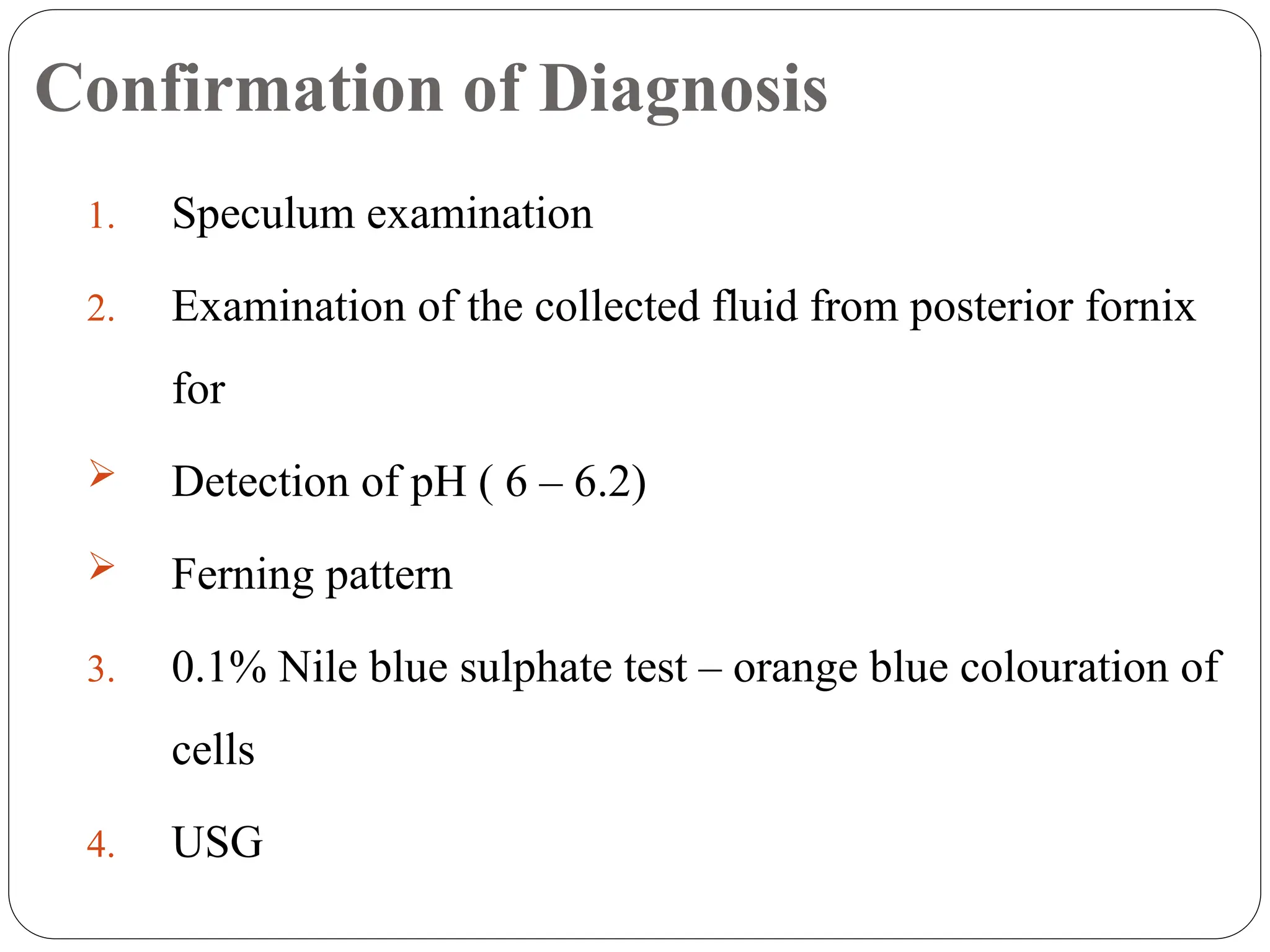
Confirmation of Diagnosis
1. Speculum examination
2. Examination of the collected fluid from posterior fornix
for
 Detection of pH ( 6 – 6.2)
 Ferning pattern
3. 0.1% Nile blue sulphate test – orange blue colouration of
cells
4. USG
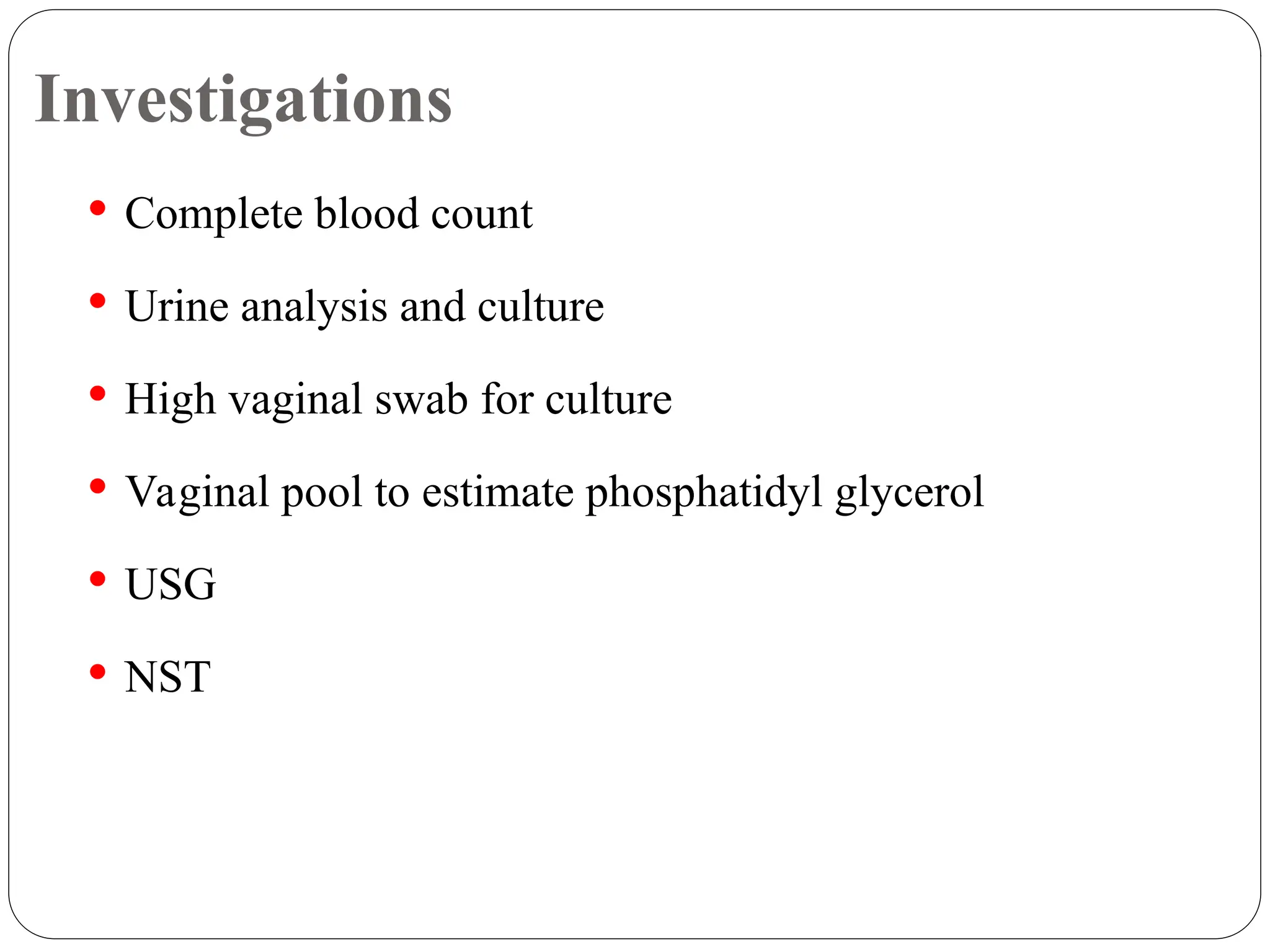
Investigations
 Complete blood count
 Urine analysis and culture
 High vaginal swab for culture
 Vaginal pool to estimate phosphatidyl glycerol
 USG
 NST
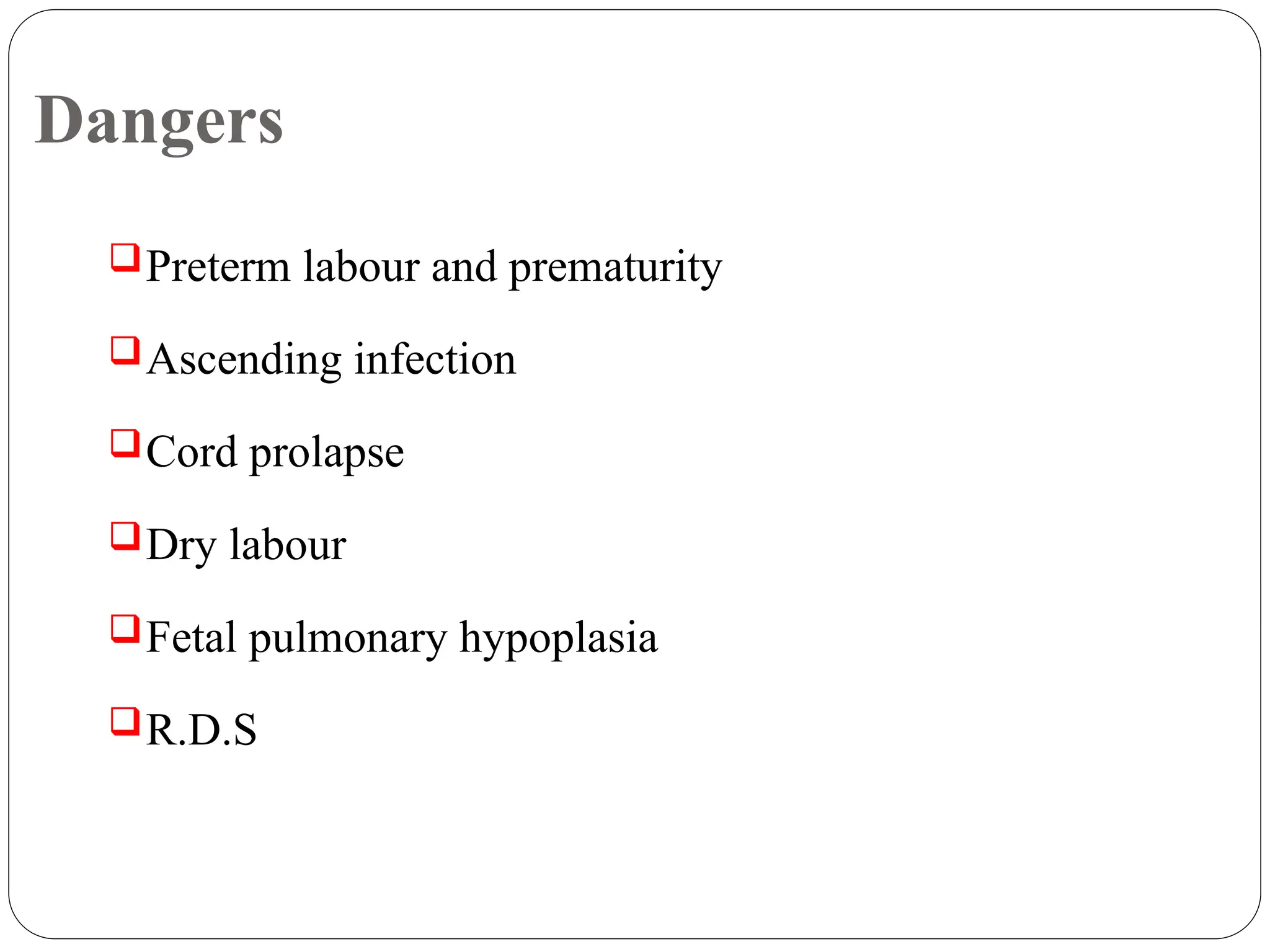
Dangers
Preterm labour and prematurity
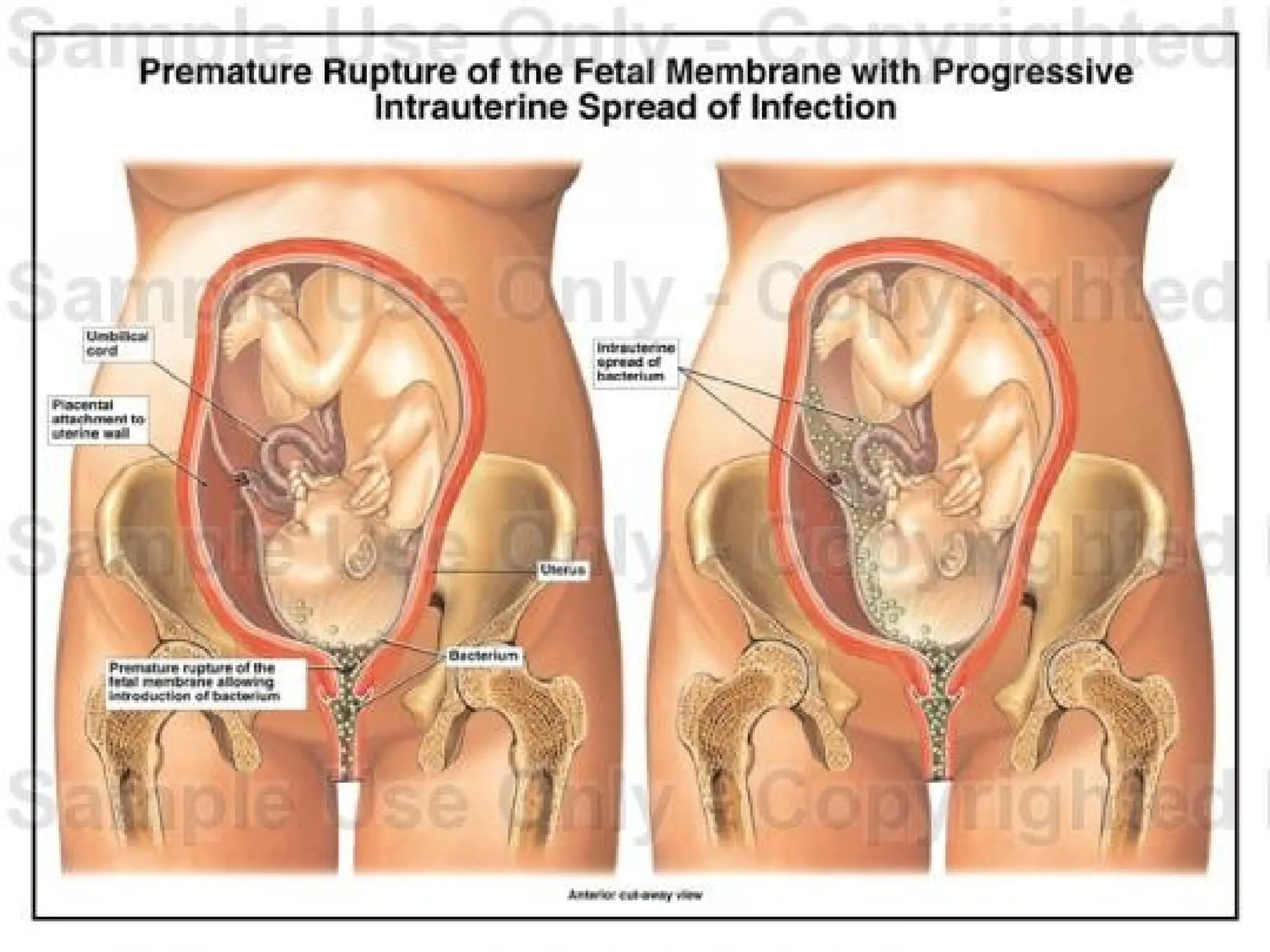
Ascending infection
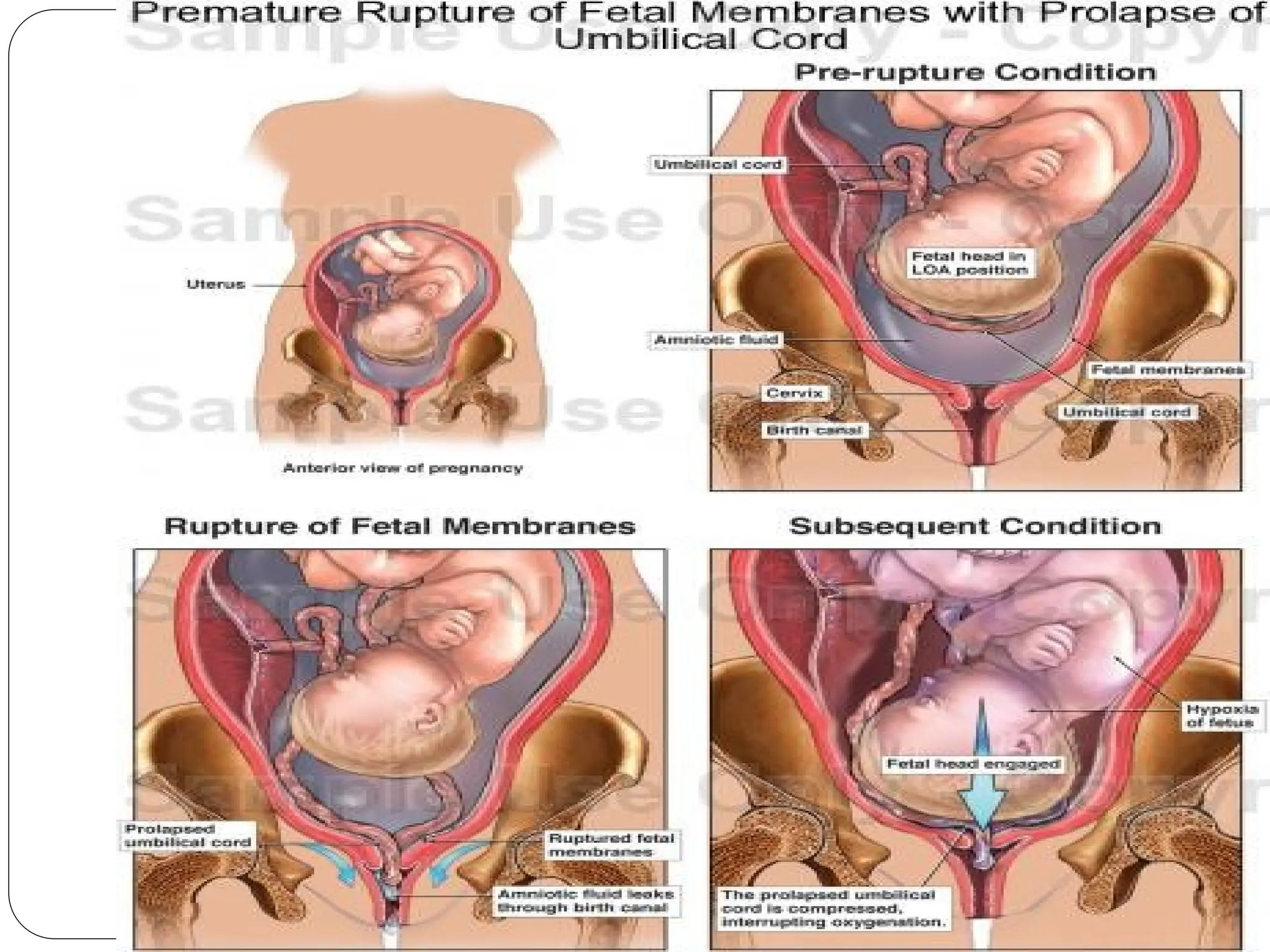
Cord prolapse
Dry labour
Fetal pulmonary hypoplasia
R.D.S
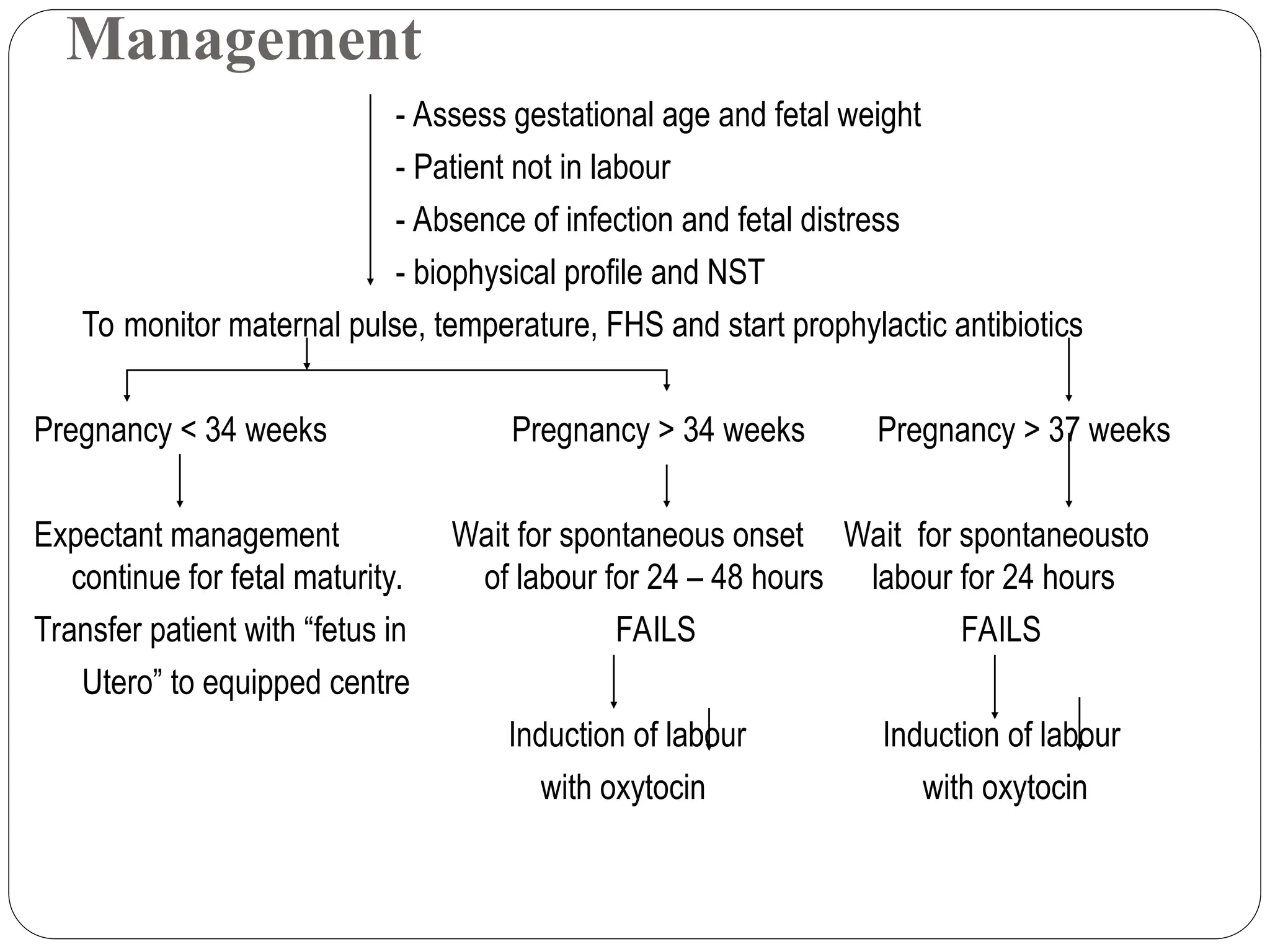
Management
- Assess gestational age and fetal weight
- Patient not in labour
- Absence of infection and fetal distress
- biophysical profile and NST
To monitor maternal pulse, temperature, FHS and start prophylactic antibiotics
Pregnancy < 34 weeks Pregnancy > 34 weeks Pregnancy > 37 weeks
Expectant management Wait for spontaneous onset Wait for spontaneousto
continue for fetal maturity. of labour for 24 – 48 hours labour for 24 hours
Transfer patient with “fetus in FAILS FAILS
Utero” to equipped centre
Induction of labour Induction of labour
with oxytocin with oxytocin
Meaning
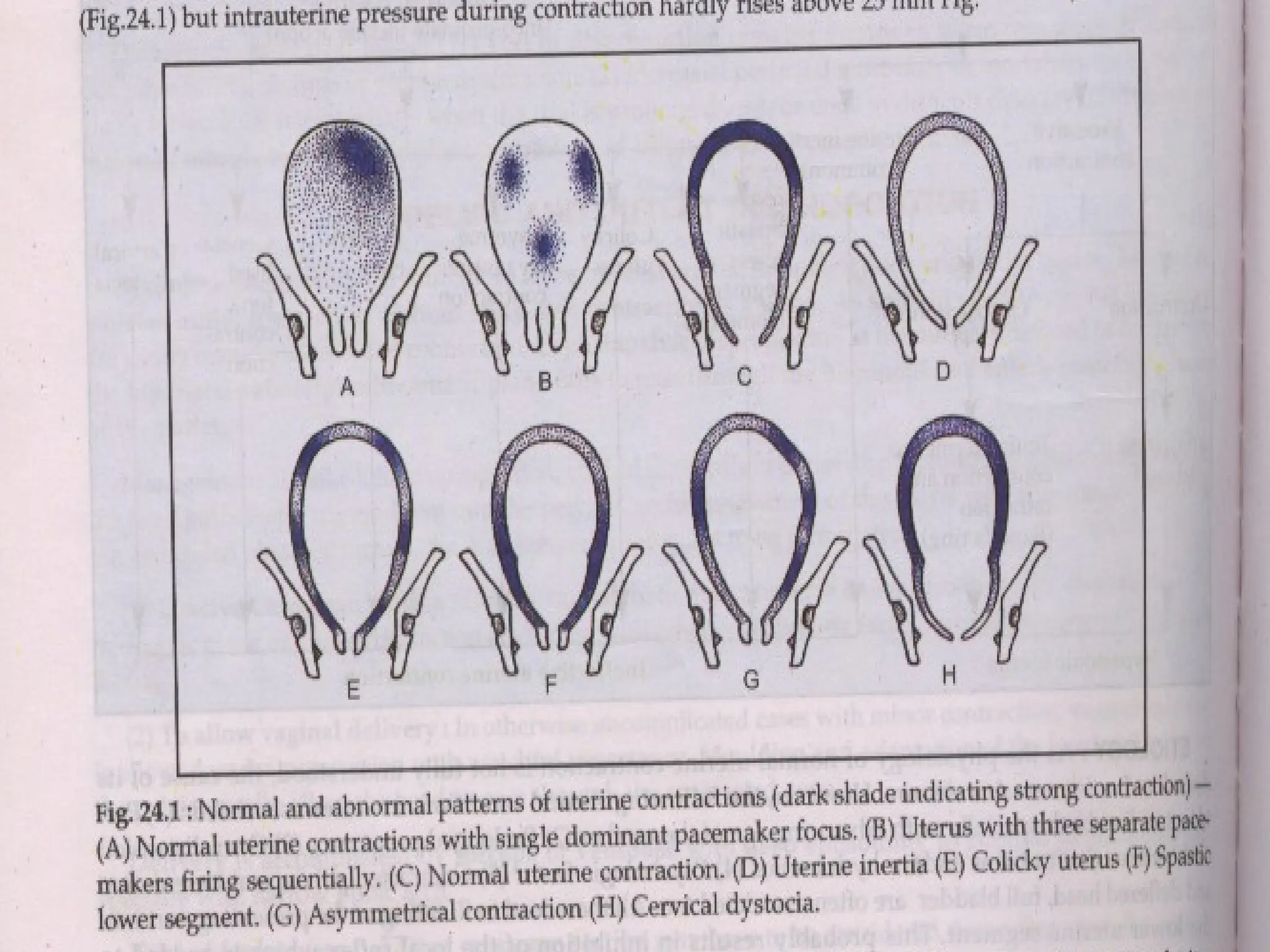
Any deviation of the normal pattern of
uterine contractions affecting the
course of labour is called abnormal
uterine action
Etiology
Advancing age of the mother
Prolonged pregnancy
Over distention of the uterus due to twins
Psychological Factors
Contracted pelvis
Malpresentations
Full bladder
Types
`
Precipitate Labour
Precipitate Labour
Definition:
A labour lasting less than 3 hours
Etiology: More common in multipara when there are
strong uterine contractions
roomy pelvis
small sized pelvis
minimal soft tissue resistance
Complications
Maternal:
 Lacerations of the cervix, vagina
and perineum.
 Shock.
 Inversion of the uterus.
 Postpartum haemorrhage:
no time for retraction,
lacerations.
 Sepsis due to:
lacerations,
inappropriate surroundings.
Foetal:
 Intracranial haemorrhage due to
sudden compression and
decompression of the head.
 Foetal asphyxia due to:
strong frequent uterine
contractions reducing placental
perfusion,
lack of immediate resuscitation.
 Avulsion of the umbilical cord.
 Foetal injury due to falling down.
Management
Before delivery
Patient who had previous precipitate labour should be hospitalized
before expected date of delivery as she is more prone to repeated
precipitate labour.
During delivery
Inhalation anaesthesia: as nitrous oxide and oxygen is given to
slow the course of labour.
Tocolytic agents: as ritodrine (Yutopar) may be effective.
Episiotomy: to avoid perineal lacerations and intracranial
haemorrhage.
After delivery
Examine the mother and foetus for injuries.
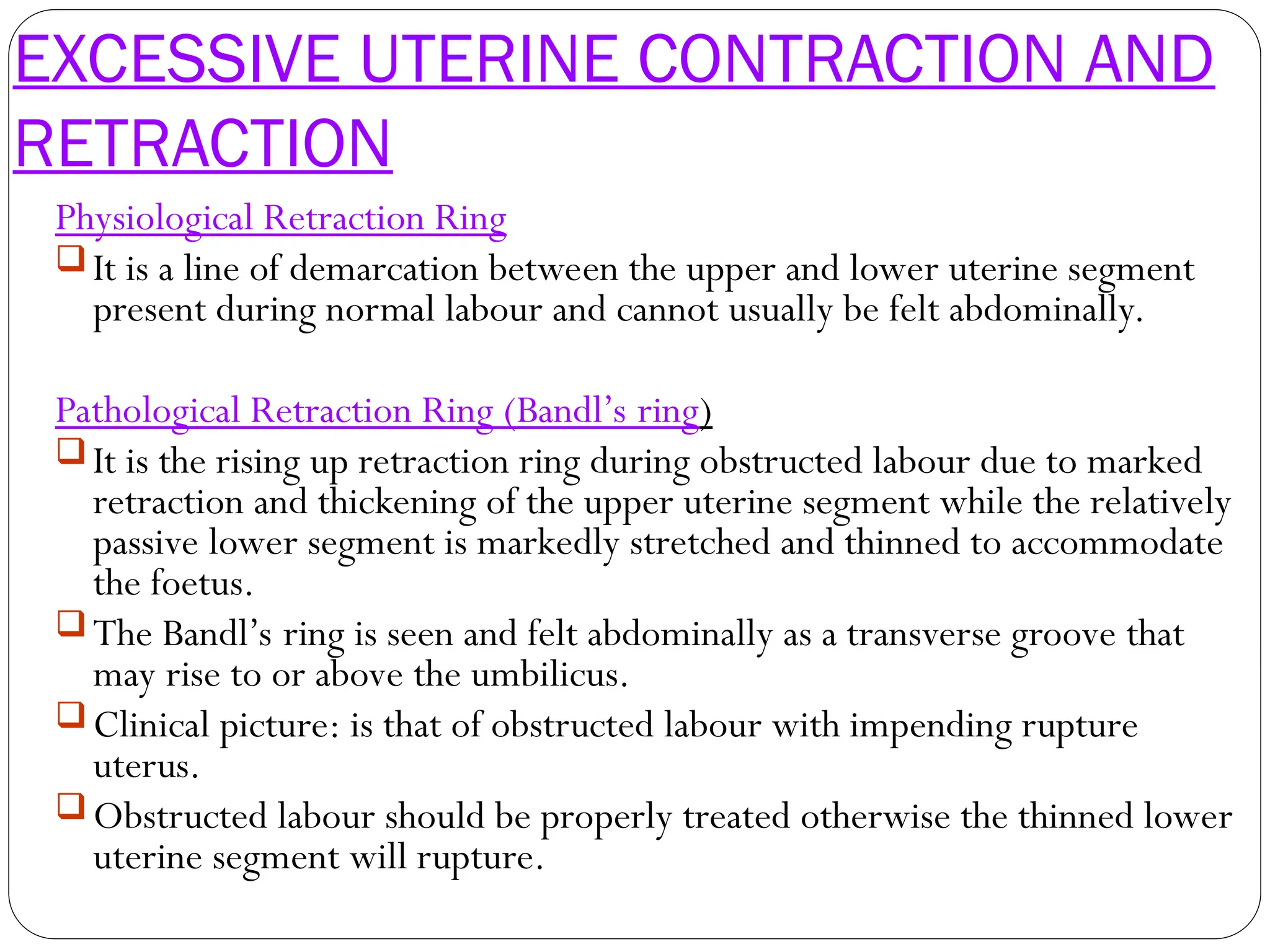
EXCESSIVE UTERINE CONTRACTION AND
RETRACTION
Physiological Retraction Ring
 It is a line of demarcation between the upper and lower uterine segment
present during normal labour and cannot usually be felt abdominally.
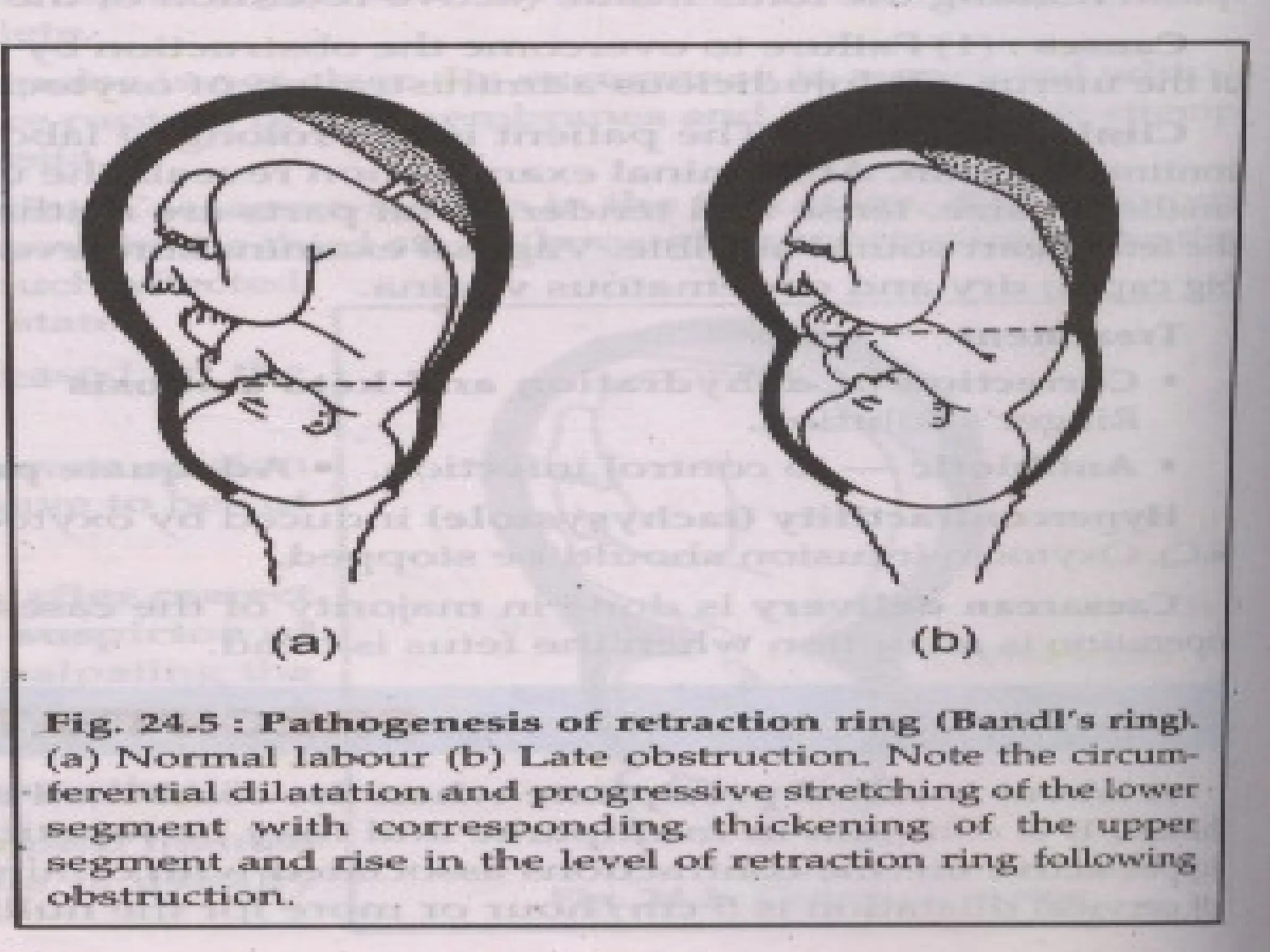
Pathological Retraction Ring (Bandl’s ring)
 It is the rising up retraction ring during obstructed labour due to marked
retraction and thickening of the upper uterine segment while the relatively
passive lower segment is markedly stretched and thinned to accommodate
the foetus.
 The Bandl’s ring is seen and felt abdominally as a transverse groove that
may rise to or above the umbilicus.
 Clinical picture: is that of obstructed labour with impending rupture
uterus.
 Obstructed labour should be properly treated otherwise the thinned lower
uterine segment will rupture.
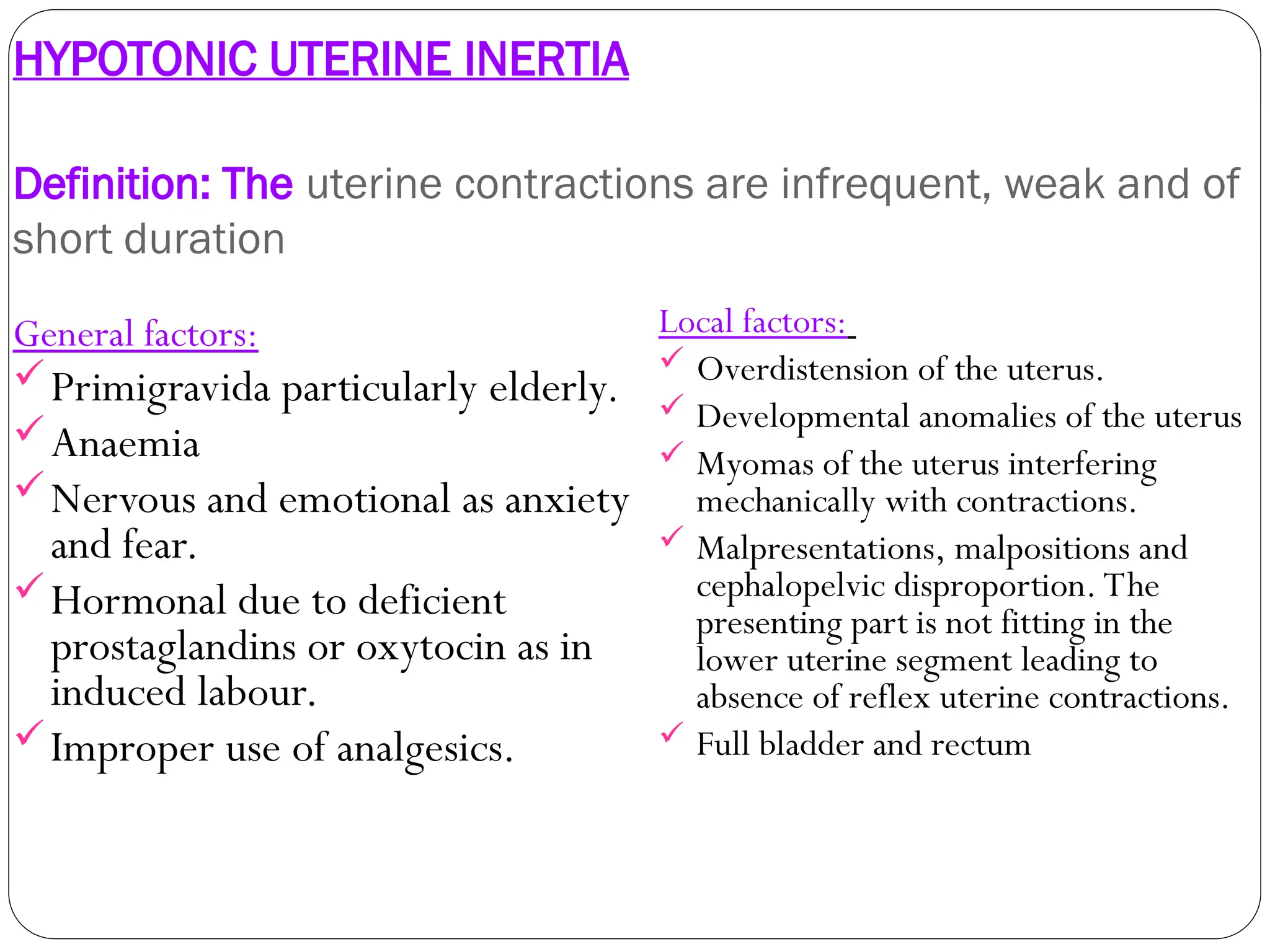
HYPOTONIC UTERINE INERTIA
Definition: The uterine contractions are infrequent, weak and of
short duration
General factors:
Primigravida particularly elderly.
Anaemia
Nervous and emotional as anxiety
and fear.
Hormonal due to deficient
prostaglandins or oxytocin as in
induced labour.
Improper use of analgesics.
Local factors:
 Overdistension of the uterus.
 Developmental anomalies of the uterus
 Myomas of the uterus interfering
mechanically with contractions.
 Malpresentations, malpositions and
cephalopelvic disproportion. The
presenting part is not fitting in the
lower uterine segment leading to
absence of reflex uterine contractions.
 Full bladder and rectum
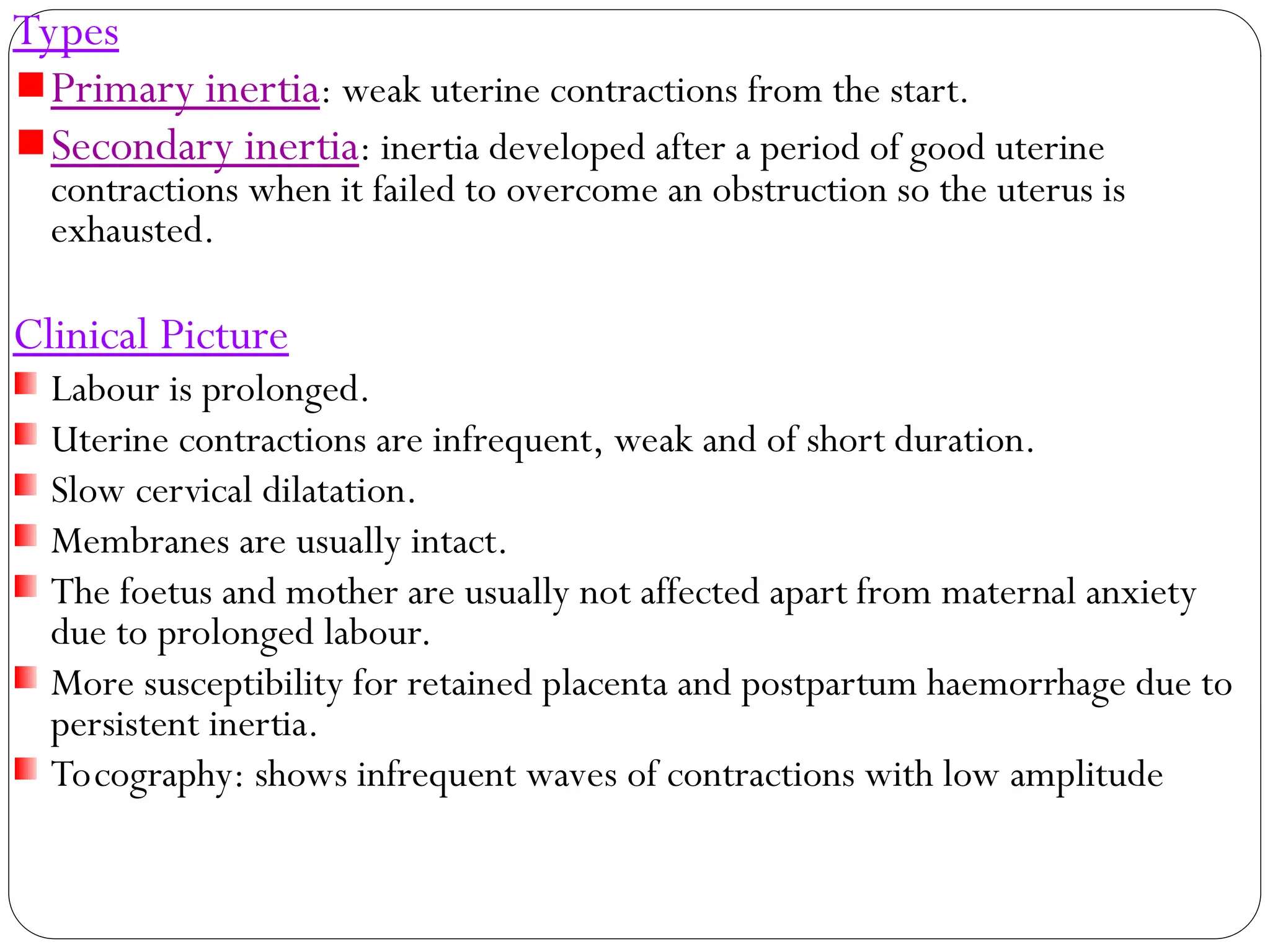
Types
Primary inertia: weak uterine contractions from the start.
Secondary inertia: inertia developed after a period of good uterine
contractions when it failed to overcome an obstruction so the uterus is
exhausted.
Clinical Picture
Labour is prolonged.
Uterine contractions are infrequent, weak and of short duration.
Slow cervical dilatation.
Membranes are usually intact.
The foetus and mother are usually not affected apart from maternal anxiety
due to prolonged labour.
More susceptibility for retained placenta and postpartum haemorrhage due to
persistent inertia.
Tocography: shows infrequent waves of contractions with low amplitude
Management
HYPERTONIC UTERINE INERTIA
Types
Colicky uterus: incoordination of the different parts of the uterus in contractions.
Hyperactive lower uterine segment: so the dominance of the upper segment is lost.
Clinical Picture
The condition is more common in primigravidae and characterized by:
 Labour is prolonged.
 Uterine contractions are irregular and more painful.
 High resting intrauterine pressure in between uterine contractions detected by
tocography (normal value is 5-10 mm of Hg).
 Slow cervical dilatation.
 Premature rupture of membranes.
 Foetal and maternal distress.
Management
 General measures: as hypotonic inertia.
 Medical measures:
€ Analgesic and antispasmodic as pethidine.
€ Epidural analgesia may be of good benefit.
 Caesarean section is indicated in:
€ Failure of the previous methods.
€ Disproportion.
€ Foetal distress before full cervical dilatation
CONSTRICTION (CONTRACTION) RING
Definition
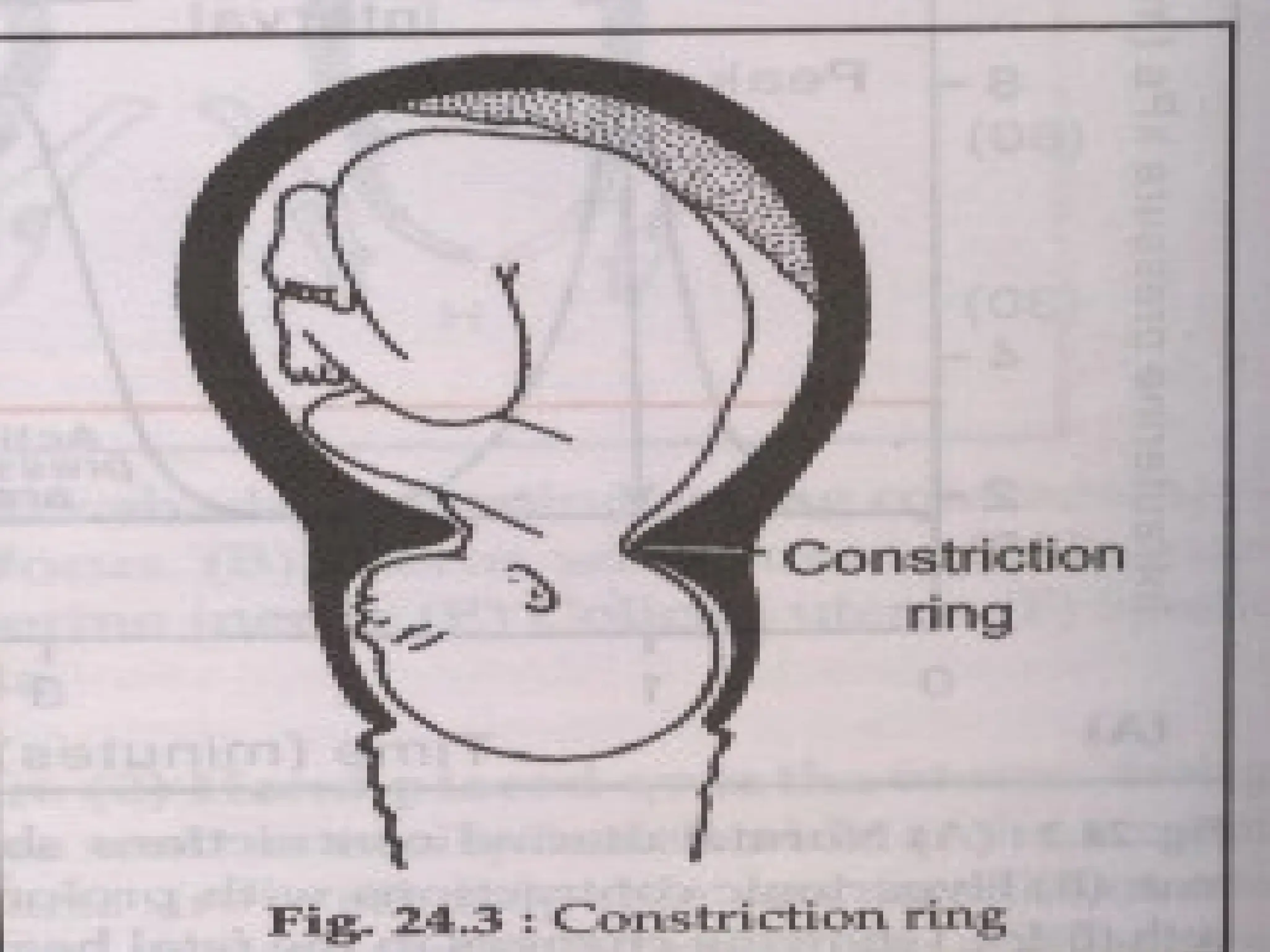
 It is a persistent localised annular spasm of the circular uterine muscles.
It occurs at any part of the uterus but usually at junction of the upper and
lower uterine segments.
It can occur at the 1st, 2nd or 3rd stage of labour.
Aetiology
Unknown but the predisposing factors are:
 Malpresentations and malpositions.
 Clumsy intrauterine manipulations under light anaesthesia.
 Improper use of oxytocin e.g.
 use of oxytocin in hypertonic inertia.
 IM injection of oxytocin.
Diagnosis
 The condition is more common in primigravidae and frequently
preceded by colicky uterus.
 The exact diagnosis is achieved only by feeling the ring with a
hand introduced into the uterine cavity.
Management
Exclude malpresentations, malposition and disproportion.
In the 1st stage: Pethidine may be of benefit.
In the 2nd stage: Deep general anaesthesia is given to relax the
constriction ring:
If the ring is relaxed, the foetus is delivered immediately by forceps.
If the ring does not relax, caesarean section is carried out with lower
segment vertical incision to divide the ring.
In the 3rd stage: Deep general anaesthesia is given followed by
manual removal of the placenta
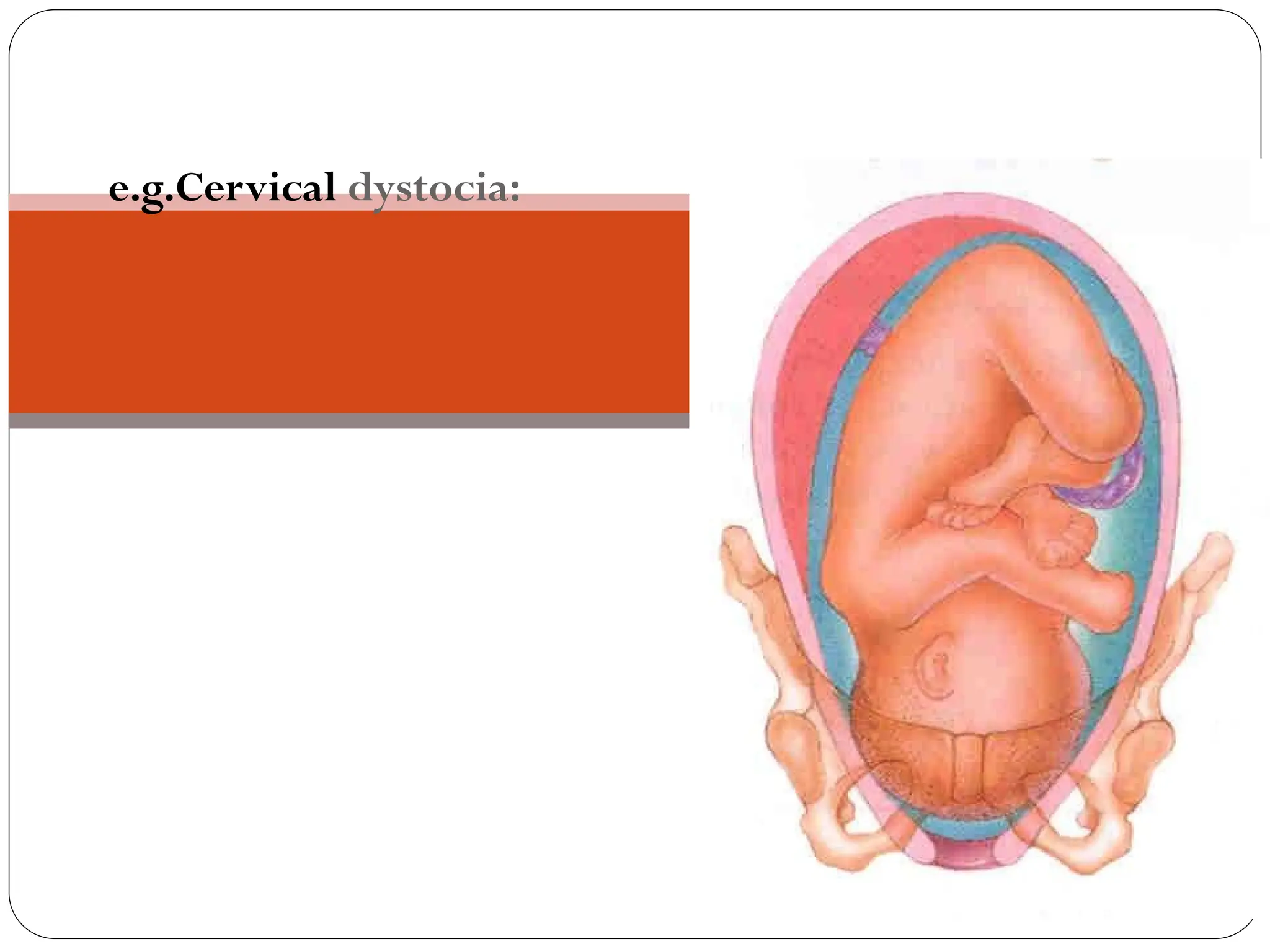
CERVICAL DYSTOCIA
Definition
Failure of the cervix to dilate within a reasonable time in spite of good
regular uterine contractions.
Varieties
Organic (secondary) due to
Cervical stances as a sequel to previous amputation, cone biopsy, extensive
cauterisation or obstetric trauma.
Organic lesions as cervical myoma or carcinoma.
Functional (primary):
In spite of the absence of any organic lesion and the well effacement of the
cervix, the external os fails to dilate.
This may be due to lack of softening of the cervix during pregnancy or
cervical spasm resulted from overactive sympathetic tone.
Complications
Annular detachment of the cervix: the bleeding from the cervix is
minimal because of fibrosis and avascular pressure necrosis leading
to thrombosis of the vessels before detachment.
Rupture uterus.
Postpartum haemorrhage: particularly if cervical laceration extends
upwards tearing the main uterine vessels.
Management
 Organic dystocia:
♣ Caesarean section is the management of choice.
 Functional dystocia:
♣ Pethidine and antispasmodics: may be effective.
♣ Caesarean section: if
♣ medical treatment fails or
♣ foetal distress developed.
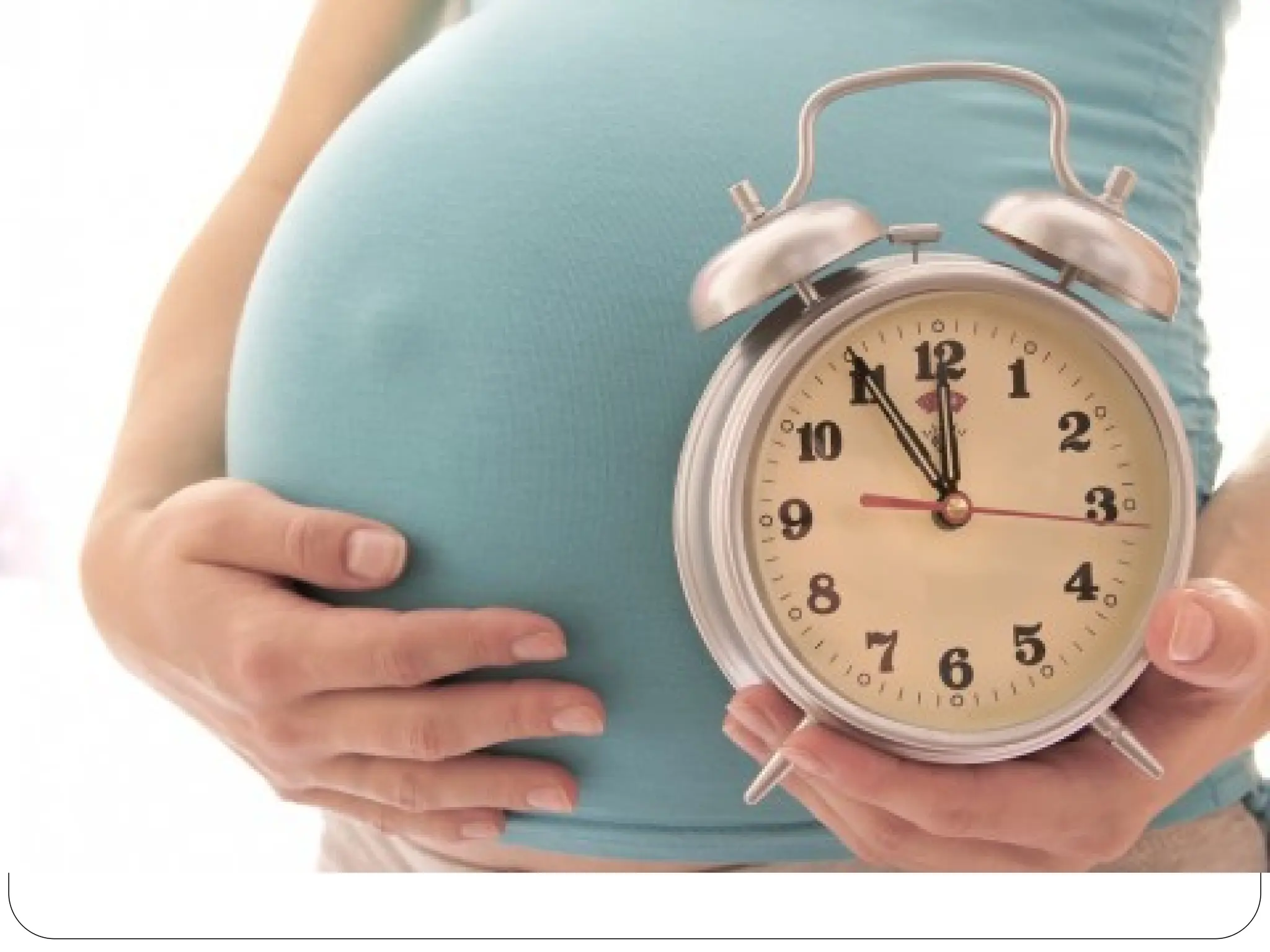
Prolonged labour
Definition
The labour is prolonged when the combined duration of the
first and second stage is more than the arbitrary time limit
of 18 hours.
[ D.C.Dutta]
Prolonged labour is defined when the first and second
stage of labour last more than 24 hours, currently duration
is taken as more than 18 hours. Duration of labour is
calculated from mother’s subjective estimate of labour
onset
[Dawn]
Prolongation due to
 Protracted cervical dilatation in the first stage
 Inadequate descent of the presenting part during the first or
in the second stage
 Labour considered prolonged when the cervical dilatation
rate is < 1 cm/hr and the descent of the presenting part is <
1 cm/hr for a period of minimum 4 hours observation.
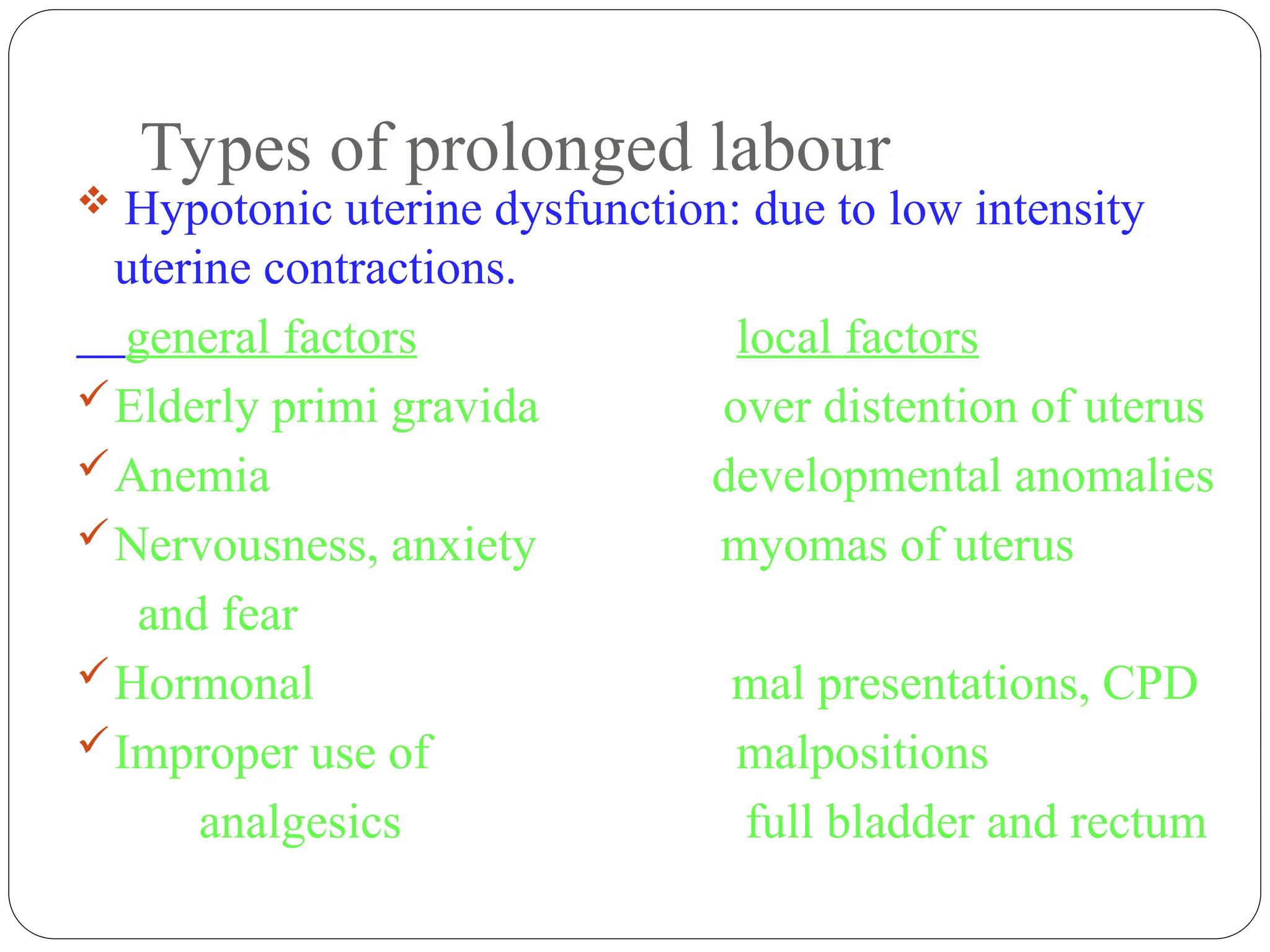
Types of prolonged labour
 Hypotonic uterine dysfunction: due to low intensity
uterine contractions.
general factors local factors
Elderly primi gravida over distention of uterus
Anemia developmental anomalies
Nervousness, anxiety myomas of uterus
and fear
Hormonal mal presentations, CPD
Improper use of malpositions
analgesics full bladder and rectum
Cont…
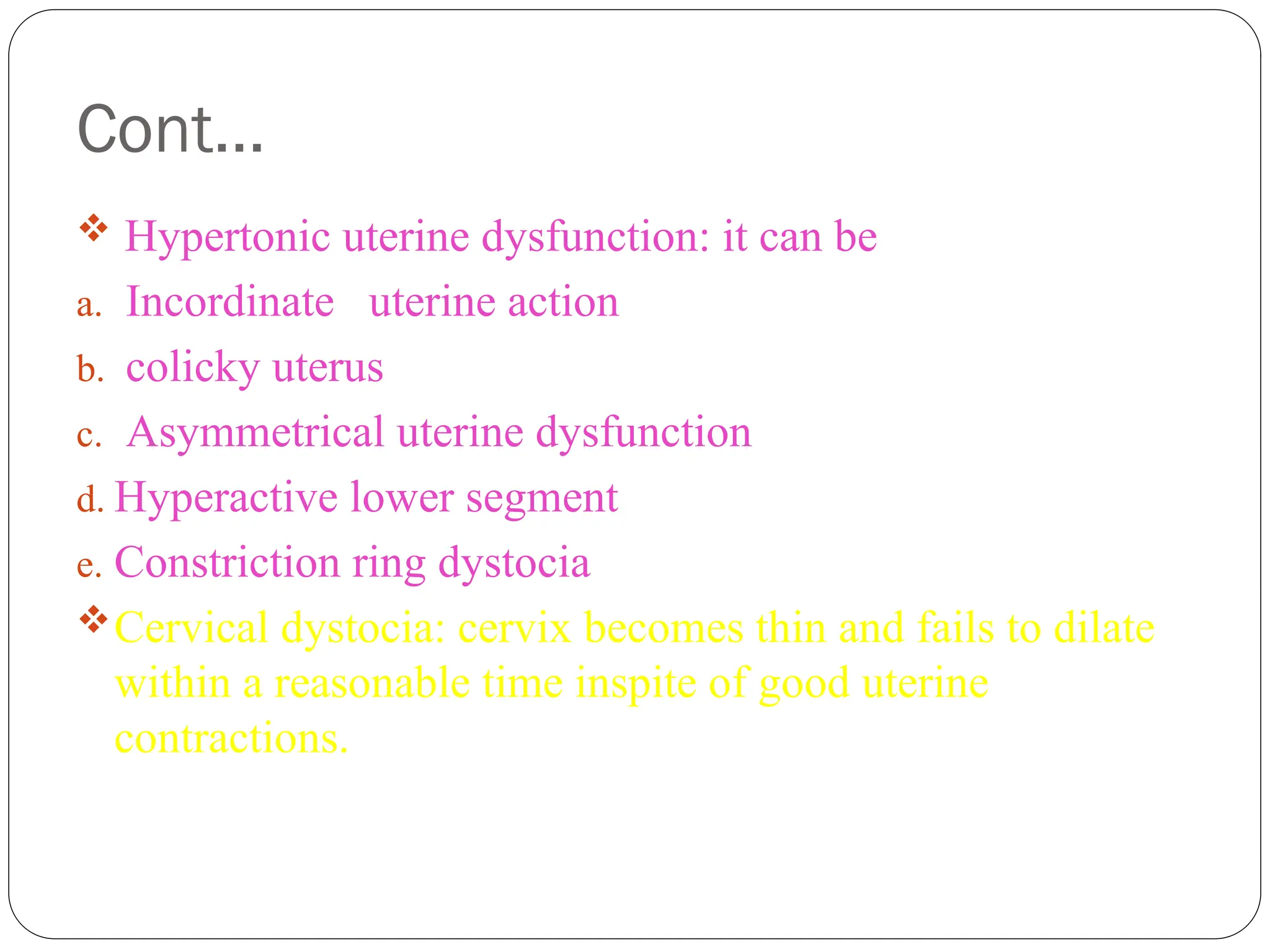
 Hypertonic uterine dysfunction: it can be
a. Incordinate uterine action
b. colicky uterus
c. Asymmetrical uterine dysfunction
d. Hyperactive lower segment
e. Constriction ring dystocia
Cervical dystocia: cervix becomes thin and fails to dilate
within a reasonable time inspite of good uterine
contractions.
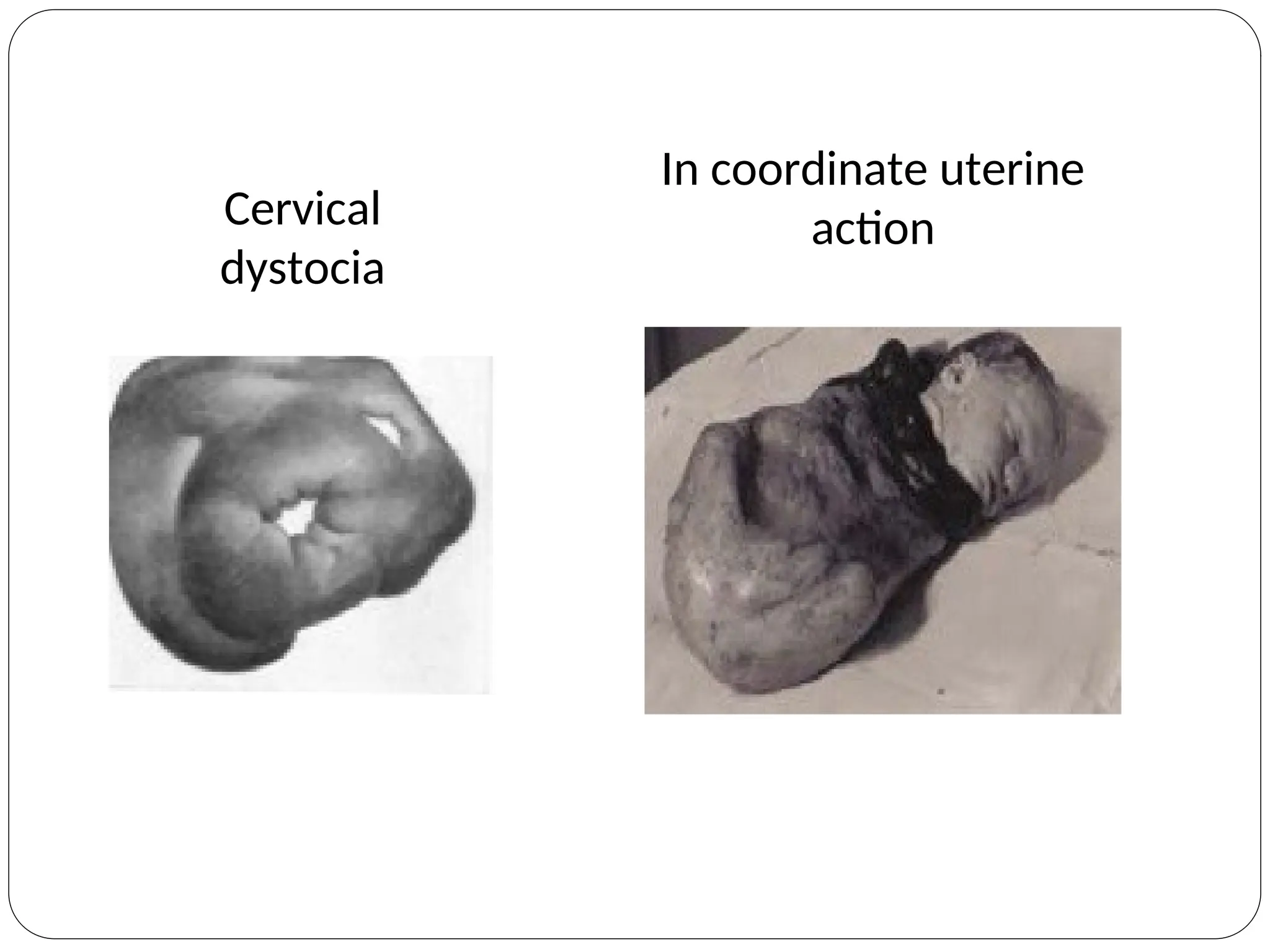
Cervical
dystocia
In coordinate uterine
action
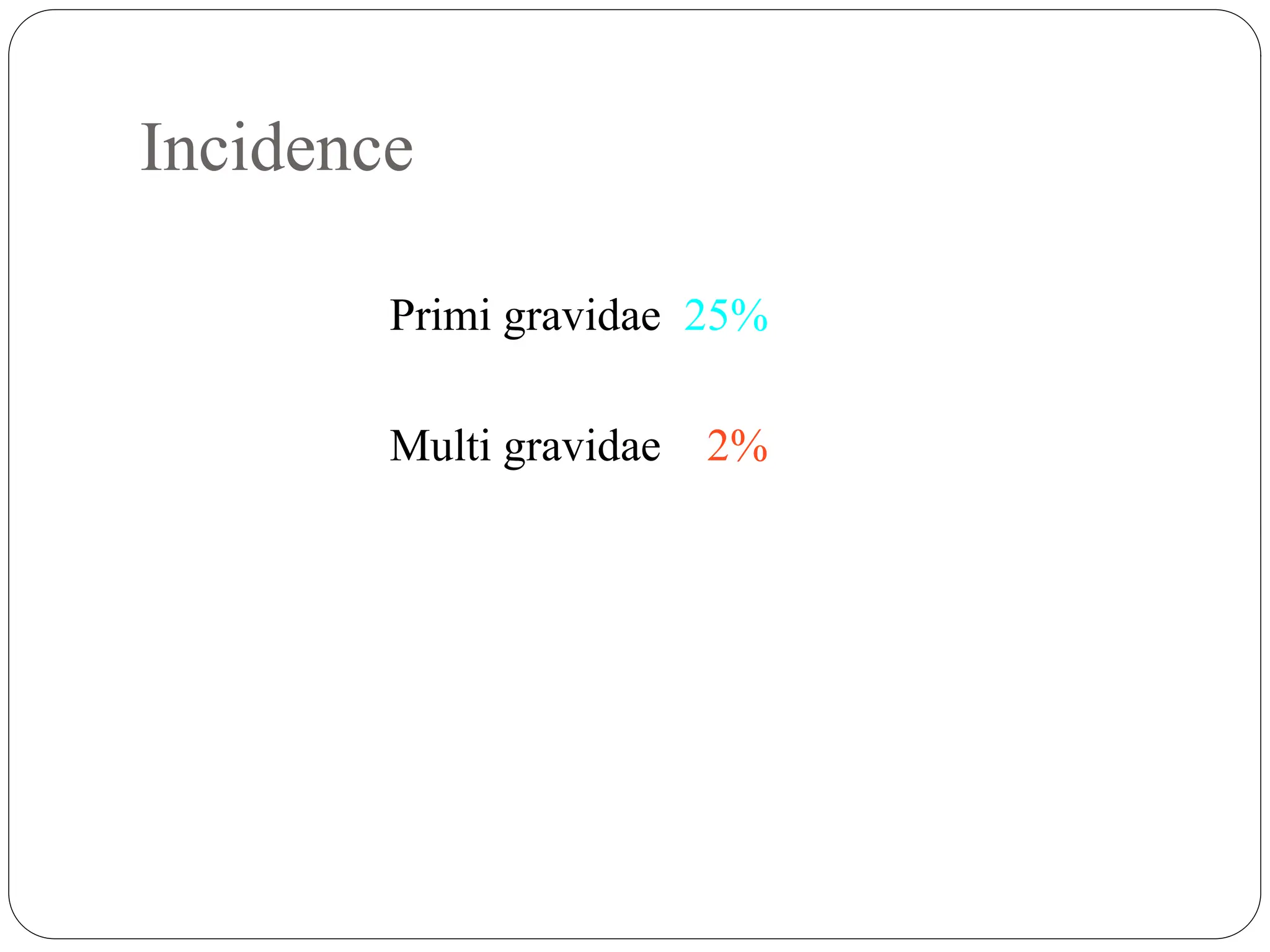
Incidence
Primi gravidae 25%
Multi gravidae 2%
Risk factors of prolonged labour
 age and parity: commonly primigravidae, more in elderly
one
 CPD and fetal malposition
 Uterine distention- twins, hydramnios
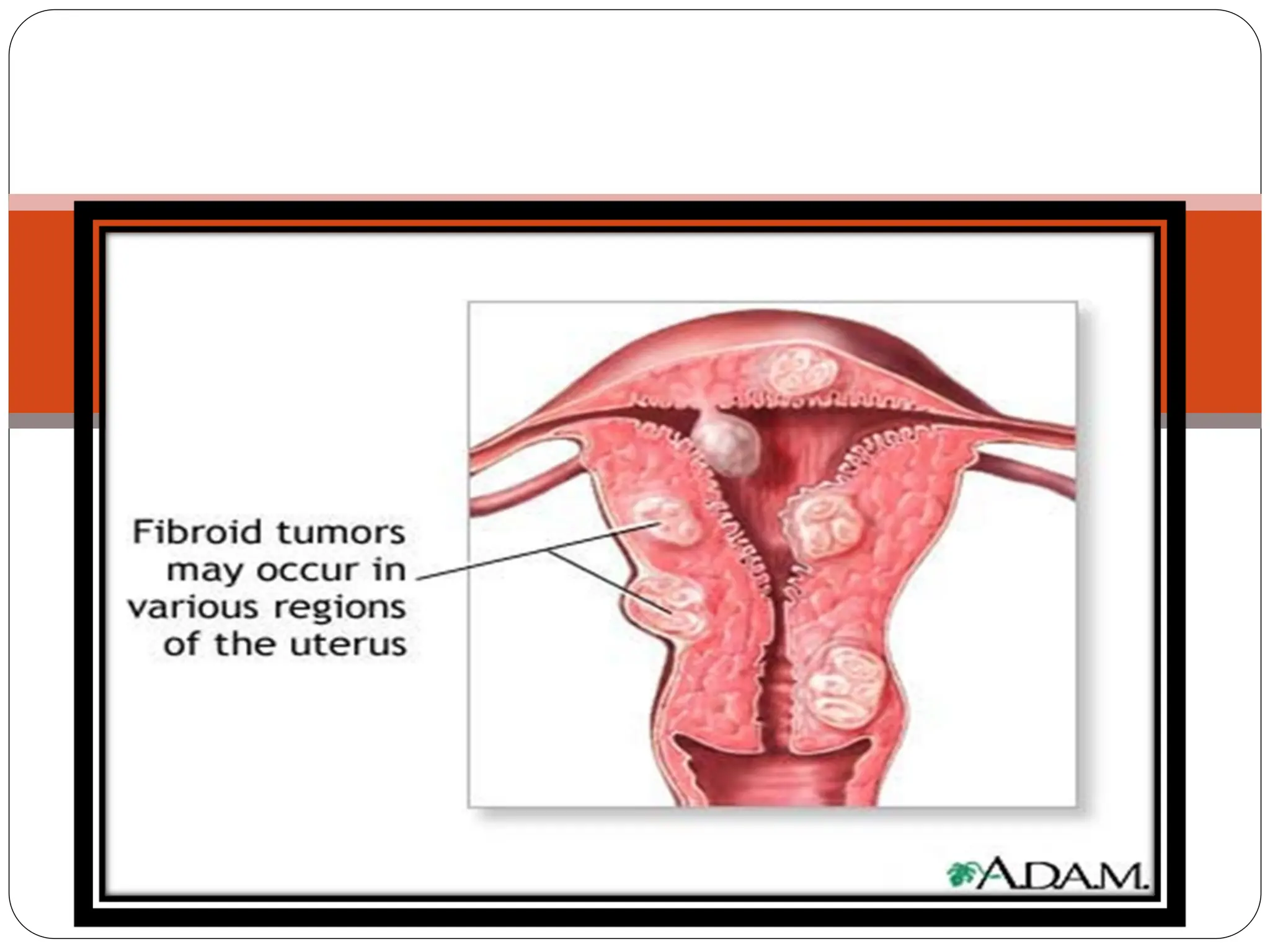
 Uterine defect- fibroid, malformation
 Nervousness, fear and emotion
 injudicious use of analgesia in labour
 injudicious induction of labour by ARM and oxytocin
drip.
 unknown cause.
Causes of prolonged labour
Faults in power [commonest cause]
*inefficient uterine dysfunction
*constriction ring
*cervical dystocia
*over dose of sedative and analgesics
* epidural analgesia
*improper use of oxytocics
Cont…
Faults in passage:
 PROM
 Contracted pelvis
CPD
Cervical stenosis
Fibroid or carcinoma
Ovarian tumor
Uterine fibroid 20%
Engagement & descent of the
foetal head -
presence of cephalopelvic
disproportion
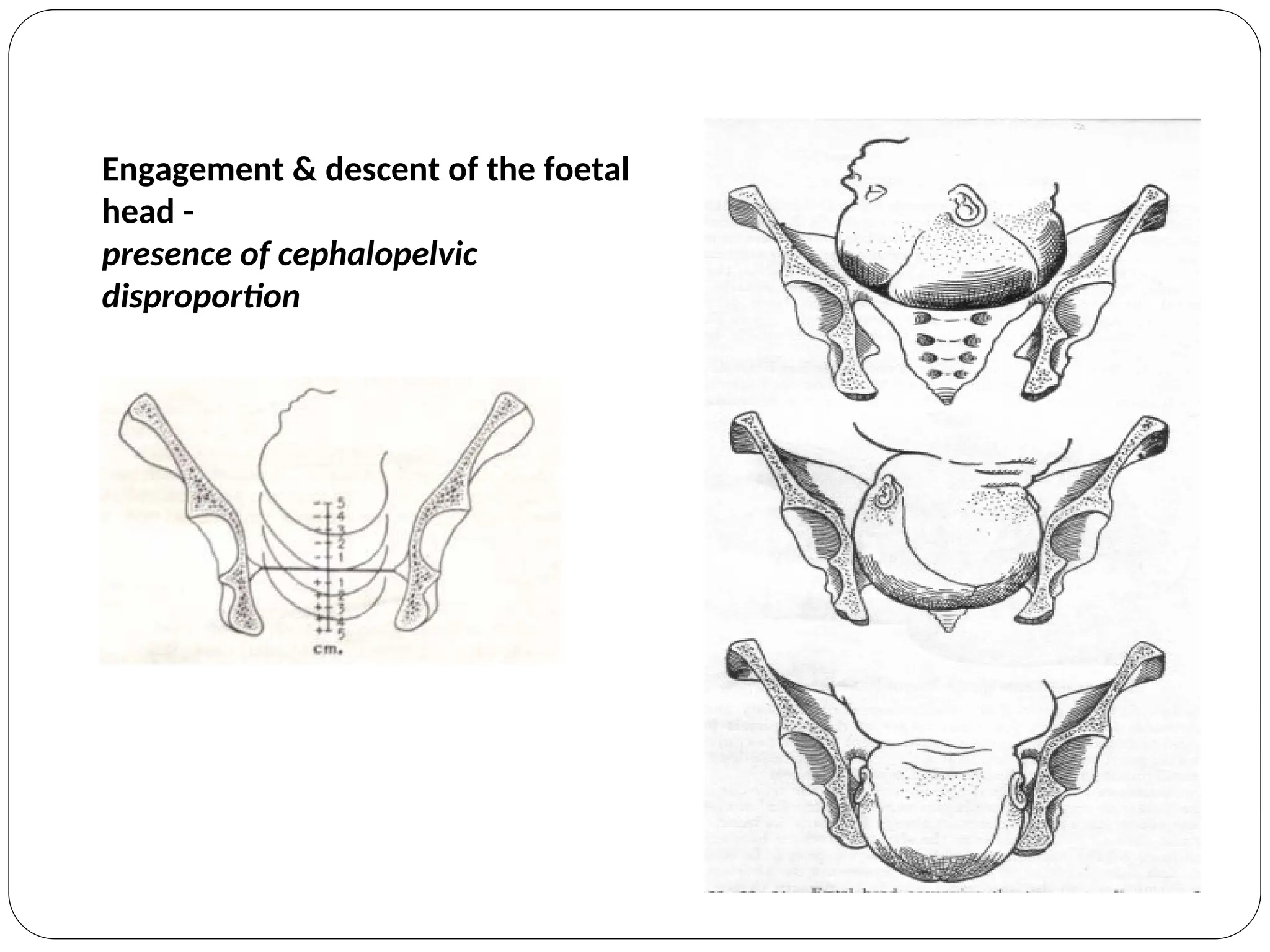
Engagement & descent of the foetal
head -
presence of cephalopelvic
disproportion
Cont…
Faults in passenger:
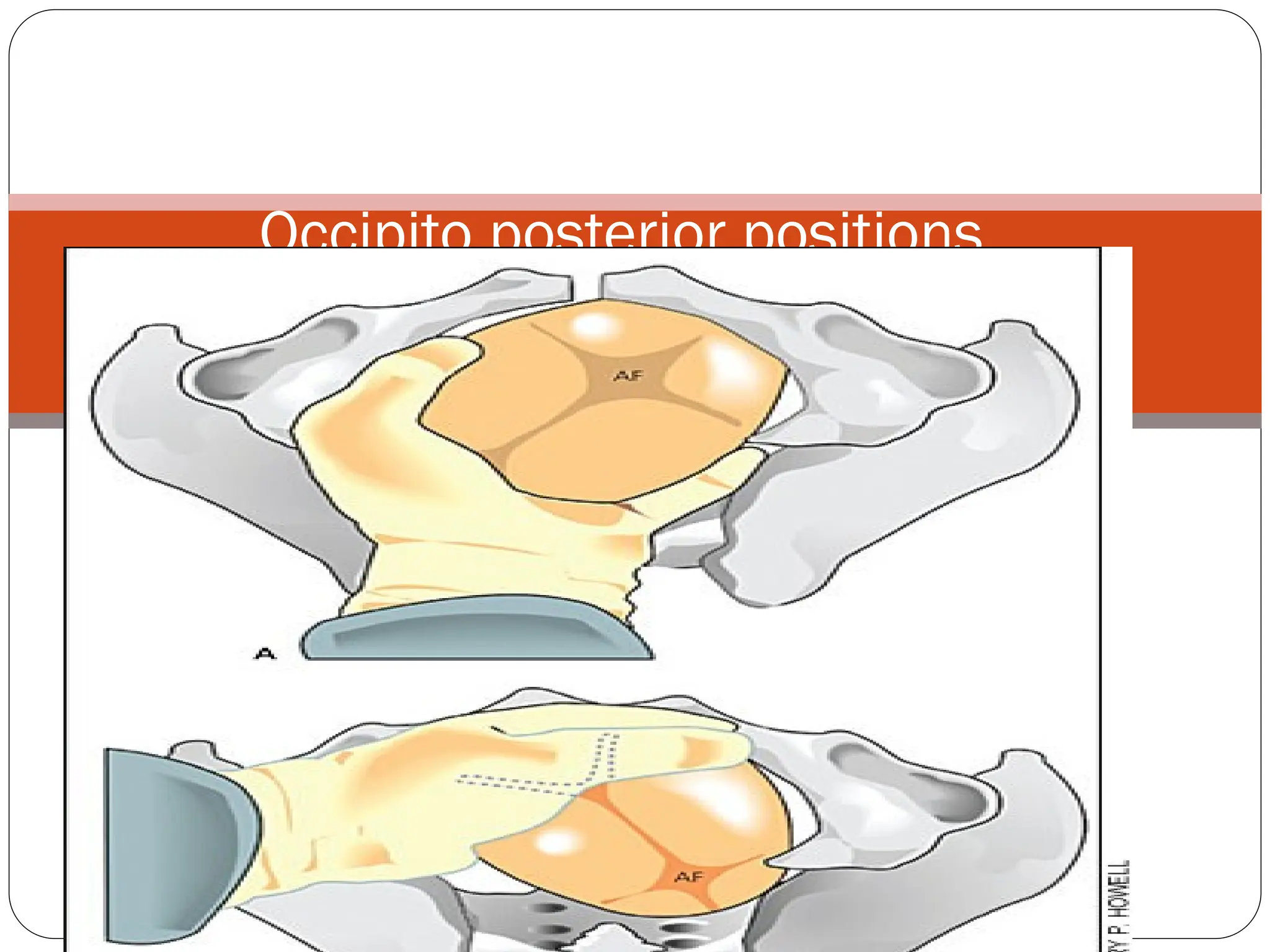
Occipito posterior positions of vertex
 Other malpresentations
 Twins
 Hydramnios[ 30%]
Labour disorders due to inefficient
uterine action
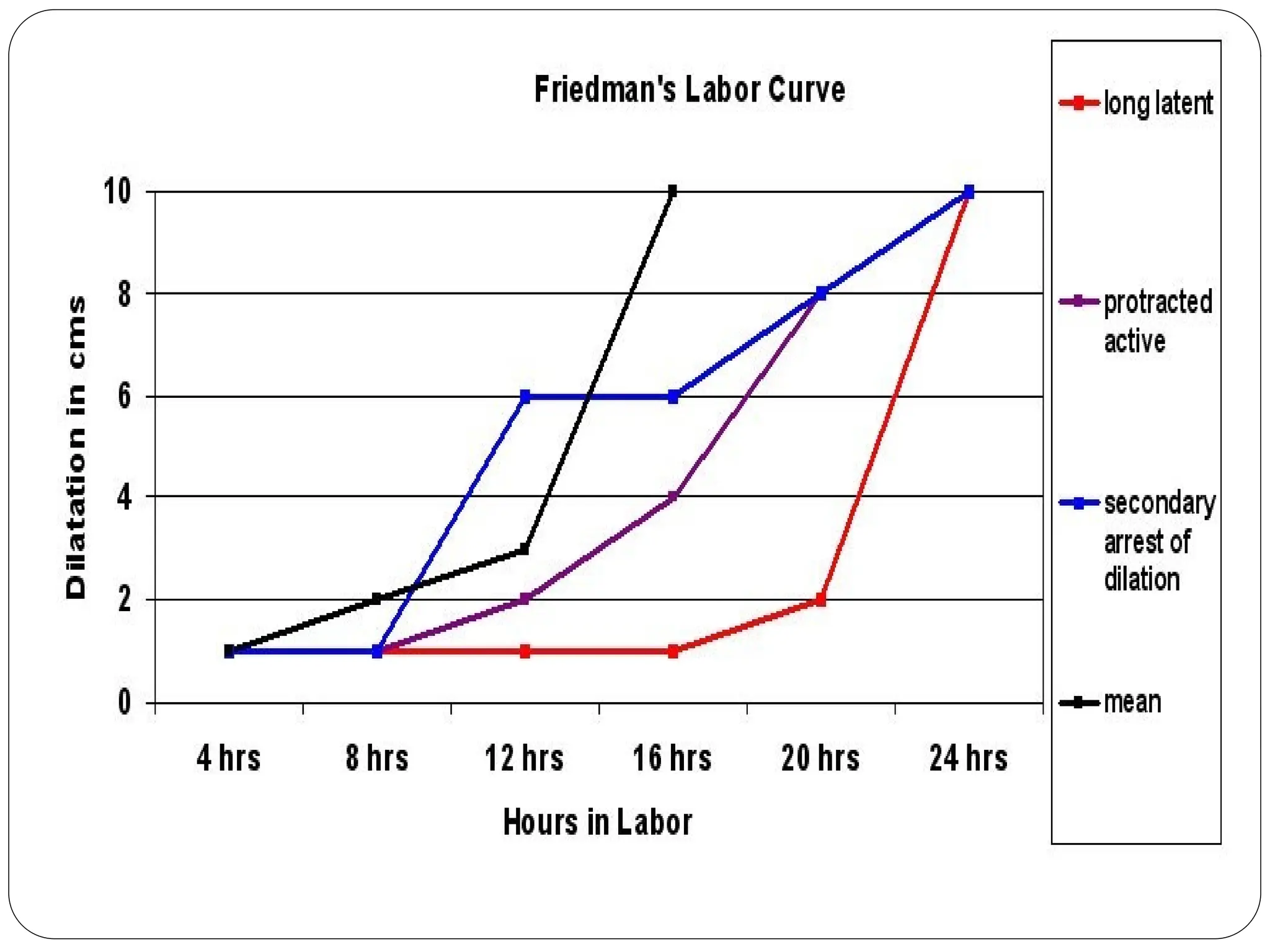
prolonged latent phase beyond 12 hours
a. Hypotonic or hypertonic dysfunction
b. Predisposing factors are sedation, anaesthesia , false
labour,unknown cause.
Prolonged active phase[ protraction disorder]
Slow rate of cervical dilatation below 1cm/hr in
nullipara and 1.5 cm/hr in multipara
Caused by hypotonic dysfunction, hyperactive lower
segment.
Predisposing factors :CPD,fetal malpositions and
sedation
Cont…
secondary arrest of cervical dilatation or head descent
Arrest of cervical dilatation is taken when there is no
cervical change for 2 hrs.
 there is head descent less than 1cm/hr in nullipara or
less than 2cm/hr in multipara and no head descent for
one hour.
Due to hypotonic dysfunction and incordinate uterine
dysfunction.
 The causative factors are occipito posterior positions
[70%], pelvic contraction ,excessive sedation.
DIAGNOSIS
Clinical features
Hypotonic
dysfunction
[more frequent]
Hypertonic
dysfunction
[ less frequent]
1. Timing of
dysfunction
[more
frequent]
At latent phase
from start of labour
usually running to
active phase
Latent phase from start of
labour
2.Labour pains Less painful, short
lasting,
infrequent
abdominal pain
and no back ache
Severely painful ,prolonged
lasting, frequent pain as
abdominal colic or as
backache ,desire to bear
down during contraction
with incompletely dilated
cervix.
Cont…
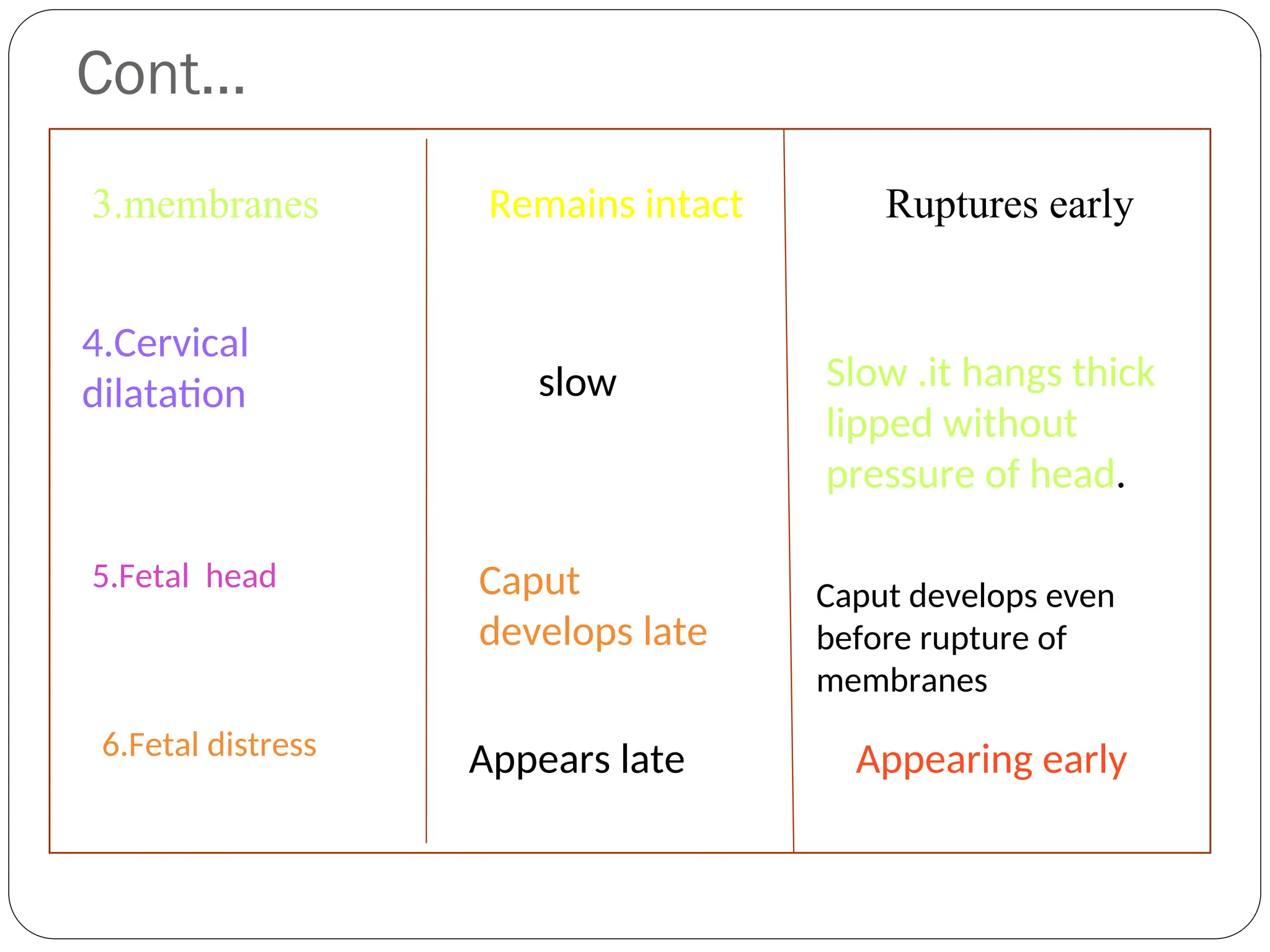
3.membranes Remains intact Ruptures early
4.Cervical
dilatation slow Slow .it hangs thick
lipped without
pressure of head.
5.Fetal head Caput
develops late
Caput develops even
before rupture of
membranes
6.Fetal distress Appears late Appearing early
Cont…
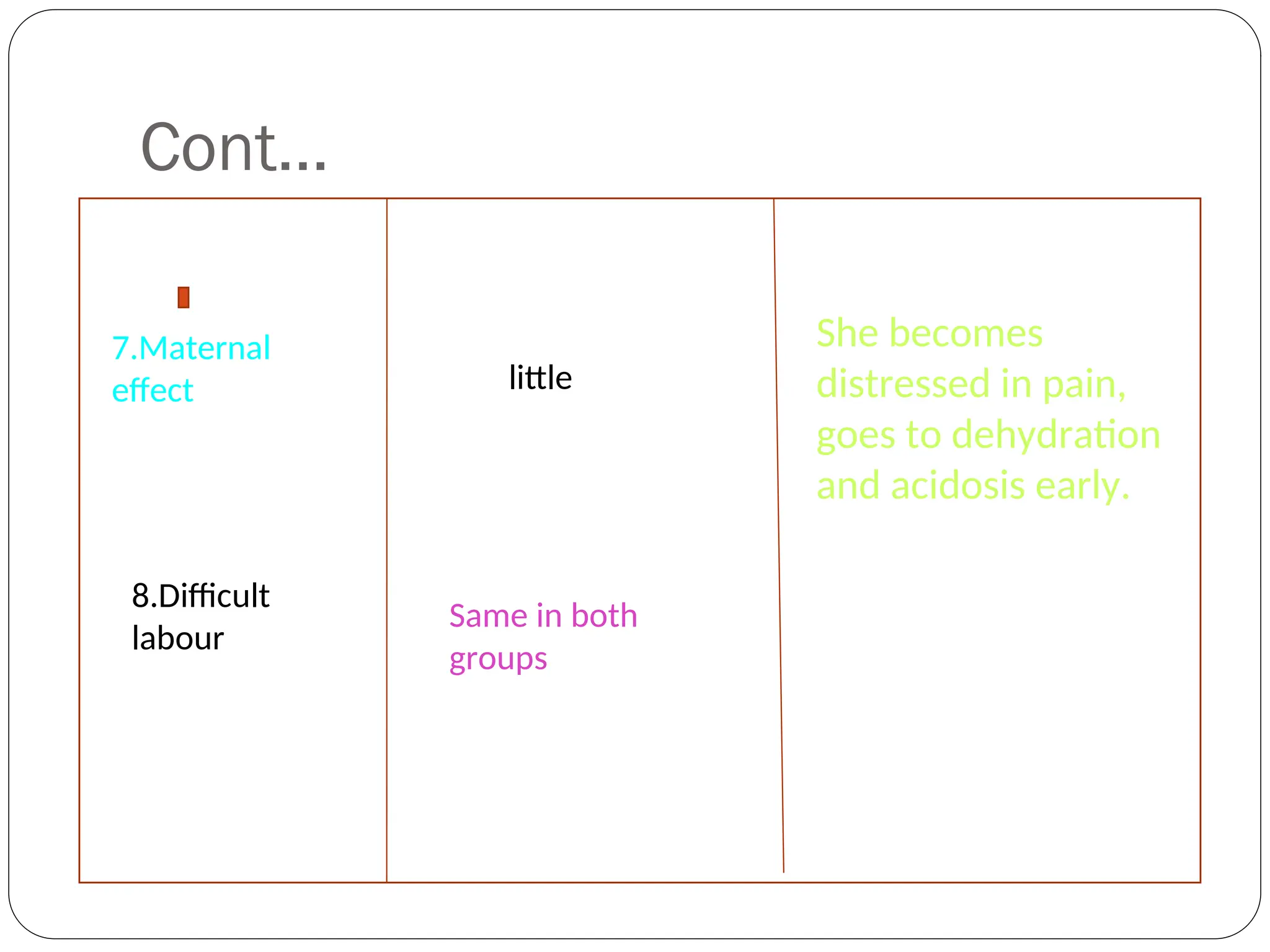
7.Maternal
effect little
She becomes
distressed in pain,
goes to dehydration
and acidosis early.
8.Difficult
labour
Same in both
groups
Cont…
Other measures such as :
 radiography, CT or MRI
 Abdominal and vaginal examination.
 partograph
Cont…
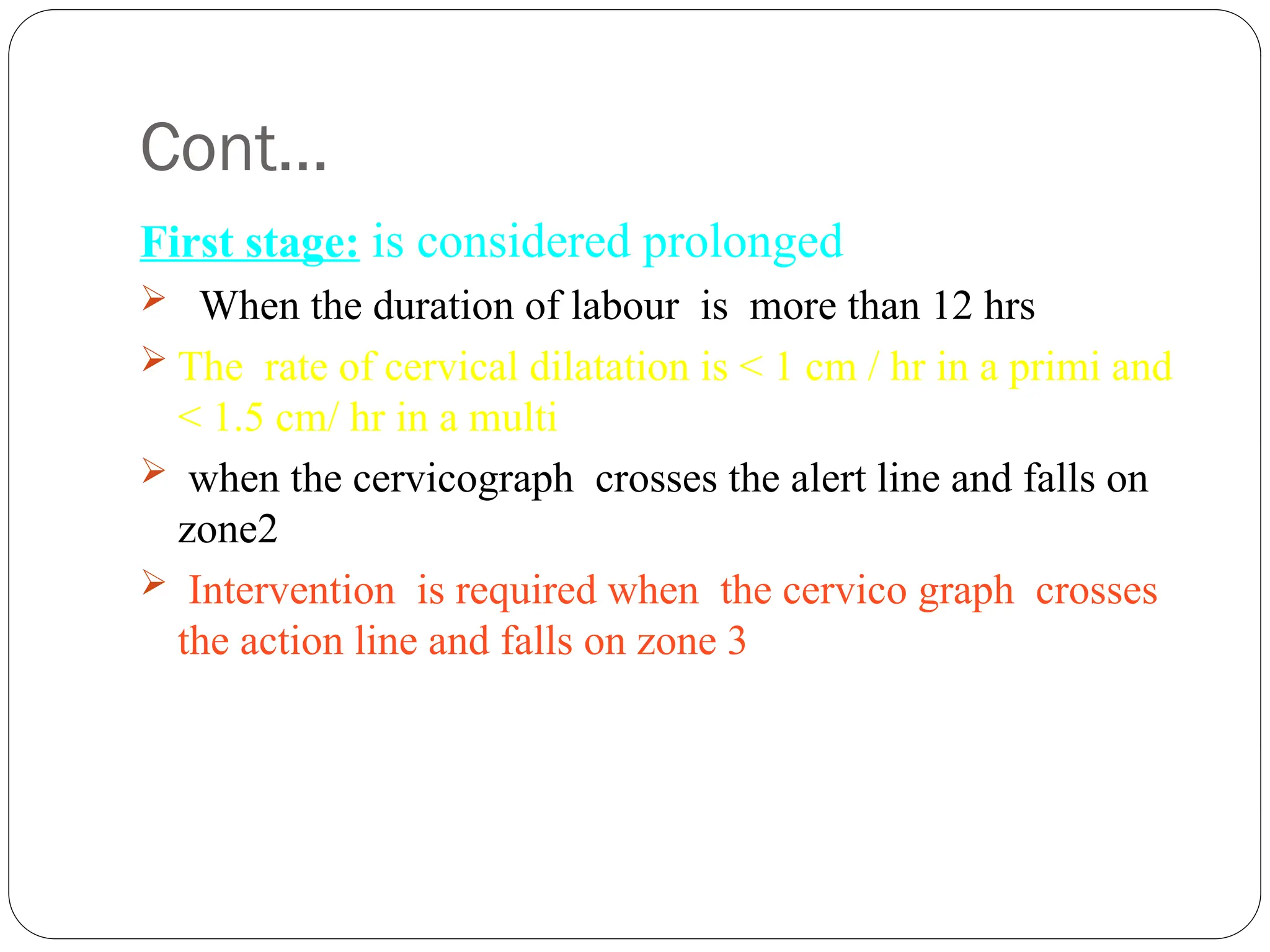
First stage: is considered prolonged
 When the duration of labour is more than 12 hrs
 The rate of cervical dilatation is < 1 cm / hr in a primi and
< 1.5 cm/ hr in a multi
 when the cervicograph crosses the alert line and falls on
zone2
 Intervention is required when the cervico graph crosses
the action line and falls on zone 3
Cont…
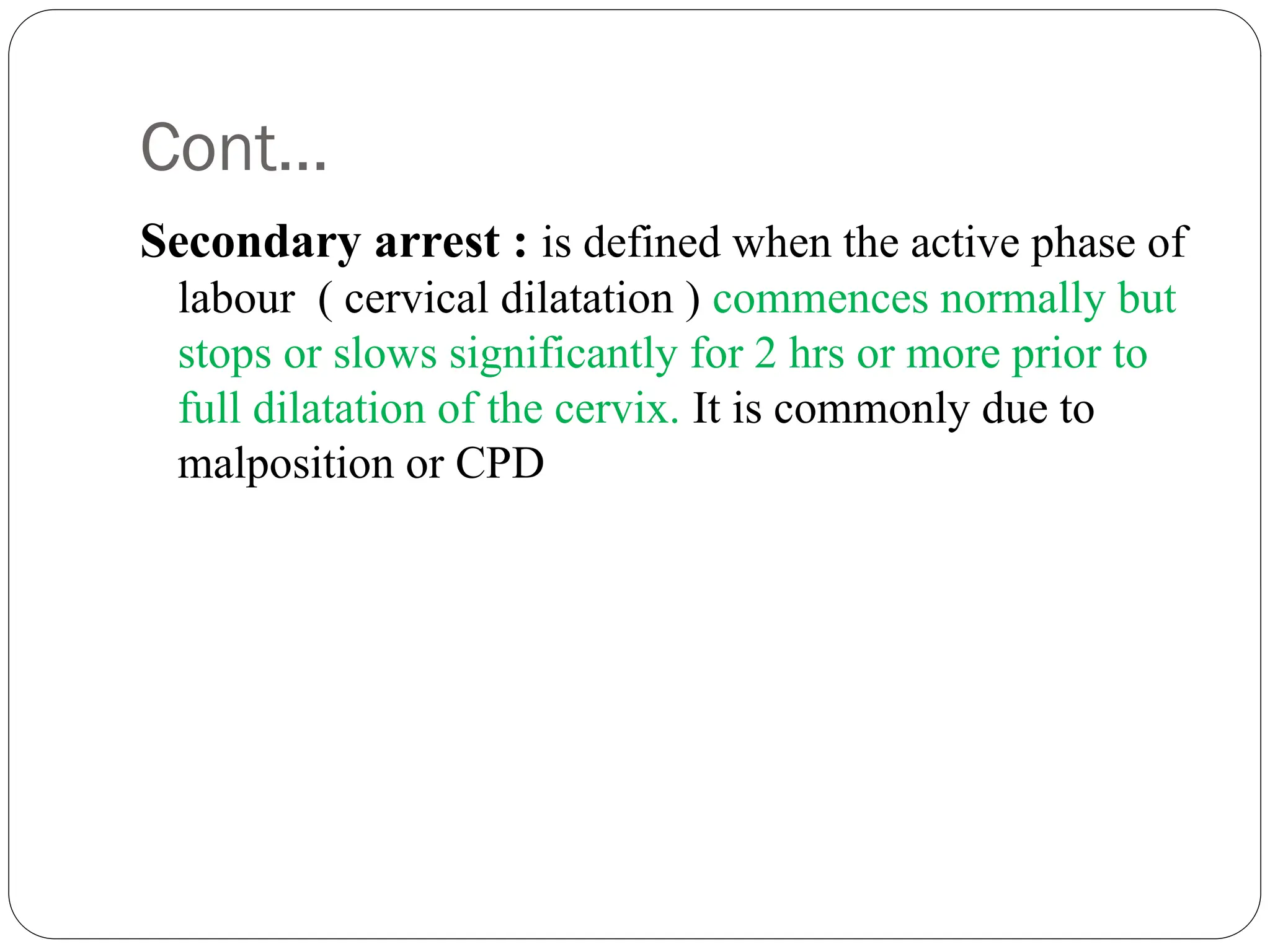
Secondary arrest : is defined when the active phase of
labour ( cervical dilatation ) commences normally but
stops or slows significantly for 2 hrs or more prior to
full dilatation of the cervix. It is commonly due to
malposition or CPD
Cont…
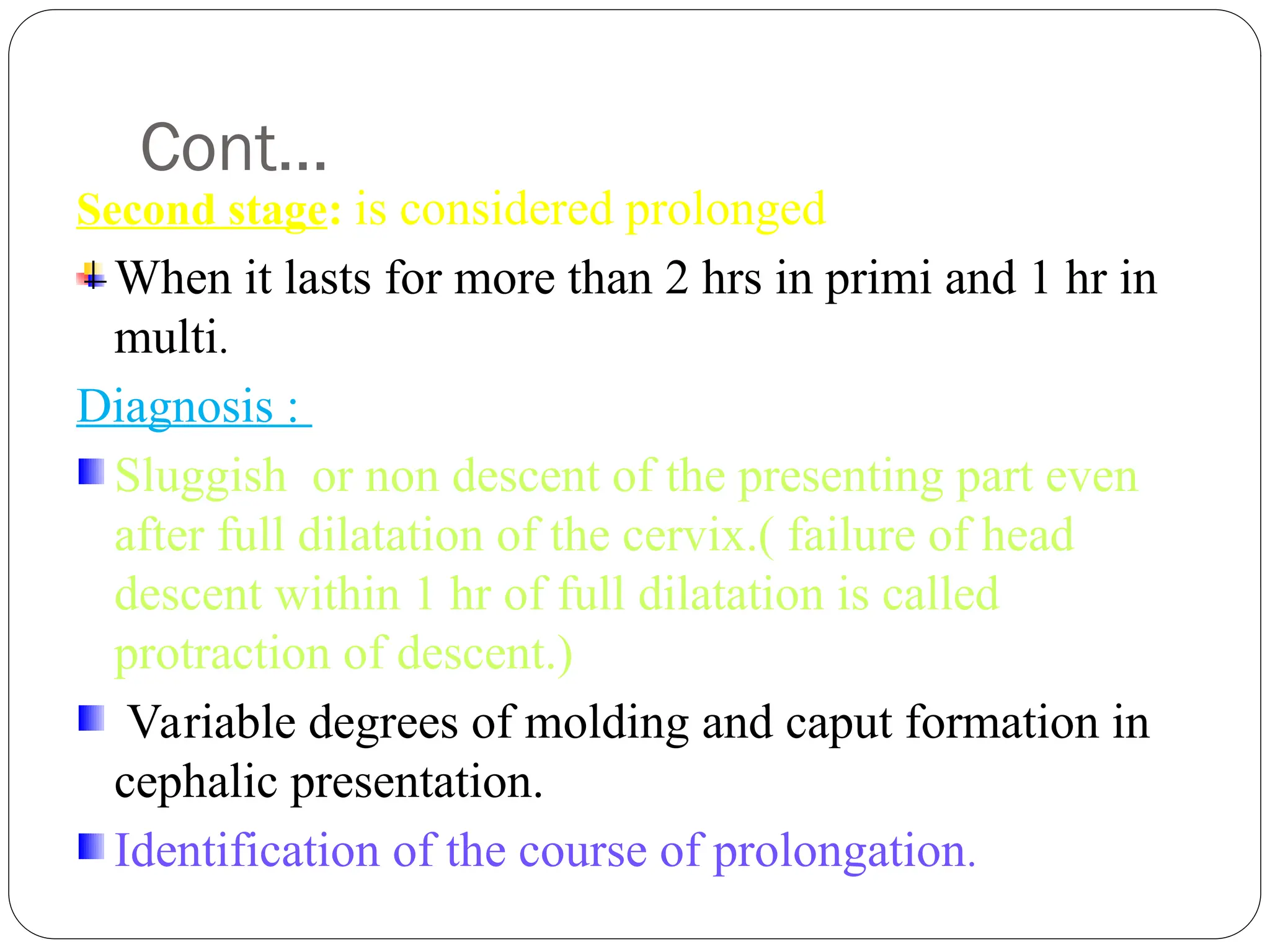
Second stage: is considered prolonged
When it lasts for more than 2 hrs in primi and 1 hr in
multi.
Diagnosis :
Sluggish or non descent of the presenting part even
after full dilatation of the cervix.( failure of head
descent within 1 hr of full dilatation is called
protraction of descent.)
Variable degrees of molding and caput formation in
cephalic presentation.
Identification of the course of prolongation.
Dangers(Complications)
Maternal effects:
Distress
PPH
Trauma to genital tract
Increased operative delivery
Puerperal sepsis
Sub involution.
Cont…
Fetal effects :
Hypoxia
Intra uterine infection
Intra cranial stress or hemorrhage
Increased operative delivery
Management
Prevention :
Antenatal or early intra natal detection of the factors
likely to produce prolonged labour.
 Use of partograph
Selection and judicious augmentation of labour by
low rupture of the membranes followed by oxytocin
drip.
Change of posture in labour, other than supine to
increase uterine contractions, avoidance of
dehydration in labour and use of adequate analgesia
for pain relief.
Cont…
Actual Rx:
Careful evaluation to find out
Cause of prolonged labour
Effect on the mother
Effect on the fetus
Cont…
Definitive Rx :
First stage
patient is referred to level 11 care without any solid food.
Only water is allowed orally.
Maintain partograph
Identify or diagnosis of hypotonic and hypertonic labour
dysfunction.
Monitor maternal vital signs and FHS
Identify CPD or fetal mal position.
Maintain I.V line with 5% DW/RL
Antibiotics ( cefazoline ) 1 gm I.V and repeated after 6 hrs on
PROM
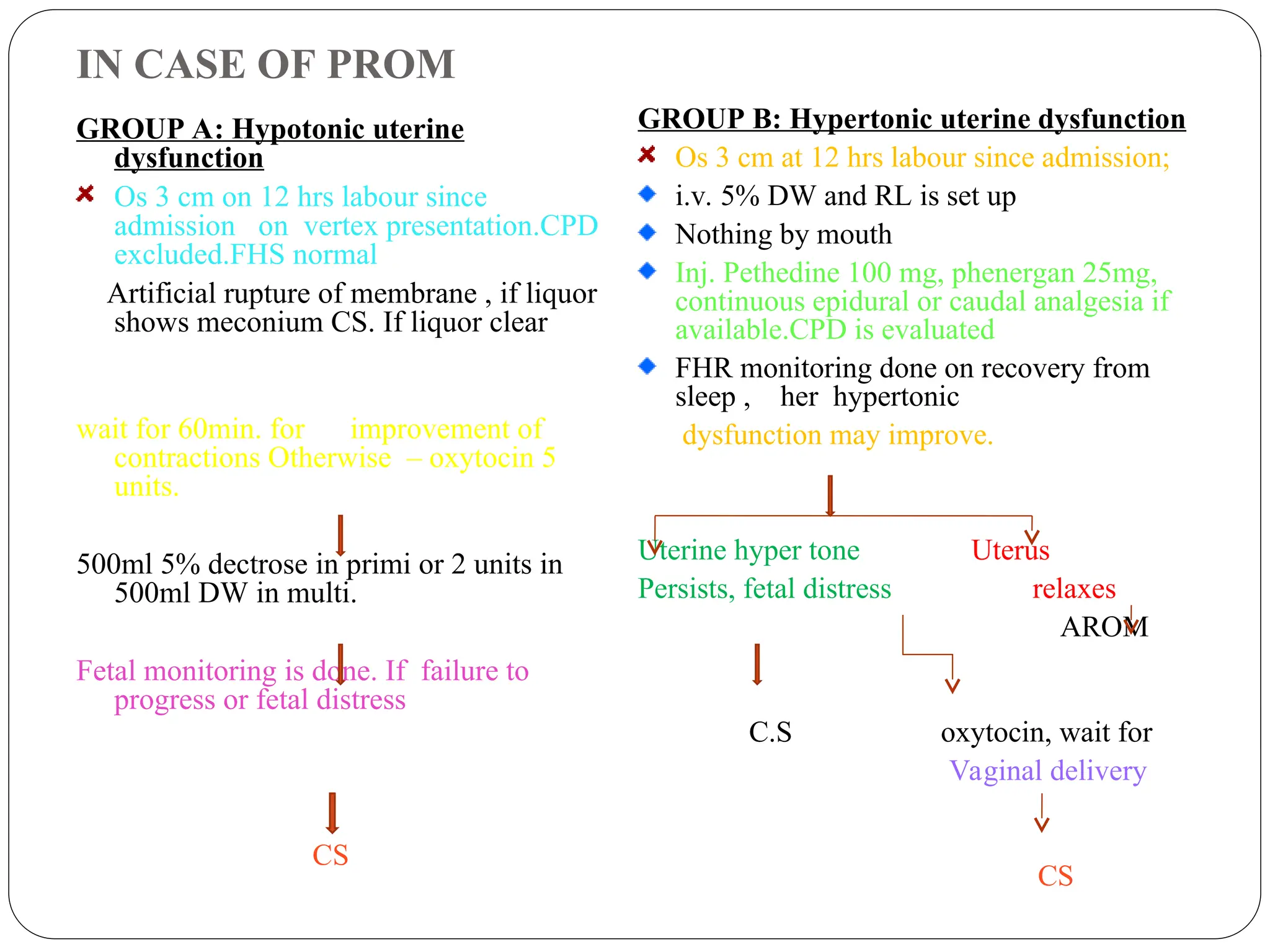
IN CASE OF PROM
GROUP A: Hypotonic uterine
dysfunction
Os 3 cm on 12 hrs labour since
admission on vertex presentation.CPD
excluded.FHS normal
Artificial rupture of membrane , if liquor
shows meconium CS. If liquor clear
wait for 60min. for improvement of
contractions Otherwise – oxytocin 5
units.
500ml 5% dectrose in primi or 2 units in
500ml DW in multi.
Fetal monitoring is done. If failure to
progress or fetal distress
CS
GROUP B: Hypertonic uterine dysfunction
Os 3 cm at 12 hrs labour since admission;
i.v. 5% DW and RL is set up
Nothing by mouth
Inj. Pethedine 100 mg, phenergan 25mg,
continuous epidural or caudal analgesia if
available.CPD is evaluated
FHR monitoring done on recovery from
sleep , her hypertonic
dysfunction may improve.
Uterine hyper tone Uterus
Persists, fetal distress relaxes
AROM
C.S oxytocin, wait for
Vaginal delivery
CS
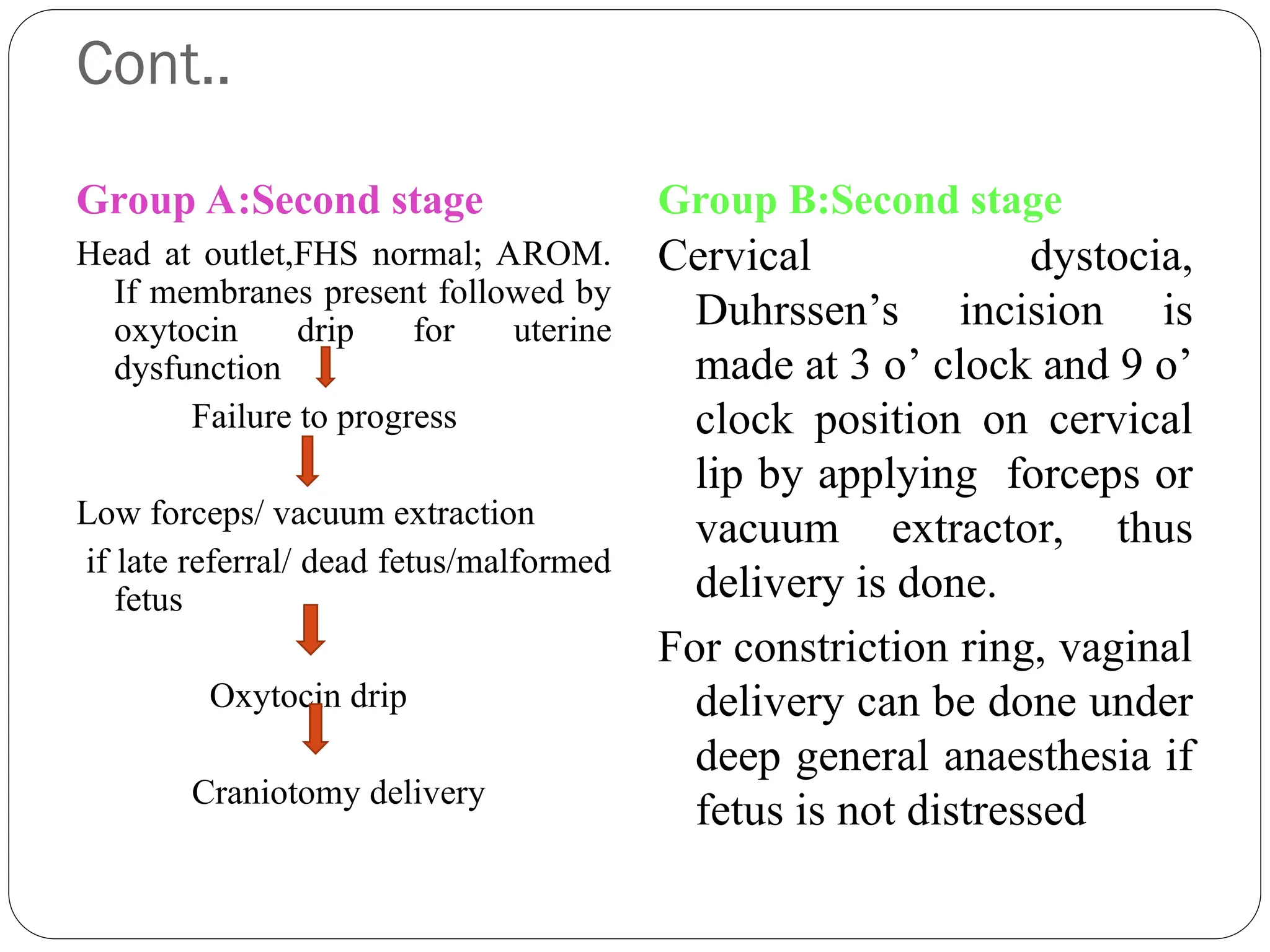
Cont..
Group A:Second stage
Head at outlet,FHS normal; AROM.
If membranes present followed by
oxytocin drip for uterine
dysfunction
Failure to progress
Low forceps/ vacuum extraction
if late referral/ dead fetus/malformed
fetus
Oxytocin drip
Craniotomy delivery
Group B:Second stage
Cervical dystocia,
Duhrssen’s incision is
made at 3 o’ clock and 9 o’
clock position on cervical
lip by applying forceps or
vacuum extractor, thus
delivery is done.
For constriction ring, vaginal
delivery can be done under
deep general anaesthesia if
fetus is not distressed
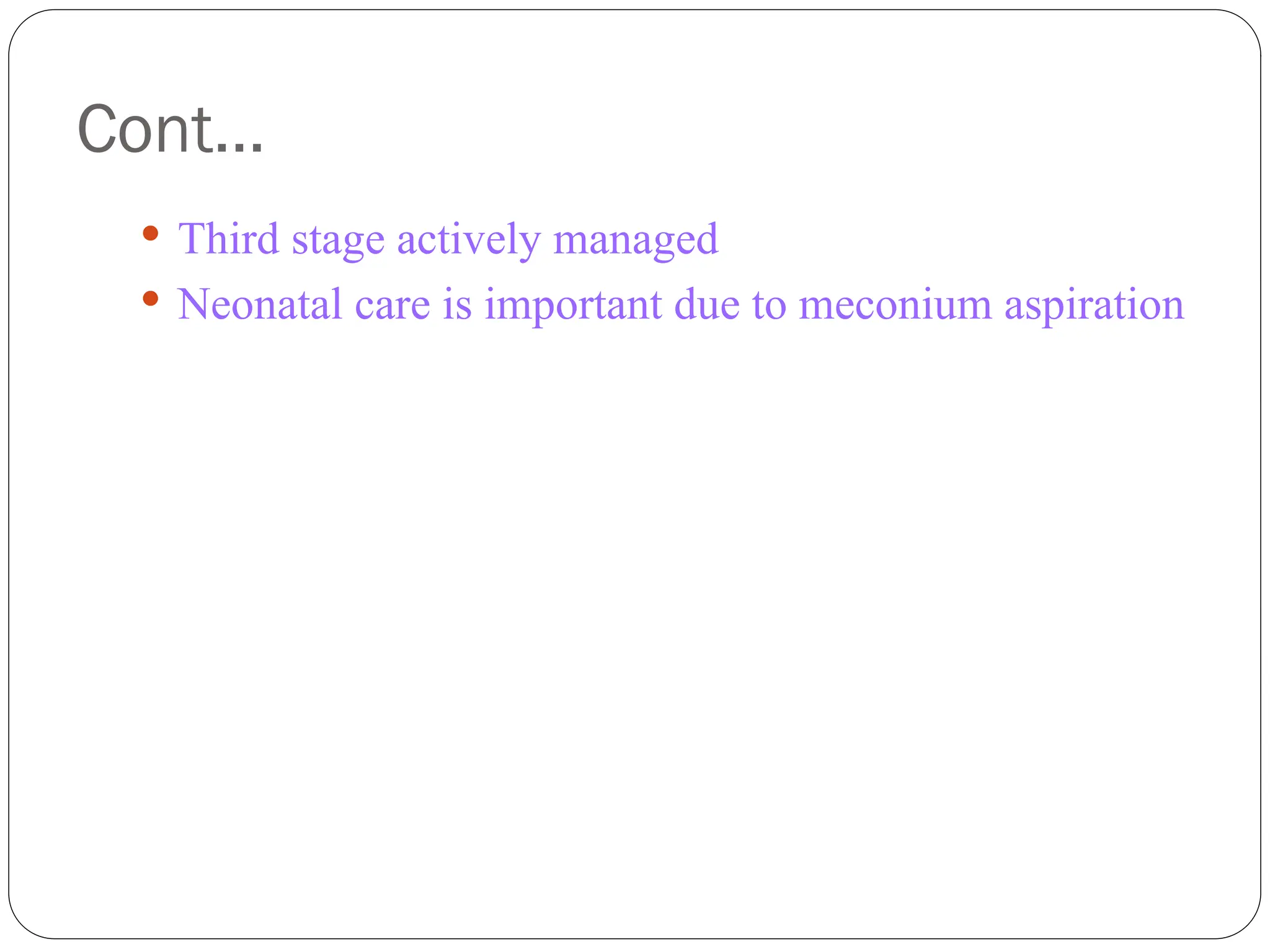
Cont…
 Third stage actively managed
 Neonatal care is important due to meconium aspiration
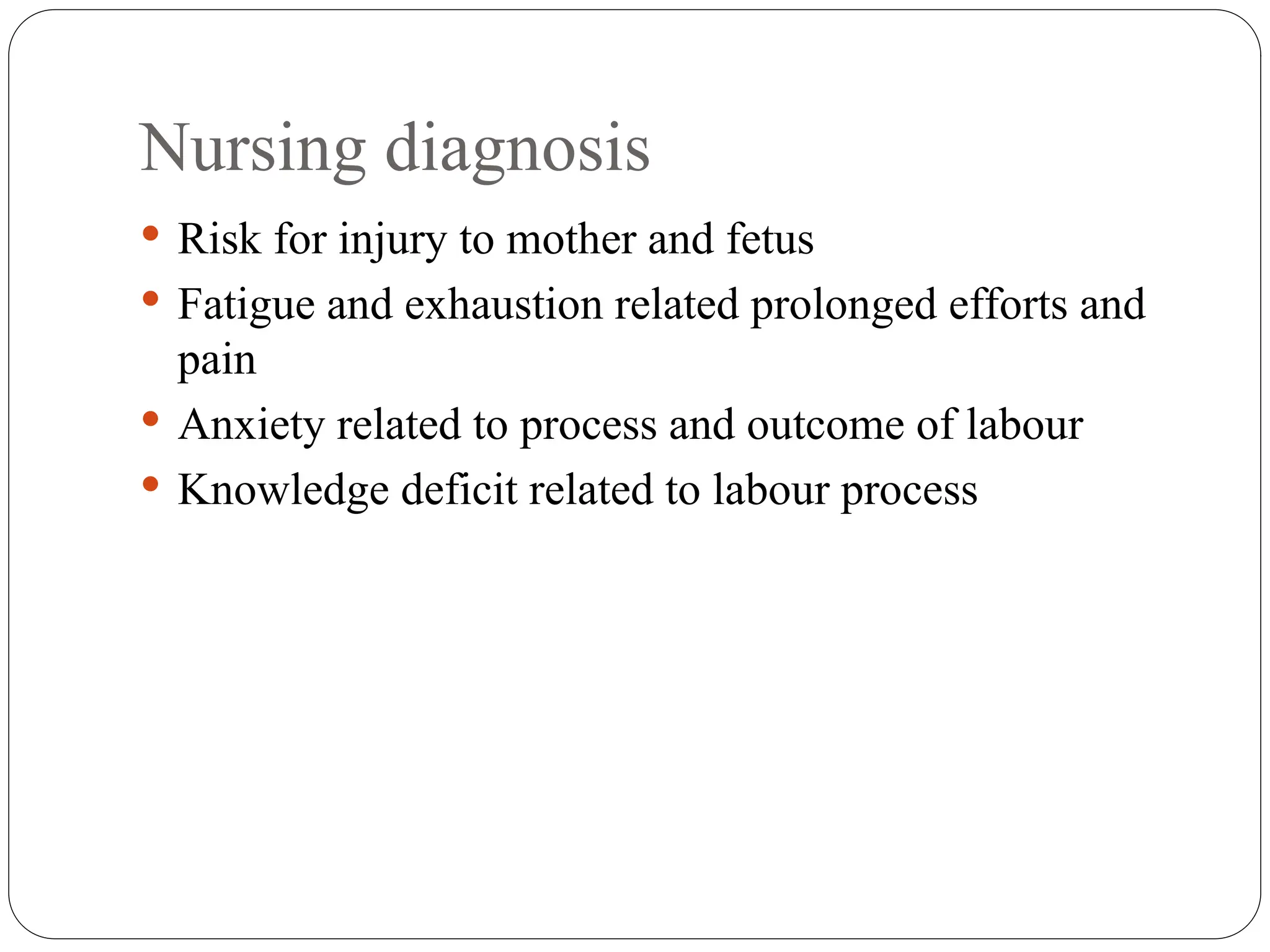
Nursing diagnosis
 Risk for injury to mother and fetus
 Fatigue and exhaustion related prolonged efforts and
pain
 Anxiety related to process and outcome of labour
 Knowledge deficit related to labour process
OBSTRUCTED LABOUR.
ETIOLOGY.
FAULT INTHE PASSAGE.
FAULT INTHE PASSENGER.
FAULT IN THE PASSAGE.
Bony obstruction.
Soft tissue obstruction.
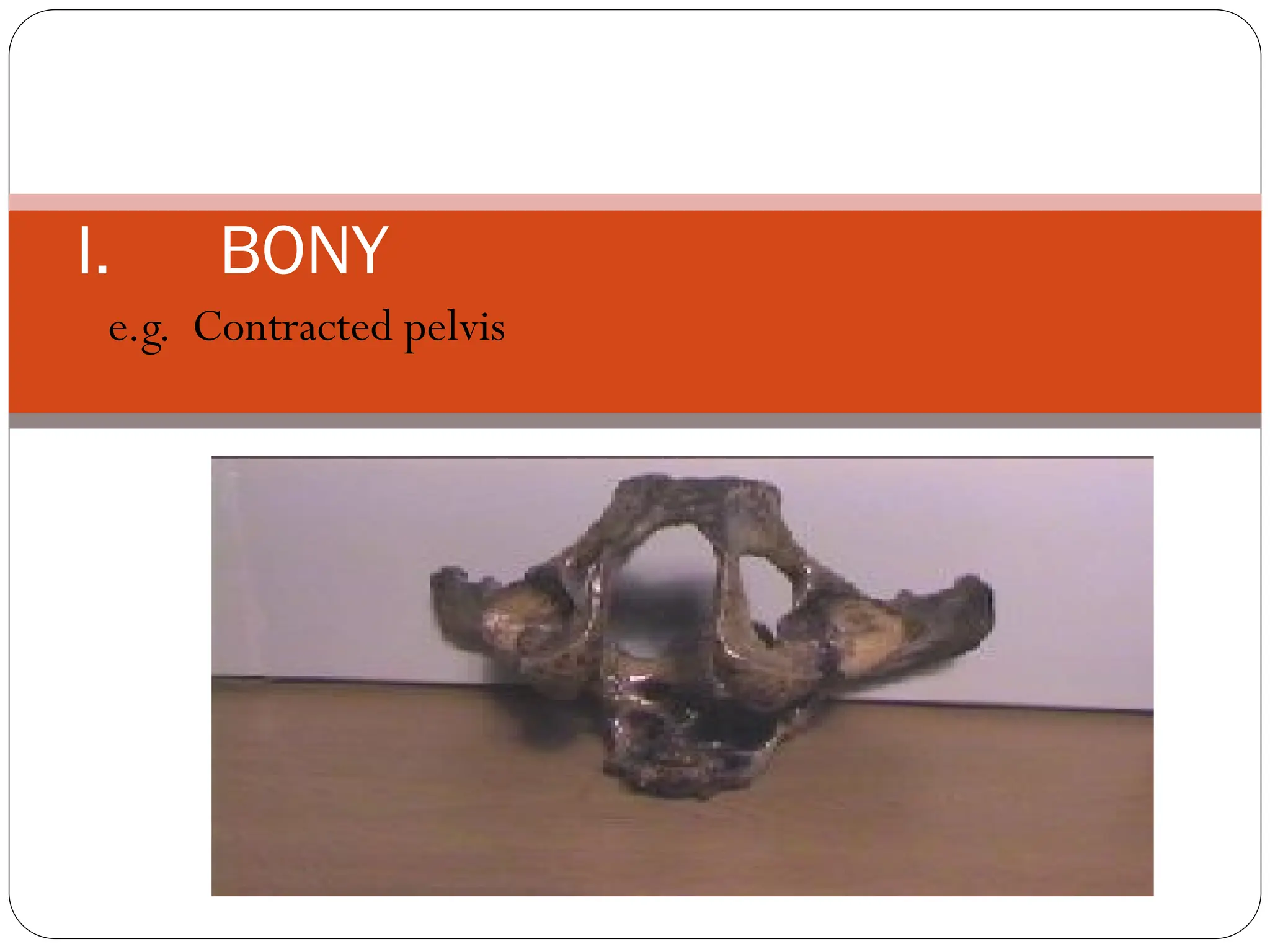
I. BONY
e.g. Contracted pelvis
e.g.Cephalopelvic disproportion
2) SOFT TISSUE OBSTRUCTION
e.g.Cervical dystocia:
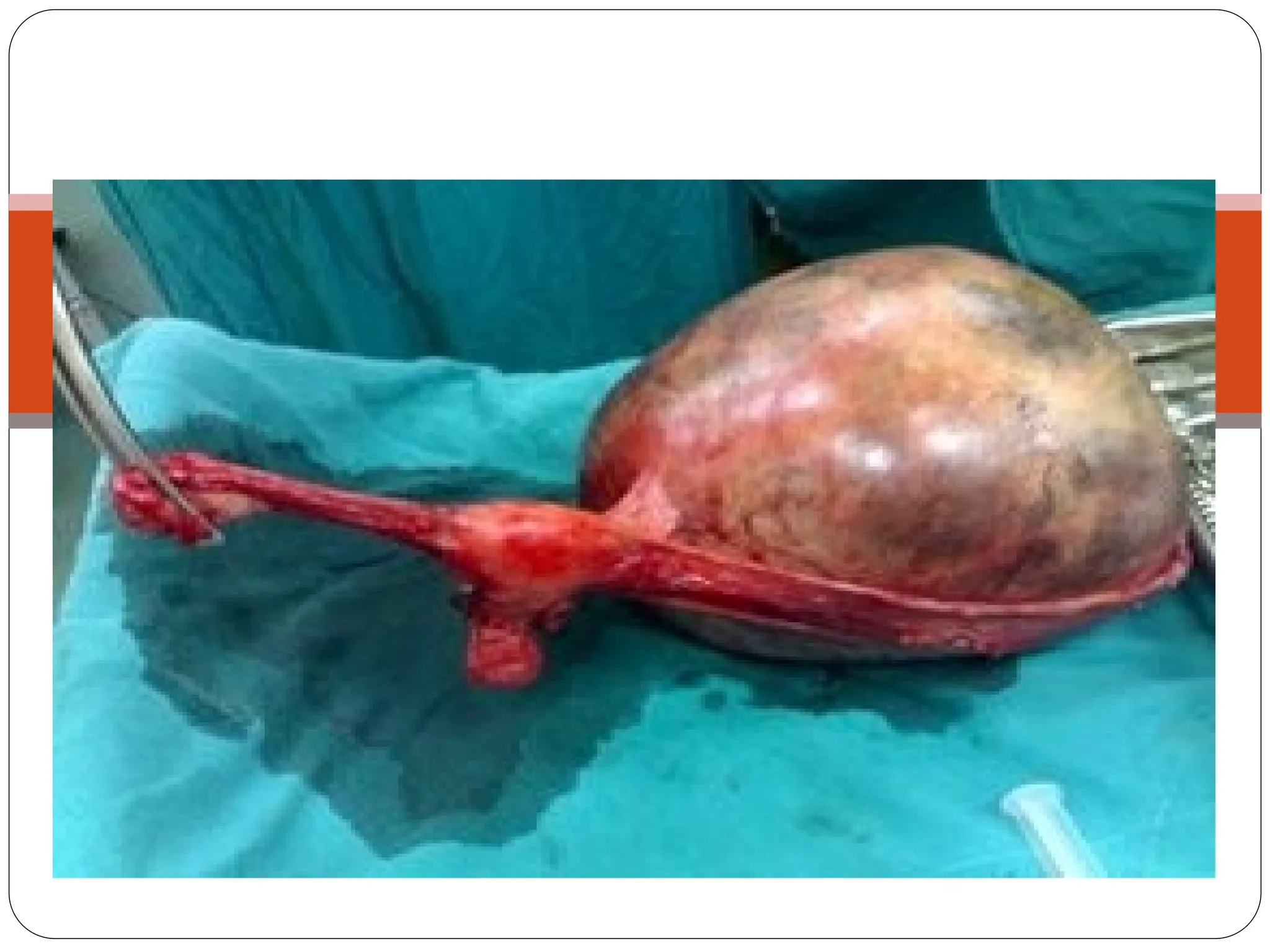
e.g.Cervical or broad ligament fibroid
e.g. Impacted ovarian tumor
e.g.Non gravid horn of a bicornuate uterus:
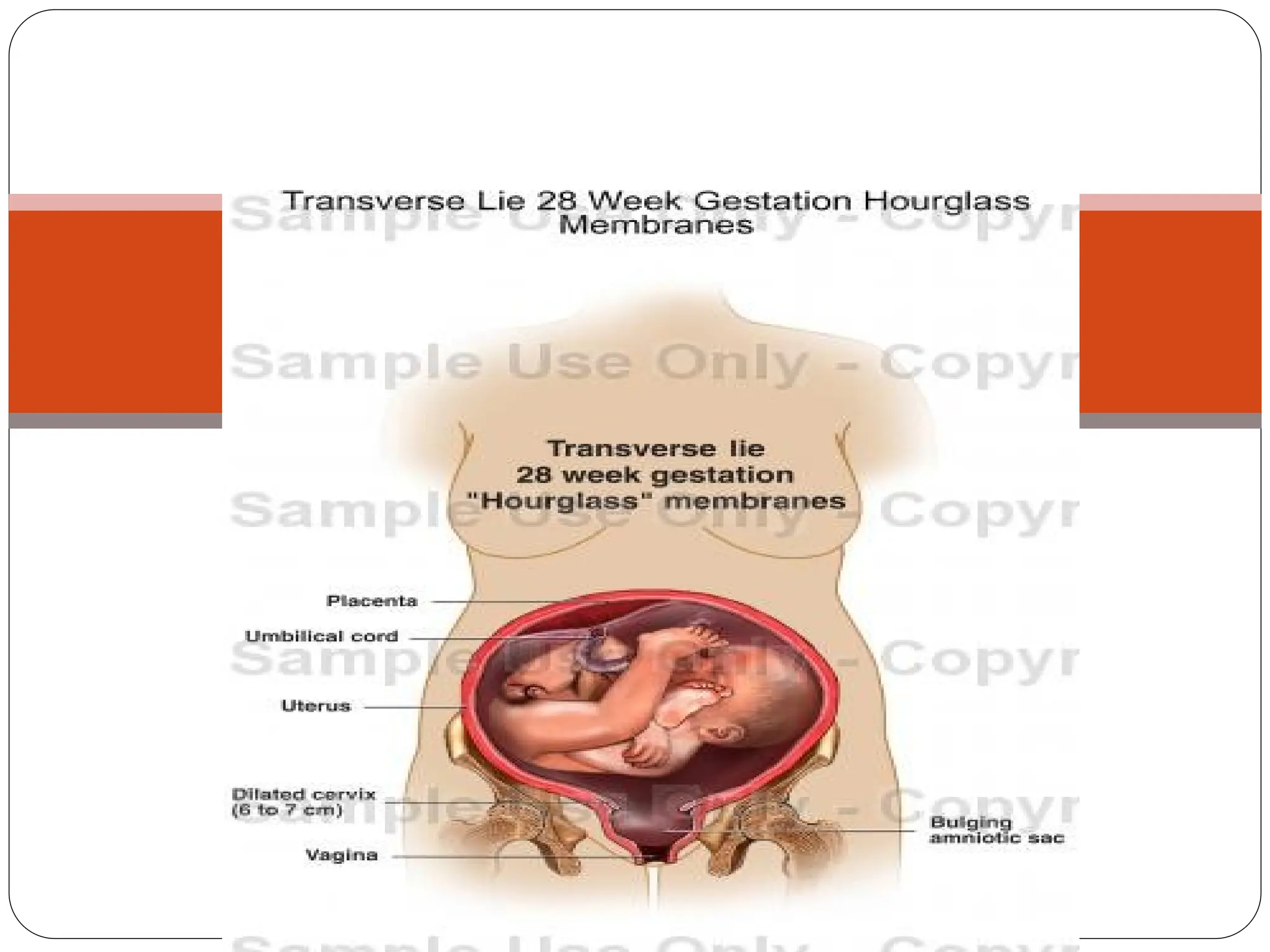
Transverse lie.
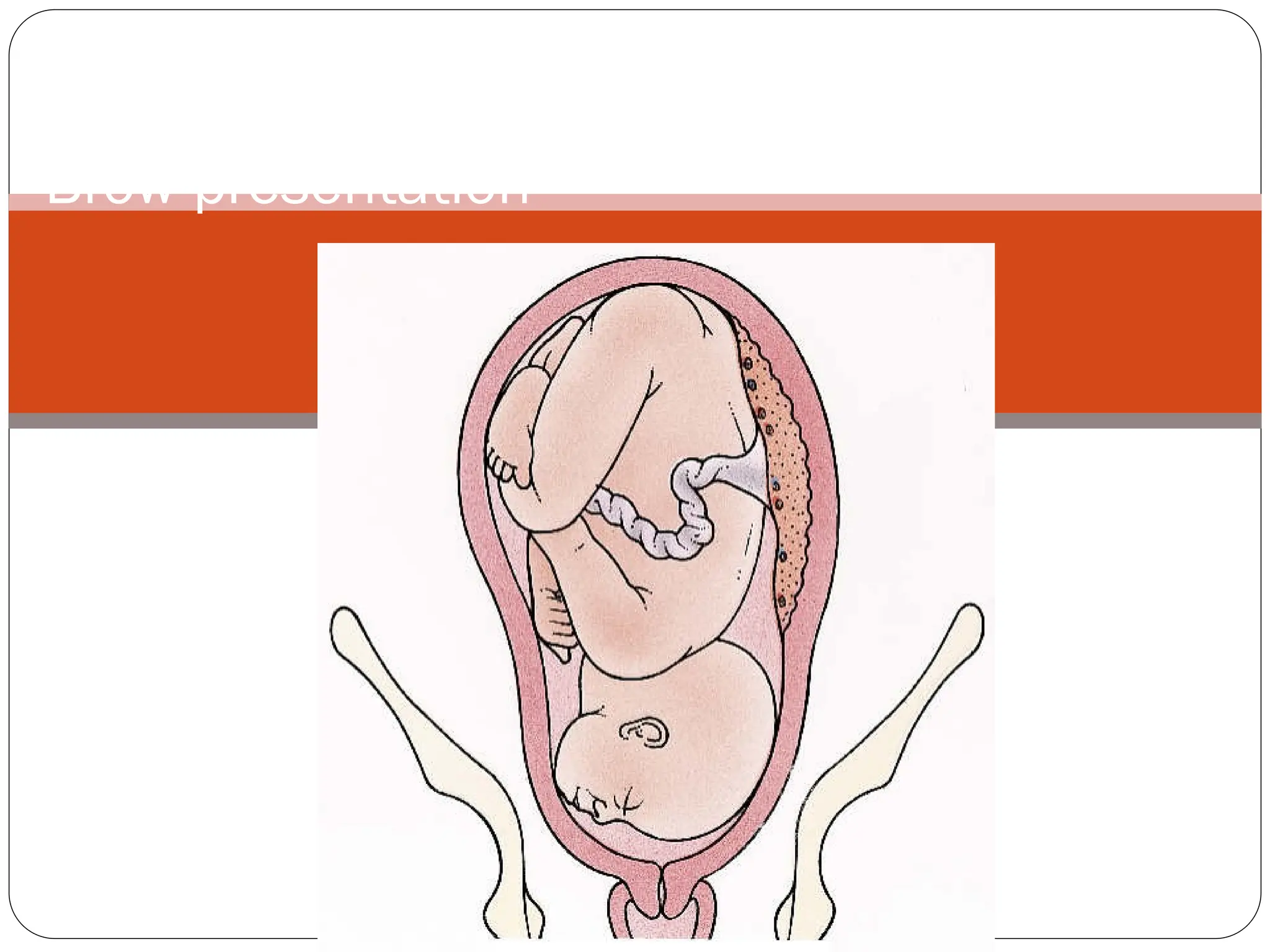
Brow presentation.
Congenital malformations.
Big baby.
Occipito posterior positions.
Compound presentation.
Locked twins.
Transverse lie
Brow presentation
Congenital malformations
Big baby
Occipito posterior positions.
Compound presentation
Locked twins
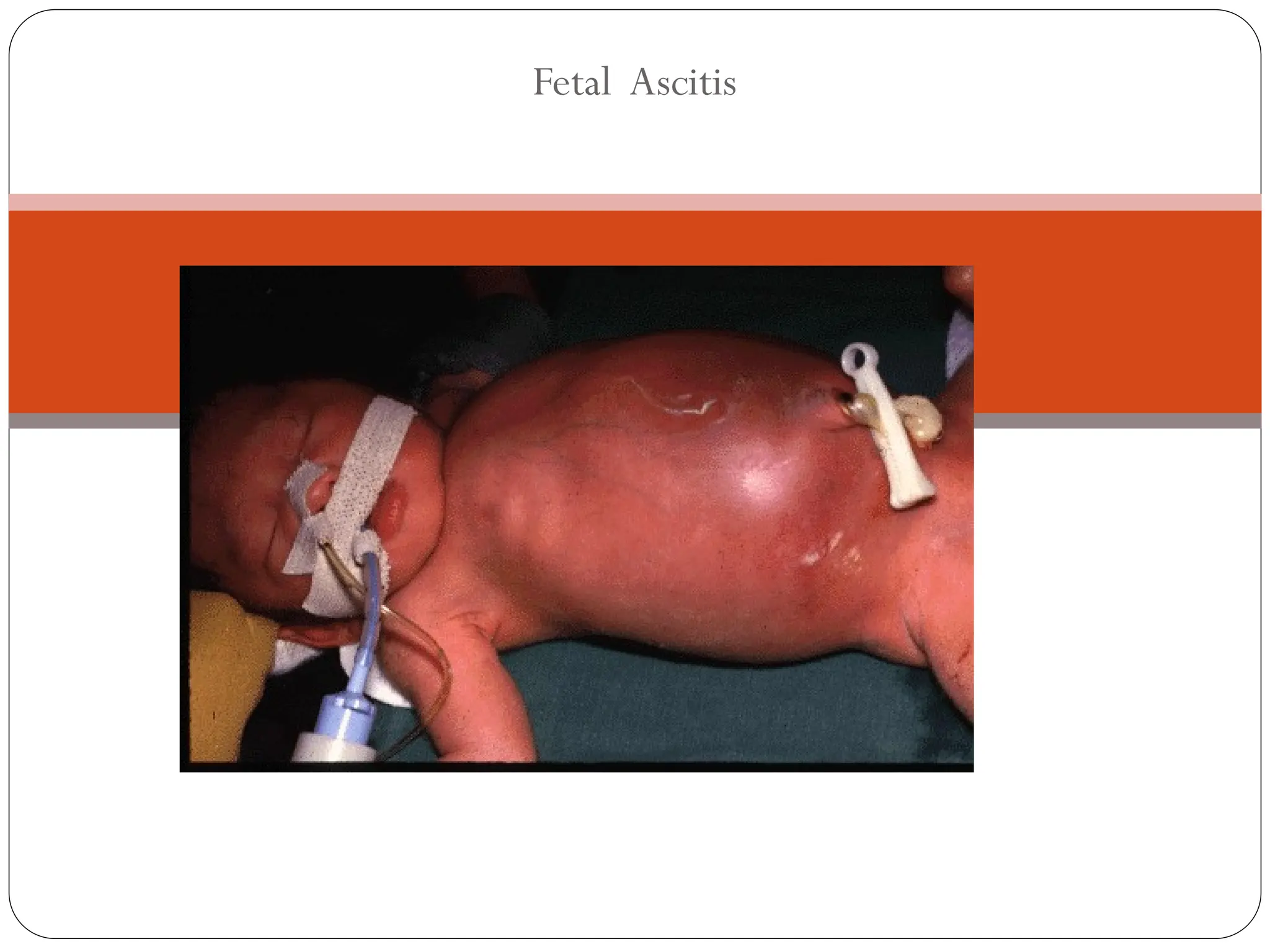
Fetal Ascitis
MORBID ANATOMICAL CHANGES
 BLADDER
 UTERUS
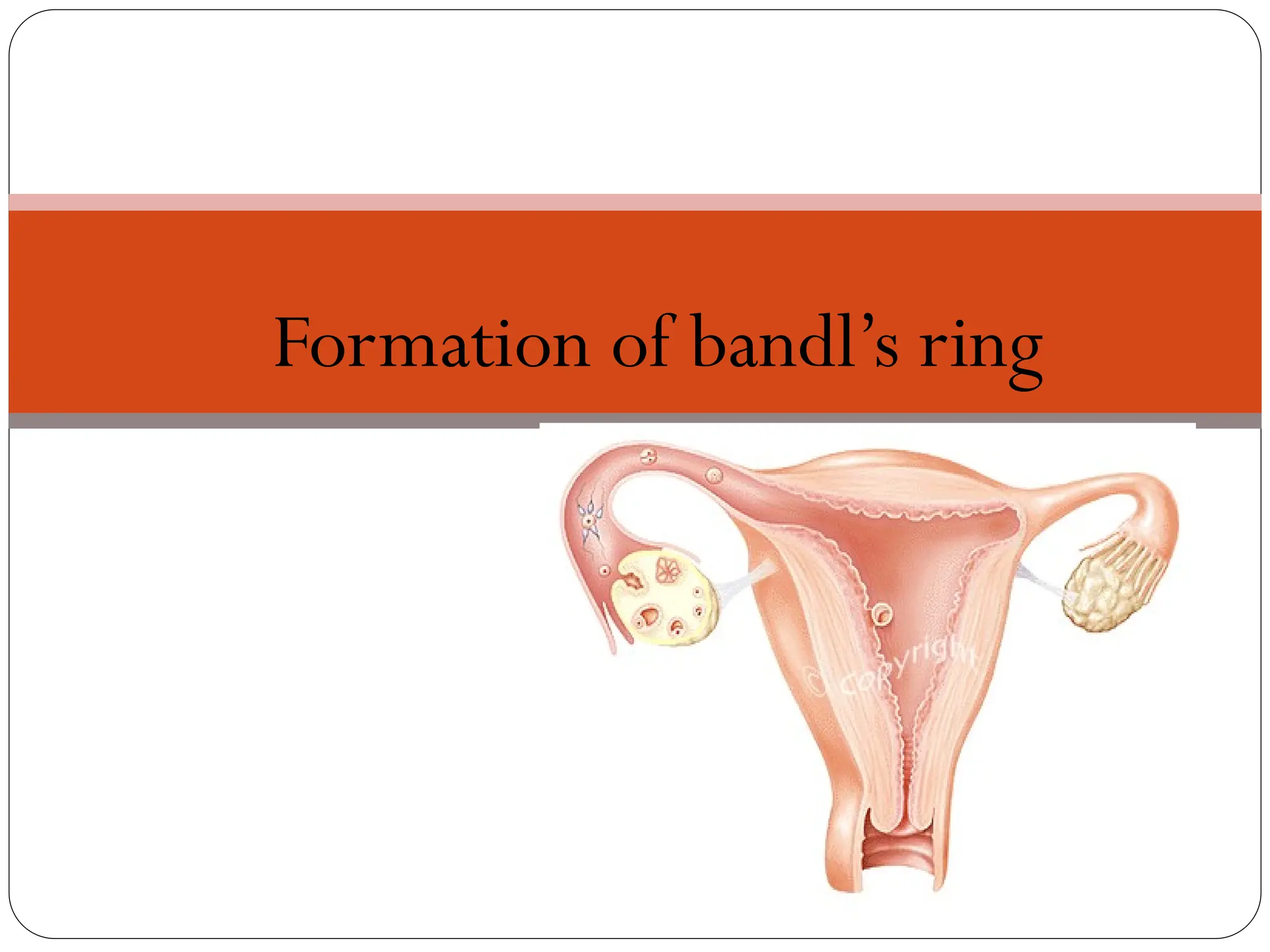
UTERUS:
Formation of bandl’s ring
BLADDER:
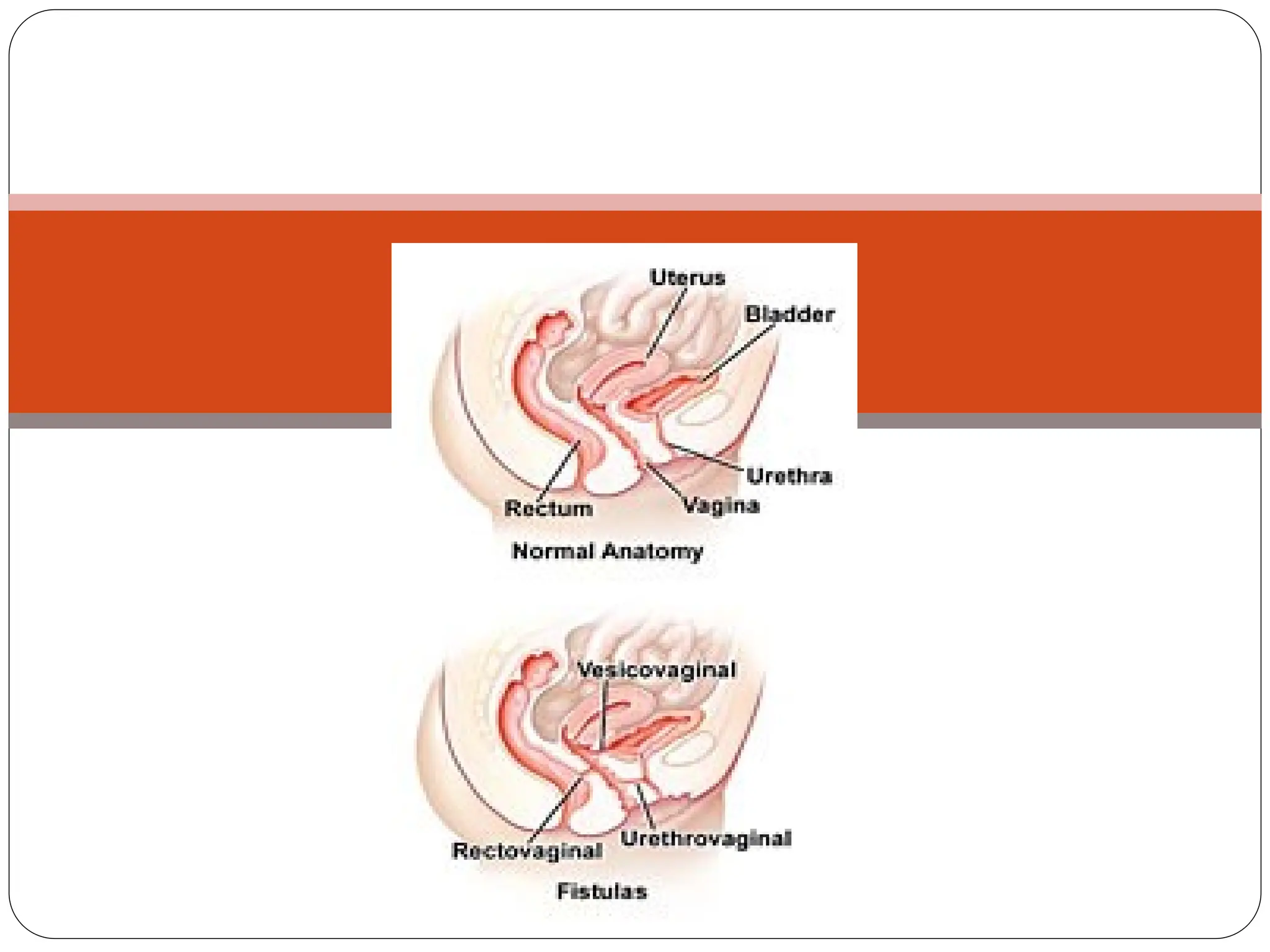
Bladder become an abdominal organ.
Patient fails to empty the bladder.
Bladder walls get traumatized.
Blood stained urine.
Pressure necrosis.
Genito urinary fistula.
Genito urinary Fistula
SIGNS OF OBSTRUCTED LABOUR.
EARLY SIGNS:
PRESENTING PART DOES NOT ENTERTHE PELVIC
BRIM.
SLOW CERVICAL DILATATION.
LOOSELY HANGING CERVIX.
EARLY RUPTURE OF MEMBRANE OR FORMATION
OF A LARGE ELONGATED SAC OF FOREWATERS.
LATE SIGNS:
I. MOTHER MAY BE DEHYDRATED AND KETOTIC AND IN
CONSTANT PAIN.
II. CLINICAL SIGNS:-
a) PYREXIA,TACHYCARDIA.
b) DIFFICULT ABDOMINAL PALPATION.
c) DIFFICULT ABDOMINAL EXAMINATION.
d) COMPLICATEDVAGINAL EXAMINATION.
CONTI…
e) LESS URINE OUTPUT,HAEMATURIA.
f) EVIDENCE OF FETAL DISTRESS.
g) PHYSIOLOGIC RETRACTION RING.
h) VISIBLE RETRACTION RING OR BANDL’S RING.
i) HOT,DRYVAGINA.
j) PRESENTING PARTWILL BE HIGH AND
IMMOVABLE.
Multiple Pregnancy
DEFINITION
When more than one fetus
simultaneously develops in the
uterus ,it is called multiple
pregnancy.
According to their number, they could be
categorized into:
Twins (most common)
 Triplets
Quadruplets
Quintuplets
Sextuplets
Types
 Monozygotic
 Identical/Uniovular
 Fertilization of a single ovum,
 Similar sex.
 Identical in every way including
the HLA genes
 Not genetically determined
 Dizygotic
 Fertilization of 2 seperate
ova
 Fraternal /Dizygotic
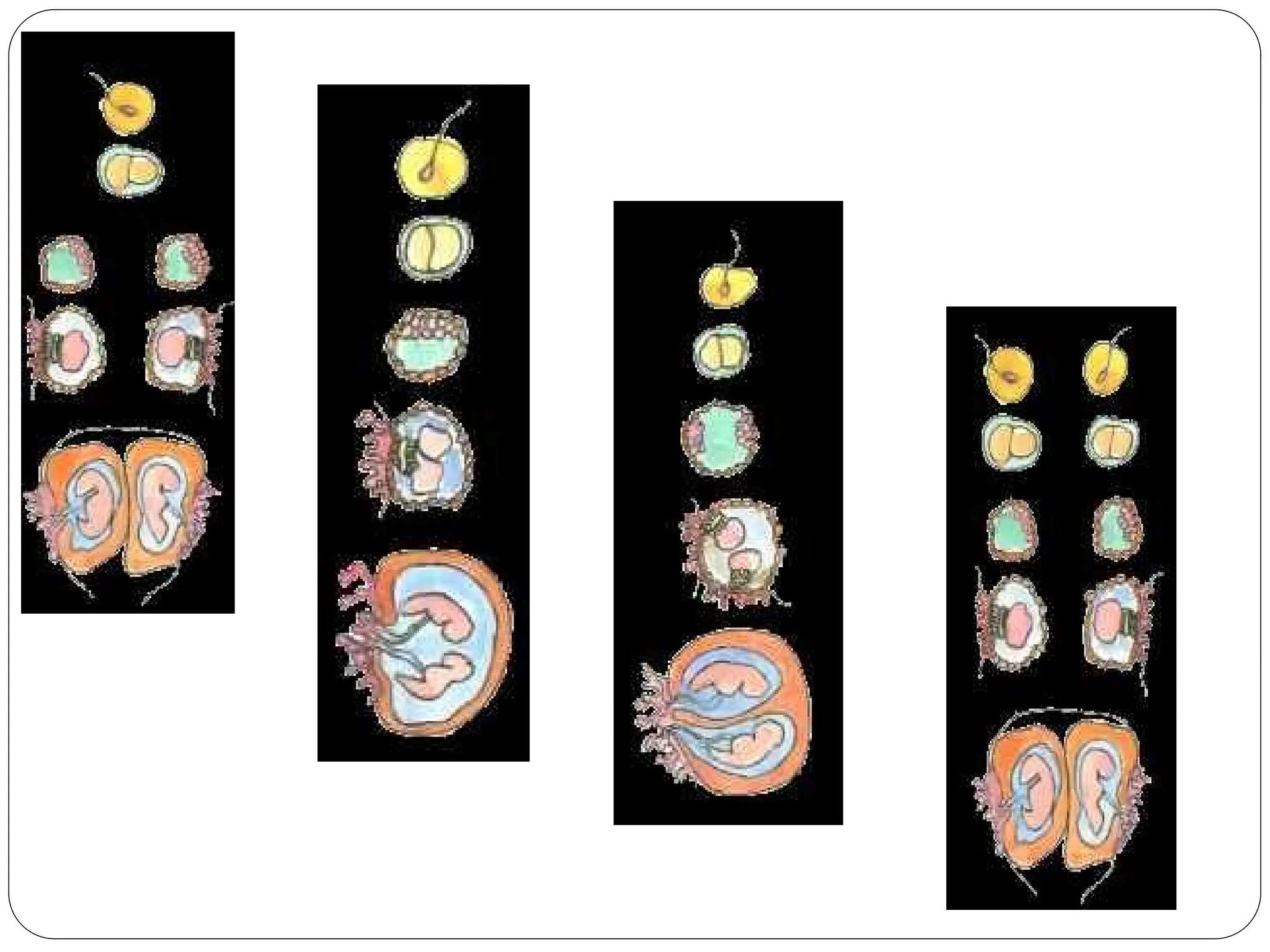
Monozygotic Twins…
Different Scenarios of Cleavage
If the separation takes place just after the first cellular
division [1st
3 days ]/ prior to morula stage
both of the twins will have their own placenta and an
amniotic sac each.
Scenario 1
Monozygotic twin pregnancy
Di-Amniotic and Di-Chorionic
or D/D
Scenario 2
Monozygotic twin pregnancy
Di-amniotic - Mono-chorial
and or D/M
Separation can also take place a little
later in the development [4-8 days after
the formation of inner cell mass when
chorion has developed]
of the embryonic cells but before the
blastocyte has defined the roles of each
cell.
Twins will be in the same placenta, but
they will have 2 amniotic sacs.
Scenario 3
Monozygotic twin pregnancy
Mono-amniotic and Mono-
chorial
Separation takes place at the stage when the amniotic bag is
already being formed
[day 8-14]
Twins will be in the same placenta, and in the same amniotic
Conjoined Twins
 If the division occur after 2 weeks
of the embryonic disc formation,
incomplete or conjoined twins
will occur.
 They may be joined
 anteriorly [thoracopagus-
commonest],
 posteriorly [pyopagus]
 cephalic [craniopagus] o
 caudal [ischiopagus].
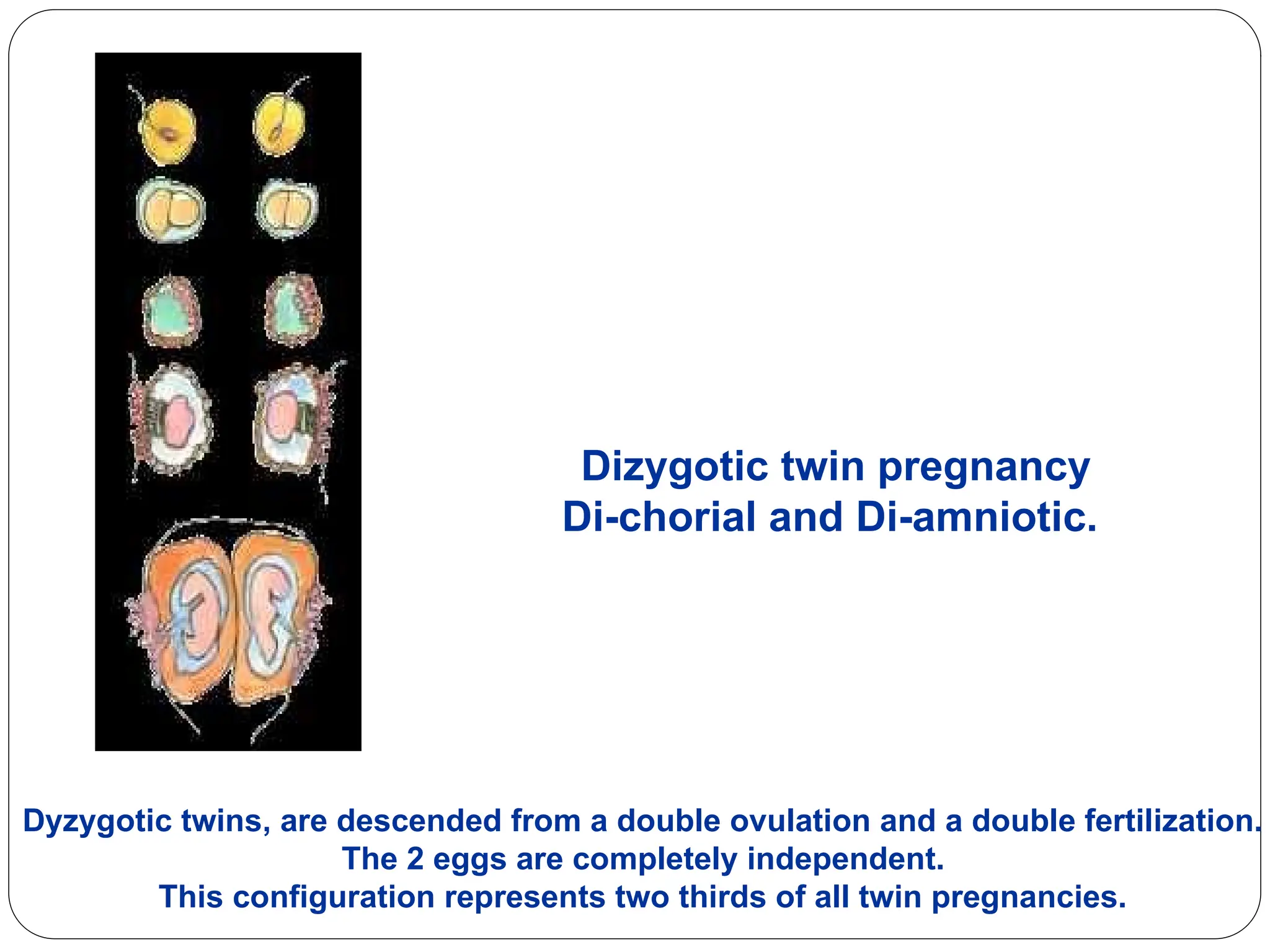
Dizygotic twin pregnancy
Di-chorial and Di-amniotic.
Dyzygotic twins, are descended from a double ovulation and a double fertilization.
The 2 eggs are completely independent.
This configuration represents two thirds of all twin pregnancies.
Superfecundation
It is the fertilization of two different ova
released in the same menstrual cycle,by
separate act of coitus within a short period of
time.
Superfetation
It is the fertilization of two ova released in
different menstrual cycle
One fetus over another
Possible until decidual space is obliterated by
12 weeks of pregnancy
Fetus papyraceous or compressus
One fetus dies early
Dead fetus is flattened and compressed
between the membranes of the living fetus
and the uterine wall
Fetus acardicus
Occurs only in monozygotic twins
Part of the fetus remains amorphous and
becomes parasitic without a heart
Hydatidiform mole
Hydatidiform mole from one placenta
And a normal fetus and placenta
Vanishing twins
USG in early pregnancy revealed occassional
death of one fetus and continuation of
pregnancy with surviving one
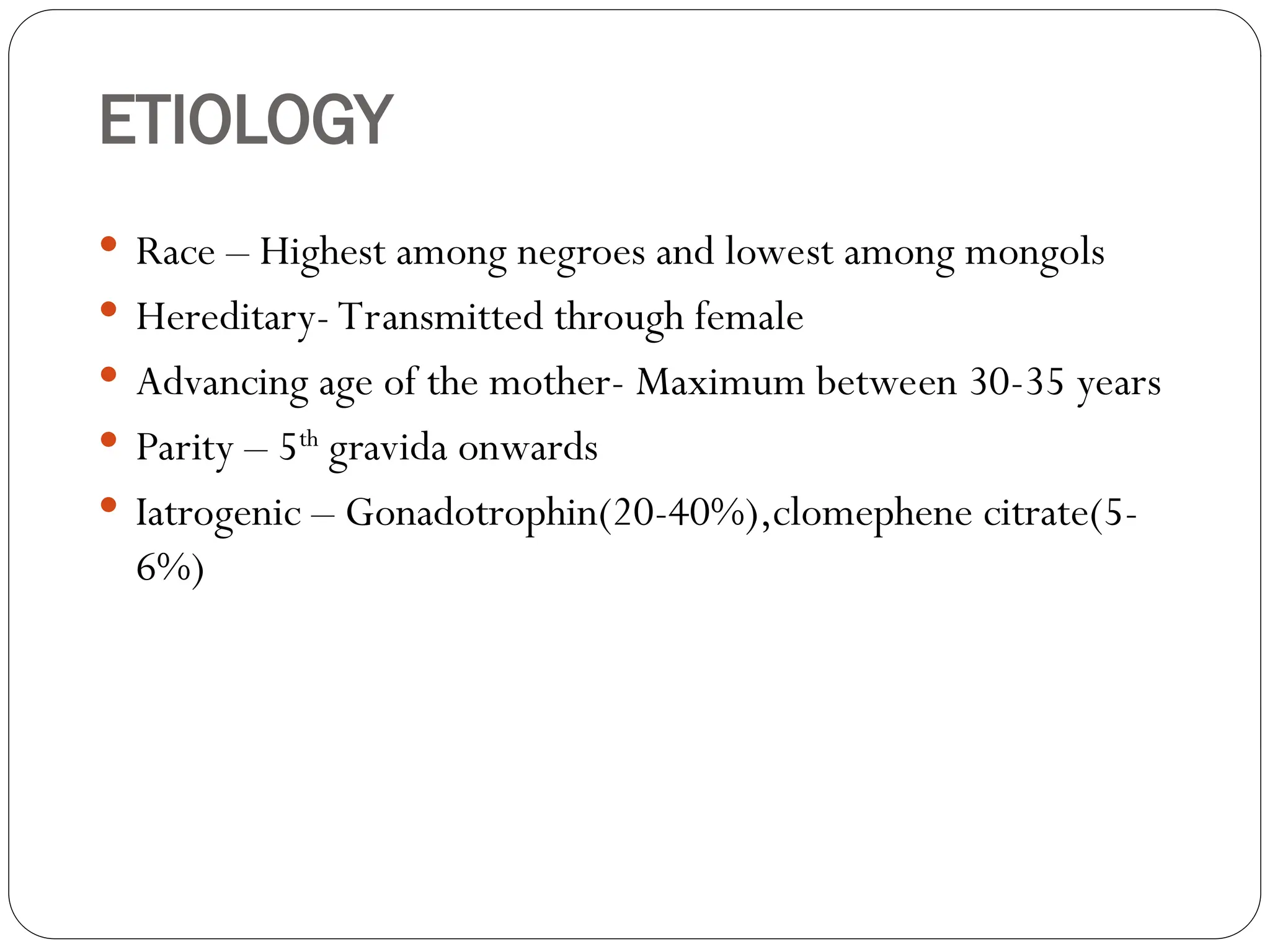
ETIOLOGY
 Race – Highest among negroes and lowest among mongols
 Hereditary- Transmitted through female
 Advancing age of the mother- Maximum between 30-35 years
 Parity – 5th
gravida onwards
 Iatrogenic – Gonadotrophin(20-40%),clomephene citrate(5-
6%)
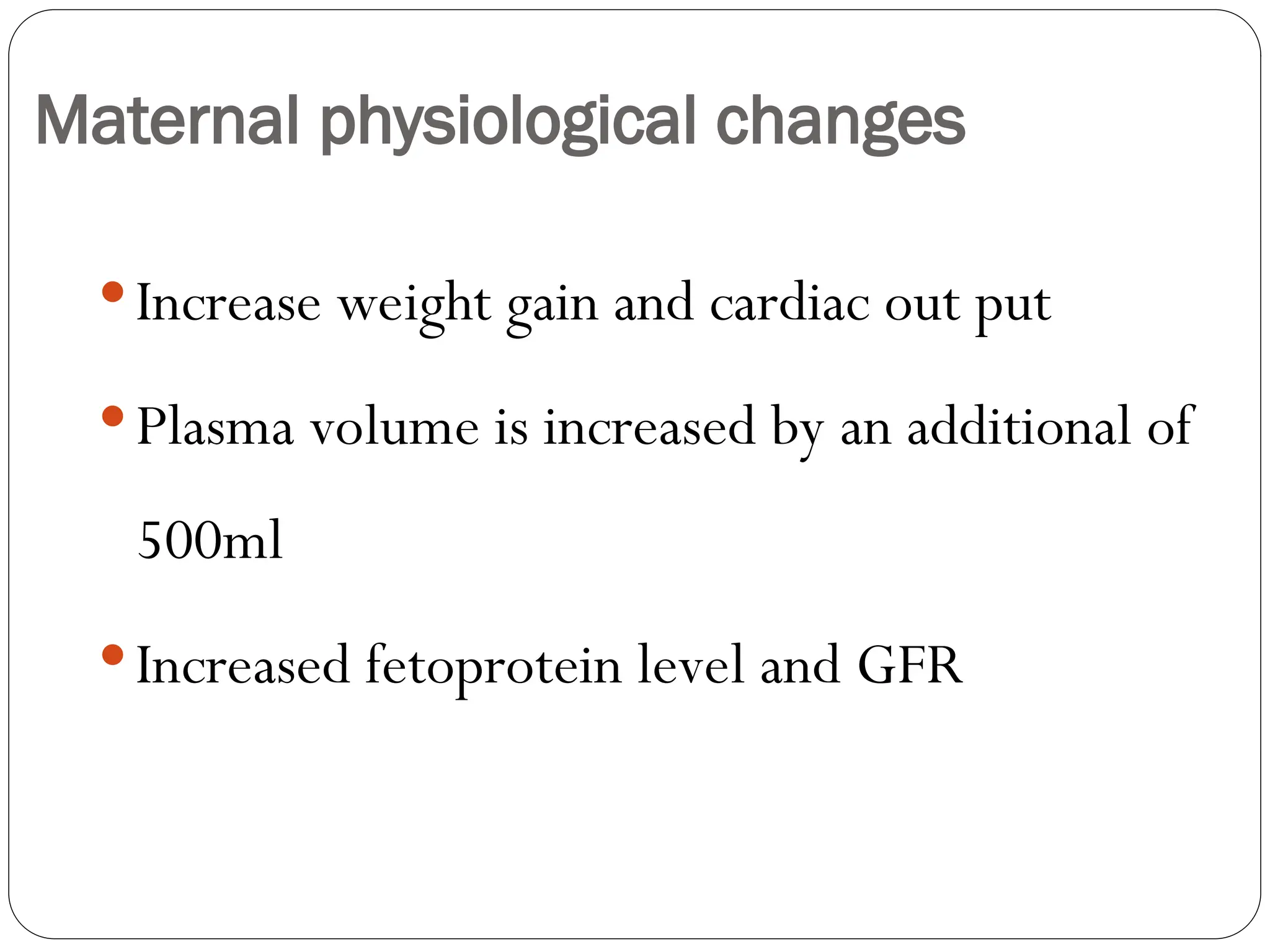
Maternal physiological changes
Increase weight gain and cardiac out put
Plasma volume is increased by an additional of
500ml
Increased fetoprotein level and GFR
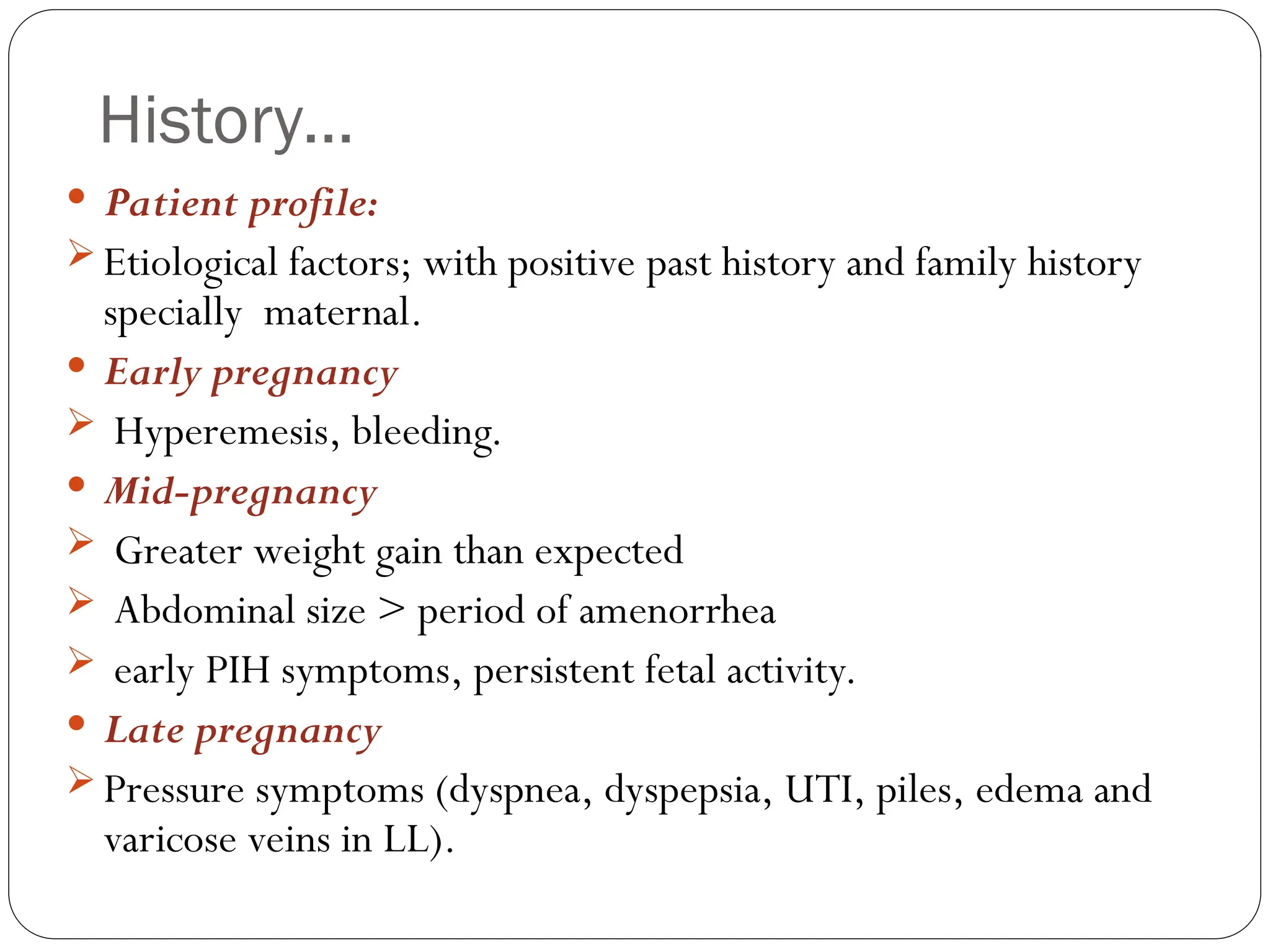
History…
 Patient profile:
 Etiological factors; with positive past history and family history
specially maternal.
 Early pregnancy
 Hyperemesis, bleeding.
 Mid-pregnancy
 Greater weight gain than expected
 Abdominal size > period of amenorrhea
 early PIH symptoms, persistent fetal activity.
 Late pregnancy
 Pressure symptoms (dyspnea, dyspepsia, UTI, piles, edema and
varicose veins in LL).
Examination
General:
 An early increase weight gain,
 Pallor
 Less mid-trimisteric fall blood pressure
 Early PIH
 Eary edema, and varicose veins in LL.
Abdominal:
 Fundal level > amenorrhea especially in mid-pregnancy
 exclude other causes.
 Palpation: Multiple fetal
 identify presentations.
 Auscultation of FHS:
 2 different recordings by 2 observers and a difference > 10 bpm a Gallop between 2
points[ Arnoux sign]
Pelvic: Specially during the course of labor
 small presenting part compared to abdominal size
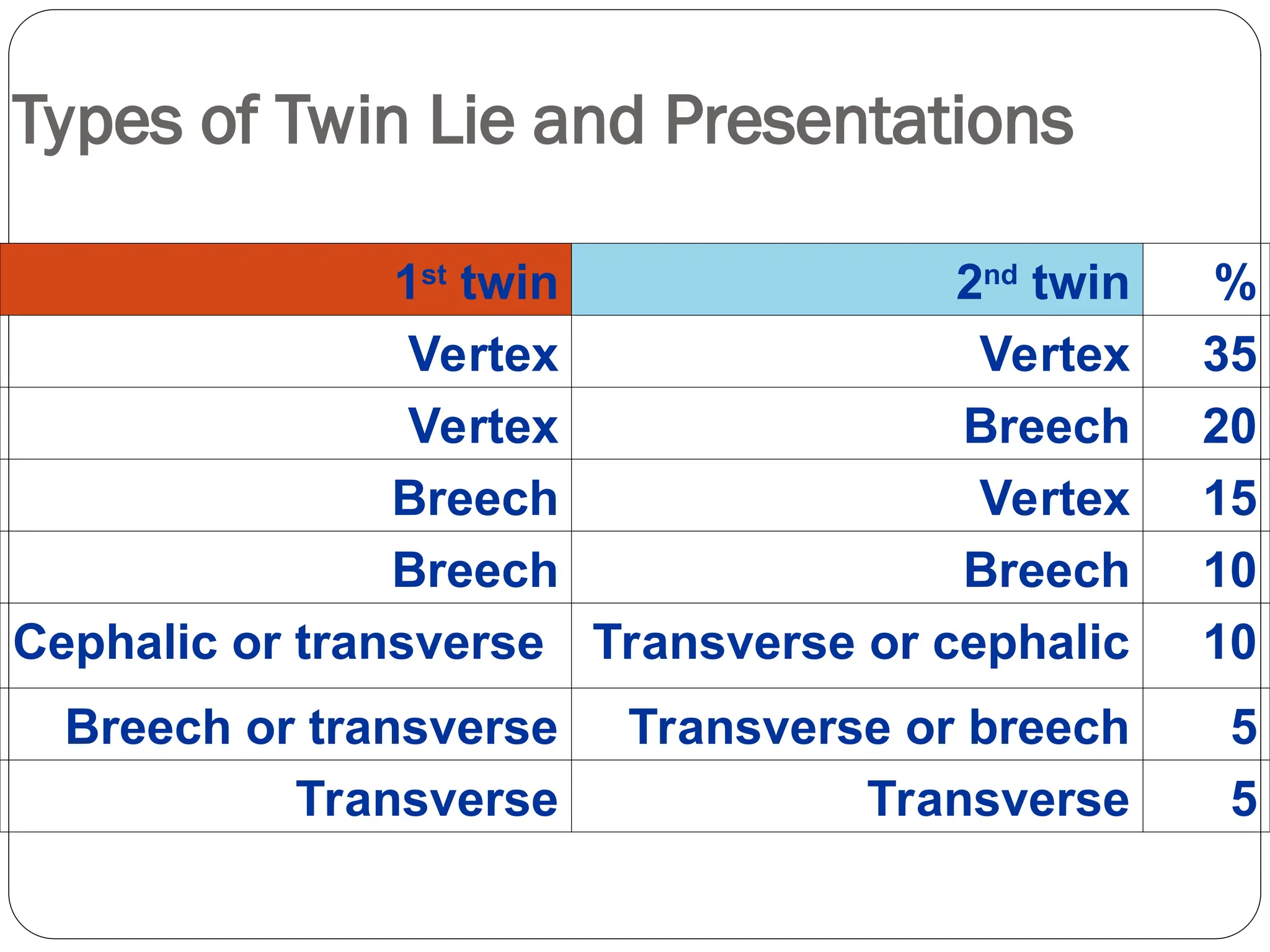
Types of Twin Lie and Presentations
1st
twin 2nd
twin %
Vertex Vertex 35
Vertex Breech 20
Breech Vertex 15
Breech Breech 10
Cephalic or transverse Transverse or cephalic 10
Breech or transverse Transverse or breech 5
Transverse Transverse 5
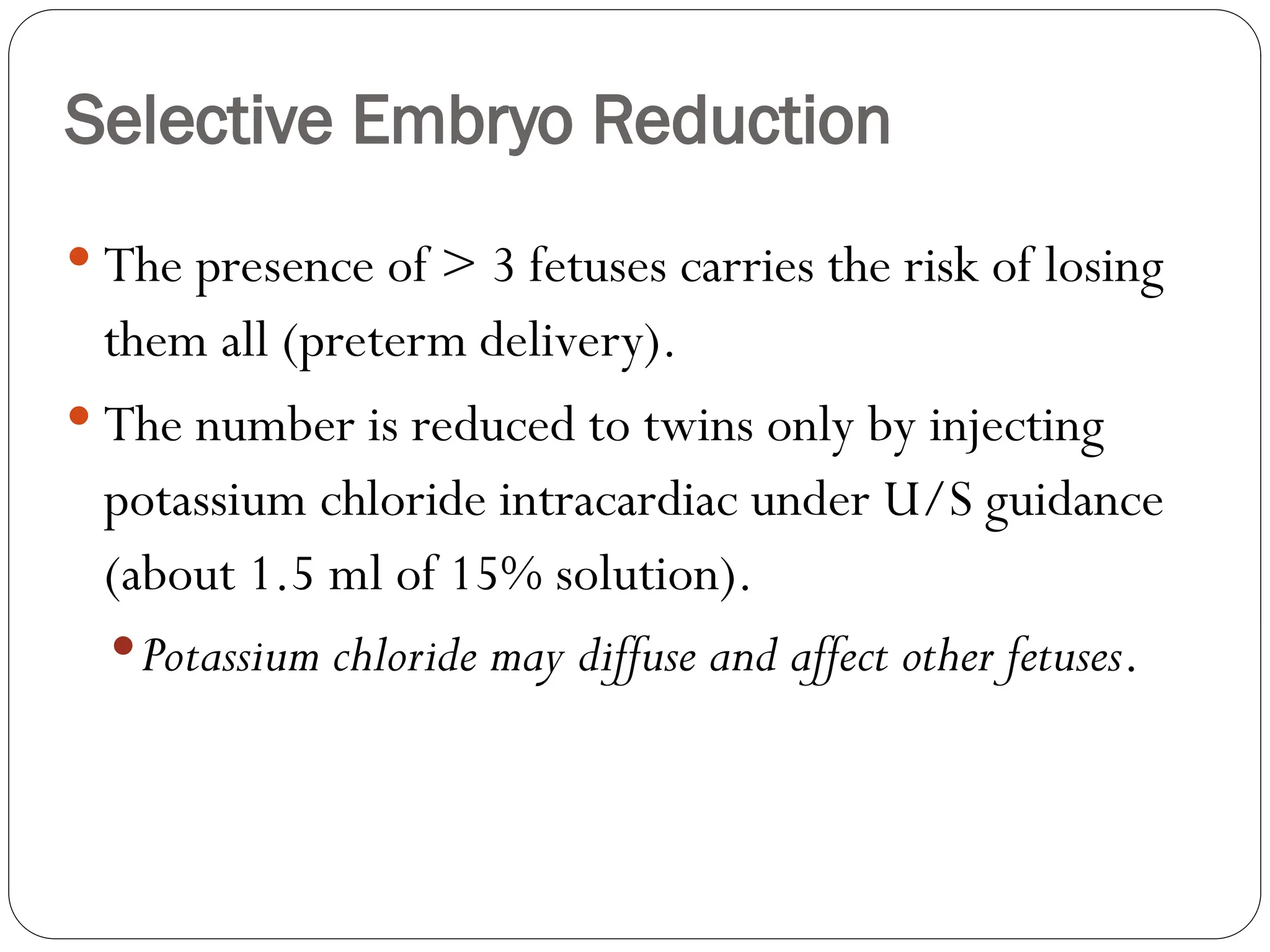
Selective Embryo Reduction
 The presence of > 3 fetuses carries the risk of losing
them all (preterm delivery).
 The number is reduced to twins only by injecting
potassium chloride intracardiac under U/S guidance
(about 1.5 ml of 15% solution).
Potassium chloride may diffuse and affect other fetuses.
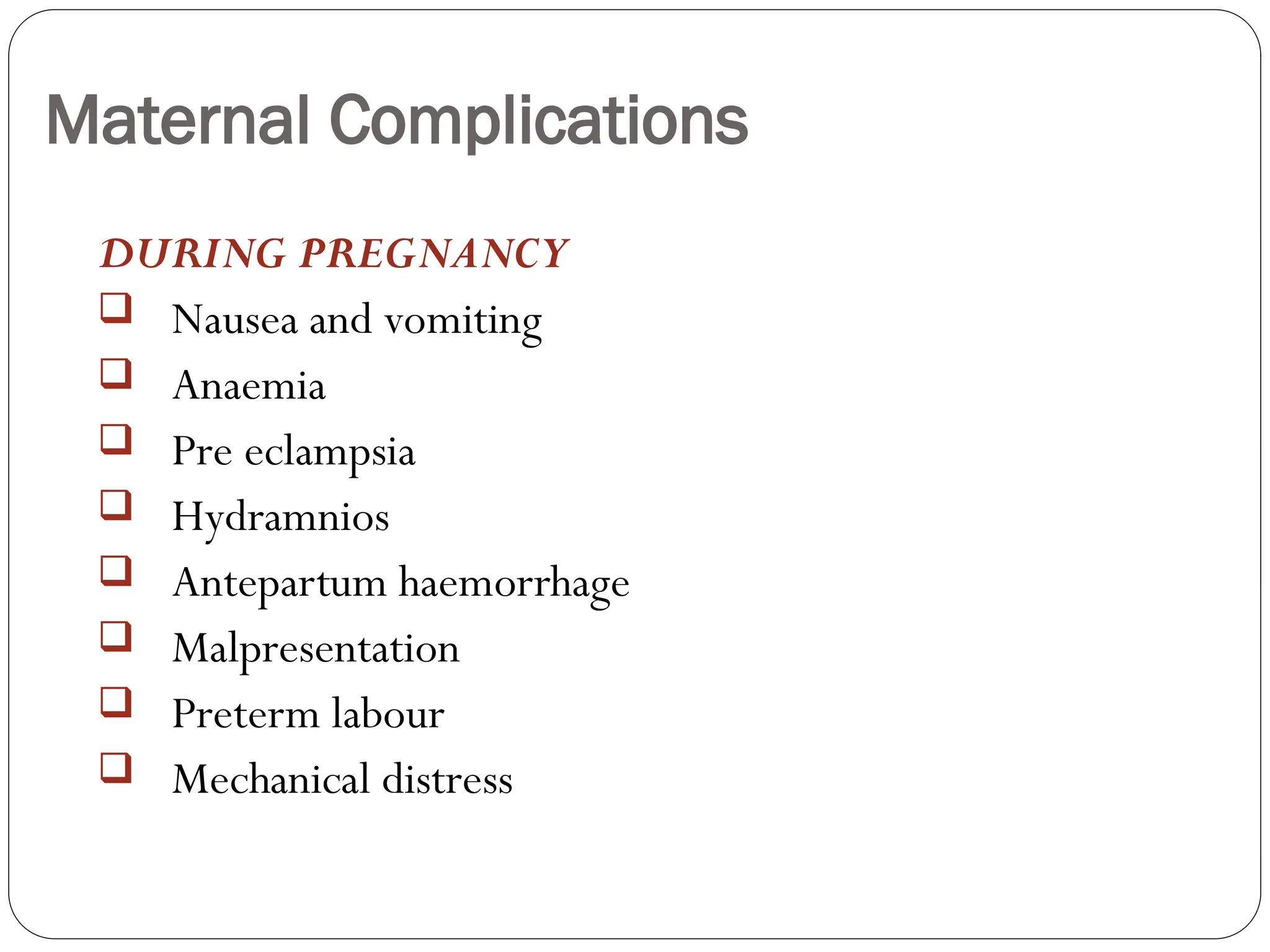
Maternal Complications
DURING PREGNANCY
 Nausea and vomiting
 Anaemia
 Pre eclampsia
 Hydramnios
 Antepartum haemorrhage
 Malpresentation
 Preterm labour
 Mechanical distress
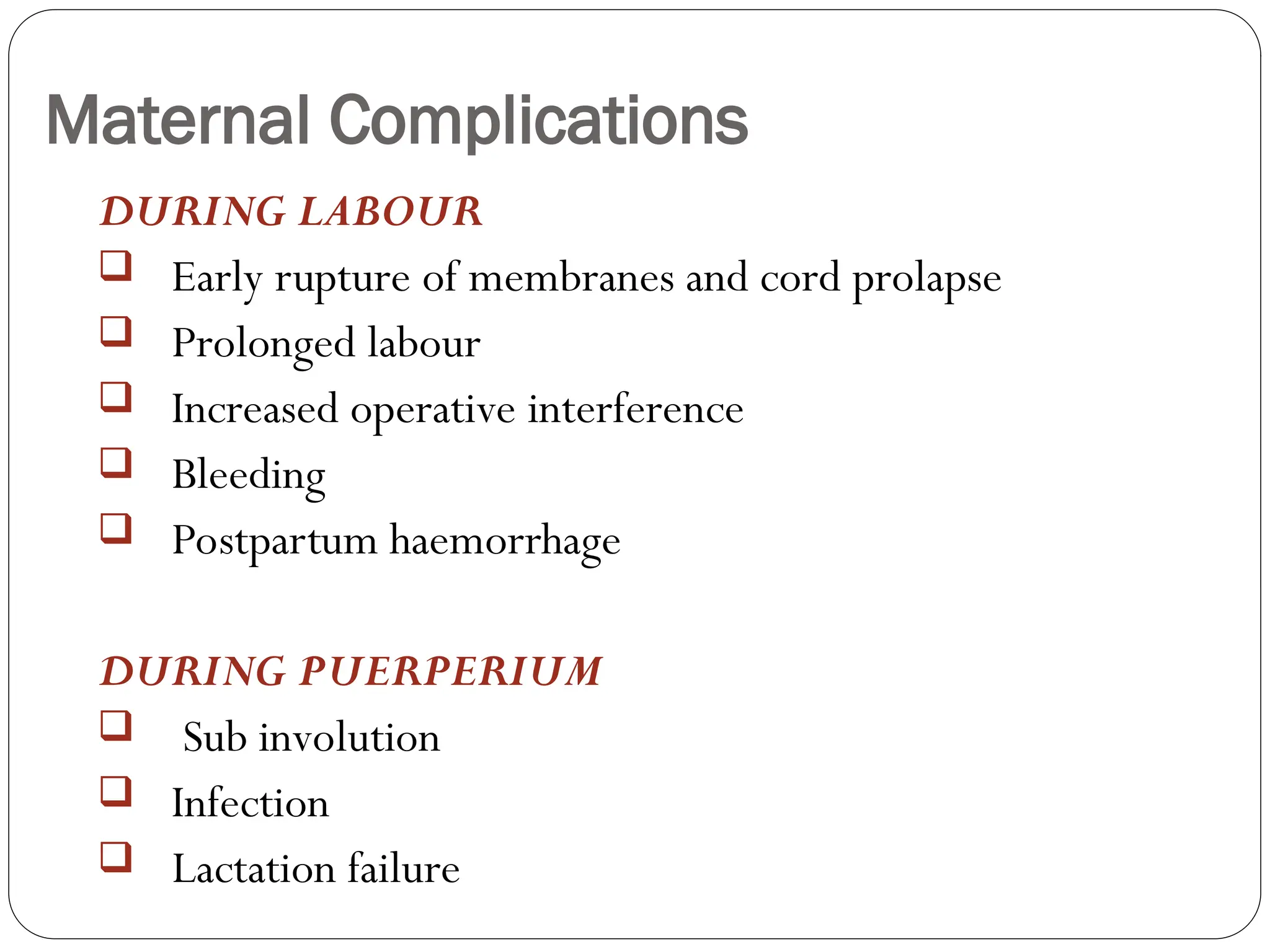
Maternal Complications
DURING LABOUR
 Early rupture of membranes and cord prolapse
 Prolonged labour
 Increased operative interference
 Bleeding
 Postpartum haemorrhage
DURING PUERPERIUM
 Sub involution
 Infection
 Lactation failure
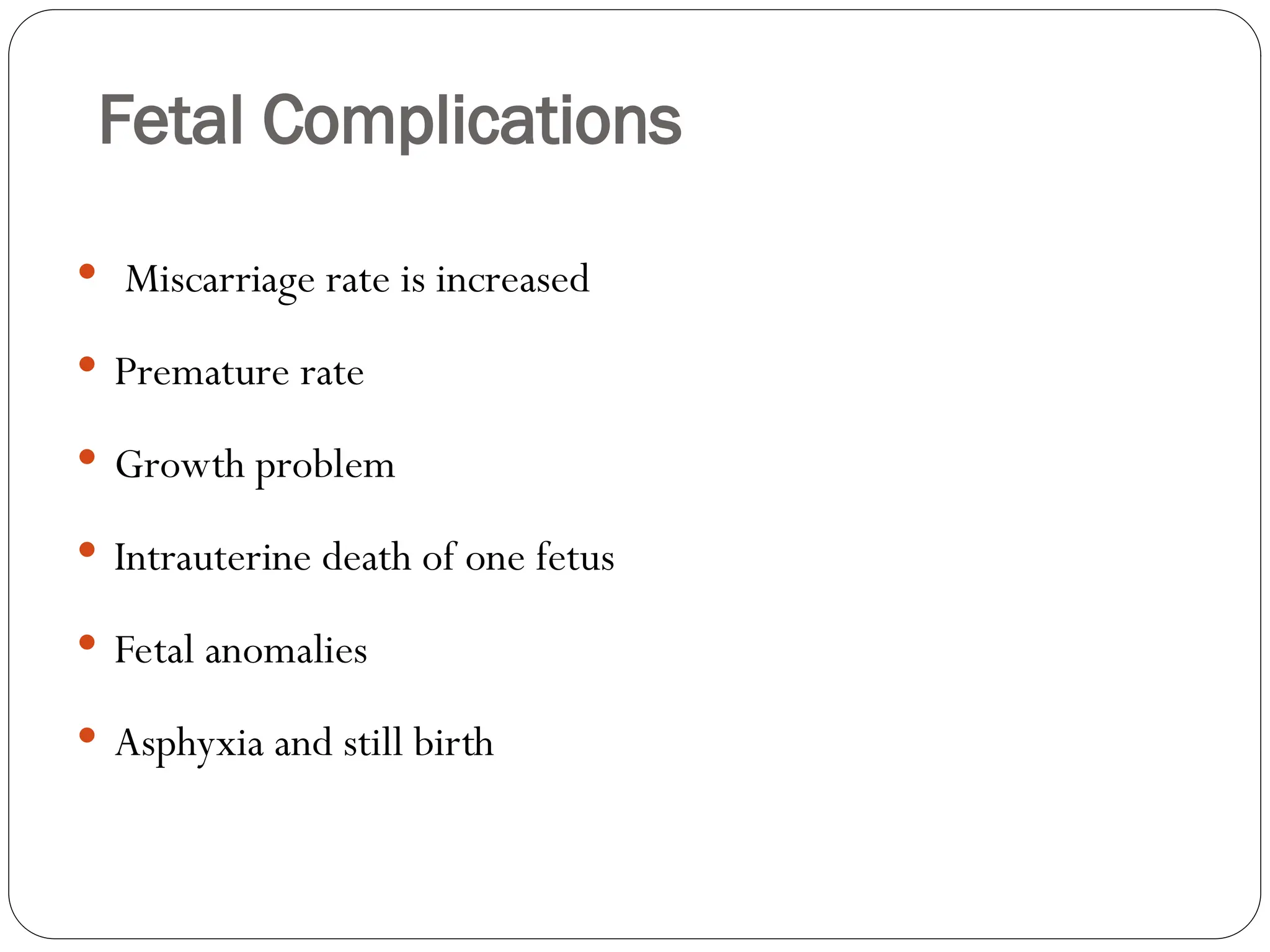
Fetal Complications
 Miscarriage rate is increased
 Premature rate
 Growth problem
 Intrauterine death of one fetus
 Fetal anomalies
 Asphyxia and still birth
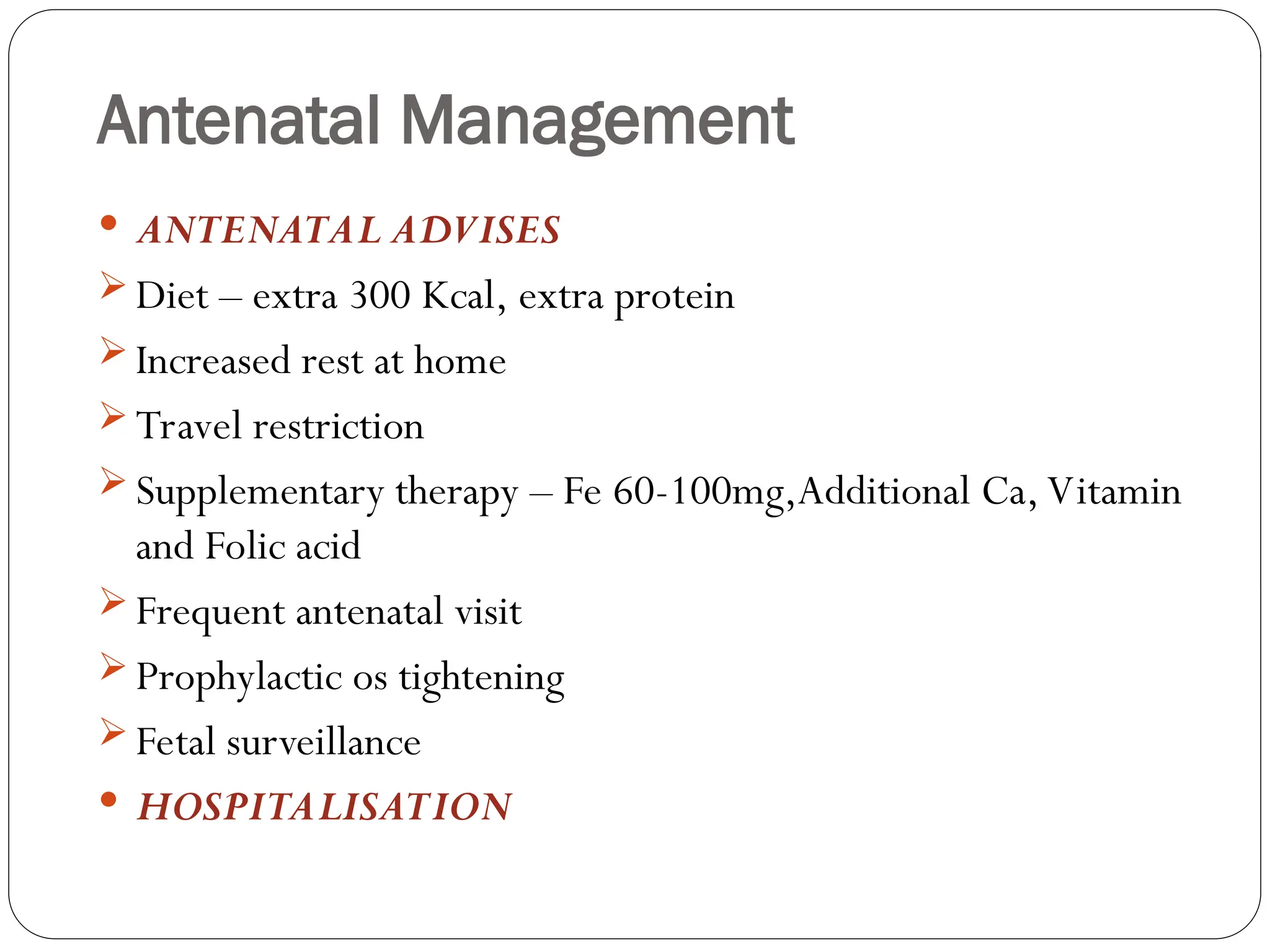
Antenatal Management
 ANTENATAL ADVISES
 Diet – extra 300 Kcal, extra protein
 Increased rest at home
 Travel restriction
 Supplementary therapy – Fe 60-100mg,Additional Ca, Vitamin
and Folic acid
 Frequent antenatal visit
 Prophylactic os tightening
 Fetal surveillance
 HOSPITALISATION
How are they going to be delivered?
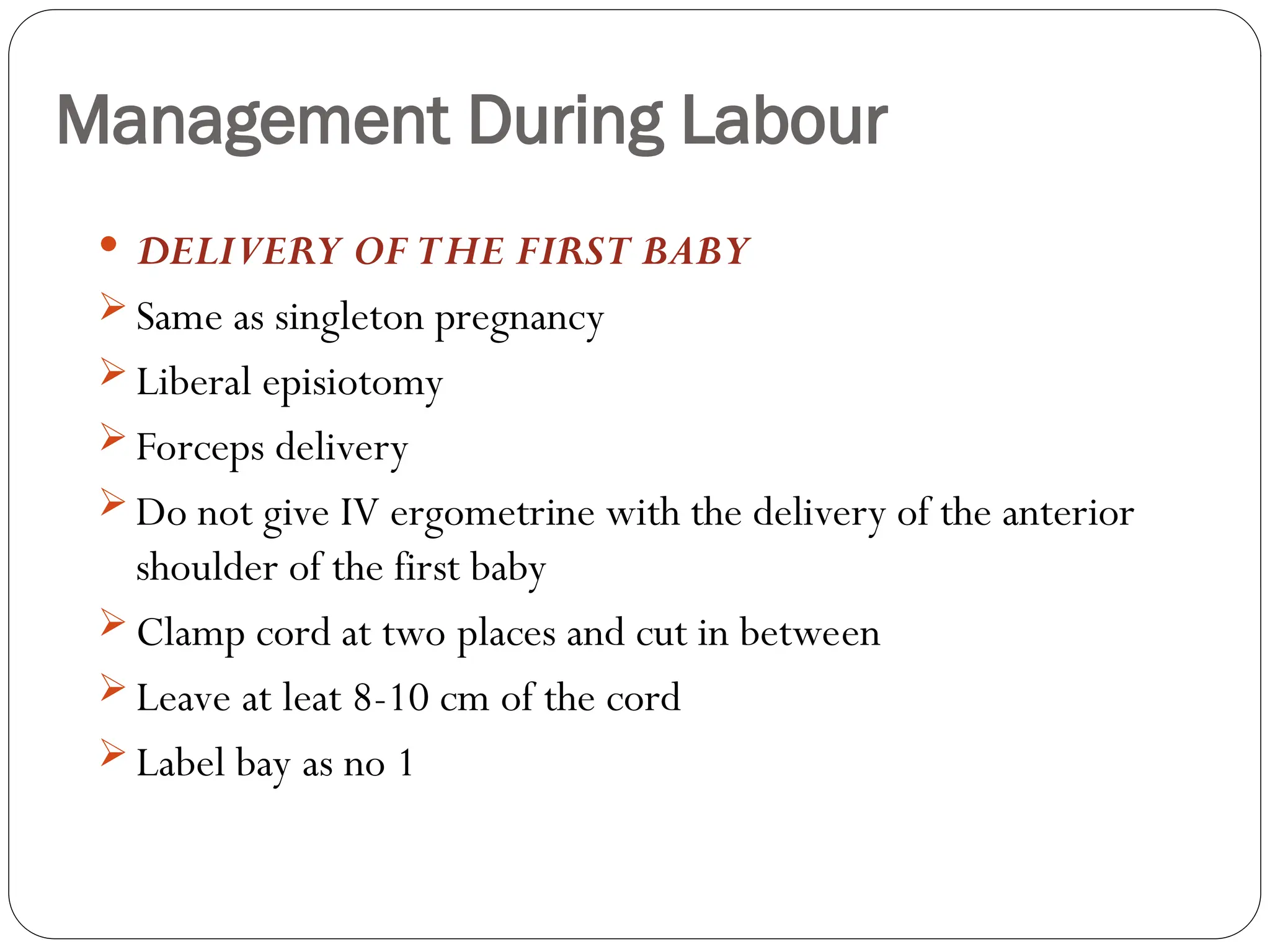
Management During Labour
 DELIVERY OF THE FIRST BABY
 Same as singleton pregnancy
 Liberal episiotomy
 Forceps delivery
 Do not give IV ergometrine with the delivery of the anterior
shoulder of the first baby
 Clamp cord at two places and cut in between
 Leave at leat 8-10 cm of the cord
 Label bay as no 1
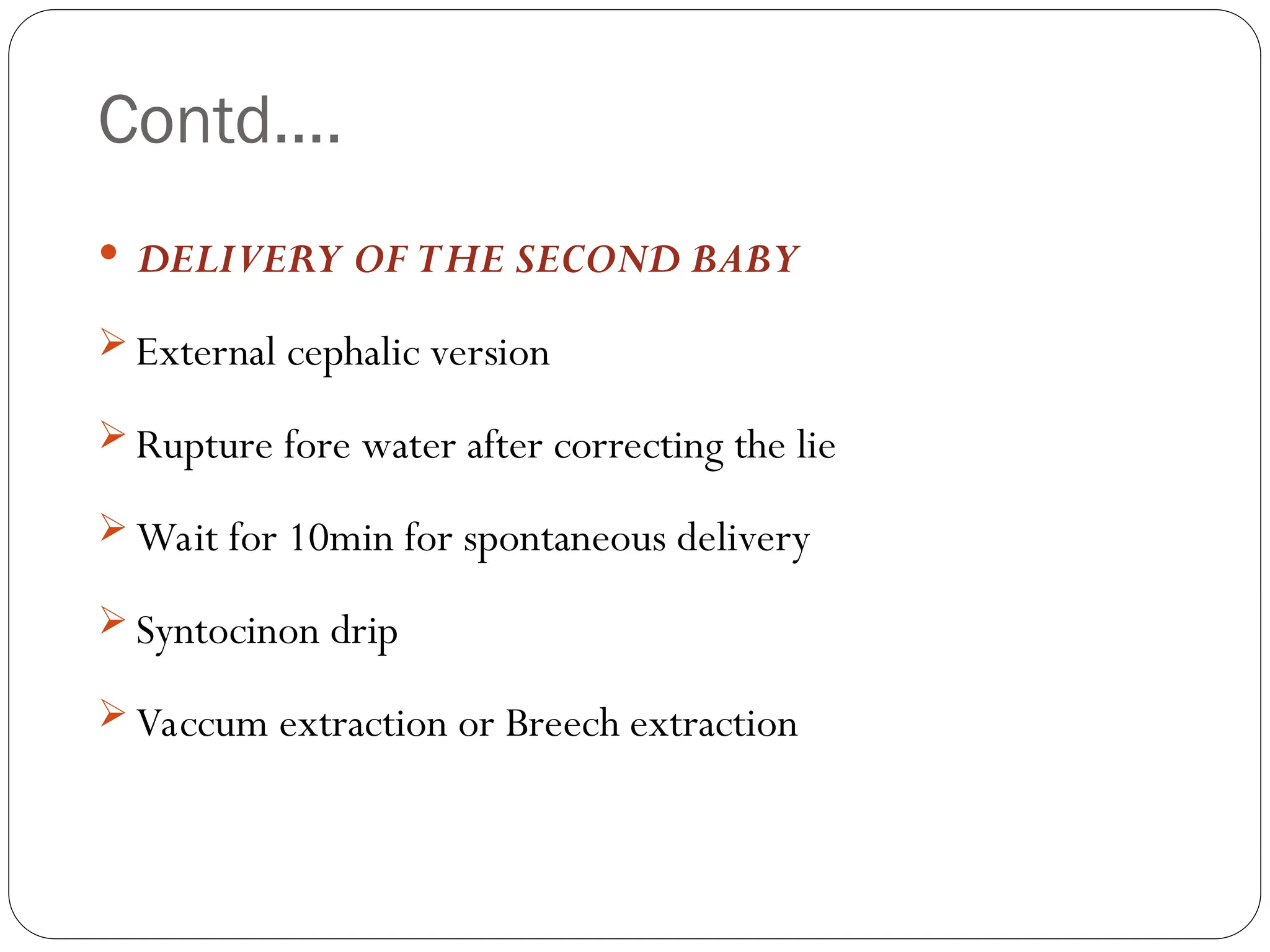
Contd….
 DELIVERY OF THE SECOND BABY
 External cephalic version
 Rupture fore water after correcting the lie
 Wait for 10min for spontaneous delivery
 Syntocinon drip
 Vaccum extraction or Breech extraction
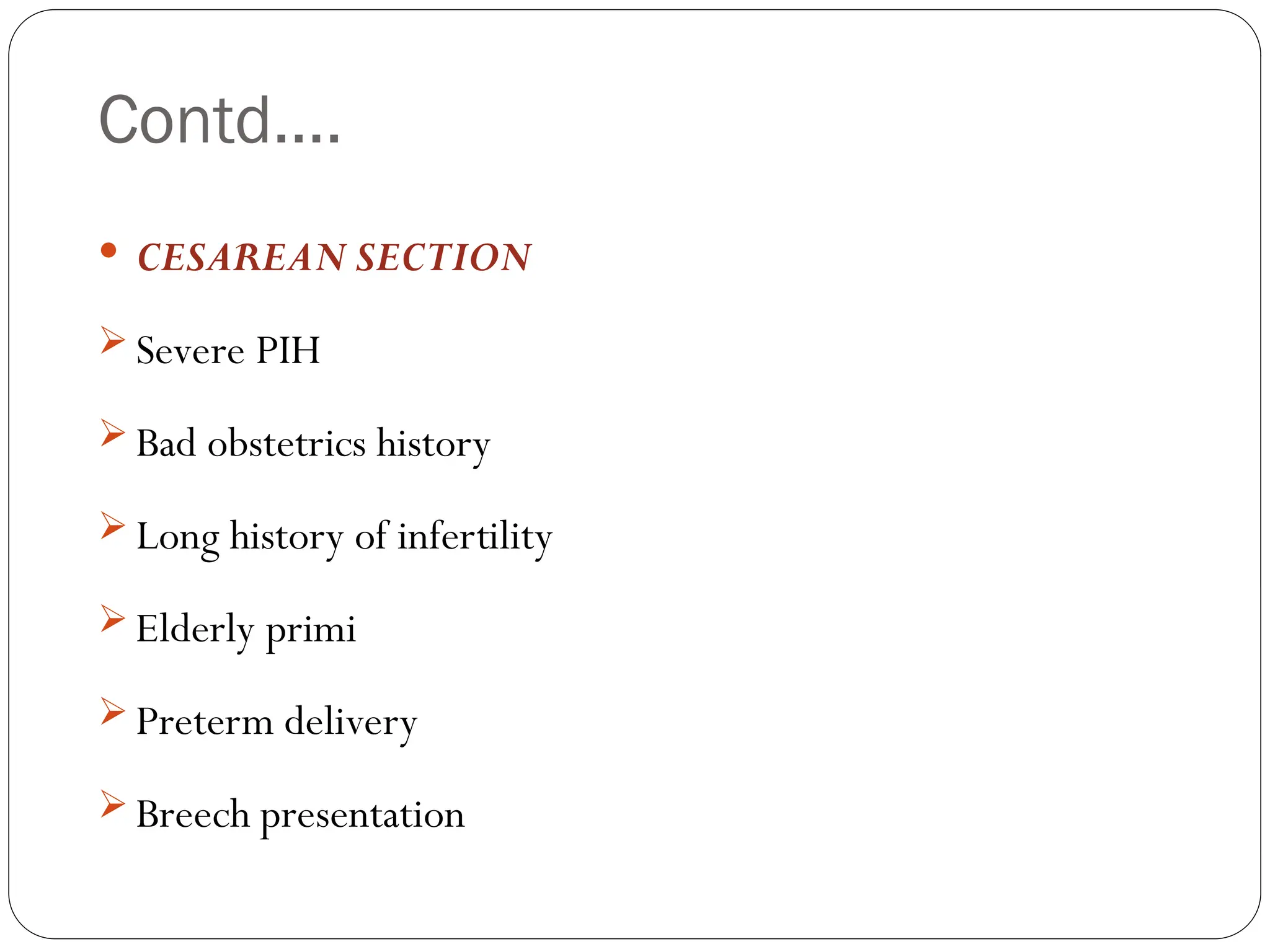
Contd….
 CESAREAN SECTION
 Severe PIH
 Bad obstetrics history
 Long history of infertility
 Elderly primi
 Preterm delivery
 Breech presentation
 MANAGEMENT OF THIRD STAGE AND PUERPARIUM
 Prevention of PPH
 Treatment of anemia
 Psychological adjustment
 Family planning advice
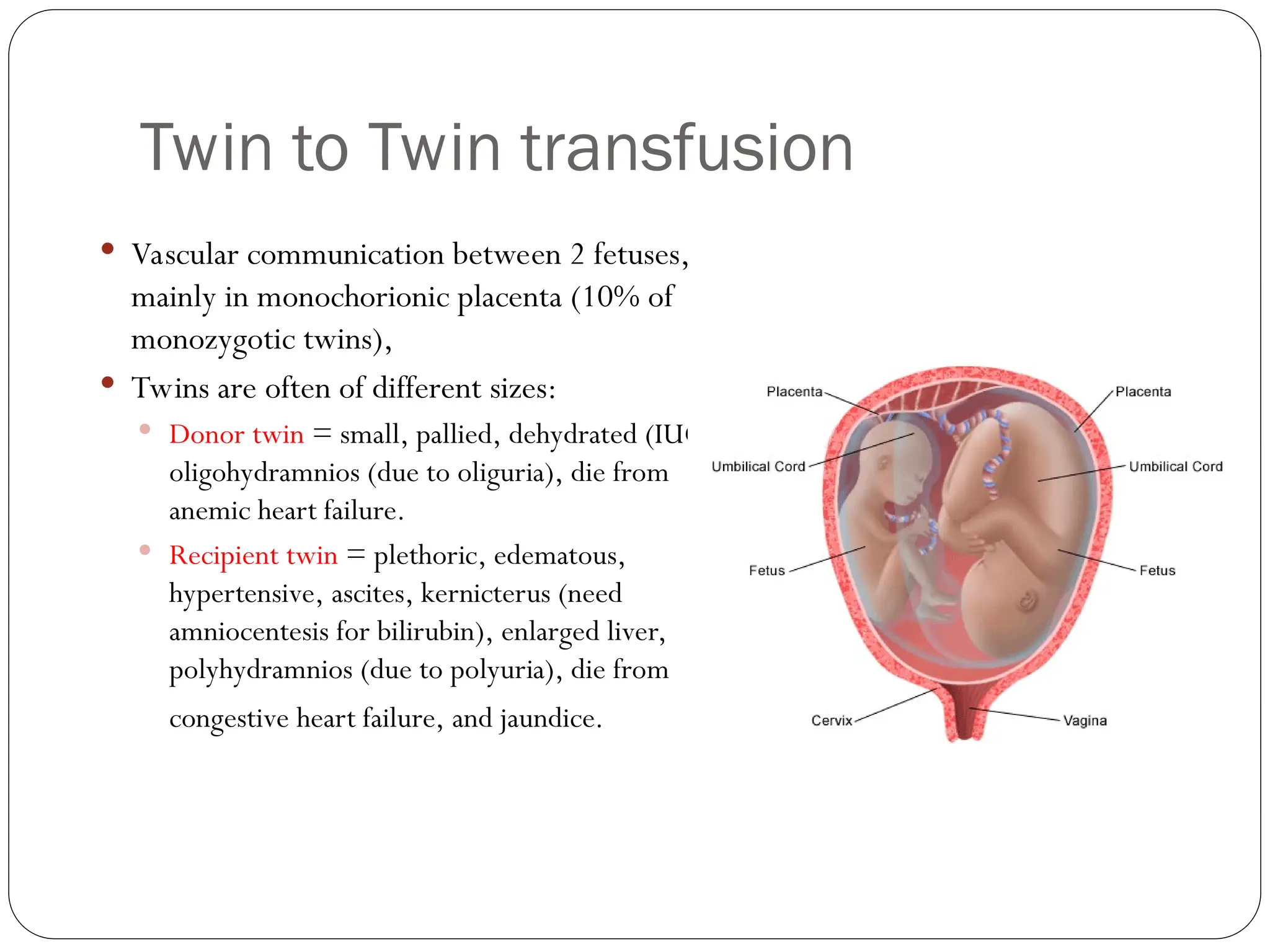
Twin to Twin transfusion
 Vascular communication between 2 fetuses,
mainly in monochorionic placenta (10% of
monozygotic twins),
 Twins are often of different sizes:
 Donor twin = small, pallied, dehydrated (IUGR),
oligohydramnios (due to oliguria), die from
anemic heart failure.
 Recipient twin = plethoric, edematous,
hypertensive, ascites, kernicterus (need
amniocentesis for bilirubin), enlarged liver,
polyhydramnios (due to polyuria), die from
congestive heart failure, and jaundice.
FETAL DISTRESS
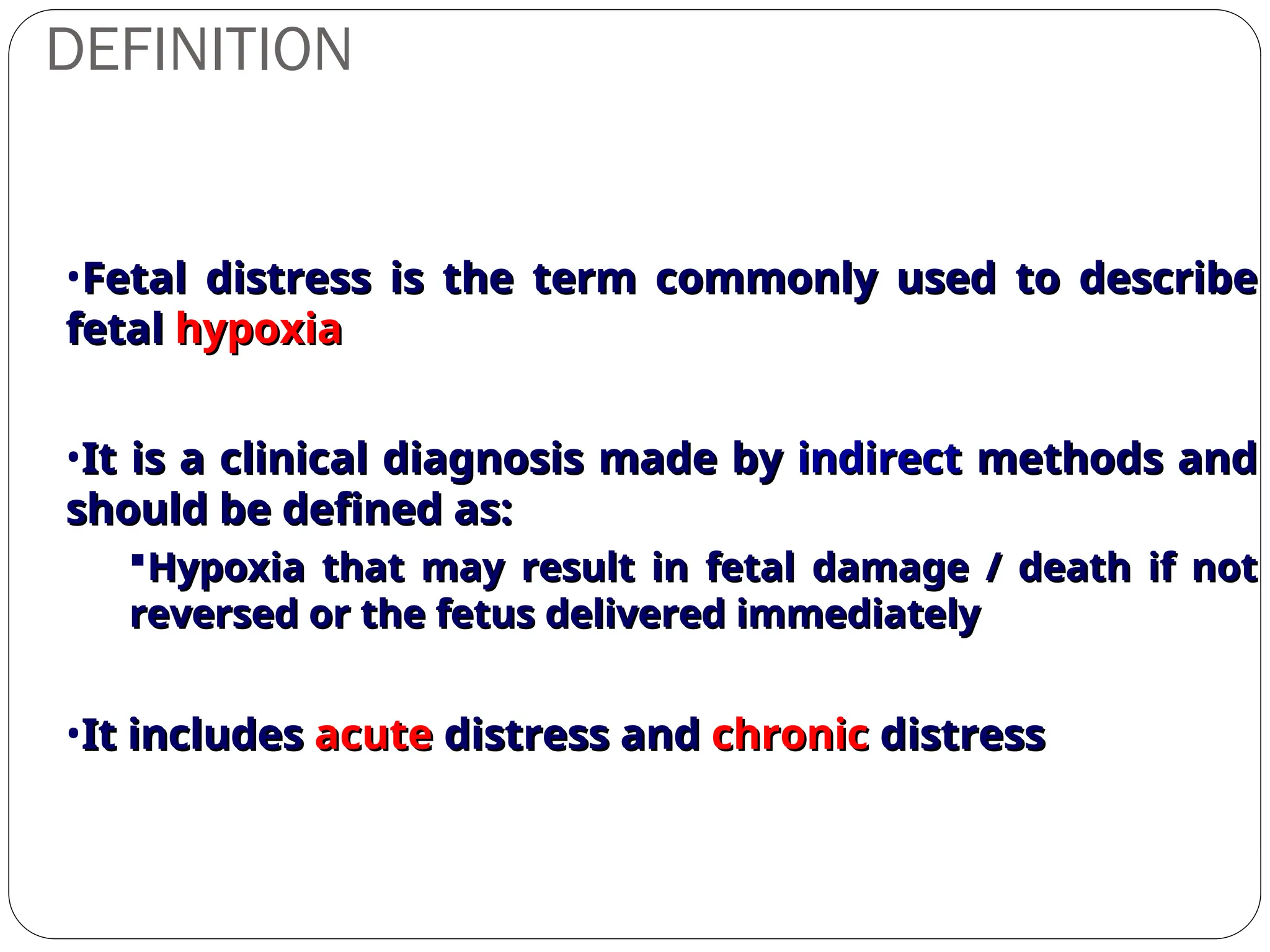
DEFINITION
•Fetal distress is the term commonly used to describe
Fetal distress is the term commonly used to describe
fetal
fetal hypoxia
hypoxia
•It is a clinical diagnosis made by
It is a clinical diagnosis made by indirect
indirect methods and
methods and
should be defined as:
Hypoxia that may result in fetal damage / death if not
Hypoxia that may result in fetal damage / death if not
reversed or the fetus delivered immediately
•It includes
It includes acute
acute distress and
distress and chronic
chronic distress
distress
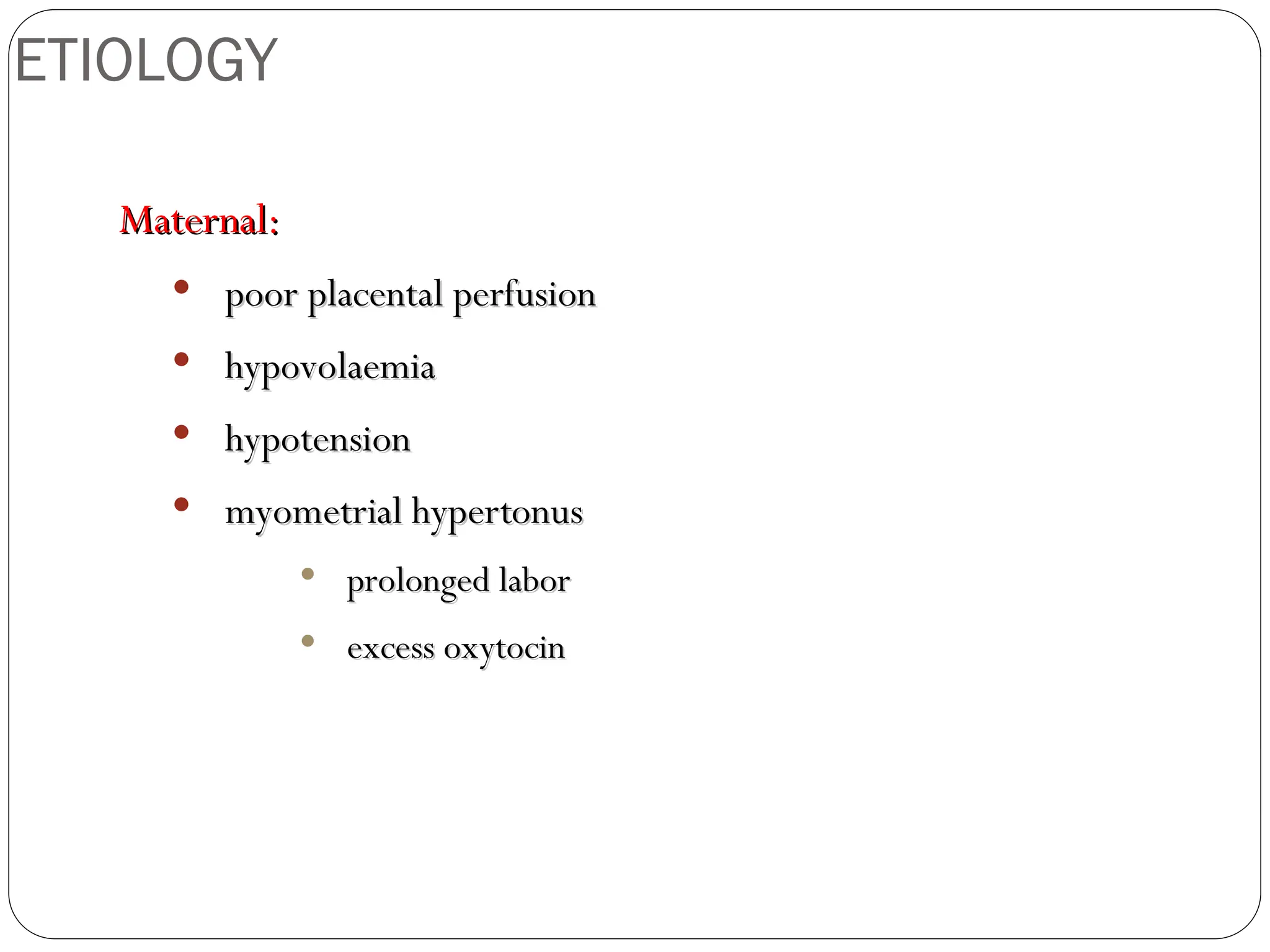
ETIOLOGY
Maternal:
Maternal:
 poor placental perfusion
poor placental perfusion
 hypovolaemia
hypovolaemia
 hypotension
hypotension
 myometrial hypertonus
myometrial hypertonus
 prolonged labor
prolonged labor
 excess oxytocin
excess oxytocin
Fetal:
Fetal:
 cord compression
cord compression
 oligohydramnios
oligohydramnios
 entanglement
entanglement
 prolapse
prolapse
 pre-existing hypoxia or growth retardation
pre-existing hypoxia or growth retardation
 infection
infection
 cardiac
cardiac
ETIOLOGY
MECHANISM
 There are potentially limitless causes for fetal distress, but
There are potentially limitless causes for fetal distress, but
several key mechanisms are usually involved
 Contractions reduce temporarily placental blood flow and can
Contractions reduce temporarily placental blood flow and can
compress the umbilical cord
 If a women is in labor longer then this can cause fetal distress via
If a women is in labor longer then this can cause fetal distress via
the above mechanism
the above mechanism
MECHANISM
 Acute distress can be a result of:
Acute distress can be a result of:
 placental abruption
placental abruption
 prolapse of the umbilical cord
prolapse of the umbilical cord (especially with breech presentations)
(especially with breech presentations)
 hypertonic uterine states
hypertonic uterine states
 use of oxytocin
use of oxytocin
 Hypotension
Hypotension can be caused by either epidural anesthesia or the
can be caused by either epidural anesthesia or the
supine position, which reduces inferior vena cava return of blood to
the heart
the heart
 The decreased blood flow in hypotension can be a cause of fetal
The decreased blood flow in hypotension can be a cause of fetal
distress
distress
SIGNS AND SYMPTOMS
SIGNS AND SYMPTOMS
Acute fetal distress
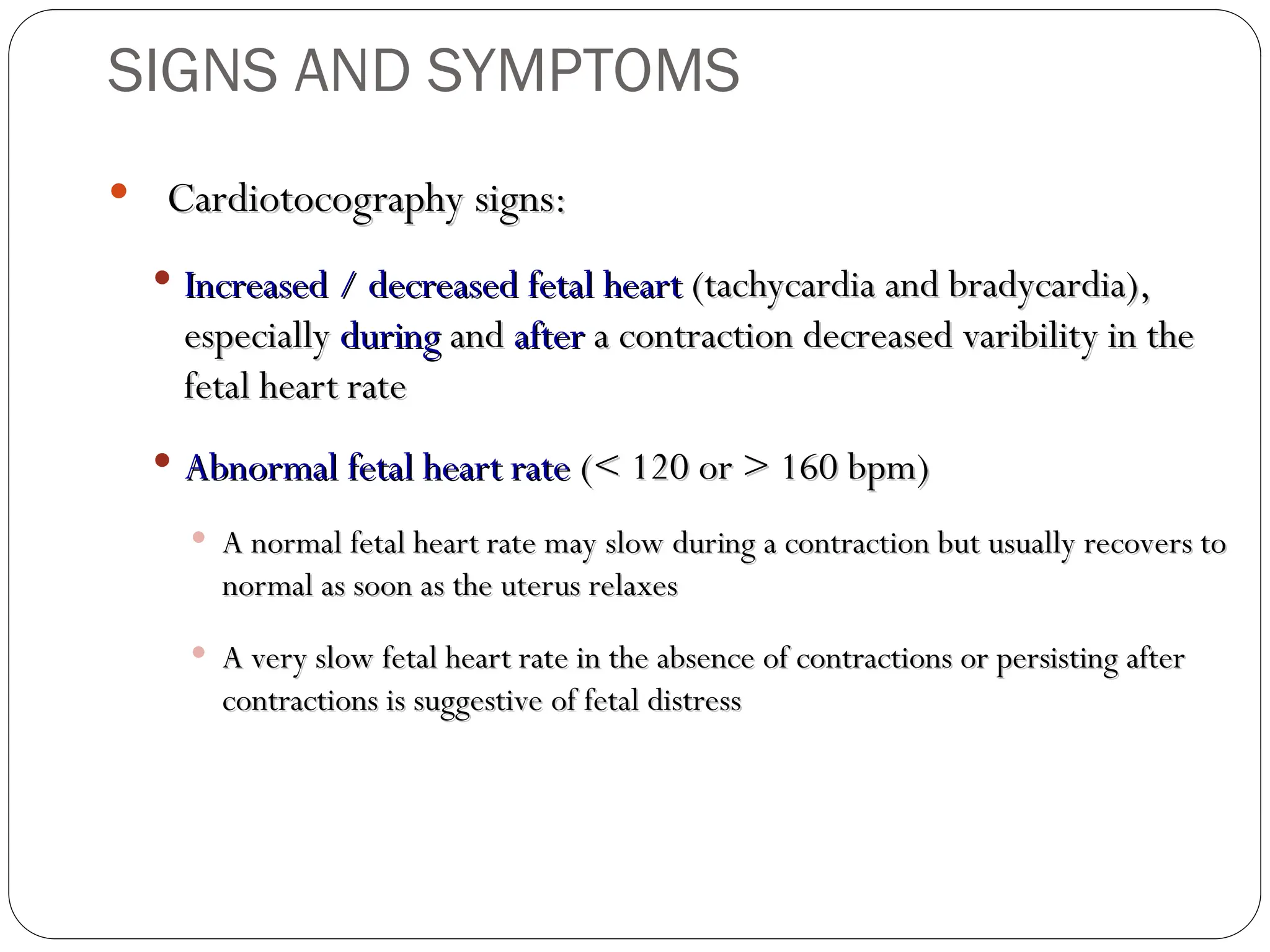
 Cardiotocography signs:
Cardiotocography signs:
 Increased / decreased fetal heart
Increased / decreased fetal heart (tachycardia and bradycardia),
(tachycardia and bradycardia),
especially
especially during
during and
and after
after a contraction decreased varibility in the
a contraction decreased varibility in the
fetal heart rate
fetal heart rate
 Abnormal fetal heart rate
Abnormal fetal heart rate (< 120 or > 160 bpm)
(< 120 or > 160 bpm)
 A normal fetal heart rate may slow during a contraction but usually recovers to
A normal fetal heart rate may slow during a contraction but usually recovers to
normal as soon as the uterus relaxes
 A very slow fetal heart rate in the absence of contractions or persisting after
A very slow fetal heart rate in the absence of contractions or persisting after
contractions is suggestive of fetal distress
SIGNS AND SYMPTOMS
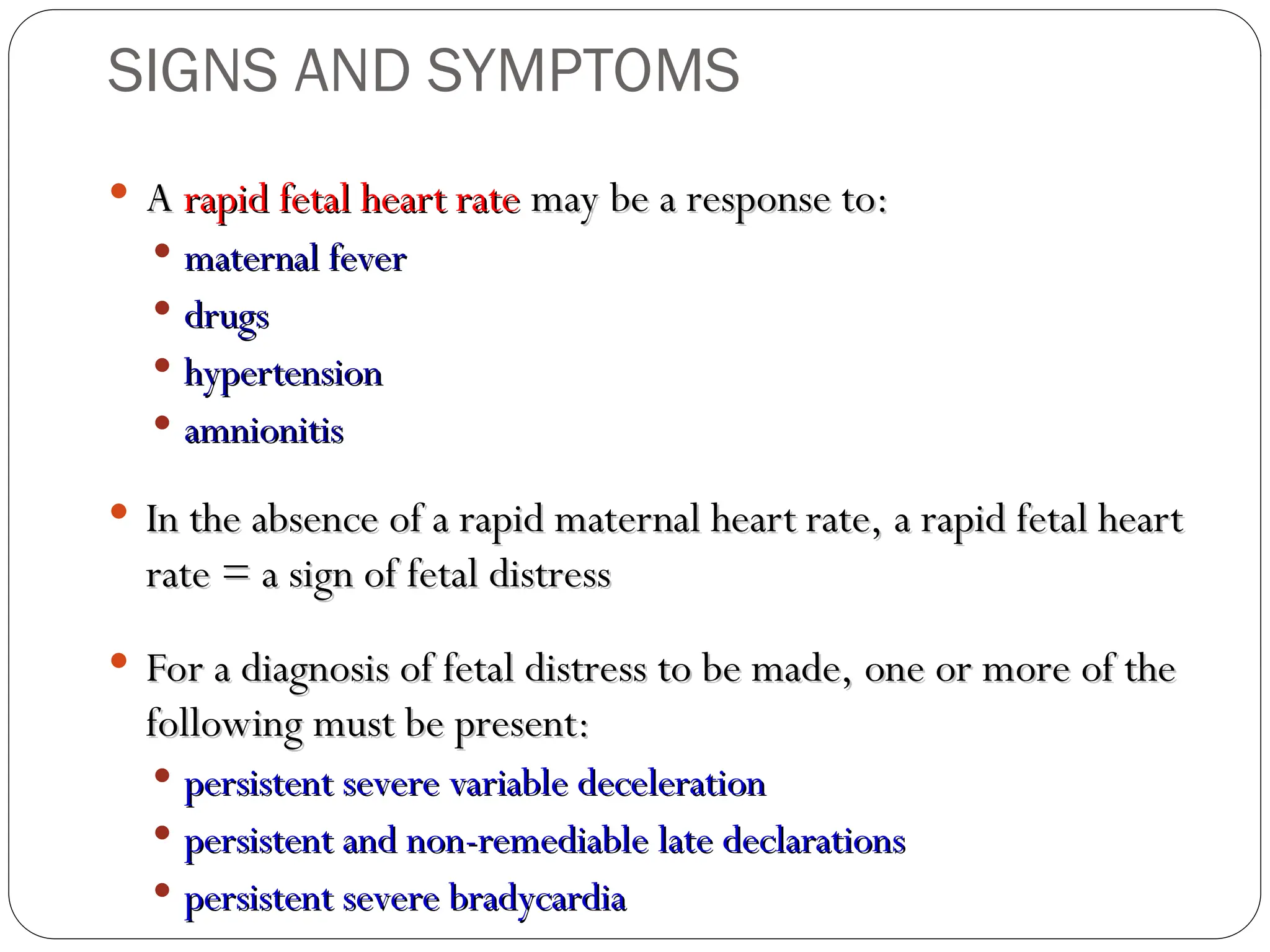
 A
A rapid fetal heart rate
rapid fetal heart rate may be a response to:
may be a response to:
 maternal fever
maternal fever
 drugs
drugs
 hypertension
hypertension
 amnionitis
amnionitis
 In the absence of a rapid maternal heart rate, a rapid fetal heart
In the absence of a rapid maternal heart rate, a rapid fetal heart
rate = a sign of fetal distress
 For a diagnosis of fetal distress to be made, one or more of the
For a diagnosis of fetal distress to be made, one or more of the
following must be present:
 persistent severe variable deceleration
persistent severe variable deceleration
 persistent and non-remediable late declarations
persistent and non-remediable late declarations
 persistent severe bradycardia
persistent severe bradycardia
SIGNS AND SYMPTOMS
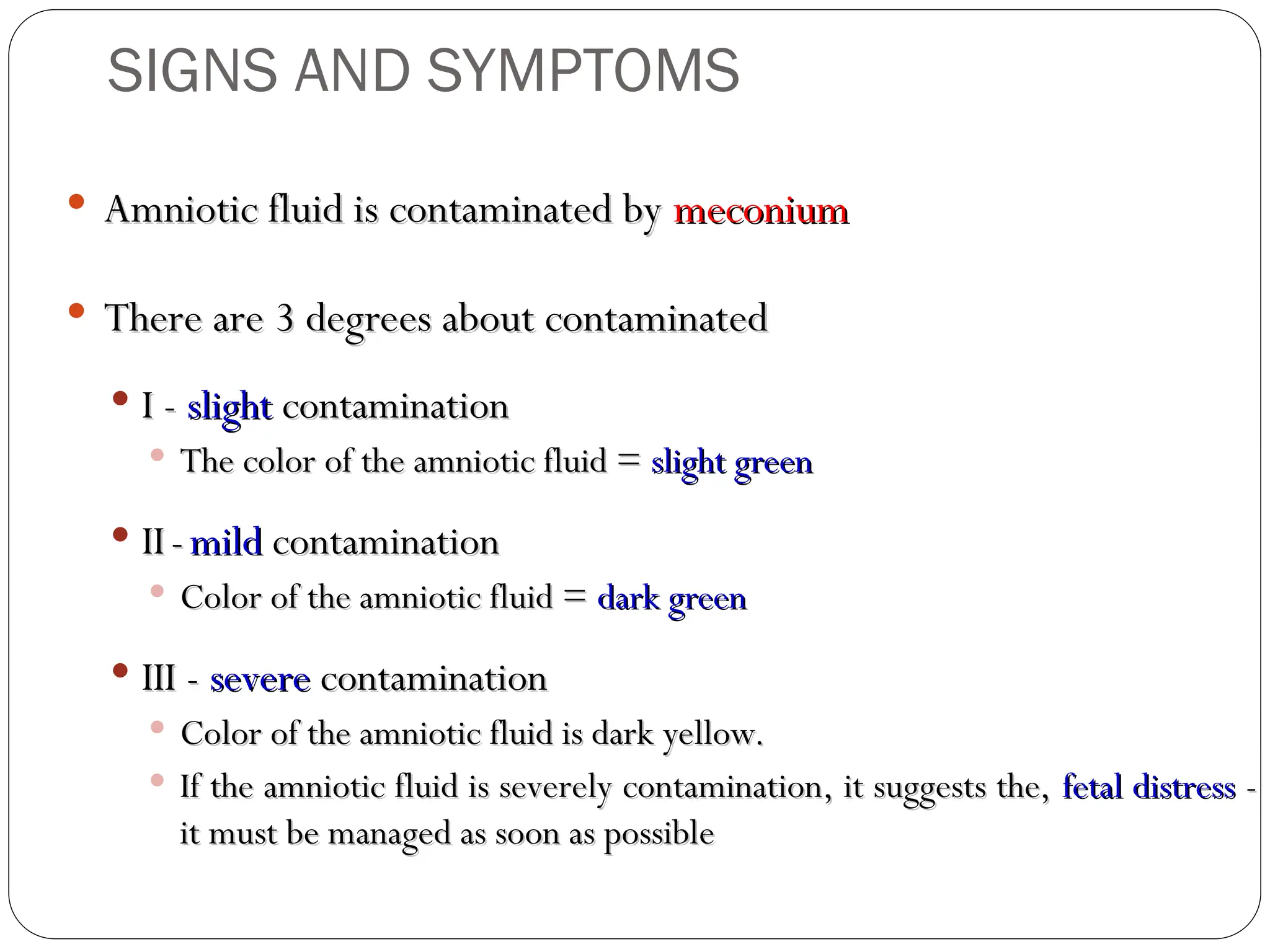
 Amniotic fluid is contaminated by
Amniotic fluid is contaminated by meconium
meconium
 There are 3 degrees about contaminated
There are 3 degrees about contaminated
 I -
I - slight
slight contamination
contamination
 The color of the amniotic fluid =
The color of the amniotic fluid = slight green
slight green
 II
II -
- mild
mild contamination
contamination
 Color of the amniotic fluid =
Color of the amniotic fluid = dark green
dark green
 III -
III - severe
severe contamination
contamination
 Color of the amniotic fluid is dark yellow.
Color of the amniotic fluid is dark yellow.
 If the amniotic fluid is severely contamination, it suggests the,
If the amniotic fluid is severely contamination, it suggests the, fetal distress
fetal distress -
-
it must be managed as soon as possible
SIGNS AND SYMPTOMS
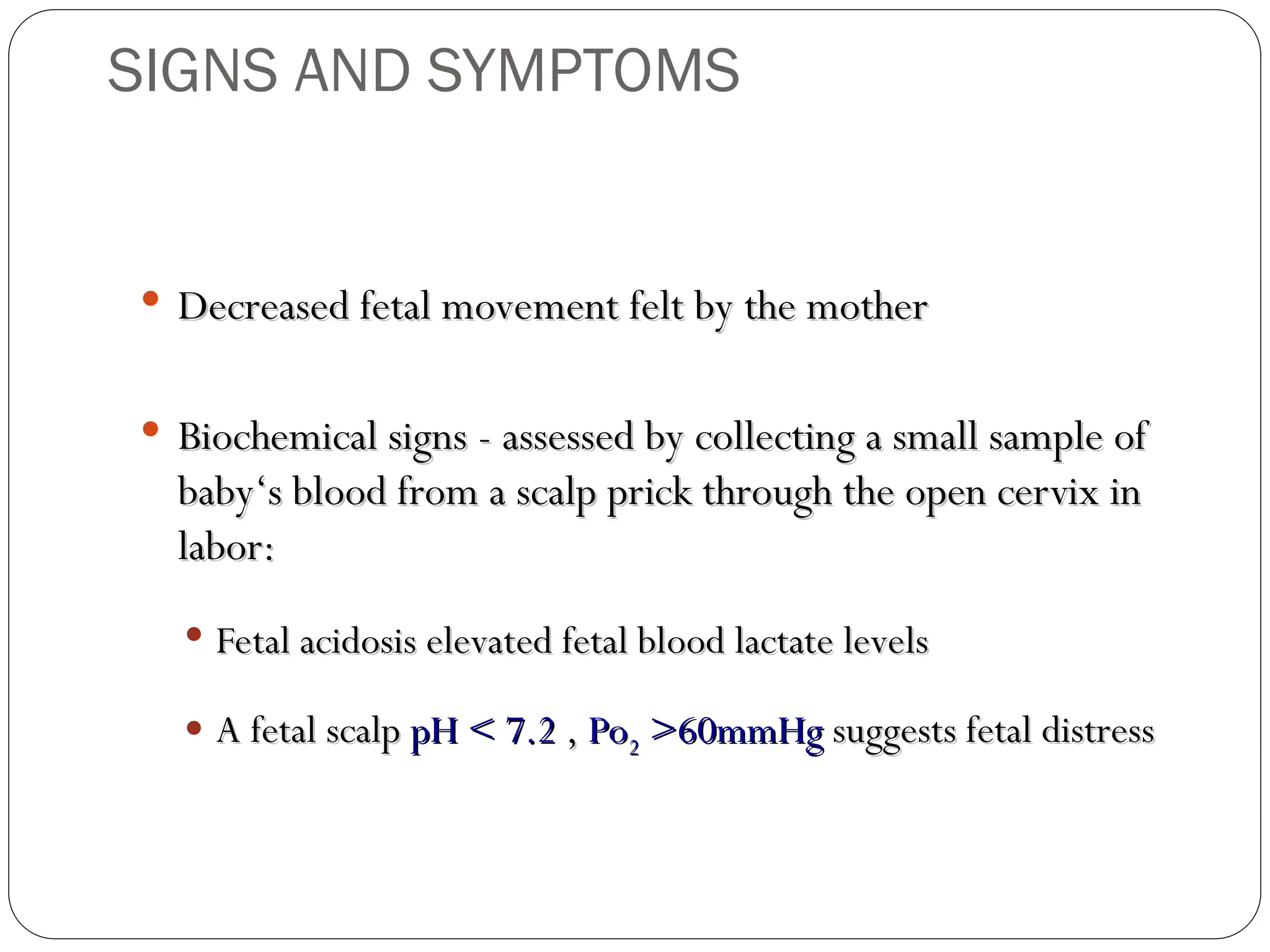
 Decreased fetal movement felt by the mother
Decreased fetal movement felt by the mother
 Biochemical signs - assessed by collecting a small sample of
Biochemical signs - assessed by collecting a small sample of
baby‘s blood from a scalp prick through the open cervix in
labor:
labor:
 Fetal acidosis elevated fetal blood lactate levels
Fetal acidosis elevated fetal blood lactate levels
 A fetal scalp
A fetal scalp pH < 7.2
pH < 7.2 ,
, Po
Po2
2 >60mmHg
>60mmHg suggests fetal distress
suggests fetal distress
SIGNS AND SYMPTOMS
Chronic Fetal Distress
 Decreased or disappear fetal movement:
Decreased or disappear fetal movement:
 < 10 times per 12 hours is regarded as decreased
< 10 times per 12 hours is regarded as decreased
 With the first effect of hypoxia, the fetal movement is increased
With the first effect of hypoxia, the fetal movement is increased
 If the hypoxia persists, the fetal movement is decreased, and may
If the hypoxia persists, the fetal movement is decreased, and may
disappear
disappear
 If the fetal movement lost, the fetal heart beat will be disappearing
If the fetal movement lost, the fetal heart beat will be disappearing
within 24 hours
within 24 hours
Cautions: Dangerous for the fetus if the fetal movement disappear.
Management immediately!!
SIGNS AND SYMPTOMS
 Abnormal cardiotocography signs:
Abnormal cardiotocography signs:
 Slow fetal heart rate(<120bpm) or rapid fetal heart rate
Slow fetal heart rate(<120bpm) or rapid fetal heart rate
(>180bpm)
(>180bpm) last more than 10 min
last more than 10 min in the absence of
in the absence of
contractions
contractions is suggestive
is suggestive of fetal distress
of fetal distress
 The fetal heart rate > 160 bpm , especially > 180 bpm, it
The fetal heart rate > 160 bpm , especially > 180 bpm, it
suggests
suggests early hypoxia
early hypoxia, unless the maternal heart rate is faster
, unless the maternal heart rate is faster
SIGNS AND SYMPTOMS
 FHR < 120bpm, typically less than 100bpm
FHR < 120bpm, typically less than 100bpm
 It is very danger for fetus
It is very danger for fetus
 The fetal heart rate normally show continuous minor
The fetal heart rate normally show continuous minor
variations, with a range of about 5 bpm, loss of base line
variability implies that the cardiac reflexes are impaired,
either from the effect of
either from the effect of hypoxia
hypoxia or of
or of drugs
drugs such as
such as valium
valium
 It may be serious
It may be serious
SIGNS AND SYMPTOMS
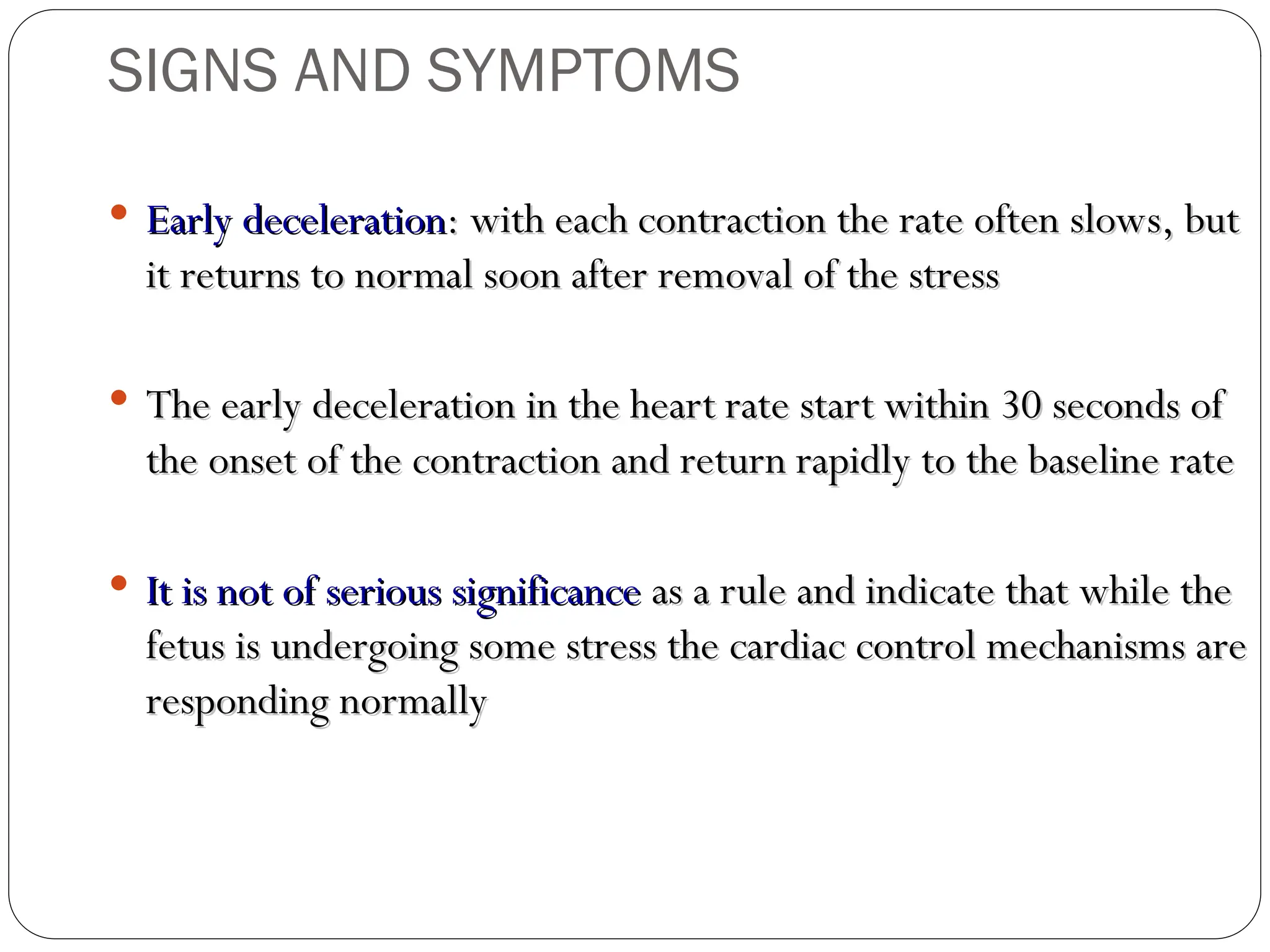
 Early deceleration
Early deceleration: with each contraction the rate often slows, but
: with each contraction the rate often slows, but
it returns to normal soon after removal of the stress
 The early deceleration in the heart rate start within 30 seconds of
The early deceleration in the heart rate start within 30 seconds of
the onset of the contraction and return rapidly to the baseline rate
 It is not of serious significance
It is not of serious significance as a rule and indicate that while the
as a rule and indicate that while the
fetus is undergoing some stress the cardiac control mechanisms are
responding normally
responding normally
SIGNS AND SYMPTOMS
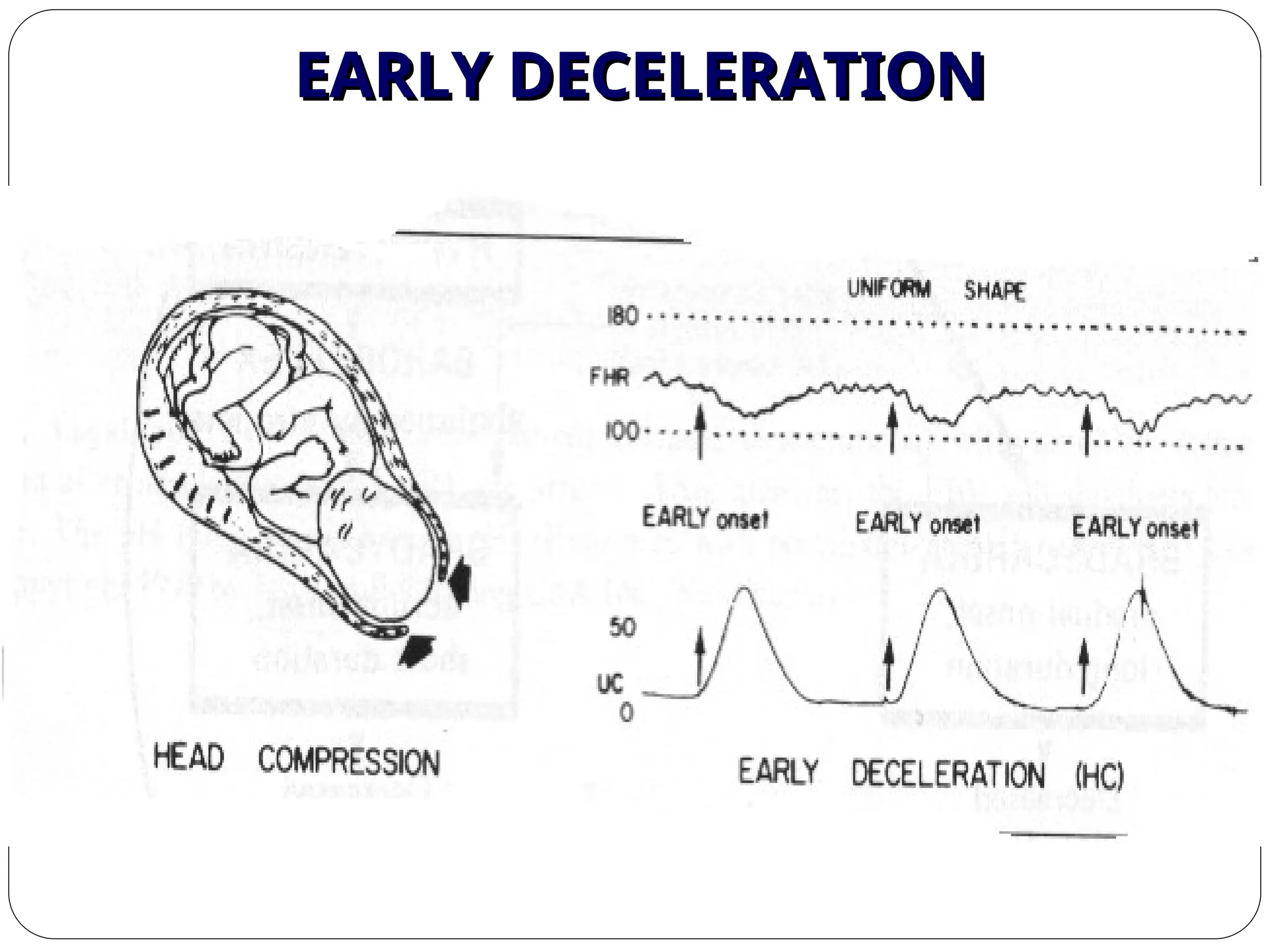
EARLY DECELERATION
EARLY DECELERATION
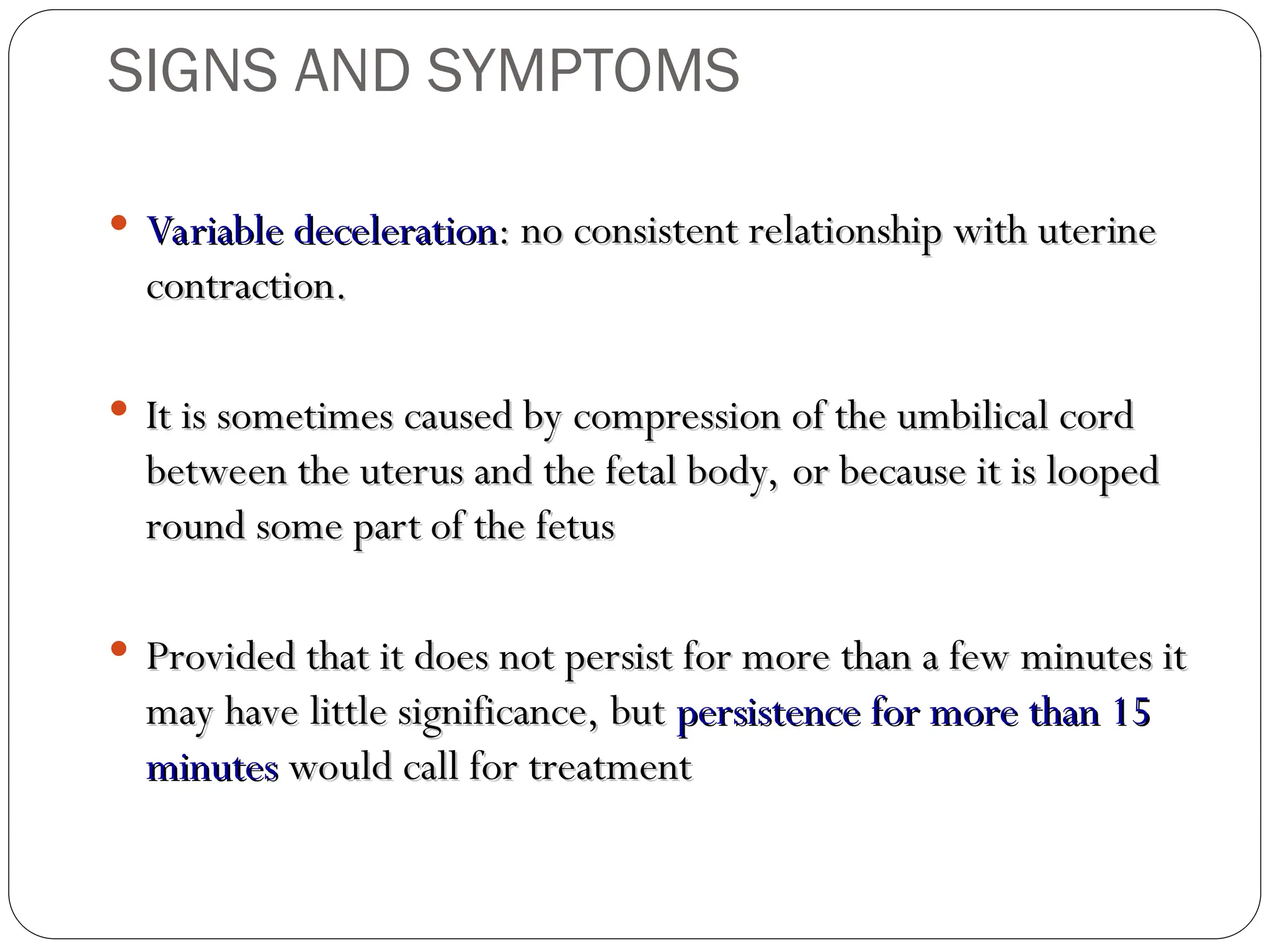
 Variable deceleration
Variable deceleration: no consistent relationship with uterine
: no consistent relationship with uterine
contraction.
contraction.
 It is sometimes caused by compression of the umbilical cord
It is sometimes caused by compression of the umbilical cord
between the uterus and the fetal body, or because it is looped
round some part of the fetus
 Provided that it does not persist for more than a few minutes it
Provided that it does not persist for more than a few minutes it
may have little significance, but
may have little significance, but persistence for more than 15
persistence for more than 15
minutes
minutes would call for treatment
would call for treatment
SIGNS AND SYMPTOMS
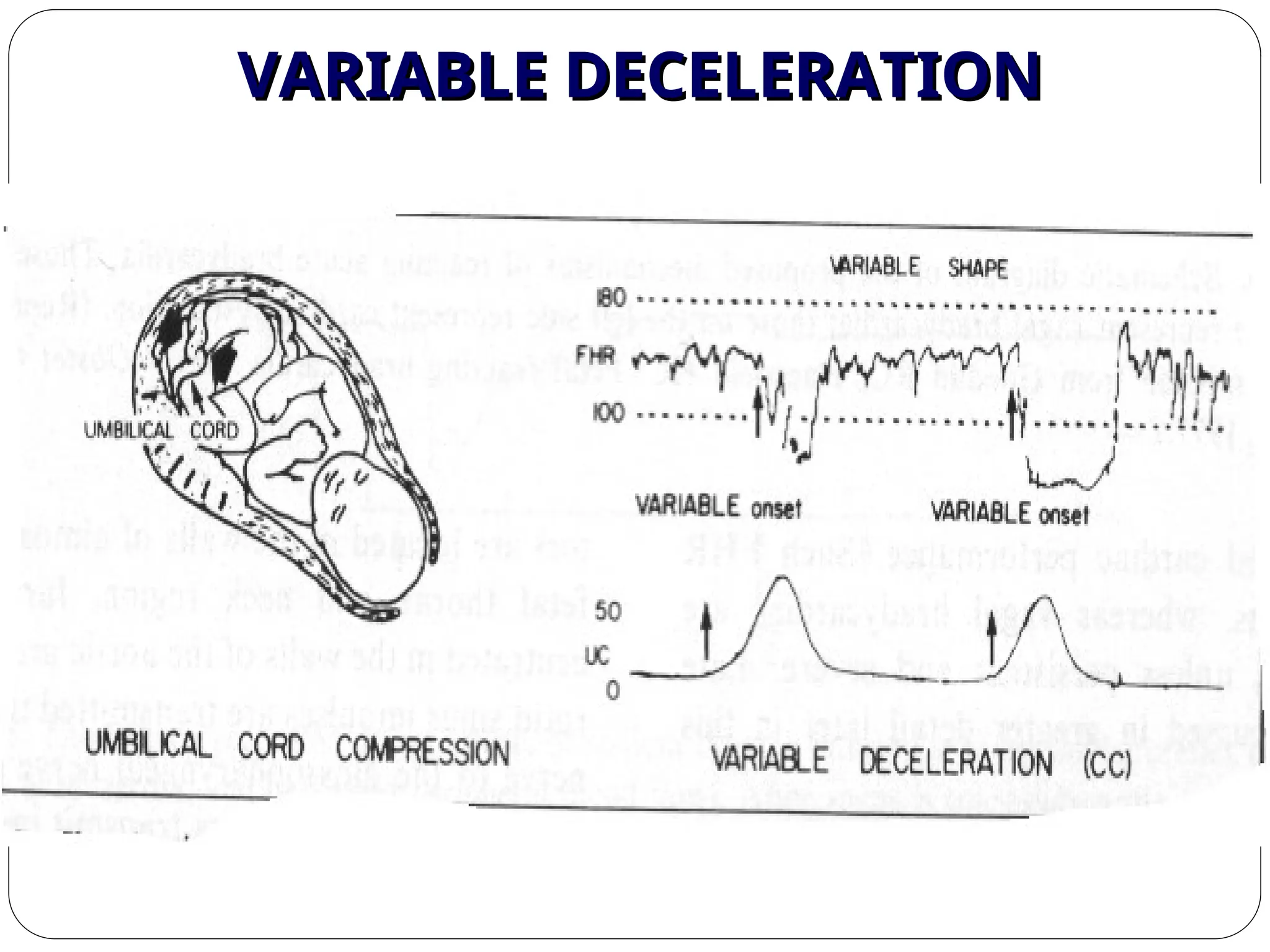
VARIABLE DECELERATION
 The most serious pattern of heart rate changes is
The most serious pattern of heart rate changes is fetal bradycardia
fetal bradycardia
with loss of baseline variability and
with loss of baseline variability and late decelerations
late decelerations
 Decrease (defined as onset of deceleration to nadir =30 seconds)
Decrease (defined as onset of deceleration to nadir =30 seconds)
and return to baseline FHR associated with a uterine contraction.
 The deceleration is delayed in timing, with the nadir of the
The deceleration is delayed in timing, with the nadir of the
deceleration occurring after the peak on the contraction
SIGNS AND SYMPTOMS
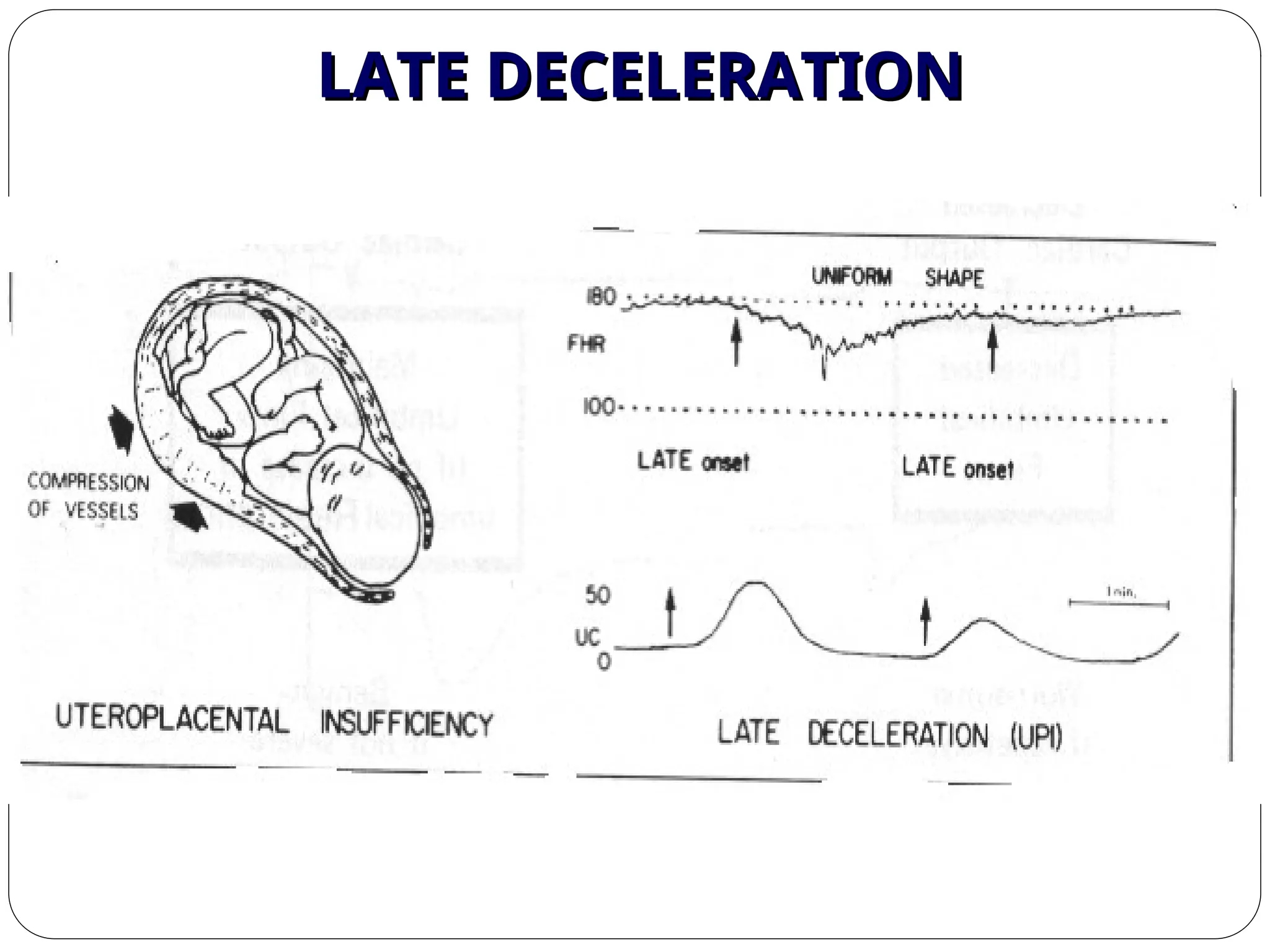
LATE DECELERATION
LATE DECELERATION
 Biophysical Profile:
Biophysical Profile:
 Amniotic Fluid Volume Normal = 2 Points
Amniotic Fluid Volume Normal = 2 Points
 Non-Stress Test Result Positive = 2 Points
Non-Stress Test Result Positive = 2 Points
 Fetal Breathing Movements Active = 2 Points
Fetal Breathing Movements Active = 2 Points
 Fetal Extremity/Trunk Movements Active = 2 Points
Fetal Extremity/Trunk Movements Active = 2 Points
 Fetal Movements Active= 2 Points
Fetal Movements Active= 2 Points
 If Biophysical Profile scores
If Biophysical Profile scores < 4
< 4 suggest fetal distress
suggest fetal distress
 Placental Insufficiency: Low estriol levels, E
Placental Insufficiency: Low estriol levels, E3
3 in urine
in urine <
<
10mg/24h
10mg/24h
BIOPHYSICAL PROFILE
TREATMENT
 Reposition patient: left-side-lying position
Reposition patient: left-side-lying position
 Administer oxygen by mask
Administer oxygen by mask
 Perform vaginal examination to check for prolapsed cord
Perform vaginal examination to check for prolapsed cord
 Ensure that qualified personnel are in attendance for resuscitation
Ensure that qualified personnel are in attendance for resuscitation
and care of the newborn
 Note: each institution shall define in writing the term qualified
Note: each institution shall define in writing the term qualified
personnel for resuscitation and care of the newborn
 Each of the following actions should be performed and
Each of the following actions should be performed and
documented prior to starting a Cesarean section for fetal distress:
 Perform vaginal exam to rule out imminent vaginal delivery
Perform vaginal exam to rule out imminent vaginal delivery
 Initiate preoperative routines
Initiate preoperative routines
 Monitor fetal heart tones (by continuous fetal monitoring or by
Monitor fetal heart tones (by continuous fetal monitoring or by
auscultation) immediately prior to preparation of the abdomen
TREATMENT
 Ensure that qualified personnel are in attendance for
Ensure that qualified personnel are in attendance for
resuscitation and care of the newborn (each institution shall
define in writing the term qualified personnel for resuscitation
and care of the newborn)
 STOP
STOP using
using oxytocin
oxytocin !
!
 Oxytocin can strengthen the contraction of uterine which
Oxytocin can strengthen the contraction of uterine which
affects the baby's heart rate
TREATMENT
DEFINITIONS MUST GRASPED
 Baseline FHR
Baseline FHR:
:
 approximate mean FHR rounded to increments of 5 bpm
approximate mean FHR rounded to increments of 5 bpm
during a 10-minute segment, excluding periodic or episodic
changes, periods of marked FHR variability, and segments of
the baseline that differ by > 25 bpm
 In any 10-minute window, the minimum baseline duration
In any 10-minute window, the minimum baseline duration
must be at least 2 minutes or the baseline for that period is
indeterminate
indeterminate
 Baseline FHR variability
Baseline FHR variability:
:
 Fluctuations in the baseline FHR =2 cycles / min
Fluctuations in the baseline FHR =2 cycles / min
 These fluctuations are irregular in amplitude and frequency, and are
These fluctuations are irregular in amplitude and frequency, and are
visually quantitated as the amplitude of the peak to the trough in beats
per minute as follows:
 amplitude range undetectable, absent FHR variability;
amplitude range undetectable, absent FHR variability;
 amplitude range greater than undetectable but = 5 bpm, minimal FHR
amplitude range greater than undetectable but = 5 bpm, minimal FHR
variability;
variability;
 amplitude range 6 bpm to 25 bpm, moderate FHR variability;
amplitude range 6 bpm to 25 bpm, moderate FHR variability;
 amplitude range >25 bpm, marked FHR variability
amplitude range >25 bpm, marked FHR variability
DEFINITIONS MUST GRASPED
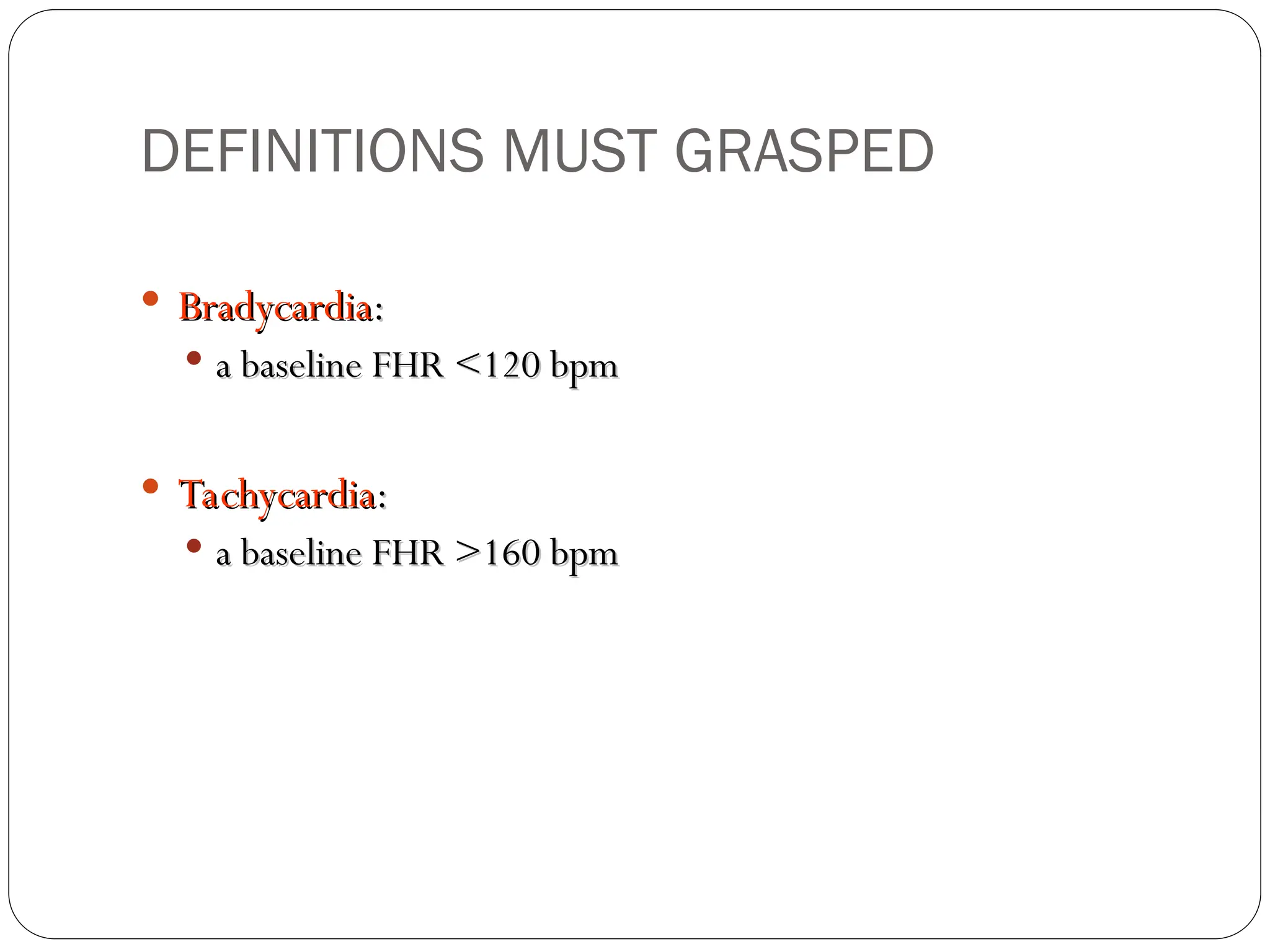
 Bradycardia
Bradycardia:
:
 a baseline FHR <120 bpm
a baseline FHR <120 bpm
 Tachycardia
Tachycardia:
:
 a baseline FHR >160 bpm
a baseline FHR >160 bpm
DEFINITIONS MUST GRASPED
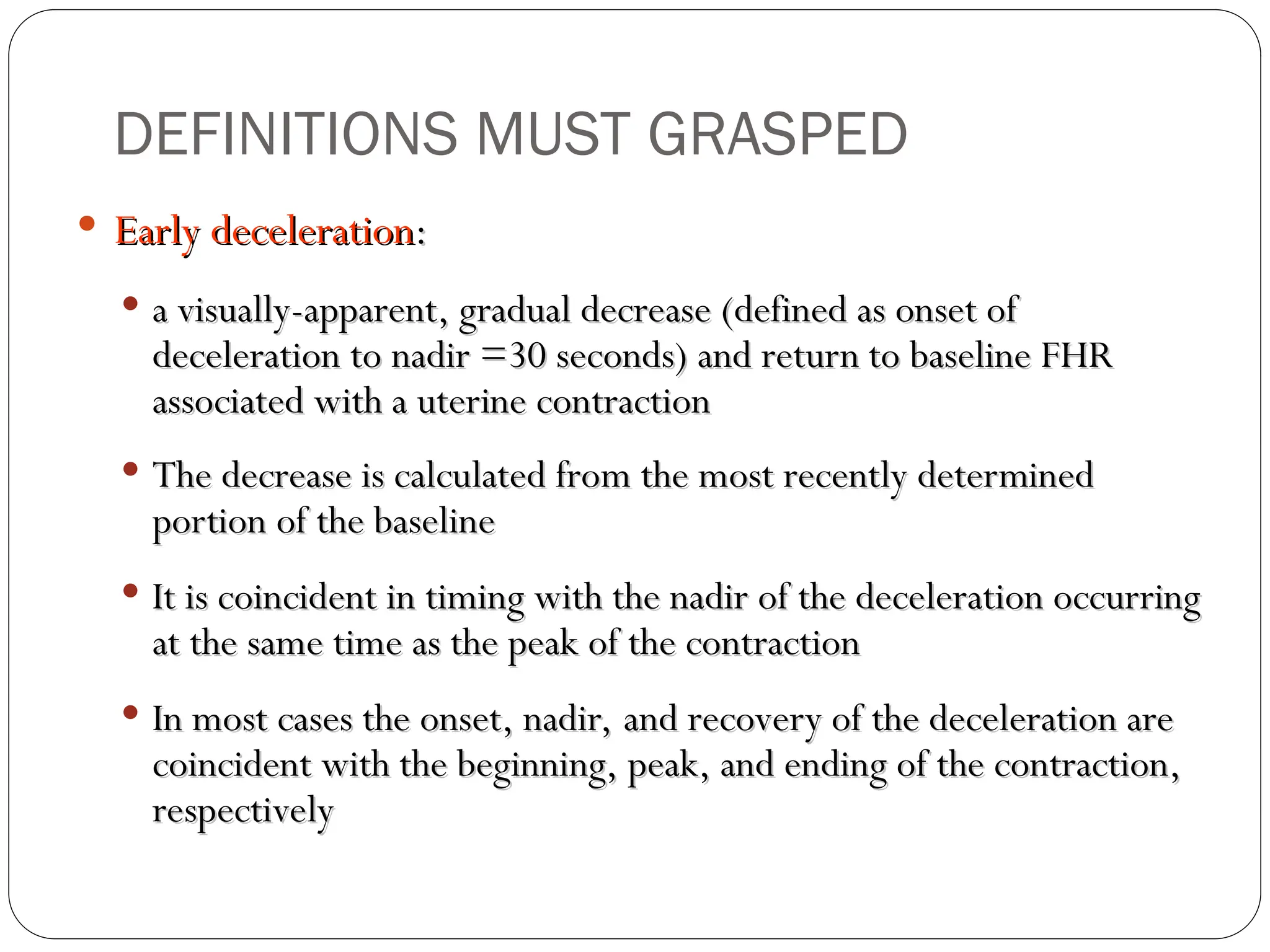
 Early deceleration
Early deceleration:
:
 a visually-apparent, gradual decrease (defined as onset of
a visually-apparent, gradual decrease (defined as onset of
deceleration to nadir =30 seconds) and return to baseline FHR
associated with a uterine contraction
 The decrease is calculated from the most recently determined
The decrease is calculated from the most recently determined
portion of the baseline
 It is coincident in timing with the nadir of the deceleration occurring
It is coincident in timing with the nadir of the deceleration occurring
at the same time as the peak of the contraction
 In most cases the onset, nadir, and recovery of the deceleration are
In most cases the onset, nadir, and recovery of the deceleration are
coincident with the beginning, peak, and ending of the contraction,
respectively
respectively
DEFINITIONS MUST GRASPED
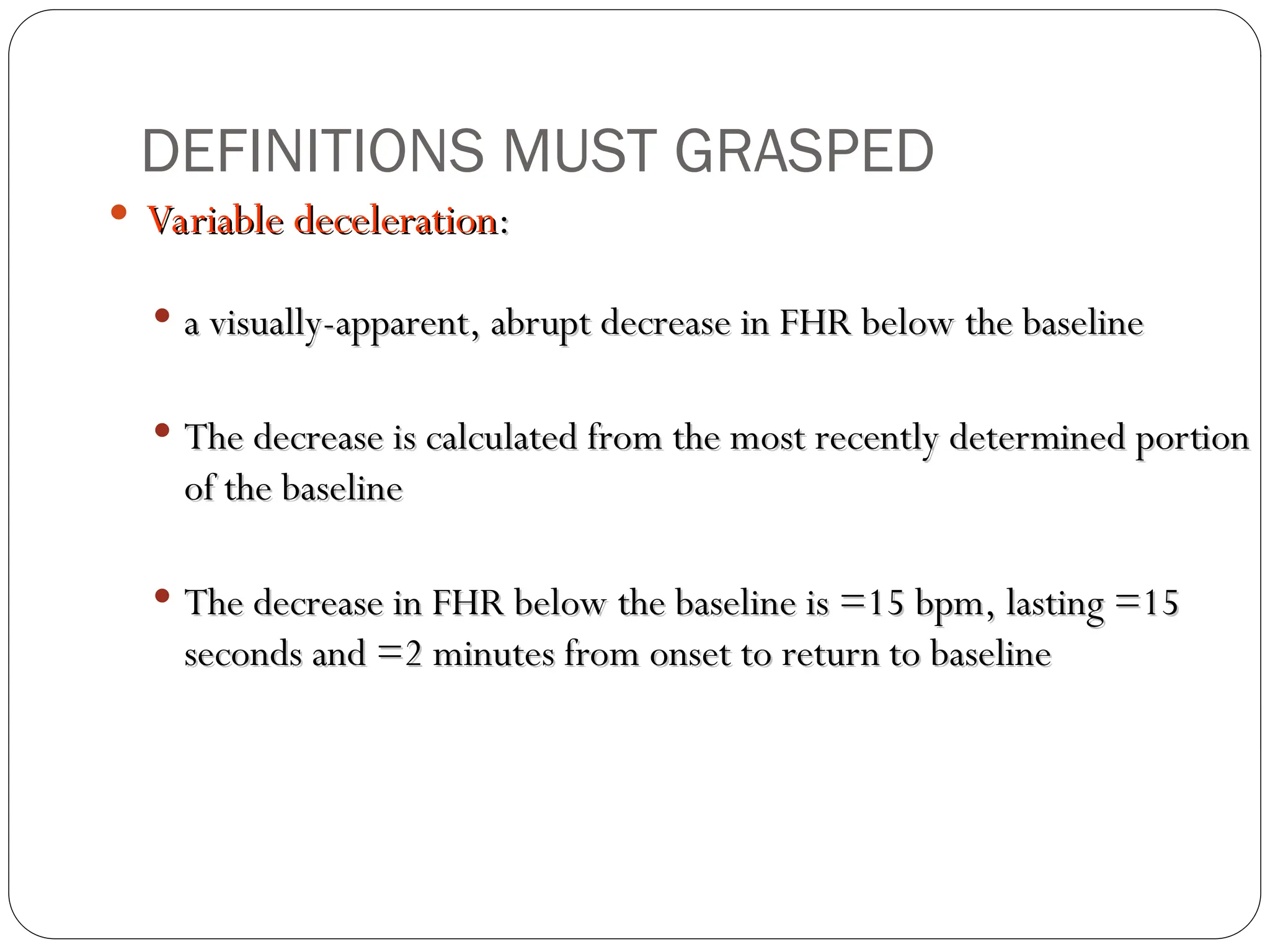
 Variable deceleration
Variable deceleration:
:
 a visually-apparent, abrupt decrease in FHR below the baseline
a visually-apparent, abrupt decrease in FHR below the baseline
 The decrease is calculated from the most recently determined portion
The decrease is calculated from the most recently determined portion
of the baseline
of the baseline
 The decrease in FHR below the baseline is =15 bpm, lasting =15
The decrease in FHR below the baseline is =15 bpm, lasting =15
seconds and =2 minutes from onset to return to baseline
DEFINITIONS MUST GRASPED
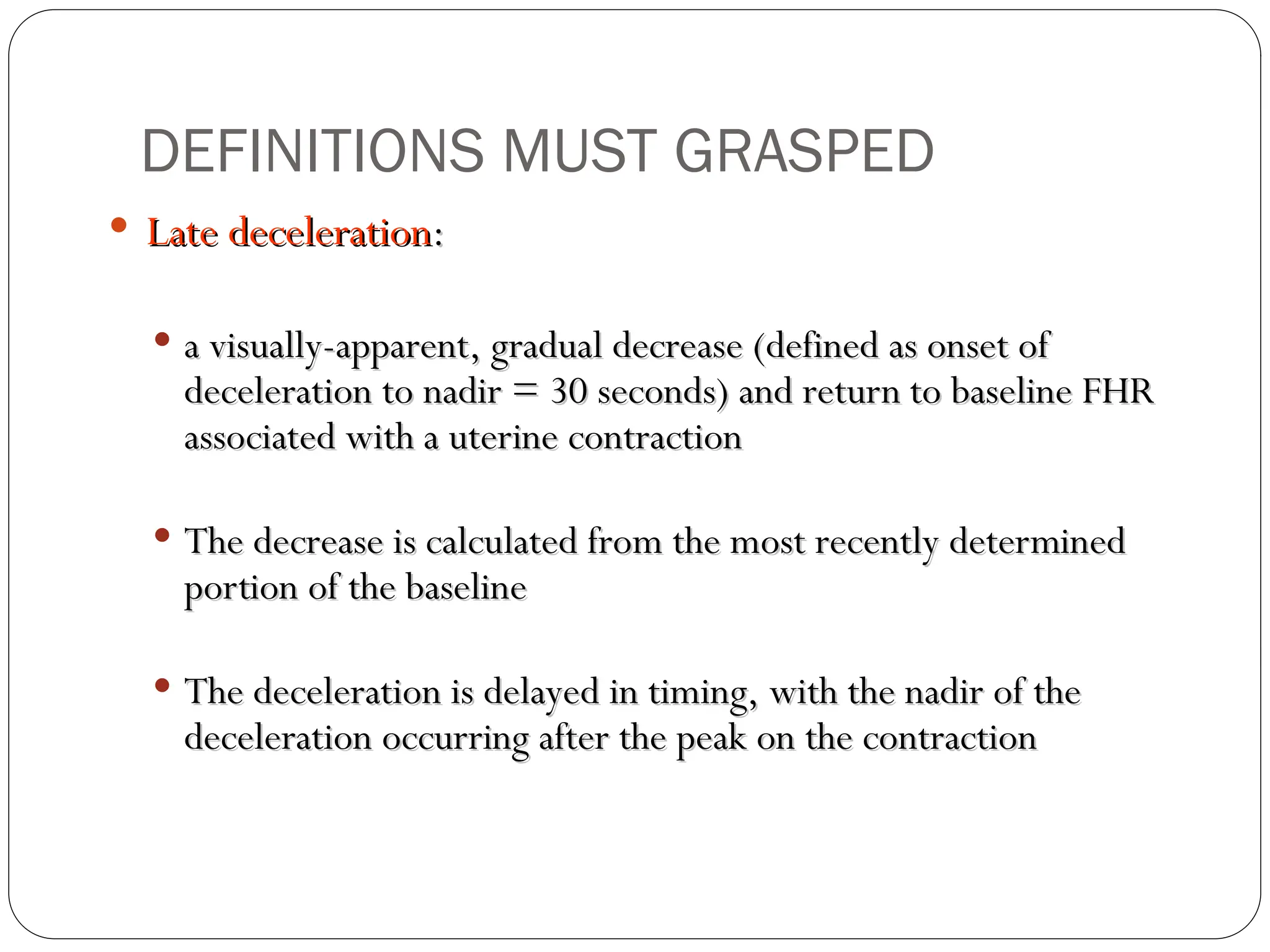
 Late deceleration
Late deceleration:
:
 a visually-apparent, gradual decrease (defined as onset of
a visually-apparent, gradual decrease (defined as onset of
deceleration to nadir = 30 seconds) and return to baseline FHR
associated with a uterine contraction
 The decrease is calculated from the most recently determined
The decrease is calculated from the most recently determined
portion of the baseline
 The deceleration is delayed in timing, with the nadir of the
The deceleration is delayed in timing, with the nadir of the
deceleration occurring after the peak on the contraction
DEFINITIONS MUST GRASPED
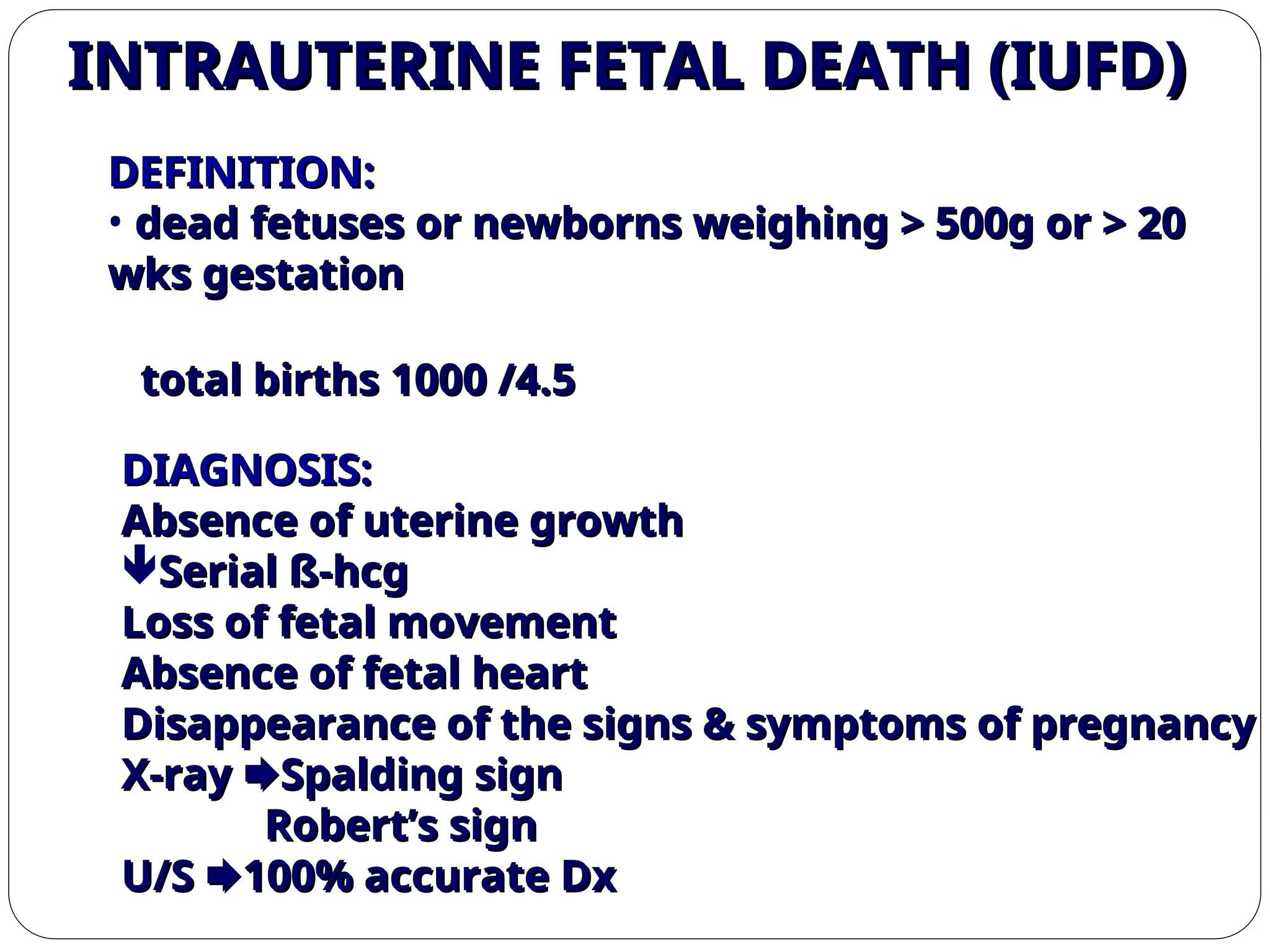
DIAGNOSIS:
DIAGNOSIS:
Absence of uterine growth
Serial ß-hcg
Serial ß-hcg
Loss of fetal movement
Absence of fetal heart
Disappearance of the signs & symptoms of pregnancy
X-ray
X-ray 
Spalding sign
Spalding sign
Robert’s sign
Robert’s sign
U/S
U/S 
100% accurate Dx
100% accurate Dx
DEFINITION:
DEFINITION:
• dead fetuses or newborns weighing > 500g or > 20
dead fetuses or newborns weighing > 500g or > 20
wks gestation
wks gestation
4.5
4.5
/
/
1000
1000
total births
total births
INTRAUTERINE FETAL DEATH (IUFD)
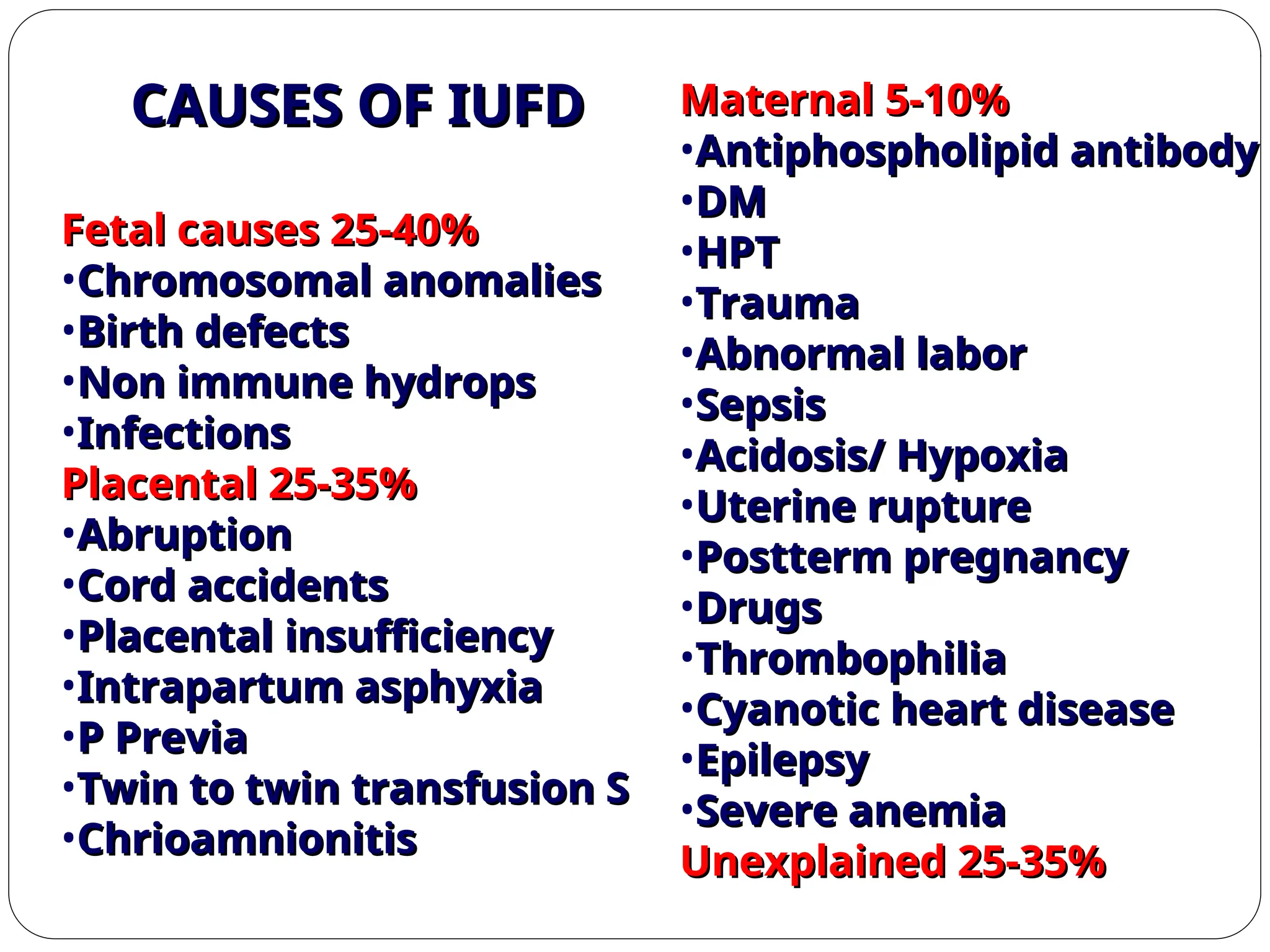
Fetal causes 25-40%
Fetal causes 25-40%
•Chromosomal anomalies
Chromosomal anomalies
•Birth defects
Birth defects
•Non immune hydrops
Non immune hydrops
•Infections
Infections
Placental 25-35%
Placental 25-35%
•Abruption
Abruption
•Cord accidents
Cord accidents
•Placental insufficiency
Placental insufficiency
•Intrapartum asphyxia
Intrapartum asphyxia
•P Previa
P Previa
•Twin to twin transfusion S
Twin to twin transfusion S
•Chrioamnionitis
Chrioamnionitis
Maternal 5-10%
Maternal 5-10%
•Antiphospholipid antibody
Antiphospholipid antibody
•DM
DM
•HPT
HPT
•Trauma
Trauma
•Abnormal labor
Abnormal labor
•Sepsis
Sepsis
•Acidosis/ Hypoxia
Acidosis/ Hypoxia
•Uterine rupture
Uterine rupture
•Postterm pregnancy
Postterm pregnancy
•Drugs
Drugs
•Thrombophilia
Thrombophilia
•Cyanotic heart disease
Cyanotic heart disease
•Epilepsy
Epilepsy
•Severe anemia
Severe anemia
Unexplained 25-35%
Unexplained 25-35%
CAUSES OF IUFD
CAUSES OF IUFD
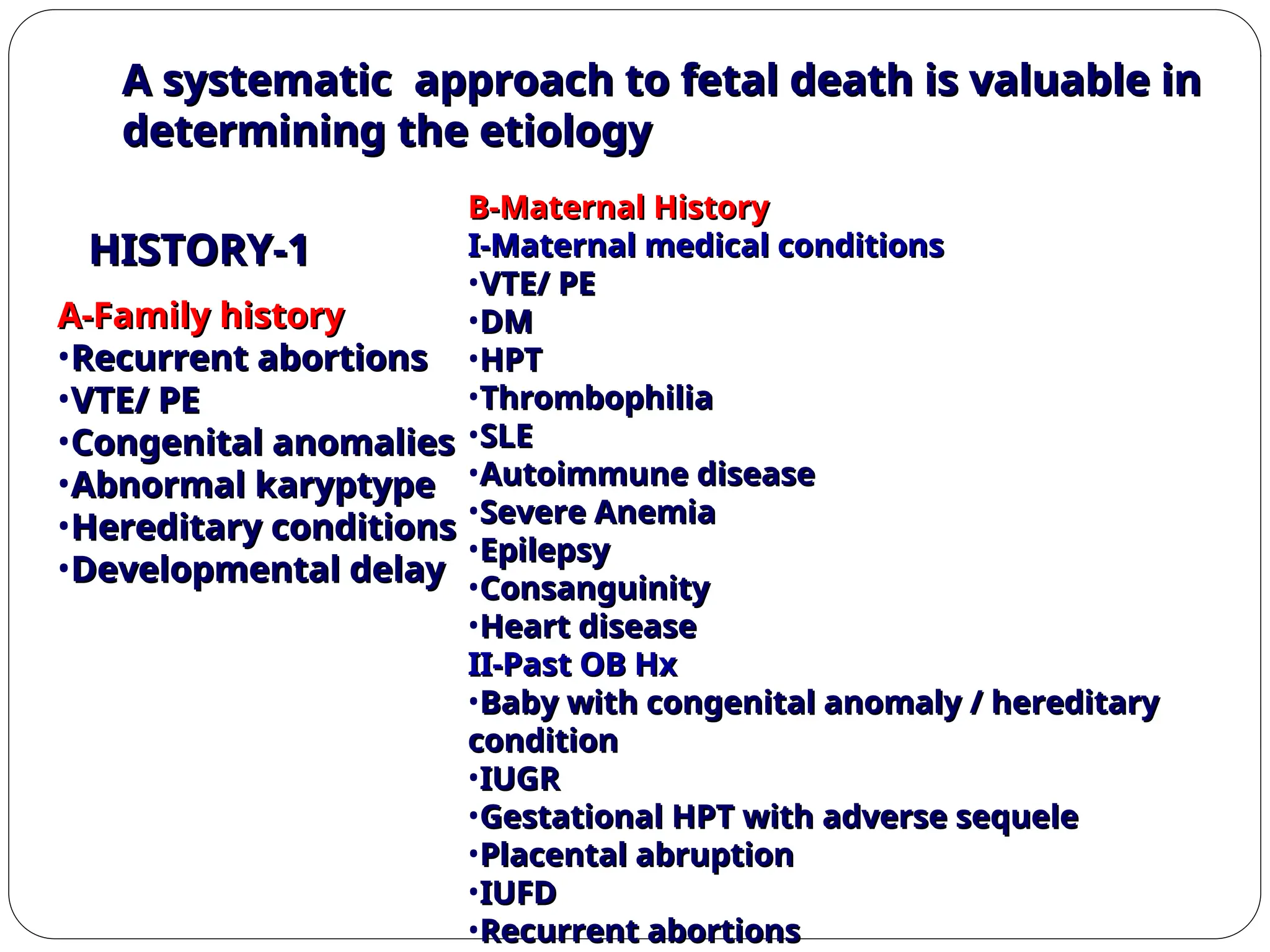
A systematic approach to fetal death is valuable in
determining the etiology
1
1
-
-
HISTORY
HISTORY
A-Family history
A-Family history
•Recurrent abortions
Recurrent abortions
•VTE/ PE
VTE/ PE
•Congenital anomalies
Congenital anomalies
•Abnormal karyptype
Abnormal karyptype
•Hereditary conditions
Hereditary conditions
•Developmental delay
Developmental delay
B-Maternal History
B-Maternal History
I-Maternal medical conditions
•VTE/ PE
VTE/ PE
•DM
DM
•HPT
HPT
•Thrombophilia
Thrombophilia
•SLE
SLE
•Autoimmune disease
Autoimmune disease
•Severe Anemia
Severe Anemia
•Epilepsy
Epilepsy
•Consanguinity
Consanguinity
•Heart disease
Heart disease
II-Past OB Hx
II-Past OB Hx
•Baby with congenital anomaly / hereditary
Baby with congenital anomaly / hereditary
condition
condition
•IUGR
IUGR
•Gestational HPT with adverse sequele
Gestational HPT with adverse sequele
•Placental abruption
Placental abruption
•IUFD
IUFD
•Recurrent abortions
Recurrent abortions
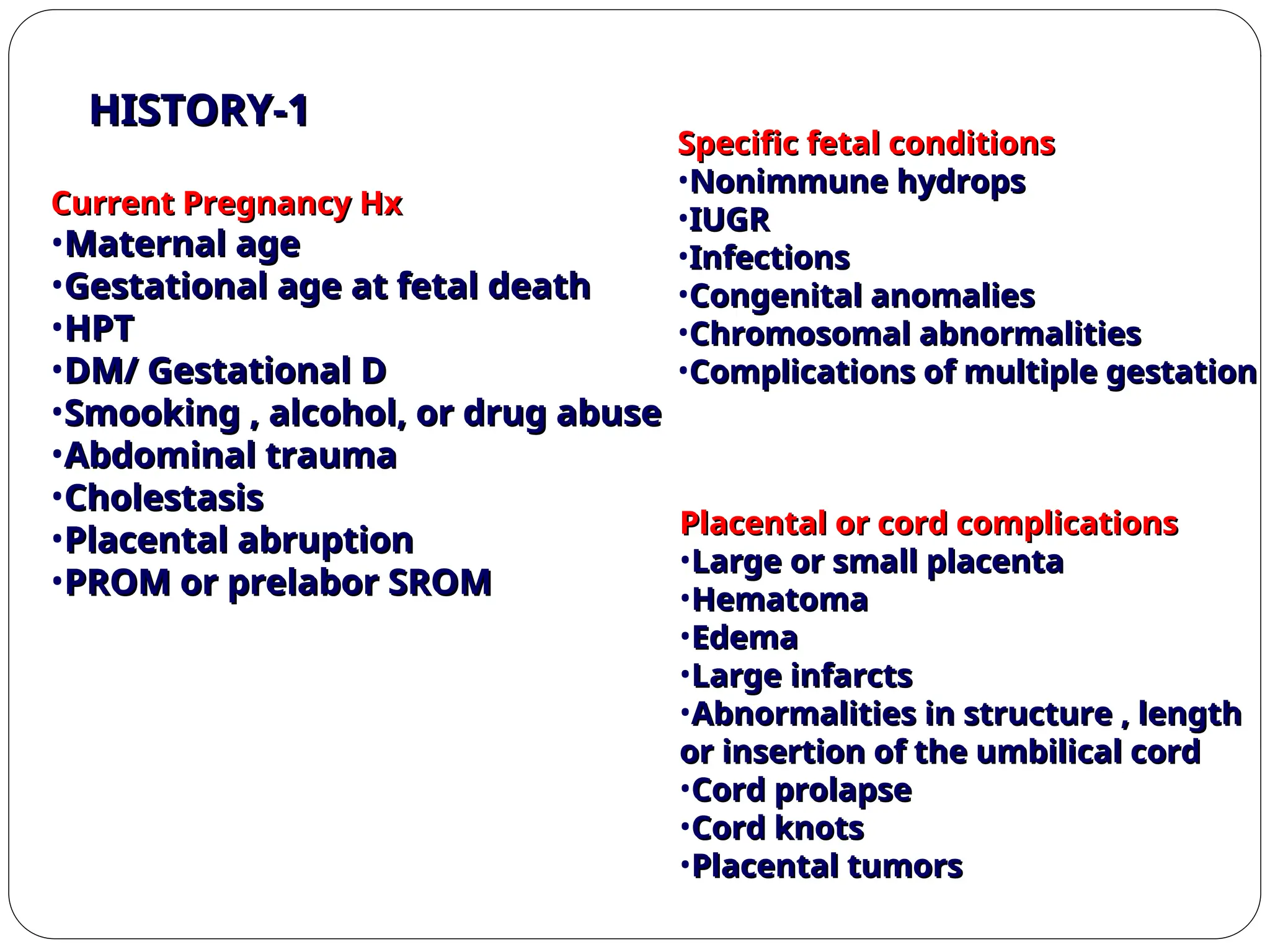
Current Pregnancy Hx
•Maternal age
Maternal age
•Gestational age at fetal death
Gestational age at fetal death
•HPT
HPT
•DM/ Gestational D
DM/ Gestational D
•Smooking , alcohol, or drug abuse
Smooking , alcohol, or drug abuse
•Abdominal trauma
Abdominal trauma
•Cholestasis
Cholestasis
•Placental abruption
Placental abruption
•PROM or prelabor SROM
PROM or prelabor SROM
Specific fetal conditions
•Nonimmune hydrops
Nonimmune hydrops
•IUGR
IUGR
•Infections
Infections
•Congenital anomalies
Congenital anomalies
•Chromosomal abnormalities
Chromosomal abnormalities
•Complications of multiple gestation
Complications of multiple gestation
Placental or cord complications
•Large or small placenta
Large or small placenta
•Hematoma
Hematoma
•Edema
Edema
•Large infarcts
Large infarcts
•Abnormalities in structure , length
Abnormalities in structure , length
or insertion of the umbilical cord
•Cord prolapse
Cord prolapse
•Cord knots
Cord knots
•Placental tumors
Placental tumors
1
1
-
-
HISTORY
HISTORY
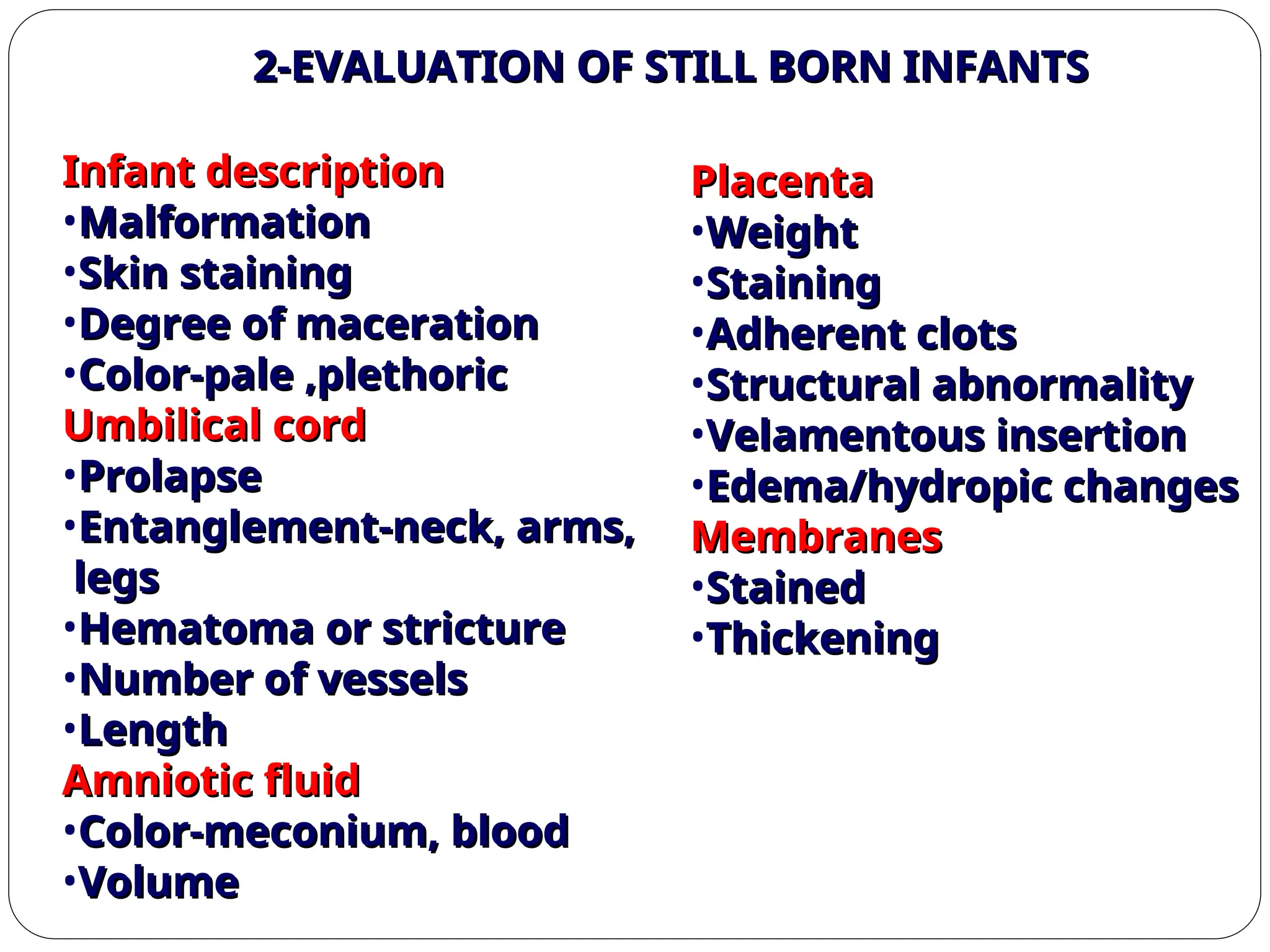
2-EVALUATION OF STILL BORN INFANTS
Infant description
Infant description
•Malformation
Malformation
•Skin staining
Skin staining
•Degree of maceration
Degree of maceration
•Color-pale ,plethoric
Color-pale ,plethoric
Umbilical cord
Umbilical cord
•Prolapse
Prolapse
•Entanglement-neck, arms,
Entanglement-neck, arms,
legs
legs
•Hematoma or stricture
Hematoma or stricture
•Number of vessels
Number of vessels
•Length
Length
Amniotic fluid
Amniotic fluid
•Color-meconium, blood
Color-meconium, blood
•Volume
Volume
Placenta
Placenta
•Weight
Weight
•Staining
Staining
•Adherent clots
Adherent clots
•Structural abnormality
Structural abnormality
•Velamentous insertion
Velamentous insertion
•Edema/hydropic changes
Edema/hydropic changes
Membranes
Membranes
•Stained
Stained
•Thickening
Thickening
3
3
-
-
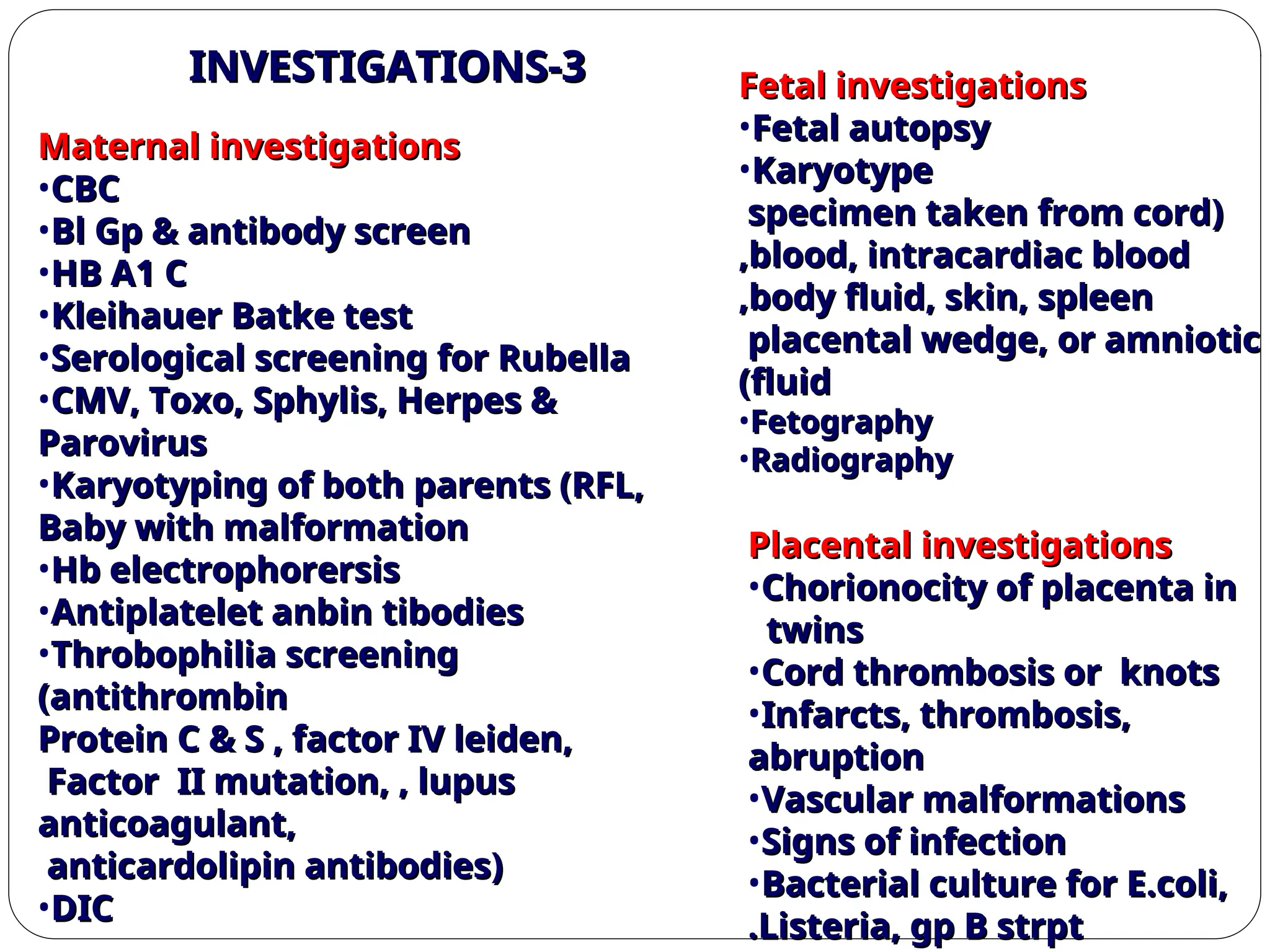
INVESTIGATIONS
INVESTIGATIONS
Maternal investigations
•CBC
CBC
•Bl Gp & antibody screen
Bl Gp & antibody screen
•HB A1 C
HB A1 C
•Kleihauer Batke test
Kleihauer Batke test
•Serological screening for Rubella
Serological screening for Rubella
•CMV, Toxo, Sphylis, Herpes &
CMV, Toxo, Sphylis, Herpes &
Parovirus
Parovirus
•Karyotyping of both parents (RFL,
Karyotyping of both parents (RFL,
Baby with malformation
•Hb electrophorersis
Hb electrophorersis
•Antiplatelet anbin tibodies
Antiplatelet anbin tibodies
•Throbophilia screening
Throbophilia screening
(antithrombin
(antithrombin
Protein C & S , factor IV leiden,
Factor II mutation, , lupus
anticoagulant,
anticoagulant,
anticardolipin antibodies)
•DIC
DIC
Fetal investigations
•Fetal autopsy
Fetal autopsy
•Karyotype
Karyotype
(
(
specimen taken from cord
blood, intracardiac blood
,
,
body fluid, skin, spleen
,
,
placental wedge, or amniotic
fluid
fluid
)
)
•Fetography
Fetography
•Radiography
Radiography
Placental investigations
•Chorionocity of placenta in
Chorionocity of placenta in
twins
twins
•Cord thrombosis or knots
Cord thrombosis or knots
•Infarcts, thrombosis,
Infarcts, thrombosis,
abruption
abruption
•Vascular malformations
Vascular malformations
•Signs of infection
Signs of infection
•Bacterial culture for E.coli,
Bacterial culture for E.coli,
Listeria, gp B strpt
.
.
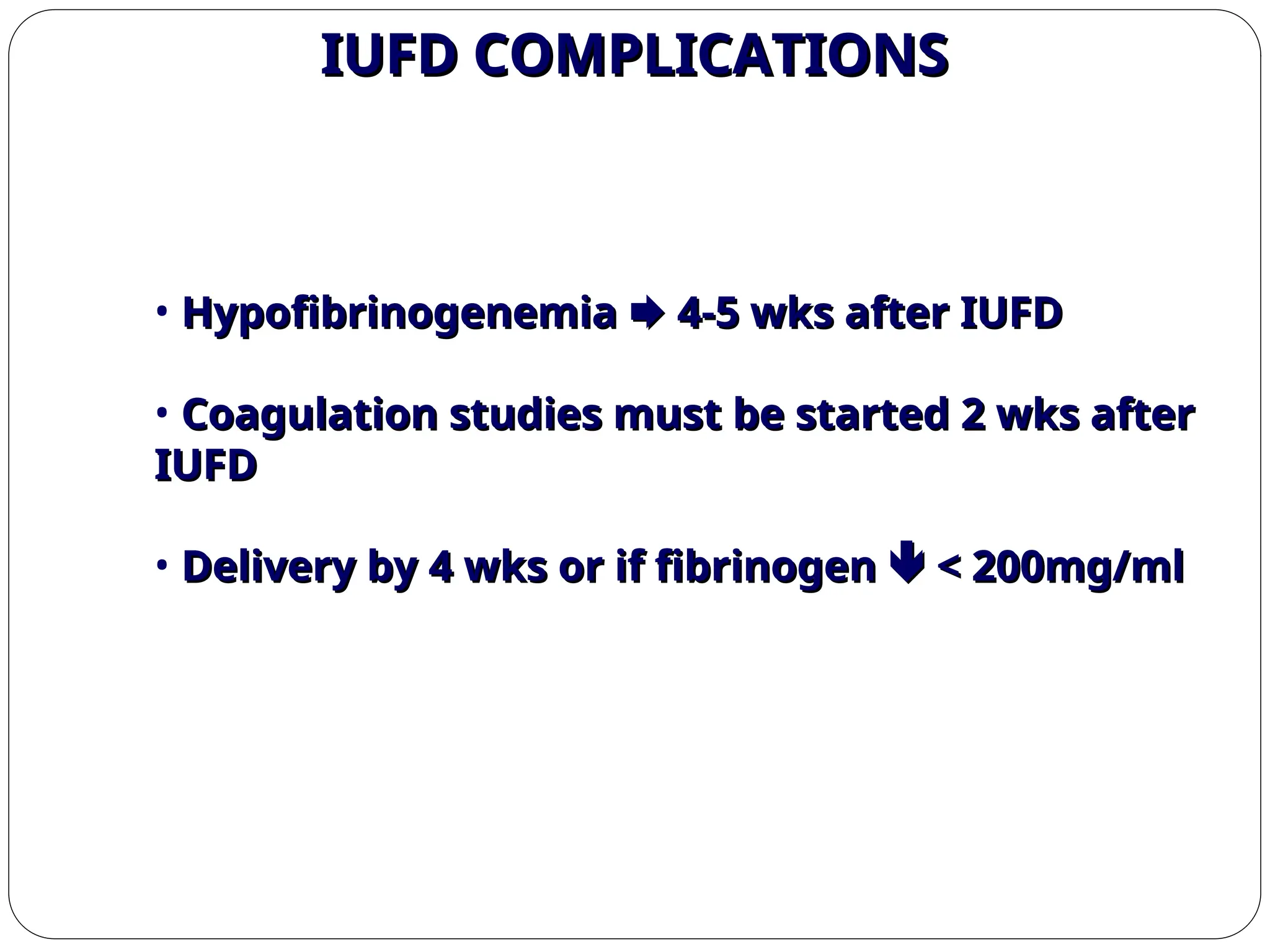
IUFD COMPLICATIONS
IUFD COMPLICATIONS
• Hypofibrinogenemia
Hypofibrinogenemia 
 4-5 wks after IUFD
4-5 wks after IUFD
• Coagulation studies must be started 2 wks after
Coagulation studies must be started 2 wks after
IUFD
IUFD
• Delivery by 4 wks or if fibrinogen
Delivery by 4 wks or if fibrinogen 
 < 200mg/ml
< 200mg/ml
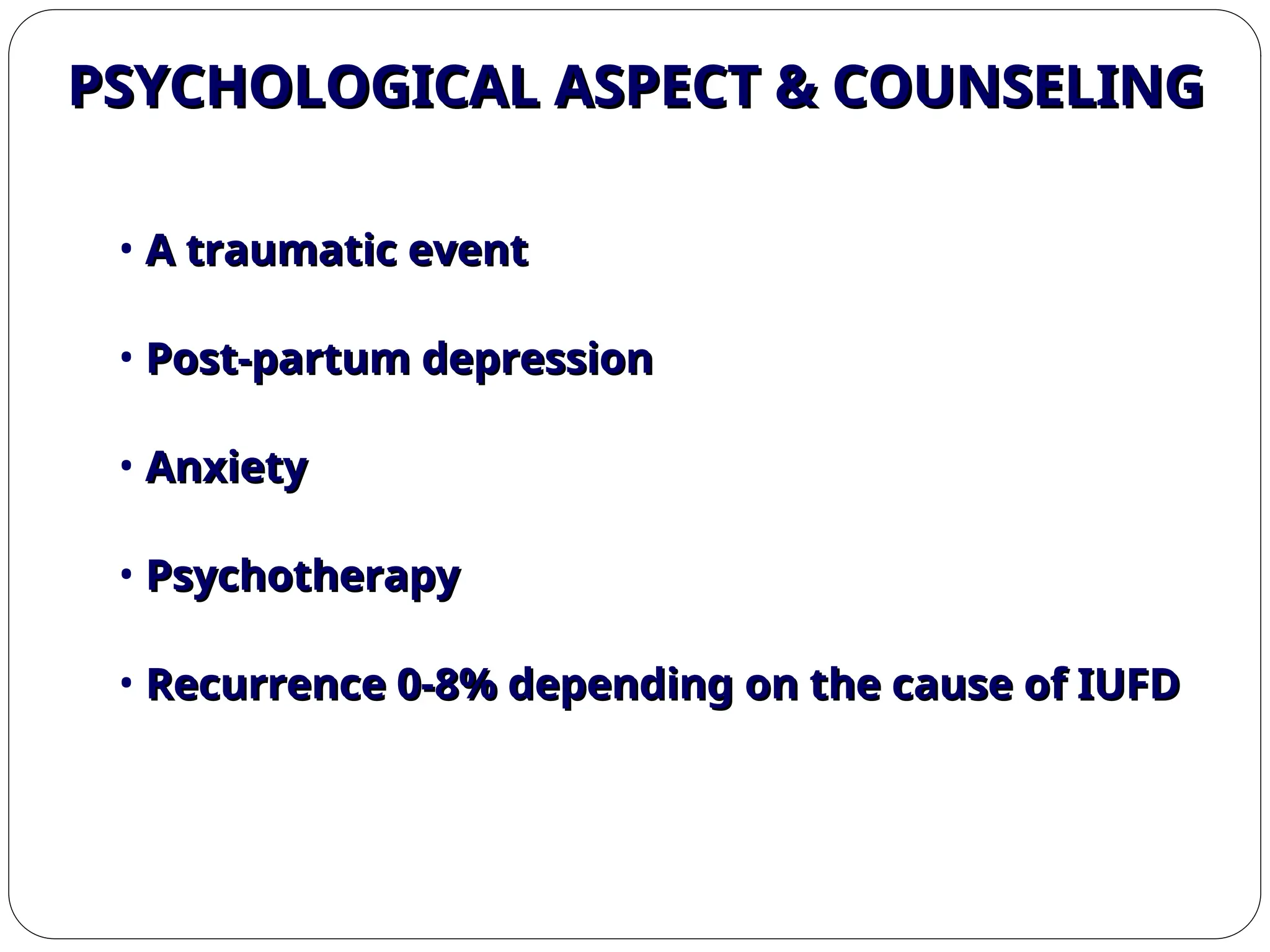
PSYCHOLOGICAL ASPECT & COUNSELING
• A traumatic event
A traumatic event
• Post-partum depression
Post-partum depression
• Anxiety
Anxiety
• Psychotherapy
Psychotherapy
• Recurrence 0-8% depending on the cause of IUFD
Recurrence 0-8% depending on the cause of IUFD
RETAINED PLACENTA
DEFINITION
The placenta is said to be retained when it is
not expelled out even 30mts after the birth of
the baby.
C.S. Dawn
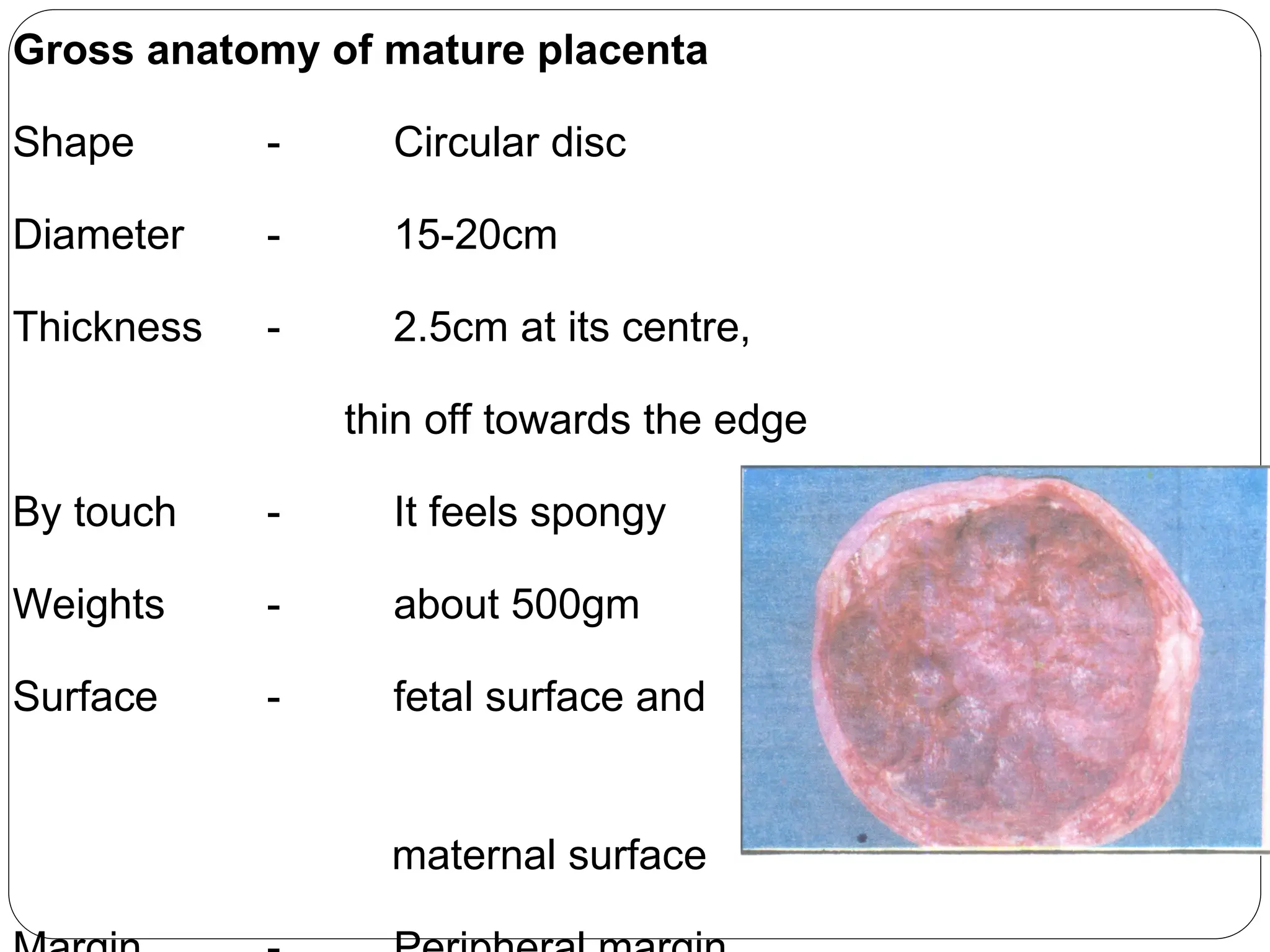
Gross anatomy of mature placenta
Shape - Circular disc
Diameter - 15-20cm
Thickness - 2.5cm at its centre,
thin off towards the edge
By touch - It feels spongy
Weights - about 500gm
Surface - fetal surface and
maternal surface
Phases in expulsion of placenta
1.Separation through the spongy layer of
decidua
2.Descent into the lower segment and vagina
3.Finally its expulsion to outside
Causes of retained placenta
- Poor voluntary expulsive efforts
- Uterine atonicity in cases of grand multipara overdistension
of uterus, prolonged labour, uterine malformation
- Incarcerated placenta following partially or completely
separated. It is due to constriction ring (hour – glass
contraction)
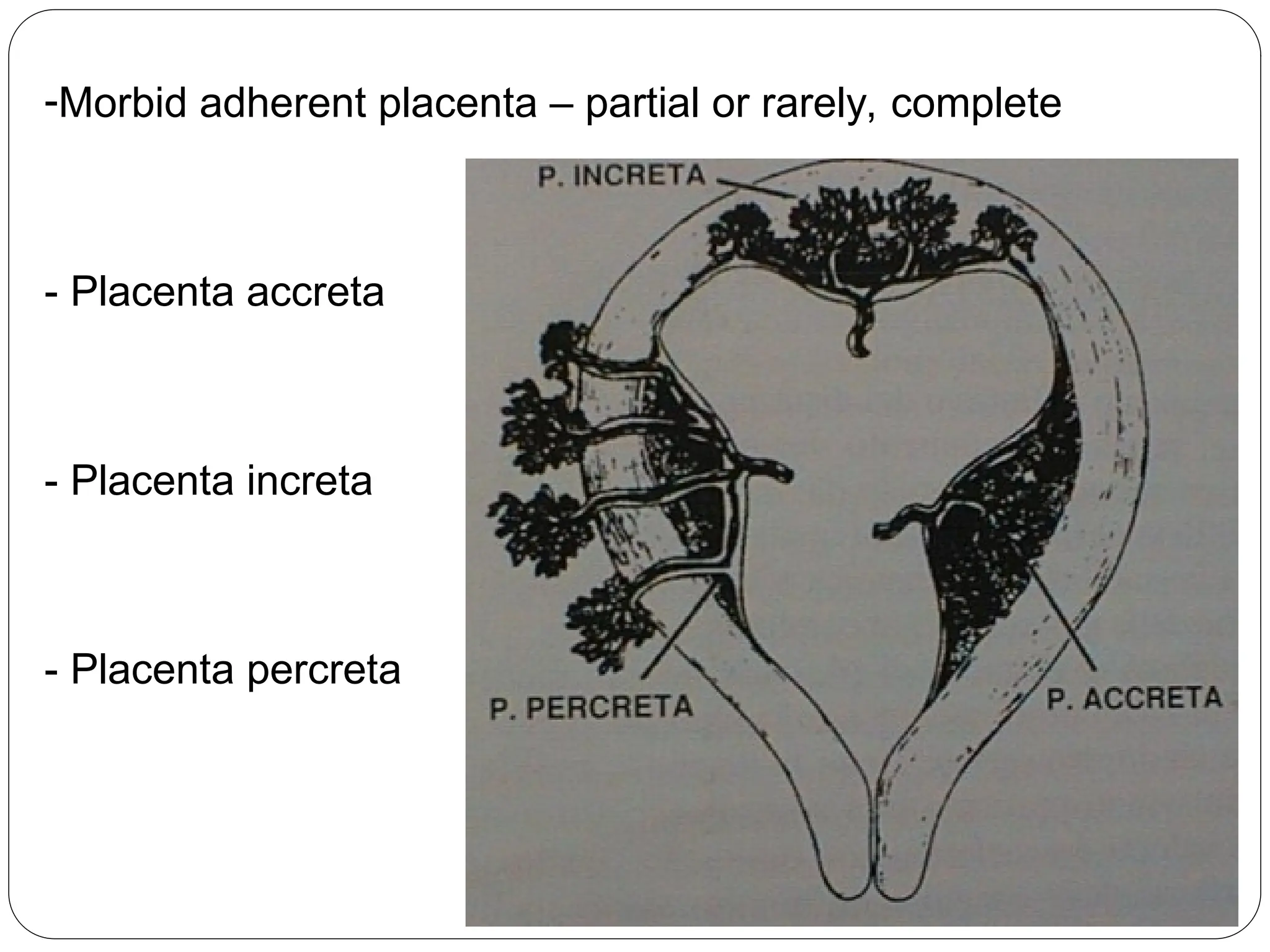
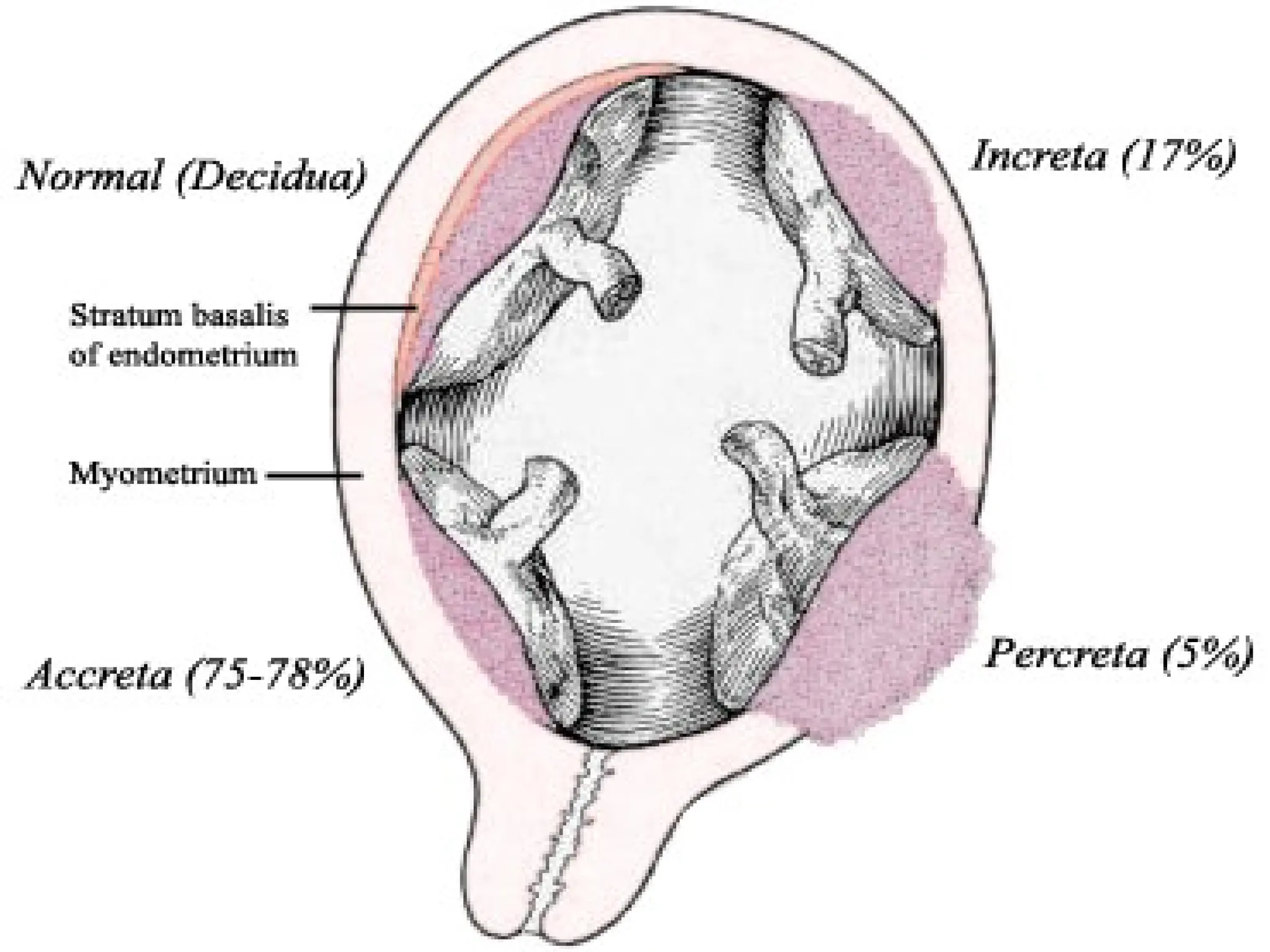
-Morbid adherent placenta – partial or rarely, complete
- Placenta accreta
- Placenta increta
- Placenta percreta
DANGERS:
They are:
1. Post-partum haemorrhage.
2. Shock – mainly due to haemorrhage.
3. Puerperal sepsis.
4. Thrombophlebitis – in the pelvic and leg veins.
5. Embolism
6. Placental polyp.
Diagnosis
Diagnosis is made by an arbitary time spent following
delivery of the baby
Dangers
1. Haemorrhage
2. Shock is due to a. Blood loss
b. Retained more than one hour
c. Frequent attempts of abdominal
manipulation
3. Puerperal sepsis
4. Risk of its recurrence in next pregnancy
Management
 Period of watchful expectancy
•Watch for bleeding
•Note the signs of separation of placenta
•The bladder should be emptied using a rubber catheter
•Any bleeding during the period should be managed.
 Placenta is separated and retained
- To express the placenta out by controlled cord traction. - -
 Unseparated retained plaenta
- Manual removal of placenta under G.A
Management of unforseen complications during manual
removal
1. Hour glass contraction – placenta either inseparated or
separated – partially or completely, may be trapped by a
localised contraction of circular muscles of the uterus.
 This ring should be made to relax by
a. Deepening the plane of plane of anaesthesia (halothane)
b. Subcutaneous injection of .5ml of 1 in 1000 adrenaline Hcl.
c. Inhalation of two amyl nitrate capsules of 5 minim each.
If the ring is too tight and bleeding is absent
• Operation is to be postponed
• The patient is to be sedated by morphine 15mg Im
after the manual removal.
• Watch for a period of 4-6hrs
If the ring is not too tight and bleeding is continuing
The ring is to be manually stretched by the cone shaped
hand and the separation of the placenta is preferably
done from above down wards to minimise bleeding.
Morbid adherent placenta
-Manual removal
Management of complicated retained placenta
1. Retained placenta with shock but no haemorrhage
• To treat shock
• Manual removal of placenta when the condition
improves.
2. Retained placenta with haemorrhage
• To assess the amount blood loss and to replace the lost
blood
3. Retained placenta with sepsis
• Intrauterine swabs are taken for culture
• Administer broad spectrum antibiotic
• Blood transfusion
4. Retained placenta with an episiotomy wound
• The bleeding points of the episiotomy wound are to be
secured by artery forceps
• Manual removal of placenta followed by repair of
episiotomy wound.
Placenta Acreta (morbid adherent placenta)
• The placenta is directly anchored to the myometrium partially
or completely without any intervening decidna.
• Probable cause is defective decidual formation
• The condition is usually associated when the placenta
happens to be implanted in lower segment.
Management
•In case of partial morbid adherent placenta
•Manual removal if there is effective uterine contractions with
haemostasis
•If the uterus fails to contract an early decision of hystrectomy may
have to be taken.
 In total placenta accreta hysterectomy is indicated
• It the patient desiring to have a child conservative
management.
• Antibiotics
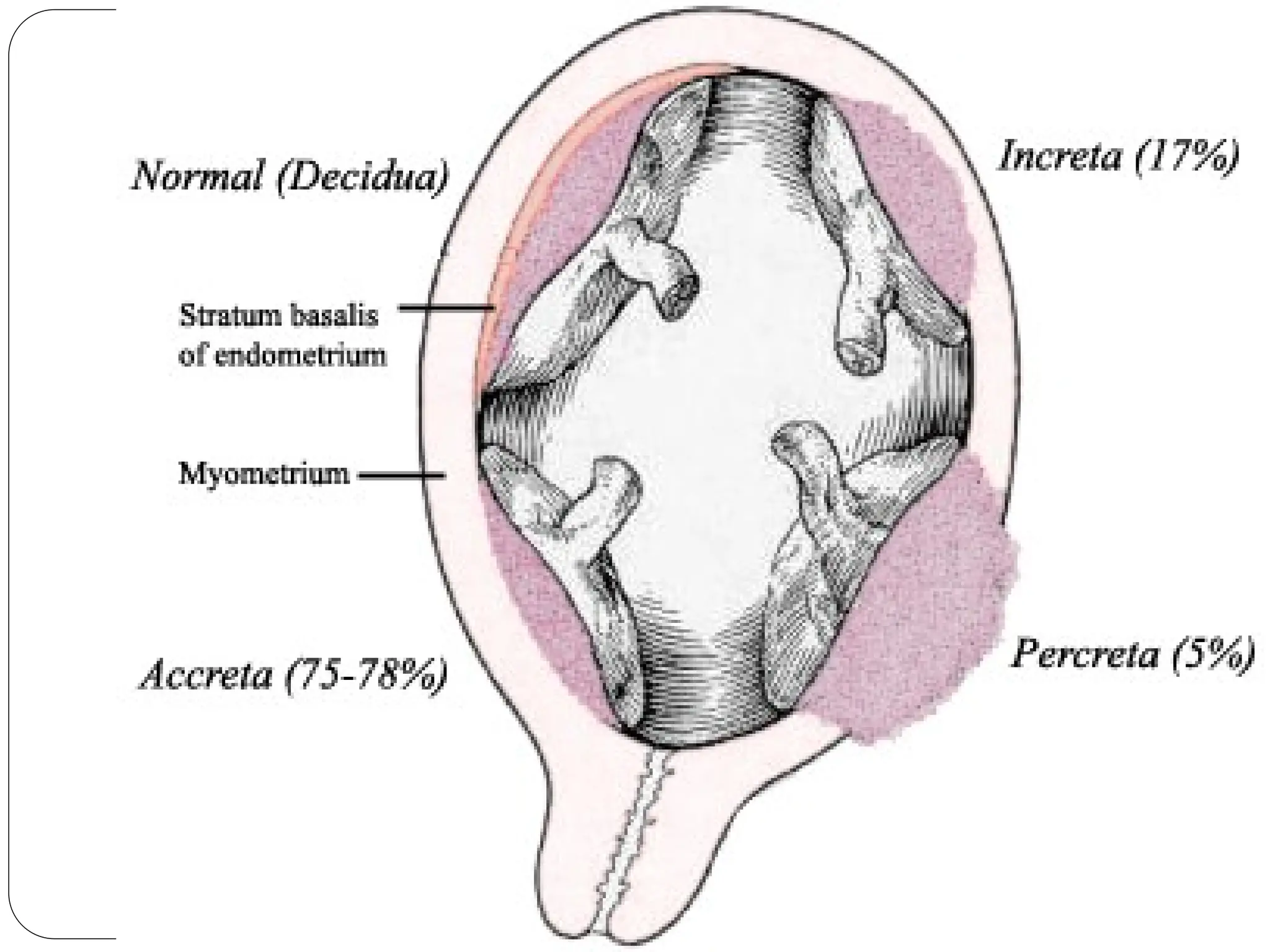
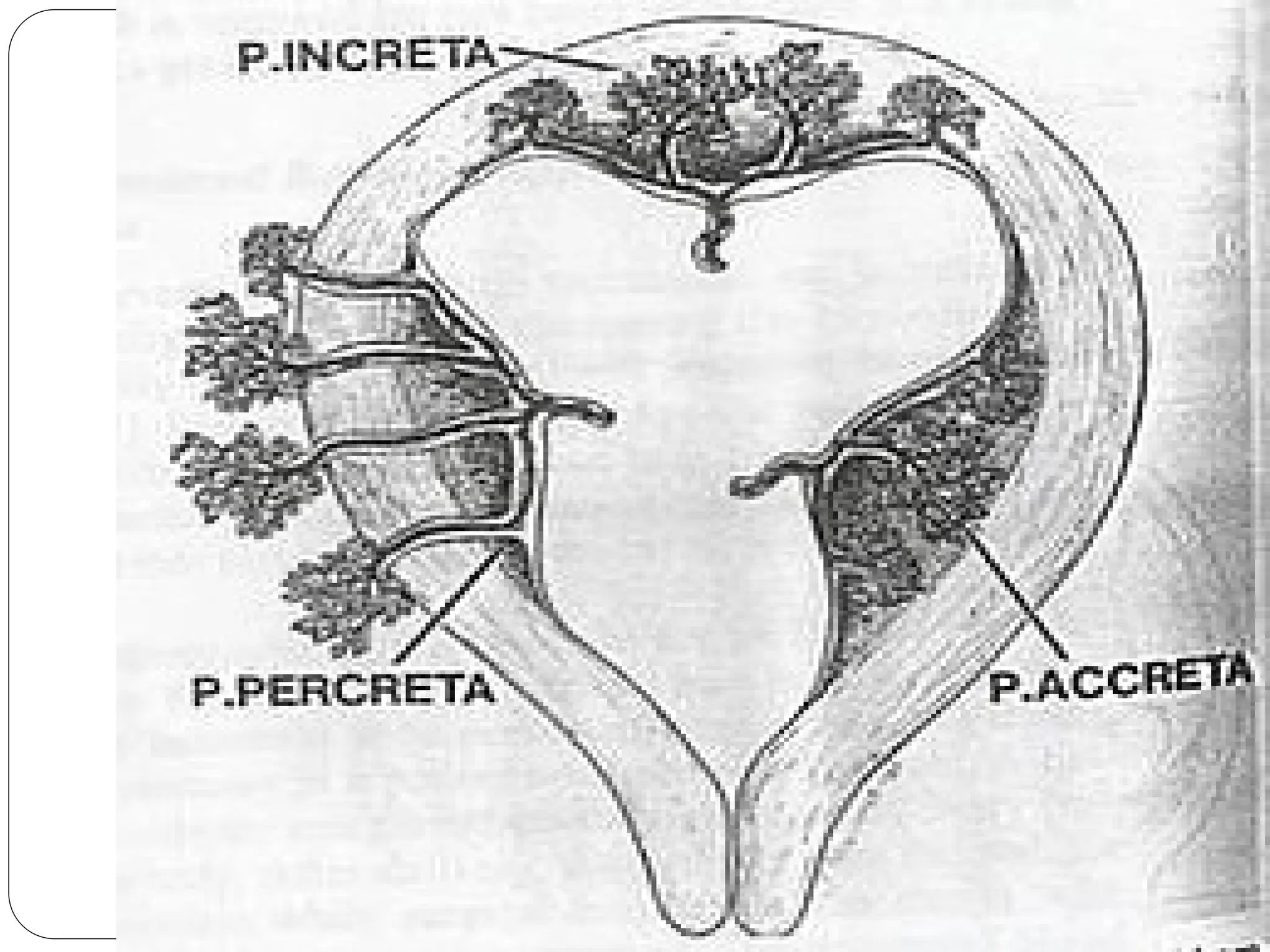
• Placenta accreta – choriomic villi invade up to the
myometrium
• Placenta increta – Choriomic villi invade the myometrium
• Placenta percreta – chronic villi penetrate the whole uterine
wall to the serosal layer.
Manual Removal of the Placenta
One hand is inserted through the vagina and into the uterine
cavity.
1. Insert the side of your hand in between the placenta and the
uterus.
2. Using the side of your hand, sweep the placenta off the uterus.
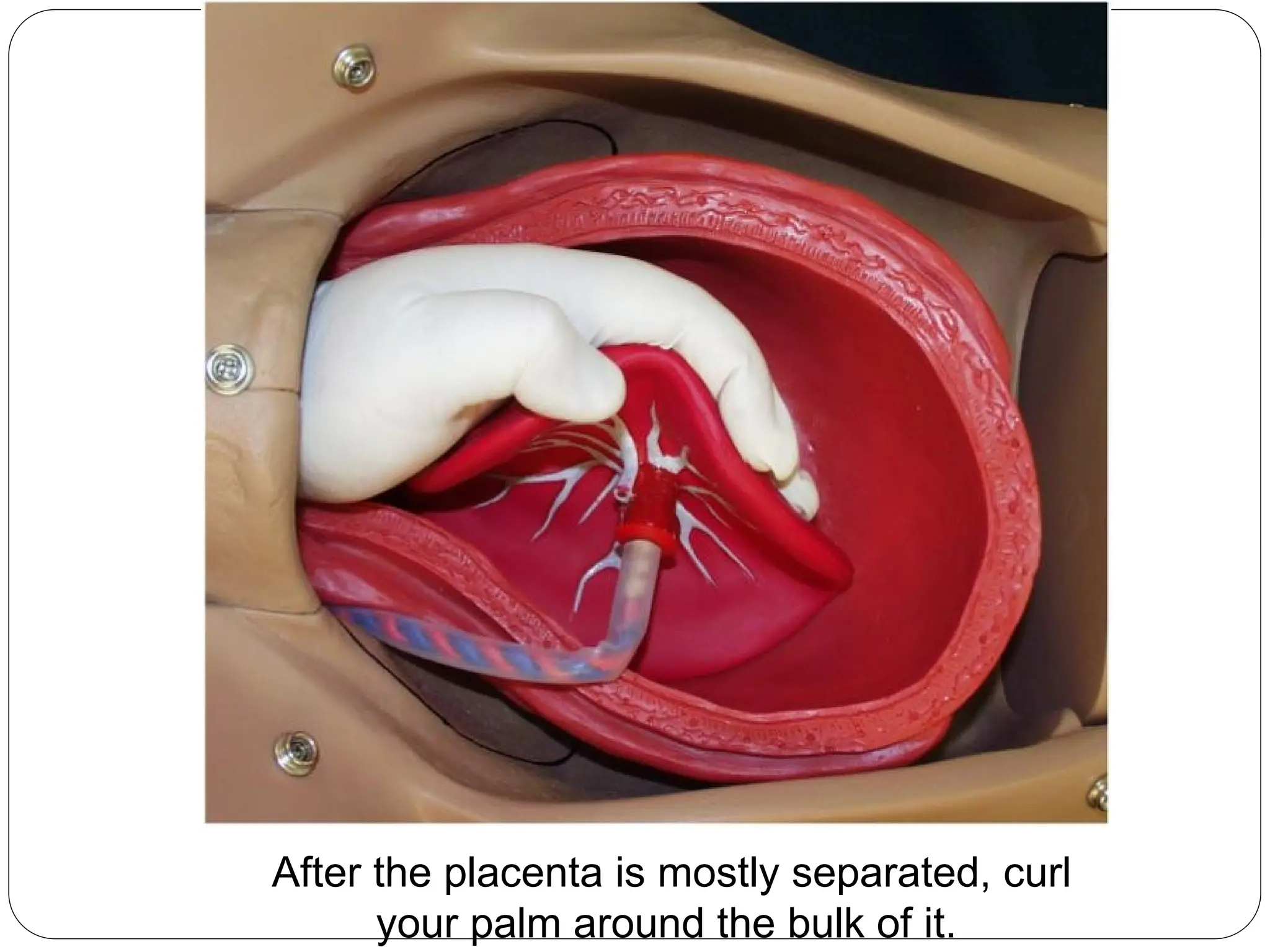
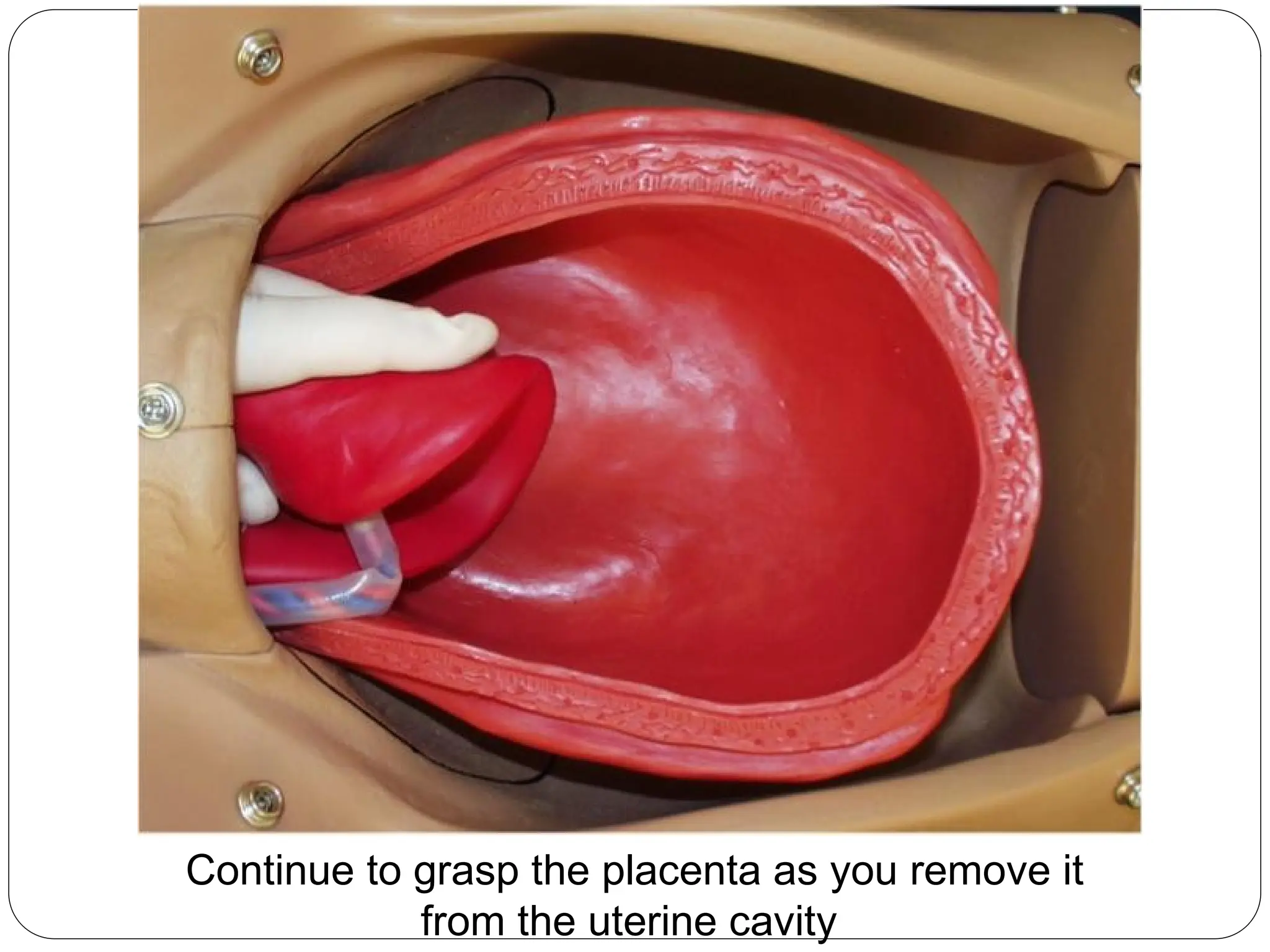
3. After most of the placenta has been swept off the uterus, curl
your fingers around the bulk of the placenta and exert gentle
downward and outward traction. You may need to release the
placenta and then re-grab it.
4. Then pull the placenta through the cervix. Most placentas can
be easily and uneventfully removed in this way. A few prove to
be problems.
Placenta Accreta and Percreta
When you manually remove the placenta, be prepared to
deal with an abnormally adherent placenta (placenta accreta or
placenta percreta). These abnormal attachments may be partial or
complete.
•If partial and focal, the attachments can be manually broken and
the placenta removed. It may be necessary to curette the
placental bed to reduce bleeding. Recovery is usually satisfactory,
although more than the usual amount of post partum bleeding will
be noted.
•If extensive or complete, you probably won't be able to remove
the placenta in other than handfuls of fragments. Bleeding from
this problem will be considerable, and the patient will likely end up
with multiple blood transfusions while you prepare her for a life-
saving, post partum uterine artery ligation or hysterectomy. If
surgery is not immediately available, consider tight uterine and/or
vaginal packing to slow the bleeding until surgery is available.
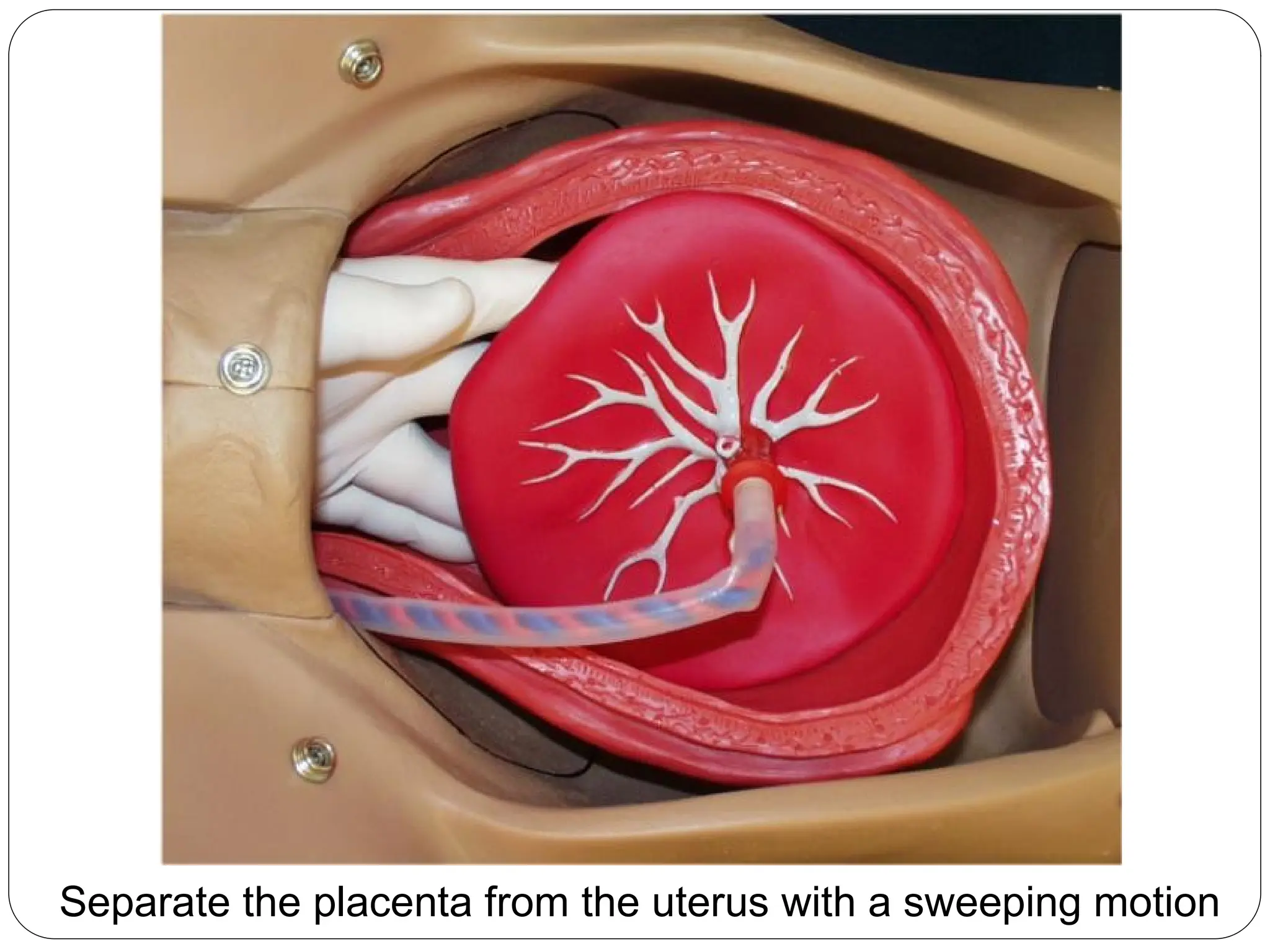
Separate the placenta from the uterus with a sweeping motion
After the placenta is mostly separated, curl
your palm around the bulk of it.
Continue to grasp the placenta as you remove it
from the uterine cavity
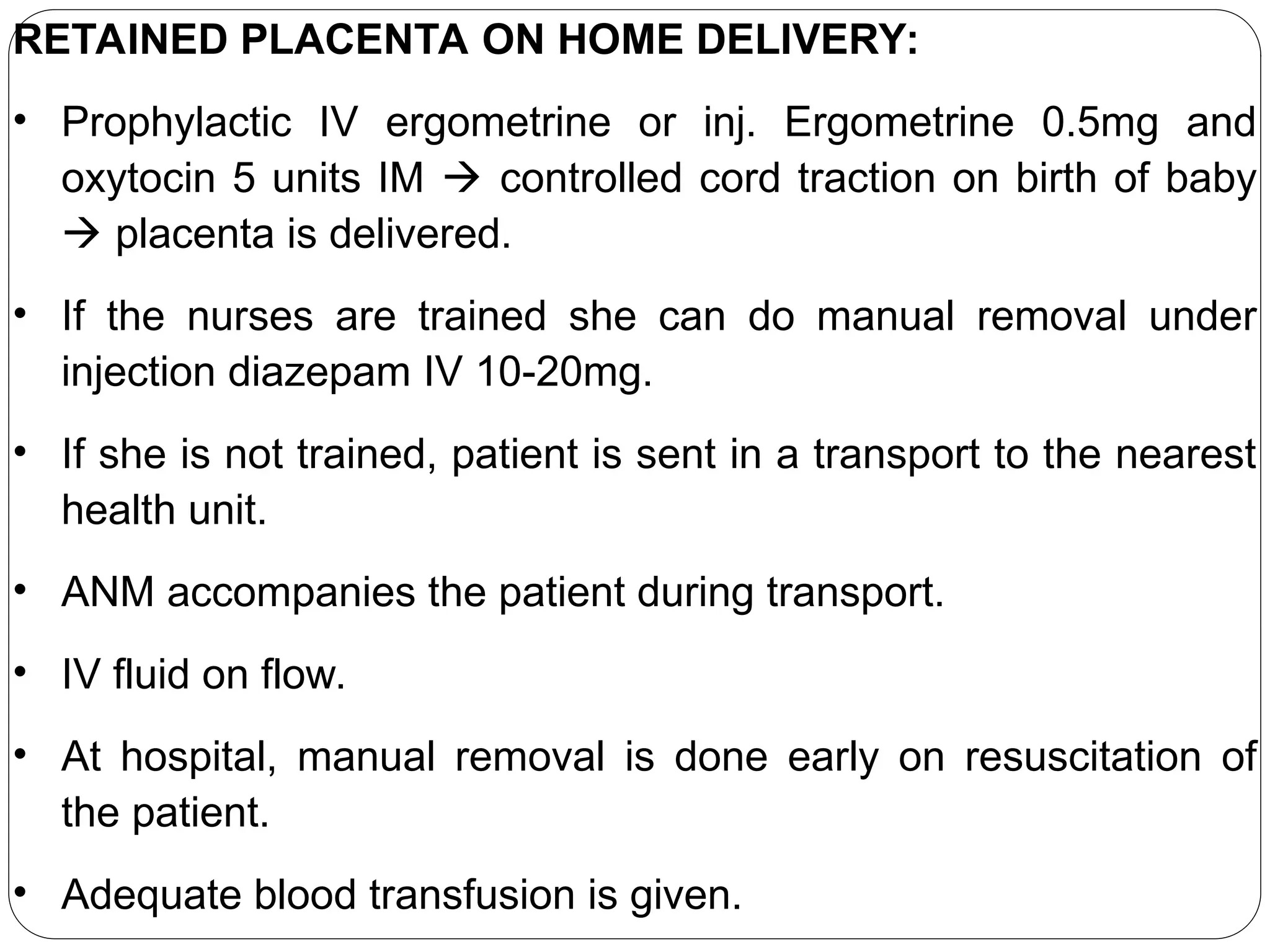
RETAINED PLACENTA ON HOME DELIVERY:
• Prophylactic IV ergometrine or inj. Ergometrine 0.5mg and
oxytocin 5 units IM  controlled cord traction on birth of baby
 placenta is delivered.
• If the nurses are trained she can do manual removal under
injection diazepam IV 10-20mg.
• If she is not trained, patient is sent in a transport to the nearest
health unit.
• ANM accompanies the patient during transport.
• IV fluid on flow.
• At hospital, manual removal is done early on resuscitation of
the patient.
• Adequate blood transfusion is given.
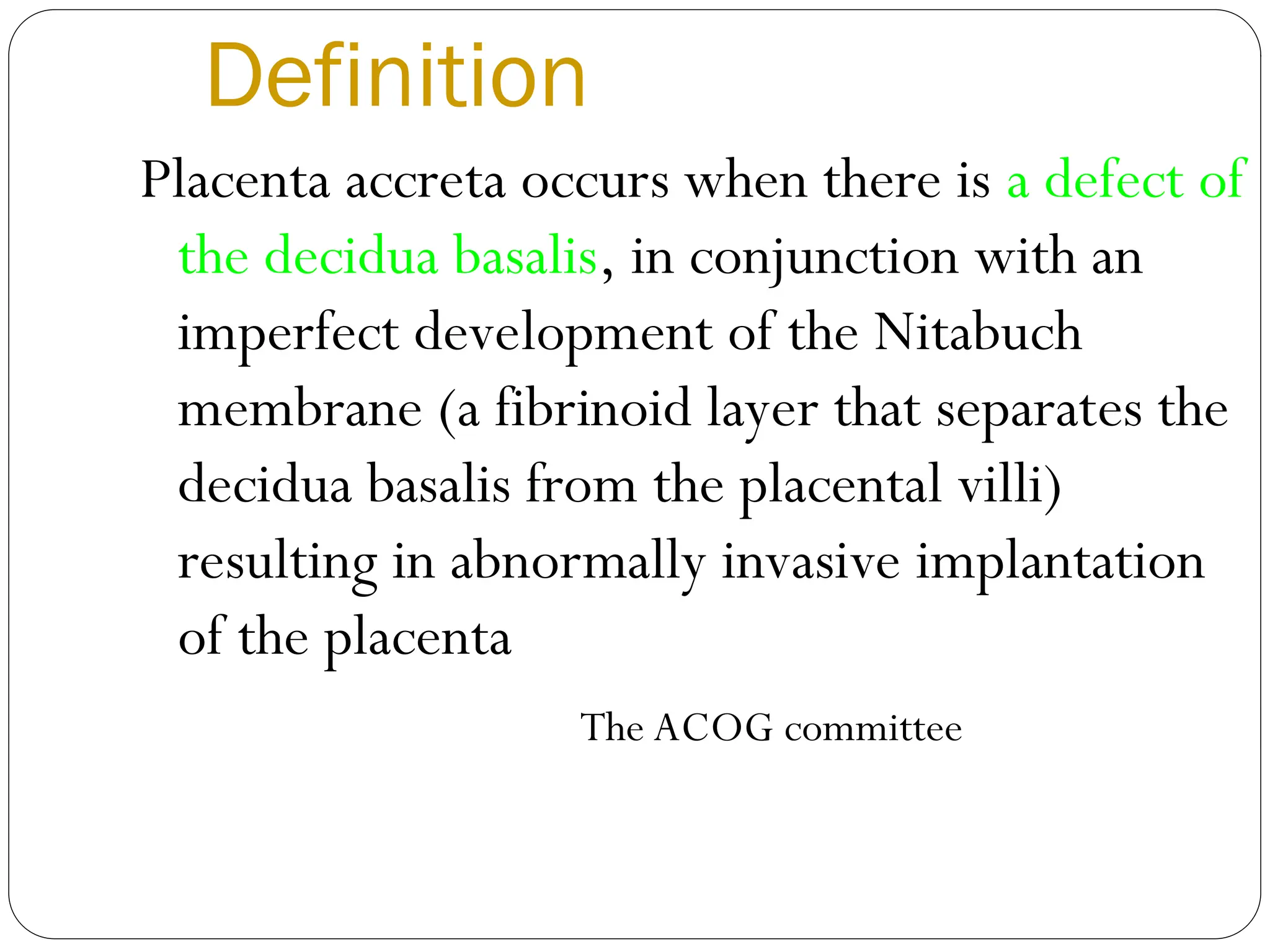
Definition
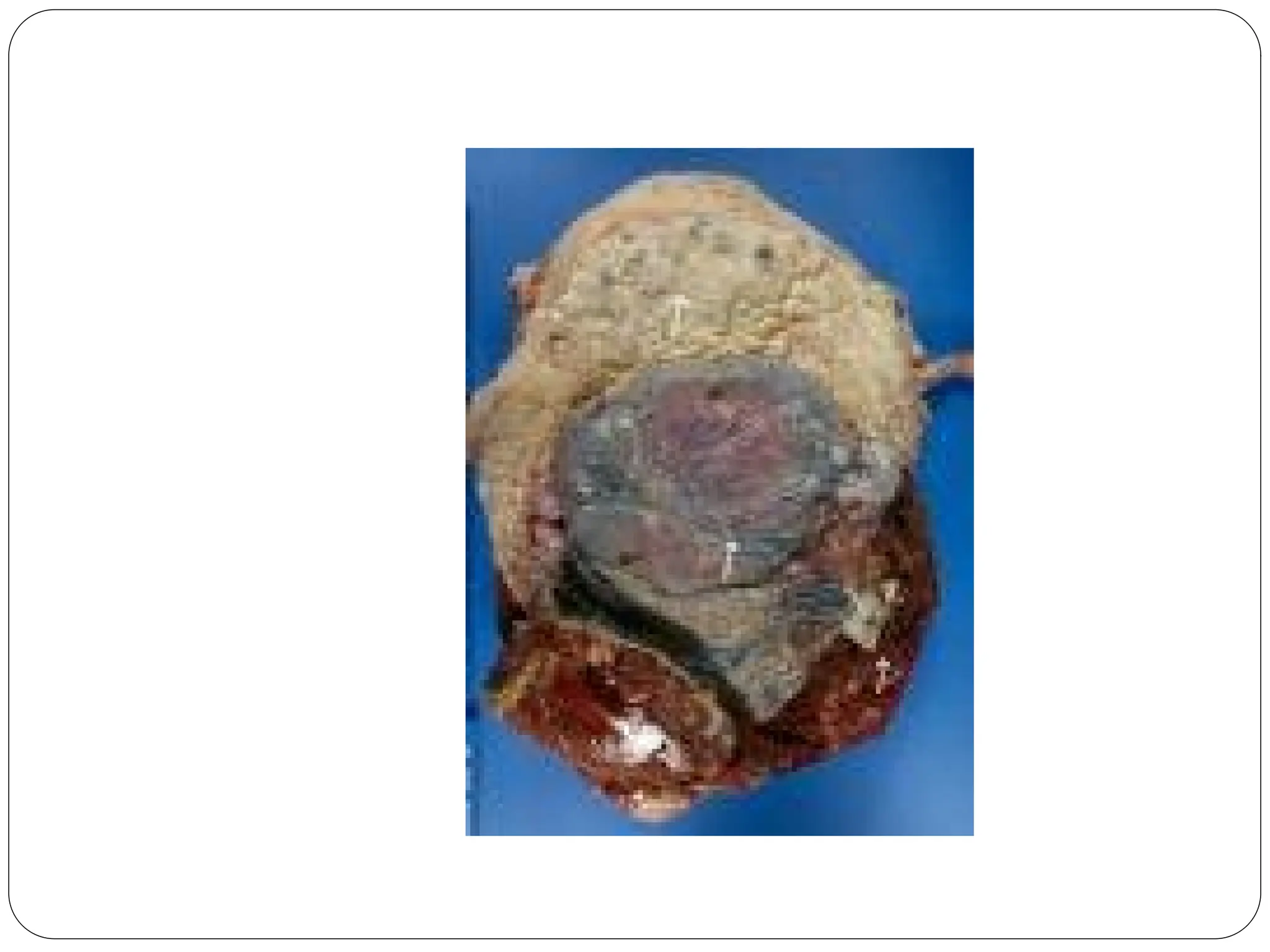
Placenta accreta occurs when there is a defect of
the decidua basalis, in conjunction with an
imperfect development of the Nitabuch
membrane (a fibrinoid layer that separates the
decidua basalis from the placental villi)
resulting in abnormally invasive implantation
of the placenta
The ACOG committee
According to Mudhaliar and Menon
Placenta accreta is defined as the abnormal adherence,either in
whole or in part,of the afterbirth to the unlying uterine wall.
According to D.C.Dutta
Placenta accreta in extremely rare form in which the placen is
directly anchored to the myometrium partially or completely thout
any intervening decidua.
Incidence
 From 1930 to 1950--one case in 30,000 deliveries.
 From 1950 to 1960, one in 19,000, deliveries.
 by 1980 to one in 7,000.
 the incidence has now risen to one in 2,500
deliveries
The ACOG committee
Degrees of severity/ Types of Placenta
Accreta
 (1) Accreta, in which the placenta adheres to the myometrium
without invasion into the muscle.
 (2) Increta, in which it invades into the myometrium.
 (3) Percreta, in which it invades the full thickness of the uterine
wall and possibly other pelvic structures, most frequently the
bladder.
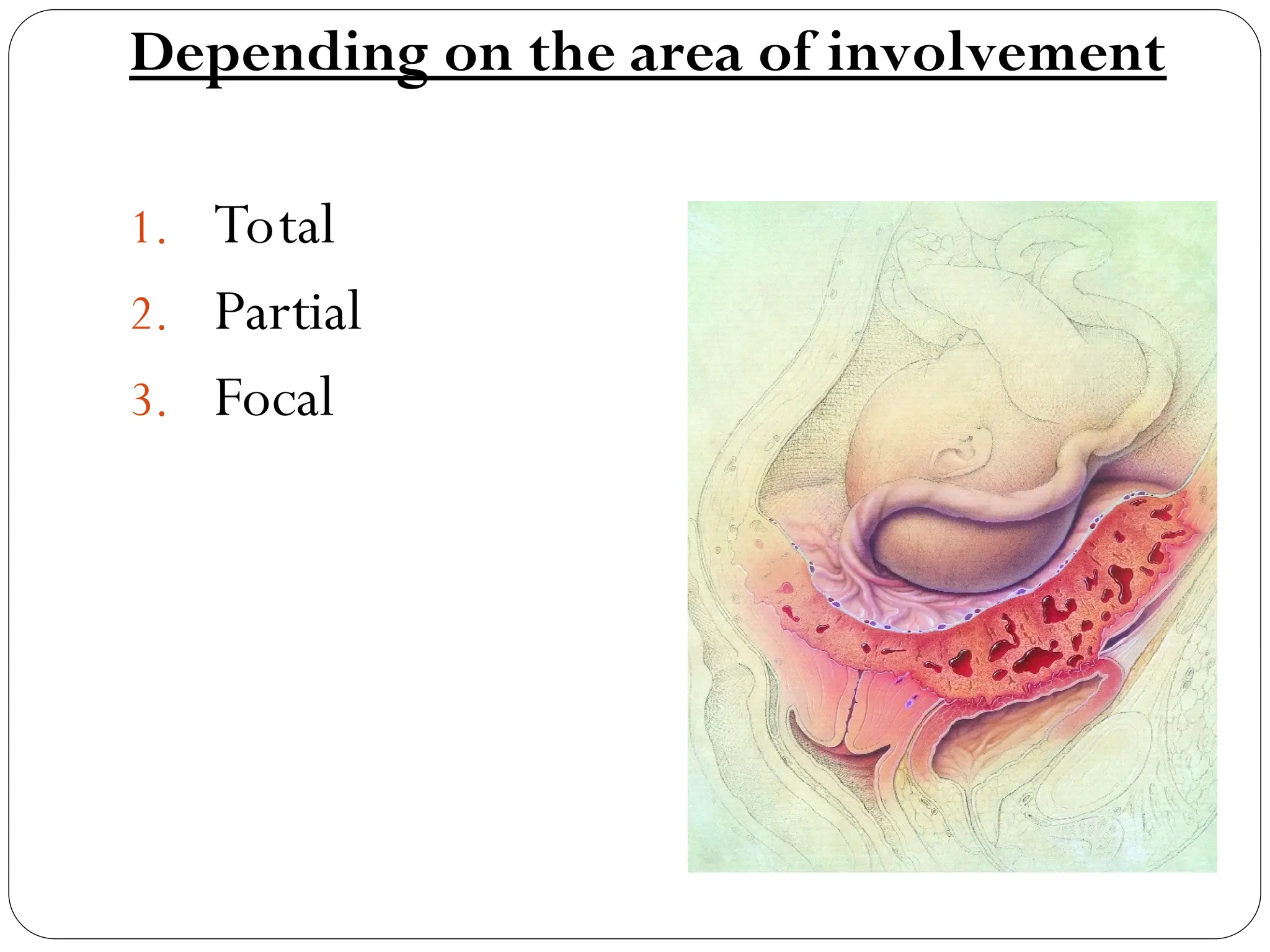
Depending on the area of involvement
1. Total
2. Partial
3. Focal
Risk factors
Placenta previa with or without previous
uterine surgery.
previous myomectomy.
previous cesarean delivery.
Asherman's syndrome.
submucous leiomyomata.
maternal age of 36 years and older.
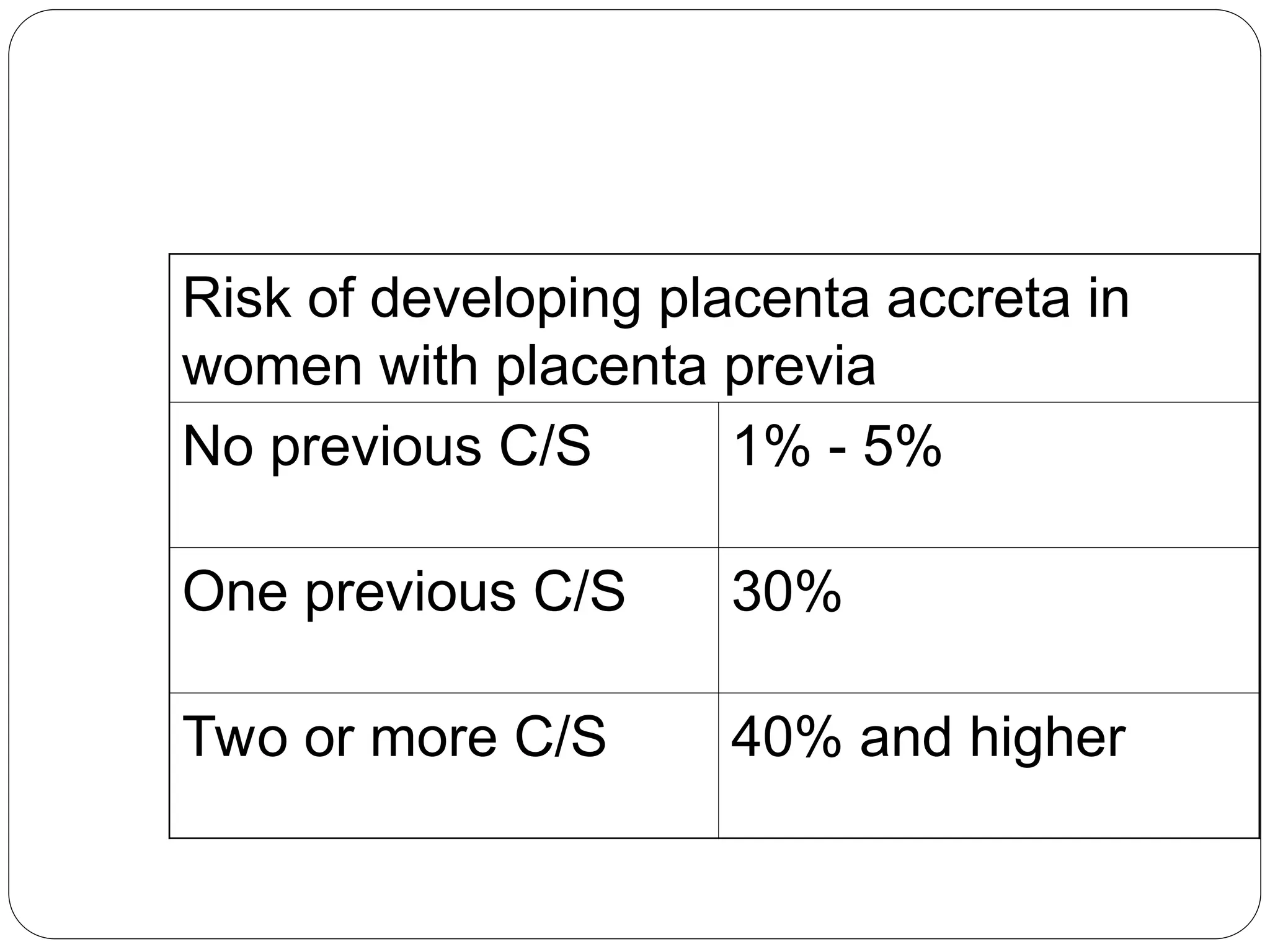
Risk of developing placenta accreta in
women with placenta previa
No previous C/S 1% - 5%
One previous C/S 30%
Two or more C/S 40% and higher
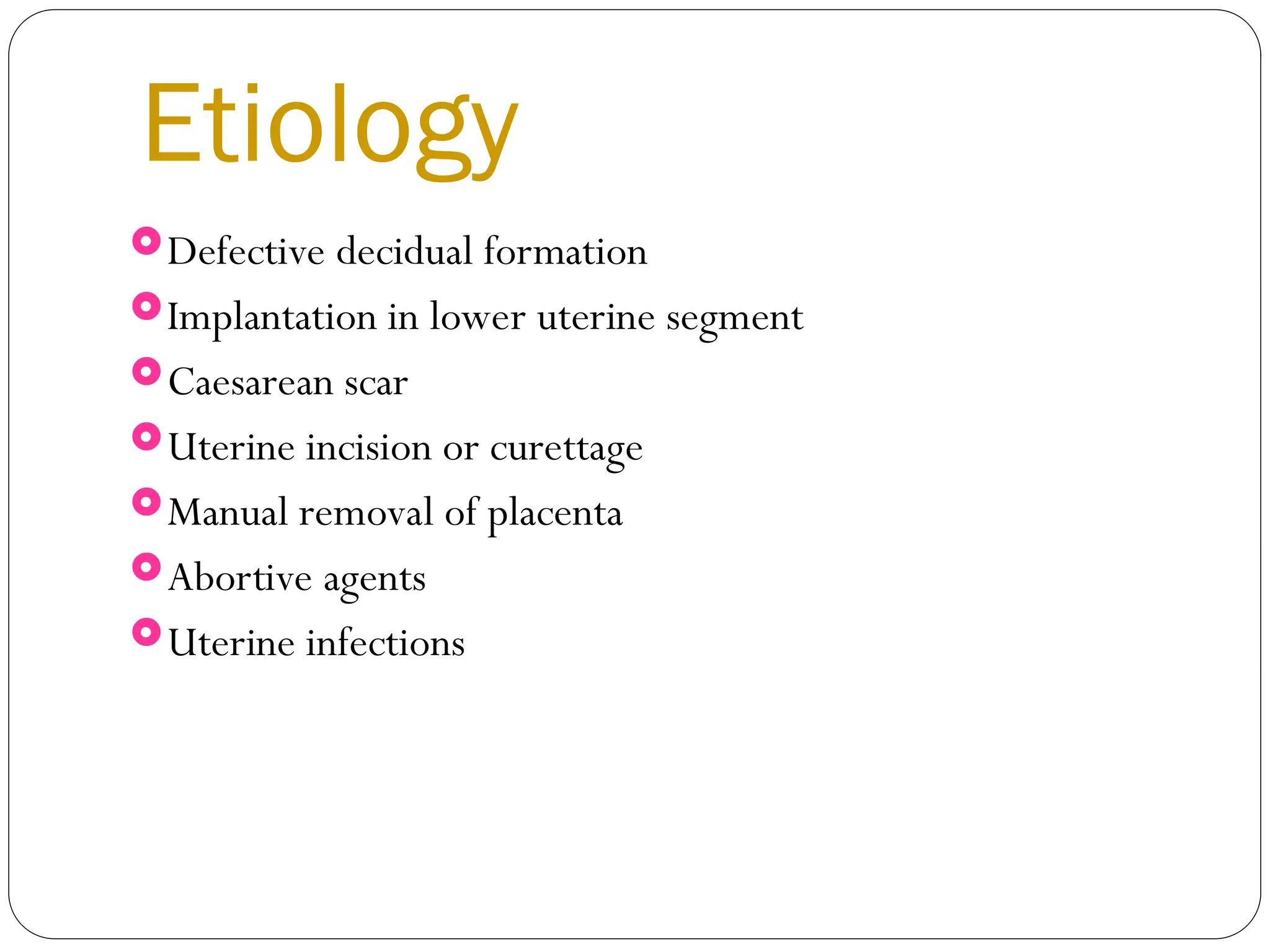
Etiology
Defective decidual formation
Implantation in lower uterine segment
Caesarean scar
Uterine incision or curettage
Manual removal of placenta
Abortive agents
Uterine infections
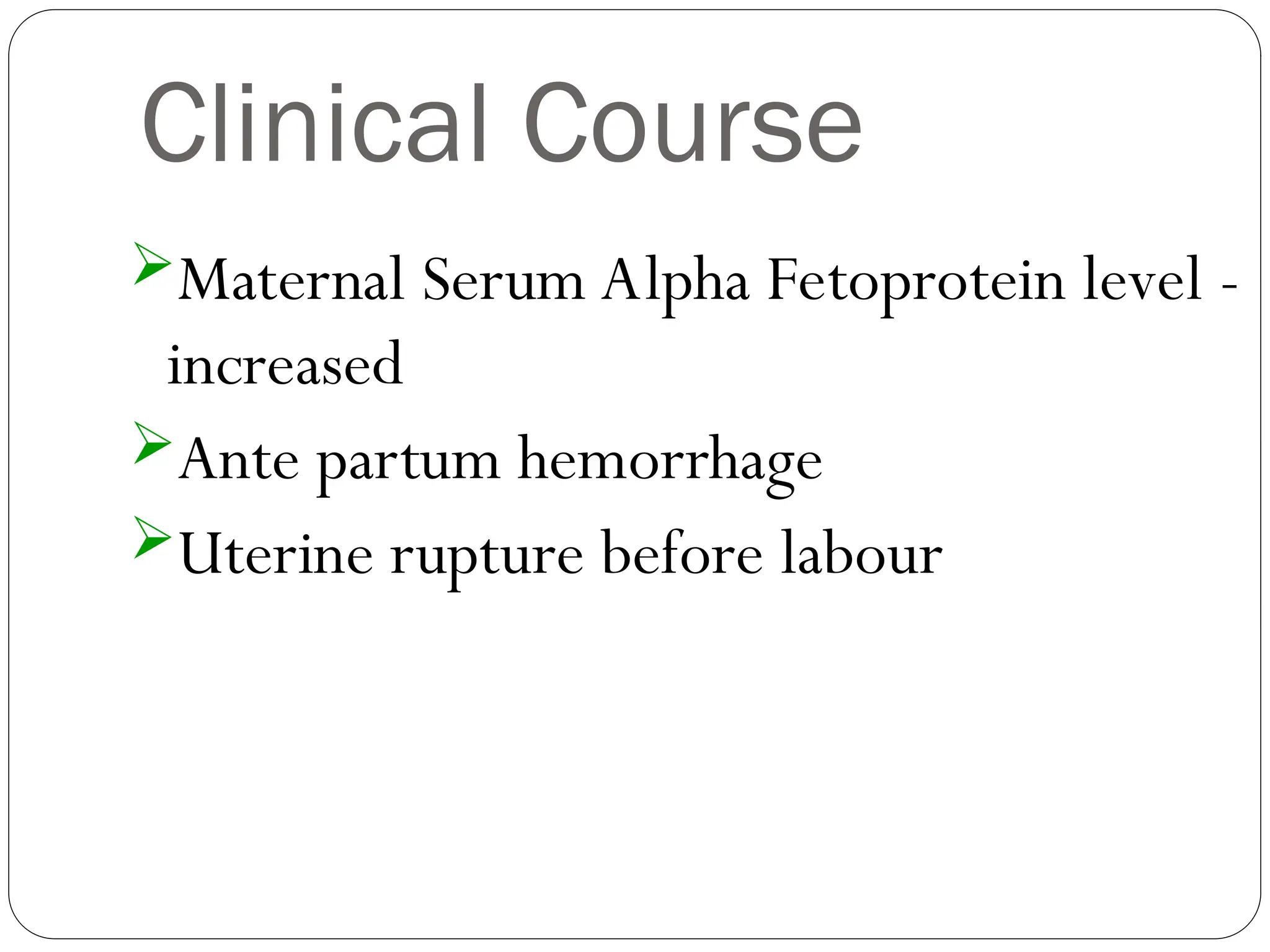
Clinical Course
Maternal Serum Alpha Fetoprotein level -
increased
Ante partum hemorrhage
Uterine rupture before labour
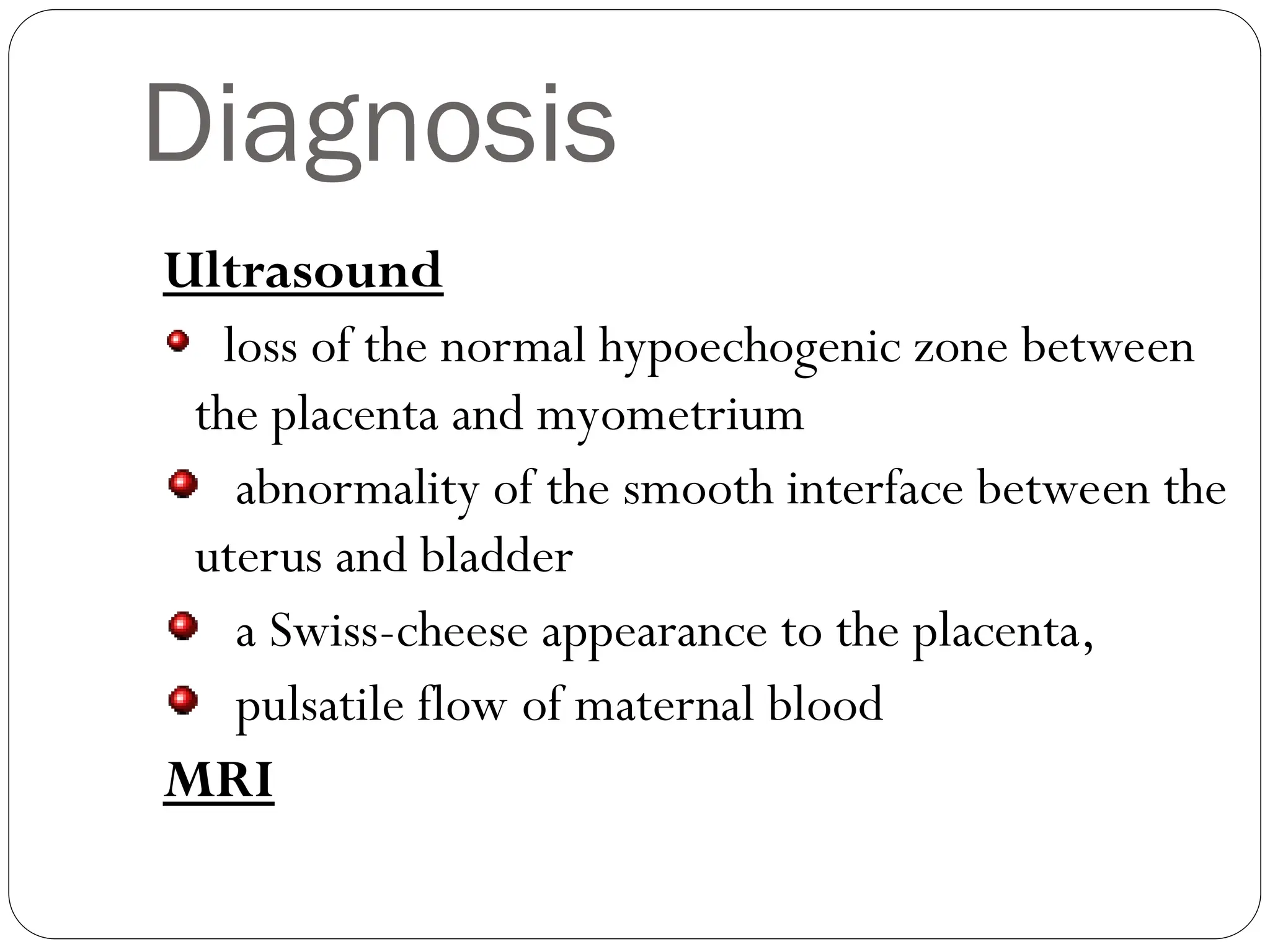
Diagnosis
Ultrasound
loss of the normal hypoechogenic zone between
the placenta and myometrium
abnormality of the smooth interface between the
uterus and bladder
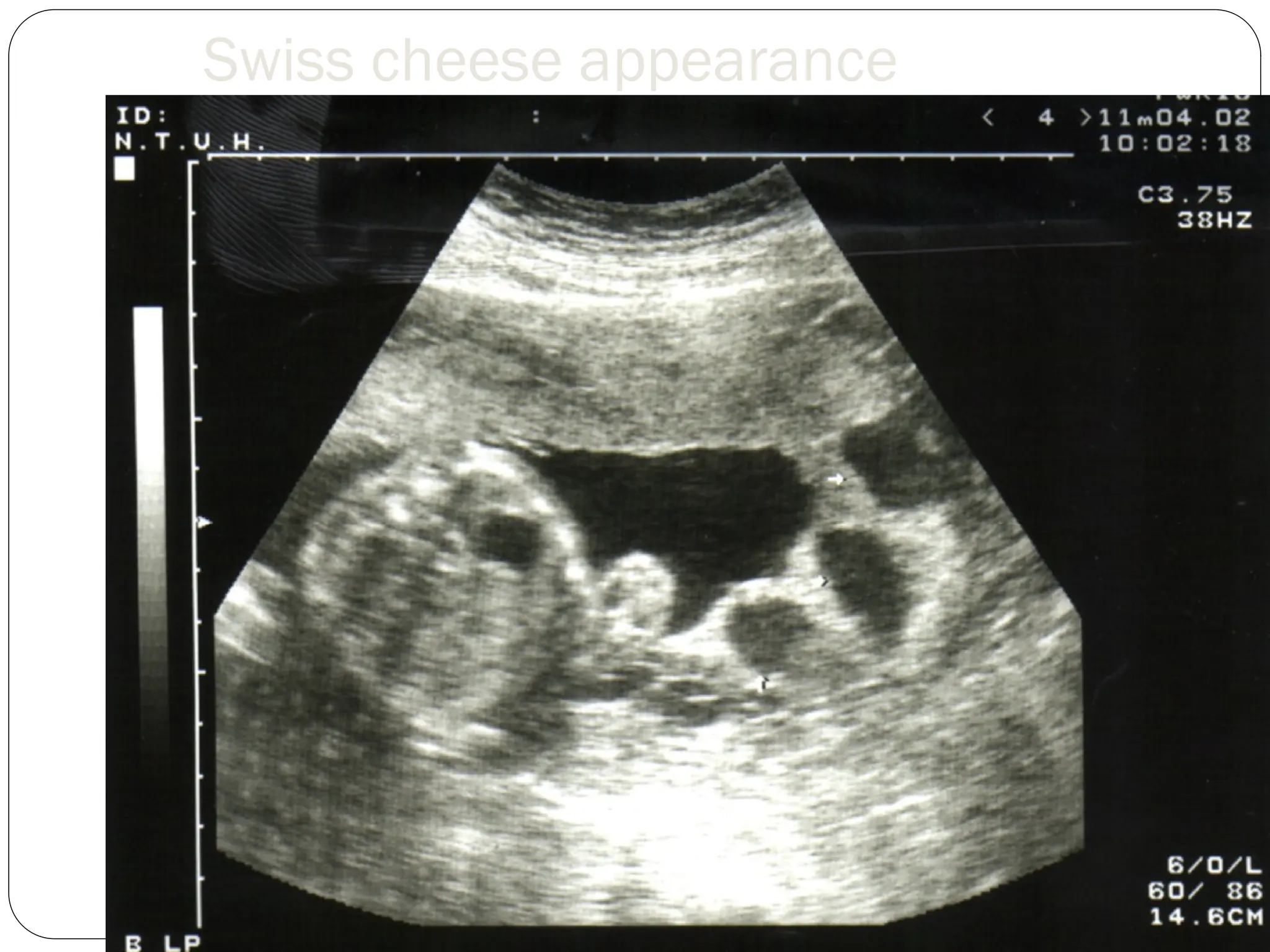
a Swiss-cheese appearance to the placenta,
pulsatile flow of maternal blood
MRI
Swiss cheese appearance
Management
Partial Morbid Adherent Placenta
“Playing with the placenta with fingers”
Oxytocics
Intrauterine plugging
Hysterectomy
Total Placenta Accreta
Hysterectomy
Conservative :
1. Cutting umbilical cord
2. Antibiotics
Other measures
Blood replacement
Uterine and internal iliac artery ligation
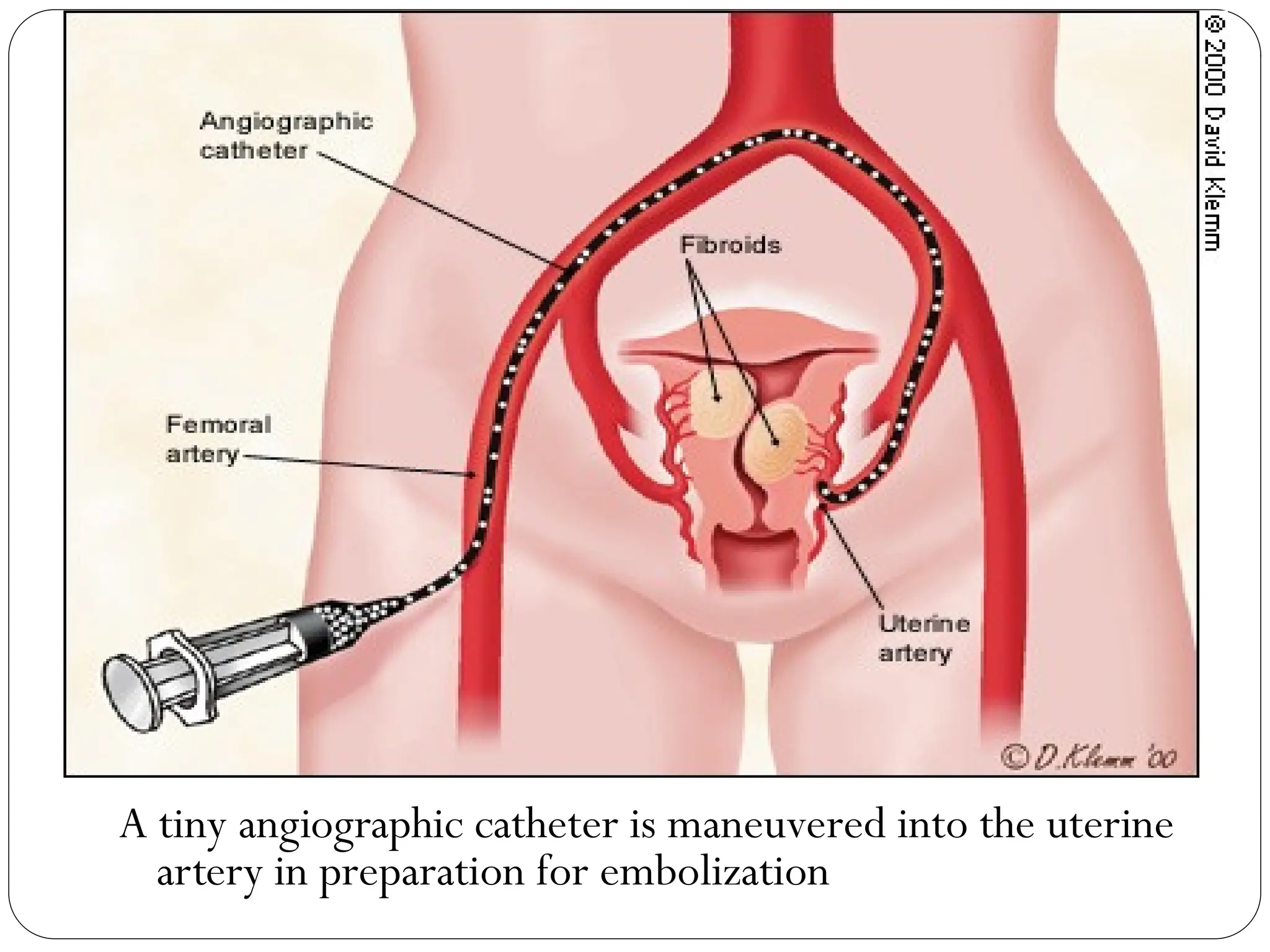
Angiographic embolization
Argon beam coagulation
A tiny angiographic catheter is maneuvered into the uterine
artery in preparation for embolization
Complications
 Hemorrhage
 Shock
 Infection
 Sub involution of uterus
 Secondary postpartum hemorrhage
 Formation of placental polyp
INDUCTION OF
INDUCTION OF
LABOUR
LABOUR
DEFINITION
Induction of labour means deliberate termination
of pregnancy beyond 28 weeks (Period of viability)
by any method which aims at initiation of labour and
a vaginal delivery.
Indications
Fetal
Maternal
Combined
Post maturity
History of IUD
DM
IUGR
Rh-isoimmunisation
Unstable lie
Fetal
IUD
Chronic polyhydramnios
Congenital malformations
Maternal
Pre –eclampsia
Minor degree of placenta praveia
Abruptio placenta
PROM
Chronic HTN
Chronic renal disease
Combined
CONTRAINDICATIONS
 Contracted pelvis and CPD
 Persistent malpresentation
 Pregnancy with previous caesarean section
 Elderly primigravida
 Heart disease
 High risk pregnancy with compromised fetus
 Pelvic tumour
SUCCESS OF INDUCTION depends on
 Period of gestation
 Case profile
 Sensitivity of the uterus
 Pre induction scoring
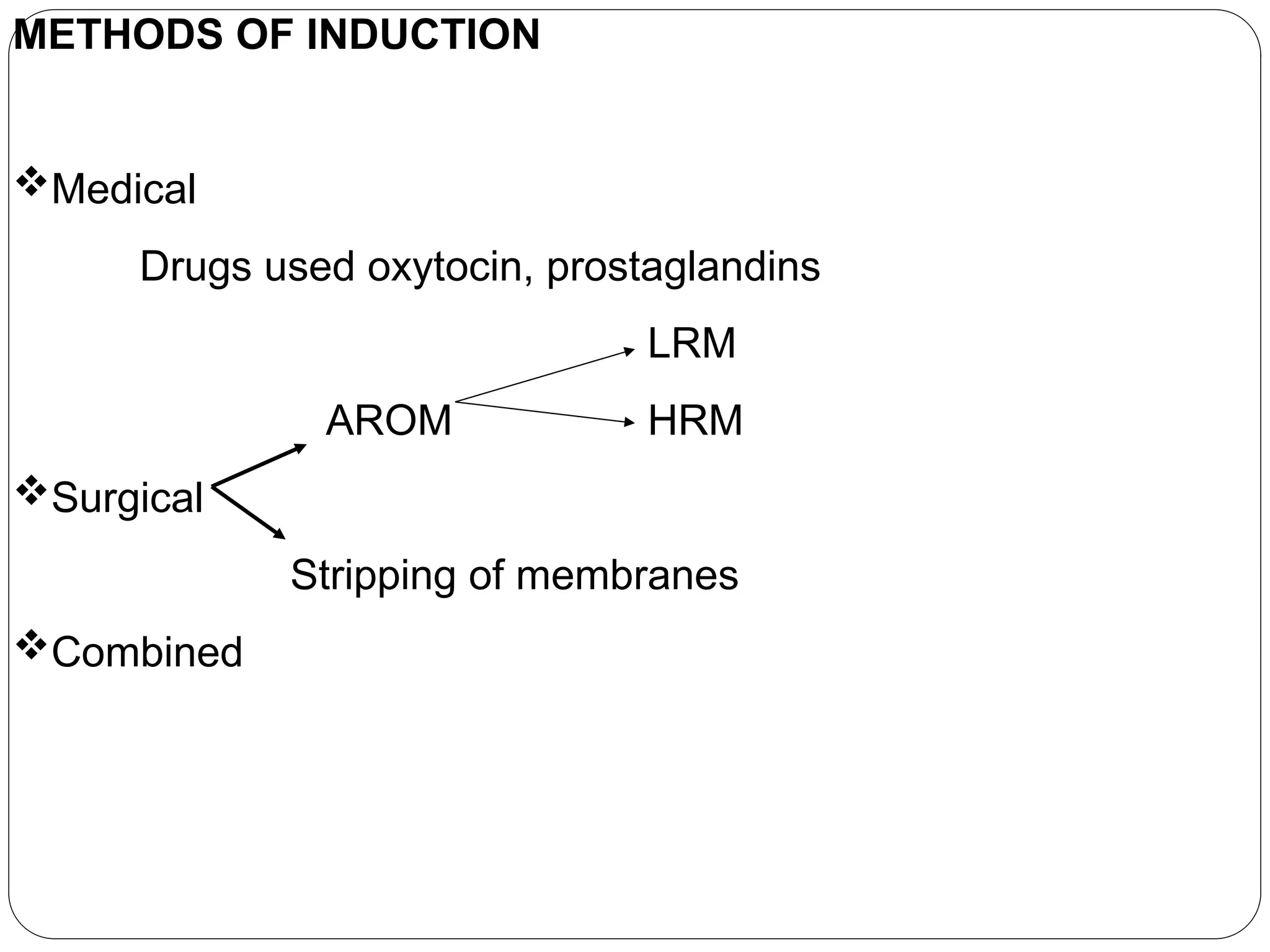
METHODS OF INDUCTION
Medical
Drugs used oxytocin, prostaglandins
LRM
AROM HRM
Surgical
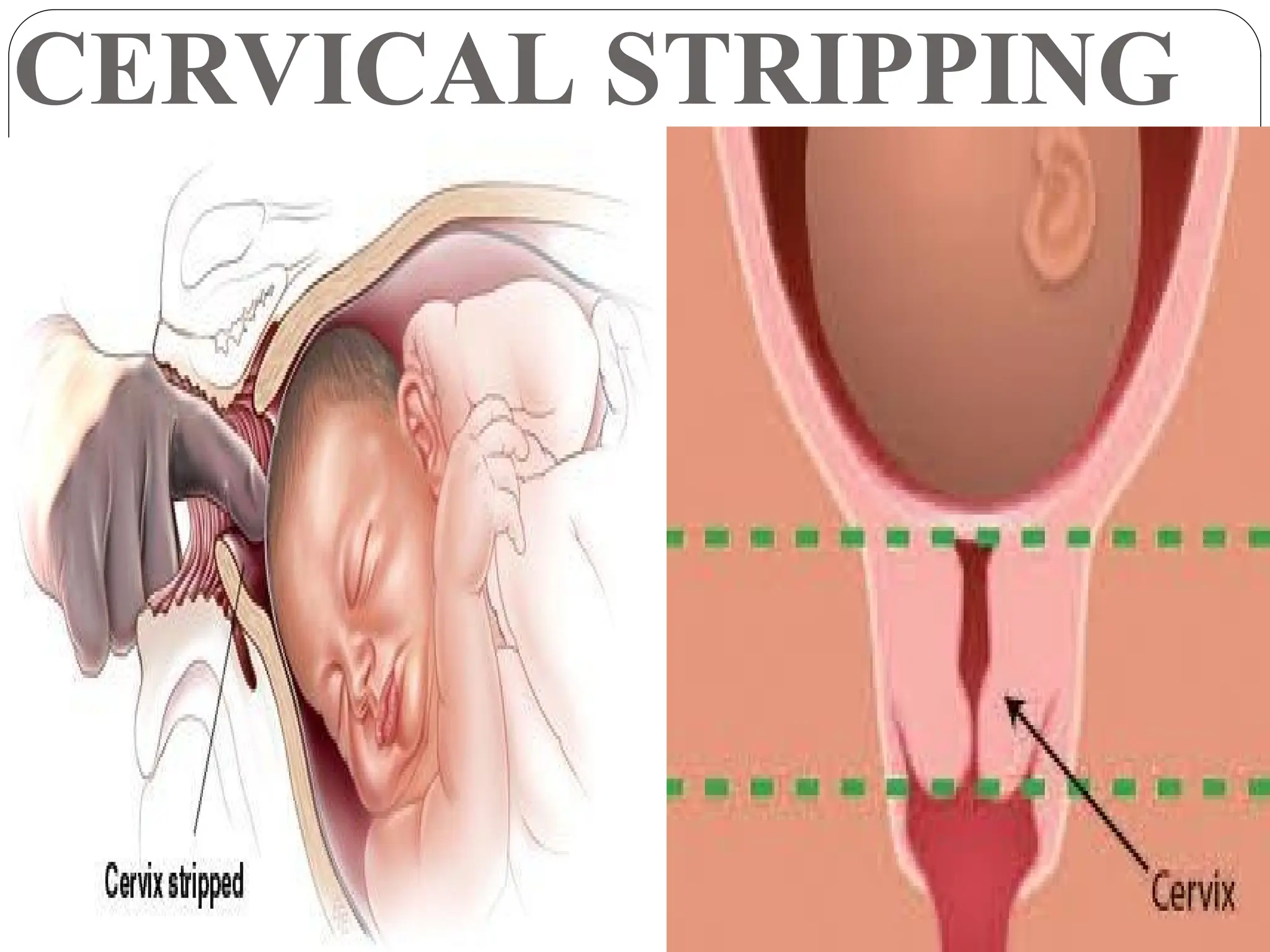
Stripping of membranes
Combined
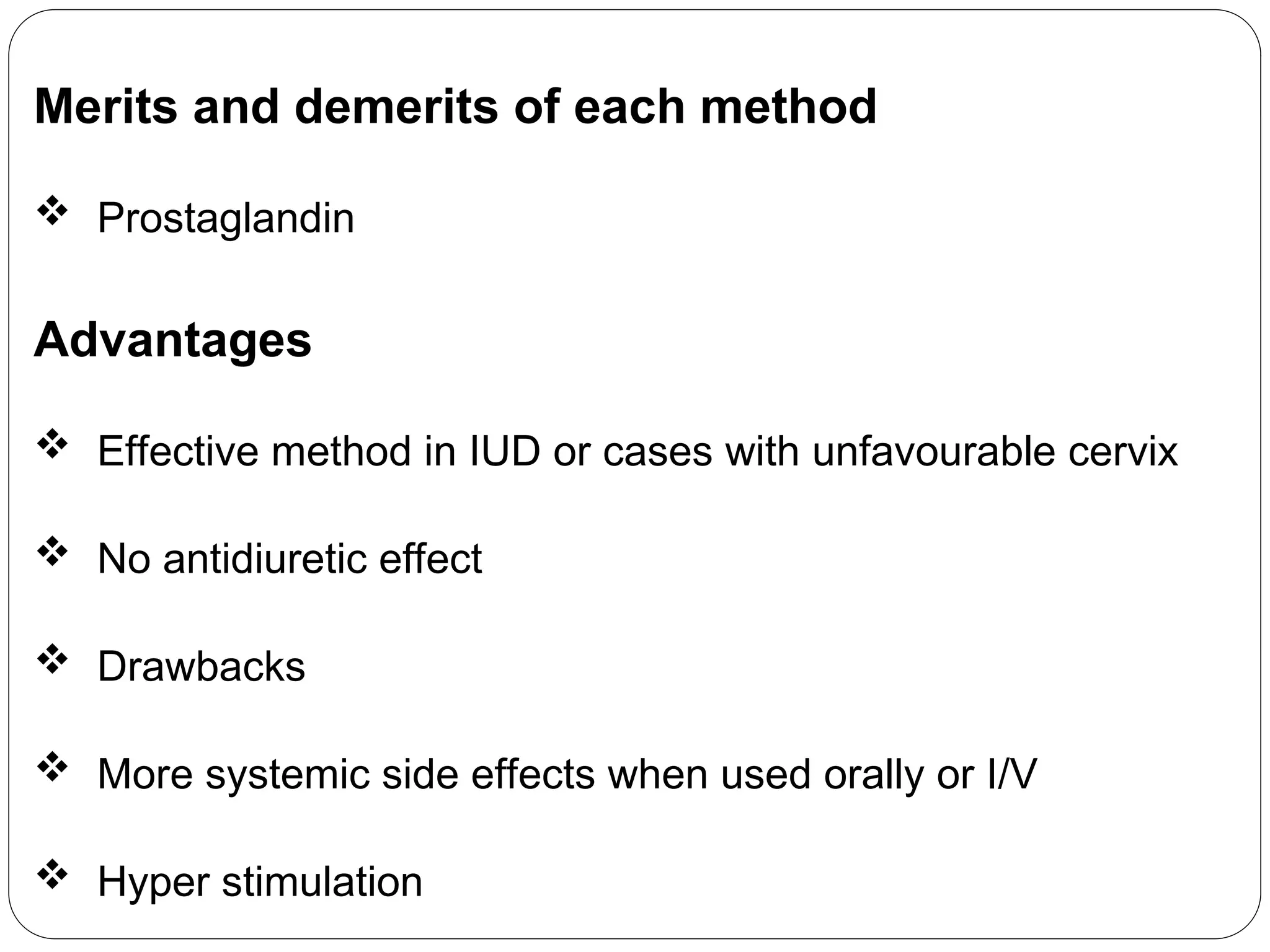
Merits and demerits of each method
 Prostaglandin
Advantages
 Effective method in IUD or cases with unfavourable cervix
 No antidiuretic effect
 Drawbacks
 More systemic side effects when used orally or I/V
 Hyper stimulation
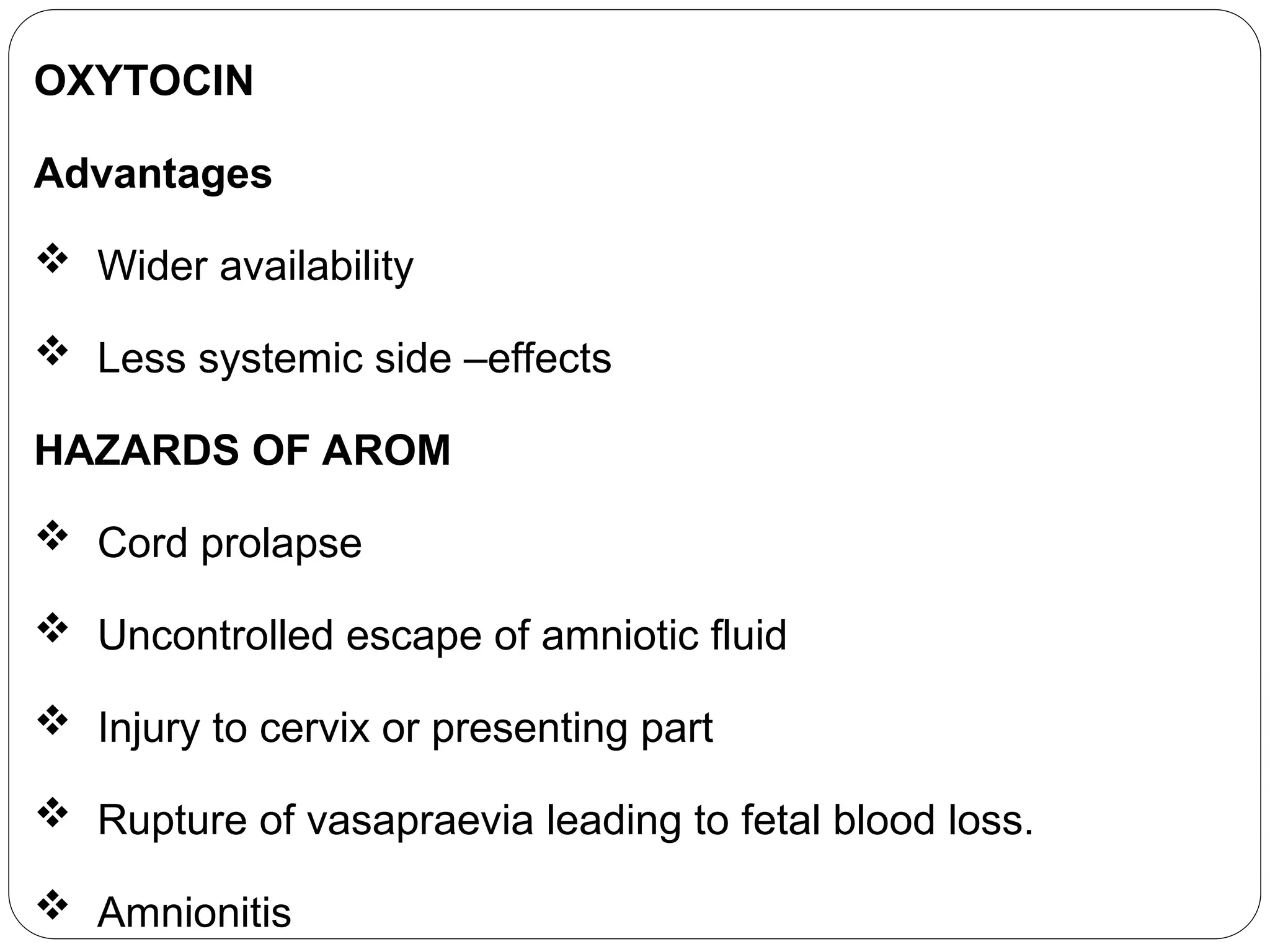
OXYTOCIN
Advantages
 Wider availability
 Less systemic side –effects
HAZARDS OF AROM
 Cord prolapse
 Uncontrolled escape of amniotic fluid
 Injury to cervix or presenting part
 Rupture of vasapraevia leading to fetal blood loss.
 Amnionitis
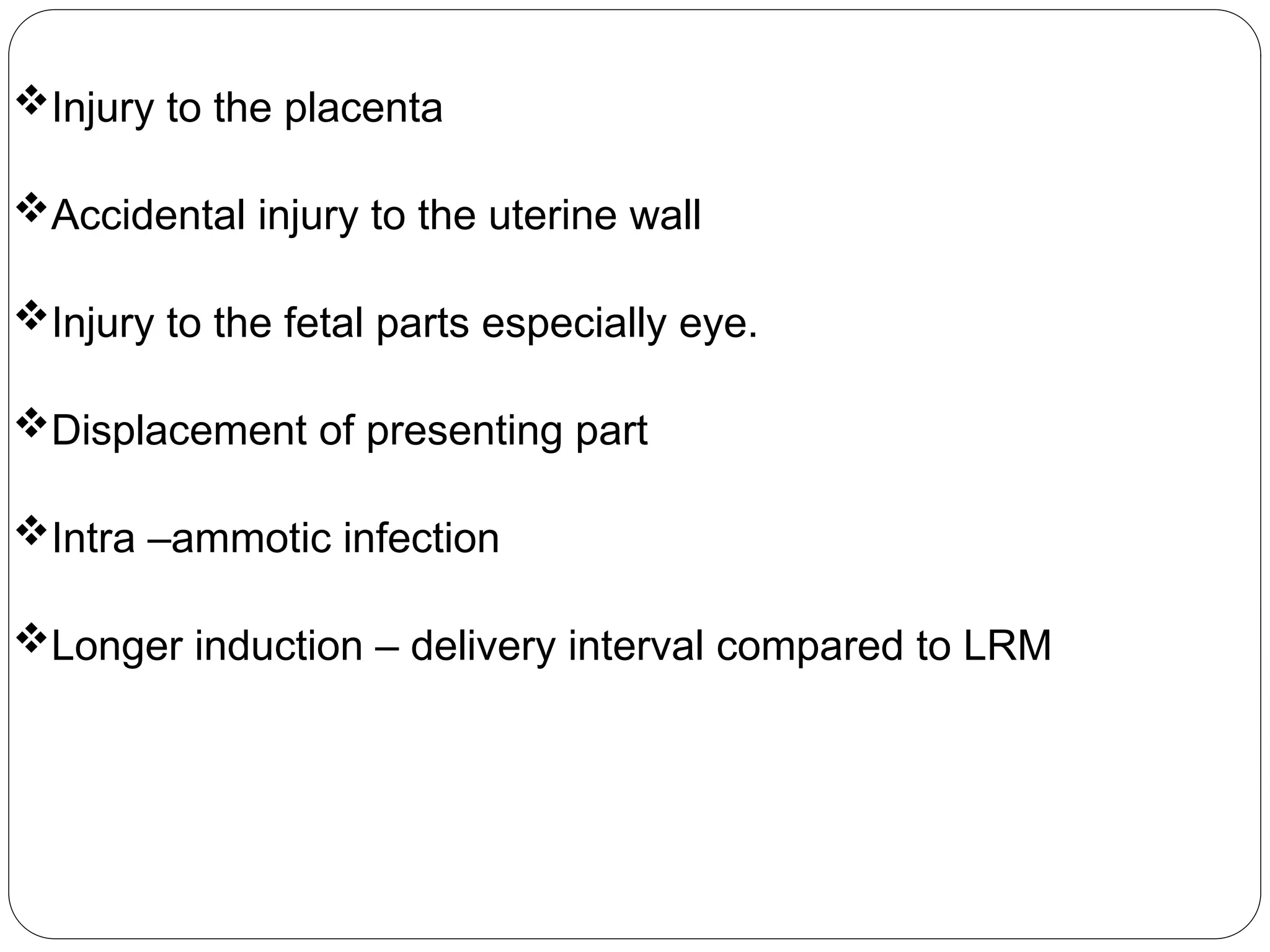
Injury to the placenta
Accidental injury to the uterine wall
Injury to the fetal parts especially eye.
Displacement of presenting part
Intra –ammotic infection
Longer induction – delivery interval compared to LRM
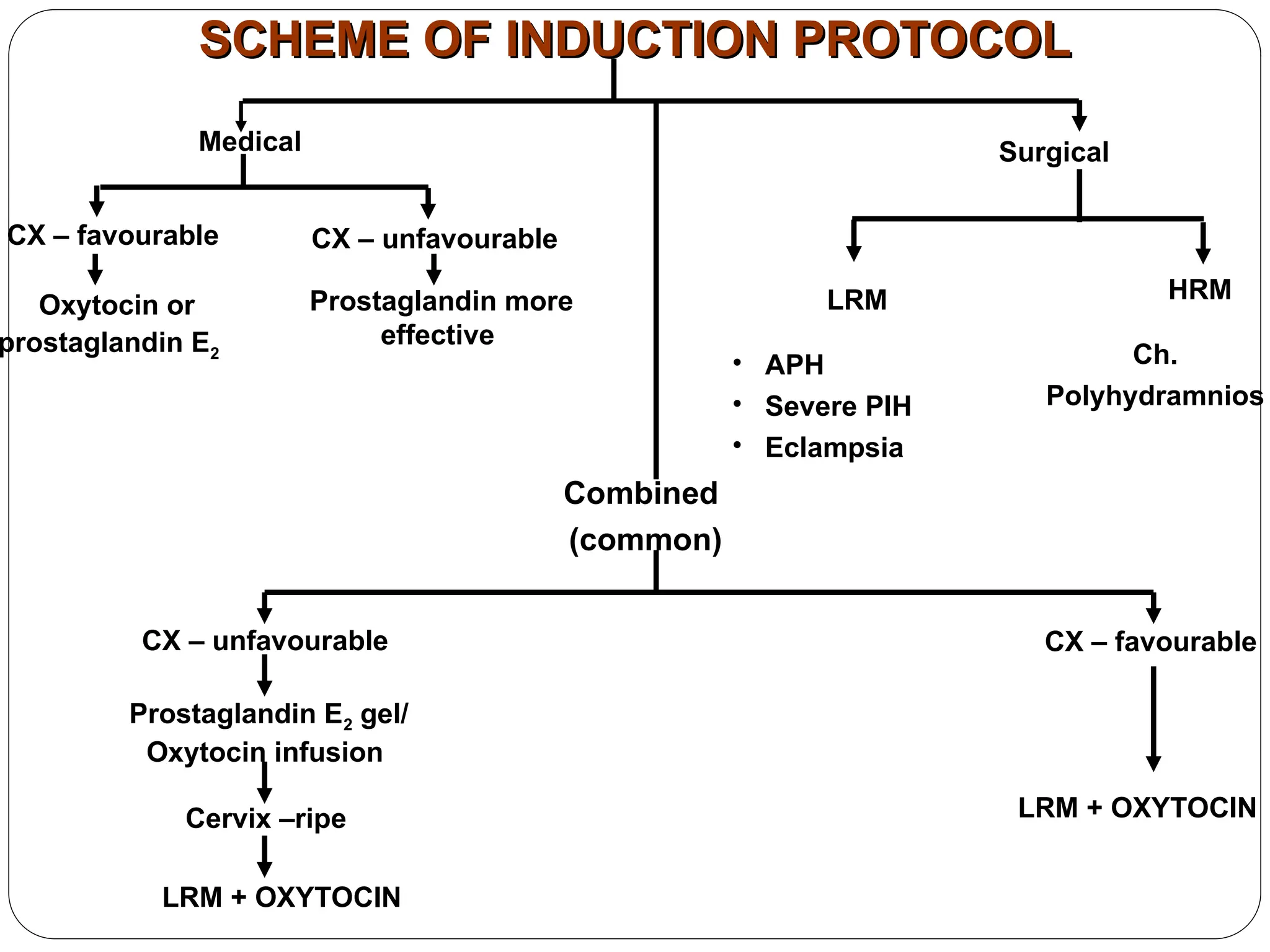
SCHEME OF INDUCTION PROTOCOL
CX – favourable
Surgical
Medical
CX – unfavourable
Oxytocin or
prostaglandin E2
Prostaglandin more
effective
LRM HRM
• APH
• Severe PIH
• Eclampsia
Ch.
Polyhydramnios
Combined
(common)
CX – unfavourable
Prostaglandin E2 gel/
Oxytocin infusion
Cervix –ripe
LRM + OXYTOCIN
CX – favourable
LRM + OXYTOCIN
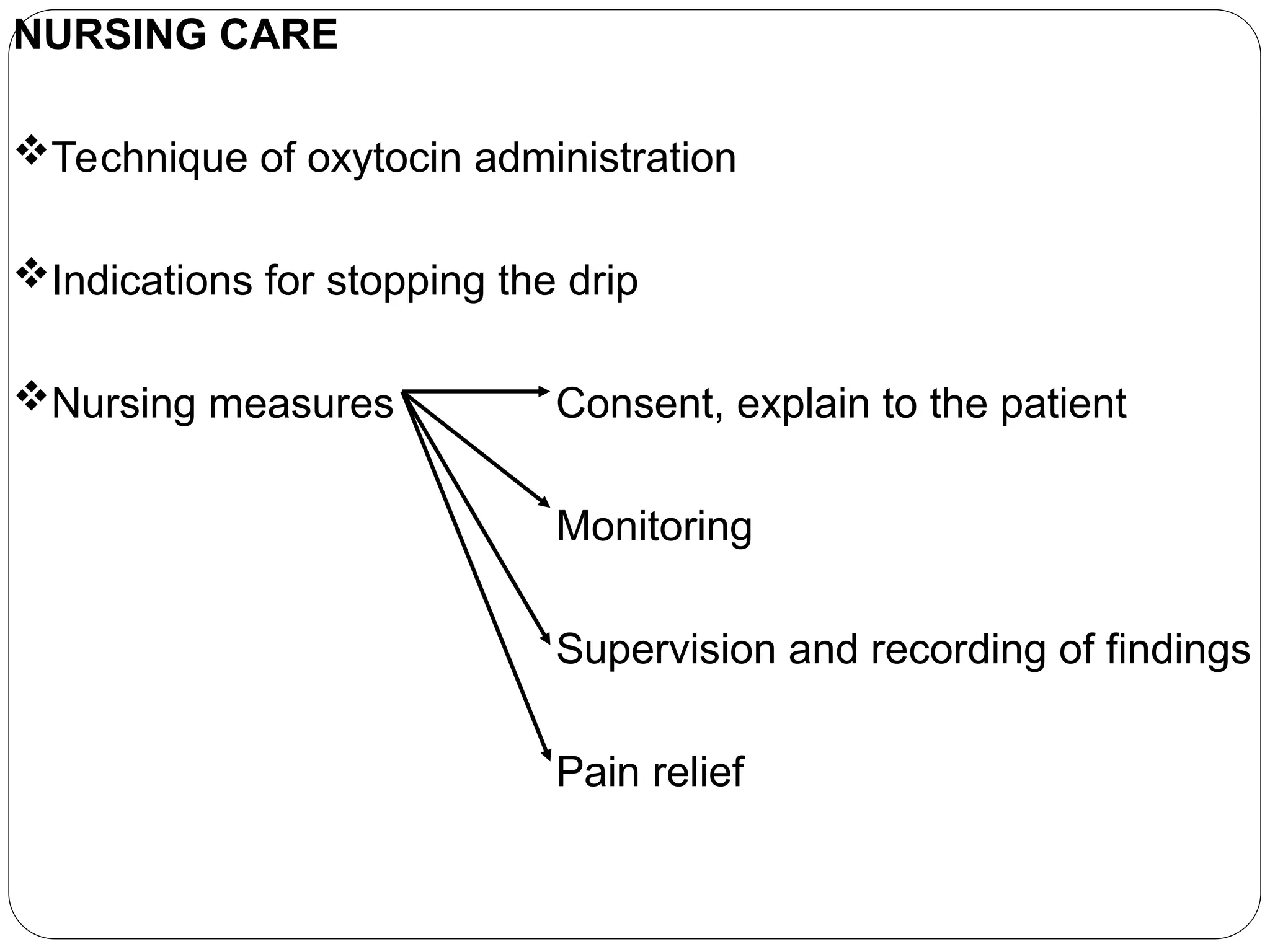
NURSING CARE
Technique of oxytocin administration
Indications for stopping the drip
Nursing measures Consent, explain to the patient
Monitoring
Supervision and recording of findings
Pain relief
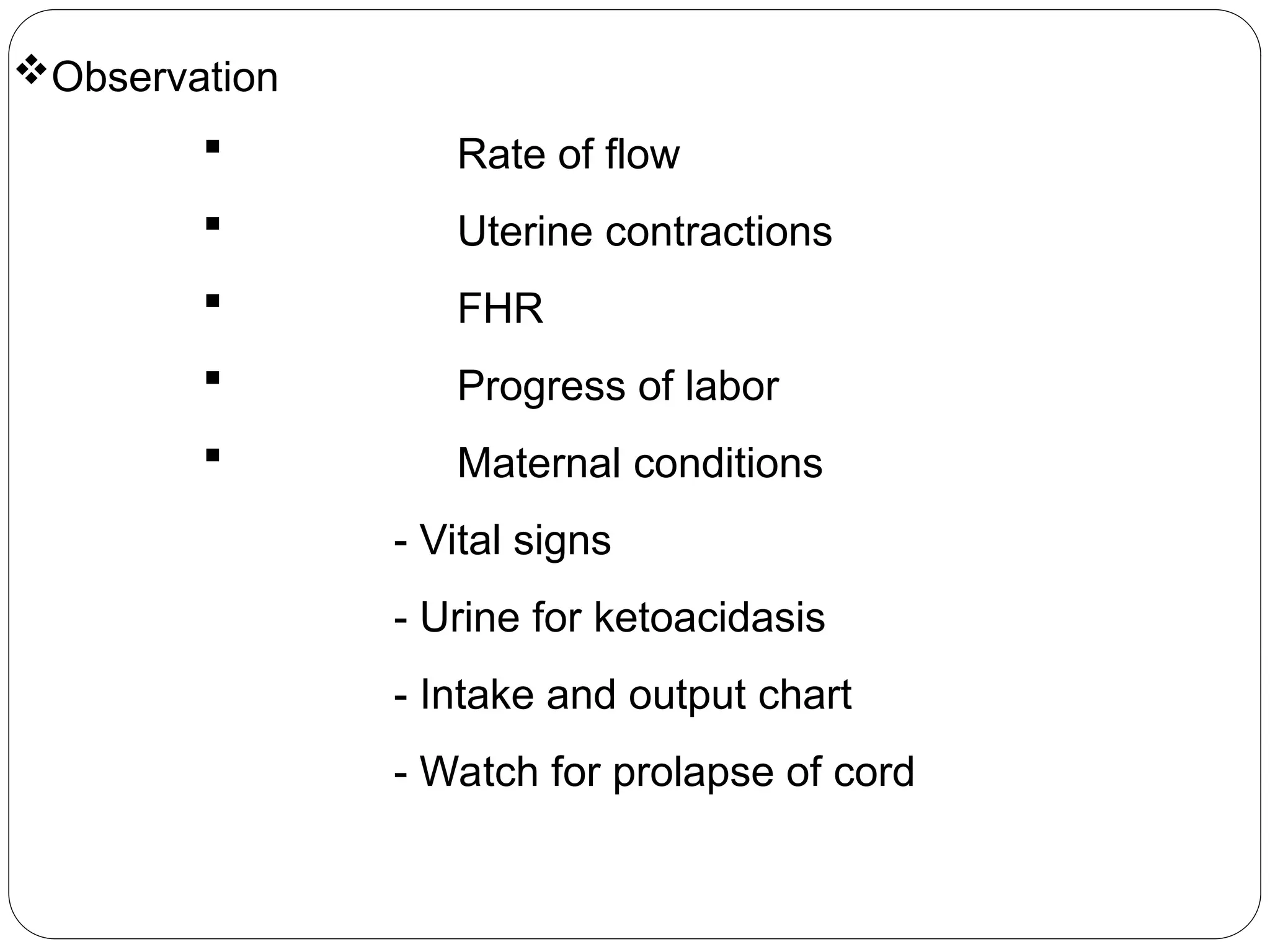
Observation
 Rate of flow
 Uterine contractions
 FHR
 Progress of labor
 Maternal conditions
- Vital signs
- Urine for ketoacidasis
- Intake and output chart
- Watch for prolapse of cord
Observation
 Rate of flow
 Uterine contractions
 FHR
 Progress of labor
 Maternal conditions
- Vital signs
- Urine for ketoacidasis
- Intake and output chart
- Watch for prolapse of cord
Observation
 Rate of flow
 Uterine contractions
 FHR
 Progress of labor
 Maternal conditions
- Vital signs
- Urine for ketoacidasis
- Intake and output chart
- Watch for prolapse of cord
Augmentation Of Labour:
.
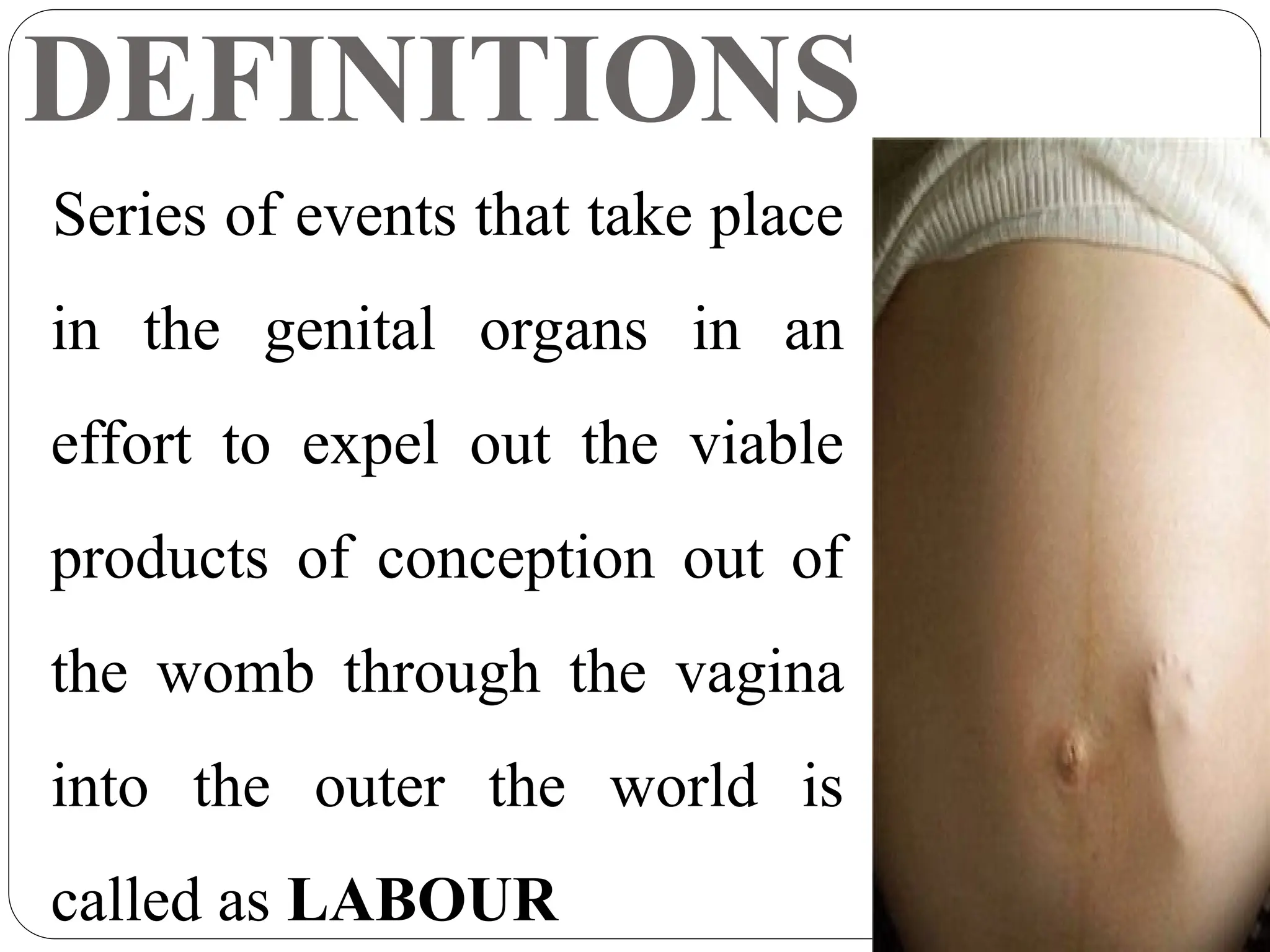
DEFINITIONS
Series of events that take place
in the genital organs in an
effort to expel out the viable
products of conception out of
the womb through the vagina
into the outer the world is
called as LABOUR
AUGMENATION OF LABOUR
Induction of labour means
initiation of uterine contractions
(after a period of viability) by
any method (medical, surgical
and combined) for the purpose
of the vaginal delivery.
AUGMENTATION
Augmentation is the
process of stimulation of
the uterine contraction
that are already present
but found to be
inadequate.
ELECTIVE INDUCTION OF LABOUR
Elective Induction Of Labour
means termination of pregnancy
without any acceptable medical
induction. (It is done for the
convenience of the patient,
obstetrician or the hospital.)

CONFUSION
ASSESSMENT
FETAL ASSESSMENT
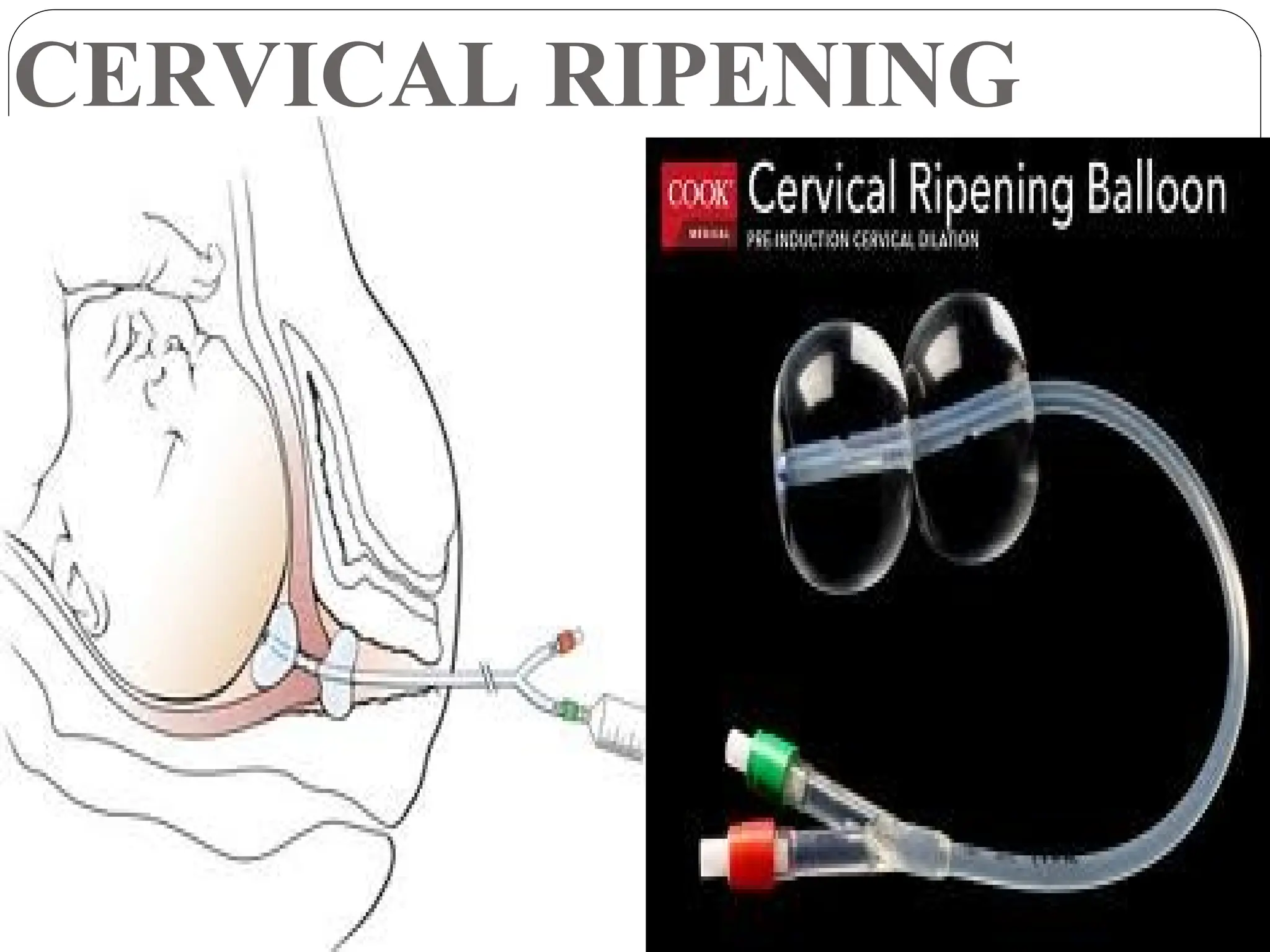
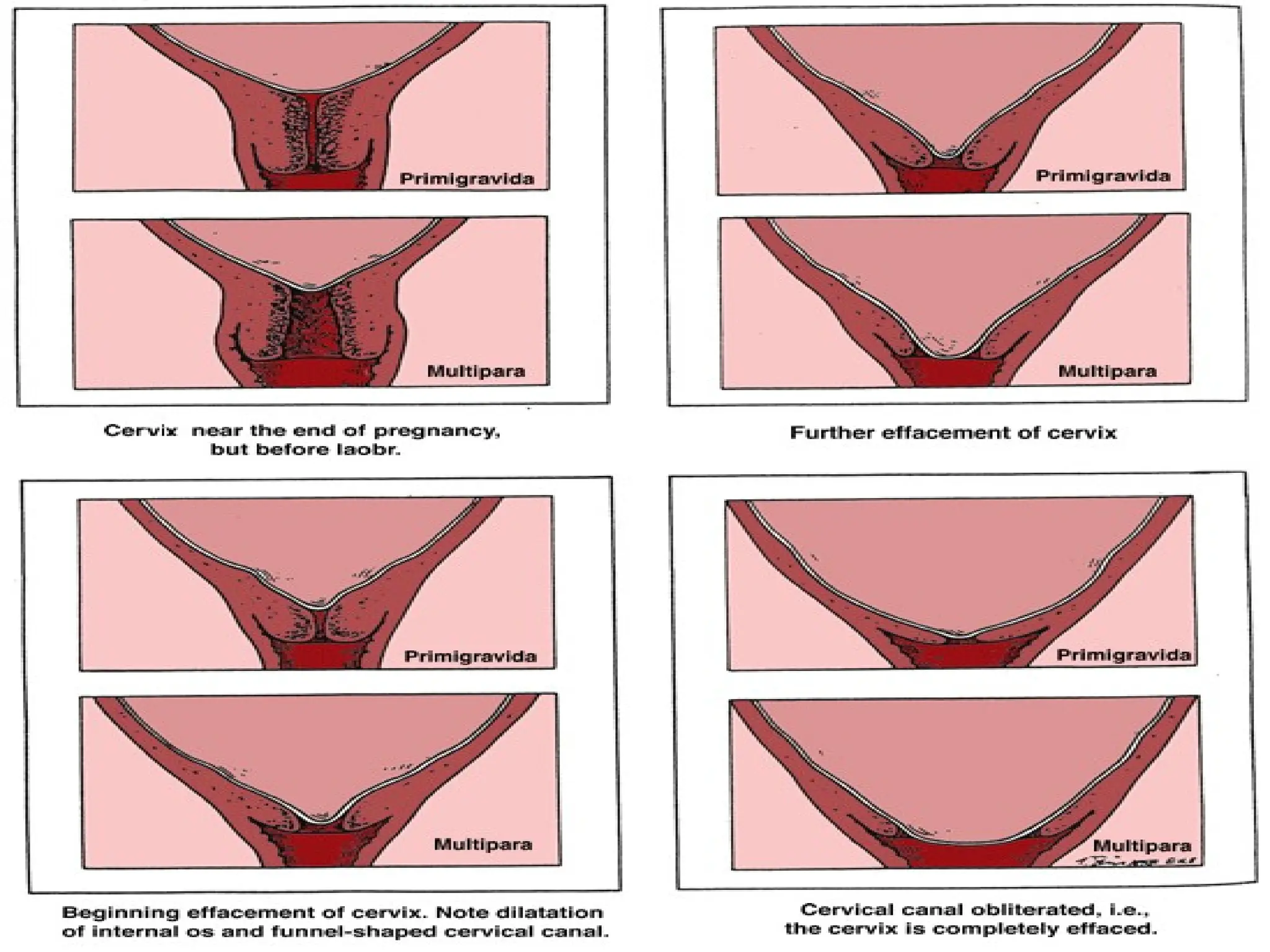
CERVICAL RIPENING
CERVICAL STRIPPING
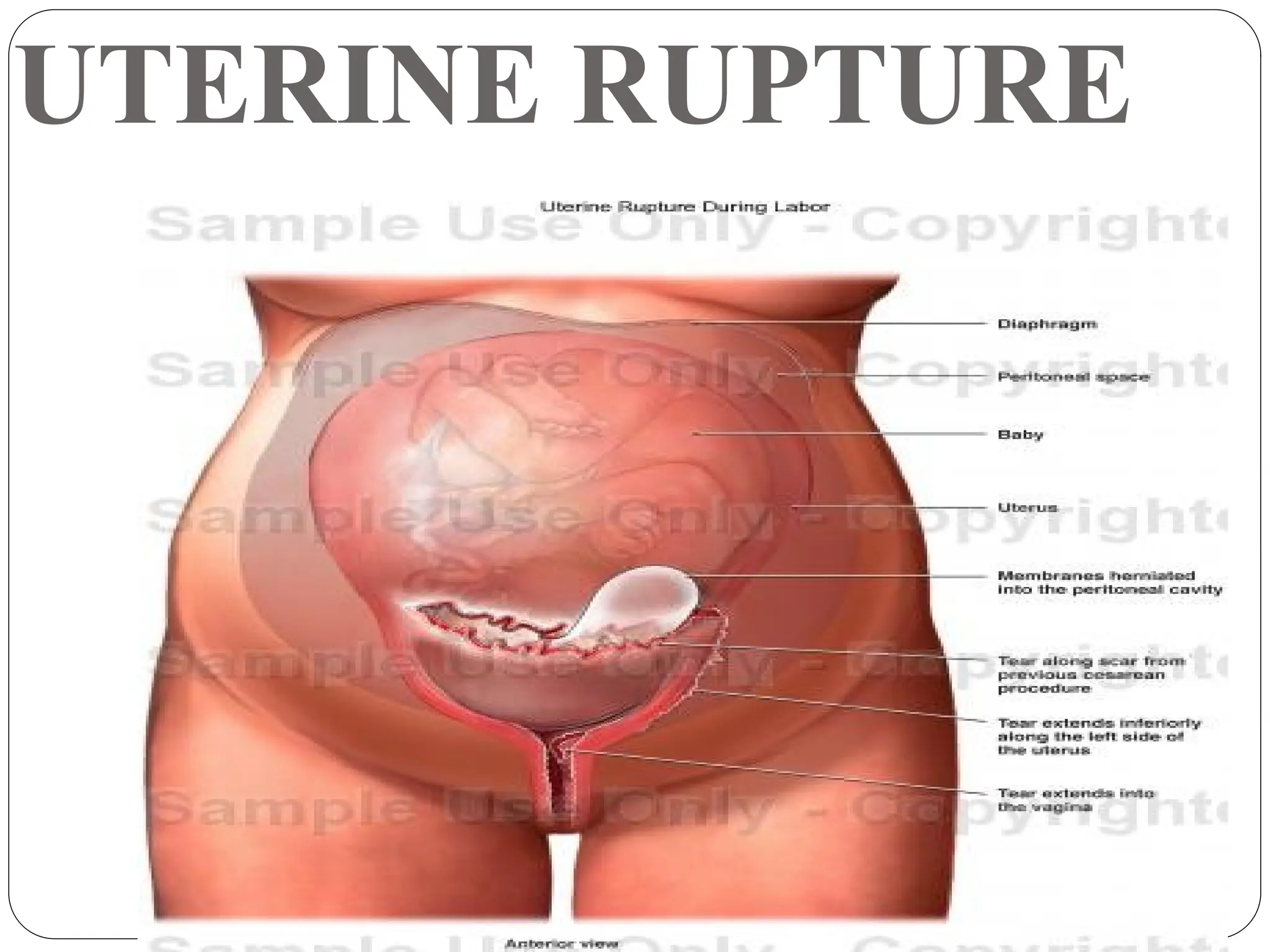
UTERINE RUPTURE
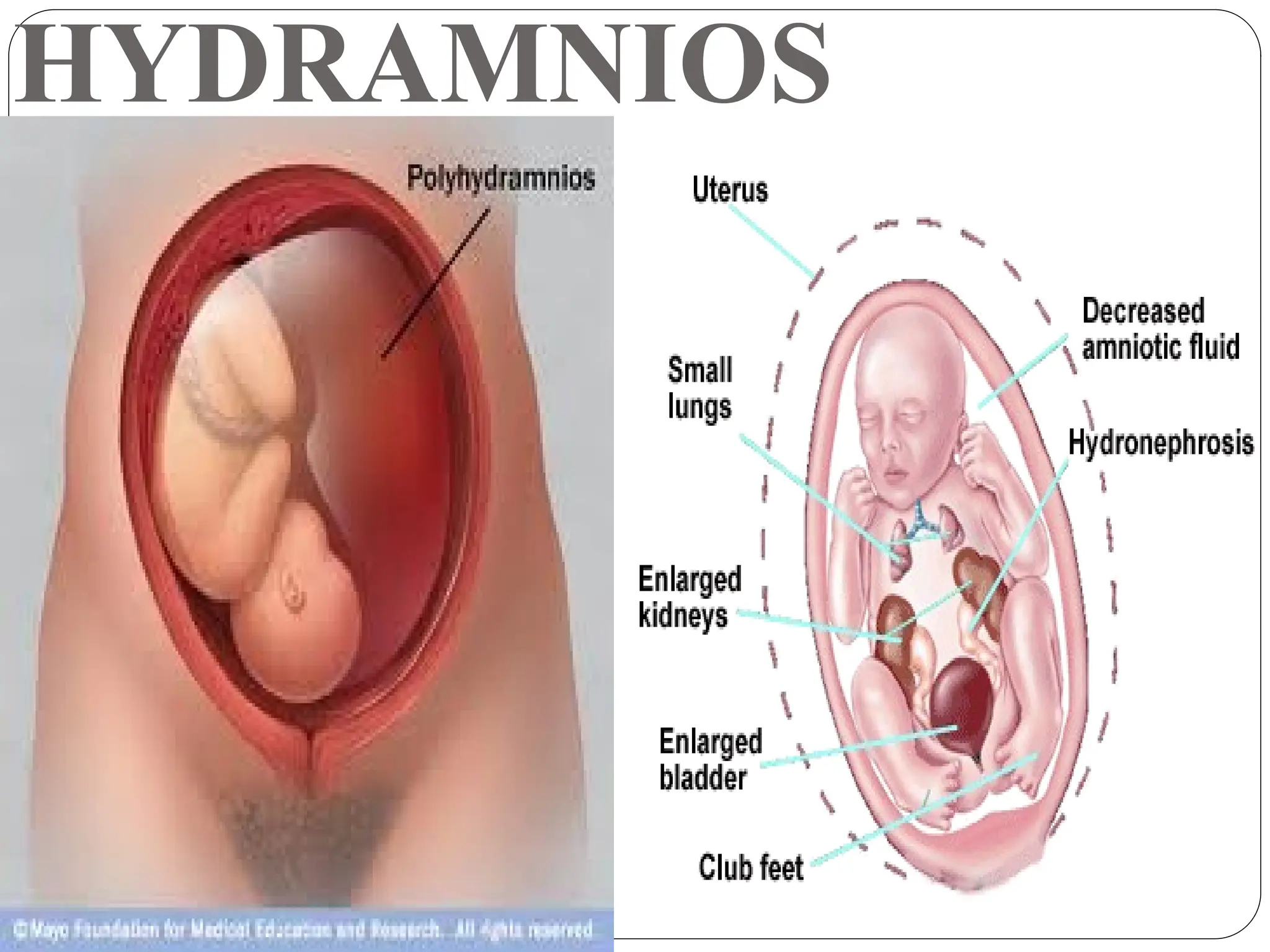
HYDRAMNIOS
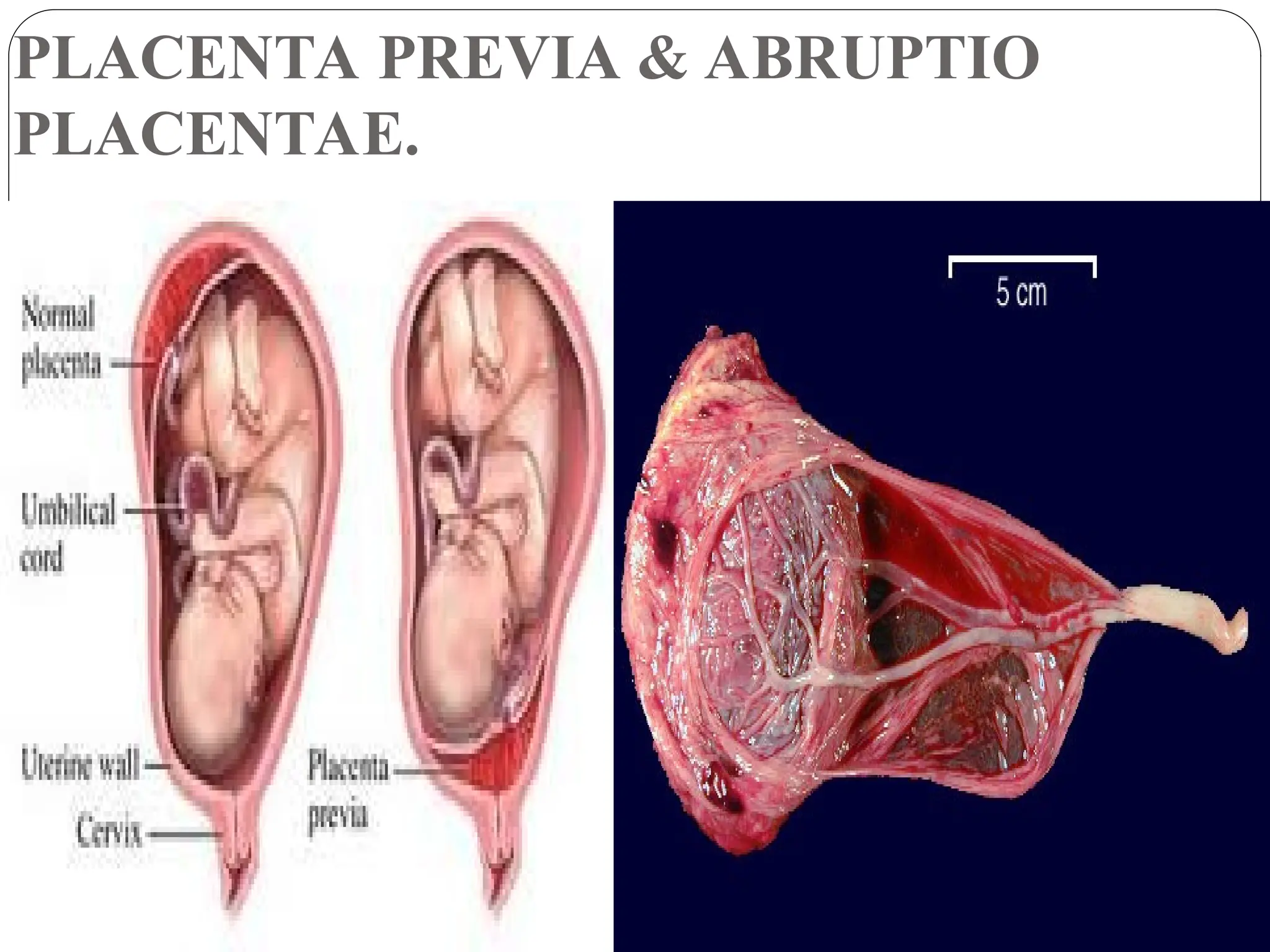
PLACENTA PREVIA & ABRUPTIO
PLACENTAE.
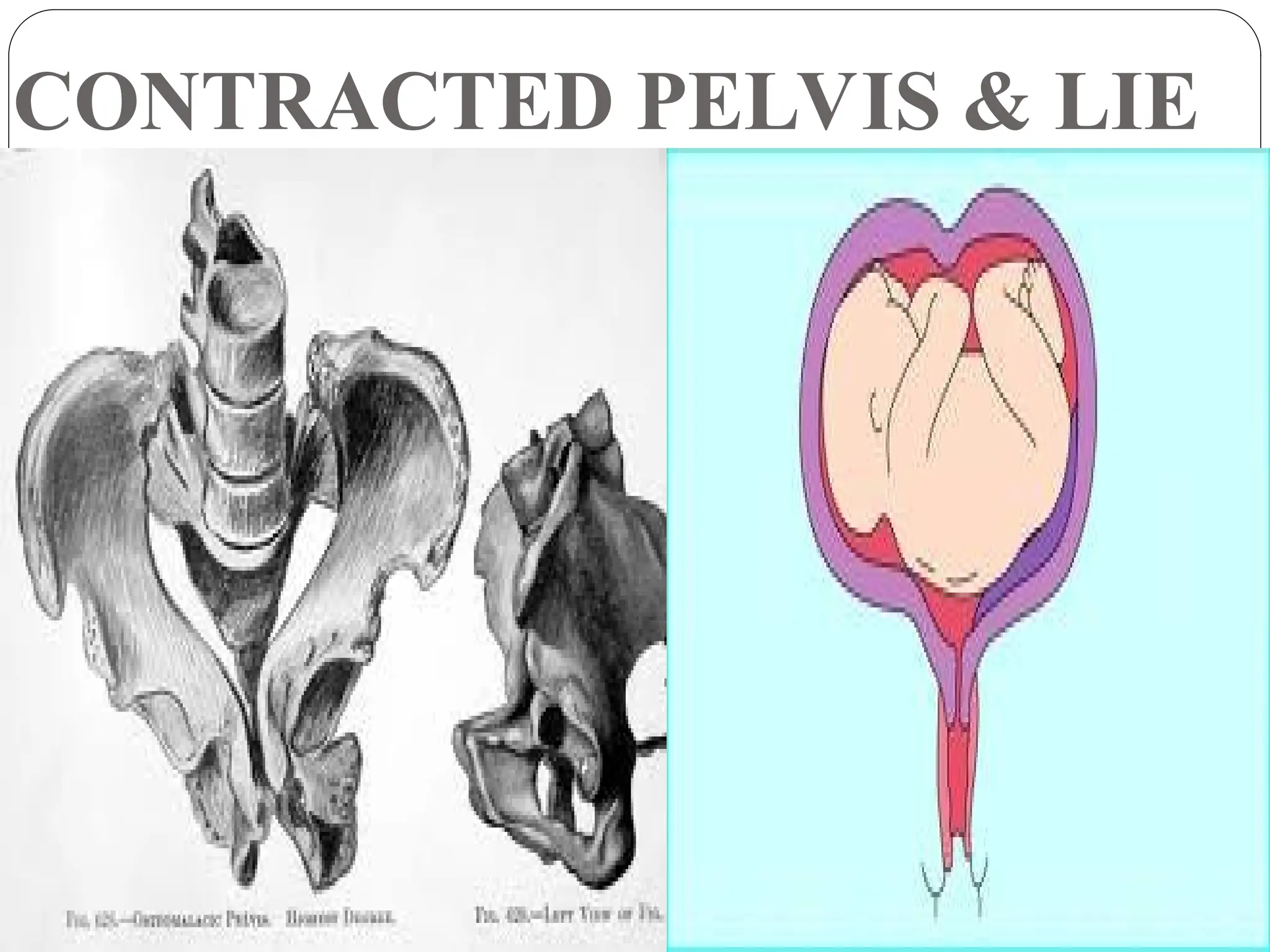
CONTRACTED PELVIS & LIE
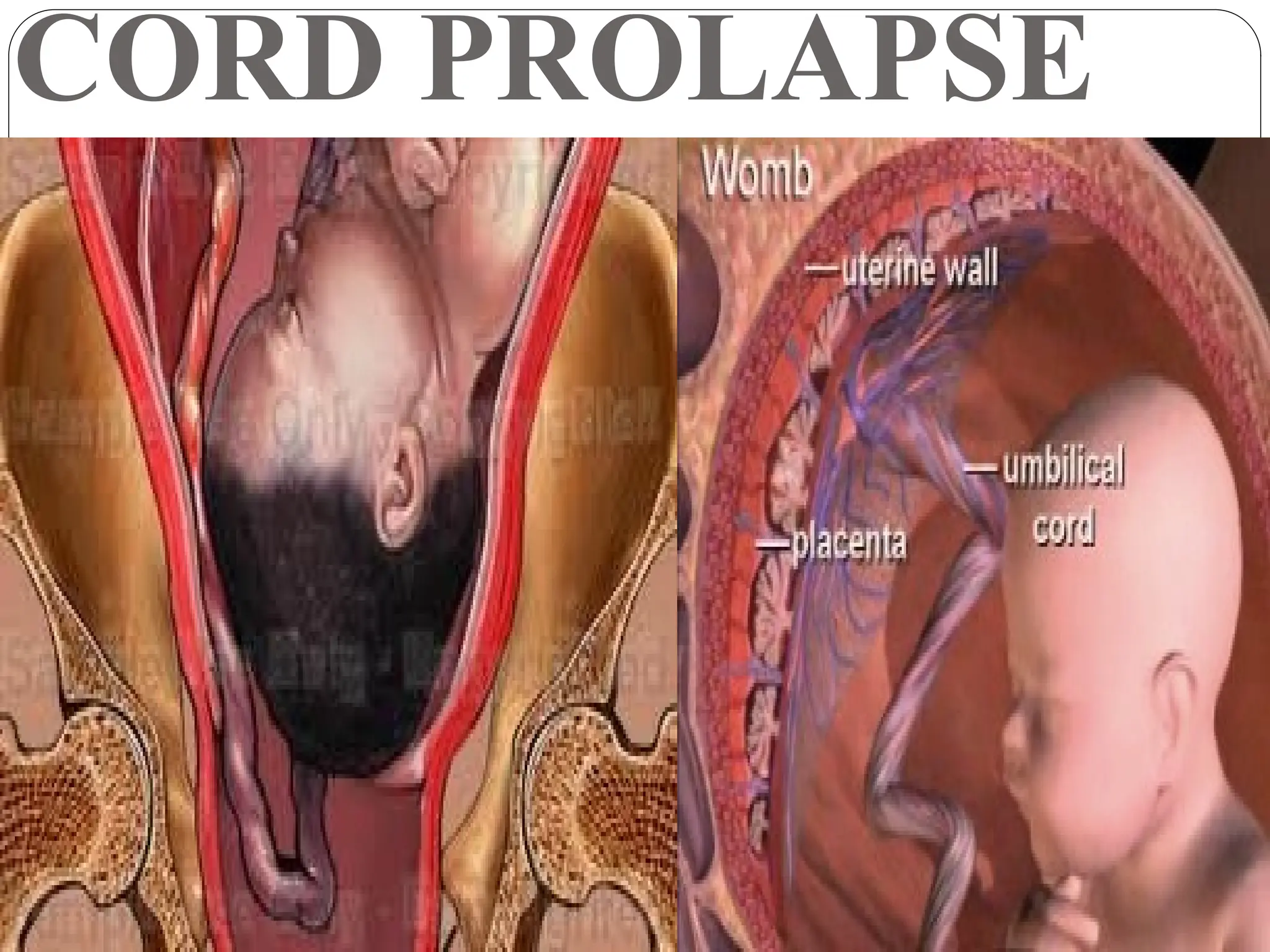
CORD PROLAPSE
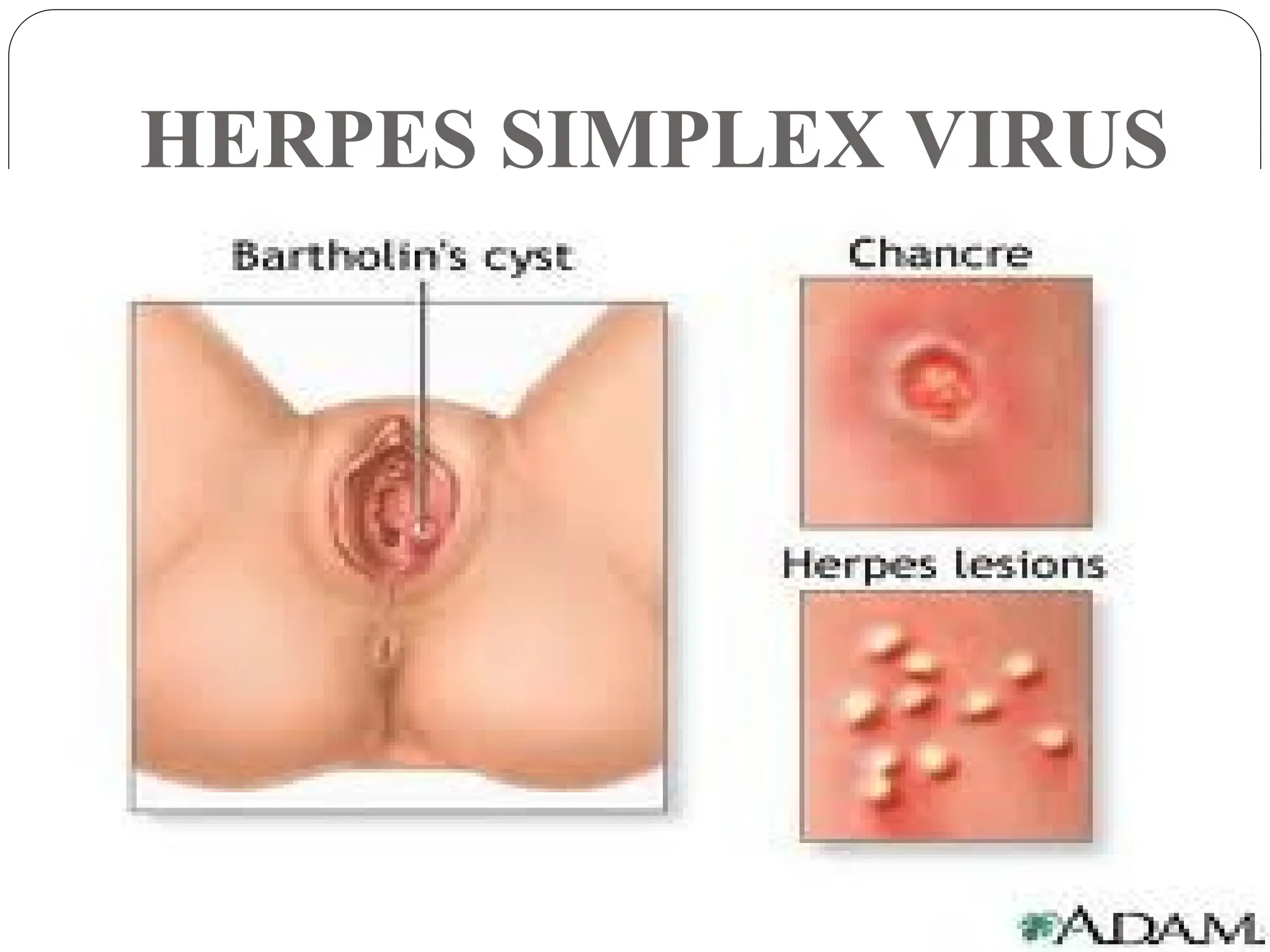
HERPES SIMPLEX VIRUS
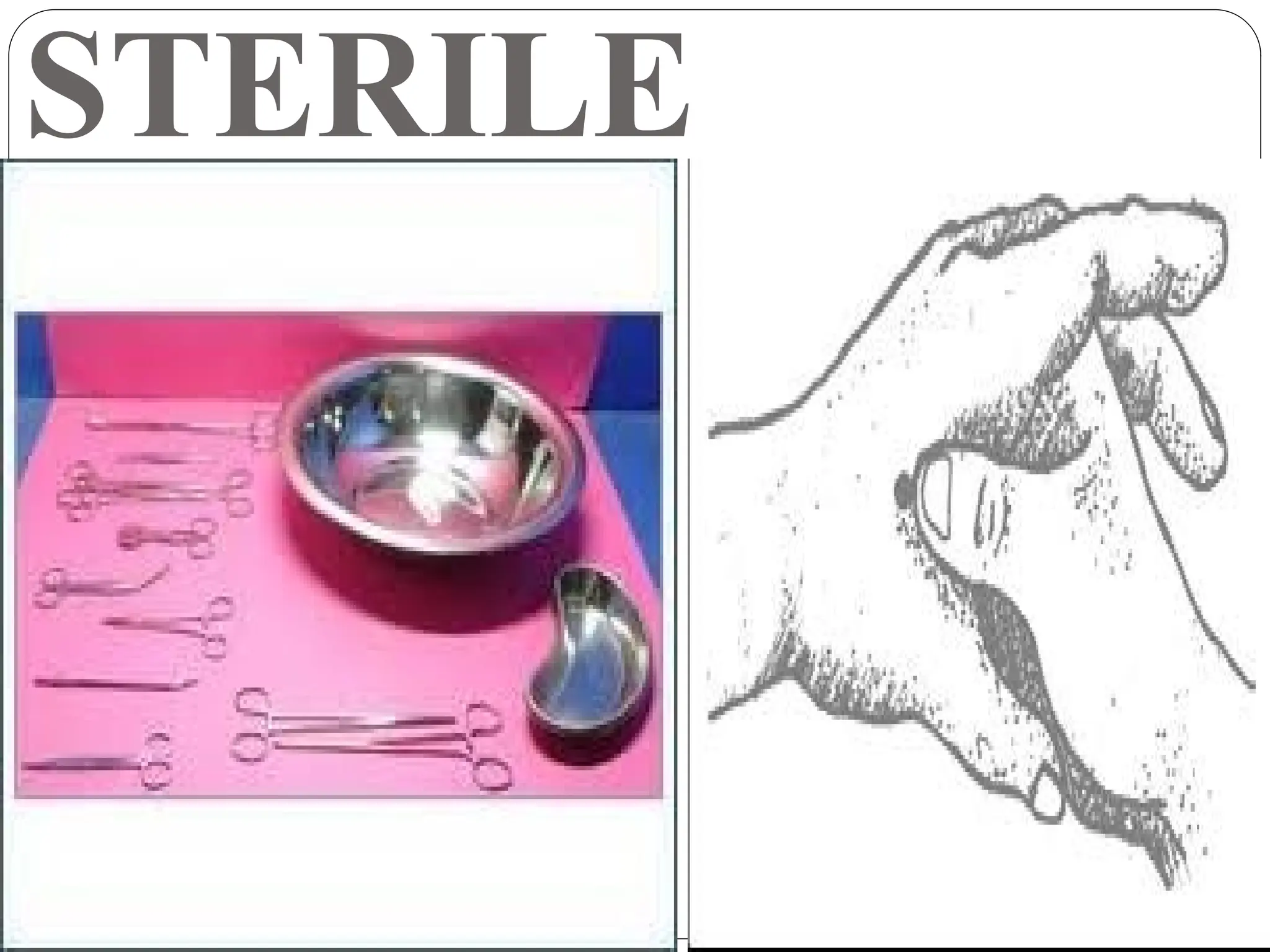
STERILE
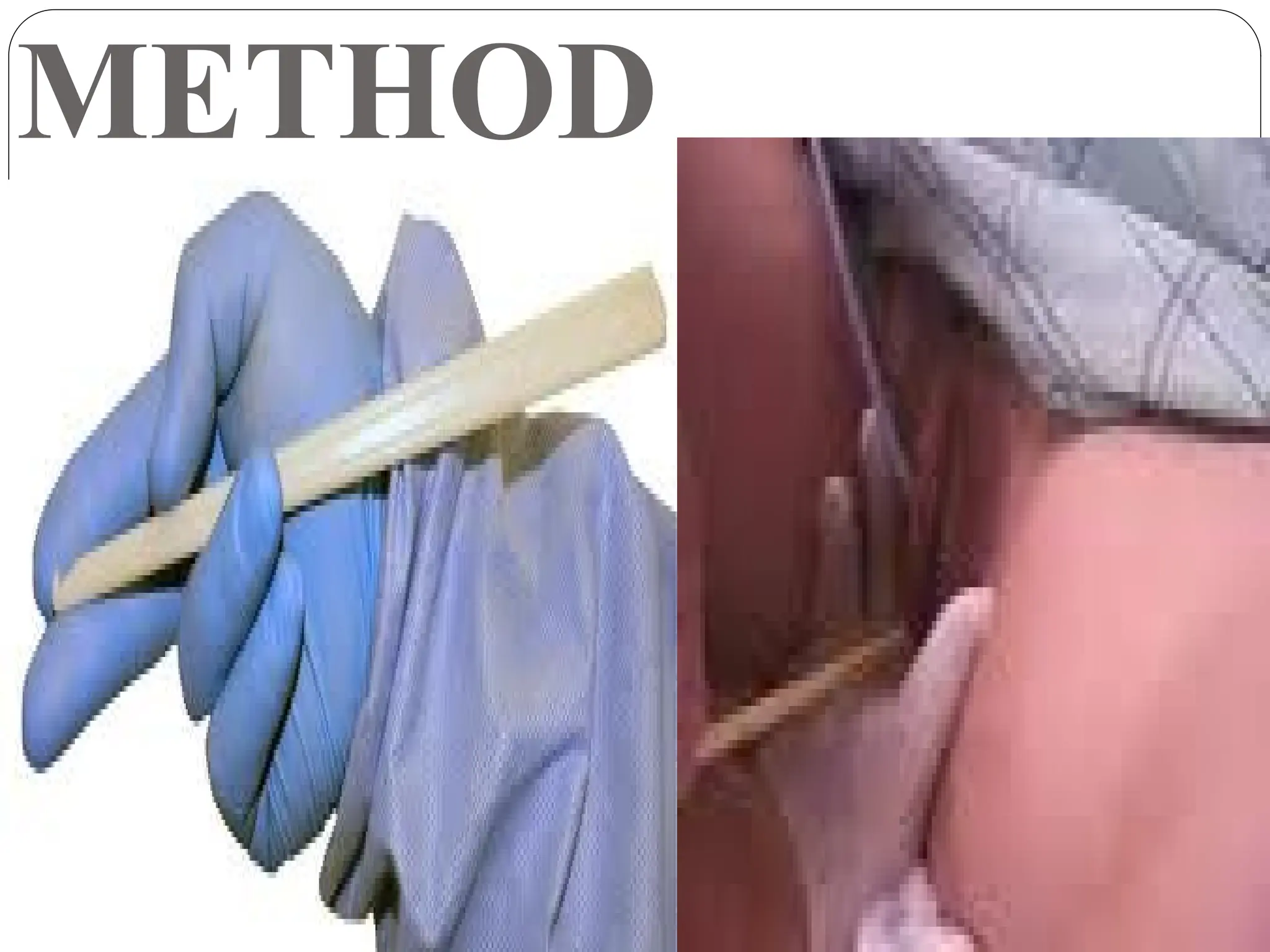
METHOD
TEAM WORK
Unit 1.ppt for the studentsbbbbbbbbbbbbbbbbbbbbbbbbb

Unit 1.ppt for the studentsbbbbbbbbbbbbbbbbbbbbbbbbb

  • 1.
  • 3.
    DEFINITION  Preterm labouris defined as one where the labour starts before the 37th completed weeks counting from the first day of the last menstrual period
  • 4.
  • 5.
    ETIOLOGY HISTORY Abortion Bacteriuria or recurrentUTI Smocking Low socio-economic and nutritional status
  • 6.
    COMPLICATIONS IN THEPRESENT PREGNANCY  Maternal  Pregnancy complications • Pre eclampsia • APH • PROM • Polyhydramnios  Uterine anomalies • Cervical incompetence • Malformations of the uterus
  • 7.
    Contd...  Medical andsurgical illness • Acute fever • Acute pyelonephritis • Diarrhoea • Acute appendicitis • Toxoplasmosis • Abdominal operations  Genital tract infection • Bacterial vaginosis • Chlamydia • Mycoplasma
  • 8.
    Contd…  Fetal  Multiplepregnancy  Congenital malformations  IUD  Placental  Infarction  Thrombosis  Placenta previa or abruption IATROGENIC IDIOPATHIC
  • 9.
    Etiopathogenesis Decidual cells andmacrophages produce cytokines Increase synthesis of prostaglandins and leukotrienes Initiate pre term contraction
  • 10.
    Diagnosis Regular uterine contractionwith or without pain ( 1 in 10 minute) Dialation (2cm) Effacement ( 80%) Pelvic pressure Back ache Vaginal discharge
  • 11.
    Management OBJECTIVES 1.To prevent preterm onset of labour 2.To arrest pre term labour 3.To minimise perinatal mortality and morbidity 4.Appropriate management of labour 5.Effective neonatal care
  • 12.
    Prevention  Identification ofrisk factors  Rest  Nutritional supplement  Avoidance of smocking  Encerclage operation  Premature effacement with irritable uterus and early engagement of head  Tocolytic agent  Bed rest  Be sure about the gestational age before induction  Selective continuation of complicated pregnancy  Rest  Appropriate therapy  Early hospitalisation
  • 13.
    Investigations FBC Urine for routineand c/s Endocervical swab USG Serum electrolyte and glucose when tocolytic agents are to be used Fibronectin
  • 14.
    To arrest preterm labour Adequate rest  Left lateral position Adequate sedation  Diazepam 5mg  Phenobarbitone 30- 60 mg Adequate hydration Antibiotic if there is infection Tocolytic agents ( short and long term therapy)
  • 15.
    Short term therapy Objectives 1.To delay delivery for at least 24 hrs for glucocorticoid therapy 2.In utero transfer of patient
  • 16.
    Contd…  Contraindications 1. Maternal •Diabetes • Thyrotoxicosis • Hypertension • Cardiac disease • Haemorrhage 2. Fetal • Fetal distress • Fetal death • Congenital malformation • Pregnancy beyond 34 weeks 3. Others • Rupture of membrane • Cervical dialatation more than 4 cm • Chorioamnionitis
  • 17.
    Long term therapy Pregnancyprior to 34 weeks Pregnancy can be continued for at least one week Benificial when pregnancy beyond 48 hours but less than 7 days Glucocorticoid therapy  Betamethasone 12mg IM every 12hrs - 2 doses  Dexametasone 8mg IM every 12 hrs - 3 doses Contraindication  PROM  Pre eclampsia  Delivery time is outside 24hrs – 7 day interval
  • 18.
    Management during labour Objective •To prevent asphyxia • To prevent birth trauma
  • 19.
    First stage  Patientis put to bed to prevent PROM  Ensure adequate oxygenation  Strong sedatives and acceleration should be avoided  Watch during labour  Delay - LSCS
  • 20.
    Second stage  Birthshould be gentle and slow  Liberal episiotomy  Tendency to delay curtailed by forceps  Cord is to be clamped immediately to prevent hypervolemia and hyperbilirubinemia  Place baby in NICU
  • 21.
    LSCS  Before 34wks with breech  Lower segment or j shaped incision is preferred
  • 22.
    Nursing Diagnosis 1. Alteredcardiopulmonary tissue perfusion related to the effects of tocolytic agents 2. Fear related to the uncertainity of outcome and effects of preterm labour on fetus 3. Impaired gas exchange related to lung immaturity 4. Pain related to uterine contraction 5. Ineffective management of therapeutic regimen related to the lack of knowledge and complexity of therapy 6. Diversional activity deficit related to the imposed bed rest
  • 23.
    Contd… 7. Constipation relatedto decreased gastrointestinal motility from prolonged bed rest / adverse effect of tocolytic agent 8. Situational low self esteem related to the feeling of inadequacy from pre term labour complications 9. Knowledge deficit related to the treatment of preterm labour
  • 24.
    Premature Rupture ofMembranes (PROM)
  • 25.
    Definition Spontaneous rupture ofthe membranes any time beyond 28th week of pregnancy but before the onset of labour is called premature (pre labour) rupture of membranes.
  • 26.
     TERM PROM Whenthe rupture occurs beyond 37th week but before the onset of labour it is called term PROM PRE TERM PROM When the rupture occurs before the 37th completed weeks it is called preterm PROM PROLONGED RUPTURE OF MEMBRANE Rupture of membrane for 24 hours before delivery is called prolonged rupture of membrane
  • 27.
    INCIDENCE 10 % ofall pregnancies
  • 28.
    Causes  Increased friabilityof the membranes  Decreased tensile strength of the membranes  Polyhydramnios  Cervical incompetence  Multiple pregnancy  Infection – Chorio-amnionitis, UTI, lower genital tract infections
  • 29.
    Diagnosis  Subjective symptomis Escape of watery discharge per vagina either as a gush or slow leak.  Usually confused with 1. Hydrorrhoea gravidarum 2. Incontinence of urine
  • 30.
    Confirmation of Diagnosis 1.Speculum examination 2. Examination of the collected fluid from posterior fornix for  Detection of pH ( 6 – 6.2)  Ferning pattern 3. 0.1% Nile blue sulphate test – orange blue colouration of cells 4. USG
  • 31.
    Investigations  Complete bloodcount  Urine analysis and culture  High vaginal swab for culture  Vaginal pool to estimate phosphatidyl glycerol  USG  NST
  • 32.
    Dangers Preterm labour andprematurity Ascending infection Cord prolapse Dry labour Fetal pulmonary hypoplasia R.D.S
  • 35.
    Management - Assess gestationalage and fetal weight - Patient not in labour - Absence of infection and fetal distress - biophysical profile and NST To monitor maternal pulse, temperature, FHS and start prophylactic antibiotics Pregnancy < 34 weeks Pregnancy > 34 weeks Pregnancy > 37 weeks Expectant management Wait for spontaneous onset Wait for spontaneousto continue for fetal maturity. of labour for 24 – 48 hours labour for 24 hours Transfer patient with “fetus in FAILS FAILS Utero” to equipped centre Induction of labour Induction of labour with oxytocin with oxytocin
  • 39.
    Meaning Any deviation ofthe normal pattern of uterine contractions affecting the course of labour is called abnormal uterine action
  • 40.
    Etiology Advancing age ofthe mother Prolonged pregnancy Over distention of the uterus due to twins Psychological Factors Contracted pelvis Malpresentations Full bladder
  • 41.
  • 42.
  • 43.
    Precipitate Labour Precipitate Labour Definition: Alabour lasting less than 3 hours Etiology: More common in multipara when there are strong uterine contractions roomy pelvis small sized pelvis minimal soft tissue resistance
  • 44.
    Complications Maternal:  Lacerations ofthe cervix, vagina and perineum.  Shock.  Inversion of the uterus.  Postpartum haemorrhage: no time for retraction, lacerations.  Sepsis due to: lacerations, inappropriate surroundings. Foetal:  Intracranial haemorrhage due to sudden compression and decompression of the head.  Foetal asphyxia due to: strong frequent uterine contractions reducing placental perfusion, lack of immediate resuscitation.  Avulsion of the umbilical cord.  Foetal injury due to falling down.
  • 45.
    Management Before delivery Patient whohad previous precipitate labour should be hospitalized before expected date of delivery as she is more prone to repeated precipitate labour. During delivery Inhalation anaesthesia: as nitrous oxide and oxygen is given to slow the course of labour. Tocolytic agents: as ritodrine (Yutopar) may be effective. Episiotomy: to avoid perineal lacerations and intracranial haemorrhage. After delivery Examine the mother and foetus for injuries.
  • 46.
    EXCESSIVE UTERINE CONTRACTIONAND RETRACTION Physiological Retraction Ring  It is a line of demarcation between the upper and lower uterine segment present during normal labour and cannot usually be felt abdominally. Pathological Retraction Ring (Bandl’s ring)  It is the rising up retraction ring during obstructed labour due to marked retraction and thickening of the upper uterine segment while the relatively passive lower segment is markedly stretched and thinned to accommodate the foetus.  The Bandl’s ring is seen and felt abdominally as a transverse groove that may rise to or above the umbilicus.  Clinical picture: is that of obstructed labour with impending rupture uterus.  Obstructed labour should be properly treated otherwise the thinned lower uterine segment will rupture.
  • 48.
    HYPOTONIC UTERINE INERTIA Definition:The uterine contractions are infrequent, weak and of short duration General factors: Primigravida particularly elderly. Anaemia Nervous and emotional as anxiety and fear. Hormonal due to deficient prostaglandins or oxytocin as in induced labour. Improper use of analgesics. Local factors:  Overdistension of the uterus.  Developmental anomalies of the uterus  Myomas of the uterus interfering mechanically with contractions.  Malpresentations, malpositions and cephalopelvic disproportion. The presenting part is not fitting in the lower uterine segment leading to absence of reflex uterine contractions.  Full bladder and rectum
  • 49.
    Types Primary inertia: weakuterine contractions from the start. Secondary inertia: inertia developed after a period of good uterine contractions when it failed to overcome an obstruction so the uterus is exhausted. Clinical Picture Labour is prolonged. Uterine contractions are infrequent, weak and of short duration. Slow cervical dilatation. Membranes are usually intact. The foetus and mother are usually not affected apart from maternal anxiety due to prolonged labour. More susceptibility for retained placenta and postpartum haemorrhage due to persistent inertia. Tocography: shows infrequent waves of contractions with low amplitude
  • 50.
  • 51.
    HYPERTONIC UTERINE INERTIA Types Colickyuterus: incoordination of the different parts of the uterus in contractions. Hyperactive lower uterine segment: so the dominance of the upper segment is lost. Clinical Picture The condition is more common in primigravidae and characterized by:  Labour is prolonged.  Uterine contractions are irregular and more painful.  High resting intrauterine pressure in between uterine contractions detected by tocography (normal value is 5-10 mm of Hg).  Slow cervical dilatation.  Premature rupture of membranes.  Foetal and maternal distress.
  • 52.
    Management  General measures:as hypotonic inertia.  Medical measures: € Analgesic and antispasmodic as pethidine. € Epidural analgesia may be of good benefit.  Caesarean section is indicated in: € Failure of the previous methods. € Disproportion. € Foetal distress before full cervical dilatation
  • 53.
    CONSTRICTION (CONTRACTION) RING Definition It is a persistent localised annular spasm of the circular uterine muscles. It occurs at any part of the uterus but usually at junction of the upper and lower uterine segments. It can occur at the 1st, 2nd or 3rd stage of labour.
  • 55.
    Aetiology Unknown but thepredisposing factors are:  Malpresentations and malpositions.  Clumsy intrauterine manipulations under light anaesthesia.  Improper use of oxytocin e.g.  use of oxytocin in hypertonic inertia.  IM injection of oxytocin. Diagnosis  The condition is more common in primigravidae and frequently preceded by colicky uterus.  The exact diagnosis is achieved only by feeling the ring with a hand introduced into the uterine cavity.
  • 56.
    Management Exclude malpresentations, malpositionand disproportion. In the 1st stage: Pethidine may be of benefit. In the 2nd stage: Deep general anaesthesia is given to relax the constriction ring: If the ring is relaxed, the foetus is delivered immediately by forceps. If the ring does not relax, caesarean section is carried out with lower segment vertical incision to divide the ring. In the 3rd stage: Deep general anaesthesia is given followed by manual removal of the placenta
  • 57.
    CERVICAL DYSTOCIA Definition Failure ofthe cervix to dilate within a reasonable time in spite of good regular uterine contractions. Varieties Organic (secondary) due to Cervical stances as a sequel to previous amputation, cone biopsy, extensive cauterisation or obstetric trauma. Organic lesions as cervical myoma or carcinoma. Functional (primary): In spite of the absence of any organic lesion and the well effacement of the cervix, the external os fails to dilate. This may be due to lack of softening of the cervix during pregnancy or cervical spasm resulted from overactive sympathetic tone.
  • 58.
    Complications Annular detachment ofthe cervix: the bleeding from the cervix is minimal because of fibrosis and avascular pressure necrosis leading to thrombosis of the vessels before detachment. Rupture uterus. Postpartum haemorrhage: particularly if cervical laceration extends upwards tearing the main uterine vessels. Management  Organic dystocia: ♣ Caesarean section is the management of choice.  Functional dystocia: ♣ Pethidine and antispasmodics: may be effective. ♣ Caesarean section: if ♣ medical treatment fails or ♣ foetal distress developed.
  • 60.
  • 62.
    Definition The labour isprolonged when the combined duration of the first and second stage is more than the arbitrary time limit of 18 hours. [ D.C.Dutta] Prolonged labour is defined when the first and second stage of labour last more than 24 hours, currently duration is taken as more than 18 hours. Duration of labour is calculated from mother’s subjective estimate of labour onset [Dawn]
  • 63.
    Prolongation due to Protracted cervical dilatation in the first stage  Inadequate descent of the presenting part during the first or in the second stage  Labour considered prolonged when the cervical dilatation rate is < 1 cm/hr and the descent of the presenting part is < 1 cm/hr for a period of minimum 4 hours observation.
  • 64.
    Types of prolongedlabour  Hypotonic uterine dysfunction: due to low intensity uterine contractions. general factors local factors Elderly primi gravida over distention of uterus Anemia developmental anomalies Nervousness, anxiety myomas of uterus and fear Hormonal mal presentations, CPD Improper use of malpositions analgesics full bladder and rectum
  • 65.
    Cont…  Hypertonic uterinedysfunction: it can be a. Incordinate uterine action b. colicky uterus c. Asymmetrical uterine dysfunction d. Hyperactive lower segment e. Constriction ring dystocia Cervical dystocia: cervix becomes thin and fails to dilate within a reasonable time inspite of good uterine contractions.
  • 66.
  • 67.
  • 68.
    Risk factors ofprolonged labour  age and parity: commonly primigravidae, more in elderly one  CPD and fetal malposition  Uterine distention- twins, hydramnios  Uterine defect- fibroid, malformation  Nervousness, fear and emotion  injudicious use of analgesia in labour  injudicious induction of labour by ARM and oxytocin drip.  unknown cause.
  • 69.
    Causes of prolongedlabour Faults in power [commonest cause] *inefficient uterine dysfunction *constriction ring *cervical dystocia *over dose of sedative and analgesics * epidural analgesia *improper use of oxytocics
  • 70.
    Cont… Faults in passage: PROM  Contracted pelvis CPD Cervical stenosis Fibroid or carcinoma Ovarian tumor Uterine fibroid 20%
  • 71.
    Engagement & descentof the foetal head - presence of cephalopelvic disproportion
  • 72.
    Engagement & descentof the foetal head - presence of cephalopelvic disproportion
  • 73.
    Cont… Faults in passenger: Occipitoposterior positions of vertex  Other malpresentations  Twins  Hydramnios[ 30%]
  • 74.
    Labour disorders dueto inefficient uterine action prolonged latent phase beyond 12 hours a. Hypotonic or hypertonic dysfunction b. Predisposing factors are sedation, anaesthesia , false labour,unknown cause. Prolonged active phase[ protraction disorder] Slow rate of cervical dilatation below 1cm/hr in nullipara and 1.5 cm/hr in multipara Caused by hypotonic dysfunction, hyperactive lower segment. Predisposing factors :CPD,fetal malpositions and sedation
  • 75.
    Cont… secondary arrest ofcervical dilatation or head descent Arrest of cervical dilatation is taken when there is no cervical change for 2 hrs.  there is head descent less than 1cm/hr in nullipara or less than 2cm/hr in multipara and no head descent for one hour. Due to hypotonic dysfunction and incordinate uterine dysfunction.  The causative factors are occipito posterior positions [70%], pelvic contraction ,excessive sedation.
  • 76.
    DIAGNOSIS Clinical features Hypotonic dysfunction [more frequent] Hypertonic dysfunction [less frequent] 1. Timing of dysfunction [more frequent] At latent phase from start of labour usually running to active phase Latent phase from start of labour 2.Labour pains Less painful, short lasting, infrequent abdominal pain and no back ache Severely painful ,prolonged lasting, frequent pain as abdominal colic or as backache ,desire to bear down during contraction with incompletely dilated cervix.
  • 77.
    Cont… 3.membranes Remains intactRuptures early 4.Cervical dilatation slow Slow .it hangs thick lipped without pressure of head. 5.Fetal head Caput develops late Caput develops even before rupture of membranes 6.Fetal distress Appears late Appearing early
  • 78.
    Cont… 7.Maternal effect little She becomes distressedin pain, goes to dehydration and acidosis early. 8.Difficult labour Same in both groups
  • 79.
    Cont… Other measures suchas :  radiography, CT or MRI  Abdominal and vaginal examination.  partograph
  • 80.
    Cont… First stage: isconsidered prolonged  When the duration of labour is more than 12 hrs  The rate of cervical dilatation is < 1 cm / hr in a primi and < 1.5 cm/ hr in a multi  when the cervicograph crosses the alert line and falls on zone2  Intervention is required when the cervico graph crosses the action line and falls on zone 3
  • 81.
    Cont… Secondary arrest :is defined when the active phase of labour ( cervical dilatation ) commences normally but stops or slows significantly for 2 hrs or more prior to full dilatation of the cervix. It is commonly due to malposition or CPD
  • 84.
    Cont… Second stage: isconsidered prolonged When it lasts for more than 2 hrs in primi and 1 hr in multi. Diagnosis : Sluggish or non descent of the presenting part even after full dilatation of the cervix.( failure of head descent within 1 hr of full dilatation is called protraction of descent.) Variable degrees of molding and caput formation in cephalic presentation. Identification of the course of prolongation.
  • 85.
    Dangers(Complications) Maternal effects: Distress PPH Trauma togenital tract Increased operative delivery Puerperal sepsis Sub involution.
  • 86.
    Cont… Fetal effects : Hypoxia Intrauterine infection Intra cranial stress or hemorrhage Increased operative delivery
  • 87.
    Management Prevention : Antenatal orearly intra natal detection of the factors likely to produce prolonged labour.  Use of partograph Selection and judicious augmentation of labour by low rupture of the membranes followed by oxytocin drip. Change of posture in labour, other than supine to increase uterine contractions, avoidance of dehydration in labour and use of adequate analgesia for pain relief.
  • 88.
    Cont… Actual Rx: Careful evaluationto find out Cause of prolonged labour Effect on the mother Effect on the fetus
  • 89.
    Cont… Definitive Rx : Firststage patient is referred to level 11 care without any solid food. Only water is allowed orally. Maintain partograph Identify or diagnosis of hypotonic and hypertonic labour dysfunction. Monitor maternal vital signs and FHS Identify CPD or fetal mal position. Maintain I.V line with 5% DW/RL Antibiotics ( cefazoline ) 1 gm I.V and repeated after 6 hrs on PROM
  • 90.
    IN CASE OFPROM GROUP A: Hypotonic uterine dysfunction Os 3 cm on 12 hrs labour since admission on vertex presentation.CPD excluded.FHS normal Artificial rupture of membrane , if liquor shows meconium CS. If liquor clear wait for 60min. for improvement of contractions Otherwise – oxytocin 5 units. 500ml 5% dectrose in primi or 2 units in 500ml DW in multi. Fetal monitoring is done. If failure to progress or fetal distress CS GROUP B: Hypertonic uterine dysfunction Os 3 cm at 12 hrs labour since admission; i.v. 5% DW and RL is set up Nothing by mouth Inj. Pethedine 100 mg, phenergan 25mg, continuous epidural or caudal analgesia if available.CPD is evaluated FHR monitoring done on recovery from sleep , her hypertonic dysfunction may improve. Uterine hyper tone Uterus Persists, fetal distress relaxes AROM C.S oxytocin, wait for Vaginal delivery CS
  • 91.
    Cont.. Group A:Second stage Headat outlet,FHS normal; AROM. If membranes present followed by oxytocin drip for uterine dysfunction Failure to progress Low forceps/ vacuum extraction if late referral/ dead fetus/malformed fetus Oxytocin drip Craniotomy delivery Group B:Second stage Cervical dystocia, Duhrssen’s incision is made at 3 o’ clock and 9 o’ clock position on cervical lip by applying forceps or vacuum extractor, thus delivery is done. For constriction ring, vaginal delivery can be done under deep general anaesthesia if fetus is not distressed
  • 92.
    Cont…  Third stageactively managed  Neonatal care is important due to meconium aspiration
  • 93.
    Nursing diagnosis  Riskfor injury to mother and fetus  Fatigue and exhaustion related prolonged efforts and pain  Anxiety related to process and outcome of labour  Knowledge deficit related to labour process
  • 95.
  • 97.
  • 98.
    FAULT IN THEPASSAGE. Bony obstruction. Soft tissue obstruction.
  • 99.
  • 100.
  • 101.
    2) SOFT TISSUEOBSTRUCTION e.g.Cervical dystocia:
  • 102.
    e.g.Cervical or broadligament fibroid
  • 103.
  • 104.
    e.g.Non gravid hornof a bicornuate uterus:
  • 106.
    Transverse lie. Brow presentation. Congenitalmalformations. Big baby. Occipito posterior positions. Compound presentation. Locked twins.
  • 107.
  • 108.
  • 109.
  • 110.
  • 111.
  • 112.
  • 113.
  • 114.
  • 115.
  • 116.
  • 117.
    BLADDER: Bladder become anabdominal organ. Patient fails to empty the bladder. Bladder walls get traumatized. Blood stained urine. Pressure necrosis. Genito urinary fistula.
  • 118.
  • 119.
    SIGNS OF OBSTRUCTEDLABOUR. EARLY SIGNS: PRESENTING PART DOES NOT ENTERTHE PELVIC BRIM. SLOW CERVICAL DILATATION. LOOSELY HANGING CERVIX. EARLY RUPTURE OF MEMBRANE OR FORMATION OF A LARGE ELONGATED SAC OF FOREWATERS.
  • 120.
    LATE SIGNS: I. MOTHERMAY BE DEHYDRATED AND KETOTIC AND IN CONSTANT PAIN. II. CLINICAL SIGNS:- a) PYREXIA,TACHYCARDIA. b) DIFFICULT ABDOMINAL PALPATION. c) DIFFICULT ABDOMINAL EXAMINATION. d) COMPLICATEDVAGINAL EXAMINATION.
  • 121.
    CONTI… e) LESS URINEOUTPUT,HAEMATURIA. f) EVIDENCE OF FETAL DISTRESS. g) PHYSIOLOGIC RETRACTION RING. h) VISIBLE RETRACTION RING OR BANDL’S RING. i) HOT,DRYVAGINA. j) PRESENTING PARTWILL BE HIGH AND IMMOVABLE.
  • 122.
  • 123.
    DEFINITION When more thanone fetus simultaneously develops in the uterus ,it is called multiple pregnancy.
  • 124.
    According to theirnumber, they could be categorized into: Twins (most common)  Triplets Quadruplets Quintuplets Sextuplets
  • 125.
    Types  Monozygotic  Identical/Uniovular Fertilization of a single ovum,  Similar sex.  Identical in every way including the HLA genes  Not genetically determined  Dizygotic  Fertilization of 2 seperate ova  Fraternal /Dizygotic
  • 126.
    Monozygotic Twins… Different Scenariosof Cleavage If the separation takes place just after the first cellular division [1st 3 days ]/ prior to morula stage both of the twins will have their own placenta and an amniotic sac each. Scenario 1 Monozygotic twin pregnancy Di-Amniotic and Di-Chorionic or D/D
  • 127.
    Scenario 2 Monozygotic twinpregnancy Di-amniotic - Mono-chorial and or D/M Separation can also take place a little later in the development [4-8 days after the formation of inner cell mass when chorion has developed] of the embryonic cells but before the blastocyte has defined the roles of each cell. Twins will be in the same placenta, but they will have 2 amniotic sacs.
  • 128.
    Scenario 3 Monozygotic twinpregnancy Mono-amniotic and Mono- chorial Separation takes place at the stage when the amniotic bag is already being formed [day 8-14] Twins will be in the same placenta, and in the same amniotic
  • 129.
    Conjoined Twins  Ifthe division occur after 2 weeks of the embryonic disc formation, incomplete or conjoined twins will occur.  They may be joined  anteriorly [thoracopagus- commonest],  posteriorly [pyopagus]  cephalic [craniopagus] o  caudal [ischiopagus].
  • 130.
    Dizygotic twin pregnancy Di-chorialand Di-amniotic. Dyzygotic twins, are descended from a double ovulation and a double fertilization. The 2 eggs are completely independent. This configuration represents two thirds of all twin pregnancies.
  • 132.
    Superfecundation It is thefertilization of two different ova released in the same menstrual cycle,by separate act of coitus within a short period of time.
  • 133.
    Superfetation It is thefertilization of two ova released in different menstrual cycle One fetus over another Possible until decidual space is obliterated by 12 weeks of pregnancy
  • 134.
    Fetus papyraceous orcompressus One fetus dies early Dead fetus is flattened and compressed between the membranes of the living fetus and the uterine wall
  • 135.
    Fetus acardicus Occurs onlyin monozygotic twins Part of the fetus remains amorphous and becomes parasitic without a heart
  • 136.
    Hydatidiform mole Hydatidiform molefrom one placenta And a normal fetus and placenta
  • 137.
    Vanishing twins USG inearly pregnancy revealed occassional death of one fetus and continuation of pregnancy with surviving one
  • 138.
    ETIOLOGY  Race –Highest among negroes and lowest among mongols  Hereditary- Transmitted through female  Advancing age of the mother- Maximum between 30-35 years  Parity – 5th gravida onwards  Iatrogenic – Gonadotrophin(20-40%),clomephene citrate(5- 6%)
  • 139.
    Maternal physiological changes Increaseweight gain and cardiac out put Plasma volume is increased by an additional of 500ml Increased fetoprotein level and GFR
  • 140.
    History…  Patient profile: Etiological factors; with positive past history and family history specially maternal.  Early pregnancy  Hyperemesis, bleeding.  Mid-pregnancy  Greater weight gain than expected  Abdominal size > period of amenorrhea  early PIH symptoms, persistent fetal activity.  Late pregnancy  Pressure symptoms (dyspnea, dyspepsia, UTI, piles, edema and varicose veins in LL).
  • 141.
    Examination General:  An earlyincrease weight gain,  Pallor  Less mid-trimisteric fall blood pressure  Early PIH  Eary edema, and varicose veins in LL. Abdominal:  Fundal level > amenorrhea especially in mid-pregnancy  exclude other causes.  Palpation: Multiple fetal  identify presentations.  Auscultation of FHS:  2 different recordings by 2 observers and a difference > 10 bpm a Gallop between 2 points[ Arnoux sign] Pelvic: Specially during the course of labor  small presenting part compared to abdominal size
  • 142.
    Types of TwinLie and Presentations 1st twin 2nd twin % Vertex Vertex 35 Vertex Breech 20 Breech Vertex 15 Breech Breech 10 Cephalic or transverse Transverse or cephalic 10 Breech or transverse Transverse or breech 5 Transverse Transverse 5
  • 143.
    Selective Embryo Reduction The presence of > 3 fetuses carries the risk of losing them all (preterm delivery).  The number is reduced to twins only by injecting potassium chloride intracardiac under U/S guidance (about 1.5 ml of 15% solution). Potassium chloride may diffuse and affect other fetuses.
  • 144.
    Maternal Complications DURING PREGNANCY Nausea and vomiting  Anaemia  Pre eclampsia  Hydramnios  Antepartum haemorrhage  Malpresentation  Preterm labour  Mechanical distress
  • 145.
    Maternal Complications DURING LABOUR Early rupture of membranes and cord prolapse  Prolonged labour  Increased operative interference  Bleeding  Postpartum haemorrhage DURING PUERPERIUM  Sub involution  Infection  Lactation failure
  • 146.
    Fetal Complications  Miscarriagerate is increased  Premature rate  Growth problem  Intrauterine death of one fetus  Fetal anomalies  Asphyxia and still birth
  • 147.
    Antenatal Management  ANTENATALADVISES  Diet – extra 300 Kcal, extra protein  Increased rest at home  Travel restriction  Supplementary therapy – Fe 60-100mg,Additional Ca, Vitamin and Folic acid  Frequent antenatal visit  Prophylactic os tightening  Fetal surveillance  HOSPITALISATION
  • 148.
    How are theygoing to be delivered?
  • 149.
    Management During Labour DELIVERY OF THE FIRST BABY  Same as singleton pregnancy  Liberal episiotomy  Forceps delivery  Do not give IV ergometrine with the delivery of the anterior shoulder of the first baby  Clamp cord at two places and cut in between  Leave at leat 8-10 cm of the cord  Label bay as no 1
  • 150.
    Contd….  DELIVERY OFTHE SECOND BABY  External cephalic version  Rupture fore water after correcting the lie  Wait for 10min for spontaneous delivery  Syntocinon drip  Vaccum extraction or Breech extraction
  • 151.
    Contd….  CESAREAN SECTION Severe PIH  Bad obstetrics history  Long history of infertility  Elderly primi  Preterm delivery  Breech presentation
  • 152.
     MANAGEMENT OFTHIRD STAGE AND PUERPARIUM  Prevention of PPH  Treatment of anemia  Psychological adjustment  Family planning advice
  • 153.
    Twin to Twintransfusion  Vascular communication between 2 fetuses, mainly in monochorionic placenta (10% of monozygotic twins),  Twins are often of different sizes:  Donor twin = small, pallied, dehydrated (IUGR), oligohydramnios (due to oliguria), die from anemic heart failure.  Recipient twin = plethoric, edematous, hypertensive, ascites, kernicterus (need amniocentesis for bilirubin), enlarged liver, polyhydramnios (due to polyuria), die from congestive heart failure, and jaundice.
  • 157.
  • 158.
    DEFINITION •Fetal distress isthe term commonly used to describe Fetal distress is the term commonly used to describe fetal fetal hypoxia hypoxia •It is a clinical diagnosis made by It is a clinical diagnosis made by indirect indirect methods and methods and should be defined as: should be defined as: Hypoxia that may result in fetal damage / death if not Hypoxia that may result in fetal damage / death if not reversed or the fetus delivered immediately reversed or the fetus delivered immediately •It includes It includes acute acute distress and distress and chronic chronic distress distress
  • 159.
    ETIOLOGY Maternal: Maternal:  poor placentalperfusion poor placental perfusion  hypovolaemia hypovolaemia  hypotension hypotension  myometrial hypertonus myometrial hypertonus  prolonged labor prolonged labor  excess oxytocin excess oxytocin
  • 160.
    Fetal: Fetal:  cord compression cordcompression  oligohydramnios oligohydramnios  entanglement entanglement  prolapse prolapse  pre-existing hypoxia or growth retardation pre-existing hypoxia or growth retardation  infection infection  cardiac cardiac ETIOLOGY
  • 161.
    MECHANISM  There arepotentially limitless causes for fetal distress, but There are potentially limitless causes for fetal distress, but several key mechanisms are usually involved several key mechanisms are usually involved  Contractions reduce temporarily placental blood flow and can Contractions reduce temporarily placental blood flow and can compress the umbilical cord compress the umbilical cord  If a women is in labor longer then this can cause fetal distress via If a women is in labor longer then this can cause fetal distress via the above mechanism the above mechanism
  • 162.
    MECHANISM  Acute distresscan be a result of: Acute distress can be a result of:  placental abruption placental abruption  prolapse of the umbilical cord prolapse of the umbilical cord (especially with breech presentations) (especially with breech presentations)  hypertonic uterine states hypertonic uterine states  use of oxytocin use of oxytocin  Hypotension Hypotension can be caused by either epidural anesthesia or the can be caused by either epidural anesthesia or the supine position, which reduces inferior vena cava return of blood to supine position, which reduces inferior vena cava return of blood to the heart the heart  The decreased blood flow in hypotension can be a cause of fetal The decreased blood flow in hypotension can be a cause of fetal distress distress
  • 163.
    SIGNS AND SYMPTOMS SIGNSAND SYMPTOMS Acute fetal distress Acute fetal distress
  • 164.
     Cardiotocography signs: Cardiotocographysigns:  Increased / decreased fetal heart Increased / decreased fetal heart (tachycardia and bradycardia), (tachycardia and bradycardia), especially especially during during and and after after a contraction decreased varibility in the a contraction decreased varibility in the fetal heart rate fetal heart rate  Abnormal fetal heart rate Abnormal fetal heart rate (< 120 or > 160 bpm) (< 120 or > 160 bpm)  A normal fetal heart rate may slow during a contraction but usually recovers to A normal fetal heart rate may slow during a contraction but usually recovers to normal as soon as the uterus relaxes normal as soon as the uterus relaxes  A very slow fetal heart rate in the absence of contractions or persisting after A very slow fetal heart rate in the absence of contractions or persisting after contractions is suggestive of fetal distress contractions is suggestive of fetal distress SIGNS AND SYMPTOMS
  • 165.
     A A rapidfetal heart rate rapid fetal heart rate may be a response to: may be a response to:  maternal fever maternal fever  drugs drugs  hypertension hypertension  amnionitis amnionitis  In the absence of a rapid maternal heart rate, a rapid fetal heart In the absence of a rapid maternal heart rate, a rapid fetal heart rate = a sign of fetal distress rate = a sign of fetal distress  For a diagnosis of fetal distress to be made, one or more of the For a diagnosis of fetal distress to be made, one or more of the following must be present: following must be present:  persistent severe variable deceleration persistent severe variable deceleration  persistent and non-remediable late declarations persistent and non-remediable late declarations  persistent severe bradycardia persistent severe bradycardia SIGNS AND SYMPTOMS
  • 166.
     Amniotic fluidis contaminated by Amniotic fluid is contaminated by meconium meconium  There are 3 degrees about contaminated There are 3 degrees about contaminated  I - I - slight slight contamination contamination  The color of the amniotic fluid = The color of the amniotic fluid = slight green slight green  II II - - mild mild contamination contamination  Color of the amniotic fluid = Color of the amniotic fluid = dark green dark green  III - III - severe severe contamination contamination  Color of the amniotic fluid is dark yellow. Color of the amniotic fluid is dark yellow.  If the amniotic fluid is severely contamination, it suggests the, If the amniotic fluid is severely contamination, it suggests the, fetal distress fetal distress - - it must be managed as soon as possible it must be managed as soon as possible SIGNS AND SYMPTOMS
  • 167.
     Decreased fetalmovement felt by the mother Decreased fetal movement felt by the mother  Biochemical signs - assessed by collecting a small sample of Biochemical signs - assessed by collecting a small sample of baby‘s blood from a scalp prick through the open cervix in baby‘s blood from a scalp prick through the open cervix in labor: labor:  Fetal acidosis elevated fetal blood lactate levels Fetal acidosis elevated fetal blood lactate levels  A fetal scalp A fetal scalp pH < 7.2 pH < 7.2 , , Po Po2 2 >60mmHg >60mmHg suggests fetal distress suggests fetal distress SIGNS AND SYMPTOMS
  • 168.
  • 169.
     Decreased ordisappear fetal movement: Decreased or disappear fetal movement:  < 10 times per 12 hours is regarded as decreased < 10 times per 12 hours is regarded as decreased  With the first effect of hypoxia, the fetal movement is increased With the first effect of hypoxia, the fetal movement is increased  If the hypoxia persists, the fetal movement is decreased, and may If the hypoxia persists, the fetal movement is decreased, and may disappear disappear  If the fetal movement lost, the fetal heart beat will be disappearing If the fetal movement lost, the fetal heart beat will be disappearing within 24 hours within 24 hours Cautions: Dangerous for the fetus if the fetal movement disappear. Cautions: Dangerous for the fetus if the fetal movement disappear. Management immediately!! Management immediately!! SIGNS AND SYMPTOMS
  • 170.
     Abnormal cardiotocographysigns: Abnormal cardiotocography signs:  Slow fetal heart rate(<120bpm) or rapid fetal heart rate Slow fetal heart rate(<120bpm) or rapid fetal heart rate (>180bpm) (>180bpm) last more than 10 min last more than 10 min in the absence of in the absence of contractions contractions is suggestive is suggestive of fetal distress of fetal distress  The fetal heart rate > 160 bpm , especially > 180 bpm, it The fetal heart rate > 160 bpm , especially > 180 bpm, it suggests suggests early hypoxia early hypoxia, unless the maternal heart rate is faster , unless the maternal heart rate is faster SIGNS AND SYMPTOMS
  • 171.
     FHR <120bpm, typically less than 100bpm FHR < 120bpm, typically less than 100bpm  It is very danger for fetus It is very danger for fetus  The fetal heart rate normally show continuous minor The fetal heart rate normally show continuous minor variations, with a range of about 5 bpm, loss of base line variations, with a range of about 5 bpm, loss of base line variability implies that the cardiac reflexes are impaired, variability implies that the cardiac reflexes are impaired, either from the effect of either from the effect of hypoxia hypoxia or of or of drugs drugs such as such as valium valium  It may be serious It may be serious SIGNS AND SYMPTOMS
  • 172.
     Early deceleration Earlydeceleration: with each contraction the rate often slows, but : with each contraction the rate often slows, but it returns to normal soon after removal of the stress it returns to normal soon after removal of the stress  The early deceleration in the heart rate start within 30 seconds of The early deceleration in the heart rate start within 30 seconds of the onset of the contraction and return rapidly to the baseline rate the onset of the contraction and return rapidly to the baseline rate  It is not of serious significance It is not of serious significance as a rule and indicate that while the as a rule and indicate that while the fetus is undergoing some stress the cardiac control mechanisms are fetus is undergoing some stress the cardiac control mechanisms are responding normally responding normally SIGNS AND SYMPTOMS
  • 173.
  • 174.
     Variable deceleration Variabledeceleration: no consistent relationship with uterine : no consistent relationship with uterine contraction. contraction.  It is sometimes caused by compression of the umbilical cord It is sometimes caused by compression of the umbilical cord between the uterus and the fetal body, or because it is looped between the uterus and the fetal body, or because it is looped round some part of the fetus round some part of the fetus  Provided that it does not persist for more than a few minutes it Provided that it does not persist for more than a few minutes it may have little significance, but may have little significance, but persistence for more than 15 persistence for more than 15 minutes minutes would call for treatment would call for treatment SIGNS AND SYMPTOMS
  • 175.
  • 176.
     The mostserious pattern of heart rate changes is The most serious pattern of heart rate changes is fetal bradycardia fetal bradycardia with loss of baseline variability and with loss of baseline variability and late decelerations late decelerations  Decrease (defined as onset of deceleration to nadir =30 seconds) Decrease (defined as onset of deceleration to nadir =30 seconds) and return to baseline FHR associated with a uterine contraction. and return to baseline FHR associated with a uterine contraction.  The deceleration is delayed in timing, with the nadir of the The deceleration is delayed in timing, with the nadir of the deceleration occurring after the peak on the contraction deceleration occurring after the peak on the contraction SIGNS AND SYMPTOMS
  • 177.
  • 178.
     Biophysical Profile: BiophysicalProfile:  Amniotic Fluid Volume Normal = 2 Points Amniotic Fluid Volume Normal = 2 Points  Non-Stress Test Result Positive = 2 Points Non-Stress Test Result Positive = 2 Points  Fetal Breathing Movements Active = 2 Points Fetal Breathing Movements Active = 2 Points  Fetal Extremity/Trunk Movements Active = 2 Points Fetal Extremity/Trunk Movements Active = 2 Points  Fetal Movements Active= 2 Points Fetal Movements Active= 2 Points  If Biophysical Profile scores If Biophysical Profile scores < 4 < 4 suggest fetal distress suggest fetal distress  Placental Insufficiency: Low estriol levels, E Placental Insufficiency: Low estriol levels, E3 3 in urine in urine < < 10mg/24h 10mg/24h BIOPHYSICAL PROFILE
  • 179.
    TREATMENT  Reposition patient:left-side-lying position Reposition patient: left-side-lying position  Administer oxygen by mask Administer oxygen by mask  Perform vaginal examination to check for prolapsed cord Perform vaginal examination to check for prolapsed cord  Ensure that qualified personnel are in attendance for resuscitation Ensure that qualified personnel are in attendance for resuscitation and care of the newborn and care of the newborn  Note: each institution shall define in writing the term qualified Note: each institution shall define in writing the term qualified personnel for resuscitation and care of the newborn personnel for resuscitation and care of the newborn
  • 180.
     Each ofthe following actions should be performed and Each of the following actions should be performed and documented prior to starting a Cesarean section for fetal distress: documented prior to starting a Cesarean section for fetal distress:  Perform vaginal exam to rule out imminent vaginal delivery Perform vaginal exam to rule out imminent vaginal delivery  Initiate preoperative routines Initiate preoperative routines  Monitor fetal heart tones (by continuous fetal monitoring or by Monitor fetal heart tones (by continuous fetal monitoring or by auscultation) immediately prior to preparation of the abdomen auscultation) immediately prior to preparation of the abdomen TREATMENT
  • 181.
     Ensure thatqualified personnel are in attendance for Ensure that qualified personnel are in attendance for resuscitation and care of the newborn (each institution shall resuscitation and care of the newborn (each institution shall define in writing the term qualified personnel for resuscitation define in writing the term qualified personnel for resuscitation and care of the newborn) and care of the newborn)  STOP STOP using using oxytocin oxytocin ! !  Oxytocin can strengthen the contraction of uterine which Oxytocin can strengthen the contraction of uterine which affects the baby's heart rate affects the baby's heart rate TREATMENT
  • 182.
    DEFINITIONS MUST GRASPED Baseline FHR Baseline FHR: :  approximate mean FHR rounded to increments of 5 bpm approximate mean FHR rounded to increments of 5 bpm during a 10-minute segment, excluding periodic or episodic during a 10-minute segment, excluding periodic or episodic changes, periods of marked FHR variability, and segments of changes, periods of marked FHR variability, and segments of the baseline that differ by > 25 bpm the baseline that differ by > 25 bpm  In any 10-minute window, the minimum baseline duration In any 10-minute window, the minimum baseline duration must be at least 2 minutes or the baseline for that period is must be at least 2 minutes or the baseline for that period is indeterminate indeterminate
  • 183.
     Baseline FHRvariability Baseline FHR variability: :  Fluctuations in the baseline FHR =2 cycles / min Fluctuations in the baseline FHR =2 cycles / min  These fluctuations are irregular in amplitude and frequency, and are These fluctuations are irregular in amplitude and frequency, and are visually quantitated as the amplitude of the peak to the trough in beats visually quantitated as the amplitude of the peak to the trough in beats per minute as follows: per minute as follows:  amplitude range undetectable, absent FHR variability; amplitude range undetectable, absent FHR variability;  amplitude range greater than undetectable but = 5 bpm, minimal FHR amplitude range greater than undetectable but = 5 bpm, minimal FHR variability; variability;  amplitude range 6 bpm to 25 bpm, moderate FHR variability; amplitude range 6 bpm to 25 bpm, moderate FHR variability;  amplitude range >25 bpm, marked FHR variability amplitude range >25 bpm, marked FHR variability DEFINITIONS MUST GRASPED
  • 184.
     Bradycardia Bradycardia: :  abaseline FHR <120 bpm a baseline FHR <120 bpm  Tachycardia Tachycardia: :  a baseline FHR >160 bpm a baseline FHR >160 bpm DEFINITIONS MUST GRASPED
  • 185.
     Early deceleration Earlydeceleration: :  a visually-apparent, gradual decrease (defined as onset of a visually-apparent, gradual decrease (defined as onset of deceleration to nadir =30 seconds) and return to baseline FHR deceleration to nadir =30 seconds) and return to baseline FHR associated with a uterine contraction associated with a uterine contraction  The decrease is calculated from the most recently determined The decrease is calculated from the most recently determined portion of the baseline portion of the baseline  It is coincident in timing with the nadir of the deceleration occurring It is coincident in timing with the nadir of the deceleration occurring at the same time as the peak of the contraction at the same time as the peak of the contraction  In most cases the onset, nadir, and recovery of the deceleration are In most cases the onset, nadir, and recovery of the deceleration are coincident with the beginning, peak, and ending of the contraction, coincident with the beginning, peak, and ending of the contraction, respectively respectively DEFINITIONS MUST GRASPED
  • 186.
     Variable deceleration Variabledeceleration: :  a visually-apparent, abrupt decrease in FHR below the baseline a visually-apparent, abrupt decrease in FHR below the baseline  The decrease is calculated from the most recently determined portion The decrease is calculated from the most recently determined portion of the baseline of the baseline  The decrease in FHR below the baseline is =15 bpm, lasting =15 The decrease in FHR below the baseline is =15 bpm, lasting =15 seconds and =2 minutes from onset to return to baseline seconds and =2 minutes from onset to return to baseline DEFINITIONS MUST GRASPED
  • 187.
     Late deceleration Latedeceleration: :  a visually-apparent, gradual decrease (defined as onset of a visually-apparent, gradual decrease (defined as onset of deceleration to nadir = 30 seconds) and return to baseline FHR deceleration to nadir = 30 seconds) and return to baseline FHR associated with a uterine contraction associated with a uterine contraction  The decrease is calculated from the most recently determined The decrease is calculated from the most recently determined portion of the baseline portion of the baseline  The deceleration is delayed in timing, with the nadir of the The deceleration is delayed in timing, with the nadir of the deceleration occurring after the peak on the contraction deceleration occurring after the peak on the contraction DEFINITIONS MUST GRASPED
  • 188.
    DIAGNOSIS: DIAGNOSIS: Absence of uterinegrowth Absence of uterine growth Serial ß-hcg Serial ß-hcg Loss of fetal movement Loss of fetal movement Absence of fetal heart Absence of fetal heart Disappearance of the signs & symptoms of pregnancy Disappearance of the signs & symptoms of pregnancy X-ray X-ray  Spalding sign Spalding sign Robert’s sign Robert’s sign U/S U/S  100% accurate Dx 100% accurate Dx DEFINITION: DEFINITION: • dead fetuses or newborns weighing > 500g or > 20 dead fetuses or newborns weighing > 500g or > 20 wks gestation wks gestation 4.5 4.5 / / 1000 1000 total births total births INTRAUTERINE FETAL DEATH (IUFD) INTRAUTERINE FETAL DEATH (IUFD)
  • 189.
    Fetal causes 25-40% Fetalcauses 25-40% •Chromosomal anomalies Chromosomal anomalies •Birth defects Birth defects •Non immune hydrops Non immune hydrops •Infections Infections Placental 25-35% Placental 25-35% •Abruption Abruption •Cord accidents Cord accidents •Placental insufficiency Placental insufficiency •Intrapartum asphyxia Intrapartum asphyxia •P Previa P Previa •Twin to twin transfusion S Twin to twin transfusion S •Chrioamnionitis Chrioamnionitis Maternal 5-10% Maternal 5-10% •Antiphospholipid antibody Antiphospholipid antibody •DM DM •HPT HPT •Trauma Trauma •Abnormal labor Abnormal labor •Sepsis Sepsis •Acidosis/ Hypoxia Acidosis/ Hypoxia •Uterine rupture Uterine rupture •Postterm pregnancy Postterm pregnancy •Drugs Drugs •Thrombophilia Thrombophilia •Cyanotic heart disease Cyanotic heart disease •Epilepsy Epilepsy •Severe anemia Severe anemia Unexplained 25-35% Unexplained 25-35% CAUSES OF IUFD CAUSES OF IUFD
  • 190.
    A systematic approachto fetal death is valuable in A systematic approach to fetal death is valuable in determining the etiology determining the etiology 1 1 - - HISTORY HISTORY A-Family history A-Family history •Recurrent abortions Recurrent abortions •VTE/ PE VTE/ PE •Congenital anomalies Congenital anomalies •Abnormal karyptype Abnormal karyptype •Hereditary conditions Hereditary conditions •Developmental delay Developmental delay B-Maternal History B-Maternal History I-Maternal medical conditions I-Maternal medical conditions •VTE/ PE VTE/ PE •DM DM •HPT HPT •Thrombophilia Thrombophilia •SLE SLE •Autoimmune disease Autoimmune disease •Severe Anemia Severe Anemia •Epilepsy Epilepsy •Consanguinity Consanguinity •Heart disease Heart disease II-Past OB Hx II-Past OB Hx •Baby with congenital anomaly / hereditary Baby with congenital anomaly / hereditary condition condition •IUGR IUGR •Gestational HPT with adverse sequele Gestational HPT with adverse sequele •Placental abruption Placental abruption •IUFD IUFD •Recurrent abortions Recurrent abortions
  • 191.
    Current Pregnancy Hx CurrentPregnancy Hx •Maternal age Maternal age •Gestational age at fetal death Gestational age at fetal death •HPT HPT •DM/ Gestational D DM/ Gestational D •Smooking , alcohol, or drug abuse Smooking , alcohol, or drug abuse •Abdominal trauma Abdominal trauma •Cholestasis Cholestasis •Placental abruption Placental abruption •PROM or prelabor SROM PROM or prelabor SROM Specific fetal conditions Specific fetal conditions •Nonimmune hydrops Nonimmune hydrops •IUGR IUGR •Infections Infections •Congenital anomalies Congenital anomalies •Chromosomal abnormalities Chromosomal abnormalities •Complications of multiple gestation Complications of multiple gestation Placental or cord complications Placental or cord complications •Large or small placenta Large or small placenta •Hematoma Hematoma •Edema Edema •Large infarcts Large infarcts •Abnormalities in structure , length Abnormalities in structure , length or insertion of the umbilical cord or insertion of the umbilical cord •Cord prolapse Cord prolapse •Cord knots Cord knots •Placental tumors Placental tumors 1 1 - - HISTORY HISTORY
  • 192.
    2-EVALUATION OF STILLBORN INFANTS 2-EVALUATION OF STILL BORN INFANTS Infant description Infant description •Malformation Malformation •Skin staining Skin staining •Degree of maceration Degree of maceration •Color-pale ,plethoric Color-pale ,plethoric Umbilical cord Umbilical cord •Prolapse Prolapse •Entanglement-neck, arms, Entanglement-neck, arms, legs legs •Hematoma or stricture Hematoma or stricture •Number of vessels Number of vessels •Length Length Amniotic fluid Amniotic fluid •Color-meconium, blood Color-meconium, blood •Volume Volume Placenta Placenta •Weight Weight •Staining Staining •Adherent clots Adherent clots •Structural abnormality Structural abnormality •Velamentous insertion Velamentous insertion •Edema/hydropic changes Edema/hydropic changes Membranes Membranes •Stained Stained •Thickening Thickening
  • 193.
    3 3 - - INVESTIGATIONS INVESTIGATIONS Maternal investigations Maternal investigations •CBC CBC •BlGp & antibody screen Bl Gp & antibody screen •HB A1 C HB A1 C •Kleihauer Batke test Kleihauer Batke test •Serological screening for Rubella Serological screening for Rubella •CMV, Toxo, Sphylis, Herpes & CMV, Toxo, Sphylis, Herpes & Parovirus Parovirus •Karyotyping of both parents (RFL, Karyotyping of both parents (RFL, Baby with malformation Baby with malformation •Hb electrophorersis Hb electrophorersis •Antiplatelet anbin tibodies Antiplatelet anbin tibodies •Throbophilia screening Throbophilia screening (antithrombin (antithrombin Protein C & S , factor IV leiden, Protein C & S , factor IV leiden, Factor II mutation, , lupus Factor II mutation, , lupus anticoagulant, anticoagulant, anticardolipin antibodies) anticardolipin antibodies) •DIC DIC Fetal investigations Fetal investigations •Fetal autopsy Fetal autopsy •Karyotype Karyotype ( ( specimen taken from cord specimen taken from cord blood, intracardiac blood blood, intracardiac blood , , body fluid, skin, spleen body fluid, skin, spleen , , placental wedge, or amniotic placental wedge, or amniotic fluid fluid ) ) •Fetography Fetography •Radiography Radiography Placental investigations Placental investigations •Chorionocity of placenta in Chorionocity of placenta in twins twins •Cord thrombosis or knots Cord thrombosis or knots •Infarcts, thrombosis, Infarcts, thrombosis, abruption abruption •Vascular malformations Vascular malformations •Signs of infection Signs of infection •Bacterial culture for E.coli, Bacterial culture for E.coli, Listeria, gp B strpt Listeria, gp B strpt . .
  • 194.
    IUFD COMPLICATIONS IUFD COMPLICATIONS •Hypofibrinogenemia Hypofibrinogenemia   4-5 wks after IUFD 4-5 wks after IUFD • Coagulation studies must be started 2 wks after Coagulation studies must be started 2 wks after IUFD IUFD • Delivery by 4 wks or if fibrinogen Delivery by 4 wks or if fibrinogen   < 200mg/ml < 200mg/ml
  • 195.
    PSYCHOLOGICAL ASPECT &COUNSELING PSYCHOLOGICAL ASPECT & COUNSELING • A traumatic event A traumatic event • Post-partum depression Post-partum depression • Anxiety Anxiety • Psychotherapy Psychotherapy • Recurrence 0-8% depending on the cause of IUFD Recurrence 0-8% depending on the cause of IUFD
  • 197.
  • 198.
    DEFINITION The placenta issaid to be retained when it is not expelled out even 30mts after the birth of the baby. C.S. Dawn
  • 199.
    Gross anatomy ofmature placenta Shape - Circular disc Diameter - 15-20cm Thickness - 2.5cm at its centre, thin off towards the edge By touch - It feels spongy Weights - about 500gm Surface - fetal surface and maternal surface
  • 200.
    Phases in expulsionof placenta 1.Separation through the spongy layer of decidua 2.Descent into the lower segment and vagina 3.Finally its expulsion to outside
  • 201.
    Causes of retainedplacenta - Poor voluntary expulsive efforts - Uterine atonicity in cases of grand multipara overdistension of uterus, prolonged labour, uterine malformation - Incarcerated placenta following partially or completely separated. It is due to constriction ring (hour – glass contraction)
  • 202.
    -Morbid adherent placenta– partial or rarely, complete - Placenta accreta - Placenta increta - Placenta percreta
  • 204.
    DANGERS: They are: 1. Post-partumhaemorrhage. 2. Shock – mainly due to haemorrhage. 3. Puerperal sepsis. 4. Thrombophlebitis – in the pelvic and leg veins. 5. Embolism 6. Placental polyp.
  • 205.
    Diagnosis Diagnosis is madeby an arbitary time spent following delivery of the baby Dangers 1. Haemorrhage 2. Shock is due to a. Blood loss b. Retained more than one hour c. Frequent attempts of abdominal manipulation 3. Puerperal sepsis 4. Risk of its recurrence in next pregnancy
  • 206.
    Management  Period ofwatchful expectancy •Watch for bleeding •Note the signs of separation of placenta •The bladder should be emptied using a rubber catheter •Any bleeding during the period should be managed.  Placenta is separated and retained - To express the placenta out by controlled cord traction. - -  Unseparated retained plaenta - Manual removal of placenta under G.A
  • 207.
    Management of unforseencomplications during manual removal 1. Hour glass contraction – placenta either inseparated or separated – partially or completely, may be trapped by a localised contraction of circular muscles of the uterus.  This ring should be made to relax by a. Deepening the plane of plane of anaesthesia (halothane) b. Subcutaneous injection of .5ml of 1 in 1000 adrenaline Hcl.
  • 208.
    c. Inhalation oftwo amyl nitrate capsules of 5 minim each. If the ring is too tight and bleeding is absent • Operation is to be postponed • The patient is to be sedated by morphine 15mg Im after the manual removal. • Watch for a period of 4-6hrs If the ring is not too tight and bleeding is continuing The ring is to be manually stretched by the cone shaped hand and the separation of the placenta is preferably done from above down wards to minimise bleeding.
  • 209.
    Morbid adherent placenta -Manualremoval Management of complicated retained placenta 1. Retained placenta with shock but no haemorrhage • To treat shock • Manual removal of placenta when the condition improves. 2. Retained placenta with haemorrhage • To assess the amount blood loss and to replace the lost blood
  • 210.
    3. Retained placentawith sepsis • Intrauterine swabs are taken for culture • Administer broad spectrum antibiotic • Blood transfusion 4. Retained placenta with an episiotomy wound • The bleeding points of the episiotomy wound are to be secured by artery forceps • Manual removal of placenta followed by repair of episiotomy wound.
  • 211.
    Placenta Acreta (morbidadherent placenta) • The placenta is directly anchored to the myometrium partially or completely without any intervening decidna. • Probable cause is defective decidual formation • The condition is usually associated when the placenta happens to be implanted in lower segment.
  • 212.
    Management •In case ofpartial morbid adherent placenta •Manual removal if there is effective uterine contractions with haemostasis •If the uterus fails to contract an early decision of hystrectomy may have to be taken.
  • 213.
     In totalplacenta accreta hysterectomy is indicated • It the patient desiring to have a child conservative management. • Antibiotics • Placenta accreta – choriomic villi invade up to the myometrium • Placenta increta – Choriomic villi invade the myometrium • Placenta percreta – chronic villi penetrate the whole uterine wall to the serosal layer.
  • 214.
    Manual Removal ofthe Placenta One hand is inserted through the vagina and into the uterine cavity. 1. Insert the side of your hand in between the placenta and the uterus. 2. Using the side of your hand, sweep the placenta off the uterus. 3. After most of the placenta has been swept off the uterus, curl your fingers around the bulk of the placenta and exert gentle downward and outward traction. You may need to release the placenta and then re-grab it. 4. Then pull the placenta through the cervix. Most placentas can be easily and uneventfully removed in this way. A few prove to be problems.
  • 215.
    Placenta Accreta andPercreta When you manually remove the placenta, be prepared to deal with an abnormally adherent placenta (placenta accreta or placenta percreta). These abnormal attachments may be partial or complete. •If partial and focal, the attachments can be manually broken and the placenta removed. It may be necessary to curette the placental bed to reduce bleeding. Recovery is usually satisfactory, although more than the usual amount of post partum bleeding will be noted. •If extensive or complete, you probably won't be able to remove the placenta in other than handfuls of fragments. Bleeding from this problem will be considerable, and the patient will likely end up with multiple blood transfusions while you prepare her for a life- saving, post partum uterine artery ligation or hysterectomy. If surgery is not immediately available, consider tight uterine and/or vaginal packing to slow the bleeding until surgery is available.
  • 216.
    Separate the placentafrom the uterus with a sweeping motion
  • 217.
    After the placentais mostly separated, curl your palm around the bulk of it.
  • 218.
    Continue to graspthe placenta as you remove it from the uterine cavity
  • 219.
    RETAINED PLACENTA ONHOME DELIVERY: • Prophylactic IV ergometrine or inj. Ergometrine 0.5mg and oxytocin 5 units IM  controlled cord traction on birth of baby  placenta is delivered. • If the nurses are trained she can do manual removal under injection diazepam IV 10-20mg. • If she is not trained, patient is sent in a transport to the nearest health unit. • ANM accompanies the patient during transport. • IV fluid on flow. • At hospital, manual removal is done early on resuscitation of the patient. • Adequate blood transfusion is given.
  • 222.
    Definition Placenta accreta occurswhen there is a defect of the decidua basalis, in conjunction with an imperfect development of the Nitabuch membrane (a fibrinoid layer that separates the decidua basalis from the placental villi) resulting in abnormally invasive implantation of the placenta The ACOG committee
  • 223.
    According to Mudhaliarand Menon Placenta accreta is defined as the abnormal adherence,either in whole or in part,of the afterbirth to the unlying uterine wall. According to D.C.Dutta Placenta accreta in extremely rare form in which the placen is directly anchored to the myometrium partially or completely thout any intervening decidua.
  • 225.
    Incidence  From 1930to 1950--one case in 30,000 deliveries.  From 1950 to 1960, one in 19,000, deliveries.  by 1980 to one in 7,000.  the incidence has now risen to one in 2,500 deliveries The ACOG committee
  • 226.
    Degrees of severity/Types of Placenta Accreta  (1) Accreta, in which the placenta adheres to the myometrium without invasion into the muscle.  (2) Increta, in which it invades into the myometrium.  (3) Percreta, in which it invades the full thickness of the uterine wall and possibly other pelvic structures, most frequently the bladder.
  • 229.
    Depending on thearea of involvement 1. Total 2. Partial 3. Focal
  • 230.
    Risk factors Placenta previawith or without previous uterine surgery. previous myomectomy. previous cesarean delivery. Asherman's syndrome. submucous leiomyomata. maternal age of 36 years and older.
  • 231.
    Risk of developingplacenta accreta in women with placenta previa No previous C/S 1% - 5% One previous C/S 30% Two or more C/S 40% and higher
  • 232.
    Etiology Defective decidual formation Implantationin lower uterine segment Caesarean scar Uterine incision or curettage Manual removal of placenta Abortive agents Uterine infections
  • 233.
    Clinical Course Maternal SerumAlpha Fetoprotein level - increased Ante partum hemorrhage Uterine rupture before labour
  • 234.
    Diagnosis Ultrasound loss of thenormal hypoechogenic zone between the placenta and myometrium abnormality of the smooth interface between the uterus and bladder a Swiss-cheese appearance to the placenta, pulsatile flow of maternal blood MRI
  • 235.
  • 236.
    Management Partial Morbid AdherentPlacenta “Playing with the placenta with fingers” Oxytocics Intrauterine plugging Hysterectomy
  • 237.
    Total Placenta Accreta Hysterectomy Conservative: 1. Cutting umbilical cord 2. Antibiotics Other measures Blood replacement Uterine and internal iliac artery ligation Angiographic embolization Argon beam coagulation
  • 238.
    A tiny angiographiccatheter is maneuvered into the uterine artery in preparation for embolization
  • 239.
    Complications  Hemorrhage  Shock Infection  Sub involution of uterus  Secondary postpartum hemorrhage  Formation of placental polyp
  • 241.
  • 242.
    DEFINITION Induction of labourmeans deliberate termination of pregnancy beyond 28 weeks (Period of viability) by any method which aims at initiation of labour and a vaginal delivery.
  • 243.
    Indications Fetal Maternal Combined Post maturity History ofIUD DM IUGR Rh-isoimmunisation Unstable lie Fetal IUD Chronic polyhydramnios Congenital malformations Maternal Pre –eclampsia Minor degree of placenta praveia Abruptio placenta PROM Chronic HTN Chronic renal disease Combined
  • 244.
    CONTRAINDICATIONS  Contracted pelvisand CPD  Persistent malpresentation  Pregnancy with previous caesarean section  Elderly primigravida  Heart disease  High risk pregnancy with compromised fetus  Pelvic tumour
  • 245.
    SUCCESS OF INDUCTIONdepends on  Period of gestation  Case profile  Sensitivity of the uterus  Pre induction scoring
  • 246.
    METHODS OF INDUCTION Medical Drugsused oxytocin, prostaglandins LRM AROM HRM Surgical Stripping of membranes Combined
  • 247.
    Merits and demeritsof each method  Prostaglandin Advantages  Effective method in IUD or cases with unfavourable cervix  No antidiuretic effect  Drawbacks  More systemic side effects when used orally or I/V  Hyper stimulation
  • 248.
    OXYTOCIN Advantages  Wider availability Less systemic side –effects HAZARDS OF AROM  Cord prolapse  Uncontrolled escape of amniotic fluid  Injury to cervix or presenting part  Rupture of vasapraevia leading to fetal blood loss.  Amnionitis
  • 249.
    Injury to theplacenta Accidental injury to the uterine wall Injury to the fetal parts especially eye. Displacement of presenting part Intra –ammotic infection Longer induction – delivery interval compared to LRM
  • 250.
    SCHEME OF INDUCTIONPROTOCOL SCHEME OF INDUCTION PROTOCOL CX – favourable Surgical Medical CX – unfavourable Oxytocin or prostaglandin E2 Prostaglandin more effective LRM HRM • APH • Severe PIH • Eclampsia Ch. Polyhydramnios Combined (common) CX – unfavourable Prostaglandin E2 gel/ Oxytocin infusion Cervix –ripe LRM + OXYTOCIN CX – favourable LRM + OXYTOCIN
  • 251.
    NURSING CARE Technique ofoxytocin administration Indications for stopping the drip Nursing measures Consent, explain to the patient Monitoring Supervision and recording of findings Pain relief
  • 252.
    Observation  Rate offlow  Uterine contractions  FHR  Progress of labor  Maternal conditions - Vital signs - Urine for ketoacidasis - Intake and output chart - Watch for prolapse of cord
  • 253.
    Observation  Rate offlow  Uterine contractions  FHR  Progress of labor  Maternal conditions - Vital signs - Urine for ketoacidasis - Intake and output chart - Watch for prolapse of cord
  • 254.
    Observation  Rate offlow  Uterine contractions  FHR  Progress of labor  Maternal conditions - Vital signs - Urine for ketoacidasis - Intake and output chart - Watch for prolapse of cord
  • 255.
  • 256.
    DEFINITIONS Series of eventsthat take place in the genital organs in an effort to expel out the viable products of conception out of the womb through the vagina into the outer the world is called as LABOUR
  • 257.
    AUGMENATION OF LABOUR Inductionof labour means initiation of uterine contractions (after a period of viability) by any method (medical, surgical and combined) for the purpose of the vaginal delivery.
  • 258.
    AUGMENTATION Augmentation is the processof stimulation of the uterine contraction that are already present but found to be inadequate.
  • 259.
    ELECTIVE INDUCTION OFLABOUR Elective Induction Of Labour means termination of pregnancy without any acceptable medical induction. (It is done for the convenience of the patient, obstetrician or the hospital.)

  • 260.
  • 261.
  • 262.
  • 263.
  • 264.
  • 267.
  • 269.
  • 270.
    PLACENTA PREVIA &ABRUPTIO PLACENTAE.
  • 271.
  • 272.
  • 273.
  • 274.
  • 275.
  • 276.