Czech Republic
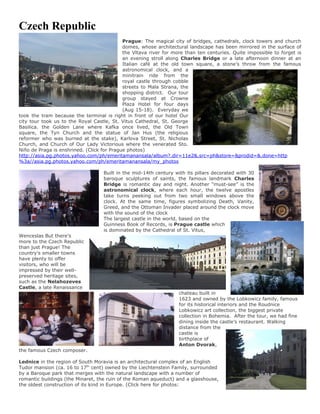
                                            Prague: The magical city of bridges, cathedrals, clock towers and church
                                            domes, whose architectural landscape has been mirrored in the surface of
                                            the Vltava river for more than ten centuries. Quite impossible to forget is
                                            an evening stroll along Charles Bridge or a late afternoon dinner at an
                                            Italian café at the old town square, a stone’s throw from the famous
                                            astronomical clock, and a
                                            minitrain ride from the
                                            royal castle through cobble
                                            streets to Mala Strana, the
                                            shopping district. Our tour
                                            group stayed at Crowne
                                            Plaza Hotel for four days
                                            (Aug 15-18). Everyday we
took the tram because the terminal is right in front of our hotel Our
city tour took us to the Royal Castle, St. Vitus Cathedral, St. George
Basilica. the Golden Lane where Kafka once lived, the Old Town
square, the Tyn Church and the statue of Jan Hus (the religious
reformer who was burned at the stake), Karlova Street, St. Nicholas
Church, and Church of Our Lady Victorious where the venerated Sto.
Niño de Praga is enshrined. (Click for Prague photos)
http://asia.pg.photos.yahoo.com/ph/emeritamanansala/album?.dir=11e2&.src=ph&store=&prodid=&.done=http
%3a//asia.pg.photos.yahoo.com/ph/emeritamanansala/my_photos

                                   Built in the mid-14th century with its pillars decorated with 30
                                   baroque sculptures of saints, the famous landmark Charles
                                   Bridge is romantic day and night. Another “must-see” is the
                                   astronomical clock, where each hour, the twelve apostles
                                   take turns peeking out from two small windows above the
                                   clock. At the same time, figures symbolizing Death, Vanity,
                                   Greed, and the Ottoman Invader placed around the clock move
                                   with the sound of the clock
                                   The largest castle in the world, based on the
                                   Guinness Book of Records, is Prague castle which
                                   is dominated by the Cathedral of St. Vitus,
Wenceslas But there’s
more to the Czech Republic
than just Prague! The
country’s smaller towns
have plenty to offer
visitors, who will be
impressed by their well-
preserved heritage sites,
such as the Nelahozeves
Castle, a late Renaissance
                                                                   chateau built in
                                                                   1623 and owned by the Lobkowicz family, famous
                                                                   for its historical interiors and the Roudnice
                                                                   Lobkowicz art collection, the biggest private
                                                                   collection in Bohemia. After the tour, we had fine
                                                                   dining inside the castle’s restaurant. Walking
                                                                   distance from the
                                                                   castle is
                                                                   birthplace of
                                                                   Anton Dvorak,
the famous Czech composer.

Lednice in the region of South Moravia is an architectural complex of an English
Tudor mansion (ca. 16 to 17th cent) owned by the Liechtenstein Family, surrounded
by a Baroque park that merges with the natural landscape with a number of
romantic buildings (the Minaret, the ruin of the Roman aqueduct) and a glasshouse,
the oldest construction of its kind in Europe. (Click here for photos:
http://asia.pg.photos.yahoo.com/ph/emeritamanansala/album?.dir=11e2&.src=ph&store=&prodid=&.done=http
%3a//asia.pg.photos.yahoo.com/ph/emeritamanansala/my_photos

The second largest town is Brno, the traditional capital of Moravia, where
Napoleon Bonaparte once held his headquarters. Here we spent half a day
visiting the Gothic cathedral of Sts. Peter and Paul, and the Capuchin Church of
the Holy Cross and its monastery where there’s a crypt of skulls and bones.
The amber earrings were much cheaper here than in Prague.

                                                    Picturesque Tábor,
                                                    another town where we
                                                    had the best pizza and
                                                    Czech beer, boasts a
                                                    history as fascinating as
                                                    any town in Prague because its history is linked with the Hussite
                                                    movement. This is the town square, our meeting point.


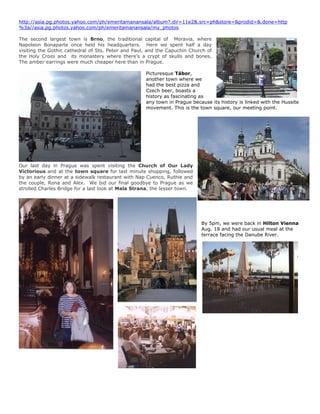
Our last day in Prague was spent visiting the Church of Our Lady
Victorious and at the town square for last minute shopping, followed
by an early dinner at a sidewalk restaurant with Nap Cuenco, Ruthie and
the couple, Rona and Alex. We bid our final goodbye to Prague as we
strolled Charles Bridge for a last look at Mala Strana, the lesser town.


                                                                           By 5pm, we were back in Hilton Vienna
                                                                           Aug. 18 and had our usual meal at the
                                                                           terrace facing the Danube River.

Prague

  • 1.
    Czech Republic Prague: The magical city of bridges, cathedrals, clock towers and church domes, whose architectural landscape has been mirrored in the surface of the Vltava river for more than ten centuries. Quite impossible to forget is an evening stroll along Charles Bridge or a late afternoon dinner at an Italian café at the old town square, a stone’s throw from the famous astronomical clock, and a minitrain ride from the royal castle through cobble streets to Mala Strana, the shopping district. Our tour group stayed at Crowne Plaza Hotel for four days (Aug 15-18). Everyday we took the tram because the terminal is right in front of our hotel Our city tour took us to the Royal Castle, St. Vitus Cathedral, St. George Basilica. the Golden Lane where Kafka once lived, the Old Town square, the Tyn Church and the statue of Jan Hus (the religious reformer who was burned at the stake), Karlova Street, St. Nicholas Church, and Church of Our Lady Victorious where the venerated Sto. Niño de Praga is enshrined. (Click for Prague photos) http://asia.pg.photos.yahoo.com/ph/emeritamanansala/album?.dir=11e2&.src=ph&store=&prodid=&.done=http %3a//asia.pg.photos.yahoo.com/ph/emeritamanansala/my_photos Built in the mid-14th century with its pillars decorated with 30 baroque sculptures of saints, the famous landmark Charles Bridge is romantic day and night. Another “must-see” is the astronomical clock, where each hour, the twelve apostles take turns peeking out from two small windows above the clock. At the same time, figures symbolizing Death, Vanity, Greed, and the Ottoman Invader placed around the clock move with the sound of the clock The largest castle in the world, based on the Guinness Book of Records, is Prague castle which is dominated by the Cathedral of St. Vitus, Wenceslas But there’s more to the Czech Republic than just Prague! The country’s smaller towns have plenty to offer visitors, who will be impressed by their well- preserved heritage sites, such as the Nelahozeves Castle, a late Renaissance chateau built in 1623 and owned by the Lobkowicz family, famous for its historical interiors and the Roudnice Lobkowicz art collection, the biggest private collection in Bohemia. After the tour, we had fine dining inside the castle’s restaurant. Walking distance from the castle is birthplace of Anton Dvorak, the famous Czech composer. Lednice in the region of South Moravia is an architectural complex of an English Tudor mansion (ca. 16 to 17th cent) owned by the Liechtenstein Family, surrounded by a Baroque park that merges with the natural landscape with a number of romantic buildings (the Minaret, the ruin of the Roman aqueduct) and a glasshouse, the oldest construction of its kind in Europe. (Click here for photos:
  • 2.
    http://asia.pg.photos.yahoo.com/ph/emeritamanansala/album?.dir=11e2&.src=ph&store=&prodid=&.done=http %3a//asia.pg.photos.yahoo.com/ph/emeritamanansala/my_photos The second largesttown is Brno, the traditional capital of Moravia, where Napoleon Bonaparte once held his headquarters. Here we spent half a day visiting the Gothic cathedral of Sts. Peter and Paul, and the Capuchin Church of the Holy Cross and its monastery where there’s a crypt of skulls and bones. The amber earrings were much cheaper here than in Prague. Picturesque Tábor, another town where we had the best pizza and Czech beer, boasts a history as fascinating as any town in Prague because its history is linked with the Hussite movement. This is the town square, our meeting point. Our last day in Prague was spent visiting the Church of Our Lady Victorious and at the town square for last minute shopping, followed by an early dinner at a sidewalk restaurant with Nap Cuenco, Ruthie and the couple, Rona and Alex. We bid our final goodbye to Prague as we strolled Charles Bridge for a last look at Mala Strana, the lesser town. By 5pm, we were back in Hilton Vienna Aug. 18 and had our usual meal at the terrace facing the Danube River.