Excellent & Practical Tips for 
  Excellent & Practical Tips for
 Acquiring Information Objects 
and Maximizing Public & Private 
          Partnerships

   Lourdes David, Director, Rizal Library, 
  Ateneo de Manila University, August 19, 
                  2010
Scope of the paper
• As per description provided by the organizers for this 
  parallel session, this paper will focus on: 
   – Relating success stories about public‐private partnerships 
     in the acquisition and digitization of information. 
   – Enabling participants to understand realize and embark on
     Enabling participants to understand, realize and embark on 
     acquisition’s work that  brings in and uses public and 
     private players (PPPs). 
   – Enabling participants to draw conclusions as to how each 
     institution would  benefit from public‐private partnerships. 
   – Guiding participants in reflecting on probable partnership
     Guiding participants in reflecting on probable  partnership 
     guidelines, technology issues, and project specifics
Definition: Data
              Definition: Data
• “Data is a set of discrete objective facts about
   Data is a set of discrete, objective facts about 
  events…there is no inherent meaning in data.” 
  (Davenport Thomas and Prusak Laurence Working
   Davenport, Thomas and Prusak, Laurence. Working 
  Knowledge: How Organizations Manage What They 
  Know. (Harvard Business School Press, 2000), pp.2‐
        (                             ,     ), pp
  3).
Definition: Information
• “…[Information] is the strange, compressible 
  stuff that flows out of a tangible object, be it 
  …a book or a piano, and, after a complex 
  series of transformations involving the senses, 
  lodges in the conscious brain…Knowledge of 
  the world is information…”(Von Baeyer, Hans 
  Christian. Information: The New Language of 
  Science (Phoenix, 2003). pp.15, 17, and 229) 
Definition: Information Objects
  Definition: Information Objects
• An information object is an entity that
  An information object is an entity that 
  contains the content of a message and has the 
  required structure and context to allow that 
  required structure and context to allow that
  message to be decoded and 
  understood.(http://archivemati.ca/2007/01/2
  understood (http://archivemati ca/2007/01/2
  9/what‐is‐information‐anyway/)
Definition: Information Object
   Definition: Information Object
• An information object is an entity that
  An information object is an entity that 
  contains the content of a message and has the 
  required structure and context to allow that 
  required structure and context to allow that
  message to be decoded and understood. 
  (http://archivemati.ca/2007/01/29/what is
  (http://archivemati ca/2007/01/29/what‐is‐
  information‐anyway/) 
Definition: Message
          Definition: Message
• A usually short communication transmitted by
  A usually short communication transmitted by 
  words, signals, or other means from one 
  person, station, or group to another. 
  person station or group to another
  (http://www.thefreedictionary.com/message) 
Example of an Information Object
   Example of an Information Object
• Two or more pieces of digital content such as
  Two or more pieces of digital content, such as 
  web page (s), activities, simulations, 
  animations, or tutorials that illustrate a 
  animations or tutorials that illustrate a
  principle, explain a concept, or describe a 
  process or procedure. Information objects can 
  process or procedure Information objects can
  be combined to form a learning object. ...
  www.oncoreblueprint.org/Blueprint/Glossary.
  www oncoreblueprint org/Blueprint/Glossary
  htm
Example of an Information Object
   Example of an Information Object
• An abstraction of a real information entity (eg
  An abstraction of a real information entity (eg, 
  CT Image, Structured Report, etc.) which is 
  acted upon by one or more DICOM 
  acted upon by one or more DICOM
  Commands.
  www.dabsoft.ch/dicom/1/3/
  www dabsoft ch/dicom/1/3/
Definition: Partnership
        Definition: Partnership
• a cooperative relationship between people or
  a cooperative relationship between people or 
  groups who agree to share responsibility for 
  achieving some specific goal
  achieving some specific goal
• Source: 
  http://www.google.com.ph/search?hl=en&q=
  http://www google com ph/search?hl=en&q=
  define%3Apartnership&btnG=Search&meta=  
Definition: Consortium
• Consortium derives from the Latin word 
  consors, meaning ‘partner.’ 
• Consortium refers to a partnership or an
  Consortium refers to a partnership or an 
  association of two or more entities 
  (individuals, companies, organizations, 
  (individuals, companies, organizations,
  societies, agencies or governments) with the 
  objective of participating in a common activity 
  objective of participating in a common activity
  for a common goal.
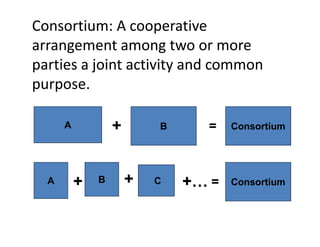
Consortium: A cooperative 
arrangement among two or more 
arrangement among two or more
parties a joint activity and common 
purpose. 

      A           +       B     =    Consortium


  A       +   B       +   C   +… =   Consortium
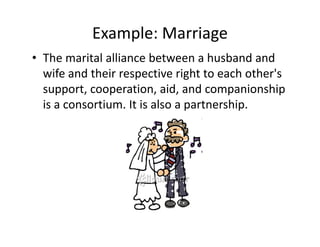
Example: Marriage
• The marital alliance between a husband and 
  wife and their respective right to each other s 
  wife and their respective right to each other's
  support, cooperation, aid, and companionship 
  is a consortium. It is also a partnership.
  is a consortium. It is also a partnership.
Examples of Consortia
          Examples of Consortia
• Banks: Bancnet, Megalink, Expressnet
                   ,    g    , p
• Universities and Colleges: Mendiola Consortium, 
  Davao Colleges and Universities Network (DACUN)
• Associations: Philippine Association of Academic and 
  Research Librarians PAAR, Academic Libraries Book 
  Acquisitions System Association (ALBASA)
  Acquisitions System Association (ALBASA)
• Libraries: Public Library Consortium, Aurora 
  Boulevard Consortium 
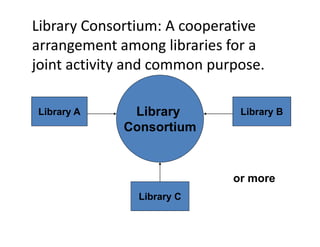
Library Consortium: A cooperative 
arrangement among libraries for a 
arrangement among libraries for a
joint activity and common purpose. 

Library A     Library
              Lib             Library B
             Consortium


                             or more
               Library C
                     y
Characteristics
• Agreement to cooperate
  Agreement to cooperate
• Common Purpose
• Mutually Beneficial
       ll      fi i l
  – Shared Resources (Collection, facilities, staff 
    expertise))
  – Reciprocal Services (Interlibrary Loan, Document 
    delivery, reference, onsite use)
    d li        f           it     )
  – Cooperative acquisition
  – Cooperative cataloguing
                      l
Paradigm Shift: Trends in E‐Publishing 
             and Access
                 d
• Rapid growth of e‐journals and e‐books
  Rapid growth of e journals and e books  
• Increasing acceptance of electronic 
  information resources
• Increasing availability of full‐text titles and
  Increasing availability of full text titles and 
  links to full text articles from databases
• Increasing acceptability of access instead of 
  ownership
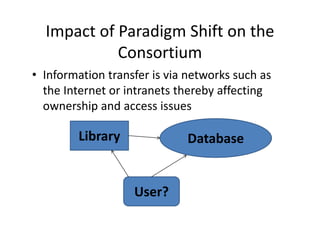
Impact of Paradigm Shift on the 
            Consortium
• Information transfer is via networks such as
  Information transfer is via networks such as 
  the Internet or intranets thereby affecting 
  ownership and access issues
  ownership and access issues

         Library              Database


                   User?
Consortium Models
          Consortium Models
• Only e‐resources will be shared
  Only e resources will be shared
• All resources will be shared
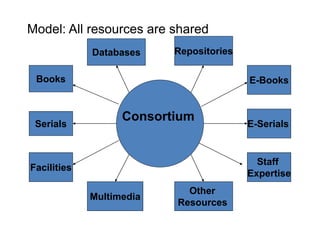
Model: All resources are shared
             Databases    Repositories

 Books
 B k                                     E-Books
                                         EB k


                   Consortium
 Serials                                 E-Serials


                                           Staff
Facilities
                                         Expertise
                                         E     ti
                            Other
             Multimedia
                          Resources
Major issues with e Resources
    Major issues with e‐Resources
• Licensing agreements‐‐Issue—who may access the 
  information, how many may access the information
  information how many may access the information
• Copyright‐‐transfer of knowledge to others, how 
  much information may be downloaded
  much information may be downloaded
• Authentication and authorization—IP address access, 
  allows remote access using User ID and Password
   ll
• Pricing models—Varies from institution to institution
Major issues with e Resources
    Major issues with e‐Resources
• Archival access—Perpetual access to archive that has 
  been paid for but access to archives may be limited 
  been paid for but access to archives may be limited
  to one PC
• Budget issues Costly More for less in total but the
  Budget issues—Costly—More for less in total but the 
  initial and annual prices are too high for the small 
  library 
• Measurement/statistics of use
• Small bandwidth leading to slow access
  Small bandwidth leading to slow access
• Withdrawal from the consortium
Consortium Pricing
           Consortium Pricing
• 1 Lump sum license fee—shared access and
  1 Lump sum license fee shared access and 
  shared cost
• Individually priced with options for difference
  Individually priced with options for difference 
  datasets and licensing—each billed 
  individually and licensed individually. 
  individually and licensed individually
• Per institution price at various levels of 
  commitment
         i
Consortium Benefits
• Information Resource Sharing allows smaller 
  institutions to have access to resources they 
  otherwise cannot afford through 
  – interlibrary loan, 
  – document delivery, 
  – reciprocal onsite use
• Cooperative acquisitions could lead to a larger 
                               ld l d      l
  common collection
• Cooperative cataloguing could save on 
                  l           ld
  cataloguing time and could lead to a union 
  catalog 
  catalog
Benefits to the Consortium
     Benefits to the Consortium
• Shared cost—win win situation
• All
  Allows smaller institutions to have direct 
              ll i i i           h    di
  access to resources they otherwise cannot 
  afford 
  afford
• More information could be purchased as a 
  consortium due to less cost for each member
  consortium due to less cost for each member
• Consortium can leverage negotiation power 
  with service providers  
                p
• Consortium can extend mutual support in  
  areas related to e‐resources
Contents of Agreement
        Contents of Agreement
• Mission Vision Goal Objectives Purpose
  Mission, Vision, Goal, Objectives, Purpose
• Terms of Agreement 
  –P i i
    Pricing model
               d l
  – Sharing of resources
  – Withdrawal policies
  – Terms of membership
  – Other
• Responsible authority
Conclusion
• The Library consortium provides a cooperative 
  response to changes in the way information is 
                h        i h        i f       i i
  published and conveyed. 
• Partnership in acquiring information objects 
  will prove beneficial to all partners in terms of 
  extent of access to information and costs 
  involved 

Excellent & Practical Tips for Acquiring Information Objects and Maximizing Public & Private Partnerships

  • 1.
    Excellent & Practical Tips for  Excellent& Practical Tips for Acquiring Information Objects  and Maximizing Public & Private  Partnerships Lourdes David, Director, Rizal Library,  Ateneo de Manila University, August 19,  2010
  • 2.
    Scope of the paper • As per description provided by the organizers for this  parallel session, this paper will focus on:  – Relating success stories about public‐private partnerships  in the acquisition and digitization of information.  – Enabling participants to understand realize and embark on Enabling participants to understand, realize and embark on  acquisition’s work that  brings in and uses public and  private players (PPPs).  – Enabling participants to draw conclusions as to how each  institution would  benefit from public‐private partnerships.  – Guiding participants in reflecting on probable partnership Guiding participants in reflecting on probable  partnership  guidelines, technology issues, and project specifics
  • 3.
    Definition: Data Definition: Data • “Data is a set of discrete objective facts about Data is a set of discrete, objective facts about  events…there is no inherent meaning in data.”  (Davenport Thomas and Prusak Laurence Working Davenport, Thomas and Prusak, Laurence. Working  Knowledge: How Organizations Manage What They  Know. (Harvard Business School Press, 2000), pp.2‐ ( , ), pp 3).
  • 4.
    Definition: Information • “…[Information] is the strange, compressible  stuff that flows out of a tangible object, be it  …a book or a piano, and, after a complex  series of transformations involving the senses,  lodges in the conscious brain…Knowledge of  the world is information…”(Von Baeyer, Hans  Christian. Information: The New Language of  Science (Phoenix, 2003). pp.15, 17, and 229) 
  • 5.
    Definition: Information Objects Definition:Information Objects • An information object is an entity that An information object is an entity that  contains the content of a message and has the  required structure and context to allow that  required structure and context to allow that message to be decoded and  understood.(http://archivemati.ca/2007/01/2 understood (http://archivemati ca/2007/01/2 9/what‐is‐information‐anyway/)
  • 6.
    Definition: Information Object Definition: Information Object • An information object is an entity that An information object is an entity that  contains the content of a message and has the  required structure and context to allow that  required structure and context to allow that message to be decoded and understood.  (http://archivemati.ca/2007/01/29/what is (http://archivemati ca/2007/01/29/what‐is‐ information‐anyway/) 
  • 7.
    Definition: Message Definition: Message • A usually short communication transmitted by A usually short communication transmitted by  words, signals, or other means from one  person, station, or group to another.  person station or group to another (http://www.thefreedictionary.com/message) 
  • 8.
    Example of an Information Object Example of an Information Object • Two or more pieces of digital content such as Two or more pieces of digital content, such as  web page (s), activities, simulations,  animations, or tutorials that illustrate a  animations or tutorials that illustrate a principle, explain a concept, or describe a  process or procedure. Information objects can  process or procedure Information objects can be combined to form a learning object. ... www.oncoreblueprint.org/Blueprint/Glossary. www oncoreblueprint org/Blueprint/Glossary htm
  • 9.
    Example of an Information Object Example of an Information Object • An abstraction of a real information entity (eg An abstraction of a real information entity (eg,  CT Image, Structured Report, etc.) which is  acted upon by one or more DICOM  acted upon by one or more DICOM Commands. www.dabsoft.ch/dicom/1/3/ www dabsoft ch/dicom/1/3/
  • 10.
    Definition: Partnership Definition: Partnership • a cooperative relationship between people or a cooperative relationship between people or  groups who agree to share responsibility for  achieving some specific goal achieving some specific goal • Source:  http://www.google.com.ph/search?hl=en&q= http://www google com ph/search?hl=en&q= define%3Apartnership&btnG=Search&meta=  
  • 11.
    Definition: Consortium • Consortium derives from the Latin word  consors, meaning ‘partner.’  • Consortium refers to a partnership or an Consortium refers to a partnership or an  association of two or more entities  (individuals, companies, organizations,  (individuals, companies, organizations, societies, agencies or governments) with the  objective of participating in a common activity  objective of participating in a common activity for a common goal.
  • 12.
    Consortium: A cooperative  arrangement among two or more  arrangement among twoor more parties a joint activity and common  purpose.  A + B = Consortium A + B + C +… = Consortium
  • 13.
    Example: Marriage • The marital alliance between a husband and  wife and their respective right to each other s  wife and their respective right to each other's support, cooperation, aid, and companionship  is a consortium. It is also a partnership. is a consortium. It is also a partnership.
  • 14.
    Examples of Consortia Examples of Consortia • Banks: Bancnet, Megalink, Expressnet , g , p • Universities and Colleges: Mendiola Consortium,  Davao Colleges and Universities Network (DACUN) • Associations: Philippine Association of Academic and  Research Librarians PAAR, Academic Libraries Book  Acquisitions System Association (ALBASA) Acquisitions System Association (ALBASA) • Libraries: Public Library Consortium, Aurora  Boulevard Consortium 
  • 15.
    Library Consortium: A cooperative  arrangement among libraries for a  arrangement among librariesfor a joint activity and common purpose.  Library A Library Lib Library B Consortium or more Library C y
  • 16.
    Characteristics • Agreement tocooperate Agreement to cooperate • Common Purpose • Mutually Beneficial ll fi i l – Shared Resources (Collection, facilities, staff  expertise)) – Reciprocal Services (Interlibrary Loan, Document  delivery, reference, onsite use) d li f it ) – Cooperative acquisition – Cooperative cataloguing l
  • 17.
    Paradigm Shift: Trends in E‐Publishing  and Access d • Rapid growth of e‐journals and e‐books Rapid growth of e journals and e books   • Increasing acceptance of electronic  information resources • Increasing availability of full‐text titles and Increasing availability of full text titles and  links to full text articles from databases • Increasing acceptability of access instead of  ownership
  • 18.
    Impact of Paradigm Shift on the  Consortium • Information transfer is via networks such as Information transfer is via networks such as  the Internet or intranets thereby affecting  ownership and access issues ownership and access issues Library Database User?
  • 19.
    Consortium Models Consortium Models • Only e‐resources will be shared Only e resources will be shared • All resources will be shared
  • 20.
    Model: All resourcesare shared Databases Repositories Books B k E-Books EB k Consortium Serials E-Serials Staff Facilities Expertise E ti Other Multimedia Resources
  • 21.
    Major issues with e Resources Major issues with e‐Resources • Licensing agreements‐‐Issue—who may access the  information, how many may access the information information how many may access the information • Copyright‐‐transfer of knowledge to others, how  much information may be downloaded much information may be downloaded • Authentication and authorization—IP address access,  allows remote access using User ID and Password ll • Pricing models—Varies from institution to institution
  • 22.
    Major issues with e Resources Major issues with e‐Resources • Archival access—Perpetual access to archive that has  been paid for but access to archives may be limited  been paid for but access to archives may be limited to one PC • Budget issues Costly More for less in total but the Budget issues—Costly—More for less in total but the  initial and annual prices are too high for the small  library  • Measurement/statistics of use • Small bandwidth leading to slow access Small bandwidth leading to slow access • Withdrawal from the consortium
  • 23.
    Consortium Pricing Consortium Pricing • 1 Lump sum license fee—shared access and 1 Lump sum license fee shared access and  shared cost • Individually priced with options for difference Individually priced with options for difference  datasets and licensing—each billed  individually and licensed individually.  individually and licensed individually • Per institution price at various levels of  commitment i
  • 24.
    Consortium Benefits • Information Resource Sharing allows smaller  institutions to have access to resources they  otherwise cannot afford through  – interlibrary loan,  – document delivery,  – reciprocal onsite use • Cooperative acquisitions could lead to a larger  ld l d l common collection • Cooperative cataloguing could save on  l ld cataloguing time and could lead to a union  catalog  catalog
  • 25.
    Benefits to the Consortium Benefits to the Consortium • Shared cost—win win situation • All Allows smaller institutions to have direct  ll i i i h di access to resources they otherwise cannot  afford  afford • More information could be purchased as a  consortium due to less cost for each member consortium due to less cost for each member • Consortium can leverage negotiation power  with service providers   p • Consortium can extend mutual support in   areas related to e‐resources
  • 26.
    Contents of Agreement Contents of Agreement • Mission Vision Goal Objectives Purpose Mission, Vision, Goal, Objectives, Purpose • Terms of Agreement  –P i i Pricing model d l – Sharing of resources – Withdrawal policies – Terms of membership – Other • Responsible authority
  • 27.
    Conclusion • The Library consortium provides a cooperative  response to changes in the way information is  h i h i f i i published and conveyed.  • Partnership in acquiring information objects  will prove beneficial to all partners in terms of  extent of access to information and costs  involved