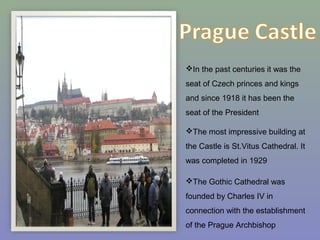
In the past centuries it was the
seat of Czech princes and kings
and since 1918 it has been the
seat of the President
The most impressive building at
the Castle is St.Vitus Cathedral. It
was completed in 1929
The Gothic Cathedral was
founded by Charles IV in
connection with the establishment
of the Prague Archbishop
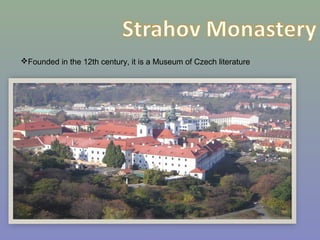
Founded in the 12th century, it is a Museum of Czech literature
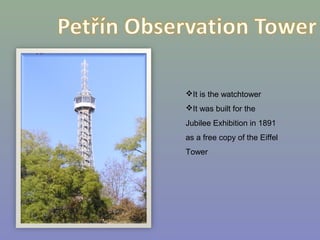
It is the watchtower
It was built for the
Jubilee Exhibition in 1891
as a free copy of the Eiffel
Tower
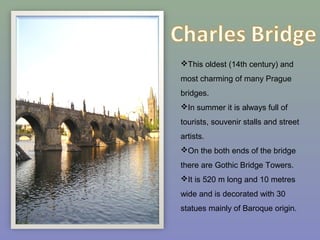
This oldest (14th century) and
most charming of many Prague
bridges.
In summer it is always full of
tourists, souvenir stalls and street
artists.
On the both ends of the bridge
there are Gothic Bridge Towers.
It is 520 m long and 10 metres
wide and is decorated with 30
statues mainly of Baroque origin.
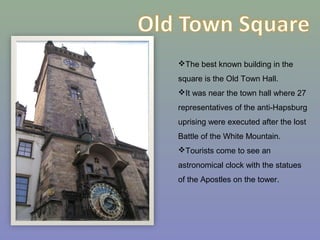
The best known building in the
square is the Old Town Hall.
It was near the town hall where 27
representatives of the anti-Hapsburg
uprising were executed after the lost
Battle of the White Mountain.
Tourists come to see an
astronomical clock with the statues
of the Apostles on the tower.
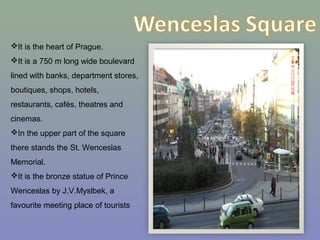
It is the heart of Prague.
It is a 750 m long wide boulevard
lined with banks, department stores,
boutiques, shops, hotels,
restaurants, cafés, theatres and
cinemas.
In the upper part of the square
there stands the St. Wenceslas
Memorial.
It is the bronze statue of Prince
Wenceslas by J.V.Myslbek, a
favourite meeting place of tourists
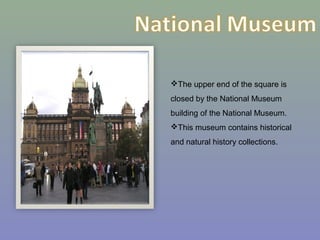
The upper end of the square is
closed by the National Museum
building of the National Museum.
This museum contains historical
and natural history collections.
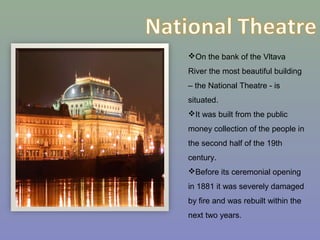
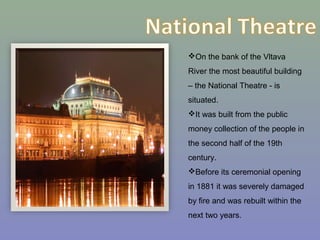
On the bank of the Vltava
River the most beautiful building
– the National Theatre - is
situated.
It was built from the public
money collection of the people in
the second half of the 19th
century.
Before its ceremonial opening
in 1881 it was severely damaged
by fire and was rebuilt within the
next two years.
On the bank of the Vltava
River the most beautiful building
– the National Theatre - is
situated.
It was built from the public
money collection of the people in
the second half of the 19th
century.
Before its ceremonial opening
in 1881 it was severely damaged
by fire and was rebuilt within the
next two years.

Prague

  • 2.
    In the pastcenturies it was the seat of Czech princes and kings and since 1918 it has been the seat of the President The most impressive building at the Castle is St.Vitus Cathedral. It was completed in 1929 The Gothic Cathedral was founded by Charles IV in connection with the establishment of the Prague Archbishop
  • 3.
    Founded in the12th century, it is a Museum of Czech literature
  • 4.
    It is thewatchtower It was built for the Jubilee Exhibition in 1891 as a free copy of the Eiffel Tower
  • 5.
    This oldest (14thcentury) and most charming of many Prague bridges. In summer it is always full of tourists, souvenir stalls and street artists. On the both ends of the bridge there are Gothic Bridge Towers. It is 520 m long and 10 metres wide and is decorated with 30 statues mainly of Baroque origin.
  • 6.
    The best knownbuilding in the square is the Old Town Hall. It was near the town hall where 27 representatives of the anti-Hapsburg uprising were executed after the lost Battle of the White Mountain. Tourists come to see an astronomical clock with the statues of the Apostles on the tower.
  • 7.
    It is theheart of Prague. It is a 750 m long wide boulevard lined with banks, department stores, boutiques, shops, hotels, restaurants, cafés, theatres and cinemas. In the upper part of the square there stands the St. Wenceslas Memorial. It is the bronze statue of Prince Wenceslas by J.V.Myslbek, a favourite meeting place of tourists
  • 8.
    The upper endof the square is closed by the National Museum building of the National Museum. This museum contains historical and natural history collections.
  • 9.
    On the bankof the Vltava River the most beautiful building – the National Theatre - is situated. It was built from the public money collection of the people in the second half of the 19th century. Before its ceremonial opening in 1881 it was severely damaged by fire and was rebuilt within the next two years.
  • 10.
    On the bankof the Vltava River the most beautiful building – the National Theatre - is situated. It was built from the public money collection of the people in the second half of the 19th century. Before its ceremonial opening in 1881 it was severely damaged by fire and was rebuilt within the next two years.