Topic: GENERAL AND EDUCATIONAL
PHILOSOPICAL THOUGHT
.
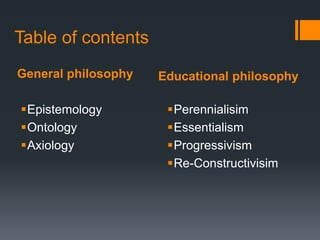
General philosophy Educational philosophy
Table of contents
Epistemology
Ontology
Axiology
Perennialisim
Essentialism
Progressivism
Re-Constructivisim
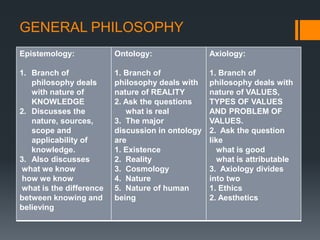
GENERAL PHILOSOPHY.
Epistemology:
1. Branch of
philosophy deals
with nature of
KNOWLEDGE
2. Discusses the
nature, sources,
scope and
applicability of
knowledge.
3. Also discusses
what we know
how we know
what is the difference
between knowing and
believing
Ontology:
1. Branch of
philosophy deals with
nature of REALITY
2. Ask the questions
what is real
3. The major
discussion in ontology
are
1. Existence
2. Reality
3. Cosmology
4. Nature
5. Nature of human
being
Axiology:
1. Branch of
philosophy deals with
nature of VALUES,
TYPES OF VALUES
AND PROBLEM OF
VALUES.
2. Ask the question
like
what is good
what is attributable
3. Axiology divides
into two
1. Ethics
2. Aesthetics
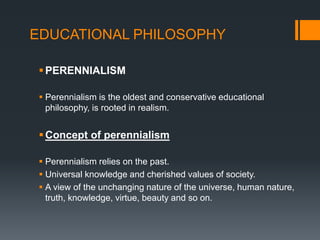
EDUCATIONAL PHILOSOPHY
PERENNIALISM
 Perennialism is the oldest and conservative educational
philosophy, is rooted in realism.
Concept of perennialism
 Perennialism relies on the past.
 Universal knowledge and cherished values of society.
 A view of the unchanging nature of the universe, human nature,
truth, knowledge, virtue, beauty and so on.
.
Perennialism and education
 As Robert Hutchins, a long time advocate of perennialism
noted: “The function of man as man is the same in every
society.”
 The aim of the educational system is the same in every age and
in every society where such system can exist, it is to improve
man.
Perennialism and curriculum
 It draws heavily on defined disciplines or logically organized
bodies of content- what proponents call ,liberal education, with
emphasis on language, literature, mathematics, arts, and
science.
.
Perennialism and teacher
 An authority in the filed whose knowledge is unquestionable.
 A master of the subject and discipline and must be able to
guide discussion
 Method of teaching
 Socratic method: oral exposition, lecture and explication.
,
 Essentialism
 This philosophy is rooted in both idealism and realism and
surfaced in the 1930s as a reaction to progressivism.
Concept of essentialism
 According to essentialism, the school curriculum should be
geared to the fundamentals or essentials.
 Essentialism today is reflected in the public demand to raise
academic standards and to improve the students work and
minds.
,
Essentialism and discipline
 The philosophy believes in tough discipline and training and
a good deal of home work and serious studies permeate the
curriculum.
 Essentialism and curriculum
 Essentialism rejects subject such as art, music, physical
education, home making and vocational education as fades
and frills and thus appeal to those who favor limiting
education expenses.
;
Essentialism and aims of education
 To promote the intellectual growth of the individual.
 To educate the competent person.
Essentialism and teacher
 The teacher is considered as;
 Master of particular subject.
 An authority because of the high standards he or she holds.
 A person who holds control over the classroom with minimal
student input.
,
Progressivism
 Progressivism is developed from pragmatic philosophy and
as a protest against perennialism thinking in education.
Concept of progressivism
 Progressivism is considered a contemporary reform
movement in educational, social and political affairs.
 Dewey viewed the school as a miniature democratic society
in which student could learn and practice the skills and tools
necessary for democratic living.
.
Progressivism and education
 According to the progressivism thought, the skills and tools of
learning include problem solving methods and scientific
inquiry.
 This philosophy places emphasis on how to think and not
what to think.
 Progressive education focused on the child as the learner
rather than verbal and literary skills and encouraged
cooperative group learning activities rather than competitive
individualized lesson learning.
Progressivism and aim of education
 To promote democratic social living .
,
Progressivism and curriculum
 The curriculum is interdisciplinary in nature.
 Curriculum is based on student’s interests, involves the
application of human problems and affairs.
Progressivism and teacher
 The role of teacher:
 Serves as a guide for students in problem solving and
scientific projects.
 Leader of group activities.
 Involves students in planning activities.,
/
Reconstructionism
 The reconstructionist philosophy is based on early socialistic
and utopian ideas of the 19th century.
 It is society-centered philosophy.
 Exponents:
 Theodore Brameld is often considered the originator of
the term reconstructionism in 1950.
Concept of Reconstructionism
 The social issues of the 1930s according to George Counts
involved racial and class discrimination, poverty and
unemployment which are similar to present issues.
 This is a crisis philosophy appropriate for a society in crisis,
which is the essence of our society today
.
Reconstructionism and aims of education
 Strengthen control of the schools by and for goal-seeking
interests of the overwhelming majority of mankind.
Reconstructionism and curriculum
 For reconstructionism analysis, interpretation and evaluation
of problem are insufficient commitment and action by student
and teacher are needed.
Reconstructionism and teacher
 Teacher should measure up to their social responsibilities.
General and educational philosophy thought

General and educational philosophy thought

  • 1.
    Topic: GENERAL ANDEDUCATIONAL PHILOSOPICAL THOUGHT .
  • 2.
    General philosophy Educationalphilosophy Table of contents Epistemology Ontology Axiology Perennialisim Essentialism Progressivism Re-Constructivisim
  • 3.
    GENERAL PHILOSOPHY. Epistemology: 1. Branchof philosophy deals with nature of KNOWLEDGE 2. Discusses the nature, sources, scope and applicability of knowledge. 3. Also discusses what we know how we know what is the difference between knowing and believing Ontology: 1. Branch of philosophy deals with nature of REALITY 2. Ask the questions what is real 3. The major discussion in ontology are 1. Existence 2. Reality 3. Cosmology 4. Nature 5. Nature of human being Axiology: 1. Branch of philosophy deals with nature of VALUES, TYPES OF VALUES AND PROBLEM OF VALUES. 2. Ask the question like what is good what is attributable 3. Axiology divides into two 1. Ethics 2. Aesthetics
  • 4.
    EDUCATIONAL PHILOSOPHY PERENNIALISM  Perennialismis the oldest and conservative educational philosophy, is rooted in realism. Concept of perennialism  Perennialism relies on the past.  Universal knowledge and cherished values of society.  A view of the unchanging nature of the universe, human nature, truth, knowledge, virtue, beauty and so on.
  • 5.
    . Perennialism and education As Robert Hutchins, a long time advocate of perennialism noted: “The function of man as man is the same in every society.”  The aim of the educational system is the same in every age and in every society where such system can exist, it is to improve man. Perennialism and curriculum  It draws heavily on defined disciplines or logically organized bodies of content- what proponents call ,liberal education, with emphasis on language, literature, mathematics, arts, and science.
  • 6.
    . Perennialism and teacher An authority in the filed whose knowledge is unquestionable.  A master of the subject and discipline and must be able to guide discussion  Method of teaching  Socratic method: oral exposition, lecture and explication.
  • 7.
    ,  Essentialism  Thisphilosophy is rooted in both idealism and realism and surfaced in the 1930s as a reaction to progressivism. Concept of essentialism  According to essentialism, the school curriculum should be geared to the fundamentals or essentials.  Essentialism today is reflected in the public demand to raise academic standards and to improve the students work and minds.
  • 8.
    , Essentialism and discipline The philosophy believes in tough discipline and training and a good deal of home work and serious studies permeate the curriculum.  Essentialism and curriculum  Essentialism rejects subject such as art, music, physical education, home making and vocational education as fades and frills and thus appeal to those who favor limiting education expenses.
  • 9.
    ; Essentialism and aimsof education  To promote the intellectual growth of the individual.  To educate the competent person. Essentialism and teacher  The teacher is considered as;  Master of particular subject.  An authority because of the high standards he or she holds.  A person who holds control over the classroom with minimal student input.
  • 10.
    , Progressivism  Progressivism isdeveloped from pragmatic philosophy and as a protest against perennialism thinking in education. Concept of progressivism  Progressivism is considered a contemporary reform movement in educational, social and political affairs.  Dewey viewed the school as a miniature democratic society in which student could learn and practice the skills and tools necessary for democratic living.
  • 11.
    . Progressivism and education According to the progressivism thought, the skills and tools of learning include problem solving methods and scientific inquiry.  This philosophy places emphasis on how to think and not what to think.  Progressive education focused on the child as the learner rather than verbal and literary skills and encouraged cooperative group learning activities rather than competitive individualized lesson learning. Progressivism and aim of education  To promote democratic social living .
  • 12.
    , Progressivism and curriculum The curriculum is interdisciplinary in nature.  Curriculum is based on student’s interests, involves the application of human problems and affairs. Progressivism and teacher  The role of teacher:  Serves as a guide for students in problem solving and scientific projects.  Leader of group activities.  Involves students in planning activities.,
  • 13.
    / Reconstructionism  The reconstructionistphilosophy is based on early socialistic and utopian ideas of the 19th century.  It is society-centered philosophy.  Exponents:  Theodore Brameld is often considered the originator of the term reconstructionism in 1950. Concept of Reconstructionism  The social issues of the 1930s according to George Counts involved racial and class discrimination, poverty and unemployment which are similar to present issues.  This is a crisis philosophy appropriate for a society in crisis, which is the essence of our society today
  • 14.
    . Reconstructionism and aimsof education  Strengthen control of the schools by and for goal-seeking interests of the overwhelming majority of mankind. Reconstructionism and curriculum  For reconstructionism analysis, interpretation and evaluation of problem are insufficient commitment and action by student and teacher are needed. Reconstructionism and teacher  Teacher should measure up to their social responsibilities.