Pragmatic
Microservices
Randy Shoup
@randyshoup
linkedin.com/in/randyshoup
Background
• VP Engineering at Stitch Fix
o Revolutionizing retail
• Consulting “CTO as a service”
o Helping companies scale their organizations and technology
• Director of Engineering for Google App Engine
o World’s largest Platform-as-a-Service
• Chief Engineer at eBay
o Multiple generations of eBay’s infrastructure
“Tell us how you did things at
Google and eBay.”
“Sure, I’ll tell you, but you
have to promise not to do
them! [… yet]”
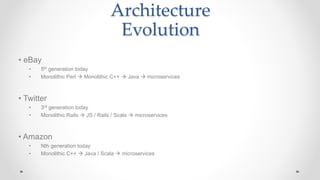
Architecture
Evolution
• eBay
• 5th generation today
• Monolithic Perl  Monolithic C++  Java  microservices
• Twitter
• 3rd generation today
• Monolithic Rails  JS / Rails / Scala  microservices
• Amazon
• Nth generation today
• Monolithic C++  Java / Scala  microservices
Are microservices the right
approach to every problem?
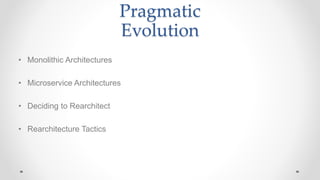
Pragmatic
Evolution
• Monolithic Architectures
• Microservice Architectures
• Deciding to Rearchitect
• Rearchitecture Tactics
Pragmatic
Evolution
• Monolithic Architectures
• Microservice Architectures
• Deciding to Rearchitect
• Rearchitecture Tactics
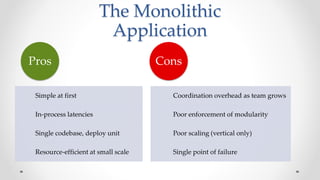
The Monolithic
Application
Simple at first
In-process latencies
Single codebase, deploy unit
Resource-efficient at small scale
Pros
Coordination overhead as team grows
Poor enforcement of modularity
Poor scaling (vertical only)
Single point of failure
Cons
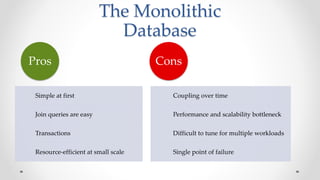
The Monolithic
Database
Simple at first
Join queries are easy
Transactions
Resource-efficient at small scale
Pros
Coupling over time
Performance and scalability bottleneck
Difficult to tune for multiple workloads
Single point of failure
Cons
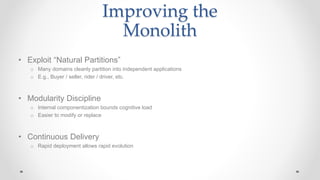
Improving the
Monolith
• Exploit “Natural Partitions”
o Many domains cleanly partition into independent applications
o E.g., Buyer / seller, rider / driver, etc.
• Modularity Discipline
o Internal componentization bounds cognitive load
o Easier to modify or replace
• Continuous Delivery
o Rapid deployment allows rapid evolution
Pragmatic
Evolution
• Monolithic Architectures
• Microservice Architectures
• Deciding to Rearchitect
• Rearchitecture Tactics
Microservices
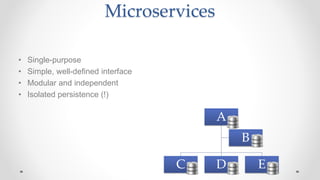
• Single-purpose
• Simple, well-defined interface
• Modular and independent
• Isolated persistence (!)
A
C D E
B
“Microservices are nothing
more than SOA done properly.”
-- me
Microservices
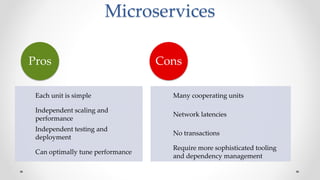
Each unit is simple
Independent scaling and
performance
Independent testing and
deployment
Can optimally tune performance
Pros
Many cooperating units
Network latencies
No transactions
Require more sophisticated tooling
and dependency management
Cons
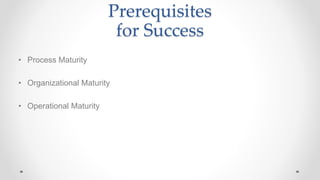
Prerequisites
for Success
• Process Maturity
• Organizational Maturity
• Operational Maturity
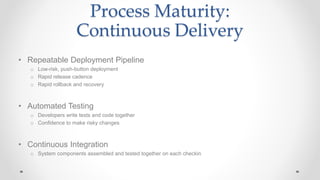
Process Maturity:
Continuous Delivery
• Repeatable Deployment Pipeline
o Low-risk, push-button deployment
o Rapid release cadence
o Rapid rollback and recovery
• Automated Testing
o Developers write tests and code together
o Confidence to make risky changes
• Continuous Integration
o System components assembled and tested together on each checkin
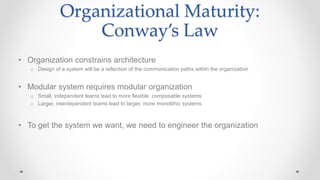
Organizational Maturity:
Conway’s Law
• Organization constrains architecture
o Design of a system will be a reflection of the communication paths within the organization
• Modular system requires modular organization
o Small, independent teams lead to more flexible, composable systems
o Larger, interdependent teams lead to larger, more monolithic systems
• To get the system we want, we need to engineer the organization
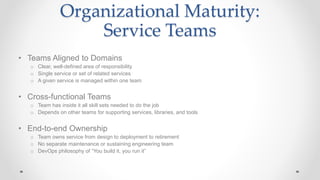
Organizational Maturity:
Service Teams
• Teams Aligned to Domains
o Clear, well-defined area of responsibility
o Single service or set of related services
o A given service is managed within one team
• Cross-functional Teams
o Team has inside it all skill sets needed to do the job
o Depends on other teams for supporting services, libraries, and tools
• End-to-end Ownership
o Team owns service from design to deployment to retirement
o No separate maintenance or sustaining engineering team
o DevOps philosophy of “You build it, you run it”
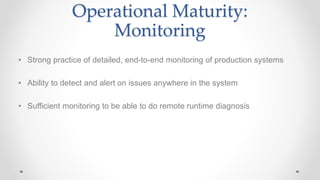
Operational Maturity:
Monitoring
• Strong practice of detailed, end-to-end monitoring of production systems
• Ability to detect and alert on issues anywhere in the system
• Sufficient monitoring to be able to do remote runtime diagnosis
“If you ever have to ssh into a
machine, your monitoring has
failed you.”
-- me
Pragmatic
Evolution
• Monolithic Architectures
• Microservice Architectures
• Deciding to Rearchitect
• Rearchitecture Tactics
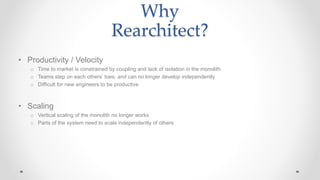
Why
Rearchitect?
• Productivity / Velocity
o Time to market is constrained by coupling and lack of isolation in the monolith
o Teams step on each others’ toes, and can no longer develop independently
o Difficult for new engineers to be productive
• Scaling
o Vertical scaling of the monolith no longer works
o Parts of the system need to scale independently of others
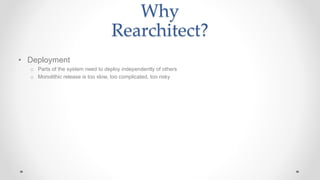
Why
Rearchitect?
• Deployment
o Parts of the system need to deploy independently of others
o Monolithic release is too slow, too complicated, too risky
“Getting to rearchitect a system
is a sign of success, not failure.”
-- me
“If you don’t end up regretting
your early technology decisions,
you probably over-engineered.”
-- me
Pragmatic
Evolution
• Monolithic Architectures
• Microservice Architectures
• Deciding to Rearchitect
• Rearchitecture Tactics
“The only thing a Big Bang
migration guarantees is a big
*Bang*.”
-- Martin Fowler
Incremental
Migration
• Step 0: Pilot Implementation
o Choose initial end-to-end vertical experience to migrate / create
o (+) Opportunity to learn and adjust
o (+) Demonstrate feasibility and gain confidence
o (+) Bound investment and risk
o (+) Provide real customer value
• Initial step is the hardest
o Learning how to do things in the new way
o Building out basic supporting capabilities
Incremental
Migration
• Steps 1-N: Incremental Migration
o Prioritize business value -- highest ROI areas first
o Focus on areas with greatest rate of change
o (+) Maximize near-term payoff from investment
o (+) Confront and solve hard problems sooner rather than later
• New feature development in parallel
o Typically cannot pause all feature work in all areas to migrate 
o Within a particular area, try to separate feature work from migration work in distinct steps
Incremental
Migration
• Residual monolith may remain indefinitely
o Lowest business value
o Most stable and least changing
o Can migrate – or not – opportunistically
Carving up the
Monolith
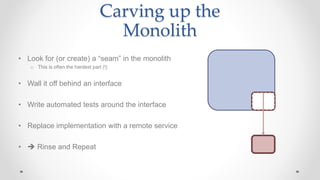
• Look for (or create) a “seam” in the monolith
o This is often the hardest part (!)
• Wall it off behind an interface
• Write automated tests around the interface
• Replace implementation with a remote service
•  Rinse and Repeat
Maintaining
Interface Stability
• Backward / forward compatibility of interfaces
o Can *never* break your clients’ code
o Often multiple interface versions
o Sometimes multiple deployments
• Explicit deprecation policy
o Strong incentive to wean customers off old versions (!)
Service
Anti-Patterns
• The “Mega-Service”
o Overbroad area of responsibility is difficult to reason about, change
o Leads to more upstream / downstream dependencies
• “Leaky Abstraction” Service
o Interface reflects provider’s implementation, not the consumer’s model
o Consumer’s model is typically more aligned with the domain, simpler, more abstract
o Leaking provider’s model in the interface constrains evolution of the implementation
Service
Anti-Patterns
• Shared persistence
o Breaks encapsulation, encourages “backdoor” interface violations
o Unhealthy and near-invisible coupling of services
o (-) Initial eBay SOA efforts
• “Client-less” Service
o Service built without a specific client in mind
o Very difficult to design a minimal, complete interface without a tangible use-case
o Opportunity cost and wasted effort
o Usage is the true metric of the value of a service
Microservices may
not be for you if …
• … you have a simple system
• … you have a small team
• … you are not able to invest in continuous delivery, monitoring, etc.
• … they don’t solve the problems you actually have
Thank You!
• @randyshoup
• linkedin.com/in/randyshoup

Pragmatic Microservices

  • 1.
  • 2.
    Background • VP Engineeringat Stitch Fix o Revolutionizing retail • Consulting “CTO as a service” o Helping companies scale their organizations and technology • Director of Engineering for Google App Engine o World’s largest Platform-as-a-Service • Chief Engineer at eBay o Multiple generations of eBay’s infrastructure
  • 3.
    “Tell us howyou did things at Google and eBay.” “Sure, I’ll tell you, but you have to promise not to do them! [… yet]”
  • 4.
    Architecture Evolution • eBay • 5thgeneration today • Monolithic Perl  Monolithic C++  Java  microservices • Twitter • 3rd generation today • Monolithic Rails  JS / Rails / Scala  microservices • Amazon • Nth generation today • Monolithic C++  Java / Scala  microservices
  • 5.
    Are microservices theright approach to every problem?
  • 6.
    Pragmatic Evolution • Monolithic Architectures •Microservice Architectures • Deciding to Rearchitect • Rearchitecture Tactics
  • 7.
    Pragmatic Evolution • Monolithic Architectures •Microservice Architectures • Deciding to Rearchitect • Rearchitecture Tactics
  • 8.
    The Monolithic Application Simple atfirst In-process latencies Single codebase, deploy unit Resource-efficient at small scale Pros Coordination overhead as team grows Poor enforcement of modularity Poor scaling (vertical only) Single point of failure Cons
  • 9.
    The Monolithic Database Simple atfirst Join queries are easy Transactions Resource-efficient at small scale Pros Coupling over time Performance and scalability bottleneck Difficult to tune for multiple workloads Single point of failure Cons
  • 10.
    Improving the Monolith • Exploit“Natural Partitions” o Many domains cleanly partition into independent applications o E.g., Buyer / seller, rider / driver, etc. • Modularity Discipline o Internal componentization bounds cognitive load o Easier to modify or replace • Continuous Delivery o Rapid deployment allows rapid evolution
  • 11.
    Pragmatic Evolution • Monolithic Architectures •Microservice Architectures • Deciding to Rearchitect • Rearchitecture Tactics
  • 12.
    Microservices • Single-purpose • Simple,well-defined interface • Modular and independent • Isolated persistence (!) A C D E B
  • 13.
    “Microservices are nothing morethan SOA done properly.” -- me
  • 14.
    Microservices Each unit issimple Independent scaling and performance Independent testing and deployment Can optimally tune performance Pros Many cooperating units Network latencies No transactions Require more sophisticated tooling and dependency management Cons
  • 15.
    Prerequisites for Success • ProcessMaturity • Organizational Maturity • Operational Maturity
  • 16.
    Process Maturity: Continuous Delivery •Repeatable Deployment Pipeline o Low-risk, push-button deployment o Rapid release cadence o Rapid rollback and recovery • Automated Testing o Developers write tests and code together o Confidence to make risky changes • Continuous Integration o System components assembled and tested together on each checkin
  • 17.
    Organizational Maturity: Conway’s Law •Organization constrains architecture o Design of a system will be a reflection of the communication paths within the organization • Modular system requires modular organization o Small, independent teams lead to more flexible, composable systems o Larger, interdependent teams lead to larger, more monolithic systems • To get the system we want, we need to engineer the organization
  • 18.
    Organizational Maturity: Service Teams •Teams Aligned to Domains o Clear, well-defined area of responsibility o Single service or set of related services o A given service is managed within one team • Cross-functional Teams o Team has inside it all skill sets needed to do the job o Depends on other teams for supporting services, libraries, and tools • End-to-end Ownership o Team owns service from design to deployment to retirement o No separate maintenance or sustaining engineering team o DevOps philosophy of “You build it, you run it”
  • 19.
    Operational Maturity: Monitoring • Strongpractice of detailed, end-to-end monitoring of production systems • Ability to detect and alert on issues anywhere in the system • Sufficient monitoring to be able to do remote runtime diagnosis
  • 20.
    “If you everhave to ssh into a machine, your monitoring has failed you.” -- me
  • 21.
    Pragmatic Evolution • Monolithic Architectures •Microservice Architectures • Deciding to Rearchitect • Rearchitecture Tactics
  • 22.
    Why Rearchitect? • Productivity /Velocity o Time to market is constrained by coupling and lack of isolation in the monolith o Teams step on each others’ toes, and can no longer develop independently o Difficult for new engineers to be productive • Scaling o Vertical scaling of the monolith no longer works o Parts of the system need to scale independently of others
  • 23.
    Why Rearchitect? • Deployment o Partsof the system need to deploy independently of others o Monolithic release is too slow, too complicated, too risky
  • 24.
    “Getting to rearchitecta system is a sign of success, not failure.” -- me
  • 25.
    “If you don’tend up regretting your early technology decisions, you probably over-engineered.” -- me
  • 26.
    Pragmatic Evolution • Monolithic Architectures •Microservice Architectures • Deciding to Rearchitect • Rearchitecture Tactics
  • 27.
    “The only thinga Big Bang migration guarantees is a big *Bang*.” -- Martin Fowler
  • 28.
    Incremental Migration • Step 0:Pilot Implementation o Choose initial end-to-end vertical experience to migrate / create o (+) Opportunity to learn and adjust o (+) Demonstrate feasibility and gain confidence o (+) Bound investment and risk o (+) Provide real customer value • Initial step is the hardest o Learning how to do things in the new way o Building out basic supporting capabilities
  • 29.
    Incremental Migration • Steps 1-N:Incremental Migration o Prioritize business value -- highest ROI areas first o Focus on areas with greatest rate of change o (+) Maximize near-term payoff from investment o (+) Confront and solve hard problems sooner rather than later • New feature development in parallel o Typically cannot pause all feature work in all areas to migrate  o Within a particular area, try to separate feature work from migration work in distinct steps
  • 30.
    Incremental Migration • Residual monolithmay remain indefinitely o Lowest business value o Most stable and least changing o Can migrate – or not – opportunistically
  • 31.
    Carving up the Monolith •Look for (or create) a “seam” in the monolith o This is often the hardest part (!) • Wall it off behind an interface • Write automated tests around the interface • Replace implementation with a remote service •  Rinse and Repeat
  • 32.
    Maintaining Interface Stability • Backward/ forward compatibility of interfaces o Can *never* break your clients’ code o Often multiple interface versions o Sometimes multiple deployments • Explicit deprecation policy o Strong incentive to wean customers off old versions (!)
  • 33.
    Service Anti-Patterns • The “Mega-Service” oOverbroad area of responsibility is difficult to reason about, change o Leads to more upstream / downstream dependencies • “Leaky Abstraction” Service o Interface reflects provider’s implementation, not the consumer’s model o Consumer’s model is typically more aligned with the domain, simpler, more abstract o Leaking provider’s model in the interface constrains evolution of the implementation
  • 34.
    Service Anti-Patterns • Shared persistence oBreaks encapsulation, encourages “backdoor” interface violations o Unhealthy and near-invisible coupling of services o (-) Initial eBay SOA efforts • “Client-less” Service o Service built without a specific client in mind o Very difficult to design a minimal, complete interface without a tangible use-case o Opportunity cost and wasted effort o Usage is the true metric of the value of a service
  • 35.
    Microservices may not befor you if … • … you have a simple system • … you have a small team • … you are not able to invest in continuous delivery, monitoring, etc. • … they don’t solve the problems you actually have
  • 36.
    Thank You! • @randyshoup •linkedin.com/in/randyshoup