The Importance of Culture
Building and Sustaining Effective Engineering
Organizations
Randy Shoup
@randyshoup
linkedin.com/in/randyshoup
Background
CTO at KIXEYE
• Real-time strategy games for web and mobile
Director of Engineering for Google App Engine
• World’s largest Platform-as-a-Service
Chief Engineer at eBay
• Multiple generations of eBay’s real-time search
infrastructure
Building Blocks of Culture
Hiring and Retention
Ownership and Collaboration
Quality and Discipline
Learning and Experimentation
Building Blocks of Culture
Hiring and Retention
Ownership and Collaboration
Quality and Discipline
Learning and Experimentation
Hire and Retain the Best
Hire „A‟ Players
• In creative disciplines, top performers are 10x
more productive (!)
Confidence
• A players bring A players
• B players bring C players
Google Hiring
Goal: Only hire top talent
• False negatives are OK; false positives are
not
Hiring Process
• Famously challenging interviews
• Very detailed interviewer feedback
• Hiring committee decides whether to hire
• Separately assign new Googler to group
 Highly talented and engaged employees
Respect People
People are not interchangeable
• Different skills, interests, capabilities
• Create a Symphony, not a Factory
Most valuable and irreplaceable asset
• Treat people with care and respect
• If the company values its people, people will
provide value to the company
eBay “Train Seats”
eBay‟s development process (circa 2006)
• Design and estimate project
(“Train Seat” == 2 engineer-weeks)
• Assign engineers from common pool to implement
tasks
• Designer does not implement; implementers do not
design
 Dysfunctional engineering culture
• (-) Engineers treated as interchangeable “cogs”
• (-) No regard for skill, interest, experience
• (-) No pride of ownership in task implementation
• (-) No long-term ownership of codebase
Building Blocks of Culture
Hiring and Retention
Ownership and Collaboration
Quality and Discipline
Learning and Experimentation
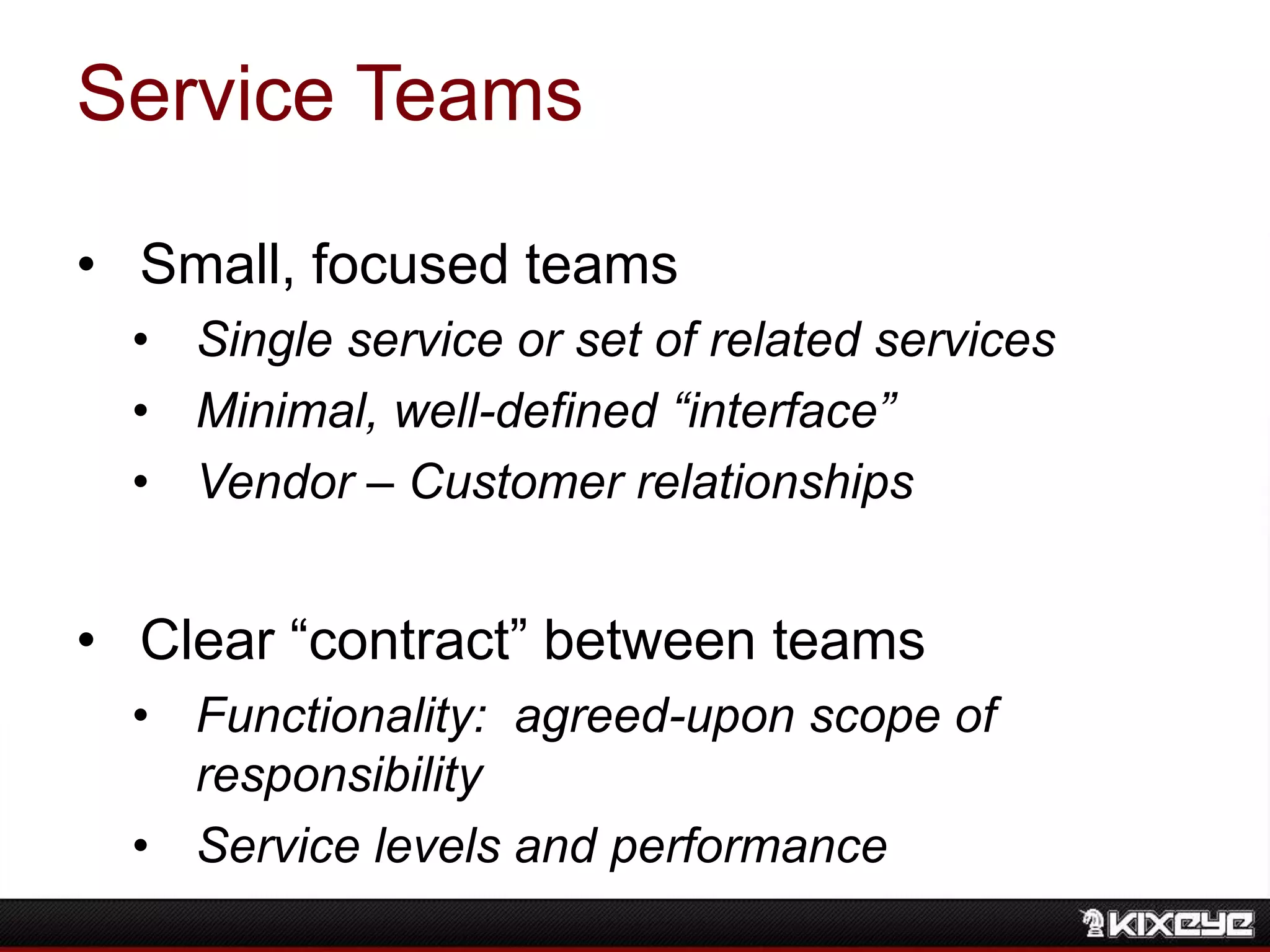
Service Teams
• Small, focused teams
• Single service or set of related services
• Minimal, well-defined “interface”
• Vendor – Customer relationships
• Clear “contract” between teams
• Functionality: agreed-upon scope of
responsibility
• Service levels and performance
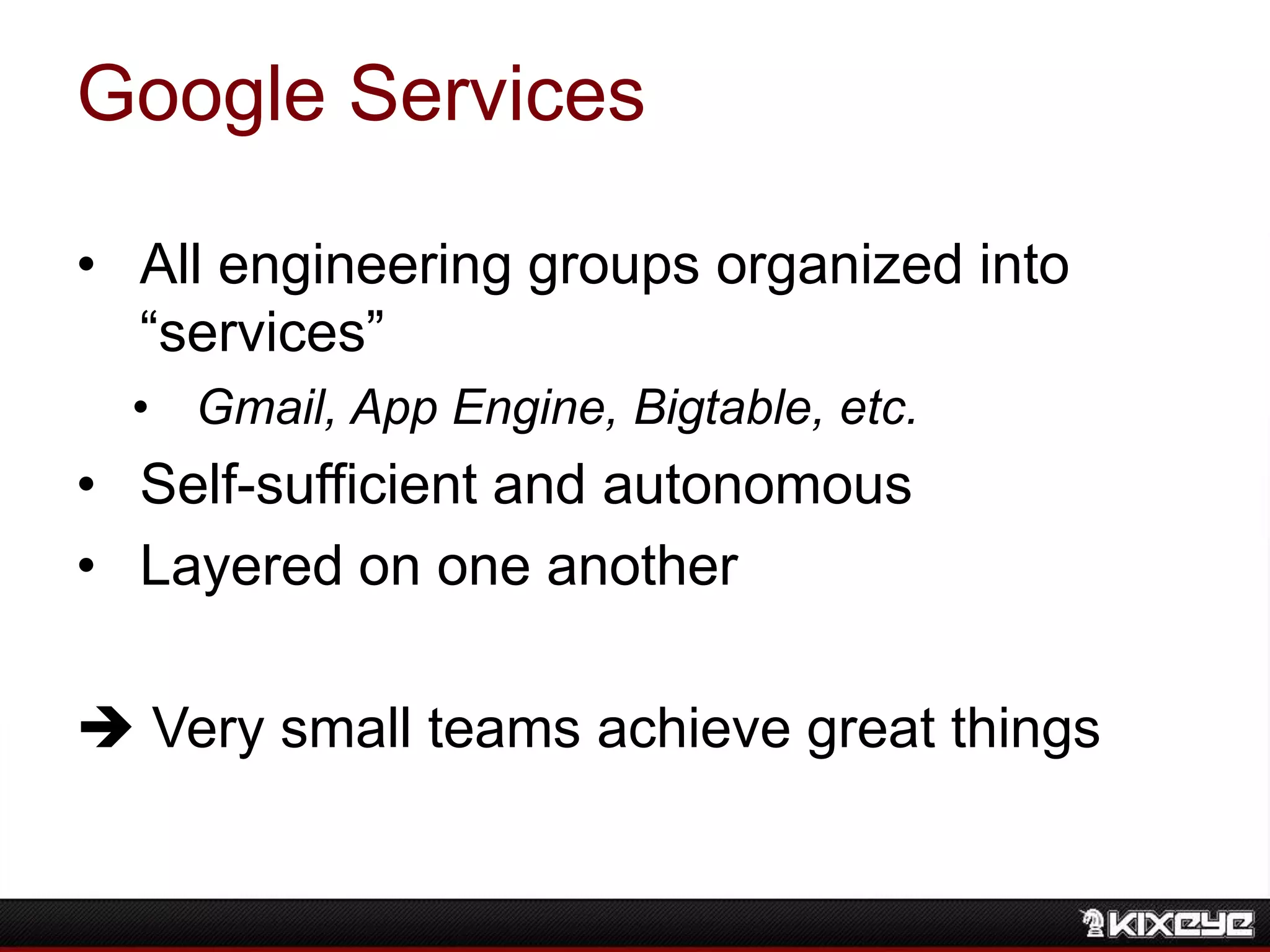
Google Services
• All engineering groups organized into
“services”
• Gmail, App Engine, Bigtable, etc.
• Self-sufficient and autonomous
• Layered on one another
 Very small teams achieve great things
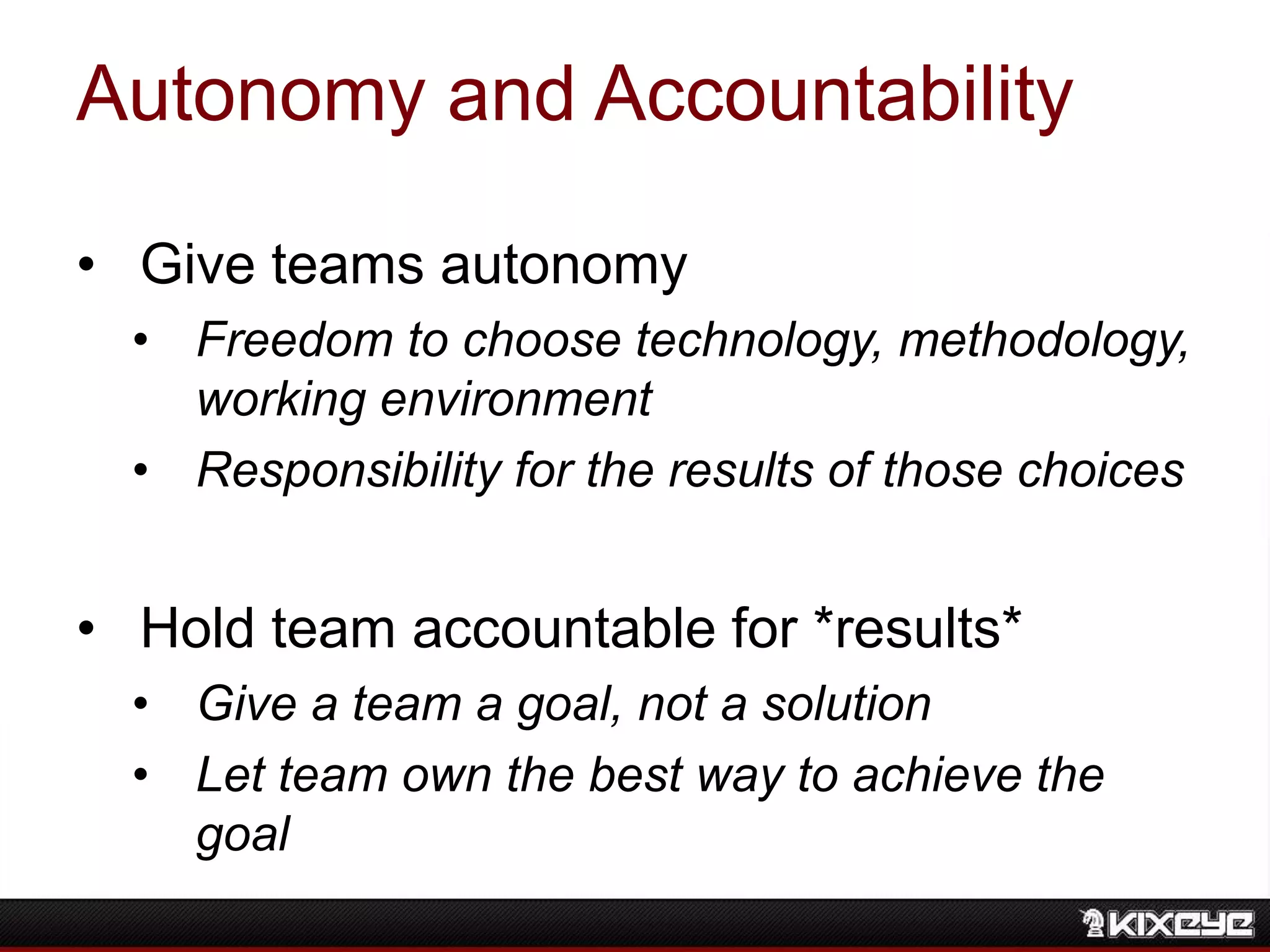
Autonomy and Accountability
• Give teams autonomy
• Freedom to choose technology, methodology,
working environment
• Responsibility for the results of those choices
• Hold team accountable for *results*
• Give a team a goal, not a solution
• Let team own the best way to achieve the
goal
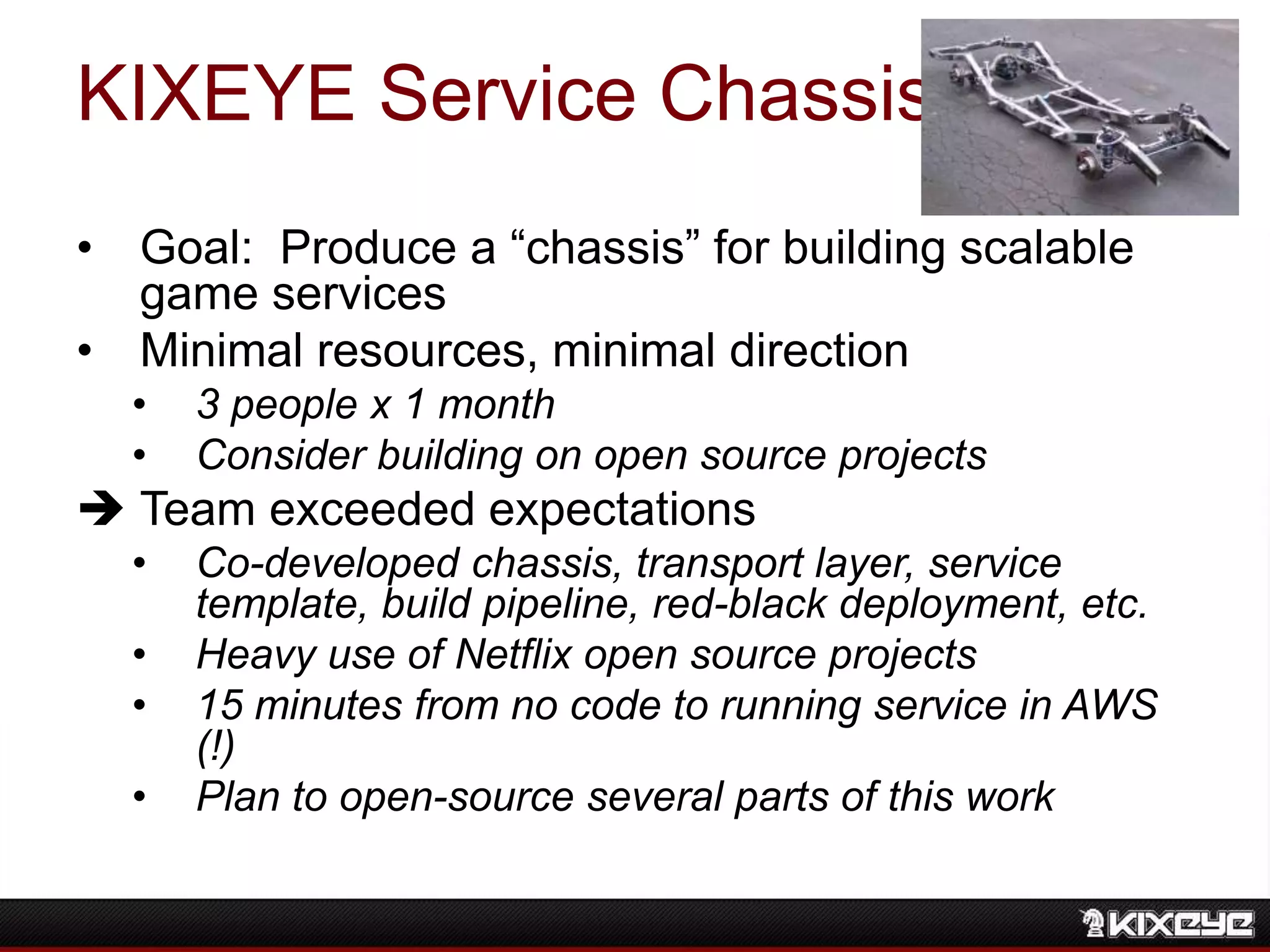
KIXEYE Service Chassis
• Goal: Produce a “chassis” for building scalable
game services
• Minimal resources, minimal direction
• 3 people x 1 month
• Consider building on open source projects
 Team exceeded expectations
• Co-developed chassis, transport layer, service
template, build pipeline, red-black deployment, etc.
• Heavy use of Netflix open source projects
• 15 minutes from no code to running service in AWS
(!)
• Plan to open-source several parts of this work
Google and DevOps
Ops Support is a privilege, not a right
• Developers carry pager for first 6+ months
• Service “graduates” to SRE after intensive
review of monitoring, reliability, resilience, etc.
• SRE collaborates with service to move
forward
Everyone‟s incentives are aligned
• Everyone is responsible for production
• Everyone strongly motivated to have solid
instrumentation and monitoring
Collaboration
• One team across
engineering, product, operations, etc.
• Solve problems instead of pointing fingers
Google Co-Location
Multiple Organizations
• Engineering
• Product
• Operations
• Support
• Different reporting structures to different VPs
Virtual Team with Single Goal
• All work to make Google App Engine successful
• Coworkers are “Us”, not “Them”
• When asked which teams we need to sit next to, it
never occurred to us that other organizations were
not “our team”
Building Blocks of Culture
Hiring and Retention
Ownership and Collaboration
Quality and Discipline
Learning and Experimentation
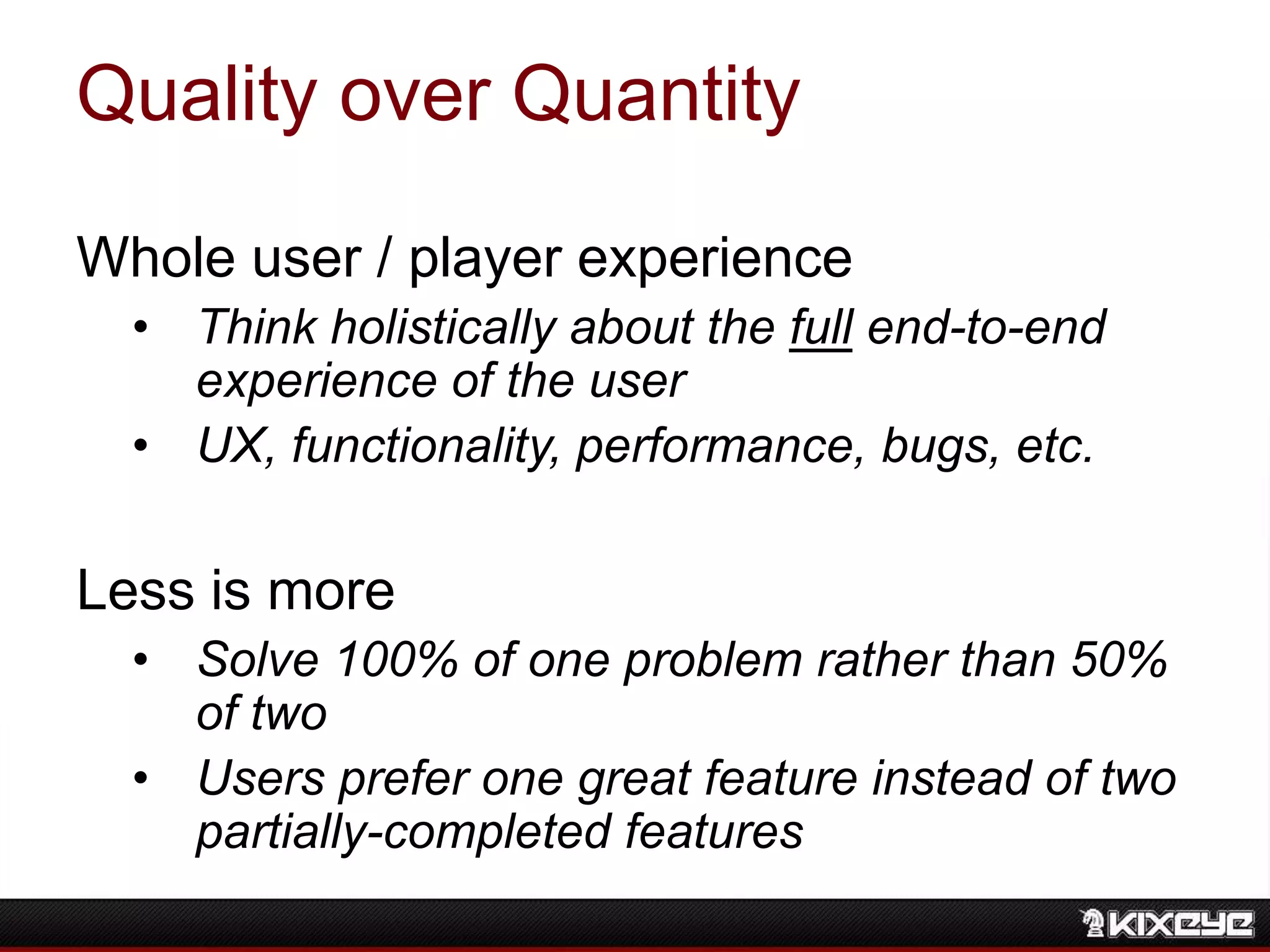
Quality over Quantity
Whole user / player experience
• Think holistically about the full end-to-end
experience of the user
• UX, functionality, performance, bugs, etc.
Less is more
• Solve 100% of one problem rather than 50%
of two
• Users prefer one great feature instead of two
partially-completed features
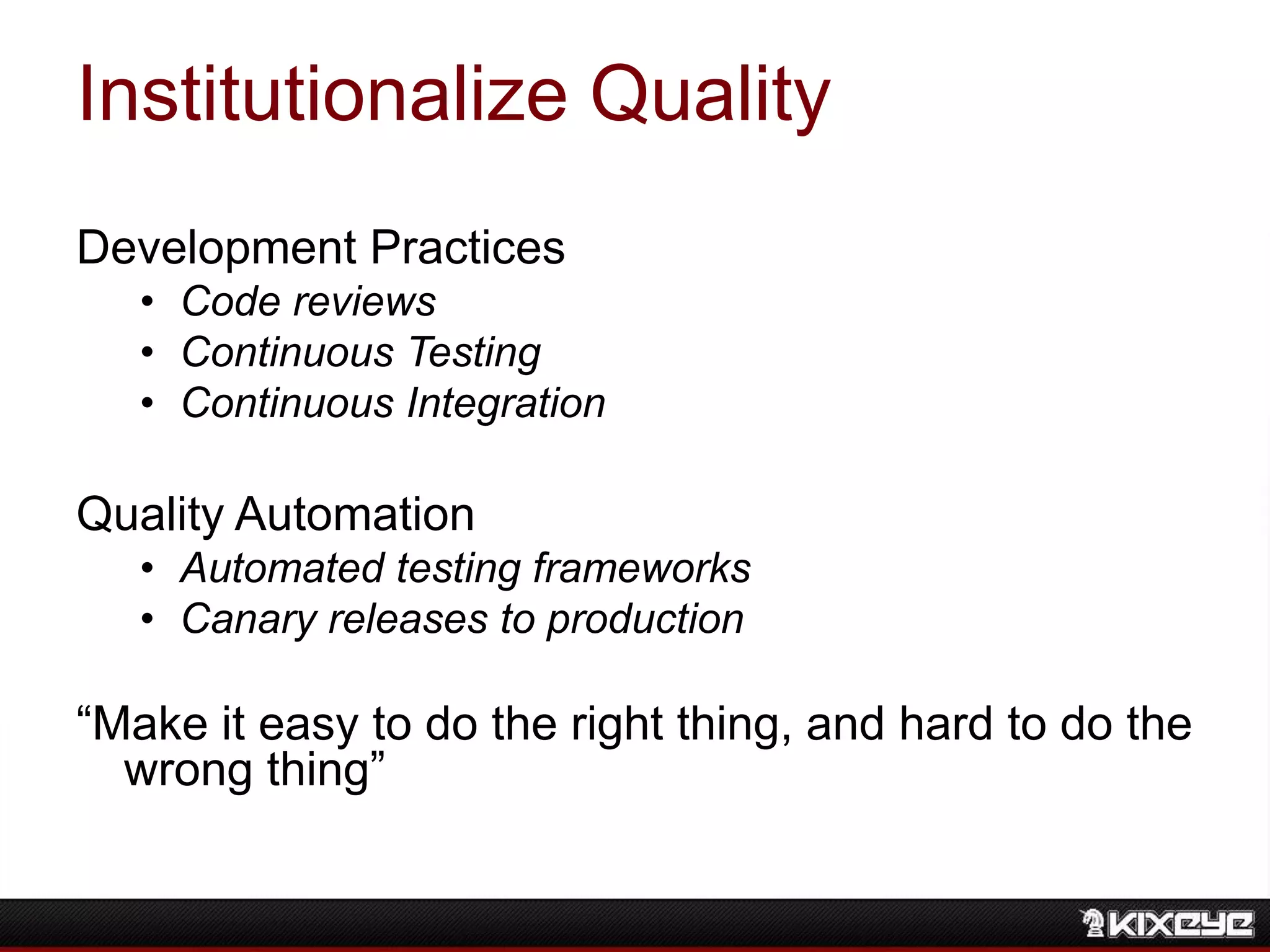
Institutionalize Quality
Development Practices
• Code reviews
• Continuous Testing
• Continuous Integration
Quality Automation
• Automated testing frameworks
• Canary releases to production
“Make it easy to do the right thing, and hard to do the
wrong thing”
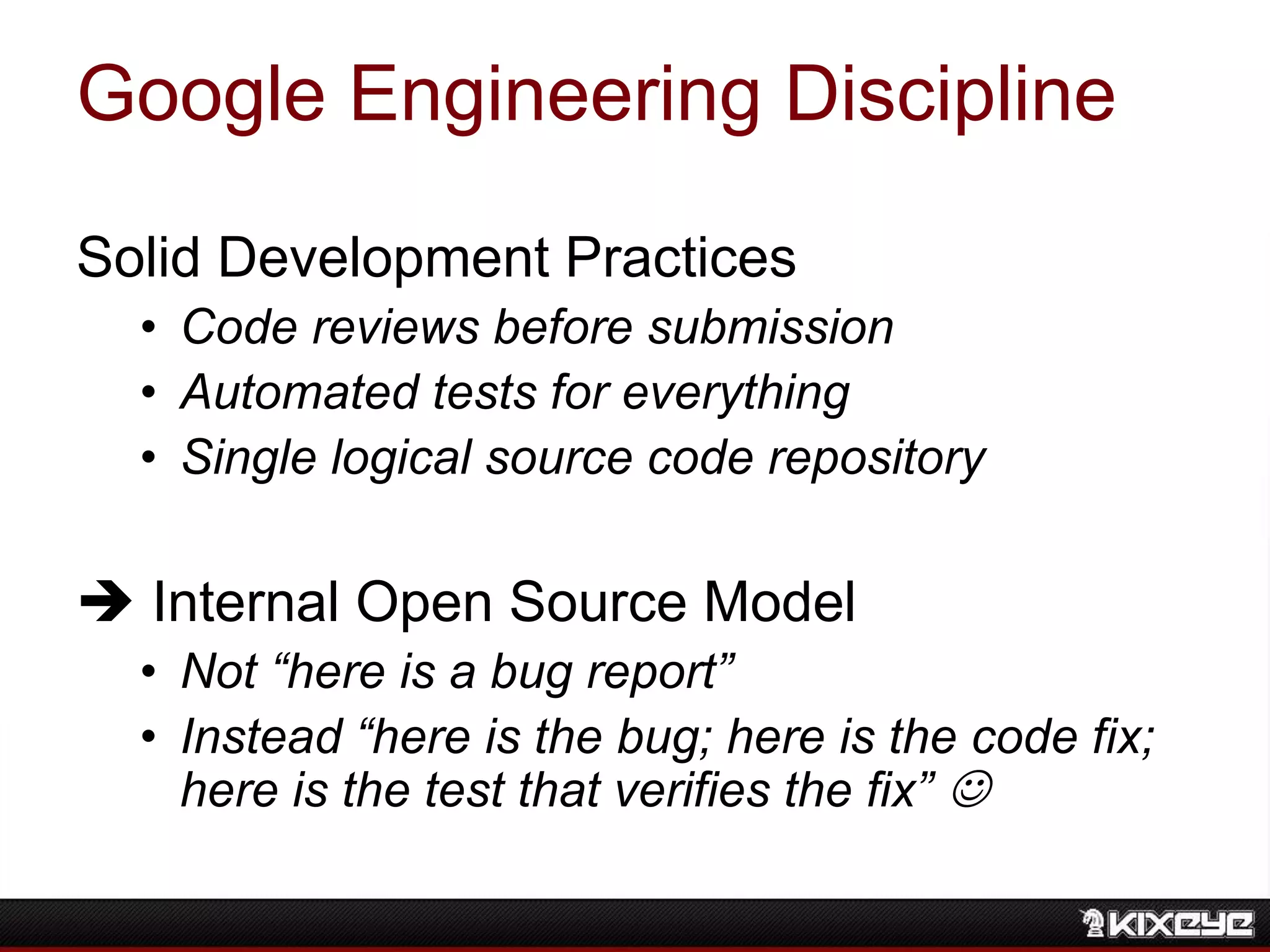
Google Engineering Discipline
Solid Development Practices
• Code reviews before submission
• Automated tests for everything
• Single logical source code repository
 Internal Open Source Model
• Not “here is a bug report”
• Instead “here is the bug; here is the code fix;
here is the test that verifies the fix” 
Technical Tradeoffs
Make Tradeoffs Explicit
• Triangle: date vs. quality vs. features
• When you choose date and features, you
implicitly choose a level of quality
Manage Technical Debt
• Plan for how and when you will pay it off
• Maintain sustainable and well-understood level of
debt
“Don‟t have time to do it right” ?
• WRONG – Don’t have time to do it twice (!)
Building Blocks of Culture
Hiring and Retention
Ownership and Collaboration
Quality and Discipline
Learning and Experimentation
Constant Learning
Any process, organization, or product can
always be improved
Mistakes are a learning opportunity
• What did you do -> What did you *learn*
• Take emotion and personalization out of it
Encourage iteration and velocity
• “Failure is not falling down but refusing to get
back up” – Theodore Roosevelt
Google Blame-Free Post-
Mortems
Post-mortem After Every Incident
• Document exactly what happened
• What went right
• What went wrong
Open and Honest Discussion
• What contributed to the incident?
• What could we have done better?
Engineers compete to take personal
responsibility (!)
Google Blame-Free Post-
Mortems
Action Items
• How will we change process, technology,
documentation, etc.
• How could we have automated the problems
away?
• How could we have diagnosed more quickly?
• How could we have restored service more
quickly?
Follow up (!)
Iteration and Experimentation
*Engineer* successes
• Constant iteration
• Launch is only the first step
• Assume you will not get it perfect on the first
try
• A / B Testing needs to be a core competence
Many small experiments sum to big wins
eBay Machine-Learned Ranking
Ranking function for search results
• Which item should appear 1st, 10th, 100th, 1000th
• Before: Small number of hand-tuned factors
• Goal: Thousands of factors
Experimentation Process
• Predictive models: query->view, view-
>purchase, etc.
• Hundreds of parallel A|B tests
• Full year of steady, incremental improvements
 2% increase in eBay revenue (~$120M)
Recap: Building Blocks of
Culture
Hiring and Retention
Ownership and Collaboration
Quality and Discipline
Learning and Experimentation
Thank you!
rshoup@kixeye.com
@randyshoup
linkedin.com/in/randyshoup

The Importance of Culture: Building and Sustaining Effective Engineering Organizations [QCon Beijing 2014]

  • 1.
    The Importance ofCulture Building and Sustaining Effective Engineering Organizations Randy Shoup @randyshoup linkedin.com/in/randyshoup
  • 2.
    Background CTO at KIXEYE •Real-time strategy games for web and mobile Director of Engineering for Google App Engine • World’s largest Platform-as-a-Service Chief Engineer at eBay • Multiple generations of eBay’s real-time search infrastructure
  • 3.
    Building Blocks ofCulture Hiring and Retention Ownership and Collaboration Quality and Discipline Learning and Experimentation
  • 4.
    Building Blocks ofCulture Hiring and Retention Ownership and Collaboration Quality and Discipline Learning and Experimentation
  • 5.
    Hire and Retainthe Best Hire „A‟ Players • In creative disciplines, top performers are 10x more productive (!) Confidence • A players bring A players • B players bring C players
  • 6.
    Google Hiring Goal: Onlyhire top talent • False negatives are OK; false positives are not Hiring Process • Famously challenging interviews • Very detailed interviewer feedback • Hiring committee decides whether to hire • Separately assign new Googler to group  Highly talented and engaged employees
  • 7.
    Respect People People arenot interchangeable • Different skills, interests, capabilities • Create a Symphony, not a Factory Most valuable and irreplaceable asset • Treat people with care and respect • If the company values its people, people will provide value to the company
  • 8.
    eBay “Train Seats” eBay‟sdevelopment process (circa 2006) • Design and estimate project (“Train Seat” == 2 engineer-weeks) • Assign engineers from common pool to implement tasks • Designer does not implement; implementers do not design  Dysfunctional engineering culture • (-) Engineers treated as interchangeable “cogs” • (-) No regard for skill, interest, experience • (-) No pride of ownership in task implementation • (-) No long-term ownership of codebase
  • 9.
    Building Blocks ofCulture Hiring and Retention Ownership and Collaboration Quality and Discipline Learning and Experimentation
  • 10.
    Service Teams • Small,focused teams • Single service or set of related services • Minimal, well-defined “interface” • Vendor – Customer relationships • Clear “contract” between teams • Functionality: agreed-upon scope of responsibility • Service levels and performance
  • 11.
    Google Services • Allengineering groups organized into “services” • Gmail, App Engine, Bigtable, etc. • Self-sufficient and autonomous • Layered on one another  Very small teams achieve great things
  • 12.
    Autonomy and Accountability •Give teams autonomy • Freedom to choose technology, methodology, working environment • Responsibility for the results of those choices • Hold team accountable for *results* • Give a team a goal, not a solution • Let team own the best way to achieve the goal
  • 13.
    KIXEYE Service Chassis •Goal: Produce a “chassis” for building scalable game services • Minimal resources, minimal direction • 3 people x 1 month • Consider building on open source projects  Team exceeded expectations • Co-developed chassis, transport layer, service template, build pipeline, red-black deployment, etc. • Heavy use of Netflix open source projects • 15 minutes from no code to running service in AWS (!) • Plan to open-source several parts of this work
  • 14.
    Google and DevOps OpsSupport is a privilege, not a right • Developers carry pager for first 6+ months • Service “graduates” to SRE after intensive review of monitoring, reliability, resilience, etc. • SRE collaborates with service to move forward Everyone‟s incentives are aligned • Everyone is responsible for production • Everyone strongly motivated to have solid instrumentation and monitoring
  • 15.
    Collaboration • One teamacross engineering, product, operations, etc. • Solve problems instead of pointing fingers
  • 16.
    Google Co-Location Multiple Organizations •Engineering • Product • Operations • Support • Different reporting structures to different VPs Virtual Team with Single Goal • All work to make Google App Engine successful • Coworkers are “Us”, not “Them” • When asked which teams we need to sit next to, it never occurred to us that other organizations were not “our team”
  • 17.
    Building Blocks ofCulture Hiring and Retention Ownership and Collaboration Quality and Discipline Learning and Experimentation
  • 18.
    Quality over Quantity Wholeuser / player experience • Think holistically about the full end-to-end experience of the user • UX, functionality, performance, bugs, etc. Less is more • Solve 100% of one problem rather than 50% of two • Users prefer one great feature instead of two partially-completed features
  • 19.
    Institutionalize Quality Development Practices •Code reviews • Continuous Testing • Continuous Integration Quality Automation • Automated testing frameworks • Canary releases to production “Make it easy to do the right thing, and hard to do the wrong thing”
  • 20.
    Google Engineering Discipline SolidDevelopment Practices • Code reviews before submission • Automated tests for everything • Single logical source code repository  Internal Open Source Model • Not “here is a bug report” • Instead “here is the bug; here is the code fix; here is the test that verifies the fix” 
  • 21.
    Technical Tradeoffs Make TradeoffsExplicit • Triangle: date vs. quality vs. features • When you choose date and features, you implicitly choose a level of quality Manage Technical Debt • Plan for how and when you will pay it off • Maintain sustainable and well-understood level of debt “Don‟t have time to do it right” ? • WRONG – Don’t have time to do it twice (!)
  • 22.
    Building Blocks ofCulture Hiring and Retention Ownership and Collaboration Quality and Discipline Learning and Experimentation
  • 23.
    Constant Learning Any process,organization, or product can always be improved Mistakes are a learning opportunity • What did you do -> What did you *learn* • Take emotion and personalization out of it Encourage iteration and velocity • “Failure is not falling down but refusing to get back up” – Theodore Roosevelt
  • 24.
    Google Blame-Free Post- Mortems Post-mortemAfter Every Incident • Document exactly what happened • What went right • What went wrong Open and Honest Discussion • What contributed to the incident? • What could we have done better? Engineers compete to take personal responsibility (!)
  • 25.
    Google Blame-Free Post- Mortems ActionItems • How will we change process, technology, documentation, etc. • How could we have automated the problems away? • How could we have diagnosed more quickly? • How could we have restored service more quickly? Follow up (!)
  • 26.
    Iteration and Experimentation *Engineer*successes • Constant iteration • Launch is only the first step • Assume you will not get it perfect on the first try • A / B Testing needs to be a core competence Many small experiments sum to big wins
  • 27.
    eBay Machine-Learned Ranking Rankingfunction for search results • Which item should appear 1st, 10th, 100th, 1000th • Before: Small number of hand-tuned factors • Goal: Thousands of factors Experimentation Process • Predictive models: query->view, view- >purchase, etc. • Hundreds of parallel A|B tests • Full year of steady, incremental improvements  2% increase in eBay revenue (~$120M)
  • 28.
    Recap: Building Blocksof Culture Hiring and Retention Ownership and Collaboration Quality and Discipline Learning and Experimentation
  • 29.