

REIMAGINE
TECHNOLOGY
Architecting for speed
Jesper Nordström
Tomas Betzholtz
How agile innovators accelerate growth through microservices, containers, DevOps, APIs and cloud
Cutthroat competition requires enterprises to
transform how they build and deliver software
 In the digital age, every company is a software company, and software is the key differentiator
 To stay in the game, businesses must rapidly and continuously upgrade their applications with nonstop availability
 Companies that lack the capacity to experiment, innovate and get new features out quickly will lose out
“Software is eating the world”
Marc Andreesen
Problems with traditional application architecture
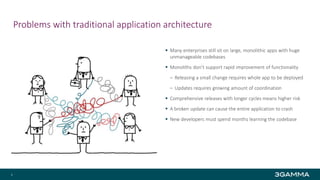
 Many enterprises still sit on large, monolithic apps with huge
unmanageable codebases
 Monoliths don’t support rapid improvement of functionality
‒ Releasing a small change requires whole app to be deployed
‒ Updates requires growing amount of coordination
 Comprehensive releases with longer cycles means higher risk
 A broken update can cause the entire application to crash
 New developers must spend months learning the codebase
3
Problems with traditional application architecture
The blame game: Dev vs Ops rather than DevOps
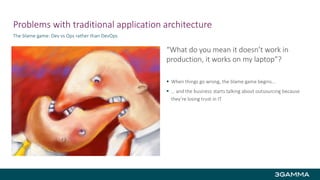
“What do you mean it doesn’t work in
production, it works on my laptop”?
 When things go wrong, the blame game begins…
 … and the business starts talking about outsourcing because
they’re losing trust in IT
The rise of microservices
Changing the fundamentals of enterprise application management.
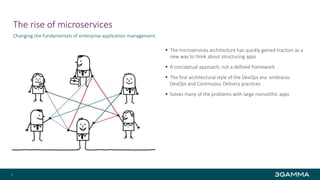
 The microservices architecture has quickly gained traction as a
new way to think about structuring apps
 A conceptual approach, not a defined framework
 The first architectural style of the DevOps era: embraces
DevOps and Continuous Delivery practices
 Solves many of the problems with large monolithic apps
5
What are microservices?
 Perform a single business function
‒ Focus on doing one thing well
‒ Have clearly defined interfaces (bounded context)
 Autonomous
‒ Can be changed and deployed independently
‒ Have minimal dependency on one another (loose coupling)
 Communicate via language/platform-agnostic APIs
‒ Can be developed in any language
6
What are microservices?
 Small
‒ Minimal but complete
‒ Small enough to be managed by a “2 pizza team"
‒ Should conceptually fit in a developer’s head
 Managed by decentralised, cross functional product teams
‒ Small empowered teams
‒ Manage all aspects of development
‒ Include every role necessary to deliver the service
‒ Each team responsible for a business function composed of
one or more services
7
Conway’s law
8
“The interface structure of a software system
will reflect the social structure of the
organisation that produced it.”
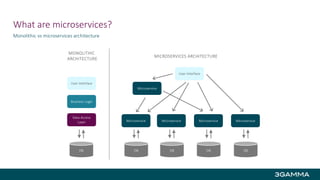
What are microservices?
Monolithic vs microservices architecture
MICROSERVICES ARCHITECTURE
User Interface
Business Logic
Data Access
Layer
DB
User Interface
Microservice
Microservice Microservice Microservice
DB DB DB
MONOLITHIC
ARCHITECTURE
Microservice
DB
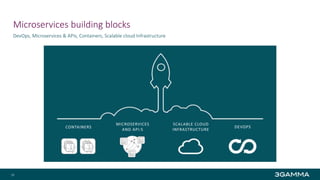
Microservices building blocks
DevOps, Microservices & APIs, Containers, Scalable cloud Infrastructure
10
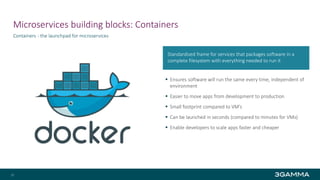
Microservices building blocks: Containers
Containers - the launchpad for microservices
 Ensures software will run the same every time, independent of
environment
 Easier to move apps from development to production
 Small footprint compared to VM’s
 Can be launched in seconds (compared to minutes for VMs)
 Enable developers to scale apps faster and cheaper
11
Standardised frame for services that packages software in a
complete filesystem with everything needed to run it
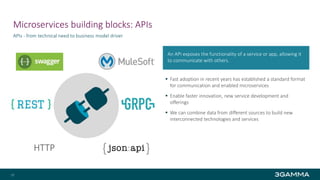
Microservices building blocks: APIs
 Fast adoption in recent years has established a standard format
for communication and enabled microservices
 Enable faster innovation, new service development and
offerings
 We can combine data from different sources to build new
interconnected technologies and services
APIs - from technical need to business model driver
12
HTTP
An API exposes the functionality of a service or app, allowing it
to communicate with others.
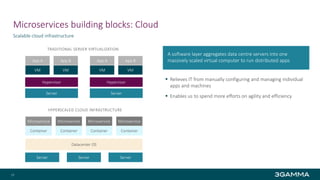
Microservices building blocks: Cloud
 Relieves IT from manually configuring and managing individual
apps and machines
 Enables us to spend more efforts on agility and efficiency
Scalable cloud infrastructure
13
App A
VM
Hypervisor
Server
TRADITIONAL SERVER VIRTUALIZATION
App B
VM
App A
VM
Hypervisor
Server
App B
VM
Microservice
Container
Datacenter OS
Server Server
HYPERSCALED CLOUD INFRASTRUCTURE
Server
Microservice
Container
Microservice
Container
Microservice
Container
A software layer aggregates data centre servers into one
massively scaled virtual computer to run distributed apps
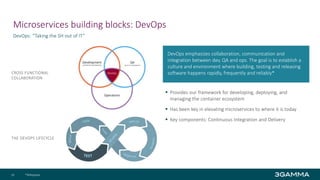
Microservices building blocks: DevOps
DevOps: “Taking the SH out of IT”
 Provides our framework for developing, deploying, and
managing the container ecosystem
 Has been key in elevating microservices to where it is today
 Key components: Continuous Integration and Delivery
*Wikipedia14
DevOps emphasizes collaboration, communication and
integration between dev, QA and ops. The goal is to establish a
culture and environment where building, testing and releasing
software happens rapidly, frequently and reliably*
THE DEVOPS LIFECYCLE
CROSS FUNCTIONAL
COLLABORATION
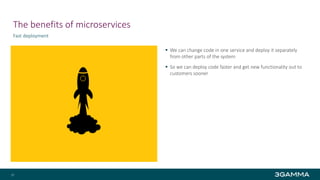
The benefits of microservices
Fast deployment
 We can change code in one service and deploy it separately
from other parts of the system
 So we can deploy code faster and get new functionality out to
customers sooner
15
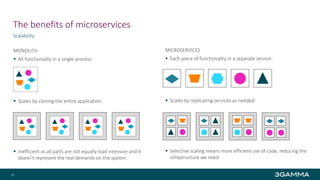
MICROSERVICES
 Each piece of functionality in a separate service:
 Scales by replicating services as needed:
 Selective scaling means more efficient use of code, reducing the
infrastructure we need
MONOLITH
 All functionality in a single process:
 Scales by cloning the entire application:
 Inefficient as all parts are not equally load intensive and it
doesn’t represent the real demands on the system
The benefits of microservices
Scalability
16
The benefits of microservices
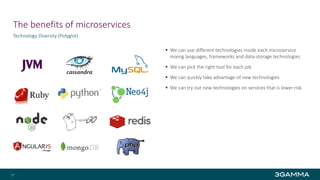
 We can use different technologies inside each microservice
mixing languages, frameworks and data-storage technologies
 We can pick the right tool for each job
 We can quickly take advantage of new technologies
 We can try out new technologies on services that is lower risk
Technology Diversity (Polyglot)
17
The benefits of microservices
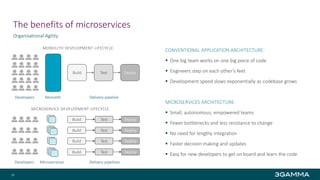
Organisational Agility
CONVENTIONAL APPLICATION ARCHITECTURE:
 One big team works on one big piece of code
 Engineers step on each other’s feet
 Development speed slows exponentially as codebase grows
MICROSERVICES ARCHITECTURE:
 Small, autonomous, empowered teams
 Fewer bottlenecks and less resistance to change
 No need for lengthy integration
 Faster decision making and updates
 Easy for new developers to get on board and learn the code
18
Developers Monolith Delivery pipeline
Developers Microservices Delivery pipelines
MONOLITH DEVELOPMENT LIFECYCLE
MICROSERVICE DEVELOPMENT LIFECYCLE
Build Test Deploy
Build Test Deploy
Build Test Deploy
Build Test Deploy
Build Test Deploy
The benefits of microservices
Resilience
 Loose coupling and bounded context limits the failure domain
 Less risk microservices cause system failure if they stop working
 Failure of one instance of has minimal impact on the application
 If all instances goes down, it only impacts the function of the
particular service, and the rest of the app continues to work
 When failing is less risky we can easier experiment and innovate
19
The benefits of microservices
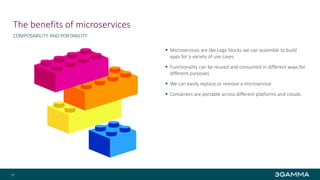
COMPOSABILITY AND PORTABILITY
 Microservices are like Lego blocks we can assemble to build
apps for a variety of use cases
 Functionality can be reused and consumed in different ways for
different purposes
 We can easily replace or remove a microservice
 Containers are portable across different platforms and clouds
20
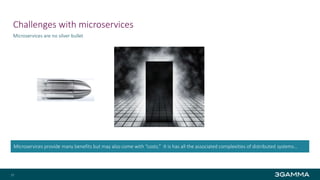
Challenges with microservices
Microservices are no silver bullet
21
Microservices provide many benefits but may also come with “costs.” It is has all the associated complexities of distributed systems…
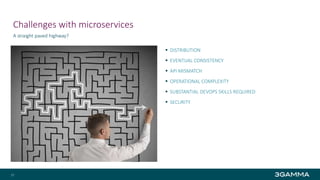
Challenges with microservices
A straight paved highway?
22
 DISTRIBUTION
 EVENTUAL CONSISTENCY
 API MISMATCH
 OPERATIONAL COMPLEXITY
 SUBSTANTIAL DEVOPS SKILLS REQUIRED
 SECURITY
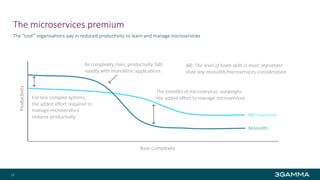
The microservices premium
The “cost” organisations pay in reduced productivity to learn and manage microservices
23
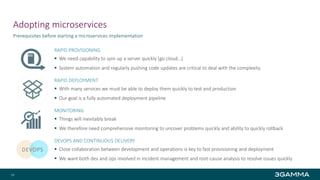
Adopting microservices
RAPID PROVISIONING
 We need capability to spin up a server quickly (go cloud…)
 System automation and regularly pushing code updates are critical to deal with the complexity
RAPID DEPLOYMENT
 With many services we must be able to deploy them quickly to test and production
 Our goal is a fully automated deployment pipeline
MONITORING
 Things will inevitably break
 We therefore need comprehensive monitoring to uncover problems quickly and ability to quickly rollback
DEVOPS AND CONTINUOUS DELIVERY
 Close collaboration between development and operations is key to fast provisioning and deployment
 We want both dev and ops involved in incident management and root-cause analysis to resolve issues quickly
Prerequisites before starting a microservices implementation
24
DEVOPS
Adopting microservices
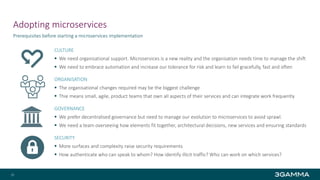
CULTURE
 We need organisational support. Microservices is a new reality and the organisation needs time to manage the shift
 We need to embrace automation and increase our tolerance for risk and learn to fail gracefully, fast and often
ORGANISATION
 The organisational changes required may be the biggest challenge
 Thie means small, agile, product teams that own all aspects of their services and can integrate work frequently
GOVERNANCE
 We prefer decentralised governance but need to manage our evolution to microservices to avoid sprawl.
 We need a team overseeing how elements fit together, architectural decisions, new services and ensuring standards
SECURITY
 More surfaces and complexity raise security requirements
 How authenticate who can speak to whom? How identify illicit traffic? Who can work on which services?
Prerequisites before starting a microservices implementation
25
Moving from monolith to microservices
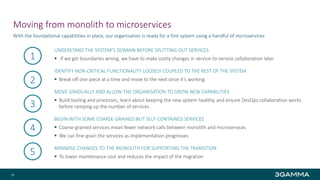
UNDERSTAND THE SYSTEM’S DOMAIN BEFORE SPLITTING OUT SERVICES
 If we get boundaries wrong, we have to make costly changes in service-to-service collaboration later
IDENTIFY NON-CRITICAL FUNCTIONALITY LOOSELY COUPLED TO THE REST OF THE SYSTEM
 Break off one piece at a time and move to the next once it’s working
MOVE GRADUALLY AND ALLOW THE ORGANISATION TO GROW NEW CAPABILITIES
 Build tooling and processes, learn about keeping the new system healthy, and ensure DevOps collaboration works
before ramping up the number of services
BEGIN WITH SOME COARSE-GRAINED BUT SELF-CONTAINED SERVICES
 Coarse-grained services mean fewer network calls between monolith and microservices
 We can fine-grain the services as implementation progresses
MINIMISE CHANGES TO THE MONOLITH FOR SUPPORTING THE TRANSITION
 To lower maintenance cost and reduces the impact of the migration
With the foundational capabilities in place, our organisation is ready for a first system using a handful of microservices
26
1
2
3
4
5
Moving from monolith to microservices
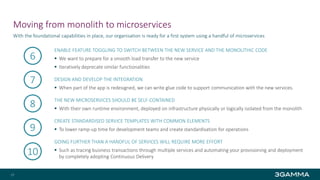
ENABLE FEATURE TOGGLING TO SWITCH BETWEEN THE NEW SERVICE AND THE MONOLITHIC CODE
 We want to prepare for a smooth load transfer to the new service
 Iteratively deprecate similar functionalities
DESIGN AND DEVELOP THE INTEGRATION
 When part of the app is redesigned, we can write glue code to support communication with the new services.
THE NEW MICROSERVICES SHOULD BE SELF-CONTAINED
 With their own runtime environment, deployed on infrastructure physically or logically isolated from the monolith
CREATE STANDARDISED SERVICE TEMPLATES WITH COMMON ELEMENTS
 To lower ramp-up time for development teams and create standardisation for operations
GOING FURTHER THAN A HANDFUL OF SERVICES WILL REQUIRE MORE EFFORT
 Such as tracing business transactions through multiple services and automating your provisioning and deployment
by completely adopting Continuous Delivery
With the foundational capabilities in place, our organisation is ready for a first system using a handful of microservices
27
6
7
8
9
10
Tools
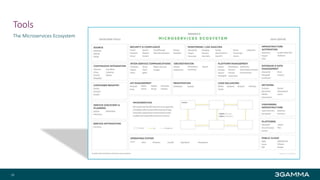
The Microservices Ecosystem
28
Further Reading
29
Read our full article about microservices
on Slideshare or 3gamma.com
UNITED KINGDOM
3gamma UK Ltd
The News Building
3 London Bridge Street,
London SE1 9SG
United Kingdom
Phone +44 (0) 203 743 6104
GROUP HEAD OFFICE
3gamma Group
Drottningtorget 5
SE-411 03 Göteborg
Sweden
Phone: +46 31 309 7910
SWEDEN
3gamma Sweden AB
Centralplan 15
SE-111 20 Stockholm
Sweden
Phone: +46 8 748 0330
DENMARK
3gamma ApS
Frederiksborggade 15
DK-1360 Copenhagen K
Denmark
Phone: +45 53 700 400
UNITED KINGDOM
3gamma UK Ltd
Manchester Business Park
3000 Aviator Way,
Manchester M22 5TG
United Kingdom
Phone +44 1928 796800
REIMAGINE
TECHNOLOGY

Architecting for speed: How agile innovators accelerate growth through microservices, containers, DevOps and Cloud

  • 1.
    REIMAGINE TECHNOLOGY Architecting for speed JesperNordström Tomas Betzholtz How agile innovators accelerate growth through microservices, containers, DevOps, APIs and cloud
  • 2.
    Cutthroat competition requiresenterprises to transform how they build and deliver software  In the digital age, every company is a software company, and software is the key differentiator  To stay in the game, businesses must rapidly and continuously upgrade their applications with nonstop availability  Companies that lack the capacity to experiment, innovate and get new features out quickly will lose out “Software is eating the world” Marc Andreesen
  • 3.
    Problems with traditionalapplication architecture  Many enterprises still sit on large, monolithic apps with huge unmanageable codebases  Monoliths don’t support rapid improvement of functionality ‒ Releasing a small change requires whole app to be deployed ‒ Updates requires growing amount of coordination  Comprehensive releases with longer cycles means higher risk  A broken update can cause the entire application to crash  New developers must spend months learning the codebase 3
  • 4.
    Problems with traditionalapplication architecture The blame game: Dev vs Ops rather than DevOps “What do you mean it doesn’t work in production, it works on my laptop”?  When things go wrong, the blame game begins…  … and the business starts talking about outsourcing because they’re losing trust in IT
  • 5.
    The rise ofmicroservices Changing the fundamentals of enterprise application management.  The microservices architecture has quickly gained traction as a new way to think about structuring apps  A conceptual approach, not a defined framework  The first architectural style of the DevOps era: embraces DevOps and Continuous Delivery practices  Solves many of the problems with large monolithic apps 5
  • 6.
    What are microservices? Perform a single business function ‒ Focus on doing one thing well ‒ Have clearly defined interfaces (bounded context)  Autonomous ‒ Can be changed and deployed independently ‒ Have minimal dependency on one another (loose coupling)  Communicate via language/platform-agnostic APIs ‒ Can be developed in any language 6
  • 7.
    What are microservices? Small ‒ Minimal but complete ‒ Small enough to be managed by a “2 pizza team" ‒ Should conceptually fit in a developer’s head  Managed by decentralised, cross functional product teams ‒ Small empowered teams ‒ Manage all aspects of development ‒ Include every role necessary to deliver the service ‒ Each team responsible for a business function composed of one or more services 7
  • 8.
    Conway’s law 8 “The interfacestructure of a software system will reflect the social structure of the organisation that produced it.”
  • 9.
    What are microservices? Monolithicvs microservices architecture MICROSERVICES ARCHITECTURE User Interface Business Logic Data Access Layer DB User Interface Microservice Microservice Microservice Microservice DB DB DB MONOLITHIC ARCHITECTURE Microservice DB
  • 10.
    Microservices building blocks DevOps,Microservices & APIs, Containers, Scalable cloud Infrastructure 10
  • 11.
    Microservices building blocks:Containers Containers - the launchpad for microservices  Ensures software will run the same every time, independent of environment  Easier to move apps from development to production  Small footprint compared to VM’s  Can be launched in seconds (compared to minutes for VMs)  Enable developers to scale apps faster and cheaper 11 Standardised frame for services that packages software in a complete filesystem with everything needed to run it
  • 12.
    Microservices building blocks:APIs  Fast adoption in recent years has established a standard format for communication and enabled microservices  Enable faster innovation, new service development and offerings  We can combine data from different sources to build new interconnected technologies and services APIs - from technical need to business model driver 12 HTTP An API exposes the functionality of a service or app, allowing it to communicate with others.
  • 13.
    Microservices building blocks:Cloud  Relieves IT from manually configuring and managing individual apps and machines  Enables us to spend more efforts on agility and efficiency Scalable cloud infrastructure 13 App A VM Hypervisor Server TRADITIONAL SERVER VIRTUALIZATION App B VM App A VM Hypervisor Server App B VM Microservice Container Datacenter OS Server Server HYPERSCALED CLOUD INFRASTRUCTURE Server Microservice Container Microservice Container Microservice Container A software layer aggregates data centre servers into one massively scaled virtual computer to run distributed apps
  • 14.
    Microservices building blocks:DevOps DevOps: “Taking the SH out of IT”  Provides our framework for developing, deploying, and managing the container ecosystem  Has been key in elevating microservices to where it is today  Key components: Continuous Integration and Delivery *Wikipedia14 DevOps emphasizes collaboration, communication and integration between dev, QA and ops. The goal is to establish a culture and environment where building, testing and releasing software happens rapidly, frequently and reliably* THE DEVOPS LIFECYCLE CROSS FUNCTIONAL COLLABORATION
  • 15.
    The benefits ofmicroservices Fast deployment  We can change code in one service and deploy it separately from other parts of the system  So we can deploy code faster and get new functionality out to customers sooner 15
  • 16.
    MICROSERVICES  Each pieceof functionality in a separate service:  Scales by replicating services as needed:  Selective scaling means more efficient use of code, reducing the infrastructure we need MONOLITH  All functionality in a single process:  Scales by cloning the entire application:  Inefficient as all parts are not equally load intensive and it doesn’t represent the real demands on the system The benefits of microservices Scalability 16
  • 17.
    The benefits ofmicroservices  We can use different technologies inside each microservice mixing languages, frameworks and data-storage technologies  We can pick the right tool for each job  We can quickly take advantage of new technologies  We can try out new technologies on services that is lower risk Technology Diversity (Polyglot) 17
  • 18.
    The benefits ofmicroservices Organisational Agility CONVENTIONAL APPLICATION ARCHITECTURE:  One big team works on one big piece of code  Engineers step on each other’s feet  Development speed slows exponentially as codebase grows MICROSERVICES ARCHITECTURE:  Small, autonomous, empowered teams  Fewer bottlenecks and less resistance to change  No need for lengthy integration  Faster decision making and updates  Easy for new developers to get on board and learn the code 18 Developers Monolith Delivery pipeline Developers Microservices Delivery pipelines MONOLITH DEVELOPMENT LIFECYCLE MICROSERVICE DEVELOPMENT LIFECYCLE Build Test Deploy Build Test Deploy Build Test Deploy Build Test Deploy Build Test Deploy
  • 19.
    The benefits ofmicroservices Resilience  Loose coupling and bounded context limits the failure domain  Less risk microservices cause system failure if they stop working  Failure of one instance of has minimal impact on the application  If all instances goes down, it only impacts the function of the particular service, and the rest of the app continues to work  When failing is less risky we can easier experiment and innovate 19
  • 20.
    The benefits ofmicroservices COMPOSABILITY AND PORTABILITY  Microservices are like Lego blocks we can assemble to build apps for a variety of use cases  Functionality can be reused and consumed in different ways for different purposes  We can easily replace or remove a microservice  Containers are portable across different platforms and clouds 20
  • 21.
    Challenges with microservices Microservicesare no silver bullet 21 Microservices provide many benefits but may also come with “costs.” It is has all the associated complexities of distributed systems…
  • 22.
    Challenges with microservices Astraight paved highway? 22  DISTRIBUTION  EVENTUAL CONSISTENCY  API MISMATCH  OPERATIONAL COMPLEXITY  SUBSTANTIAL DEVOPS SKILLS REQUIRED  SECURITY
  • 23.
    The microservices premium The“cost” organisations pay in reduced productivity to learn and manage microservices 23
  • 24.
    Adopting microservices RAPID PROVISIONING We need capability to spin up a server quickly (go cloud…)  System automation and regularly pushing code updates are critical to deal with the complexity RAPID DEPLOYMENT  With many services we must be able to deploy them quickly to test and production  Our goal is a fully automated deployment pipeline MONITORING  Things will inevitably break  We therefore need comprehensive monitoring to uncover problems quickly and ability to quickly rollback DEVOPS AND CONTINUOUS DELIVERY  Close collaboration between development and operations is key to fast provisioning and deployment  We want both dev and ops involved in incident management and root-cause analysis to resolve issues quickly Prerequisites before starting a microservices implementation 24 DEVOPS
  • 25.
    Adopting microservices CULTURE  Weneed organisational support. Microservices is a new reality and the organisation needs time to manage the shift  We need to embrace automation and increase our tolerance for risk and learn to fail gracefully, fast and often ORGANISATION  The organisational changes required may be the biggest challenge  Thie means small, agile, product teams that own all aspects of their services and can integrate work frequently GOVERNANCE  We prefer decentralised governance but need to manage our evolution to microservices to avoid sprawl.  We need a team overseeing how elements fit together, architectural decisions, new services and ensuring standards SECURITY  More surfaces and complexity raise security requirements  How authenticate who can speak to whom? How identify illicit traffic? Who can work on which services? Prerequisites before starting a microservices implementation 25
  • 26.
    Moving from monolithto microservices UNDERSTAND THE SYSTEM’S DOMAIN BEFORE SPLITTING OUT SERVICES  If we get boundaries wrong, we have to make costly changes in service-to-service collaboration later IDENTIFY NON-CRITICAL FUNCTIONALITY LOOSELY COUPLED TO THE REST OF THE SYSTEM  Break off one piece at a time and move to the next once it’s working MOVE GRADUALLY AND ALLOW THE ORGANISATION TO GROW NEW CAPABILITIES  Build tooling and processes, learn about keeping the new system healthy, and ensure DevOps collaboration works before ramping up the number of services BEGIN WITH SOME COARSE-GRAINED BUT SELF-CONTAINED SERVICES  Coarse-grained services mean fewer network calls between monolith and microservices  We can fine-grain the services as implementation progresses MINIMISE CHANGES TO THE MONOLITH FOR SUPPORTING THE TRANSITION  To lower maintenance cost and reduces the impact of the migration With the foundational capabilities in place, our organisation is ready for a first system using a handful of microservices 26 1 2 3 4 5
  • 27.
    Moving from monolithto microservices ENABLE FEATURE TOGGLING TO SWITCH BETWEEN THE NEW SERVICE AND THE MONOLITHIC CODE  We want to prepare for a smooth load transfer to the new service  Iteratively deprecate similar functionalities DESIGN AND DEVELOP THE INTEGRATION  When part of the app is redesigned, we can write glue code to support communication with the new services. THE NEW MICROSERVICES SHOULD BE SELF-CONTAINED  With their own runtime environment, deployed on infrastructure physically or logically isolated from the monolith CREATE STANDARDISED SERVICE TEMPLATES WITH COMMON ELEMENTS  To lower ramp-up time for development teams and create standardisation for operations GOING FURTHER THAN A HANDFUL OF SERVICES WILL REQUIRE MORE EFFORT  Such as tracing business transactions through multiple services and automating your provisioning and deployment by completely adopting Continuous Delivery With the foundational capabilities in place, our organisation is ready for a first system using a handful of microservices 27 6 7 8 9 10
  • 28.
  • 29.
    Further Reading 29 Read ourfull article about microservices on Slideshare or 3gamma.com
  • 30.
    UNITED KINGDOM 3gamma UKLtd The News Building 3 London Bridge Street, London SE1 9SG United Kingdom Phone +44 (0) 203 743 6104 GROUP HEAD OFFICE 3gamma Group Drottningtorget 5 SE-411 03 Göteborg Sweden Phone: +46 31 309 7910 SWEDEN 3gamma Sweden AB Centralplan 15 SE-111 20 Stockholm Sweden Phone: +46 8 748 0330 DENMARK 3gamma ApS Frederiksborggade 15 DK-1360 Copenhagen K Denmark Phone: +45 53 700 400 UNITED KINGDOM 3gamma UK Ltd Manchester Business Park 3000 Aviator Way, Manchester M22 5TG United Kingdom Phone +44 1928 796800 REIMAGINE TECHNOLOGY

Editor's Notes

  • #11 The idea of microservices isn’t new. Google, Amazon and Facebook have been using microservices for more than ten years. Enterprises tried to achieve the benefits of microservices through an approach called service-oriented-architecture (SOA), which mainly failed due to poor governance, design and the lack of critical building blocks required for large-scale adoption. With the rise of DevOps and the development of containers, scalable cloud infrastructure and APIs, the benefits of microservices are now accessible to everyone.
  • #14 Traditional virtualisation can’t keep pace with demands of modern applications to effectively scale and operate services Every datacentre will soon be adopting hyperscale cloud architectures
  • #22 Microservices provide many benefits but also come with costs Microservices is no silver bullet and they have all the associated complexities of distributed systems. While the services themselves are simple, there is a great deal of complexity at a higher level with regard to managing these services and orchestrating business processes. Every organisation and system is different and a number of factors will determine whether or not microservices are right for yours. However, with the right automation and tools, most drawbacks can be addressed.
  • #23 Distribution: Microservices architecture implies a distributed system which can be complex and hard to manage. Services interact using an inter-process communication mechanism. Remote calls are slow and can fail at any moment why developers should design for failure. To not lose performance, most microservice systems use asynchronous communication, which is difficult to get right, and is harder to debug. With more components exchanging information, we have increased network communication and risk for congestion - reinforcing the need for reliable and fast network connections. Eventual Consistency Microservices introduce eventual consistency issues due to decentralised data mgmt. Microservices involves updating multiple resources so we must work out how to identify when things get out of sync.  Business logic risk acting on inconsistent information and it can be hard to identify the problem as the inconsistency window will have closed by the time we try to diagnose the issue. API mismatch As services communicate via APIs, messages need a format and semantics that every service’s API can read. Modifying the API of one service can introduce errors such as message format differences between API versions. To avoid this, we need to adjust the API of all services so they can understand any change. This requires many changes that we need to release in a coordinated way (we can avoid some with backwards compatibility approaches) Operational complexity Additional operational complexity with more moving parts to manage and monitor A multitude of services to build, test, deploy and run, possibly in polyglot languages and environments. Overhead increases exponentially as we add more microservices. Monitoring each instance is easier (because it’s doing less)… but the cost to monitor the entire application is higher and it’s difficult to debug behaviour spanning many services. With well defined service boundaries we can improve this, but ill-chosen boundaries will make it worse. Testing within each service is straightforward as the test surface is smaller and developers can test services locally… but testing the entire application and how services function with one another can be complicated. Substantial DevOps skills required Handling the complexity involved in maintaining a microservices based application with many services continuously being redeployed requires many new skills and tools. We must use DevOps and Continuous Delivery with a high degree of automation and collaboration between developers, operations and all others involved in software delivery. Without this, controlling a swarm of services isn’t possible. Experienced DevOps teams with a high level of expertise that can keep the microservices up and available are hard to find. Security Security has been named a big barrier to container adoption. Cloud-hosted microservices introduce new challenges, which force us to rethink how to secure apps. More attack surfaces Less internal consistency Existing tools don’t address securing microservices New trust relationships
  • #24 Many find microservices to be a superior approach, but some find them to be a burden that reduce productivity. We must understand the trade-offs and apply them to our specific context. Every app isn’t complicated enough to be broken into microservices and in many cases the complexity of microservices may hamper the team’s productivity. At a certain point when our app becomes complex enough or the number of engineers working on it grows past 50-75 the benefits of a microservices architecture begin to take off. As more organisations adopt microservices, improved tools will emerge to manage the increasing complexity. For greenfield development, Martin Fowler and Sam Newman generally recommends starting new products as monoliths and once you have a sense for how the product will be used, you can decompose from there. This is because it’s hard to know how best to divide up a monolith until its usage has been observed and it’s easier to chunk up something you already have. However, some disagrees with this approach, while stressing that it’s absolutely key to know the domain very well before starting.