From the Monolith to
Microservices
Lessons from Google and eBay
Randy Shoup
@randyshoup
linkedin.com/in/randyshoup
Architecture
Evolution
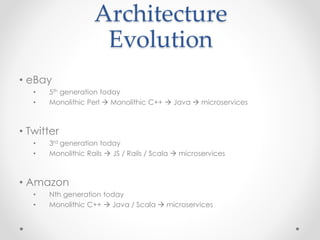
• eBay
• 5th generation today
• Monolithic Perl  Monolithic C++  Java  microservices
• Twitter
• 3rd generation today
• Monolithic Rails  JS / Rails / Scala  microservices
• Amazon
• Nth generation today
• Monolithic C++  Java / Scala  microservices
Architecture
Evolution
• The Monolith
• Ecosystem of Services
• Building and Operating a Service
• Service Anti-Patterns
Architecture
Evolution
• The Monolith
• Ecosystem of Services
• Building and Operating a Service
• Service Anti-Patterns
The Monolithic
Architecture
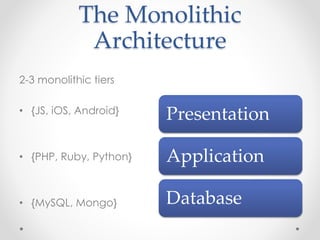
2-3 monolithic tiers
• {JS, iOS, Android}
• {PHP, Ruby, Python}
• {MySQL, Mongo}
Presentation
Application
Database
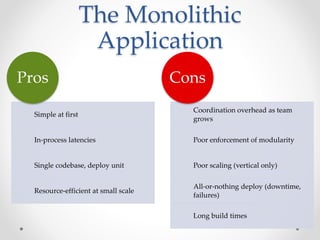
The Monolithic
Application
Simple at first
In-process latencies
Single codebase, deploy unit
Resource-efficient at small scale
Pros
Coordination overhead as team
grows
Poor enforcement of modularity
Poor scaling (vertical only)
All-or-nothing deploy (downtime,
failures)
Long build times
Cons
The Monolithic
Database
Simple at first
Join queries are easy
Single schema, deployment
Resource-efficient at small scale
Pros
Coupling over time
Poor scaling and redundancy (all-or-
nothing, vertical only)
Difficult to tune properly
All-or-nothing schema management
Cons
“If you don’t end up
regretting your early
technology decisions, you
probably over-engineered”
-- me
Architecture
Evolution
• The Monolith
• Ecosystem of Services
• Building and Operating a Service
• Service Anti-Patterns
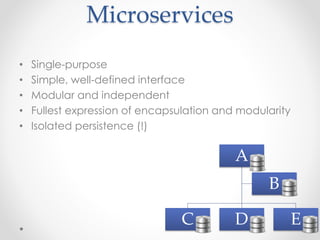
Microservices
• Single-purpose
• Simple, well-defined interface
• Modular and independent
• Fullest expression of encapsulation and modularity
• Isolated persistence (!)
A
C D E
B
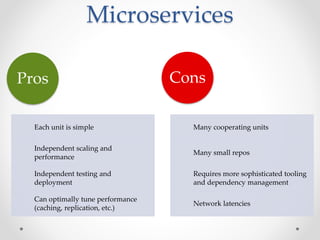
Microservices
Each unit is simple
Independent scaling and
performance
Independent testing and
deployment
Can optimally tune performance
(caching, replication, etc.)
Pros
Many cooperating units
Many small repos
Requires more sophisticated tooling
and dependency management
Network latencies
Cons
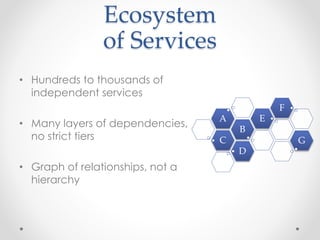
Ecosystem
of Services
• Hundreds to thousands of
independent services
• Many layers of dependencies,
no strict tiers
• Graph of relationships, not a
hierarchy
C
B
A E
F
G
D
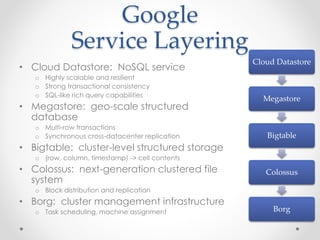
Google
Service Layering
• Cloud Datastore: NoSQL service
o Highly scalable and resilient
o Strong transactional consistency
o SQL-like rich query capabilities
• Megastore: geo-scale structured
database
o Multi-row transactions
o Synchronous cross-datacenter replication
• Bigtable: cluster-level structured storage
o (row, column, timestamp) -> cell contents
• Colossus: next-generation clustered file
system
o Block distribution and replication
• Borg: cluster management infrastructure
o Task scheduling, machine assignment
Cloud Datastore
Megastore
Bigtable
Colossus
Borg
Evolution,
not Intelligent Design
• No centralized, top-down design of the system
• Variation and Natural selection
o Create / extract new services when needed to solve a problem
o Deprecate services when no longer used
o Services justify their existence through usage
• Appearance of clean layering is an emergent
property
Architecture without an
Architect?
• No “Architect” title / role
• (+) No central approval for technology decisions
o Most technology decisions made locally instead of globally
o Better decisions in the field
Standardization
• Standardized communication
o Network protocols
o Data formats
o Interface schema / specification
• Standardized infrastructure
o Source control
o Configuration management
o Cluster management
o Monitoring, alerting, diagnosing, etc.
Standards become standards by
being better than the alternatives!
Service
Independence
• No standardization of service internals
o Programming languages
o Frameworks
o Persistence mechanisms
In a mature ecosystem of services,
we standardize the arcs of the
graph, not the nodes!
Creating
New Services
• Spinning out a new service
o Almost always built for particular use-case first
o If successful and appropriate, form a team and generalize for multiple
use-cases
• Pragmatism wins
• Examples
o Google File System
o Bigtable
o Megastore
o Google App Engine
o Gmail
Deprecating
Old Services
• What if a service is a failure?
o Repurpose technologies for other uses
o Redeploy people to other teams
• Examples
o Google Wave -> Google Apps
o Multiple generations of core services
“Every service at Google is either
deprecated or not ready yet.”
-- Google engineering proverb
Architecture
Evolution
• The Monolith
• Ecosystem of Services
• Building and Operating a Service
• Service Anti-Patterns
Goals of a
Service Owner
• Meet the needs of my clients …
• Functionality
• Quality
• Performance
• Stability and reliability
• Constant improvement over time
• … at minimum cost and effort
• Leverage common tools and infrastructure
• Leverage other services
• Automate building, deploying, and operating my service
• Optimize for efficient use of resources
Responsibilities of a
Service Owner
• End-to-end Ownership
o Team owns service from design to deployment to retirement
o No separate maintenance or sustaining engineering team
o DevOps philosophy of “You build it, you run it”
• Autonomy and Accountability
o Freedom to choose technology, methodology, working environment
o Responsibility for the results of those choices
Service-Service
Relationships
• Vendor – Customer Relationship
o Friendly and cooperative, but structured
o Clear ownership and division of responsibility
o Customer can choose to use service or not (!)
• Service-Level Agreement (SLA)
o Promise of service levels by the provider
o Customer needs to be able to rely on the service, like a utility
Service-Service
Relationships
• Charging and Cost Allocation
o Charge customers for *usage* of the service
o Aligns economic incentives of customer and provider
o Motivates both sides to optimize for efficiency
o (+) Pre- / post-allocation at Google
Architecture
Evolution
• The Monolith
• Ecosystem of Services
• Building and Operating a Service
• Service Anti-Patterns
Service
Anti-Patterns
• The “Mega-Service”
o Overbroad area of responsibility is difficult to reason about, change
o Leads to more upstream / downstream dependencies
• Shared persistence
o Breaks encapsulation, encourages “backdoor” interface violations
o Unhealthy and near-invisible coupling of services
o (-) Initial eBay SOA efforts
Service
Anti-Patterns
• “Leaky Abstraction” Service
o Interface reflects provider’s model of the interaction, not the consumer’s
model
o Consumer’s model is more aligned with the domain, simpler, more
abstract
o Leaking provider’s model in the interface constrains evolution of the
implementation
Thank You!
• @randyshoup
• linkedin.com/in/randyshoup
• Slides will be at slideshare.net/randyshoup

From the Monolith to Microservices - CraftConf 2015

  • 1.
    From the Monolithto Microservices Lessons from Google and eBay Randy Shoup @randyshoup linkedin.com/in/randyshoup
  • 2.
    Architecture Evolution • eBay • 5thgeneration today • Monolithic Perl  Monolithic C++  Java  microservices • Twitter • 3rd generation today • Monolithic Rails  JS / Rails / Scala  microservices • Amazon • Nth generation today • Monolithic C++  Java / Scala  microservices
  • 3.
    Architecture Evolution • The Monolith •Ecosystem of Services • Building and Operating a Service • Service Anti-Patterns
  • 4.
    Architecture Evolution • The Monolith •Ecosystem of Services • Building and Operating a Service • Service Anti-Patterns
  • 5.
    The Monolithic Architecture 2-3 monolithictiers • {JS, iOS, Android} • {PHP, Ruby, Python} • {MySQL, Mongo} Presentation Application Database
  • 6.
    The Monolithic Application Simple atfirst In-process latencies Single codebase, deploy unit Resource-efficient at small scale Pros Coordination overhead as team grows Poor enforcement of modularity Poor scaling (vertical only) All-or-nothing deploy (downtime, failures) Long build times Cons
  • 7.
    The Monolithic Database Simple atfirst Join queries are easy Single schema, deployment Resource-efficient at small scale Pros Coupling over time Poor scaling and redundancy (all-or- nothing, vertical only) Difficult to tune properly All-or-nothing schema management Cons
  • 8.
    “If you don’tend up regretting your early technology decisions, you probably over-engineered” -- me
  • 9.
    Architecture Evolution • The Monolith •Ecosystem of Services • Building and Operating a Service • Service Anti-Patterns
  • 10.
    Microservices • Single-purpose • Simple,well-defined interface • Modular and independent • Fullest expression of encapsulation and modularity • Isolated persistence (!) A C D E B
  • 11.
    Microservices Each unit issimple Independent scaling and performance Independent testing and deployment Can optimally tune performance (caching, replication, etc.) Pros Many cooperating units Many small repos Requires more sophisticated tooling and dependency management Network latencies Cons
  • 12.
    Ecosystem of Services • Hundredsto thousands of independent services • Many layers of dependencies, no strict tiers • Graph of relationships, not a hierarchy C B A E F G D
  • 13.
    Google Service Layering • CloudDatastore: NoSQL service o Highly scalable and resilient o Strong transactional consistency o SQL-like rich query capabilities • Megastore: geo-scale structured database o Multi-row transactions o Synchronous cross-datacenter replication • Bigtable: cluster-level structured storage o (row, column, timestamp) -> cell contents • Colossus: next-generation clustered file system o Block distribution and replication • Borg: cluster management infrastructure o Task scheduling, machine assignment Cloud Datastore Megastore Bigtable Colossus Borg
  • 14.
    Evolution, not Intelligent Design •No centralized, top-down design of the system • Variation and Natural selection o Create / extract new services when needed to solve a problem o Deprecate services when no longer used o Services justify their existence through usage • Appearance of clean layering is an emergent property
  • 15.
    Architecture without an Architect? •No “Architect” title / role • (+) No central approval for technology decisions o Most technology decisions made locally instead of globally o Better decisions in the field
  • 16.
    Standardization • Standardized communication oNetwork protocols o Data formats o Interface schema / specification • Standardized infrastructure o Source control o Configuration management o Cluster management o Monitoring, alerting, diagnosing, etc.
  • 17.
    Standards become standardsby being better than the alternatives!
  • 18.
    Service Independence • No standardizationof service internals o Programming languages o Frameworks o Persistence mechanisms
  • 19.
    In a matureecosystem of services, we standardize the arcs of the graph, not the nodes!
  • 20.
    Creating New Services • Spinningout a new service o Almost always built for particular use-case first o If successful and appropriate, form a team and generalize for multiple use-cases • Pragmatism wins • Examples o Google File System o Bigtable o Megastore o Google App Engine o Gmail
  • 21.
    Deprecating Old Services • Whatif a service is a failure? o Repurpose technologies for other uses o Redeploy people to other teams • Examples o Google Wave -> Google Apps o Multiple generations of core services
  • 22.
    “Every service atGoogle is either deprecated or not ready yet.” -- Google engineering proverb
  • 23.
    Architecture Evolution • The Monolith •Ecosystem of Services • Building and Operating a Service • Service Anti-Patterns
  • 24.
    Goals of a ServiceOwner • Meet the needs of my clients … • Functionality • Quality • Performance • Stability and reliability • Constant improvement over time • … at minimum cost and effort • Leverage common tools and infrastructure • Leverage other services • Automate building, deploying, and operating my service • Optimize for efficient use of resources
  • 25.
    Responsibilities of a ServiceOwner • End-to-end Ownership o Team owns service from design to deployment to retirement o No separate maintenance or sustaining engineering team o DevOps philosophy of “You build it, you run it” • Autonomy and Accountability o Freedom to choose technology, methodology, working environment o Responsibility for the results of those choices
  • 26.
    Service-Service Relationships • Vendor –Customer Relationship o Friendly and cooperative, but structured o Clear ownership and division of responsibility o Customer can choose to use service or not (!) • Service-Level Agreement (SLA) o Promise of service levels by the provider o Customer needs to be able to rely on the service, like a utility
  • 27.
    Service-Service Relationships • Charging andCost Allocation o Charge customers for *usage* of the service o Aligns economic incentives of customer and provider o Motivates both sides to optimize for efficiency o (+) Pre- / post-allocation at Google
  • 28.
    Architecture Evolution • The Monolith •Ecosystem of Services • Building and Operating a Service • Service Anti-Patterns
  • 29.
    Service Anti-Patterns • The “Mega-Service” oOverbroad area of responsibility is difficult to reason about, change o Leads to more upstream / downstream dependencies • Shared persistence o Breaks encapsulation, encourages “backdoor” interface violations o Unhealthy and near-invisible coupling of services o (-) Initial eBay SOA efforts
  • 30.
    Service Anti-Patterns • “Leaky Abstraction”Service o Interface reflects provider’s model of the interaction, not the consumer’s model o Consumer’s model is more aligned with the domain, simpler, more abstract o Leaking provider’s model in the interface constrains evolution of the implementation
  • 31.
    Thank You! • @randyshoup •linkedin.com/in/randyshoup • Slides will be at slideshare.net/randyshoup