Simon Brown
@simonbrown
Agility
and the essence of
software architecture
simon.brown@codingthearchitecture.com
@simonbrown on Twitter
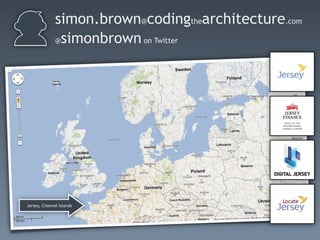
Jersey, Channel Islands
The Difference between the United Kingdom,
Great Britain and England Explained
http://www.youtube.com/watch?v=rNu8XDBSn10
I help software teams understand
software architecture,
technical leadership and
the balance with agility
I code too
⇧ ; - ⇧ 0
Software architecture
needs to be more
accessible
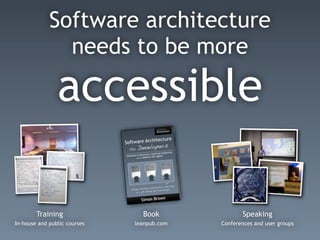
Training
In-house and public courses
Book
leanpub.com
Speaking
Conferences and user groups
Agility
Agile is about
moving fast, embracing
change, releasing often,
getting feedback, etc
plus some
fluffy stuff
What is
agile software
architecture?
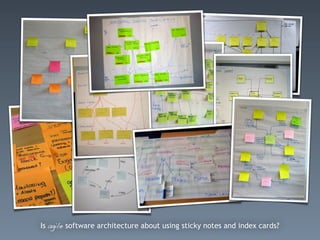
Is agile software architecture about using sticky notes and index cards?
Delivering software
in an agile way
doesn’t guarantee
that the resulting
software architecture
is agile
Agile teams
don’t necessarily
create agile
software
architectures
An agile software architecture
easily reacts
to change
within its environment
Are monolithic
architectures agile?
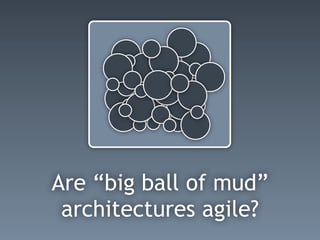
Are “big ball of mud”
architectures agile?
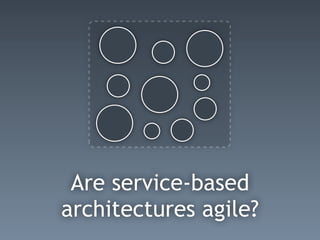
Are service-based
architectures agile?
A good
architecture
enables
agility
Nothing
is free!
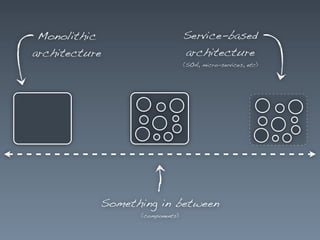
Monolithic
architecture
Service-based
architecture
(SOA, micro-services, etc)
Something in between
(components)
What does
“agility”
mean?
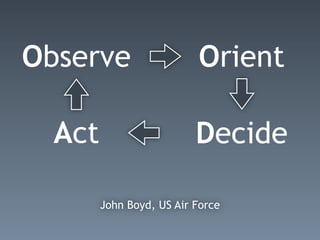
John Boyd, US Air Force
Observe Orient
Act Decide
Agility is relative
and time-based
Inspect
and
Adapt
How do we inspect
an existing
software architecture?
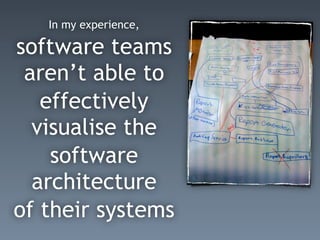
In my experience,
software teams
aren’t able to
effectively
visualise the
software
architecture
of their systems
Who here uses UML
on a regular basis?
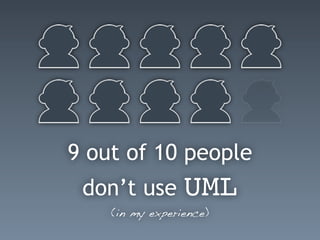
9 out of 10 people
don’t use UML
(in my experience)
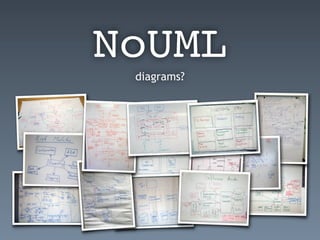
NoUML
diagrams?
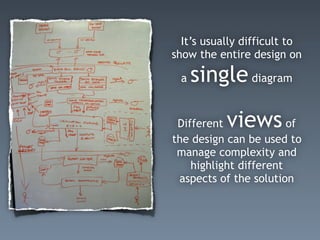
It’s usually difficult to
show the entire design on
a single diagram
Different views of
the design can be used to
manage complexity and
highlight different
aspects of the solution
Do the names
of those views make sense?
Development vs Physical
Process vs Functional
Conceptual vs Logical
Development vs Implementation
Physical vs Implementation
Physical vs Deployment
Did you
code
it that way?
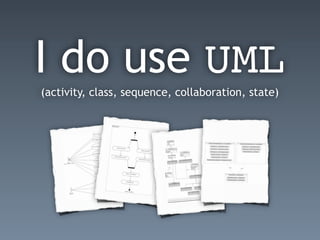
I do use UML
(activity, class, sequence, collaboration, state)
A common set of
abstractions
is more important than
a common notation
How do we adapt
an existing
software architecture?
Is architectural
refactoring hard?
Does your code reflect the
abstractions
that you think about?
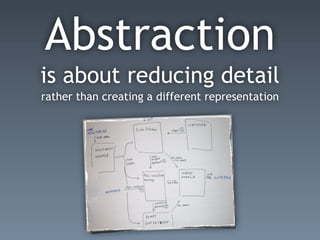
Abstraction
is about reducing detail
rather than creating a different representation
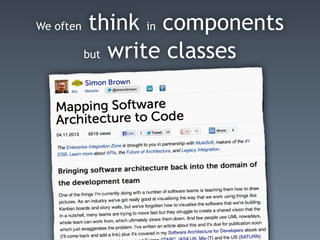
We often think in components
but write classes
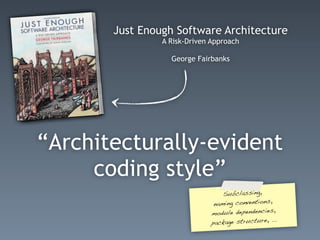
Just Enough Software Architecture
A Risk-Driven Approach
George Fairbanks
“Architecturally-evident
coding style”
Subclassing,
naming conventions,
module dependencies,
package structure, ...
Diagramming tools see
packages and classes not
components and services
The code doesn’t tell
the *whole* story,
but it does *a* story
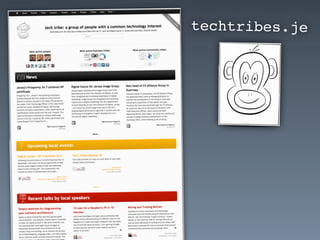
techtribes.je
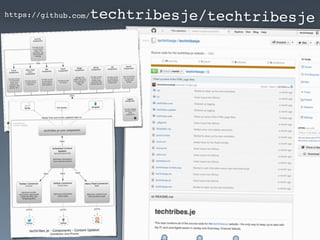
https://github.com/techtribesje/techtribesje
The essence of
software
architecture
Just enough up front design to
understand the
structure
of the software and
create a
shared vision
for the team
You need to
identify and mitigate
your highest priority
risks
Things that will cause
your project to fail
or you to be fired!
Agile software projects
do have risks, right? :-)
How?
Ensure that developers
understand
what software architecture is
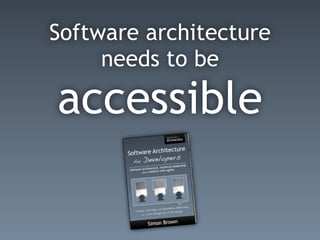
Software architecture
needs to be
accessible
Ensure that the
management
understands what software
architecture is too
Talk about
software architecture in
retrospectives
Illustrate this using
architecture
katas
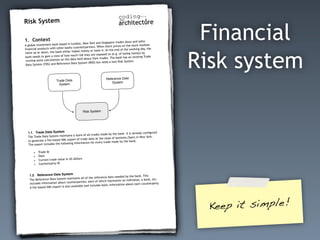
1. Context
A global investment bank based in London, New York and Singapore trades (buys and sells)
financial products with other banks (counterparties). When share prices on the stock markets
move up or down, the bank either makes money or loses it. At the end of the working day, the
bank needs to gain a view of how much risk they are exposed to (e.g. of losing money) by
running some calculations on the data held about their trades. The bank has an existing Trade
Data System (TDS) and Reference Data System (RDS) but need a new Risk System.
Trade Data
System
Reference Data
System
Risk System
1.1. Trade Data System
The Trade Data System maintains a store of all trades made by the bank. It is already configured
to generate a file-based XML export of trade data at the close of business (5pm) in New York.
The export includes the following information for every trade made by the bank:
• Trade ID
• Date
• Current trade value in US dollars
• Counterparty ID
1.2. Reference Data System
The Reference Data System maintains all of the reference data needed by the bank. This
includes information about counterparties; each of which represents an individual, a bank, etc.
A file-based XML export is also available and includes basic information about each counterparty.
Risk System
Financial
Risk system
1. Context
A global investment bank based in London, New York and Singapore trades (buys and sells)
financial products with other banks (counterparties). When share prices on the stock markets
move up or down, the bank either makes money or loses it. At the end of the working day, the
bank needs to gain a view of how much risk they are exposed to (e.g. of losing money) by
running some calculations on the data held about their trades. The bank has an existing Trade
Data System (TDS) and Reference Data System (RDS) but need a new Risk System.
Trade Data
System
Reference Data
System
Risk System
1.1. Trade Data System
The Trade Data System maintains a store of all trades made by the bank. It is already configured
to generate a file-based XML export of trade data at the close of business (5pm) in New York.
The export includes the following information for every trade made by the bank:
• Trade ID
• Date
• Current trade value in US dollars
• Counterparty ID
1.2. Reference Data System
The Reference Data System maintains all of the reference data needed by the bank. This
includes information about counterparties; each of which represents an individual, a bank, etc.
A file-based XML export is also available and includes basic information about each counterparty.
Risk System
Keep it simple!
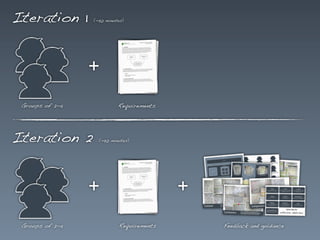
Iteration 1 (~90 minutes)
+
Iteration 2 (~90 minutes)
+ +
Groups of 2-4 Requirements
RequirementsGroups of 2-4 Feedback and guidance
The learning goals are:
1.collaborative design
2.architecture sketching
3.just enough up front design
Every
software developer
should know how to
sketch
Architecture sketching
assists with having
better conversations
Architecture sketching
assists with
collective ownership
of the code
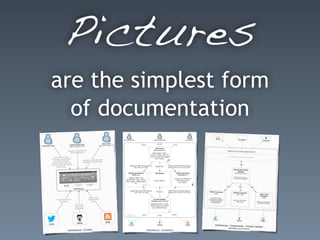
Pictures
are the simplest form
of documentation
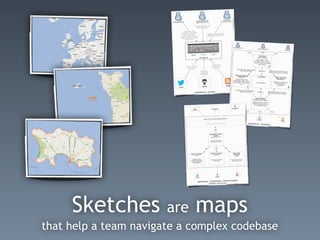
Sketches are maps
that help a team navigate a complex codebase
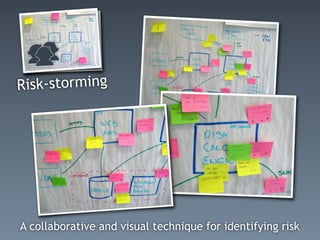
Risk-storming
A collaborative and visual technique for identifying risk
So what?
“the subject of agile and architecture have
been written about and discussed at length,
and in fact now it is almost old news”
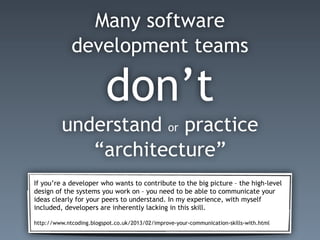
Many software
development teams
don’t
understand or practice
“architecture”
If you’re a developer who wants to contribute to the big picture – the high-level
design of the systems you work on – you need to be able to communicate your
ideas clearly for your peers to understand. In my experience, with myself
included, developers are inherently lacking in this skill.
http://www.ntcoding.blogspot.co.uk/2013/02/improve-your-communication-skills-with.html
educate
We have a duty to
simon.brown@codingthearchitecture.com
@simonbrown on Twitter
This is about
scaling teams...

ASAS 2013 - Agility and the essence of software architecture