Concurrency at Scale: 
The Evolution to Micro-Services 
Randy Shoup 
@randyshoup 
linkedin.com/in/randyshoup
Background 
• CTO at KIXEYE 
o Real-time strategy games for web and mobile 
• Director of Engineering for Google App Engine 
o World’s largest Platform-as-a-Service 
o Part of Google Cloud Platform 
• Chief Engineer at eBay 
o Multiple generations of eBay’s real-time search infrastructure
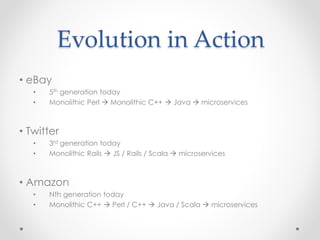
Evolution in Action 
• eBay 
• 5th generation today 
• Monolithic Perl  Monolithic C++  Java  microservices 
• Twitter 
• 3rd generation today 
• Monolithic Rails  JS / Rails / Scala  microservices 
• Amazon 
• Nth generation today 
• Monolithic C++  Perl / C++  Java / Scala  microservices
Evolution to 
Micro-Services 
• The Monolith 
• Micro-Services 
• Reactive Systems 
• Migrating to Micro-Services
Evolution to 
Micro-Services 
• The Monolith 
• Micro-Services 
• Reactive Systems 
• Migrating to Micro-Services
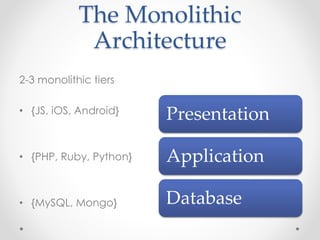
The Monolithic 
Architecture 
2-3 monolithic tiers 
• {JS, iOS, Android} 
• {PHP, Ruby, Python} 
• {MySQL, Mongo} 
Presentation 
Application 
Database
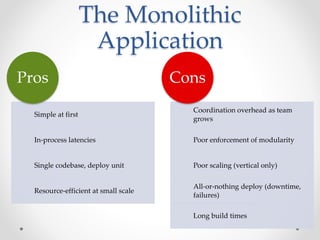
The Monolithic 
Application 
Pros 
Simple at first 
In-process latencies 
Single codebase, deploy unit 
Resource-efficient at small scale 
Cons 
Coordination overhead as team 
grows 
Poor enforcement of modularity 
Poor scaling (vertical only) 
All-or-nothing deploy (downtime, 
failures) 
Long build times
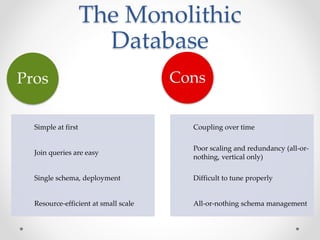
The Monolithic 
Database 
Pros 
Simple at first 
Join queries are easy 
Single schema, deployment 
Resource-efficient at small scale 
Cons 
Coupling over time 
Poor scaling and redundancy (all-or-nothing, 
vertical only) 
Difficult to tune properly 
All-or-nothing schema management
“If you don’t end up 
regretting your early 
technology decisions, you 
probably over-engineered” 
-- me
Evolution to 
Micro-Services 
• The Monolith 
• Micro-Services 
• Reactive Systems 
• Migrating to Micro-Services
Micro-Services 
“Loosely-coupled service 
oriented architecture with 
bounded contexts” 
-- Adrian Cockcroft
Micro-Services 
“Loosely-coupled service 
oriented architecture with 
bounded contexts” 
-- Adrian Cockcroft
Micro-Services 
“Loosely-coupled service 
oriented architecture with 
bounded contexts” 
-- Adrian Cockcroft
Micro-Services 
“Loosely-coupled service 
oriented architecture with 
bounded contexts” 
-- Adrian Cockcroft
Micro-Services 
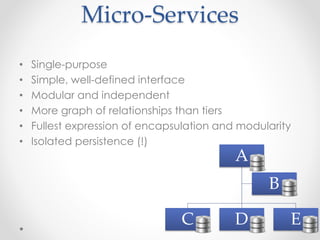
• Single-purpose 
• Simple, well-defined interface 
• Modular and independent 
• More graph of relationships than tiers 
• Fullest expression of encapsulation and modularity 
• Isolated persistence (!) 
A 
B 
C D E
Micro-Services 
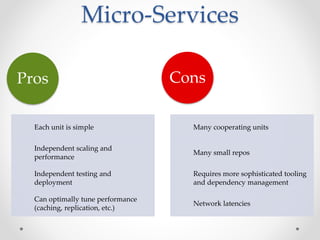
Pros 
Each unit is simple 
Independent scaling and 
performance 
Independent testing and 
deployment 
Can optimally tune performance 
(caching, replication, etc.) 
Cons 
Many cooperating units 
Many small repos 
Requires more sophisticated tooling 
and dependency management 
Network latencies
Google Services 
• All engineering groups organized into “services” 
• Gmail, App Engine, Bigtable, etc. 
• Self-sufficient and autonomous 
• Layered on one another 
 Very small teams achieve great things
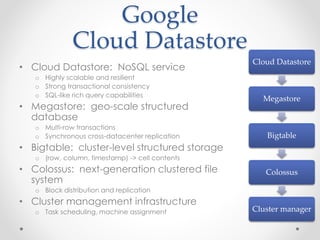
Google 
Cloud Datastore 
• Cloud Datastore: NoSQL service 
o Highly scalable and resilient 
o Strong transactional consistency 
o SQL-like rich query capabilities 
• Megastore: geo-scale structured 
database 
o Multi-row transactions 
o Synchronous cross-datacenter replication 
• Bigtable: cluster-level structured storage 
o (row, column, timestamp) -> cell contents 
• Colossus: next-generation clustered file 
system 
o Block distribution and replication 
• Cluster management infrastructure 
o Task scheduling, machine assignment 
Cloud Datastore 
Megastore 
Bigtable 
Colossus 
Cluster manager
Evolution to 
Micro-Services 
• The Monolith 
• Micro-Services 
• Reactive Systems 
• Migrating to Micro-Services
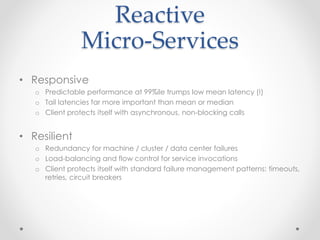
Reactive 
Micro-Services 
• Responsive 
o Predictable performance at 99%ile trumps low mean latency (!) 
o Tail latencies far more important than mean or median 
o Client protects itself with asynchronous, non-blocking calls 
• Resilient 
o Redundancy for machine / cluster / data center failures 
o Load-balancing and flow control for service invocations 
o Client protects itself with standard failure management patterns: timeouts, 
retries, circuit breakers
Reactive 
Micro-Services 
• Elastic 
o Scale up and down service instances according to load 
o Gracefully handle spiky workloads 
o Predictive and reactive scaling 
• Message-Driven 
o Asynchronous message-passing over synchronous request-response 
o Often custom protocol over TCP / UDP or WebSockets over HTTP
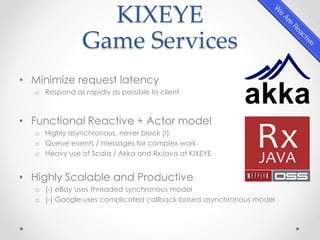
KIXEYE 
Game Services 
• Minimize request latency 
o Respond as rapidly as possible to client 
• Functional Reactive + Actor model 
o Highly asynchronous, never block (!) 
o Queue events / messages for complex work 
o Heavy use of Scala / Akka and RxJava at KIXEYE 
• Highly Scalable and Productive 
o (-) eBay uses threaded synchronous model 
o (-) Google uses complicated callback-based asynchronous model
KIXEYE 
Service Chassis 
• Goal: Make it easy to build and deploy micro-services 
• Chassis core 
• Configuration integration 
• Registration and Discovery 
• Monitoring and Metrics 
• Load-balancing for downstream services 
• Failure management for downstream services 
• Development / Deployment Pipeline 
• Transport layer over REST / JSON or WebSockets 
• Service template in Maven 
• Build pipeline through Puppet -> Packer -> AMI 
• Red-black deployment via Asgard
KIXEYE 
Service Chassis 
• Heavy use of NetflixOSS 
• Asgard 
• Hystrix 
• Ribbon + WebSockets  Janus 
• Eureka 
 Results 
• 15 minutes from no code to running service in AWS (!) 
• Open-sourced at https://github.com/Kixeye
Evolution to 
Micro-Services 
• The Monolith 
• Micro-Services 
• Reactive Systems 
• Migrating to Micro-Services
Migrating 
Incrementally 
• Find your worst scaling bottleneck 
• Wall it off behind an interface 
• Replace it 
•  Rinse and Repeat
Building 
Micro-Services 
• Common Chassis / Framework 
o Make it trivially easy to build and maintain a service 
• Define Service Interface (Formally!) 
o Propose 
o Discuss with client(s) 
o Agree 
• Prototype Implementation 
o Simplest thing that could possibly work 
o Client can integrate with prototype 
o Implementor can learn what works and what does not
Building 
Micro-Services 
• Real Implementation 
o Throw away the prototype (!) 
•  Rinse and Repeat
“So you are really 
serious about this …” 
• Distributed tracing 
• Trace a request chain through multiple service invocations 
• Network visualization 
• “Weighted” communication paths between microservices / instances 
• Latency, error rates, connection failures 
• Dashboard metrics 
• Quickly scan operational health of many services 
• Median, 99%ile, 99.9%ile, etc. 
• Netflix Hystrix / Turbine
Micro-Service 
Organization 
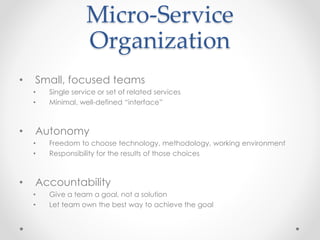
• Small, focused teams 
• Single service or set of related services 
• Minimal, well-defined “interface” 
• Autonomy 
• Freedom to choose technology, methodology, working environment 
• Responsibility for the results of those choices 
• Accountability 
• Give a team a goal, not a solution 
• Let team own the best way to achieve the goal
Micro-Service 
Relationships 
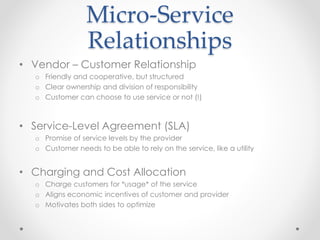
• Vendor – Customer Relationship 
o Friendly and cooperative, but structured 
o Clear ownership and division of responsibility 
o Customer can choose to use service or not (!) 
• Service-Level Agreement (SLA) 
o Promise of service levels by the provider 
o Customer needs to be able to rely on the service, like a utility 
• Charging and Cost Allocation 
o Charge customers for *usage* of the service 
o Aligns economic incentives of customer and provider 
o Motivates both sides to optimize
Recap: Evolution to 
Micro-Services 
• The Monolith 
• Micro-Services 
• Reactive Systems 
• Migrating to Micro-Services
Thank You! 
• @randyshoup 
• linkedin.com/in/randyshoup 
• Slides will be at slideshare.net/randyshoup

Concurrency at Scale: Evolution to Micro-Services

  • 1.
    Concurrency at Scale: The Evolution to Micro-Services Randy Shoup @randyshoup linkedin.com/in/randyshoup
  • 2.
    Background • CTOat KIXEYE o Real-time strategy games for web and mobile • Director of Engineering for Google App Engine o World’s largest Platform-as-a-Service o Part of Google Cloud Platform • Chief Engineer at eBay o Multiple generations of eBay’s real-time search infrastructure
  • 3.
    Evolution in Action • eBay • 5th generation today • Monolithic Perl  Monolithic C++  Java  microservices • Twitter • 3rd generation today • Monolithic Rails  JS / Rails / Scala  microservices • Amazon • Nth generation today • Monolithic C++  Perl / C++  Java / Scala  microservices
  • 4.
    Evolution to Micro-Services • The Monolith • Micro-Services • Reactive Systems • Migrating to Micro-Services
  • 5.
    Evolution to Micro-Services • The Monolith • Micro-Services • Reactive Systems • Migrating to Micro-Services
  • 6.
    The Monolithic Architecture 2-3 monolithic tiers • {JS, iOS, Android} • {PHP, Ruby, Python} • {MySQL, Mongo} Presentation Application Database
  • 7.
    The Monolithic Application Pros Simple at first In-process latencies Single codebase, deploy unit Resource-efficient at small scale Cons Coordination overhead as team grows Poor enforcement of modularity Poor scaling (vertical only) All-or-nothing deploy (downtime, failures) Long build times
  • 8.
    The Monolithic Database Pros Simple at first Join queries are easy Single schema, deployment Resource-efficient at small scale Cons Coupling over time Poor scaling and redundancy (all-or-nothing, vertical only) Difficult to tune properly All-or-nothing schema management
  • 9.
    “If you don’tend up regretting your early technology decisions, you probably over-engineered” -- me
  • 10.
    Evolution to Micro-Services • The Monolith • Micro-Services • Reactive Systems • Migrating to Micro-Services
  • 11.
    Micro-Services “Loosely-coupled service oriented architecture with bounded contexts” -- Adrian Cockcroft
  • 12.
    Micro-Services “Loosely-coupled service oriented architecture with bounded contexts” -- Adrian Cockcroft
  • 13.
    Micro-Services “Loosely-coupled service oriented architecture with bounded contexts” -- Adrian Cockcroft
  • 14.
    Micro-Services “Loosely-coupled service oriented architecture with bounded contexts” -- Adrian Cockcroft
  • 15.
    Micro-Services • Single-purpose • Simple, well-defined interface • Modular and independent • More graph of relationships than tiers • Fullest expression of encapsulation and modularity • Isolated persistence (!) A B C D E
  • 16.
    Micro-Services Pros Eachunit is simple Independent scaling and performance Independent testing and deployment Can optimally tune performance (caching, replication, etc.) Cons Many cooperating units Many small repos Requires more sophisticated tooling and dependency management Network latencies
  • 17.
    Google Services •All engineering groups organized into “services” • Gmail, App Engine, Bigtable, etc. • Self-sufficient and autonomous • Layered on one another  Very small teams achieve great things
  • 18.
    Google Cloud Datastore • Cloud Datastore: NoSQL service o Highly scalable and resilient o Strong transactional consistency o SQL-like rich query capabilities • Megastore: geo-scale structured database o Multi-row transactions o Synchronous cross-datacenter replication • Bigtable: cluster-level structured storage o (row, column, timestamp) -> cell contents • Colossus: next-generation clustered file system o Block distribution and replication • Cluster management infrastructure o Task scheduling, machine assignment Cloud Datastore Megastore Bigtable Colossus Cluster manager
  • 19.
    Evolution to Micro-Services • The Monolith • Micro-Services • Reactive Systems • Migrating to Micro-Services
  • 20.
    Reactive Micro-Services •Responsive o Predictable performance at 99%ile trumps low mean latency (!) o Tail latencies far more important than mean or median o Client protects itself with asynchronous, non-blocking calls • Resilient o Redundancy for machine / cluster / data center failures o Load-balancing and flow control for service invocations o Client protects itself with standard failure management patterns: timeouts, retries, circuit breakers
  • 21.
    Reactive Micro-Services •Elastic o Scale up and down service instances according to load o Gracefully handle spiky workloads o Predictive and reactive scaling • Message-Driven o Asynchronous message-passing over synchronous request-response o Often custom protocol over TCP / UDP or WebSockets over HTTP
  • 22.
    KIXEYE Game Services • Minimize request latency o Respond as rapidly as possible to client • Functional Reactive + Actor model o Highly asynchronous, never block (!) o Queue events / messages for complex work o Heavy use of Scala / Akka and RxJava at KIXEYE • Highly Scalable and Productive o (-) eBay uses threaded synchronous model o (-) Google uses complicated callback-based asynchronous model
  • 23.
    KIXEYE Service Chassis • Goal: Make it easy to build and deploy micro-services • Chassis core • Configuration integration • Registration and Discovery • Monitoring and Metrics • Load-balancing for downstream services • Failure management for downstream services • Development / Deployment Pipeline • Transport layer over REST / JSON or WebSockets • Service template in Maven • Build pipeline through Puppet -> Packer -> AMI • Red-black deployment via Asgard
  • 24.
    KIXEYE Service Chassis • Heavy use of NetflixOSS • Asgard • Hystrix • Ribbon + WebSockets  Janus • Eureka  Results • 15 minutes from no code to running service in AWS (!) • Open-sourced at https://github.com/Kixeye
  • 25.
    Evolution to Micro-Services • The Monolith • Micro-Services • Reactive Systems • Migrating to Micro-Services
  • 26.
    Migrating Incrementally •Find your worst scaling bottleneck • Wall it off behind an interface • Replace it •  Rinse and Repeat
  • 27.
    Building Micro-Services •Common Chassis / Framework o Make it trivially easy to build and maintain a service • Define Service Interface (Formally!) o Propose o Discuss with client(s) o Agree • Prototype Implementation o Simplest thing that could possibly work o Client can integrate with prototype o Implementor can learn what works and what does not
  • 28.
    Building Micro-Services •Real Implementation o Throw away the prototype (!) •  Rinse and Repeat
  • 29.
    “So you arereally serious about this …” • Distributed tracing • Trace a request chain through multiple service invocations • Network visualization • “Weighted” communication paths between microservices / instances • Latency, error rates, connection failures • Dashboard metrics • Quickly scan operational health of many services • Median, 99%ile, 99.9%ile, etc. • Netflix Hystrix / Turbine
  • 30.
    Micro-Service Organization •Small, focused teams • Single service or set of related services • Minimal, well-defined “interface” • Autonomy • Freedom to choose technology, methodology, working environment • Responsibility for the results of those choices • Accountability • Give a team a goal, not a solution • Let team own the best way to achieve the goal
  • 31.
    Micro-Service Relationships •Vendor – Customer Relationship o Friendly and cooperative, but structured o Clear ownership and division of responsibility o Customer can choose to use service or not (!) • Service-Level Agreement (SLA) o Promise of service levels by the provider o Customer needs to be able to rely on the service, like a utility • Charging and Cost Allocation o Charge customers for *usage* of the service o Aligns economic incentives of customer and provider o Motivates both sides to optimize
  • 32.
    Recap: Evolution to Micro-Services • The Monolith • Micro-Services • Reactive Systems • Migrating to Micro-Services
  • 33.
    Thank You! •@randyshoup • linkedin.com/in/randyshoup • Slides will be at slideshare.net/randyshoup