Forces Affecting University Mathematics
Professors' Use of Technology in Their
Geometry Classrooms
Aaron Brakoniecki
Mathematics Learning Research Group
Michigan State University
Itinerary

 Background
 Literature Review/
 Framework
 Methods
 Results
 Discussion
Background
College Mathematics & Technology
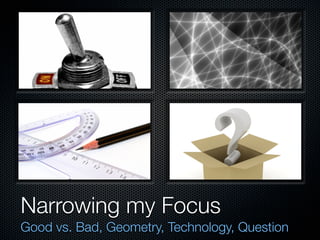
Narrowing my Focus
Good vs. Bad, Geometry, Technology, Question
Creating a Framework
Related Research
  Teacher’s Use of Technology in K-12 Schools
  (Becker, 2000), (Russell, Bebell, O'Dwyer, &
  O'Connor, 2003), (Ravitz, Wong and Becker, 1999)
  Teacher Beliefs (Thompson, 1992), (Ernest, 1998),
  (Kuhs & Ball, 1986)
  Beliefs about Technology in Mathematics Classrooms
  (Dick, 2007), (Zbiek, Heid, Blume, & Dick, 2007)
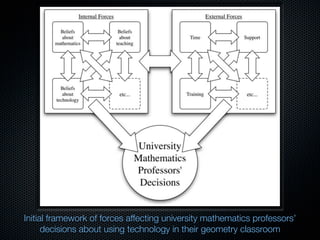
Initial framework of forces affecting university mathematics professors’
      decisions about using technology in their geometry classroom
Research Question
What is a framework that can help describe the
forces affecting college professors’ decisions to
use (or not use) technology in their classroom?
Methods

Interviews
Geometry professors
who had taught their
class more than once
Vary institution type
from within Michigan
No more than 8
Constant Comparison
(Glaser & Strauss, 1967)
 1.	 Comparing and contrasting incidents to create
 categories into which the data can fit
 2.	 Integrating categories and their properties into
 larger bins
 3.	 Delimiting the theory to focus it
 4.	 Writing the theory that has emerged out of the
 data.
Interview Protocol

I. Asks professors about the course as a whole, structure
   of individual lessons, and class preparation
II. Asks professors about any technology use in their
    lessons, how they came to decide upon technology,
    and thoughts on technology and geometry
III.Asks professors about training and support for
    technology at their institutions,
Participants
Dr. Herb Williams – Small private liberal arts college. He has
previously taught an axiomatic geometry course.
Dr. Christine Lauer – Large public research university. She has
previously taught a course in Euclidean geometry.
Dr. Samantha Gooding – Private technical institute. She has
previously taught a course focusing on the intersection of
geometry and the arts.
Dr. Karl Quinn – Small, private liberal arts college. He has
previously taught a course axiomatic geometry course.
Dr. Ursula Nichols – Medium-sized, public research institution.
She has previously taught a course on axiomatic geometry.
Results
Internal Forces
Goals for the Course
Each professors’ personal goals for the course
  Dr. Williams - students to walk away with an
  appreciation of geometry and its importance in history,
  and not necessarily facts. Change the disposition of his
  students to one favorable towards geometry
  Dr. Lauer - “more experiential than content driven”,
  wanted students to have different experiences in
  mathematics
  Dr. Gooding - wanted her course to change her
  students’ perspectives on life, and so they would see
  geometry wherever they are.
Perceived Establishment of
Course Content
Two themes emerged, either solidifying course content,
or intentionally changing content between years
  Dr. Quinn - “It’s been a long time since I’ve gone
  about…”. He added that he had been teaching this
  course since “water was invented”.
  Dr. Lauer - tried to change the course content every
  year, so that way, she wouldn’t have sat with an idea
  as long
Beliefs About What
 Technology can do

What was technology’s role within the classroom?
  Dr. Williams - geometry is about unpacking and figuring out
  what causes, whereas the software package Geometer’s
  Sketchpad was a “little black box that won’t let you peer
  inside”.
  Dr. Lauer - technology produces an environment and then
  the question is, what do you get out of that environment
Beliefs about Technology in
Geometry
 Beliefs about using technology within the geometry
 classroom
   Dr. Nichols - technology’s use in geometry should,
   “depend on the content; whether it let’s [students]
   look at a problem authentically and does it help them
   build their understanding
   Dr. Quinn - didn’t believe there was any content
   reason to be hesitant about using technology in
   geometry.
Beliefs about Student
Interactions with Technology
 Beliefs about how they wanted students to interact with
 technology in their classroom
   Dr. Williams noted that in his opinion, technology
   should be used for discovery by the students, and
   not for demonstrations to the students.
   Dr. Gooding expressed a desire for students to
   experiment more in mathematics as they do in their
   arts classes. She described a frustration of students
   going right to technology for answers without playing
   around with ideas.
How Students will Learn in
this Course
 Different learning methods to utilized in this course
   Dr. Williams & Dr. Gooding expressed the desire that
   students would learn by making discoveries
   Dr. Lauer & Dr. Nichols expressed the desire that
   students would learn by making connections and
   constructing their knowledge
Professor’s Preparation to
Use Technology
 All professors expressed confidence in their and their
 colleagues ability to use technology, however, there
 were some on using the technology pedagogically
   Dr. Williams - didn’t believe it’s that hard to use
   technology, although it might be slightly more
   challenging to learn how to use it for teaching
   Dr. Nichols - believed that teachers should
   technology should be used in meaningful ways to
   enhance the learning of a topic.
Findings
External Forces
Goals for the Course

Institution-level goals for the course. Course description
  These goals ranged from proof writing (Dr. Williams,
  Dr. Lauer, Dr. Quinn, and Dr. Nichols), to better
  understanding of Euclidean and Non-Euclidean
  geometries (all interviewees), to examining
  mathematics in the arts and architecture (Dr.
  Gooding and Dr. Quinn).
Population of the Course


Professors were conscience of the different populations
within their courses, and that they had considered
tailoring the content of their courses to fit the
populations enrolled in their courses
Position of Course within the
Curriculum

 All these geometry courses were terminal courses, they
 were not prerequisites for any other course in their
 departments
 All professors were aware of the different prerequisites
 required for their courses and that seemed to have
 effect on course content
Access to Technology
The physical location of technology and access to software
differed among classes.
  Dr. Lauer and Dr. Gooding noted that they would have
  students bring laptops to the classroom
  Dr. Lauer, Dr. Quinn, and Dr. Nichols all described efforts to
  utilize one of their institutions’ computer labs during their
  course
  Dr. Quinn also described a time his department purchased
  a large number of textbooks bundled with software. Went
  around to the different computer labs on campus and
  installed the software by hand.
Department/Institution
Support for Technology
Resources for professors who wanted to use
technology to be successful
  Dr. Williams - existed funds for travel for professional
  development opportunities
  Dr. Nichols’ - institution equipping rooms with
  technology carts and built-in data projectors
  Dr. Lauer - department and institution’s support in
  providing laptop carts for classrooms, support with
  setup and storage of technology, and acquiring
  software licenses
Department/Institution
Philosophy About
Technology Use
 Dr. Gooding - institution had formed a working group
 with the goal of promoting active learning with
 technology
 Dr. Lauer - while her university had a position that was
 favorable to technology, her department had a position
 that was not
 Dr. Nichols -classes offered by computing services for
 faculty on topics such as podcasting, e-learning, and
 developing your website
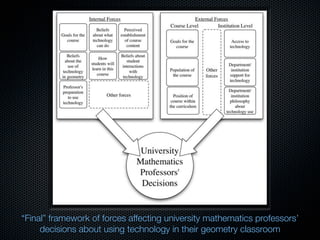
“Final” framework of forces affecting university mathematics professors’
     decisions about using technology in their geometry classroom
Discussion
Framework Structure
  External Forces - Course Level and Institution Level
  Interactions Among Forces
Framework Content
  No relation to their own experiences in geometry
  Time was not discussed as affecting decisions
Complexifying College Instruction
Limitations


 Only 5 professors interviewed, all of who used
 technology for one of their geometry courses
 One analyzer of the data
 No discussion on the enactment of these forces
Acknoweldgements
Practicum Committee - Mike Steele, Raven
McCrory, Amanda Hawkins
Writing Group - Lorraine Males, Aaron Mosier,
Sam Otten
Thank You!
Questions, comments, thoughts?

Practicum MLRG

  • 1.
    Forces Affecting UniversityMathematics Professors' Use of Technology in Their Geometry Classrooms Aaron Brakoniecki Mathematics Learning Research Group Michigan State University
  • 2.
    Itinerary Background LiteratureReview/ Framework Methods Results Discussion
  • 3.
  • 4.
    Narrowing my Focus Goodvs. Bad, Geometry, Technology, Question
  • 5.
    Creating a Framework RelatedResearch Teacher’s Use of Technology in K-12 Schools (Becker, 2000), (Russell, Bebell, O'Dwyer, & O'Connor, 2003), (Ravitz, Wong and Becker, 1999) Teacher Beliefs (Thompson, 1992), (Ernest, 1998), (Kuhs & Ball, 1986) Beliefs about Technology in Mathematics Classrooms (Dick, 2007), (Zbiek, Heid, Blume, & Dick, 2007)
  • 6.
    Initial framework offorces affecting university mathematics professors’ decisions about using technology in their geometry classroom
  • 7.
    Research Question What isa framework that can help describe the forces affecting college professors’ decisions to use (or not use) technology in their classroom?
  • 8.
    Methods Interviews Geometry professors who hadtaught their class more than once Vary institution type from within Michigan No more than 8
  • 9.
    Constant Comparison (Glaser &Strauss, 1967) 1. Comparing and contrasting incidents to create categories into which the data can fit 2. Integrating categories and their properties into larger bins 3. Delimiting the theory to focus it 4. Writing the theory that has emerged out of the data.
  • 10.
    Interview Protocol I. Asksprofessors about the course as a whole, structure of individual lessons, and class preparation II. Asks professors about any technology use in their lessons, how they came to decide upon technology, and thoughts on technology and geometry III.Asks professors about training and support for technology at their institutions,
  • 11.
    Participants Dr. Herb Williams– Small private liberal arts college. He has previously taught an axiomatic geometry course. Dr. Christine Lauer – Large public research university. She has previously taught a course in Euclidean geometry. Dr. Samantha Gooding – Private technical institute. She has previously taught a course focusing on the intersection of geometry and the arts. Dr. Karl Quinn – Small, private liberal arts college. He has previously taught a course axiomatic geometry course. Dr. Ursula Nichols – Medium-sized, public research institution. She has previously taught a course on axiomatic geometry.
  • 12.
  • 13.
    Goals for theCourse Each professors’ personal goals for the course Dr. Williams - students to walk away with an appreciation of geometry and its importance in history, and not necessarily facts. Change the disposition of his students to one favorable towards geometry Dr. Lauer - “more experiential than content driven”, wanted students to have different experiences in mathematics Dr. Gooding - wanted her course to change her students’ perspectives on life, and so they would see geometry wherever they are.
  • 14.
    Perceived Establishment of CourseContent Two themes emerged, either solidifying course content, or intentionally changing content between years Dr. Quinn - “It’s been a long time since I’ve gone about…”. He added that he had been teaching this course since “water was invented”. Dr. Lauer - tried to change the course content every year, so that way, she wouldn’t have sat with an idea as long
  • 15.
    Beliefs About What Technology can do What was technology’s role within the classroom? Dr. Williams - geometry is about unpacking and figuring out what causes, whereas the software package Geometer’s Sketchpad was a “little black box that won’t let you peer inside”. Dr. Lauer - technology produces an environment and then the question is, what do you get out of that environment
  • 16.
    Beliefs about Technologyin Geometry Beliefs about using technology within the geometry classroom Dr. Nichols - technology’s use in geometry should, “depend on the content; whether it let’s [students] look at a problem authentically and does it help them build their understanding Dr. Quinn - didn’t believe there was any content reason to be hesitant about using technology in geometry.
  • 17.
    Beliefs about Student Interactionswith Technology Beliefs about how they wanted students to interact with technology in their classroom Dr. Williams noted that in his opinion, technology should be used for discovery by the students, and not for demonstrations to the students. Dr. Gooding expressed a desire for students to experiment more in mathematics as they do in their arts classes. She described a frustration of students going right to technology for answers without playing around with ideas.
  • 18.
    How Students willLearn in this Course Different learning methods to utilized in this course Dr. Williams & Dr. Gooding expressed the desire that students would learn by making discoveries Dr. Lauer & Dr. Nichols expressed the desire that students would learn by making connections and constructing their knowledge
  • 19.
    Professor’s Preparation to UseTechnology All professors expressed confidence in their and their colleagues ability to use technology, however, there were some on using the technology pedagogically Dr. Williams - didn’t believe it’s that hard to use technology, although it might be slightly more challenging to learn how to use it for teaching Dr. Nichols - believed that teachers should technology should be used in meaningful ways to enhance the learning of a topic.
  • 20.
  • 21.
    Goals for theCourse Institution-level goals for the course. Course description These goals ranged from proof writing (Dr. Williams, Dr. Lauer, Dr. Quinn, and Dr. Nichols), to better understanding of Euclidean and Non-Euclidean geometries (all interviewees), to examining mathematics in the arts and architecture (Dr. Gooding and Dr. Quinn).
  • 22.
    Population of theCourse Professors were conscience of the different populations within their courses, and that they had considered tailoring the content of their courses to fit the populations enrolled in their courses
  • 23.
    Position of Coursewithin the Curriculum All these geometry courses were terminal courses, they were not prerequisites for any other course in their departments All professors were aware of the different prerequisites required for their courses and that seemed to have effect on course content
  • 24.
    Access to Technology Thephysical location of technology and access to software differed among classes. Dr. Lauer and Dr. Gooding noted that they would have students bring laptops to the classroom Dr. Lauer, Dr. Quinn, and Dr. Nichols all described efforts to utilize one of their institutions’ computer labs during their course Dr. Quinn also described a time his department purchased a large number of textbooks bundled with software. Went around to the different computer labs on campus and installed the software by hand.
  • 25.
    Department/Institution Support for Technology Resourcesfor professors who wanted to use technology to be successful Dr. Williams - existed funds for travel for professional development opportunities Dr. Nichols’ - institution equipping rooms with technology carts and built-in data projectors Dr. Lauer - department and institution’s support in providing laptop carts for classrooms, support with setup and storage of technology, and acquiring software licenses
  • 26.
    Department/Institution Philosophy About Technology Use Dr. Gooding - institution had formed a working group with the goal of promoting active learning with technology Dr. Lauer - while her university had a position that was favorable to technology, her department had a position that was not Dr. Nichols -classes offered by computing services for faculty on topics such as podcasting, e-learning, and developing your website
  • 27.
    “Final” framework offorces affecting university mathematics professors’ decisions about using technology in their geometry classroom
  • 28.
    Discussion Framework Structure External Forces - Course Level and Institution Level Interactions Among Forces Framework Content No relation to their own experiences in geometry Time was not discussed as affecting decisions Complexifying College Instruction
  • 29.
    Limitations Only 5professors interviewed, all of who used technology for one of their geometry courses One analyzer of the data No discussion on the enactment of these forces
  • 30.
    Acknoweldgements Practicum Committee -Mike Steele, Raven McCrory, Amanda Hawkins Writing Group - Lorraine Males, Aaron Mosier, Sam Otten
  • 31.

Editor's Notes

  • #4 One of my main interests is in college-level mathematics. I believe that this is an under-studied part of mathematics education chain. I was intrigued by a discrepancy I saw between the messages I interpreted from my undergraduate education and what part of our secondary mathematics education program was trying to tell our future teachers. One particular issue was regarding technology. Why don’t college professors use technology?
  • #5 Good vs. Bad - Don’t want to make this good vs. bad. Not everyone who uses technology is going to use it in good ways. Geometry - Dynamic, Visual, Simultaneous Representations Technology - Any electronic medium used for pedagogical purposes in the geometry classroom. The most immediate examples that fit this definition are graphing calculators, and computer software. However, personal response devices and even slide shows could fit this definition Question - Did I want to describe what was occurring in geometry classrooms, did I want to evaluate and compare student learning in different classrooms. Decided I wanted to come to a better understanding of professor decisions, and what affects and goes into their decisions.
  • #6 There was no existing framework of university mathematics professors decision-making Becker, 2000 - Characteristics of Exemplary Technology users across subjects Russell, Bebell, O'Dwyer, & O'Connor, 2003 - Different Uses of Technology in Mass. school districts Ravitz, Wong and Becker (1999)- Instructional practices, teaching philosophies, and uses of computing technologies Thompson, 1992, Ernest 1998 - Three conceptions of mathematics and teacher’s conceptions - beliefs, concepts, meaning, rules, mental images, and preferences concerning the discipline of mathematics. Kuhs & Ball, 1986 - ‘at least four dominant and distinctive views of how mathematics should be taught’ Dick, 2007 - Mathematical Fiedlity of Technology (Zbiek, Heid, Blume, & Dick, 2007) - Pedagogical Fidelity of Technology
  • #9 Thought that professors who had taught more than once would be more likely to have thought about their instruction Vary in size, degrees granted, public/private status and technology initiatives
  • #10 A way of comparing data across cases so that a theory can emerge from the data. Used in Grounded Theory
  • #12 A mathematics professor at a... What I’m not doing, trying to make connections between types of institutions and the data. Couldn’t anyway because there isn’t enough data. All professors did use technology in their classroom
  • #13 Talk about the results here, but also include some discussion of these results as well.
  • #15 Originally was number of years they taught the course. Most professors had not only taught this course more than once, but had taught it almost every year. How are professors coming this conclusion, either to intentional change, or solidiy content?
  • #16 Is it a limit that prevents, or a challenge to adapt to?
  • #28 Separation of Internal and External Forces. External Forces seemed to divide themselves into two categories, those that were related to specifically the course, and those that were external and related explicitly to the institution. I don’t know how these interact with each other, or how they interact with each other.
  • #29 Apprenticeship of Observation, surprised there wasn’t any connection to the similarities or differences in how they were taught geometry