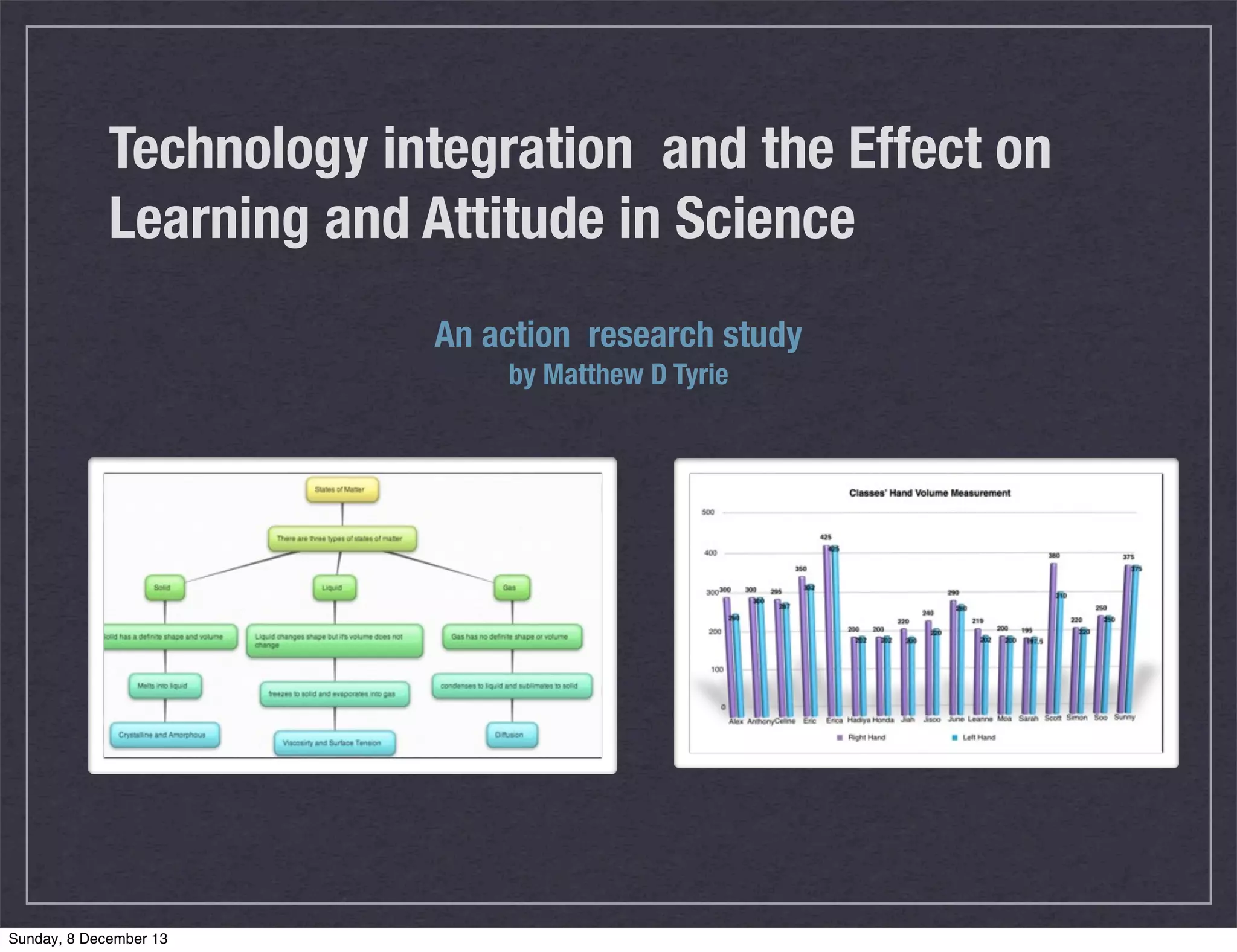
Technology integration and the Effect on
Learning and Attitude in Science
An action research study
by Matthew D Tyrie

Sunday, 8 December 13
Research question
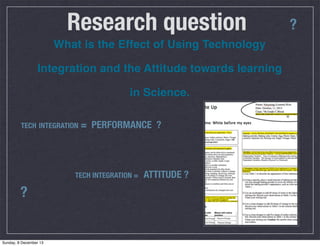
What is the Effect of Using Technology
Integration and the Attitude towards learning
in Science.
TECH INTEGRATION

= PERFORMANCE ?

TECH INTEGRATION =

?

Sunday, 8 December 13

ATTITUDE ?

?
The problem
As a science teacher, I observe many children moving
into middle school science lacking a strong base of
scientific language. Over my years in education, I
have recognized there is a need to help the
performance of students in their learning.
Differentiated instruction and tasks, supporting
learning styles, various reflection strategies, modeled
practice, criteria based rubrics which provide explicit
feedback and opportunities for student and teacher
feedback have all been employed in my teaching
approach.
The reality is, science is a vocabulary heavy subject
and some students find this threatening. When the
students are required to explain what they have
learned, they reach often demonstrate a basic
understanding of concepts.

I use technology
integration for students to process
concepts by creating a product, they can
synthesize information deeper and in a more
I’ve learned, however when

engaging way.

Sunday, 8 December 13

?

?
Variables
Dependent: The change in performance gains.
Independent: The use of technology integration
in the application of learning vs a traditional
approach of paper application tasks
Attribute: A difference in the attitude between the
two groups towards science and learning in
science.

Sunday, 8 December 13
Methods and Contexts

I used an action research intervention study with
a two group pre/post design as it presented the
least threat to validity and removed the threat of
maturation. There were two groups in the study in
which the impact of tech integration on student
attitudes and performance were explored. An
experimental group of 7th grade science
students(Group 1) and a control group of 7th
grade science students( Group 2 were chosen.
Each group was pre tested and post tested using
the Tyrie Learning Attitude Assessment before
and after the 7 week intervention to measure
change in attitude and for gains in Performance.

Sunday, 8 December 13
Prensky(2005) says...

“Digital technology is becoming an important part
of students education, but how to use it is not
completely clear.. what teachers do need to know
is just how technology can and should be used by
students to enhance their own learning” ( p 4).

Sunday, 8 December 13
Santos(2009).....

“as a result of taking part in the action research,
this study also expects to provide insights on how
collaborative action research can be used as a
means to engage teachers in a reflective and
meaningful professional development.” (p 845)

Sunday, 8 December 13
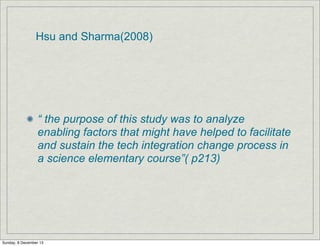
Hsu and Sharma(2008)

“ the purpose of this study was to analyze
enabling factors that might have helped to facilitate
and sustain the tech integration change process in
a science elementary course”( p213)

Sunday, 8 December 13
Luck and Fong Peng(2010),

“there is a positive relationship in the
management of tech integration for maximizing
usage of technology enhanced teaching and
learning.. where students are able to learn better
when teachers teach by using the enhanced
technology in their curriculum” ( p 94)

Sunday, 8 December 13
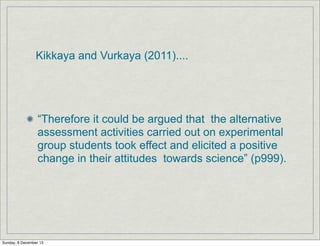
Kikkaya and Vurkaya (2011)....

“Therefore it could be argued that the alternative
assessment activities carried out on experimental
group students took effect and elicited a positive
change in their attitudes towards science” (p999).

Sunday, 8 December 13
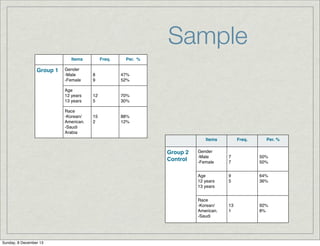
Sample
Items

Freq.

Per. %

Gender
-Male
-Female

8
9

47%
52%

Age
12 years
13 years

Group 1

12
5

70%
30%

15
2

88%
12%

Race
-Korean/
American.
-Saudi
Arabia

Items

Group 2
Control

Gender
-Male
-Female
Age
12 years
13 years
Race
-Korean/
American.
-Saudi

Sunday, 8 December 13

Freq.

Per. %

7
7

50%
50%

9
5

64%
36%

13
1

92%
8%
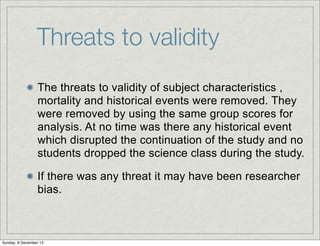
Threats to validity
The threats to validity of subject characteristics ,
mortality and historical events were removed. They
were removed by using the same group scores for
analysis. At no time was there any historical event
which disrupted the continuation of the study and no
students dropped the science class during the study.
If there was any threat it may have been researcher
bias.

Sunday, 8 December 13
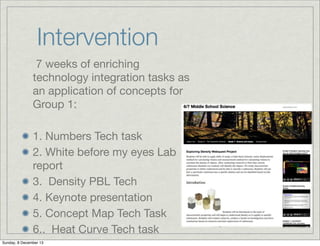
Intervention
7 weeks of enriching
technology integration tasks as
an application of concepts for
Group 1:
1. Numbers Tech task
2. White before my eyes Lab
report
3. Density PBL Tech
4. Keynote presentation
5. Concept Map Tech Task
6.. Heat Curve Tech task
Sunday, 8 December 13
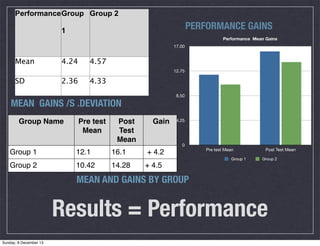
PerformanceGroup Group 2

PERFORMANCE GAINS

1

Performance Mean Gains
17.00

Mean

4.24

4.57
12.75

SD

2.36

4.33
8.50

MEAN GAINS /S .DEVIATION
Group Name

Group 1

Pre test
Mean
12.1

Post
Test
Mean
16.1

Gain

4.25

0

+ 4.2

Pre test Mean
Group 1

Group 2

10.42

14.28

Post Test Mean
Group 2

+ 4.5

MEAN AND GAINS BY GROUP

Results = Performance
Sunday, 8 December 13
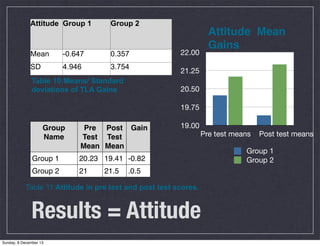
Attitude Group 1

Group 2

Mean

-0.647

0.357

22.00

SD

4.946

3.754

21.25

Table 10:Means/ Standard
deviations of TLA Gains

Attitude Mean
Gains

20.50
19.75

Group
Name

Pre Post Gain
Test Test
Mean Mean

Group 1

21

Pre test means

20.23 19.41 -0.82

Group 2

19.00

21.5

.0.5

Table 11:Attitude in pre test and post test scores.

Results = Attitude
Sunday, 8 December 13

Post test means

Group 1
Group 2
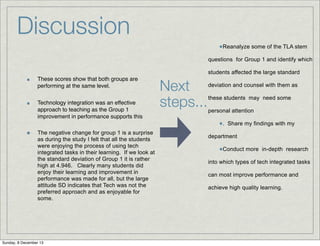
Discussion
•Reanalyze some of the TLA stem
questions for Group 1 and identify which
students affected the large standard
These scores show that both groups are
performing at the same level.
Technology integration was an effective
approach to teaching as the Group 1
improvement in performance supports this
The negative change for group 1 is a surprise
as during the study I felt that all the students
were enjoying the process of using tech
integrated tasks in their learning. If we look at
the standard deviation of Group 1 it is rather
high at 4.946. Clearly many students did
enjoy their learning and improvement in
performance was made for all, but the large
attitude SD indicates that Tech was not the
preferred approach and as enjoyable for
some.

Sunday, 8 December 13

Next
steps...

deviation and counsel with them as
these students may need some
personal attention

•.

Share my findings with my

department

•Conduct more

in-depth research

into which types of tech integrated tasks
can most improve performance and
achieve high quality learning.
References
Chun, E. (2013, September 15). bubbl.us | brainstorm and mind map
online. Retrieved September 15, 2013, from http://www.bubbl.us
Hsu, P., & Sharma, P. (2008). A case study of enabling factors in the
technology integration change process. Educational Technology and
society, 11(4), 213-228.
Kang, M., Heo, H., & Kim, M. (2011). The impact of ICT use on new
millennium learners' educational performance. Interactive Technology
and Smart Education. doi:10.1108/17415651111125487
Kirikkaya, E., & Virkaya, G. (2011). The effect of using alternative
assessment activities on students' success and attitudes in science and
technology course. Educational services theory and practise, 11(2),
National research council (2001). Educating teachers of science,
mathematics and technology: New practices for the new millennium
Sunday, 8 December 13
Oblinger, D., & Oblinger, J. L. (2005). Introduction. In Educating
the net generation (pp. 1- 1.5). Boulder, CO: EDUCAUSE.
Prensky, M. (2010). Introduction: Our changing world. In
Teaching digital natives: Partnering for real learning (p. 1- 12).
Thousand Oaks, Calif: Corwin
Santos, I. (2011, June 11). Ed/ITLib Digital Library → Technology
integration through collaborative action research.
Retrieved August 12, 2013, from http://editlib.org/p/37967/
Tyrie, M. D. (2013, August 9). Exploring Density Webquest
Project | 6/7 Middle School Science. Retrieved October 3, 2013,
from http://matttyrie.wordpress.com/exploring-density-webquestproject/
RMIT. (n.d.). RMIT. Retrieved December 6, 2013, from
http://raws.adc.rmit.edu.au/~s3326816/blog2/wpcontent/uploads/2012/03/website-home-pagecritique-550x322.jpg

Sunday, 8 December 13

Edu690 m tyrie final project presentation copy

  • 1.
    Technology integration andthe Effect on Learning and Attitude in Science An action research study by Matthew D Tyrie Sunday, 8 December 13
  • 2.
  • 3.
    Research question What isthe Effect of Using Technology Integration and the Attitude towards learning in Science. TECH INTEGRATION = PERFORMANCE ? TECH INTEGRATION = ? Sunday, 8 December 13 ATTITUDE ? ?
  • 4.
    The problem As ascience teacher, I observe many children moving into middle school science lacking a strong base of scientific language. Over my years in education, I have recognized there is a need to help the performance of students in their learning. Differentiated instruction and tasks, supporting learning styles, various reflection strategies, modeled practice, criteria based rubrics which provide explicit feedback and opportunities for student and teacher feedback have all been employed in my teaching approach. The reality is, science is a vocabulary heavy subject and some students find this threatening. When the students are required to explain what they have learned, they reach often demonstrate a basic understanding of concepts. I use technology integration for students to process concepts by creating a product, they can synthesize information deeper and in a more I’ve learned, however when engaging way. Sunday, 8 December 13 ? ?
  • 5.
    Variables Dependent: The changein performance gains. Independent: The use of technology integration in the application of learning vs a traditional approach of paper application tasks Attribute: A difference in the attitude between the two groups towards science and learning in science. Sunday, 8 December 13
  • 6.
    Methods and Contexts Iused an action research intervention study with a two group pre/post design as it presented the least threat to validity and removed the threat of maturation. There were two groups in the study in which the impact of tech integration on student attitudes and performance were explored. An experimental group of 7th grade science students(Group 1) and a control group of 7th grade science students( Group 2 were chosen. Each group was pre tested and post tested using the Tyrie Learning Attitude Assessment before and after the 7 week intervention to measure change in attitude and for gains in Performance. Sunday, 8 December 13
  • 7.
    Prensky(2005) says... “Digital technologyis becoming an important part of students education, but how to use it is not completely clear.. what teachers do need to know is just how technology can and should be used by students to enhance their own learning” ( p 4). Sunday, 8 December 13
  • 8.
    Santos(2009)..... “as a resultof taking part in the action research, this study also expects to provide insights on how collaborative action research can be used as a means to engage teachers in a reflective and meaningful professional development.” (p 845) Sunday, 8 December 13
  • 9.
    Hsu and Sharma(2008) “the purpose of this study was to analyze enabling factors that might have helped to facilitate and sustain the tech integration change process in a science elementary course”( p213) Sunday, 8 December 13
  • 10.
    Luck and FongPeng(2010), “there is a positive relationship in the management of tech integration for maximizing usage of technology enhanced teaching and learning.. where students are able to learn better when teachers teach by using the enhanced technology in their curriculum” ( p 94) Sunday, 8 December 13
  • 11.
    Kikkaya and Vurkaya(2011).... “Therefore it could be argued that the alternative assessment activities carried out on experimental group students took effect and elicited a positive change in their attitudes towards science” (p999). Sunday, 8 December 13
  • 12.
    Sample Items Freq. Per. % Gender -Male -Female 8 9 47% 52% Age 12 years 13years Group 1 12 5 70% 30% 15 2 88% 12% Race -Korean/ American. -Saudi Arabia Items Group 2 Control Gender -Male -Female Age 12 years 13 years Race -Korean/ American. -Saudi Sunday, 8 December 13 Freq. Per. % 7 7 50% 50% 9 5 64% 36% 13 1 92% 8%
  • 13.
    Threats to validity Thethreats to validity of subject characteristics , mortality and historical events were removed. They were removed by using the same group scores for analysis. At no time was there any historical event which disrupted the continuation of the study and no students dropped the science class during the study. If there was any threat it may have been researcher bias. Sunday, 8 December 13
  • 14.
    Intervention 7 weeks ofenriching technology integration tasks as an application of concepts for Group 1: 1. Numbers Tech task 2. White before my eyes Lab report 3. Density PBL Tech 4. Keynote presentation 5. Concept Map Tech Task 6.. Heat Curve Tech task Sunday, 8 December 13
  • 15.
    PerformanceGroup Group 2 PERFORMANCEGAINS 1 Performance Mean Gains 17.00 Mean 4.24 4.57 12.75 SD 2.36 4.33 8.50 MEAN GAINS /S .DEVIATION Group Name Group 1 Pre test Mean 12.1 Post Test Mean 16.1 Gain 4.25 0 + 4.2 Pre test Mean Group 1 Group 2 10.42 14.28 Post Test Mean Group 2 + 4.5 MEAN AND GAINS BY GROUP Results = Performance Sunday, 8 December 13
  • 16.
    Attitude Group 1 Group2 Mean -0.647 0.357 22.00 SD 4.946 3.754 21.25 Table 10:Means/ Standard deviations of TLA Gains Attitude Mean Gains 20.50 19.75 Group Name Pre Post Gain Test Test Mean Mean Group 1 21 Pre test means 20.23 19.41 -0.82 Group 2 19.00 21.5 .0.5 Table 11:Attitude in pre test and post test scores. Results = Attitude Sunday, 8 December 13 Post test means Group 1 Group 2
  • 17.
    Discussion •Reanalyze some ofthe TLA stem questions for Group 1 and identify which students affected the large standard These scores show that both groups are performing at the same level. Technology integration was an effective approach to teaching as the Group 1 improvement in performance supports this The negative change for group 1 is a surprise as during the study I felt that all the students were enjoying the process of using tech integrated tasks in their learning. If we look at the standard deviation of Group 1 it is rather high at 4.946. Clearly many students did enjoy their learning and improvement in performance was made for all, but the large attitude SD indicates that Tech was not the preferred approach and as enjoyable for some. Sunday, 8 December 13 Next steps... deviation and counsel with them as these students may need some personal attention •. Share my findings with my department •Conduct more in-depth research into which types of tech integrated tasks can most improve performance and achieve high quality learning.
  • 18.
    References Chun, E. (2013,September 15). bubbl.us | brainstorm and mind map online. Retrieved September 15, 2013, from http://www.bubbl.us Hsu, P., & Sharma, P. (2008). A case study of enabling factors in the technology integration change process. Educational Technology and society, 11(4), 213-228. Kang, M., Heo, H., & Kim, M. (2011). The impact of ICT use on new millennium learners' educational performance. Interactive Technology and Smart Education. doi:10.1108/17415651111125487 Kirikkaya, E., & Virkaya, G. (2011). The effect of using alternative assessment activities on students' success and attitudes in science and technology course. Educational services theory and practise, 11(2), National research council (2001). Educating teachers of science, mathematics and technology: New practices for the new millennium Sunday, 8 December 13
  • 19.
    Oblinger, D., &Oblinger, J. L. (2005). Introduction. In Educating the net generation (pp. 1- 1.5). Boulder, CO: EDUCAUSE. Prensky, M. (2010). Introduction: Our changing world. In Teaching digital natives: Partnering for real learning (p. 1- 12). Thousand Oaks, Calif: Corwin Santos, I. (2011, June 11). Ed/ITLib Digital Library → Technology integration through collaborative action research. Retrieved August 12, 2013, from http://editlib.org/p/37967/ Tyrie, M. D. (2013, August 9). Exploring Density Webquest Project | 6/7 Middle School Science. Retrieved October 3, 2013, from http://matttyrie.wordpress.com/exploring-density-webquestproject/ RMIT. (n.d.). RMIT. Retrieved December 6, 2013, from http://raws.adc.rmit.edu.au/~s3326816/blog2/wpcontent/uploads/2012/03/website-home-pagecritique-550x322.jpg Sunday, 8 December 13