Technology Training that works
Practical Troubleshooting of Electronic
Circuits for Engineers and Technicians
Technology Training that Workswww.idc-online.com/slideshare
Technology Training that worksTechnology Training that Workswww.idc-online.com/slideshare
Objectives
• Understand the technical meaning of failure
• Know the symptoms of failure
• Study the causes of failure
• Study Early Failure, Random Failure and Wear out Failure
• Know what is Failure Rate, Mean Time to Failure, Mean Time between Failure
and Mean Time to Repair
Technology Training that Workswww.idc-online.com/slideshare
Technology Training that worksTechnology Training that Workswww.idc-online.com/slideshare
Failure Symptoms
• Failure
A deviation in the properties of a component or item
from prescribed condition is considered as a fault
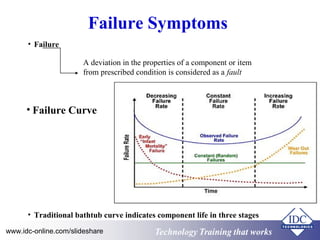
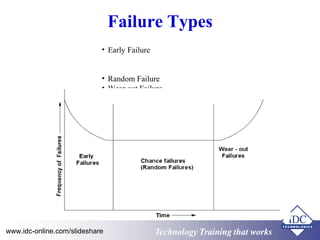
• Failure Curve
• Traditional bathtub curve indicates component life in three stages
Technology Training that worksTechnology Training that Workswww.idc-online.com/slideshare
Failure Symptoms
• Reliability Curve (generalized)
First stage Failure rate begins high and decreases rapidly with time.
This stage is known as Infant Mortality Period and has a
Decreasing Failure Rate (DFR)
Second
stage
State failure rate period, which is usually long also
known as random failure period or useful life of the
equipment
Third stage Beyond useful life period, there is a gradual increase in
failure rate. A period of ageing and wear out with
increasing failure rate
Technology Training that worksTechnology Training that Workswww.idc-online.com/slideshare
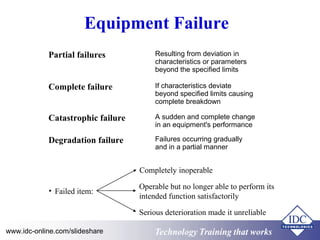
Equipment Failure
Partial failures Resulting from deviation in
characteristics or parameters
beyond the specified limits
Complete failure If characteristics deviate
beyond specified limits causing
complete breakdown
Catastrophic failure A sudden and complete change
in an equipment's performance
Degradation failure Failures occurring gradually
and in a partial manner
• Failed item:
Completely inoperable
Operable but no longer able to perform its
intended function satisfactorily
Serious deterioration made it unreliable
Technology Training that worksTechnology Training that Workswww.idc-online.com/slideshare
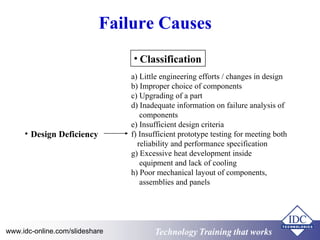
Failure Causes
• Classification
• Design Deficiency
a) Little engineering efforts / changes in design
b) Improper choice of components
c) Upgrading of a part
d) Inadequate information on failure analysis of
components
e) Insufficient design criteria
f) Insufficient prototype testing for meeting both
reliability and performance specification
g) Excessive heat development inside
equipment and lack of cooling
h) Poor mechanical layout of components,
assemblies and panels
Technology Training that worksTechnology Training that Workswww.idc-online.com/slideshare
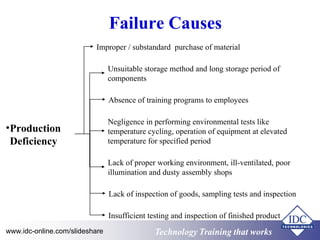
Failure Causes
•Production
Deficiency
Improper / substandard purchase of material
Unsuitable storage method and long storage period of
components
Absence of training programs to employees
Negligence in performing environmental tests like
temperature cycling, operation of equipment at elevated
temperature for specified period
Lack of proper working environment, ill-ventilated, poor
illumination and dusty assembly shops
Lack of inspection of goods, sampling tests and inspection
Insufficient testing and inspection of finished product
Technology Training that worksTechnology Training that Workswww.idc-online.com/slideshare
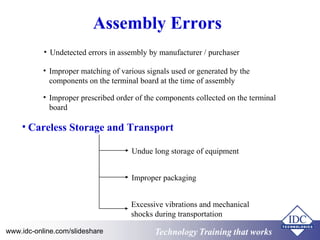
Assembly Errors
• Careless Storage and Transport
Excessive vibrations and mechanical
shocks during transportation
Improper packaging
Undue long storage of equipment
• Undetected errors in assembly by manufacturer / purchaser
• Improper matching of various signals used or generated by the
components on the terminal board at the time of assembly
• Improper prescribed order of the components collected on the terminal
board
Technology Training that worksTechnology Training that Workswww.idc-online.com/slideshare
Improper Working Conditions
• Presence of abnormal severe conditions of speed,
temperature etc.
• Using equipment without following manufacturer's
instructions, warnings and cautions
• Inadequate maintenance policy and after sale service
• Usage of equipment beyond its lifetime
• Aging of the equipment
• Operator error
• Lack of preventive measures
Technology Training that worksTechnology Training that Workswww.idc-online.com/slideshare
Failure Types
• Early Failure
• Random Failure
• Wear out Failure
Technology Training that worksTechnology Training that Workswww.idc-online.com/slideshare
Failure Types
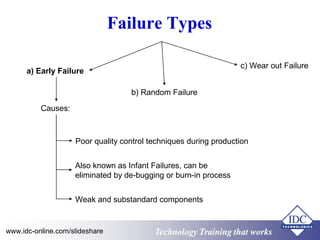
a) Early Failure
b) Random Failure
c) Wear out Failure
Poor quality control techniques during production
Causes:
Also known as Infant Failures, can be
eliminated by de-bugging or burn-in process
Weak and substandard components
Technology Training that worksTechnology Training that Workswww.idc-online.com/slideshare
Failure Types
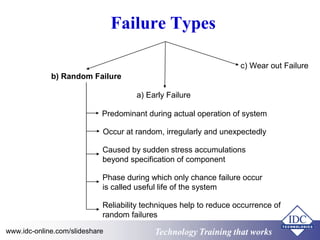
c) Wear out Failure
Predominant during actual operation of system
Occur at random, irregularly and unexpectedly
Caused by sudden stress accumulations
beyond specification of component
Phase during which only chance failure occur
is called useful life of the system
Reliability techniques help to reduce occurrence of
random failures
b) Random Failure
a) Early Failure
Technology Training that worksTechnology Training that Workswww.idc-online.com/slideshare
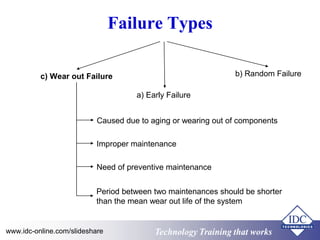
Failure Types
b) Random Failurec) Wear out Failure
a) Early Failure
Caused due to aging or wearing out of components
Improper maintenance
Need of preventive maintenance
Period between two maintenances should be shorter
than the mean wear out life of the system
Technology Training that worksTechnology Training that Workswww.idc-online.com/slideshare
Some Useful Terms in Failure
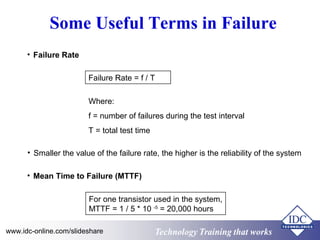
• Failure Rate
Failure Rate = f / T
Where:
f = number of failures during the test interval
T = total test time
• Smaller the value of the failure rate, the higher is the reliability of the system
• Mean Time to Failure (MTTF)
For one transistor used in the system,
MTTF = 1 / 5 * 10 -5
= 20,000 hours
Technology Training that worksTechnology Training that Workswww.idc-online.com/slideshare
Some Useful Terms in Failure
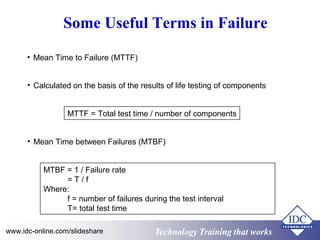
• Mean Time to Failure (MTTF)
• Calculated on the basis of the results of life testing of components
MTTF = Total test time / number of components
• Mean Time between Failures (MTBF)
MTBF = 1 / Failure rate
= T / f
Where:
f = number of failures during the test interval
T= total test time
Technology Training that worksTechnology Training that Workswww.idc-online.com/slideshare
Some Useful Terms in Failure
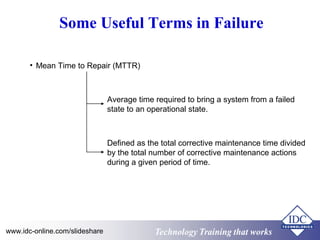
• Mean Time to Repair (MTTR)
Average time required to bring a system from a failed
state to an operational state.
Defined as the total corrective maintenance time divided
by the total number of corrective maintenance actions
during a given period of time.
Technology Training that worksTechnology Training that Workswww.idc-online.com/slideshare
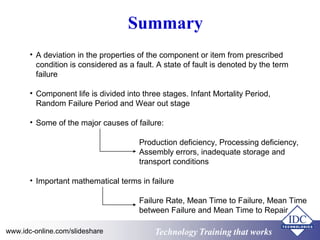
Summary
• A deviation in the properties of the component or item from prescribed
condition is considered as a fault. A state of fault is denoted by the term
failure
• Component life is divided into three stages. Infant Mortality Period,
Random Failure Period and Wear out stage
Production deficiency, Processing deficiency,
Assembly errors, inadequate storage and
transport conditions
Failure Rate, Mean Time to Failure, Mean Time
between Failure and Mean Time to Repair
• Important mathematical terms in failure
• Some of the major causes of failure:
Technology Training that worksTechnology Training that Workswww.idc-online.com/slideshare
DO YOU WANT TO KNOW MORE?
If you are interested in further training or information,
please visit:
http://idc-online.com/slideshare

Practical Troubleshooting of Electronic Circuits for Engineers and Technicians

  • 1.
    Technology Training thatworks Practical Troubleshooting of Electronic Circuits for Engineers and Technicians Technology Training that Workswww.idc-online.com/slideshare
  • 2.
    Technology Training thatworksTechnology Training that Workswww.idc-online.com/slideshare Objectives • Understand the technical meaning of failure • Know the symptoms of failure • Study the causes of failure • Study Early Failure, Random Failure and Wear out Failure • Know what is Failure Rate, Mean Time to Failure, Mean Time between Failure and Mean Time to Repair Technology Training that Workswww.idc-online.com/slideshare
  • 3.
    Technology Training thatworksTechnology Training that Workswww.idc-online.com/slideshare Failure Symptoms • Failure A deviation in the properties of a component or item from prescribed condition is considered as a fault • Failure Curve • Traditional bathtub curve indicates component life in three stages
  • 4.
    Technology Training thatworksTechnology Training that Workswww.idc-online.com/slideshare Failure Symptoms • Reliability Curve (generalized) First stage Failure rate begins high and decreases rapidly with time. This stage is known as Infant Mortality Period and has a Decreasing Failure Rate (DFR) Second stage State failure rate period, which is usually long also known as random failure period or useful life of the equipment Third stage Beyond useful life period, there is a gradual increase in failure rate. A period of ageing and wear out with increasing failure rate
  • 5.
    Technology Training thatworksTechnology Training that Workswww.idc-online.com/slideshare Equipment Failure Partial failures Resulting from deviation in characteristics or parameters beyond the specified limits Complete failure If characteristics deviate beyond specified limits causing complete breakdown Catastrophic failure A sudden and complete change in an equipment's performance Degradation failure Failures occurring gradually and in a partial manner • Failed item: Completely inoperable Operable but no longer able to perform its intended function satisfactorily Serious deterioration made it unreliable
  • 6.
    Technology Training thatworksTechnology Training that Workswww.idc-online.com/slideshare Failure Causes • Classification • Design Deficiency a) Little engineering efforts / changes in design b) Improper choice of components c) Upgrading of a part d) Inadequate information on failure analysis of components e) Insufficient design criteria f) Insufficient prototype testing for meeting both reliability and performance specification g) Excessive heat development inside equipment and lack of cooling h) Poor mechanical layout of components, assemblies and panels
  • 7.
    Technology Training thatworksTechnology Training that Workswww.idc-online.com/slideshare Failure Causes •Production Deficiency Improper / substandard purchase of material Unsuitable storage method and long storage period of components Absence of training programs to employees Negligence in performing environmental tests like temperature cycling, operation of equipment at elevated temperature for specified period Lack of proper working environment, ill-ventilated, poor illumination and dusty assembly shops Lack of inspection of goods, sampling tests and inspection Insufficient testing and inspection of finished product
  • 8.
    Technology Training thatworksTechnology Training that Workswww.idc-online.com/slideshare Assembly Errors • Careless Storage and Transport Excessive vibrations and mechanical shocks during transportation Improper packaging Undue long storage of equipment • Undetected errors in assembly by manufacturer / purchaser • Improper matching of various signals used or generated by the components on the terminal board at the time of assembly • Improper prescribed order of the components collected on the terminal board
  • 9.
    Technology Training thatworksTechnology Training that Workswww.idc-online.com/slideshare Improper Working Conditions • Presence of abnormal severe conditions of speed, temperature etc. • Using equipment without following manufacturer's instructions, warnings and cautions • Inadequate maintenance policy and after sale service • Usage of equipment beyond its lifetime • Aging of the equipment • Operator error • Lack of preventive measures
  • 10.
    Technology Training thatworksTechnology Training that Workswww.idc-online.com/slideshare Failure Types • Early Failure • Random Failure • Wear out Failure
  • 11.
    Technology Training thatworksTechnology Training that Workswww.idc-online.com/slideshare Failure Types a) Early Failure b) Random Failure c) Wear out Failure Poor quality control techniques during production Causes: Also known as Infant Failures, can be eliminated by de-bugging or burn-in process Weak and substandard components
  • 12.
    Technology Training thatworksTechnology Training that Workswww.idc-online.com/slideshare Failure Types c) Wear out Failure Predominant during actual operation of system Occur at random, irregularly and unexpectedly Caused by sudden stress accumulations beyond specification of component Phase during which only chance failure occur is called useful life of the system Reliability techniques help to reduce occurrence of random failures b) Random Failure a) Early Failure
  • 13.
    Technology Training thatworksTechnology Training that Workswww.idc-online.com/slideshare Failure Types b) Random Failurec) Wear out Failure a) Early Failure Caused due to aging or wearing out of components Improper maintenance Need of preventive maintenance Period between two maintenances should be shorter than the mean wear out life of the system
  • 14.
    Technology Training thatworksTechnology Training that Workswww.idc-online.com/slideshare Some Useful Terms in Failure • Failure Rate Failure Rate = f / T Where: f = number of failures during the test interval T = total test time • Smaller the value of the failure rate, the higher is the reliability of the system • Mean Time to Failure (MTTF) For one transistor used in the system, MTTF = 1 / 5 * 10 -5 = 20,000 hours
  • 15.
    Technology Training thatworksTechnology Training that Workswww.idc-online.com/slideshare Some Useful Terms in Failure • Mean Time to Failure (MTTF) • Calculated on the basis of the results of life testing of components MTTF = Total test time / number of components • Mean Time between Failures (MTBF) MTBF = 1 / Failure rate = T / f Where: f = number of failures during the test interval T= total test time
  • 16.
    Technology Training thatworksTechnology Training that Workswww.idc-online.com/slideshare Some Useful Terms in Failure • Mean Time to Repair (MTTR) Average time required to bring a system from a failed state to an operational state. Defined as the total corrective maintenance time divided by the total number of corrective maintenance actions during a given period of time.
  • 17.
    Technology Training thatworksTechnology Training that Workswww.idc-online.com/slideshare Summary • A deviation in the properties of the component or item from prescribed condition is considered as a fault. A state of fault is denoted by the term failure • Component life is divided into three stages. Infant Mortality Period, Random Failure Period and Wear out stage Production deficiency, Processing deficiency, Assembly errors, inadequate storage and transport conditions Failure Rate, Mean Time to Failure, Mean Time between Failure and Mean Time to Repair • Important mathematical terms in failure • Some of the major causes of failure:
  • 18.
    Technology Training thatworksTechnology Training that Workswww.idc-online.com/slideshare DO YOU WANT TO KNOW MORE? If you are interested in further training or information, please visit: http://idc-online.com/slideshare