4 pics 1 word
RELEVANCE
ACADEMIC
SOCIETAL
PRACTICAL
SCIENTIFIC
REPLICABLE
1.2 FEATURE OF
RESEARCH
1. It should be systematic
– a research must be
structured with a specified
steps in a specified sequence,
according to well defined set of
rules.
2. It should be logical
– a research must be guided by
logic reasoning and the logical
process of induction and
deduction.
3. It should be empirical
– the research must be related
to one or more aspects of real
life situations.
4. It should be replicable
– other people must be able to verify
and replicate the original research
report. Replicability of the study
means using the same instrument,
method, and procedure but to
different subjects and venue.
1.2 RELEVANCE OF
RESEARCH
Relevance in Research is an
interconnection of one research topic
with others. It is basically the level up
to which you can apply findings of
research in real life. In simple words,
the investigation which you are
conducting is useful for others.
• Academic relevance
- This basically means level up to
which investigation performed on a
particular topic has helped you in
accomplishing your academic goals.
• Societal relevance
- It is referred to as the information
gathered through investigation helps
in developing the understanding of
the society
• Practical relevance
- It is basically an extent up to which
the findings could be applied in real-
life situations.
Scientific relevance
- It is basically an extent up to which
you can fill the knowledge gap
through research on a specific topic
Activity 1
EXPOUND THE TERMS- oral recitation
tekhnologic
R
e
i
n
h
e
a
r
t
C
y
l
e
x
C
a
r
l
G
a
m
l
i
e
l
D
e
n
e
s
e
S
a
m
a
n
t
h
a
A
s
h
i
k
i
e
r
a
N
a
t
e
r
i
c
k
D
e
n
e
s
e
S
a
m
a
n
t
h
a F
r
e
n
z
K
e
v
i
n
W
i
l
l
i
n
e
J
o
y
c
e
S
h
a
m
c
e
y
E
u
l
a
J
i
n
A
s
h
l
e
y
D
e
n
n
i
s
e
T
e
d
M
a
t
t
h
e
w
Princess
D
ain
C
hedel
Ashley Dennise
Ivy
Glady Pearl
Charis Divine
Ayanah
Joy
L
e
x
i
e
A
n
n
J
u
l
i
e
n
M
a
y
e
SPIN
tekhnologic
A
k
i
s
h
a
S
o
f
i
a
R
h
u
z
z
h
e
i
l
K
e
i
n
K
y
l
i
e
J
a
n
e
P
r
i
n
c
e
s
s E
l
i
s
h
a
h
J
a
m
e
s
K
l
e
n
t
W
i
n
c
e
K
a
t
e A
l
e
x
i
s
M
a
i
s
i
e
P
r
i
n
c
e
s
s
E
l
i
s
h
a
h
J
e
r
i
c
h
o
V
o
n
M
a
y
c
e
l
C
h
a
r
i
s
D
i
v
i
n
e
W
i
l
l
i
n
e
J
o
y
c
e
C
ousel A
ngel
Shekinah Joyce
Catherine
Kate
Samantha
Nicole
Ashikiera
C
arth
D
arw
in
L
e
x
i
e
A
n
n
E
l
l
a
M
a
y
SPIN
Activity 2
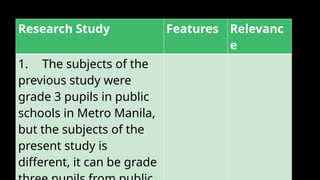
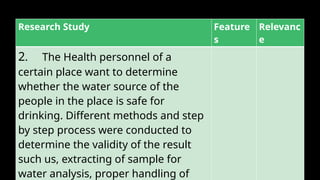
Direction: Categorize the following research study in terms of features and relevance. Write your
answer in your paper.
Research Study Features Relevanc
e
1. The subjects of the
previous study were
grade 3 pupils in public
schools in Metro Manila,
but the subjects of the
present study is
different, it can be grade
Research Study Feature
s
Relevanc
e
2. The Health personnel of a
certain place want to determine
whether the water source of the
people in the place is safe for
drinking. Different methods and step
by step process were conducted to
determine the validity of the result
such us, extracting of sample for
water analysis, proper handling of
Research Study Features Relevanc
e
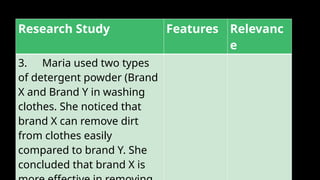
3. Maria used two types
of detergent powder (Brand
X and Brand Y in washing
clothes. She noticed that
brand X can remove dirt
from clothes easily
compared to brand Y. She
concluded that brand X is
Research Study Features Relevanc
e
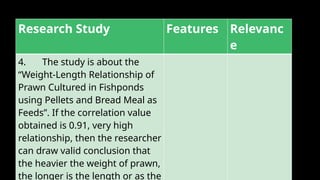
4. The study is about the
“Weight-Length Relationship of
Prawn Cultured in Fishponds
using Pellets and Bread Meal as
Feeds”. If the correlation value
obtained is 0.91, very high
relationship, then the researcher
can draw valid conclusion that
the heavier the weight of prawn,
the longer is the length or as the
NATURE OF
RESEARCH
PROCESS
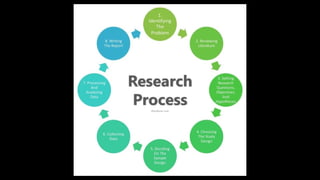
Research Process
– involves identifying,
locating, assessing, and
analyzing the information you
need to support your research
question.
Eight (8) Stages in
the Research
Process
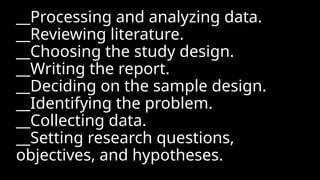
__Processing and analyzing data.
__Reviewing literature.
__Choosing the study design.
__Writing the report.
__Deciding on the sample design.
__Identifying the problem.
__Collecting data.
__Setting research questions,
objectives, and hypotheses.
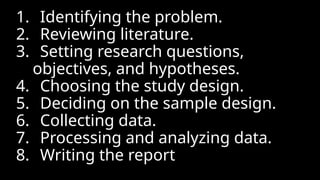
1. Identifying the problem.
2. Reviewing literature.
3. Setting research questions,
objectives, and hypotheses.
4. Choosing the study design.
5. Deciding on the sample design.
6. Collecting data.
7. Processing and analyzing data.
8. Writing the report
Step – 1: Identifying the Problem
The first and foremost task in the entire
process of scientific research is to identify
a research problem. A well-identified
problem will lead the researcher to
accomplish all-important phases of the
research process, starting from setting
objectives to the selection of the research
methodology.
Step – 2: Reviewing of Literature
A review of relevant literature is an integral
part of the research process. It enables the
researcher to formulate his problem in
terms of the specific aspects of the general
area of his interest that has not been so far
researched. Through a proper review of the
literature, the researcher may develop the
coherence between the results of his study
and those of the others.
In sum, we enumerate the following arguments
in favor of reviewing the literature:
•It avoids duplication of the work that has been
done in the recent past.
•It helps the researcher to find out what others
have learned and reported on the problem.
•It helps the researcher to become familiar with
the types of methodology followed by others.
•It helps the researcher to understand what
concepts and theories are relevant to his area
of investigation.
• It helps the researcher to understand if there
are any significant controversies,
contradictions, and inconsistencies in findings.
•It allows the researcher to understand if there
are any unanswered research questions.
•It might help the researcher to develop an
analytical framework.
•It will help the researcher to consider the
inclusion of variables in his research that he
might not otherwise have thought about.
Step – 3: Setting research questions, objectives, and
hypotheses
After discovering and defining the research problem,
researchers should make a formal statement of the
problem leading to research objectives.
An objective will precisely say what should be researched,
to delineate the type of information that should be
collected, and provide a framework for the scope of the
study. The best expression of a research objective is a well-
formulated, testable research hypothesis.
A hypothesis is an unproven statement or proposition that
can be refuted or supported by empirical data. Hypothetical
statements assert a possible answer to a research question.
Step -4: Choosing the study design
The research design is the blueprint or
framework for fulfilling objectives and
answering research questions. It is a master
plan specifying the methods and procedures for
collecting, processing, and analyzing the
collected data. There are four basic research
designs that a researcher can use to conduct
his or her study;
1. survey, 3. secondary data study, and
2. experiment, 4. observational
The type of research design to be chosen from
among the above four designs depends
primarily on four factors:
• The type of problem
• The objectives of the study,
• The existing state of knowledge about the
problem that is being studied, and
• The resources are available for the study.
Step – 5: Deciding on the sample design
Sampling is an important and separate step in the
research process. The basic idea of sampling is that it
involves any procedure that uses a relatively small
number of items or portions (called a sample) of a
universe (called population) to conclude the whole
population. A population is the total collection of
elements about which we wish to make some
inference or generalization. A sample is a part of the
population, carefully selected to represent that
population. If certain statistical procedures are
followed in selecting the sample, it should have the
same characteristics as the population as a whole.
Sample design refers to the methods to be
followed in selecting a sample from the
population and the estimating technique, vis-a-
vis formula for computing the sample statistics.
Step – 6: Collecting data
The gathering of data may range from simple observation to a large-
scale survey in any defined population. There are many ways to
collect data. The approach selected depends on the objectives of the
study, the research design, and the availability of time, money, and
personnel. With the variation in the type of data (qualitative or
quantitative) to be collected, the method of data collection also
varies. The most common means for collecting quantitative data is
the structured interview.
Studies that obtain data by interviewing respondents are called
surveys. Data can also be collected by using self-administered
questionnaires. Telephone interviewing is another way in which data
may be collected. Other means of data collection include the use of
secondary sources, such as the census, vital registration records,
official documents, previous surveys, etc. Qualitative data are
collected mainly through in-depth interviews, focus group
Step-7: Processing and Analyzing Data
Data processing generally begins with the editing
and coding of data. Data are edited to ensure
consistency across respondents and to locate
omissions, if any. In survey data, editing reduces
errors in the recording, improves legibility, and
clarifies unclear and inappropriate responses. In
addition to editing, the data also need coding. Data
analysis usually involves reducing accumulated data
to a manageable size, developing summaries,
searching for patterns, and applying statistical
techniques for understanding and interpreting the
findings in the light of the research questions.
Further, the researcher, based on his analysis,
determines if his findings are consistent with the
formulated hypotheses and theories. The techniques
to be used in analyzing data may range from simple
graphical technique to very complex multivariate
analysis depending on the objectives of the study,
research design employed, and the nature of data
collected. As in the case of methods of data
collection, an analytical technique appropriate in one
situation may not be appropriate for another.
Step-8: Writing the report – Developing
Research Proposal, Writing Report,
Disseminating and Utilizing Results
The entire task of a research study is accumulated in a
document called a proposal. A research proposal is a
work plan, prospectus, outline, an offer, a statement
of intent or commitment from an individual
researcher or an organization to produce a product or
render a service to a potential client or sponsor.
The proposal will be prepared to keep in view the
sequence presented in the research process. The
proposal tells us what, how, where, and to whom it
will be done. It must also show the benefit of doing it.
It always includes an explanation of the purpose of
the study (the research objectives) or a definition of
the problem. It systematically outlines the particular
research methodology and details the procedures
that will be utilized at each stage of the research
process.
tekhnologic
R
e
i
n
h
e
a
r
t
C
y
l
e
x
C
a
r
l
G
a
m
l
i
e
l
D
e
n
e
s
e
S
a
m
a
n
t
h
a
A
s
h
i
k
i
e
r
a
N
a
t
e
r
i
c
k
D
e
n
e
s
e
S
a
m
a
n
t
h
a F
r
e
n
z
K
e
v
i
n
W
i
l
l
i
n
e
J
o
y
c
e
S
h
a
m
c
e
y
E
u
l
a
J
i
n
A
s
h
l
e
y
D
e
n
n
i
s
e
T
e
d
M
a
t
t
h
e
w
Princess
D
ain
C
hedel
Ashley Dennise
Ivy
Glady Pearl
Charis Divine
Ayanah
Joy
L
e
x
i
e
A
n
n
J
u
l
i
e
n
M
a
y
e
SPIN
tekhnologic
A
k
i
s
h
a
S
o
f
i
a
R
h
u
z
z
h
e
i
l
K
e
i
n
K
y
l
i
e
J
a
n
e
P
r
i
n
c
e
s
s E
l
i
s
h
a
h
J
a
m
e
s
K
l
e
n
t
W
i
n
c
e
K
a
t
e A
l
e
x
i
s
M
a
i
s
i
e
P
r
i
n
c
e
s
s
E
l
i
s
h
a
h
J
e
r
i
c
h
o
V
o
n
M
a
y
c
e
l
C
h
a
r
i
s
D
i
v
i
n
e
W
i
l
l
i
n
e
J
o
y
c
e
C
ousel A
ngel
Shekinah Joyce
Catherine
Kate
Samantha
Nicole
Ashikiera
C
arth
D
arw
in
L
e
x
i
e
A
n
n
E
l
l
a
M
a
y
SPIN
Activity 2
Direction: Describe the nature of Research Process by
matching Column A with Column B then arrange the
steps of Research Process in Column A and reflect
your answer in Column C by writing 1,2,3…..Write all
your answers in your activity sheets to be pasted in
your research portfolio.


R2Q1W2Research Process Science Technology and Engineering.pptx

  • 1.
  • 2.
  • 3.
  • 4.
  • 5.
  • 6.
  • 7.
  • 8.
  • 9.
    1. It shouldbe systematic – a research must be structured with a specified steps in a specified sequence, according to well defined set of rules.
  • 10.
    2. It shouldbe logical – a research must be guided by logic reasoning and the logical process of induction and deduction.
  • 11.
    3. It shouldbe empirical – the research must be related to one or more aspects of real life situations.
  • 12.
    4. It shouldbe replicable – other people must be able to verify and replicate the original research report. Replicability of the study means using the same instrument, method, and procedure but to different subjects and venue.
  • 13.
  • 14.
    Relevance in Researchis an interconnection of one research topic with others. It is basically the level up to which you can apply findings of research in real life. In simple words, the investigation which you are conducting is useful for others.
  • 15.
    • Academic relevance -This basically means level up to which investigation performed on a particular topic has helped you in accomplishing your academic goals.
  • 16.
    • Societal relevance -It is referred to as the information gathered through investigation helps in developing the understanding of the society
  • 17.
    • Practical relevance -It is basically an extent up to which the findings could be applied in real- life situations.
  • 18.
    Scientific relevance - Itis basically an extent up to which you can fill the knowledge gap through research on a specific topic
  • 19.
    Activity 1 EXPOUND THETERMS- oral recitation
  • 20.
  • 21.
  • 22.
    Activity 2 Direction: Categorizethe following research study in terms of features and relevance. Write your answer in your paper.
  • 23.
    Research Study FeaturesRelevanc e 1. The subjects of the previous study were grade 3 pupils in public schools in Metro Manila, but the subjects of the present study is different, it can be grade
  • 24.
    Research Study Feature s Relevanc e 2.The Health personnel of a certain place want to determine whether the water source of the people in the place is safe for drinking. Different methods and step by step process were conducted to determine the validity of the result such us, extracting of sample for water analysis, proper handling of
  • 25.
    Research Study FeaturesRelevanc e 3. Maria used two types of detergent powder (Brand X and Brand Y in washing clothes. She noticed that brand X can remove dirt from clothes easily compared to brand Y. She concluded that brand X is
  • 26.
    Research Study FeaturesRelevanc e 4. The study is about the “Weight-Length Relationship of Prawn Cultured in Fishponds using Pellets and Bread Meal as Feeds”. If the correlation value obtained is 0.91, very high relationship, then the researcher can draw valid conclusion that the heavier the weight of prawn, the longer is the length or as the
  • 27.
  • 28.
    Research Process – involvesidentifying, locating, assessing, and analyzing the information you need to support your research question.
  • 29.
    Eight (8) Stagesin the Research Process
  • 30.
    __Processing and analyzingdata. __Reviewing literature. __Choosing the study design. __Writing the report. __Deciding on the sample design. __Identifying the problem. __Collecting data. __Setting research questions, objectives, and hypotheses.
  • 31.
    1. Identifying theproblem. 2. Reviewing literature. 3. Setting research questions, objectives, and hypotheses. 4. Choosing the study design. 5. Deciding on the sample design. 6. Collecting data. 7. Processing and analyzing data. 8. Writing the report
  • 33.
    Step – 1:Identifying the Problem The first and foremost task in the entire process of scientific research is to identify a research problem. A well-identified problem will lead the researcher to accomplish all-important phases of the research process, starting from setting objectives to the selection of the research methodology.
  • 34.
    Step – 2:Reviewing of Literature A review of relevant literature is an integral part of the research process. It enables the researcher to formulate his problem in terms of the specific aspects of the general area of his interest that has not been so far researched. Through a proper review of the literature, the researcher may develop the coherence between the results of his study and those of the others.
  • 35.
    In sum, weenumerate the following arguments in favor of reviewing the literature: •It avoids duplication of the work that has been done in the recent past. •It helps the researcher to find out what others have learned and reported on the problem. •It helps the researcher to become familiar with the types of methodology followed by others. •It helps the researcher to understand what concepts and theories are relevant to his area of investigation.
  • 36.
    • It helpsthe researcher to understand if there are any significant controversies, contradictions, and inconsistencies in findings. •It allows the researcher to understand if there are any unanswered research questions. •It might help the researcher to develop an analytical framework. •It will help the researcher to consider the inclusion of variables in his research that he might not otherwise have thought about.
  • 37.
    Step – 3:Setting research questions, objectives, and hypotheses After discovering and defining the research problem, researchers should make a formal statement of the problem leading to research objectives. An objective will precisely say what should be researched, to delineate the type of information that should be collected, and provide a framework for the scope of the study. The best expression of a research objective is a well- formulated, testable research hypothesis. A hypothesis is an unproven statement or proposition that can be refuted or supported by empirical data. Hypothetical statements assert a possible answer to a research question.
  • 38.
    Step -4: Choosingthe study design The research design is the blueprint or framework for fulfilling objectives and answering research questions. It is a master plan specifying the methods and procedures for collecting, processing, and analyzing the collected data. There are four basic research designs that a researcher can use to conduct his or her study; 1. survey, 3. secondary data study, and 2. experiment, 4. observational
  • 39.
    The type ofresearch design to be chosen from among the above four designs depends primarily on four factors: • The type of problem • The objectives of the study, • The existing state of knowledge about the problem that is being studied, and • The resources are available for the study.
  • 40.
    Step – 5:Deciding on the sample design Sampling is an important and separate step in the research process. The basic idea of sampling is that it involves any procedure that uses a relatively small number of items or portions (called a sample) of a universe (called population) to conclude the whole population. A population is the total collection of elements about which we wish to make some inference or generalization. A sample is a part of the population, carefully selected to represent that population. If certain statistical procedures are followed in selecting the sample, it should have the same characteristics as the population as a whole.
  • 41.
    Sample design refersto the methods to be followed in selecting a sample from the population and the estimating technique, vis-a- vis formula for computing the sample statistics.
  • 42.
    Step – 6:Collecting data The gathering of data may range from simple observation to a large- scale survey in any defined population. There are many ways to collect data. The approach selected depends on the objectives of the study, the research design, and the availability of time, money, and personnel. With the variation in the type of data (qualitative or quantitative) to be collected, the method of data collection also varies. The most common means for collecting quantitative data is the structured interview. Studies that obtain data by interviewing respondents are called surveys. Data can also be collected by using self-administered questionnaires. Telephone interviewing is another way in which data may be collected. Other means of data collection include the use of secondary sources, such as the census, vital registration records, official documents, previous surveys, etc. Qualitative data are collected mainly through in-depth interviews, focus group
  • 43.
    Step-7: Processing andAnalyzing Data Data processing generally begins with the editing and coding of data. Data are edited to ensure consistency across respondents and to locate omissions, if any. In survey data, editing reduces errors in the recording, improves legibility, and clarifies unclear and inappropriate responses. In addition to editing, the data also need coding. Data analysis usually involves reducing accumulated data to a manageable size, developing summaries, searching for patterns, and applying statistical techniques for understanding and interpreting the findings in the light of the research questions.
  • 44.
    Further, the researcher,based on his analysis, determines if his findings are consistent with the formulated hypotheses and theories. The techniques to be used in analyzing data may range from simple graphical technique to very complex multivariate analysis depending on the objectives of the study, research design employed, and the nature of data collected. As in the case of methods of data collection, an analytical technique appropriate in one situation may not be appropriate for another.
  • 45.
    Step-8: Writing thereport – Developing Research Proposal, Writing Report, Disseminating and Utilizing Results The entire task of a research study is accumulated in a document called a proposal. A research proposal is a work plan, prospectus, outline, an offer, a statement of intent or commitment from an individual researcher or an organization to produce a product or render a service to a potential client or sponsor.
  • 46.
    The proposal willbe prepared to keep in view the sequence presented in the research process. The proposal tells us what, how, where, and to whom it will be done. It must also show the benefit of doing it. It always includes an explanation of the purpose of the study (the research objectives) or a definition of the problem. It systematically outlines the particular research methodology and details the procedures that will be utilized at each stage of the research process.
  • 47.
  • 48.
  • 49.
    Activity 2 Direction: Describethe nature of Research Process by matching Column A with Column B then arrange the steps of Research Process in Column A and reflect your answer in Column C by writing 1,2,3…..Write all your answers in your activity sheets to be pasted in your research portfolio.

Editor's Notes