sSHIRLEY D. CAPILI
Practical Research 1
this subject seeks to develop critical thinking
and problem-solving skills through qualitative
research.
WHAT IS RESEARCH?
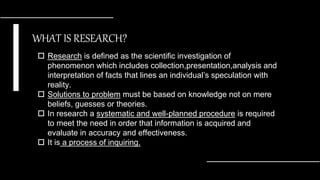
 Research is defined as the scientific investigation of
phenomenon which includes collection,presentation,analysis and
interpretation of facts that lines an individual’s speculation with
reality.
 Solutions to problem must be based on knowledge not on mere
beliefs, guesses or theories.
 In research a systematic and well-planned procedure is required
to meet the need in order that information is acquired and
evaluate in accuracy and effectiveness.
 It is a process of inquiring.
WHAT IS RESEARCH?
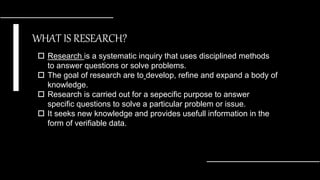
 Research is a systematic inquiry that uses disciplined methods
to answer questions or solve problems.
 The goal of research are to develop, refine and expand a body of
knowledge.
 Research is carried out for a sepecific purpose to answer
specific questions to solve a particular problem or issue.
 It seeks new knowledge and provides usefull information in the
form of verifiable data.
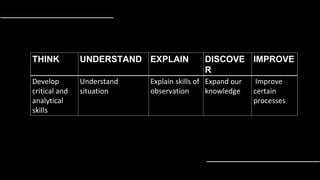
Importance of
research
THINK UNDERSTAND EXPLAIN DISCOVE
R
IMPROVE
Develop
critical and
analytical
skills
Understand
situation
Explain skills of
observation
Expand our
knowledge
Improve
certain
processes
nature of inquiry
1. inquiry is defined as “a seeking for truth,information or
knowledge”. It is a problem solving technique.
2. the information and data pursued through questioning
begins with gathering by applying the different human
senses
3. individuals carry on the process of inquiry from birth till
death
4. inquiry is synonymous with the word investigation.
According to Lachica(2018) the definition of inquiry
1. seeking for truth, information and knowledge (problem-solving
technique).
2. information pursued through questioning begins with applying the
different human senses.
3. individual carry on the process of nquiry from birth till death, and
4. inquiry is synonymous with the word investigation.
INQUIRY ELEVATED YOUR
THINKING POWER
foundation of inquiry
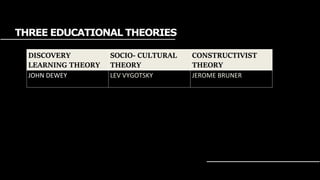
THREE EDUCATIONAL THEORIES
DISCOVERY
LEARNING THEORY
SOCIO- CULTURAL
THEORY
CONSTRUCTIVIST
THEORY
JOHN DEWEY LEV VYGOTSKY JEROME BRUNER
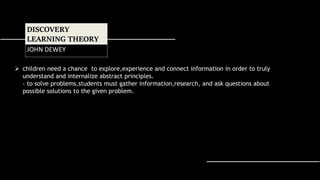
 children need a chance to explore,experience and connect information in order to truly
understand and internalize abstract principles.
- to solve problems,students must gather information,research, and ask questions about
possible solutions to the given problem.
DISCOVERY
LEARNING THEORY
JOHN DEWEY
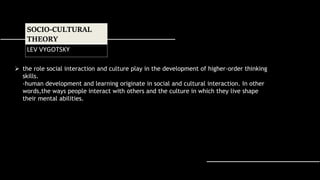
 the role social interaction and culture play in the development of higher-order thinking
skills.
-human development and learning originate in social and cultural interaction. In other
words,the ways people interact with others and the culture in which they live shape
their mental abilities.
SOCIO-CULTURAL
THEORY
LEV VYGOTSKY
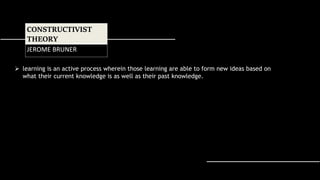
 learning is an active process wherein those learning are able to form new ideas based on
what their current knowledge is as well as their past knowledge.
CONSTRUCTIVIST
THEORY
JEROME BRUNER
 organized process of inquiring about a problem through inspection and assessment.
Inquiry vs.
investigation
 the deep level personal involvement of the researcher with the object of study.
-participating in the subject’s lives.
Immersion
photography by combining the concept
of a street with the technique of taking
pictures from the top.
Street
Photography
Street
Photography
photography by combining the concept
of a street with the technique of taking
pictures from the top.
Contact Person
Clicking on the “Send us an
email” button takes you right
to the contact form.
SEND US
+123-456-7890
hello@reallygreatsite.com
T H A N K Y O U
THAT'S MY PORTFOLIO SO FAR.

practical research g11.pptx.english for all

  • 1.
    sSHIRLEY D. CAPILI PracticalResearch 1 this subject seeks to develop critical thinking and problem-solving skills through qualitative research.
  • 2.
    WHAT IS RESEARCH? Research is defined as the scientific investigation of phenomenon which includes collection,presentation,analysis and interpretation of facts that lines an individual’s speculation with reality.  Solutions to problem must be based on knowledge not on mere beliefs, guesses or theories.  In research a systematic and well-planned procedure is required to meet the need in order that information is acquired and evaluate in accuracy and effectiveness.  It is a process of inquiring.
  • 3.
    WHAT IS RESEARCH? Research is a systematic inquiry that uses disciplined methods to answer questions or solve problems.  The goal of research are to develop, refine and expand a body of knowledge.  Research is carried out for a sepecific purpose to answer specific questions to solve a particular problem or issue.  It seeks new knowledge and provides usefull information in the form of verifiable data.
  • 4.
  • 5.
    THINK UNDERSTAND EXPLAINDISCOVE R IMPROVE Develop critical and analytical skills Understand situation Explain skills of observation Expand our knowledge Improve certain processes
  • 6.
    nature of inquiry 1.inquiry is defined as “a seeking for truth,information or knowledge”. It is a problem solving technique. 2. the information and data pursued through questioning begins with gathering by applying the different human senses 3. individuals carry on the process of inquiry from birth till death 4. inquiry is synonymous with the word investigation.
  • 7.
    According to Lachica(2018)the definition of inquiry 1. seeking for truth, information and knowledge (problem-solving technique). 2. information pursued through questioning begins with applying the different human senses. 3. individual carry on the process of nquiry from birth till death, and 4. inquiry is synonymous with the word investigation.
  • 8.
    INQUIRY ELEVATED YOUR THINKINGPOWER foundation of inquiry
  • 9.
    THREE EDUCATIONAL THEORIES DISCOVERY LEARNINGTHEORY SOCIO- CULTURAL THEORY CONSTRUCTIVIST THEORY JOHN DEWEY LEV VYGOTSKY JEROME BRUNER
  • 10.
     children needa chance to explore,experience and connect information in order to truly understand and internalize abstract principles. - to solve problems,students must gather information,research, and ask questions about possible solutions to the given problem. DISCOVERY LEARNING THEORY JOHN DEWEY
  • 11.
     the rolesocial interaction and culture play in the development of higher-order thinking skills. -human development and learning originate in social and cultural interaction. In other words,the ways people interact with others and the culture in which they live shape their mental abilities. SOCIO-CULTURAL THEORY LEV VYGOTSKY
  • 12.
     learning isan active process wherein those learning are able to form new ideas based on what their current knowledge is as well as their past knowledge. CONSTRUCTIVIST THEORY JEROME BRUNER
  • 13.
     organized processof inquiring about a problem through inspection and assessment. Inquiry vs. investigation
  • 14.
     the deeplevel personal involvement of the researcher with the object of study. -participating in the subject’s lives. Immersion
  • 15.
    photography by combiningthe concept of a street with the technique of taking pictures from the top. Street Photography
  • 16.
    Street Photography photography by combiningthe concept of a street with the technique of taking pictures from the top.
  • 17.
    Contact Person Clicking onthe “Send us an email” button takes you right to the contact form. SEND US +123-456-7890 hello@reallygreatsite.com
  • 18.
    T H AN K Y O U THAT'S MY PORTFOLIO SO FAR.