Practical 4Experimental Procedurerecall
Before experiment startsRinse all apparatus with water and distilled waterBurette, pipette, conical flasks, graduated flask, beaker, dropper, glass rod, filter funnelWipe beaker (for weighing) dryWipe exterior of pipette dry
WeighingTARE function may be usedPlace beaker in balance, close the doors, press TARE, wait for 0.000 to appearTAKE OUT beaker to add solidPlace beaker back in balance, close the doors, wait for the mass to stabiliseRepeat till mass obtained is what you need
Making standard solutionAdd abt 20 cm3 of distilled water to dissolve the crystals (a little more may be added if solid cannot dissolve)Place filter funnel on top of graduated flaskUse glass rod to guide solution from beaker into graduated flaskGlass rod should be placed back into the beaker
Making standard solutionRinse the walls of the beaker and the glass rod with distilled waterTransfer these washings into the graduated flaskRepeat above 2-3 timesRinse the sides of the filter funnel with distilled waterAdd distilled water until a finger below the mark
Making standard solutionRemove filter funnelUse dropper to add distilled water drop by drop into the graduated flask till bottom of meniscus meets the line/markClose the cap, shake the flask to ensure homogeneous solution obtained
Adding solution from graduated flask into conical flaskRinse the pipette with solution (Suck solution till about 2 fingers above the mark)Discard the solutionSuck solution till slightly above the markHold pipette tip above solutionRelease solution using E button till the bottom of meniscus touch the mark
Wipe the exterior of pipette dry, avoid touching the tip of the pipetteRelease the solution into the conical flaskWhen end, twist the pipette against the bottom of the conical flask (Do not try to get all the solution into the flask, as this vol of solution has been accounted for)
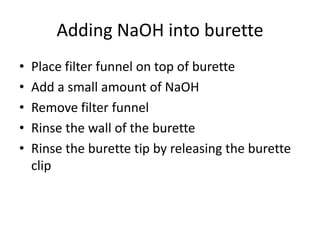
Adding NaOH into burettePlace filter funnel on top of buretteAdd a small amount of NaOHRemove filter funnelRinse the wall of the buretteRinse the burette tip by releasing the burette clip
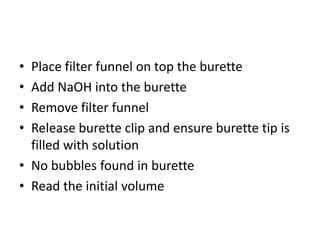
Place filter funnel on top the buretteAdd NaOH into the buretteRemove filter funnelRelease burette clip and ensure burette tip is filled with solutionNo bubbles found in buretteRead the initial volume
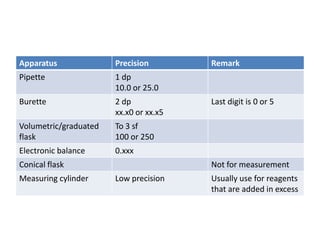
Practical 4Precision of apparatus
Practical 4Evaluation
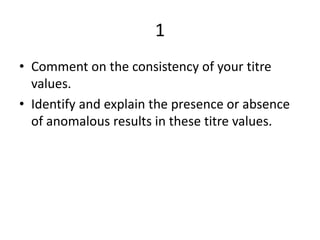
1Comment on the consistency of your titre values.Identify and explain the presence or absence of anomalous results in these titre values.
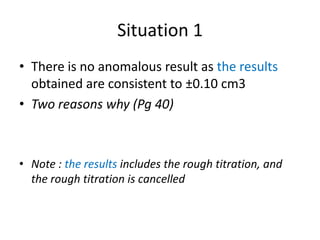
Situation 1There is no anomalous result as the results obtained are consistent to ±0.10 cm3Two reasons why (Pg 40)Note : the results includes the rough titration, and the rough titration is cancelled
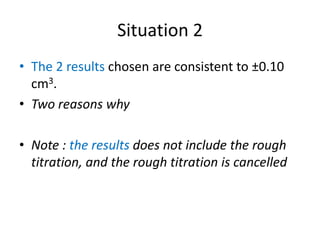
Situation 2The 2 results chosen are consistent to ±0.10 cm3. Two reasons whyNote : the results does not include the rough titration, and the rough titration is cancelled
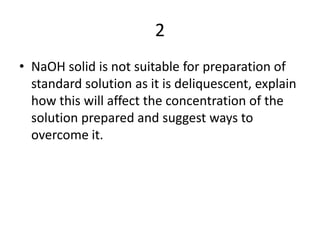
2NaOH solid is not suitable for preparation of standard solution as it is deliquescent, explain how this will affect the concentration of the solution prepared and suggest ways to overcome it.
How it affectNaOH absorbs moisture from the air which will cause the mass measured to include the mass of water absorbed by NaOH solid. For the same mass weighed, a smaller amount of NaOH is obtained. The concentration of NaOH solution will be lower than expected.
Ways to overcomeWeighing of the NaOH solid has to be carried out fast.Container used to store NaOH solid must be properly sealed to minimise contact with air.
3State one precaution that should be taken to ‘maintain’ the quality of the sodium hydroxide prepared.
FactsNaOH solution being basic can absorb CO2 from the air.Amount of NaOH present in the solution is lesser than expected.[NaOH] < expected
PrecautionThe NaOH solid weighed must be used immediately to prepare the solution.After the NaOH solution is prepared, ensure that it is always covered to minimise contact with air.
4Is there a more accurate way of determining the endpoint instead of the use of indicator?
FactsWhen colour changes from colourless (acid) to permanent pale pink (alkali), the equivalence point has been exceeded.Vol. of end point > Vol. of equivalence pointThe observation of colour change to detect endpoint of the titration can be subjective, and sometimes ambiguous.
More accurate wayUse instrumental methodUse pH meter to monitor the pH value of the solution, and plot a graph of pH against volume of titreUse data logger to plot the change in pH with the addition of solution form the burette. The endpoint correspond to the drastic change in pH during titration.
Practical 4Explain the importance of the following steps:
iEthanedioic acid crystals must be weighed accurately and the ethanedioic solution must be prepared in graduated flask.
iA more precise weighing balance will give a smaller percentage error in the mass of ethanedioic acid crystals weighed.A graduated flask measure volume with high accuracy, lower percentage error in the volume of the ethanedioic solution.
iiUse of pipette and burette to measure the volume of acid and NaOH respectively.
iiMore precise apparatus is used to measure the volume of the solution decreases the percentage error of volume measured.Using a pipette to 1 dp, ensures that an accurate volume of 10 cm3 acid is obtained. An accurate amount of acid is present in the conical flask for titration.Using a burette to 2dp ensures that the volume of NaOH used is more accurately determined, and therefore a more accurate [NaoH]
iiiWashings must be transferred into the graduated flask when the standard ethanedioic acid solution was being prepared.
iiiEnsure all the ethanedioic acid that was not transferred into the graduated flask and present in the washings was transferred.This ensures that the amount of ethanedioic acid present in graduated flask = amount of ethanedioic acid weighed.It will give rise to an accurate volume of NaOH used and therefore, accurate [NaOH]
ivUse of indicator is necessary.
ivIt is to provide a distinct colour change to determine the end point.
vOnly 1-2 drops of indicator is required.
vIndicators are also weak acids/bases that can also take part in the titrationExcessive use will cause significant reactions to occur with the indicatorsTitration values will be higher/lower than expected[NaOH] determined will be lower/higher than actual

Practical 4

  • 1.
  • 2.
    Before experiment startsRinseall apparatus with water and distilled waterBurette, pipette, conical flasks, graduated flask, beaker, dropper, glass rod, filter funnelWipe beaker (for weighing) dryWipe exterior of pipette dry
  • 3.
    WeighingTARE function maybe usedPlace beaker in balance, close the doors, press TARE, wait for 0.000 to appearTAKE OUT beaker to add solidPlace beaker back in balance, close the doors, wait for the mass to stabiliseRepeat till mass obtained is what you need
  • 4.
    Making standard solutionAddabt 20 cm3 of distilled water to dissolve the crystals (a little more may be added if solid cannot dissolve)Place filter funnel on top of graduated flaskUse glass rod to guide solution from beaker into graduated flaskGlass rod should be placed back into the beaker
  • 5.
    Making standard solutionRinsethe walls of the beaker and the glass rod with distilled waterTransfer these washings into the graduated flaskRepeat above 2-3 timesRinse the sides of the filter funnel with distilled waterAdd distilled water until a finger below the mark
  • 6.
    Making standard solutionRemovefilter funnelUse dropper to add distilled water drop by drop into the graduated flask till bottom of meniscus meets the line/markClose the cap, shake the flask to ensure homogeneous solution obtained
  • 7.
    Adding solution fromgraduated flask into conical flaskRinse the pipette with solution (Suck solution till about 2 fingers above the mark)Discard the solutionSuck solution till slightly above the markHold pipette tip above solutionRelease solution using E button till the bottom of meniscus touch the mark
  • 8.
    Wipe the exteriorof pipette dry, avoid touching the tip of the pipetteRelease the solution into the conical flaskWhen end, twist the pipette against the bottom of the conical flask (Do not try to get all the solution into the flask, as this vol of solution has been accounted for)
  • 9.
    Adding NaOH intoburettePlace filter funnel on top of buretteAdd a small amount of NaOHRemove filter funnelRinse the wall of the buretteRinse the burette tip by releasing the burette clip
  • 10.
    Place filter funnelon top the buretteAdd NaOH into the buretteRemove filter funnelRelease burette clip and ensure burette tip is filled with solutionNo bubbles found in buretteRead the initial volume
  • 11.
  • 13.
  • 14.
    1Comment on theconsistency of your titre values.Identify and explain the presence or absence of anomalous results in these titre values.
  • 15.
    Situation 1There isno anomalous result as the results obtained are consistent to ±0.10 cm3Two reasons why (Pg 40)Note : the results includes the rough titration, and the rough titration is cancelled
  • 16.
    Situation 2The 2results chosen are consistent to ±0.10 cm3. Two reasons whyNote : the results does not include the rough titration, and the rough titration is cancelled
  • 17.
    2NaOH solid isnot suitable for preparation of standard solution as it is deliquescent, explain how this will affect the concentration of the solution prepared and suggest ways to overcome it.
  • 18.
    How it affectNaOHabsorbs moisture from the air which will cause the mass measured to include the mass of water absorbed by NaOH solid. For the same mass weighed, a smaller amount of NaOH is obtained. The concentration of NaOH solution will be lower than expected.
  • 19.
    Ways to overcomeWeighingof the NaOH solid has to be carried out fast.Container used to store NaOH solid must be properly sealed to minimise contact with air.
  • 20.
    3State one precautionthat should be taken to ‘maintain’ the quality of the sodium hydroxide prepared.
  • 21.
    FactsNaOH solution beingbasic can absorb CO2 from the air.Amount of NaOH present in the solution is lesser than expected.[NaOH] < expected
  • 22.
    PrecautionThe NaOH solidweighed must be used immediately to prepare the solution.After the NaOH solution is prepared, ensure that it is always covered to minimise contact with air.
  • 23.
    4Is there amore accurate way of determining the endpoint instead of the use of indicator?
  • 24.
    FactsWhen colour changesfrom colourless (acid) to permanent pale pink (alkali), the equivalence point has been exceeded.Vol. of end point > Vol. of equivalence pointThe observation of colour change to detect endpoint of the titration can be subjective, and sometimes ambiguous.
  • 25.
    More accurate wayUseinstrumental methodUse pH meter to monitor the pH value of the solution, and plot a graph of pH against volume of titreUse data logger to plot the change in pH with the addition of solution form the burette. The endpoint correspond to the drastic change in pH during titration.
  • 26.
    Practical 4Explain theimportance of the following steps:
  • 27.
    iEthanedioic acid crystalsmust be weighed accurately and the ethanedioic solution must be prepared in graduated flask.
  • 28.
    iA more preciseweighing balance will give a smaller percentage error in the mass of ethanedioic acid crystals weighed.A graduated flask measure volume with high accuracy, lower percentage error in the volume of the ethanedioic solution.
  • 29.
    iiUse of pipetteand burette to measure the volume of acid and NaOH respectively.
  • 30.
    iiMore precise apparatusis used to measure the volume of the solution decreases the percentage error of volume measured.Using a pipette to 1 dp, ensures that an accurate volume of 10 cm3 acid is obtained. An accurate amount of acid is present in the conical flask for titration.Using a burette to 2dp ensures that the volume of NaOH used is more accurately determined, and therefore a more accurate [NaoH]
  • 31.
    iiiWashings must betransferred into the graduated flask when the standard ethanedioic acid solution was being prepared.
  • 32.
    iiiEnsure all theethanedioic acid that was not transferred into the graduated flask and present in the washings was transferred.This ensures that the amount of ethanedioic acid present in graduated flask = amount of ethanedioic acid weighed.It will give rise to an accurate volume of NaOH used and therefore, accurate [NaOH]
  • 33.
    ivUse of indicatoris necessary.
  • 34.
    ivIt is toprovide a distinct colour change to determine the end point.
  • 35.
    vOnly 1-2 dropsof indicator is required.
  • 36.
    vIndicators are alsoweak acids/bases that can also take part in the titrationExcessive use will cause significant reactions to occur with the indicatorsTitration values will be higher/lower than expected[NaOH] determined will be lower/higher than actual