Y E A R 7 – M AT T E R
PROPERTIES OF SOLID
LIQUID & GAS
By S. Choi
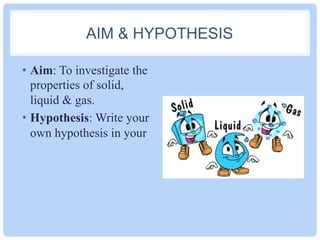
AIM & HYPOTHESIS
•  Aim: To investigate the
properties of solid,
liquid & gas.
•  Hypothesis: Write your
own hypothesis in your
EQUIPMENT
•  3 × balloons of different
shapes.
•  5 × small blocks or
density cubes
•  1 × large syringe
•  1 × large beaker of
water
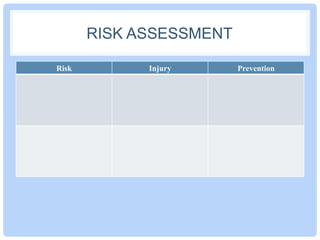
RISK ASSESSMENT
Risk Injury Prevention
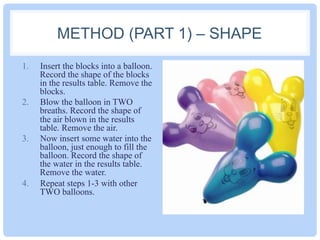
METHOD (PART 1) – SHAPE
1.  Insert the blocks into a balloon.
Record the shape of the blocks
in the results table. Remove the
blocks.
2.  Blow the balloon in TWO
breaths. Record the shape of
the air blown in the results
table. Remove the air.
3.  Now insert some water into the
balloon, just enough to fill the
balloon. Record the shape of
the water in the results table.
Remove the water.
4.  Repeat steps 1-3 with other
TWO balloons.
METHOD (PART 2) – COMPRESSION
1.  Insert the blocks into the syringe
squeeze the syringe. Record
observation in the results table.
Remove the blocks.
2.  Insert air into the syringe, block
the tip of the syringe with your
fingers and then squeeze the
syringe. Record observation in the
results. Remove the air.
3.  Insert water into the syringe,
making sure there are NO air
bubbles. Block the tip of the
syringe with your fingers and then
squeeze the syringe. Record
observation in the results. Remove
the water.
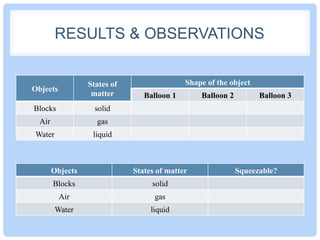
RESULTS & OBSERVATIONS
Objects
States of
matter
Shape of the object
Balloon 1 Balloon 2 Balloon 3
Blocks solid
Air gas
Water liquid
Objects States of matter Squeezable?
Blocks solid
Air gas
Water liquid
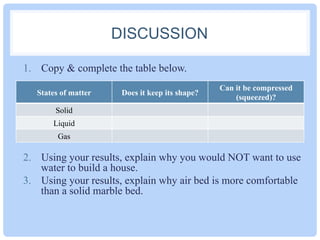
DISCUSSION
1.  Copy & complete the table below.
2.  Using your results, explain why you would NOT want to use
water to build a house.
3.  Using your results, explain why air bed is more comfortable
than a solid marble bed.
States of matter Does it keep its shape?
Can it be compressed
(squeezed)?
Solid
Liquid
Gas
CONCLUSION
•  Write your own conclusion in your experimental
report. Make sure your conclusion supports OR
rejects your hypothesis.

Prac - Properties of solid liquid & gas

  • 1.
    Y E AR 7 – M AT T E R PROPERTIES OF SOLID LIQUID & GAS By S. Choi
  • 2.
    AIM & HYPOTHESIS • Aim: To investigate the properties of solid, liquid & gas. •  Hypothesis: Write your own hypothesis in your
  • 3.
    EQUIPMENT •  3 ×balloons of different shapes. •  5 × small blocks or density cubes •  1 × large syringe •  1 × large beaker of water
  • 4.
  • 5.
    METHOD (PART 1)– SHAPE 1.  Insert the blocks into a balloon. Record the shape of the blocks in the results table. Remove the blocks. 2.  Blow the balloon in TWO breaths. Record the shape of the air blown in the results table. Remove the air. 3.  Now insert some water into the balloon, just enough to fill the balloon. Record the shape of the water in the results table. Remove the water. 4.  Repeat steps 1-3 with other TWO balloons.
  • 6.
    METHOD (PART 2)– COMPRESSION 1.  Insert the blocks into the syringe squeeze the syringe. Record observation in the results table. Remove the blocks. 2.  Insert air into the syringe, block the tip of the syringe with your fingers and then squeeze the syringe. Record observation in the results. Remove the air. 3.  Insert water into the syringe, making sure there are NO air bubbles. Block the tip of the syringe with your fingers and then squeeze the syringe. Record observation in the results. Remove the water.
  • 7.
    RESULTS & OBSERVATIONS Objects Statesof matter Shape of the object Balloon 1 Balloon 2 Balloon 3 Blocks solid Air gas Water liquid Objects States of matter Squeezable? Blocks solid Air gas Water liquid
  • 8.
    DISCUSSION 1.  Copy &complete the table below. 2.  Using your results, explain why you would NOT want to use water to build a house. 3.  Using your results, explain why air bed is more comfortable than a solid marble bed. States of matter Does it keep its shape? Can it be compressed (squeezed)? Solid Liquid Gas
  • 9.
    CONCLUSION •  Write yourown conclusion in your experimental report. Make sure your conclusion supports OR rejects your hypothesis.