
PR & Media
Communication Basics

                              PhD. Oana BARBU
                             Communication Strategist
       Part-time Lecturer at West Univrsity of Timisoara
       Communication Director – Rugby Club Timisoara
            Social Media Specialist at SymplySocial Inc.
                 Owner of www.oanabarbu.com
Basic Review

 Four       elements of communication
    1. Sender
    2. Message
    3. Medium
    4. Receiver
        Who is your message aimed at?
            There may be one or multiple publics
        Who is affected by the actions?
            Stakeholders
There is a reason why we have two ears
and one mouth – we must listen twice as
           much as we speak.
What are Public Relations?
 Public needs
 Organization  image (a projected identity)


 PR    = manage image and reputation by
  fulfilling a public’s needs!

                    HOW?
 “Thisis who we are;
 What we think about ourselves;

 What we want to do; and

 Why we deserve your support.”
PR’s role?
 Management and counseling function
 Enables organizations to build and maintain
  relationships
 Through an understanding of audience attitudes,
  opinions and values
 Planned, deliberate and two-way
 Conscience of organization
 Overseer of reputation
 Relationship management
 Determine   what people need (and want)
              and give it to them.
Persuasion vs. Manipulation
 Whatdo you think is the difference between
 persuasion vs. manipulation?
Persuasion
 Persuasion    is an attempt to influence a
  person’s actions through an appeal to his/her
  self-interest
 A PR person must be aware of what the
  audience wants to know
 Gained knowledge is “mutually beneficial”
Manipulation
 The  audience might not need to know the
  message, but they are coerced or tricked into
  that knowledge when there is little of no
  benefit to them
 Can result in loss of credibility or negative
  feelings
Media Theory
 Does  the media have an effect on viewers
  and listeners?
 There are several theories that support the
  extremes and the middle on this
     Yes, it impacts us
     No, it does not
     Yes and No... somewhere in between
A. Hypodermic Needle Theory
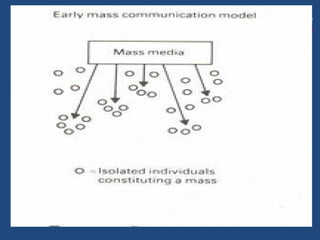
 One  of the earliest theories held that mass
  media was highly influential
 The media could “shoot” beliefs into people’s
  minds as a doctor shoots a hypodermic
  needle into a patient
 Examples: WWI propaganda, “War of the
  Worlds” radio broadcast
 This theory is no longer widely held
2. Two-Step Flow Theory
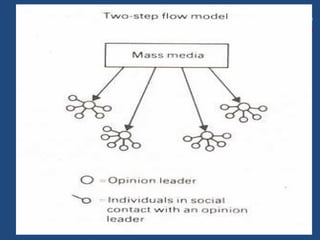
 Media  messages observed, analyzed,
  interpreted and passed on by opinion
  leaders
 The mass public gets information via these
  tastemakers
 1.   Opinions are formed
 2.   Perceptions are created
 3.   Knowledge is gained (or repressed)
Opinion Leaders?
   serve as a powerful conduit in the flow of information
   have more direct access to the media and/or a better media
    literacy than the masses
   have credibility with individuals that the mass media may lack:
     Political candidates
     Celebrities
     Community or religious leaders
     Teachers
     “Media analysts”
     Journalists
     Your very best…FRIENDS
Example Scenario

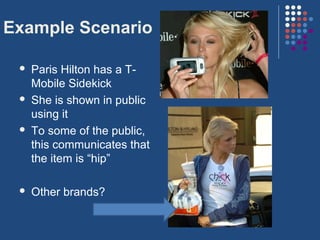
    Paris Hilton has a T-
     Mobile Sidekick
    She is shown in public
     using it
    To some of the public,
     this communicates that
     the item is “hip”

    Other brands?
The friendly-PR
 Many of us know an “early adopter” who is
 always the first on the block to own the
 coolest technology gadget
    This person serves as an “expert” that we may
     directly or indirectly learn from
Limited-Effects Theory
 Media  often does not have a direct effect on
  subjects and decision making
 However, it is just one of many influences,
  including:
     Opinion leaders
     One’s prior held beliefs
     Influence of family, friends, peers
Decision-making Process
 Exists
       on a continuum
 Depends on:
     The information itself
     Personal psyche or disposition
     Socio-cultural context
Decision-making Process
 Some    key factors:
    Socio-economic status (class)
    Religion
    Gender
    Intra-familial status
Moderate-Effects Theory
A   “middle ground”
 Recognizes that media is not all-powerful in
  its influence
 However, under certain circumstances it can
  have a very strong effect
Powerful-Effects Theory
 Media  has the potential for a huge influence
  on the audience
 Influence increases if:
     Audience has little or no opinion on a subject
     Subject is non-ego threatening
     Audience has no direct experience with the
      subject
Framing
 “Framing”  is the shaping of views and
  discussions through selective choice of facts,
  themes and words
 Sender makes the selection
 PR has a huge influence in “framing” how the
  media will discuss a product, person,
  development or ideology
 “Framing” creates the context in which the
  discussion occurs
Examples of framing
 Apple Computer makes a “comeback” with
 the introduction of iPad

 The   war on Iraq is a “war on terrorism”

A movie’s success is discussed in terms of
 opening weekend box-office numbers
SO, what are PR?
The practice of managing the flow of information between
  an individual or an organization and the public.
 provides an organization or individual exposure to their
  audiences
 using topics of public interest and news items
The aim of public relations
 to persuade the public, investors, partners, employees, and
  other stakeholders to maintain a certain point of view about
  it, its leadership, products, or of political decisions.
Common activities
 Events and campaigns, conferences, CSR, winning
  industry awards, working with the press, and employee
  communication.
Perceptions of Reality – how
does PR WORK?
 Does  what we see on TV impact our view of
 reality?

 For
    many people, the TV serves as a key
 way we learn about the world

    Particularly, when it exposes us to things or
     places that we might not normally encounter in
     “real life”
Uses and Gratification Theory
 Communication       process is interactive
    It is a selective process
 People  consume the media (and absorb
  messages embedded within it) for a reason
 It meets their needs
    Entertainment
    Information
Racial, Ethnic, and Sex-Role
Stereotypes
 Are we really seeing accurate portrayals of
  race, ethnicity, and sex roles in the media?
 Example:
     Women in Media
         Men outnumber women 2 to 1 in starring roles, yet
          women make up 51% of the population
         When women are featured, they are usually in
          subservient or younger roles
PR communication strategies
Diffusion and Adoption
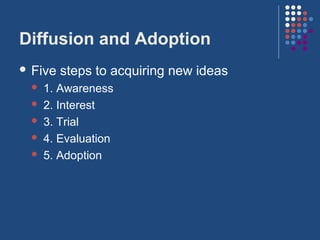
 Five   steps to acquiring new ideas
    1. Awareness
    2. Interest
    3. Trial
    4. Evaluation
    5. Adoption
Diffusion and Adoption
 In PR, the first two stages (awareness and
  interest) are most relevant
What causes change?
 Adoption   may be due to several factors:
    Is the idea better?
    Does it fit into my existing paradigm?
    Do I understand it?
    Can I safely try it out?
    How observable is it?
Application of Theory
 Asa PR professional, your goal is to
 persuade and communicate an
 organizational image
    Persuasion is easier if the audience has an interest
     in the topic and is predisposed to accept it
    Active audiences are already aware of the product
     and have an interest in it
    Passive audiences must be lured into accepting
     your message
      An inactive public has less interest in the topic
       and, thus, will be even more difficult to persuade
Strategy for an inactive public?
M-A-O Model
 Usethe M-A-O model to lure a passive
 audience into action
    Motivation
    Ability
    Opportunity
Motivation
 You must motivate the audience to become
  aware that your message even exists
 Can be done with various tactics:
    Design and style of message
    Unique form of delivery
    Reliance of credible tastemakers
    Bribe the audience
Ability
 Enable  easier understanding of the message
  (once the public is aware of it)
 Can be achieved various ways:
    Simplify the message
    Relate the message to what they already know
    Talk their… slang!
Opportunity
 Structure   the message for optimal processing
     Repetition
     Create an environment where message is most
      likely to be heard
     Keep it interesting
     Don’t stop the message. Don’t stop texting. Don’t
      stop giving information.
Example: M-A-O Model
   Progressive Direct car insurance campaign
   Many consumers do not “shop around” for car
    insurance
   They stick with their existing insurance…even if
    there is a price advantage to shopping around
EXAMPLE
   Motivate: make would-be consumers to think about
    their rates so that they may build awareness of their
    service
   They “bribe” people with free airline miles to request
    a quote
   Then, the consumer is exposed to the information
    and interest is generated due to the anticipated
    reward
   Once the consumer gets the quote, it is hoped that
    they will take action on their knowledge of the
    competitive rate
PR basics

PR basics

  • 1.
    PR & Media CommunicationBasics PhD. Oana BARBU Communication Strategist Part-time Lecturer at West Univrsity of Timisoara Communication Director – Rugby Club Timisoara Social Media Specialist at SymplySocial Inc. Owner of www.oanabarbu.com
  • 2.
    Basic Review  Four elements of communication  1. Sender  2. Message  3. Medium  4. Receiver  Who is your message aimed at?  There may be one or multiple publics  Who is affected by the actions?  Stakeholders
  • 3.
    There is areason why we have two ears and one mouth – we must listen twice as much as we speak.
  • 4.
    What are PublicRelations?  Public needs  Organization  image (a projected identity)  PR = manage image and reputation by fulfilling a public’s needs! HOW?
  • 5.
     “Thisis whowe are;  What we think about ourselves;  What we want to do; and  Why we deserve your support.”
  • 6.
    PR’s role?  Managementand counseling function  Enables organizations to build and maintain relationships  Through an understanding of audience attitudes, opinions and values  Planned, deliberate and two-way  Conscience of organization  Overseer of reputation  Relationship management
  • 7.
     Determine what people need (and want) and give it to them.
  • 8.
    Persuasion vs. Manipulation Whatdo you think is the difference between persuasion vs. manipulation?
  • 9.
    Persuasion  Persuasion is an attempt to influence a person’s actions through an appeal to his/her self-interest  A PR person must be aware of what the audience wants to know  Gained knowledge is “mutually beneficial”
  • 10.
    Manipulation  The audience might not need to know the message, but they are coerced or tricked into that knowledge when there is little of no benefit to them  Can result in loss of credibility or negative feelings
  • 11.
    Media Theory  Does the media have an effect on viewers and listeners?  There are several theories that support the extremes and the middle on this  Yes, it impacts us  No, it does not  Yes and No... somewhere in between
  • 12.
    A. Hypodermic NeedleTheory  One of the earliest theories held that mass media was highly influential  The media could “shoot” beliefs into people’s minds as a doctor shoots a hypodermic needle into a patient  Examples: WWI propaganda, “War of the Worlds” radio broadcast  This theory is no longer widely held
  • 14.
    2. Two-Step FlowTheory  Media messages observed, analyzed, interpreted and passed on by opinion leaders  The mass public gets information via these tastemakers 1. Opinions are formed 2. Perceptions are created 3. Knowledge is gained (or repressed)
  • 16.
    Opinion Leaders?  serve as a powerful conduit in the flow of information  have more direct access to the media and/or a better media literacy than the masses  have credibility with individuals that the mass media may lack:  Political candidates  Celebrities  Community or religious leaders  Teachers  “Media analysts”  Journalists  Your very best…FRIENDS
  • 17.
    Example Scenario  Paris Hilton has a T- Mobile Sidekick  She is shown in public using it  To some of the public, this communicates that the item is “hip”  Other brands?
  • 18.
    The friendly-PR  Manyof us know an “early adopter” who is always the first on the block to own the coolest technology gadget  This person serves as an “expert” that we may directly or indirectly learn from
  • 19.
    Limited-Effects Theory  Media often does not have a direct effect on subjects and decision making  However, it is just one of many influences, including:  Opinion leaders  One’s prior held beliefs  Influence of family, friends, peers
  • 20.
    Decision-making Process  Exists on a continuum  Depends on:  The information itself  Personal psyche or disposition  Socio-cultural context
  • 21.
    Decision-making Process  Some key factors:  Socio-economic status (class)  Religion  Gender  Intra-familial status
  • 22.
    Moderate-Effects Theory A “middle ground”  Recognizes that media is not all-powerful in its influence  However, under certain circumstances it can have a very strong effect
  • 23.
    Powerful-Effects Theory  Media has the potential for a huge influence on the audience  Influence increases if:  Audience has little or no opinion on a subject  Subject is non-ego threatening  Audience has no direct experience with the subject
  • 24.
    Framing  “Framing” is the shaping of views and discussions through selective choice of facts, themes and words  Sender makes the selection  PR has a huge influence in “framing” how the media will discuss a product, person, development or ideology  “Framing” creates the context in which the discussion occurs
  • 25.
    Examples of framing Apple Computer makes a “comeback” with the introduction of iPad  The war on Iraq is a “war on terrorism” A movie’s success is discussed in terms of opening weekend box-office numbers
  • 26.
    SO, what arePR? The practice of managing the flow of information between an individual or an organization and the public.  provides an organization or individual exposure to their audiences  using topics of public interest and news items The aim of public relations  to persuade the public, investors, partners, employees, and other stakeholders to maintain a certain point of view about it, its leadership, products, or of political decisions. Common activities  Events and campaigns, conferences, CSR, winning industry awards, working with the press, and employee communication.
  • 27.
    Perceptions of Reality– how does PR WORK?  Does what we see on TV impact our view of reality?  For many people, the TV serves as a key way we learn about the world  Particularly, when it exposes us to things or places that we might not normally encounter in “real life”
  • 28.
    Uses and GratificationTheory  Communication process is interactive  It is a selective process  People consume the media (and absorb messages embedded within it) for a reason  It meets their needs  Entertainment  Information
  • 29.
    Racial, Ethnic, andSex-Role Stereotypes  Are we really seeing accurate portrayals of race, ethnicity, and sex roles in the media?  Example:  Women in Media  Men outnumber women 2 to 1 in starring roles, yet women make up 51% of the population  When women are featured, they are usually in subservient or younger roles
  • 30.
  • 31.
    Diffusion and Adoption Five steps to acquiring new ideas  1. Awareness  2. Interest  3. Trial  4. Evaluation  5. Adoption
  • 32.
    Diffusion and Adoption In PR, the first two stages (awareness and interest) are most relevant
  • 33.
    What causes change? Adoption may be due to several factors:  Is the idea better?  Does it fit into my existing paradigm?  Do I understand it?  Can I safely try it out?  How observable is it?
  • 34.
    Application of Theory Asa PR professional, your goal is to persuade and communicate an organizational image  Persuasion is easier if the audience has an interest in the topic and is predisposed to accept it  Active audiences are already aware of the product and have an interest in it  Passive audiences must be lured into accepting your message  An inactive public has less interest in the topic and, thus, will be even more difficult to persuade
  • 35.
    Strategy for aninactive public?
  • 36.
    M-A-O Model  UsetheM-A-O model to lure a passive audience into action  Motivation  Ability  Opportunity
  • 37.
    Motivation  You mustmotivate the audience to become aware that your message even exists  Can be done with various tactics:  Design and style of message  Unique form of delivery  Reliance of credible tastemakers  Bribe the audience
  • 38.
    Ability  Enable easier understanding of the message (once the public is aware of it)  Can be achieved various ways:  Simplify the message  Relate the message to what they already know  Talk their… slang!
  • 39.
    Opportunity  Structure the message for optimal processing  Repetition  Create an environment where message is most likely to be heard  Keep it interesting  Don’t stop the message. Don’t stop texting. Don’t stop giving information.
  • 40.
    Example: M-A-O Model  Progressive Direct car insurance campaign  Many consumers do not “shop around” for car insurance  They stick with their existing insurance…even if there is a price advantage to shopping around
  • 41.
    EXAMPLE  Motivate: make would-be consumers to think about their rates so that they may build awareness of their service  They “bribe” people with free airline miles to request a quote  Then, the consumer is exposed to the information and interest is generated due to the anticipated reward  Once the consumer gets the quote, it is hoped that they will take action on their knowledge of the competitive rate