Persuasive Communication  Ethics		Sam Brandon & Elliot Chang
Ethics“The science of conduct.  It considers the actions of human beings with reference to their rightness or wrongness.”Mackenzie (2008) “Ethics, as a branch of philosophy, is not just about what is right and wrong, its about what is good and what is bad. Ethics is about being good and that the practitioner’s task is to determine what a good action is.”McElreath (1997)
Is all PR propaganda?How can you tell if persuasion is ethical or not?
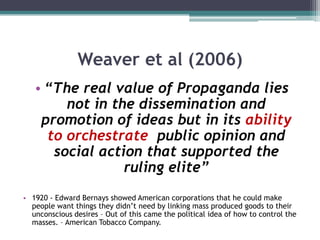
Weaver et al (2006)“The real value of Propaganda lies not in the dissemination and promotion of ideas but in its ability to orchestrate  public opinion and social action that supported the ruling elite”1920 - Edward Bernays showed American corporations that he could make people want things they didn’t need by linking mass produced goods to their  unconscious desires – Out of this came the political idea of how to control the masses. – American Tobacco Company.
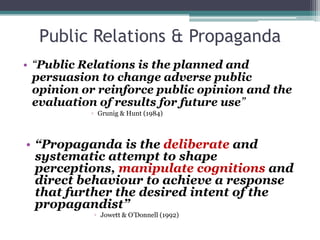
Public Relations & Propaganda“Public Relations is the planned and persuasion to change adverse public opinion or reinforce public opinion and the evaluation of results for future use”Grunig & Hunt (1984)“Propaganda is the deliberate and systematic attempt to shape perceptions, manipulate cognitions and direct behaviour to achieve a response that further the desired intent of the propagandist”
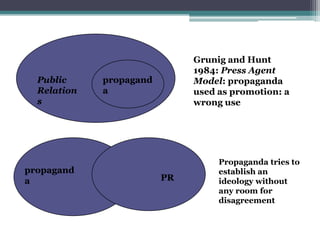
Jowett & O’Donnell (1992)Grunig and Hunt 1984: Press Agent Model: propaganda used as promotion: a wrong usepropagandaPublic RelationsPropaganda tries to establish an ideology without any room for disagreementpropagandaPR
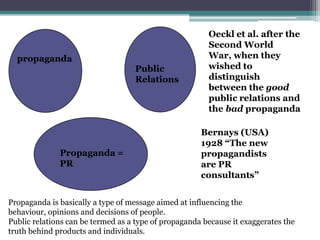
Oeckl et al. after the Second World War, when they wished to distinguish between the good public relations and the bad propagandapropagandaPublic RelationsBernays (USA) 1928 “The new propagandists are PR consultants”Propaganda = PRPropaganda is basically a type of message aimed at influencing the behaviour, opinions and decisions of people.Public relations can be termed as a type of propaganda because it exaggerates the truth behind products and individuals.
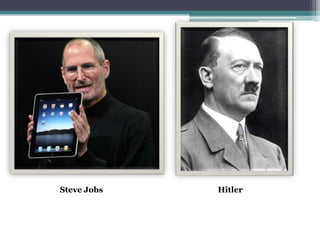
Steve Jobs                                                        Hitler
TruthThe boundary between PR & Propaganda is vaguePR & Propaganda’s tactics, aims & resources can be the sameIf what you're "spinning" has a solid basis in fact, you're doing PR. If not, it's propaganda. Plain and simple.TARES
PR or Propaganda James Grunig argued that when practiced ethically and responsibly, public relations provide a vital communication activity for the world, not only for organizations and nations.  He went further and said that public relations could help to develop an understanding among groups “and eventually reduce conflict.” JacquieL’Etang in her insights into propaganda said that revealing and communicating underpinning values explicitly together with agendas “might therefore be an important part of distinguishing public relations and propaganda”. On the other hand, some scholars (e.g. Moloney, Fawkes) have explored notions of public relations as ‘soft propaganda’ and of the ‘ethics of propaganda’; some suggest public relations damages democracy by promoting the values of interest groups over those of society
CIPR Code of Conduct Members agree to:Have honest and proper regard for the public interestMaintain the highest standards of professional endeavour, integrity, confidentiality, financial propriety and personal conductDeal honestly and fairly in businessCheck the reliability and accuracy of information before dissemination Never knowingly mislead others Work within the legal and regulatory frameworks affecting the practice of public relations Support the CIPR Principles by bringing to the attention of the CIPR examples of malpractice and unprofessional conduct
Case Study
Maloney“All Public Relations isSoft Propaganda”
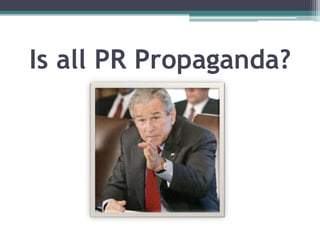
Is all PR Propaganda?
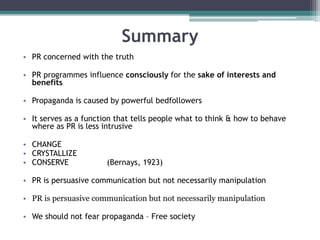
SummaryPR concerned with the truthPR programmes influence consciously for the sake of interests and benefitsPropaganda is caused by powerful bedfollowersIt serves as a function that tells people what to think & how to behave where as PR is less intrusiveCHANGECRYSTALLIZECONSERVE                (Bernays, 1923)PR is persuasive communication but not necessarily manipulationPR is persuasive communication but not necessarily manipulationWe should not fear propaganda – Free society
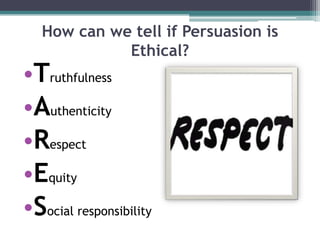
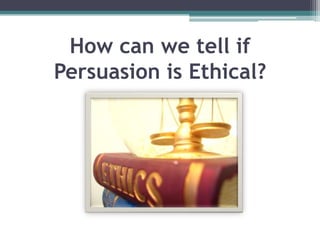
How can we tell if Persuasion is Ethical?TruthfulnessAuthenticityRespectEquitySocial responsibility
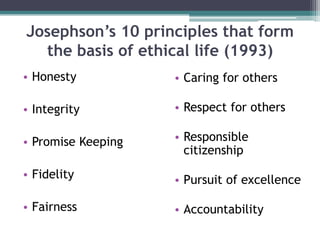
Josephson’s 10 principles that form the basis of ethical life (1993)HonestyIntegrityPromise KeepingFidelityFairnessCaring for others
Respect for others
Responsible citizenship
Pursuit of excellence
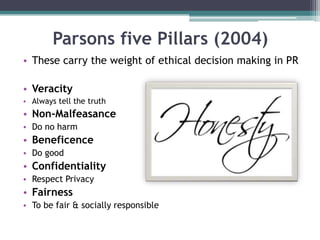
AccountabilityParsons five Pillars (2004)These carry the weight of ethical decision making in PRVeracityAlways tell the truthNon-MalfeasanceDo no harmBeneficence Do goodConfidentiality Respect PrivacyFairnessTo be fair & socially responsible
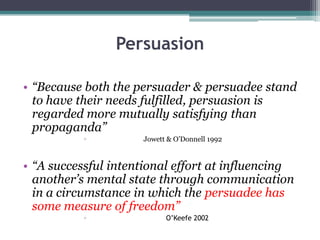
Persuasion“Because both the persuader & persuadee stand to have their needs fulfilled, persuasion is regarded more mutually satisfying than propaganda”Jowett & O’Donnell 1992“A successful intentional effort at influencing another’s mental state through communication in a circumstance in which the persuadee has some measure of freedom”                                   O’Keefe 2002
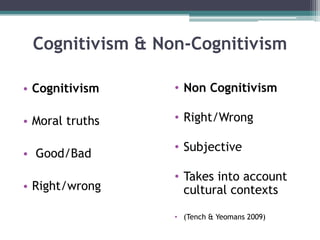
Cognitivism & Non-CognitivismCognitivismMoral truths  Good/BadRight/wrongNon Cognitivism
Right/Wrong
Subjective
Takes into account cultural contexts
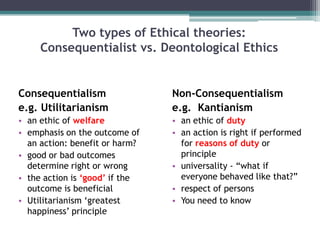
(Tench & Yeomans 2009)Two types of Ethical theories:Consequentialist vs. Deontological EthicsConsequentialisme.g. Utilitarianisman ethic of welfareemphasis on the outcome of an action: benefit or harm?good or bad outcomes determine right or wrongthe action is ‘good’ if the outcome is beneficialUtilitarianism ‘greatest happiness’ principleNon-Consequentialisme.g.  Kantianisman ethic of dutyan action is right if performed for reasons of duty or principleuniversality - “what if everyone behaved like that?”respect of personsYou need to know
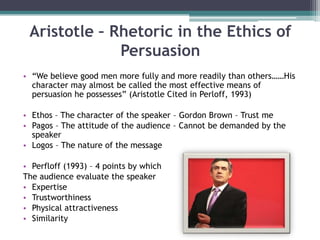
Aristotle – Rhetoric in the Ethics of Persuasion“We believe good men more fully and more readily than others……His character may almost be called the most effective means of persuasion he possesses” (Aristotle Cited in Perloff, 1993)Ethos – The character of the speaker – Gordon Brown – Trust mePagos – The attitude of the audience – Cannot be demanded by the      speakerLogos – The nature of the messagePerfloff (1993) – 4 points by whichThe audience evaluate the speakerExpertiseTrustworthiness Physical attractivenessSimilarity
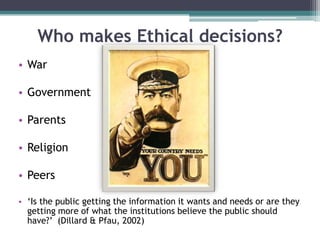
Who makes Ethical decisions?WarGovernmentParentsReligionPeers‘Is the public getting the information it wants and needs or are they getting more of what the institutions believe the public should have?’  (Dillard & Pfau, 2002)

Persuasive Communication

  • 1.
    Persuasive Communication Ethics Sam Brandon & Elliot Chang
  • 3.
    Ethics“The science ofconduct. It considers the actions of human beings with reference to their rightness or wrongness.”Mackenzie (2008) “Ethics, as a branch of philosophy, is not just about what is right and wrong, its about what is good and what is bad. Ethics is about being good and that the practitioner’s task is to determine what a good action is.”McElreath (1997)
  • 5.
    Is all PRpropaganda?How can you tell if persuasion is ethical or not?
  • 6.
    Weaver et al(2006)“The real value of Propaganda lies not in the dissemination and promotion of ideas but in its ability to orchestrate public opinion and social action that supported the ruling elite”1920 - Edward Bernays showed American corporations that he could make people want things they didn’t need by linking mass produced goods to their unconscious desires – Out of this came the political idea of how to control the masses. – American Tobacco Company.
  • 7.
    Public Relations &Propaganda“Public Relations is the planned and persuasion to change adverse public opinion or reinforce public opinion and the evaluation of results for future use”Grunig & Hunt (1984)“Propaganda is the deliberate and systematic attempt to shape perceptions, manipulate cognitions and direct behaviour to achieve a response that further the desired intent of the propagandist”
  • 8.
    Jowett & O’Donnell(1992)Grunig and Hunt 1984: Press Agent Model: propaganda used as promotion: a wrong usepropagandaPublic RelationsPropaganda tries to establish an ideology without any room for disagreementpropagandaPR
  • 9.
    Oeckl et al.after the Second World War, when they wished to distinguish between the good public relations and the bad propagandapropagandaPublic RelationsBernays (USA) 1928 “The new propagandists are PR consultants”Propaganda = PRPropaganda is basically a type of message aimed at influencing the behaviour, opinions and decisions of people.Public relations can be termed as a type of propaganda because it exaggerates the truth behind products and individuals.
  • 10.
  • 11.
    TruthThe boundary betweenPR & Propaganda is vaguePR & Propaganda’s tactics, aims & resources can be the sameIf what you're "spinning" has a solid basis in fact, you're doing PR. If not, it's propaganda. Plain and simple.TARES
  • 12.
    PR or Propaganda JamesGrunig argued that when practiced ethically and responsibly, public relations provide a vital communication activity for the world, not only for organizations and nations.  He went further and said that public relations could help to develop an understanding among groups “and eventually reduce conflict.” JacquieL’Etang in her insights into propaganda said that revealing and communicating underpinning values explicitly together with agendas “might therefore be an important part of distinguishing public relations and propaganda”. On the other hand, some scholars (e.g. Moloney, Fawkes) have explored notions of public relations as ‘soft propaganda’ and of the ‘ethics of propaganda’; some suggest public relations damages democracy by promoting the values of interest groups over those of society
  • 13.
    CIPR Code ofConduct Members agree to:Have honest and proper regard for the public interestMaintain the highest standards of professional endeavour, integrity, confidentiality, financial propriety and personal conductDeal honestly and fairly in businessCheck the reliability and accuracy of information before dissemination Never knowingly mislead others Work within the legal and regulatory frameworks affecting the practice of public relations Support the CIPR Principles by bringing to the attention of the CIPR examples of malpractice and unprofessional conduct
  • 14.
  • 15.
    Maloney“All Public RelationsisSoft Propaganda”
  • 16.
    Is all PRPropaganda?
  • 17.
    SummaryPR concerned withthe truthPR programmes influence consciously for the sake of interests and benefitsPropaganda is caused by powerful bedfollowersIt serves as a function that tells people what to think & how to behave where as PR is less intrusiveCHANGECRYSTALLIZECONSERVE (Bernays, 1923)PR is persuasive communication but not necessarily manipulationPR is persuasive communication but not necessarily manipulationWe should not fear propaganda – Free society
  • 18.
    How can wetell if Persuasion is Ethical?TruthfulnessAuthenticityRespectEquitySocial responsibility
  • 20.
    Josephson’s 10 principlesthat form the basis of ethical life (1993)HonestyIntegrityPromise KeepingFidelityFairnessCaring for others
  • 21.
  • 22.
  • 23.
  • 24.
    AccountabilityParsons five Pillars(2004)These carry the weight of ethical decision making in PRVeracityAlways tell the truthNon-MalfeasanceDo no harmBeneficence Do goodConfidentiality Respect PrivacyFairnessTo be fair & socially responsible
  • 25.
    Persuasion“Because both thepersuader & persuadee stand to have their needs fulfilled, persuasion is regarded more mutually satisfying than propaganda”Jowett & O’Donnell 1992“A successful intentional effort at influencing another’s mental state through communication in a circumstance in which the persuadee has some measure of freedom” O’Keefe 2002
  • 26.
    Cognitivism & Non-CognitivismCognitivismMoraltruths Good/BadRight/wrongNon Cognitivism
  • 27.
  • 28.
  • 29.
    Takes into accountcultural contexts
  • 30.
    (Tench & Yeomans2009)Two types of Ethical theories:Consequentialist vs. Deontological EthicsConsequentialisme.g. Utilitarianisman ethic of welfareemphasis on the outcome of an action: benefit or harm?good or bad outcomes determine right or wrongthe action is ‘good’ if the outcome is beneficialUtilitarianism ‘greatest happiness’ principleNon-Consequentialisme.g. Kantianisman ethic of dutyan action is right if performed for reasons of duty or principleuniversality - “what if everyone behaved like that?”respect of personsYou need to know
  • 31.
    Aristotle – Rhetoricin the Ethics of Persuasion“We believe good men more fully and more readily than others……His character may almost be called the most effective means of persuasion he possesses” (Aristotle Cited in Perloff, 1993)Ethos – The character of the speaker – Gordon Brown – Trust mePagos – The attitude of the audience – Cannot be demanded by the speakerLogos – The nature of the messagePerfloff (1993) – 4 points by whichThe audience evaluate the speakerExpertiseTrustworthiness Physical attractivenessSimilarity
  • 32.
    Who makes Ethicaldecisions?WarGovernmentParentsReligionPeers‘Is the public getting the information it wants and needs or are they getting more of what the institutions believe the public should have?’ (Dillard & Pfau, 2002)

Editor's Notes

  • #20 http://www.youtube.com/watch?v=anFK9SA5kKw
  • #29 http://www.youtube.com/watch?v=Vbduo4fHANA&feature=related