the gospel
and global
crises
A story
about a
youth
group …
Conventional View Emerging View
The Human
Situation: What
is the story that
we find
ourselves in?
God created the world as perfect,
but because our primal
ancestors, Adam and Eve, did
not maintain the absolute
perfection demanded by God,
God has irrevocably determined
that the entire universe and all it
contains will be destroyed, and
the souls of all human beings –
except for those specifically
exempted – will be forever
punished for their imperfection
in hell.1
God created the world as good, but
human beings – as individuals, and as
groups – have rebelled against God and
filled the world with evil and injustice
like a terrible disease. God wants to save
humanity and heal it from its sickness,
but humanity is hopelessly lost and
confused, like sheep without a shepherd,
wandering farther and farther into
lostness and danger. Left to themselves,
human beings will spiral downward in
sickness and evil.
Basic
Questions: What
questions did
Jesus come to
answer?
Since everyone is doomed to
hell, Jesus seeks to answer these
questions: how can individuals
be saved from eternal
punishment in hell and instead
go to heaven after they die? How
can God help individuals be
happy and successful until then?
Since the human race is in such desperate
trouble, Jesus seeks to answer this
question: what must be done about the
mess we’re in? The mess refers both to
the general human condition and its
specific outworking among his
contemporaries: living under domination
by the Roman empire, and divided into
various competing sects.
Jesus’ message:
How did Jesus
respond to the
crisis?
Jesus says, in essence, “If you
want to be among those
specifically qualified to escape
being forever punished for your
sins in hell, you must repent of
your individual sins and believe
that my Father punished me on
the cross so He won’t have to
punish you in hell. Only if you
believe this will you go to
heaven when everyone else is
banished to hell.”2
This is the
good news.
Jesus says, in essence, “Other people and
groups – including your own religious
leaders - are leading you farther and
farther astray. I have been sent by God
with this good news – that God loves
humanity, even in its lostness and sin.
God graciously invites everyone and
anyone to question and reject what they
have been told and instead follow a new
path. Trust me and become my disciple,
and you will be transformed, and you will
participate in the transformation of the
world, which is possible, beginning right
now.”3
This is the good news.
1
Of course, there are many modern western non-religious ontologies and framing stories too,
plus Eastern ontologies and framing stories – both religious and irreligious.
2
This reflects a Calvinistic Evangelical protestant version of the message. The popular Roman
Catholic version might say, “You must believe in the teachings of the church and follow its
instructions, especially those regarding sacraments.” The popular mainline or liberal Protestant
Conventional View Emerging View
The Human
Situation: What
is the story that
we find
ourselves in?
God created the world as perfect,
but because our primal
ancestors, Adam and Eve, did
not maintain the absolute
perfection demanded by God,
God has irrevocably determined
that the entire universe and all it
contains will be destroyed, and
the souls of all human beings –
except for those specifically
exempted – will be forever
punished for their imperfection
in hell.1
God created the world as good, but
human beings – as individuals, and as
groups – have rebelled against God and
filled the world with evil and injustice
like a terrible disease. God wants to save
humanity and heal it from its sickness,
but humanity is hopelessly lost and
confused, like sheep without a shepherd,
wandering farther and farther into
lostness and danger. Left to themselves,
human beings will spiral downward in
sickness and evil.
Basic
Questions: What
questions did
Jesus come to
answer?
Since everyone is doomed to
hell, Jesus seeks to answer these
questions: how can individuals
be saved from eternal
punishment in hell and instead
go to heaven after they die? How
can God help individuals be
happy and successful until then?
Since the human race is in such desperate
trouble, Jesus seeks to answer this
question: what must be done about the
mess we’re in? The mess refers both to
the general human condition and its
specific outworking among his
contemporaries: living under domination
by the Roman empire, and divided into
various competing sects.
Jesus’ message:
How did Jesus
respond to the
crisis?
Jesus says, in essence, “If you
want to be among those
specifically qualified to escape
being forever punished for your
sins in hell, you must repent of
your individual sins and believe
that my Father punished me on
the cross so He won’t have to
punish you in hell. Only if you
believe this will you go to
heaven when everyone else is
banished to hell.”2
This is the
good news.
Jesus says, in essence, “Other people and
groups – including your own religious
leaders - are leading you farther and
farther astray. I have been sent by God
with this good news – that God loves
humanity, even in its lostness and sin.
God graciously invites everyone and
anyone to question and reject what they
have been told and instead follow a new
path. Trust me and become my disciple,
and you will be transformed, and you will
participate in the transformation of the
world, which is possible, beginning right
now.”3
This is the good news.
1
Of course, there are many modern western non-religious ontologies and framing stories too,
plus Eastern ontologies and framing stories – both religious and irreligious.
2
This reflects a Calvinistic Evangelical protestant version of the message. The popular Roman
Catholic version might say, “You must believe in the teachings of the church and follow its
instructions, especially those regarding sacraments.” The popular mainline or liberal Protestant
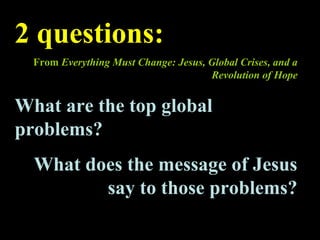
2 questions:
From Everything Must Change: Jesus, Global Crises, and a
Revolution of Hope
What are the top global
problems?
What does the message of Jesus
say to those problems?
Conventional View Emerging View
The Human
Situation: What
is the story that
we find
ourselves in?
God created the world as perfect,
but because our primal
ancestors, Adam and Eve, did
not maintain the absolute
perfection demanded by God,
God has irrevocably determined
that the entire universe and all it
contains will be destroyed, and
the souls of all human beings –
except for those specifically
exempted – will be forever
punished for their imperfection
in hell.1
God created the world as good, but
human beings – as individuals, and as
groups – have rebelled against God and
filled the world with evil and injustice
like a terrible disease. God wants to save
humanity and heal it from its sickness,
but humanity is hopelessly lost and
confused, like sheep without a shepherd,
wandering farther and farther into
lostness and danger. Left to themselves,
human beings will spiral downward in
sickness and evil.
Basic
Questions: What
questions did
Jesus come to
answer?
Since everyone is doomed to
hell, Jesus seeks to answer these
questions: how can individuals
be saved from eternal
punishment in hell and instead
go to heaven after they die? How
can God help individuals be
happy and successful until then?
Since the human race is in such desperate
trouble, Jesus seeks to answer this
question: what must be done about the
mess we’re in? The mess refers both to
the general human condition and its
specific outworking among his
contemporaries: living under domination
by the Roman empire, and divided into
various competing sects.
Jesus’ message:
How did Jesus
respond to the
crisis?
Jesus says, in essence, “If you
want to be among those
specifically qualified to escape
being forever punished for your
sins in hell, you must repent of
your individual sins and believe
that my Father punished me on
the cross so He won’t have to
punish you in hell. Only if you
believe this will you go to
heaven when everyone else is
banished to hell.”2
This is the
good news.
Jesus says, in essence, “Other people and
groups – including your own religious
leaders - are leading you farther and
farther astray. I have been sent by God
with this good news – that God loves
humanity, even in its lostness and sin.
God graciously invites everyone and
anyone to question and reject what they
have been told and instead follow a new
path. Trust me and become my disciple,
and you will be transformed, and you will
participate in the transformation of the
world, which is possible, beginning right
now.”3
This is the good news.
1
Of course, there are many modern western non-religious ontologies and framing stories too,
plus Eastern ontologies and framing stories – both religious and irreligious.
2
This reflects a Calvinistic Evangelical protestant version of the message. The popular Roman
Catholic version might say, “You must believe in the teachings of the church and follow its
instructions, especially those regarding sacraments.” The popular mainline or liberal Protestant
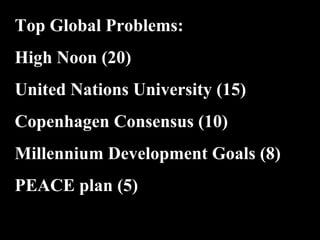
Top Global Problems:
High Noon (20)
United Nations University (15)
Copenhagen Consensus (10)
Millennium Development Goals (8)
PEACE plan (5)
Conventional View Emerging View
The Human
Situation: What
is the story that
we find
ourselves in?
God created the world as perfect,
but because our primal
ancestors, Adam and Eve, did
not maintain the absolute
perfection demanded by God,
God has irrevocably determined
that the entire universe and all it
contains will be destroyed, and
the souls of all human beings –
except for those specifically
exempted – will be forever
punished for their imperfection
in hell.1
God created the world as good, but
human beings – as individuals, and as
groups – have rebelled against God and
filled the world with evil and injustice
like a terrible disease. God wants to save
humanity and heal it from its sickness,
but humanity is hopelessly lost and
confused, like sheep without a shepherd,
wandering farther and farther into
lostness and danger. Left to themselves,
human beings will spiral downward in
sickness and evil.
Basic
Questions: What
questions did
Jesus come to
answer?
Since everyone is doomed to
hell, Jesus seeks to answer these
questions: how can individuals
be saved from eternal
punishment in hell and instead
go to heaven after they die? How
can God help individuals be
happy and successful until then?
Since the human race is in such desperate
trouble, Jesus seeks to answer this
question: what must be done about the
mess we’re in? The mess refers both to
the general human condition and its
specific outworking among his
contemporaries: living under domination
by the Roman empire, and divided into
various competing sects.
Jesus’ message:
How did Jesus
respond to the
crisis?
Jesus says, in essence, “If you
want to be among those
specifically qualified to escape
being forever punished for your
sins in hell, you must repent of
your individual sins and believe
that my Father punished me on
the cross so He won’t have to
punish you in hell. Only if you
believe this will you go to
heaven when everyone else is
banished to hell.”2
This is the
good news.
Jesus says, in essence, “Other people and
groups – including your own religious
leaders - are leading you farther and
farther astray. I have been sent by God
with this good news – that God loves
humanity, even in its lostness and sin.
God graciously invites everyone and
anyone to question and reject what they
have been told and instead follow a new
path. Trust me and become my disciple,
and you will be transformed, and you will
participate in the transformation of the
world, which is possible, beginning right
now.”3
This is the good news.
1
Of course, there are many modern western non-religious ontologies and framing stories too,
plus Eastern ontologies and framing stories – both religious and irreligious.
2
This reflects a Calvinistic Evangelical protestant version of the message. The popular Roman
Catholic version might say, “You must believe in the teachings of the church and follow its
instructions, especially those regarding sacraments.” The popular mainline or liberal Protestant
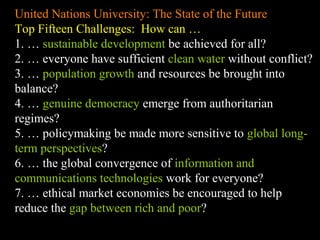
United Nations University: The State of the Future
Top Fifteen Challenges: How can …
1. … sustainable development be achieved for all?
2. … everyone have sufficient clean water without conflict?
3. … population growth and resources be brought into
balance?
4. … genuine democracy emerge from authoritarian
regimes?
5. … policymaking be made more sensitive to global long-
term perspectives?
6. … the global convergence of information and
communications technologies work for everyone?
7. … ethical market economies be encouraged to help
reduce the gap between rich and poor?
Conventional View Emerging View
The Human
Situation: What
is the story that
we find
ourselves in?
God created the world as perfect,
but because our primal
ancestors, Adam and Eve, did
not maintain the absolute
perfection demanded by God,
God has irrevocably determined
that the entire universe and all it
contains will be destroyed, and
the souls of all human beings –
except for those specifically
exempted – will be forever
punished for their imperfection
in hell.1
God created the world as good, but
human beings – as individuals, and as
groups – have rebelled against God and
filled the world with evil and injustice
like a terrible disease. God wants to save
humanity and heal it from its sickness,
but humanity is hopelessly lost and
confused, like sheep without a shepherd,
wandering farther and farther into
lostness and danger. Left to themselves,
human beings will spiral downward in
sickness and evil.
Basic
Questions: What
questions did
Jesus come to
answer?
Since everyone is doomed to
hell, Jesus seeks to answer these
questions: how can individuals
be saved from eternal
punishment in hell and instead
go to heaven after they die? How
can God help individuals be
happy and successful until then?
Since the human race is in such desperate
trouble, Jesus seeks to answer this
question: what must be done about the
mess we’re in? The mess refers both to
the general human condition and its
specific outworking among his
contemporaries: living under domination
by the Roman empire, and divided into
various competing sects.
Jesus’ message:
How did Jesus
respond to the
crisis?
Jesus says, in essence, “If you
want to be among those
specifically qualified to escape
being forever punished for your
sins in hell, you must repent of
your individual sins and believe
that my Father punished me on
the cross so He won’t have to
punish you in hell. Only if you
believe this will you go to
heaven when everyone else is
banished to hell.”2
This is the
good news.
Jesus says, in essence, “Other people and
groups – including your own religious
leaders - are leading you farther and
farther astray. I have been sent by God
with this good news – that God loves
humanity, even in its lostness and sin.
God graciously invites everyone and
anyone to question and reject what they
have been told and instead follow a new
path. Trust me and become my disciple,
and you will be transformed, and you will
participate in the transformation of the
world, which is possible, beginning right
now.”3
This is the good news.
1
Of course, there are many modern western non-religious ontologies and framing stories too,
plus Eastern ontologies and framing stories – both religious and irreligious.
2
This reflects a Calvinistic Evangelical protestant version of the message. The popular Roman
Catholic version might say, “You must believe in the teachings of the church and follow its
instructions, especially those regarding sacraments.” The popular mainline or liberal Protestant
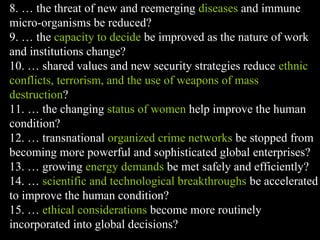
8. … the threat of new and reemerging diseases and immune
micro-organisms be reduced?
9. … the capacity to decide be improved as the nature of work
and institutions change?
10. … shared values and new security strategies reduce ethnic
conflicts, terrorism, and the use of weapons of mass
destruction?
11. … the changing status of women help improve the human
condition?
12. … transnational organized crime networks be stopped from
becoming more powerful and sophisticated global enterprises?
13. … growing energy demands be met safely and efficiently?
14. … scientific and technological breakthroughs be accelerated
to improve the human condition?
15. … ethical considerations become more routinely
incorporated into global decisions?
Conventional View Emerging View
The Human
Situation: What
is the story that
we find
ourselves in?
God created the world as perfect,
but because our primal
ancestors, Adam and Eve, did
not maintain the absolute
perfection demanded by God,
God has irrevocably determined
that the entire universe and all it
contains will be destroyed, and
the souls of all human beings –
except for those specifically
exempted – will be forever
punished for their imperfection
in hell.1
God created the world as good, but
human beings – as individuals, and as
groups – have rebelled against God and
filled the world with evil and injustice
like a terrible disease. God wants to save
humanity and heal it from its sickness,
but humanity is hopelessly lost and
confused, like sheep without a shepherd,
wandering farther and farther into
lostness and danger. Left to themselves,
human beings will spiral downward in
sickness and evil.
Basic
Questions: What
questions did
Jesus come to
answer?
Since everyone is doomed to
hell, Jesus seeks to answer these
questions: how can individuals
be saved from eternal
punishment in hell and instead
go to heaven after they die? How
can God help individuals be
happy and successful until then?
Since the human race is in such desperate
trouble, Jesus seeks to answer this
question: what must be done about the
mess we’re in? The mess refers both to
the general human condition and its
specific outworking among his
contemporaries: living under domination
by the Roman empire, and divided into
various competing sects.
Jesus’ message:
How did Jesus
respond to the
crisis?
Jesus says, in essence, “If you
want to be among those
specifically qualified to escape
being forever punished for your
sins in hell, you must repent of
your individual sins and believe
that my Father punished me on
the cross so He won’t have to
punish you in hell. Only if you
believe this will you go to
heaven when everyone else is
banished to hell.”2
This is the
good news.
Jesus says, in essence, “Other people and
groups – including your own religious
leaders - are leading you farther and
farther astray. I have been sent by God
with this good news – that God loves
humanity, even in its lostness and sin.
God graciously invites everyone and
anyone to question and reject what they
have been told and instead follow a new
path. Trust me and become my disciple,
and you will be transformed, and you will
participate in the transformation of the
world, which is possible, beginning right
now.”3
This is the good news.
1
Of course, there are many modern western non-religious ontologies and framing stories too,
plus Eastern ontologies and framing stories – both religious and irreligious.
2
This reflects a Calvinistic Evangelical protestant version of the message. The popular Roman
Catholic version might say, “You must believe in the teachings of the church and follow its
instructions, especially those regarding sacraments.” The popular mainline or liberal Protestant
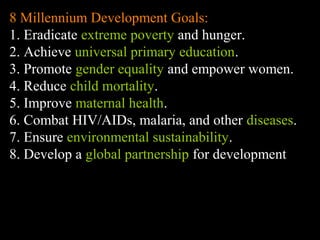
8 Millennium Development Goals:
1. Eradicate extreme poverty and hunger.
2. Achieve universal primary education.
3. Promote gender equality and empower women.
4. Reduce child mortality.
5. Improve maternal health.
6. Combat HIV/AIDs, malaria, and other diseases.
7. Ensure environmental sustainability.
8. Develop a global partnership for development
Conventional View Emerging View
The Human
Situation: What
is the story that
we find
ourselves in?
God created the world as perfect,
but because our primal
ancestors, Adam and Eve, did
not maintain the absolute
perfection demanded by God,
God has irrevocably determined
that the entire universe and all it
contains will be destroyed, and
the souls of all human beings –
except for those specifically
exempted – will be forever
punished for their imperfection
in hell.1
God created the world as good, but
human beings – as individuals, and as
groups – have rebelled against God and
filled the world with evil and injustice
like a terrible disease. God wants to save
humanity and heal it from its sickness,
but humanity is hopelessly lost and
confused, like sheep without a shepherd,
wandering farther and farther into
lostness and danger. Left to themselves,
human beings will spiral downward in
sickness and evil.
Basic
Questions: What
questions did
Jesus come to
answer?
Since everyone is doomed to
hell, Jesus seeks to answer these
questions: how can individuals
be saved from eternal
punishment in hell and instead
go to heaven after they die? How
can God help individuals be
happy and successful until then?
Since the human race is in such desperate
trouble, Jesus seeks to answer this
question: what must be done about the
mess we’re in? The mess refers both to
the general human condition and its
specific outworking among his
contemporaries: living under domination
by the Roman empire, and divided into
various competing sects.
Jesus’ message:
How did Jesus
respond to the
crisis?
Jesus says, in essence, “If you
want to be among those
specifically qualified to escape
being forever punished for your
sins in hell, you must repent of
your individual sins and believe
that my Father punished me on
the cross so He won’t have to
punish you in hell. Only if you
believe this will you go to
heaven when everyone else is
banished to hell.”2
This is the
good news.
Jesus says, in essence, “Other people and
groups – including your own religious
leaders - are leading you farther and
farther astray. I have been sent by God
with this good news – that God loves
humanity, even in its lostness and sin.
God graciously invites everyone and
anyone to question and reject what they
have been told and instead follow a new
path. Trust me and become my disciple,
and you will be transformed, and you will
participate in the transformation of the
world, which is possible, beginning right
now.”3
This is the good news.
1
Of course, there are many modern western non-religious ontologies and framing stories too,
plus Eastern ontologies and framing stories – both religious and irreligious.
2
This reflects a Calvinistic Evangelical protestant version of the message. The popular Roman
Catholic version might say, “You must believe in the teachings of the church and follow its
instructions, especially those regarding sacraments.” The popular mainline or liberal Protestant
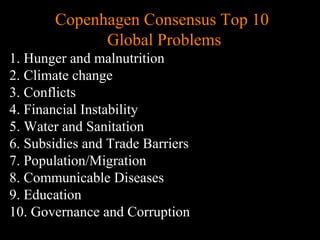
Copenhagen Consensus Top 10
Global Problems
1. Hunger and malnutrition
2. Climate change
3. Conflicts
4. Financial Instability
5. Water and Sanitation
6. Subsidies and Trade Barriers
7. Population/Migration
8. Communicable Diseases
9. Education
10. Governance and Corruption
Conventional View Emerging View
The Human
Situation: What
is the story that
we find
ourselves in?
God created the world as perfect,
but because our primal
ancestors, Adam and Eve, did
not maintain the absolute
perfection demanded by God,
God has irrevocably determined
that the entire universe and all it
contains will be destroyed, and
the souls of all human beings –
except for those specifically
exempted – will be forever
punished for their imperfection
in hell.1
God created the world as good, but
human beings – as individuals, and as
groups – have rebelled against God and
filled the world with evil and injustice
like a terrible disease. God wants to save
humanity and heal it from its sickness,
but humanity is hopelessly lost and
confused, like sheep without a shepherd,
wandering farther and farther into
lostness and danger. Left to themselves,
human beings will spiral downward in
sickness and evil.
Basic
Questions: What
questions did
Jesus come to
answer?
Since everyone is doomed to
hell, Jesus seeks to answer these
questions: how can individuals
be saved from eternal
punishment in hell and instead
go to heaven after they die? How
can God help individuals be
happy and successful until then?
Since the human race is in such desperate
trouble, Jesus seeks to answer this
question: what must be done about the
mess we’re in? The mess refers both to
the general human condition and its
specific outworking among his
contemporaries: living under domination
by the Roman empire, and divided into
various competing sects.
Jesus’ message:
How did Jesus
respond to the
crisis?
Jesus says, in essence, “If you
want to be among those
specifically qualified to escape
being forever punished for your
sins in hell, you must repent of
your individual sins and believe
that my Father punished me on
the cross so He won’t have to
punish you in hell. Only if you
believe this will you go to
heaven when everyone else is
banished to hell.”2
This is the
good news.
Jesus says, in essence, “Other people and
groups – including your own religious
leaders - are leading you farther and
farther astray. I have been sent by God
with this good news – that God loves
humanity, even in its lostness and sin.
God graciously invites everyone and
anyone to question and reject what they
have been told and instead follow a new
path. Trust me and become my disciple,
and you will be transformed, and you will
participate in the transformation of the
world, which is possible, beginning right
now.”3
This is the good news.
1
Of course, there are many modern western non-religious ontologies and framing stories too,
plus Eastern ontologies and framing stories – both religious and irreligious.
2
This reflects a Calvinistic Evangelical protestant version of the message. The popular Roman
Catholic version might say, “You must believe in the teachings of the church and follow its
instructions, especially those regarding sacraments.” The popular mainline or liberal Protestant
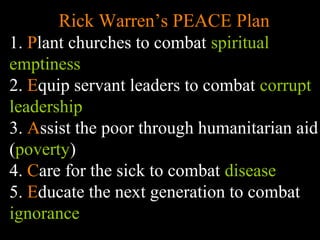
Rick Warren’s PEACE Plan
1. Plant churches to combat spiritual
emptiness
2. Equip servant leaders to combat corrupt
leadership
3. Assist the poor through humanitarian aid
(poverty)
4. Care for the sick to combat disease
5. Educate the next generation to combat
ignorance
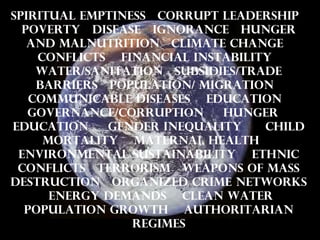
spiritual emptiness corrupt leadership
poverty disease ignorance hunger
and malnutrition climate change
conflicts Financial Instability
Water/Sanitation subsidies/trade
barriers population/ migration
communicable diseases education
governance/corruption hunger
education gender inequality child
mortality maternal health
environmental sustainability ethnic
conflicts terrorism weapons of mass
destruction organized crime networks
energy demands clean water
population growth authoritarian
regimes
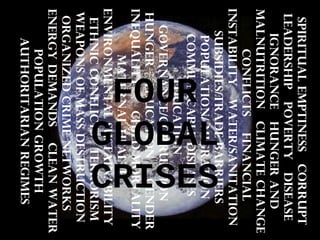
spiritualemptinesscorrupt
leadershippovertydisease
ignorancehungerand
malnutritionclimatechange
conflictsFinancial
InstabilityWater/Sanitation
subsidies/tradebarriers
population/migration
communicablediseases
education
governance/corruption
hungereducationgender
inequalitychildmortality
maternalhealth
environmentalsustainability
ethnicconflictsterrorism
weaponsofmassdestruction
organizedcrimenetworks
energydemandscleanwater
populationgrowth
authoritarianregimes
FOUR
GLOBAL
CRISES
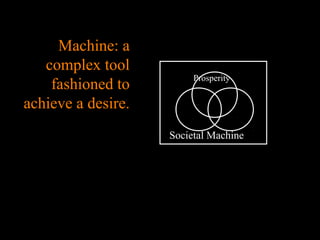
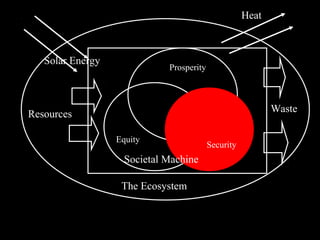
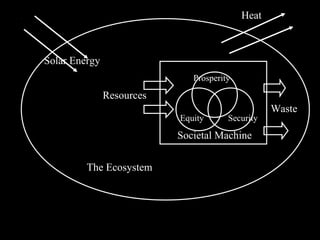
Societal Machine
Societal Machine
Prosperity
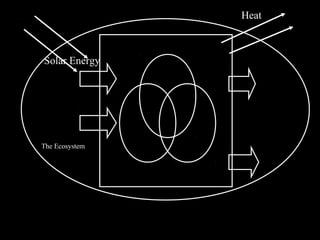
Machine: a
complex tool
fashioned to
achieve a desire.
Societal Machine
Security
Prosperity
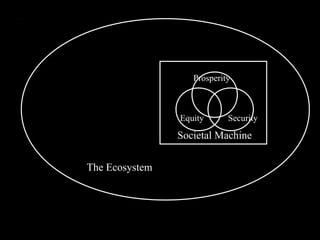
Societal Machine
Equity Security
Prosperity
Societal Machine
Equity Security
Prosperity
The Ecosystem
Societal Machine
Equity Security
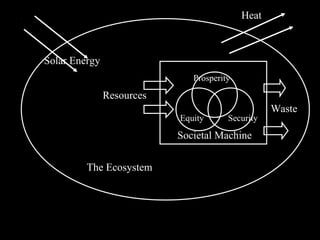
Prosperity
The Ecosystem
Heat
Solar Energy
Resources
Waste
The Ecosystem
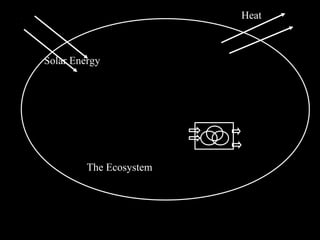
Heat
Solar Energy
The Ecosystem
Heat
Solar Energy
Societal Machine
Equity
Security
Prosperity
The Ecosystem
Heat
Solar Energy
Resources Waste
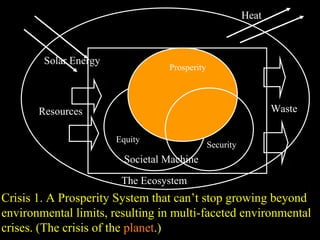
Crisis 1. A Prosperity System that can’t stop growing beyond
environmental limits, resulting in multi-faceted environmental
crises. (The crisis of the planet.)
Societal Machine
Equity
Security
Prosperity
The Ecosystem
Heat
Solar Energy
Resources Waste
Societal Machine
Equity
Security
Prosperity
Heat
Solar Energy
Resources
Waste
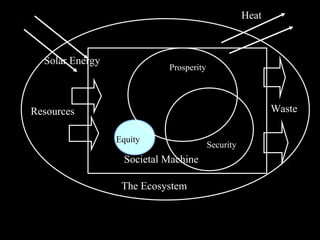
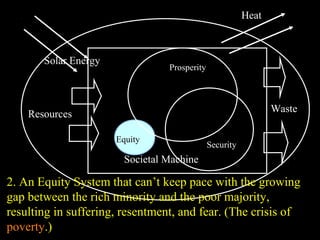
2. An Equity System that can’t keep pace with the growing
gap between the rich minority and the poor majority,
resulting in suffering, resentment, and fear. (The crisis of
poverty.)
Societal Machine
Equity
Security
Prosperity
The Ecosystem
Heat
Solar Energy
Resources
Waste
Societal Machine
Equity
Security
Prosperity
Heat
Solar Energy
Resources
Waste
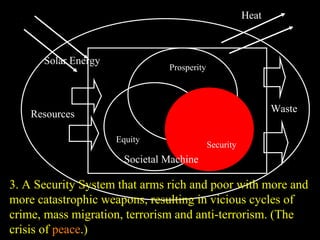
3. A Security System that arms rich and poor with more and
more catastrophic weapons, resulting in vicious cycles of
crime, mass migration, terrorism and anti-terrorism. (The
crisis of peace.)
Societal Machine
Equity Security
Prosperity
The Ecosystem
Heat
Solar Energy
Resources
Waste
Societal Machine
Equity Security
Prosperity
The Ecosystem
Heat
Solar Energy
Resources
Waste
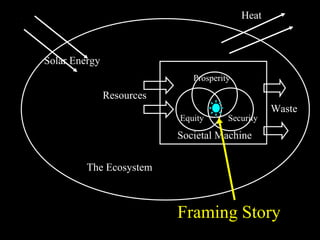
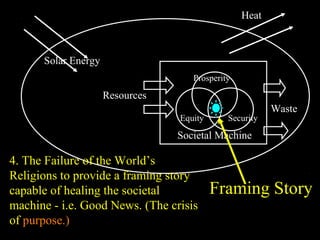
Framing Story
Societal Machine
Equity Security
Prosperity
Heat
Solar Energy
Resources
Waste
Framing Story
4. The Failure of the World’s
Religions to provide a framing story
capable of healing the societal
machine - i.e. Good News. (The crisis
of purpose.)
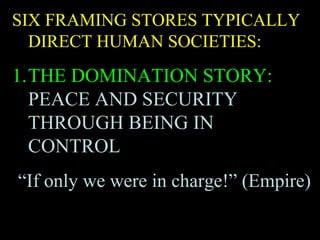
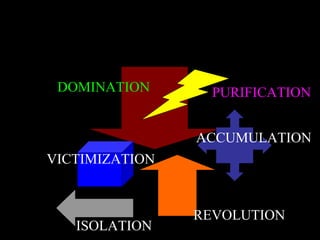
SIX FRAMING STORES TYPICALLY
DIRECT HUMAN SOCIETIES:
1.THE DOMINATION STORY:
PEACE AND SECURITY
THROUGH BEING IN
CONTROL
“If only we were in charge!” (Empire)
2. THE REVOLUTION STORY:
PEACE AND SECURITY
THROUGH VIOLENT
OVERTHROW OF
OPPRESSORS.
“If only THEY weren’t in
control!” (Revenge)
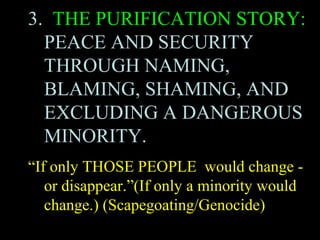
3. THE PURIFICATION STORY:
PEACE AND SECURITY
THROUGH NAMING,
BLAMING, SHAMING, AND
EXCLUDING A DANGEROUS
MINORITY.
“If only THOSE PEOPLE would change -
or disappear.”(If only a minority would
change.) (Scapegoating/Genocide)
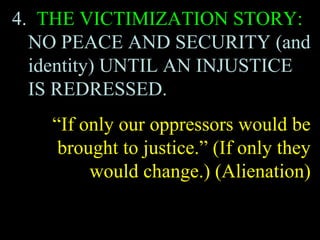
4. THE VICTIMIZATION STORY:
NO PEACE AND SECURITY (and
identity) UNTIL AN INJUSTICE
IS REDRESSED.
“If only our oppressors would be
brought to justice.” (If only they
would change.) (Alienation)
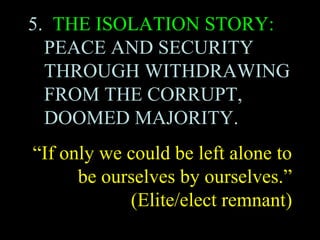
5. THE ISOLATION STORY:
PEACE AND SECURITY
THROUGH WITHDRAWING
FROM THE CORRUPT,
DOOMED MAJORITY.
“If only we could be left alone to
be ourselves by ourselves.”
(Elite/elect remnant)
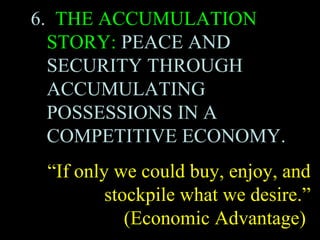
6. THE ACCUMULATION
STORY: PEACE AND
SECURITY THROUGH
ACCUMULATING
POSSESSIONS IN A
COMPETITIVE ECONOMY.
“If only we could buy, enjoy, and
stockpile what we desire.”
(Economic Advantage)
DOMINATION PURIFICATION
ACCUMULATION
VICTIMIZATION
REVOLUTION
ISOLATION
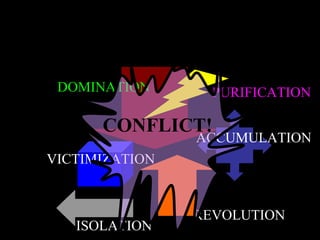
DOMINATION PURIFICATION
ACCUMULATION
VICTIMIZATION
REVOLUTION
ISOLATION
CONFLICT!
Hypocrisy:
Religions can intentionally or
accidentally baptize, support,
legitimize, and camouflage the
six destructive framing stories.
They can cover up a wolf-ish
message in sheep’s language.
A Dangerous Possibility:
Even so-called Christian
religions can lose Jesus’
story, and instead use
biblical language to
camouflage one or more of
history’s violent framing
stories.
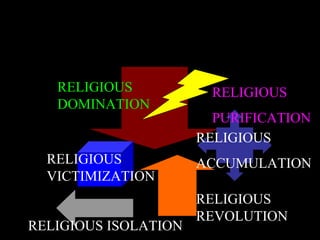
RELIGIOUS
DOMINATION
RELIGIOUS
PURIFICATION
RELIGIOUS
ACCUMULATIONRELIGIOUS
VICTIMIZATION
RELIGIOUS
REVOLUTION
RELIGIOUS ISOLATION
DOMINATION PURIFICATION
ACCUMULATION
VICTIMIZATION
REVOLUTION
ISOLATION
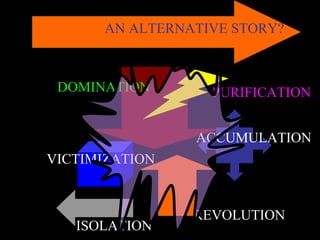
AN ALTERNATIVE STORY?
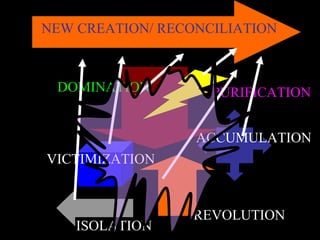
DOMINATION PURIFICATION
ACCUMULATION
VICTIMIZATION
REVOLUTION
ISOLATION
NEW CREATION/ RECONCILIATION
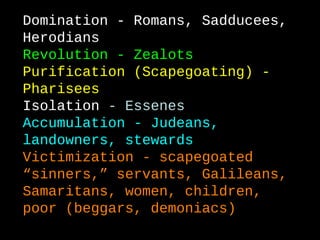
Domination - Romans, Sadducees,
Herodians
Revolution - Zealots
Purification (Scapegoating) -
Pharisees
Isolation - Essenes
Accumulation - Judeans,
landowners, stewards
Victimization - scapegoated
“sinners,” servants, Galileans,
Samaritans, women, children,
poor (beggars, demoniacs)
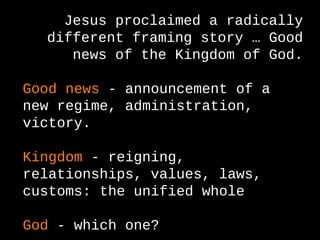
Jesus proclaimed a radically
different framing story … Good
news of the Kingdom of God.
Good news - announcement of a
new regime, administration,
victory.

Kingdom - reigning,
relationships, values, laws,
customs: the unified whole
God - which one?
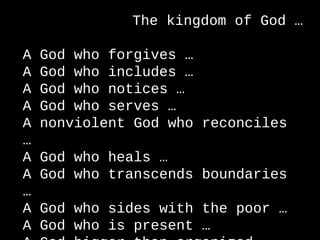
The kingdom of God …
A God who forgives …
A God who includes …
A God who notices …
A God who serves …
A nonviolent God who reconciles
…
A God who heals …
A God who transcends boundaries
…
A God who sides with the poor …
A God who is present …
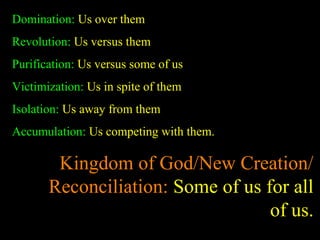
Domination: Us over them
Revolution: Us versus them
Purification: Us versus some of us
Victimization: Us in spite of them
Isolation: Us away from them
Accumulation: Us competing with them.
Kingdom of God/New Creation/
Reconciliation: Some of us for all
of us.
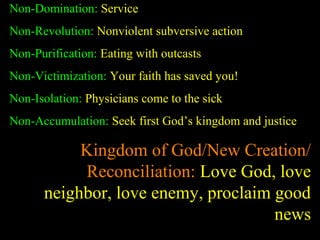
Non-Domination: Service
Non-Revolution: Nonviolent subversive action
Non-Purification: Eating with outcasts
Non-Victimization: Your faith has saved you!
Non-Isolation: Physicians come to the sick
Non-Accumulation: Seek first God’s kingdom and justice
Kingdom of God/New Creation/
Reconciliation: Love God, love
neighbor, love enemy, proclaim good
news
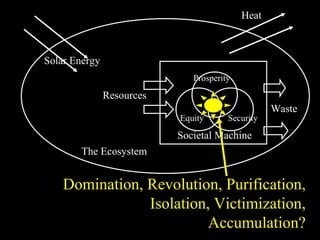
Societal Machine
Equity Security
Prosperity
The Ecosystem
Heat
Solar Energy
Resources
Waste
Domination, Revolution, Purification,
Isolation, Victimization,
Accumulation?
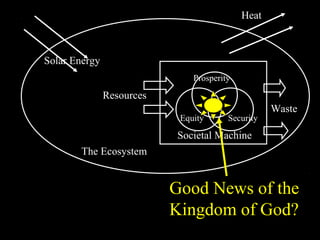
Societal Machine
Equity Security
Prosperity
The Ecosystem
Heat
Solar Energy
Resources
Waste
Good News of the
Kingdom of God?
There are many “kingdoms” or power structures or social
arrangements or ways of life available in this world …
But they set people against each other … above and against
the environment … even against themselves.
There is another kingdom … another system … another way
of arranging life … another path to prosperity, equity, and
security.
It is the original way, the Creator’s way, the way of prosperity
through service and stewardship, security through
reconciliation and peace-making, and equity through justice
and the pursuit of the common good. This is the way of the
kingdom of God, the way of Jesus.
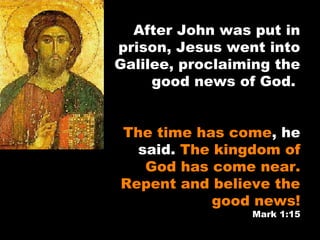
After John was put in
prison, Jesus went into
Galilee, proclaiming the
good news of God.
The time has come, he
said. The kingdom of
God has come near.
Repent and believe the
good news!
Mark 1:15
QuickTime™ and a
TIFF (Uncompressed) decompressor
are needed to see this picture.
Ivan Illich (Austrian
former priest,
philosopher, social
critic, 1926-2002)
Neither revolution nor reformation
can ultimately change a society,
rather you must tell a new powerful
tale, one so persuasive that it sweeps
away the old myths and becomes the
preferred story …
… one so inclusive that it gathers all the
bits of our past and our present into a
coherent whole, one that even shines
some light into the future so that we can
take the next step…. If you want to
change a society, then you have to tell an
alternative story.
- attributed to Ivan Illich (Austrian former priest,
philosopher, social critic, 1926-2002)
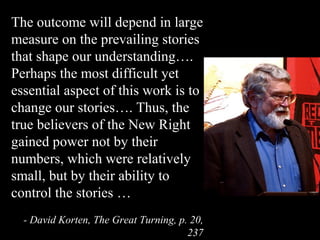
The outcome will depend in large
measure on the prevailing stories
that shape our understanding….
Perhaps the most difficult yet
essential aspect of this work is to
change our stories…. Thus, the
true believers of the New Right
gained power not by their
numbers, which were relatively
small, but by their ability to
control the stories …
- David Korten, The Great Turning, p. 20,
237
[Jesus] dedicated his life to
changing the prevailing stories.
- David Korten, The Great Turning, p. 20, 237, 261
The idea of Jesus as the messianic Christ and
founder of an imperial church was a reconstruction
that did not come to fruition until nearly three
centuries after his crucifixion, when the emperor
Constantine embraced Christianity and made it the
official religion of the Roman Empire. Christianity
has served empire ever since, lending moral
legitimacy to unconscionable violence and
oppression in the name of the man whose life was
devoted to teaching love and compassion.
- David Korten, The Great Turning, p. 259
The essence of struggle is neither endurance nor
denial. The essence of struggle is the decision to
become new rather than simply to become older. It
is the opportunity to grow either smaller or larger
in the process. There is, then, a gift hidden in the
travails of forced change. It is the gift of beginning
again: conversion.
QuickTime™ and a
TIFF (Uncompressed) decompressor
are needed to see this picture.
- Sister Joan
Chittister, Scarred
by Struggle,
Transformed by
Hope, p. 22
Conventional View Emerging View
The Human
Situation: What
is the story that
we find
ourselves in?
God created the world as perfect,
but because our primal
ancestors, Adam and Eve, did
not maintain the absolute
perfection demanded by God,
God has irrevocably determined
that the entire universe and all it
contains will be destroyed, and
the souls of all human beings –
except for those specifically
exempted – will be forever
punished for their imperfection
in hell.1
God created the world as good, but
human beings – as individuals, and as
groups – have rebelled against God and
filled the world with evil and injustice
like a terrible disease. God wants to save
humanity and heal it from its sickness,
but humanity is hopelessly lost and
confused, like sheep without a shepherd,
wandering farther and farther into
lostness and danger. Left to themselves,
human beings will spiral downward in
sickness and evil.
Basic
Questions: What
questions did
Jesus come to
answer?
Since everyone is doomed to
hell, Jesus seeks to answer these
questions: how can individuals
be saved from eternal
punishment in hell and instead
go to heaven after they die? How
can God help individuals be
happy and successful until then?
Since the human race is in such desperate
trouble, Jesus seeks to answer this
question: what must be done about the
mess we’re in? The mess refers both to
the general human condition and its
specific outworking among his
contemporaries: living under domination
by the Roman empire, and divided into
various competing sects.
Jesus’ message:
How did Jesus
respond to the
crisis?
Jesus says, in essence, “If you
want to be among those
specifically qualified to escape
being forever punished for your
sins in hell, you must repent of
your individual sins and believe
that my Father punished me on
the cross so He won’t have to
punish you in hell. Only if you
believe this will you go to
heaven when everyone else is
banished to hell.”2
This is the
good news.
Jesus says, in essence, “Other people and
groups – including your own religious
leaders - are leading you farther and
farther astray. I have been sent by God
with this good news – that God loves
humanity, even in its lostness and sin.
God graciously invites everyone and
anyone to question and reject what they
have been told and instead follow a new
path. Trust me and become my disciple,
and you will be transformed, and you will
participate in the transformation of the
world, which is possible, beginning right
now.”3
This is the good news.
1
Of course, there are many modern western non-religious ontologies and framing stories too,
plus Eastern ontologies and framing stories – both religious and irreligious.
2
This reflects a Calvinistic Evangelical protestant version of the message. The popular Roman
Catholic version might say, “You must believe in the teachings of the church and follow its
instructions, especially those regarding sacraments.” The popular mainline or liberal Protestant
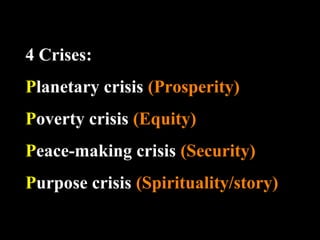
4 Crises:
Planetary crisis (Prosperity)
Poverty crisis (Equity)
Peace-making crisis (Security)
Purpose crisis (Spirituality/story)
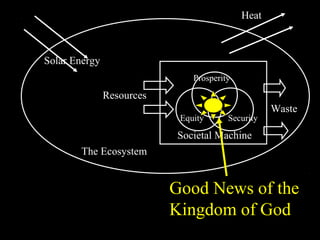
Societal Machine
Equity Security
Prosperity
The Ecosystem
Heat
Solar Energy
Resources
Waste
Good News of the
Kingdom of God
What will
happen?
What will you
and I do?
A Prayer Attributed to St. Francis:
Lord, make us instruments of your peace. Where
there is hatred, let us sow love; where there is
injury, pardon; where there is discord, union;
where there is doubt, faith; where there is
despair, hope; where there is darkness, light;
where there is sadness, joy. Grant that we may
not so much seek to be consoled as to console;
to be understood as to understand; to be loved as
to love. For it is in giving that we receive; it is in
pardoning that we are pardoned; and it is in
dying that we are born to eternal life. Amen.
There are many reasons
to compare our churches
to an old male tortoise
…
Our God who makes us
one family …
May your unspeakable
Name be revered.
Now, here on earth may your
commonwealth come…
On earth, as in heaven, may your
dreams come true.
Give us today our bread for
today.
Forgive us our wrongs as we
forgive.
Lead us away from the time of trial,
Liberate us from the evil.
For the kingdom is yours and yours alone,
the power is yours and yours alone,
the glory is yours and yours alone,
Now and forever. Amen.
Hallelujah
Hallelujah
Amen.
Now, here on earth may your
commonwealth come…
On earth, as in heaven, may your
dreams come true.
Conventional View Emerging View
The Human
Situation: What
is the story that
we find
ourselves in?
God created the world as perfect,
but because our primal
ancestors, Adam and Eve, did
not maintain the absolute
perfection demanded by God,
God has irrevocably determined
that the entire universe and all it
contains will be destroyed, and
the souls of all human beings –
except for those specifically
exempted – will be forever
punished for their imperfection
in hell.1
God created the world as good, but
human beings – as individuals, and as
groups – have rebelled against God and
filled the world with evil and injustice
like a terrible disease. God wants to save
humanity and heal it from its sickness,
but humanity is hopelessly lost and
confused, like sheep without a shepherd,
wandering farther and farther into
lostness and danger. Left to themselves,
human beings will spiral downward in
sickness and evil.
Basic
Questions: What
questions did
Jesus come to
answer?
Since everyone is doomed to
hell, Jesus seeks to answer these
questions: how can individuals
be saved from eternal
punishment in hell and instead
go to heaven after they die? How
can God help individuals be
happy and successful until then?
Since the human race is in such desperate
trouble, Jesus seeks to answer this
question: what must be done about the
mess we’re in? The mess refers both to
the general human condition and its
specific outworking among his
contemporaries: living under domination
by the Roman empire, and divided into
various competing sects.
Jesus’ message:
How did Jesus
respond to the
crisis?
Jesus says, in essence, “If you
want to be among those
specifically qualified to escape
being forever punished for your
sins in hell, you must repent of
your individual sins and believe
that my Father punished me on
the cross so He won’t have to
punish you in hell. Only if you
believe this will you go to
heaven when everyone else is
banished to hell.”2
This is the
good news.
Jesus says, in essence, “Other people and
groups – including your own religious
leaders - are leading you farther and
farther astray. I have been sent by God
with this good news – that God loves
humanity, even in its lostness and sin.
God graciously invites everyone and
anyone to question and reject what they
have been told and instead follow a new
path. Trust me and become my disciple,
and you will be transformed, and you will
participate in the transformation of the
world, which is possible, beginning right
now.”3
This is the good news.
1
Of course, there are many modern western non-religious ontologies and framing stories too,
plus Eastern ontologies and framing stories – both religious and irreligious.
2
This reflects a Calvinistic Evangelical protestant version of the message. The popular Roman
Catholic version might say, “You must believe in the teachings of the church and follow its
instructions, especially those regarding sacraments.” The popular mainline or liberal Protestant
Everythingmustchange2

Everythingmustchange2

  • 1.
  • 2.
  • 3.
    Conventional View EmergingView The Human Situation: What is the story that we find ourselves in? God created the world as perfect, but because our primal ancestors, Adam and Eve, did not maintain the absolute perfection demanded by God, God has irrevocably determined that the entire universe and all it contains will be destroyed, and the souls of all human beings – except for those specifically exempted – will be forever punished for their imperfection in hell.1 God created the world as good, but human beings – as individuals, and as groups – have rebelled against God and filled the world with evil and injustice like a terrible disease. God wants to save humanity and heal it from its sickness, but humanity is hopelessly lost and confused, like sheep without a shepherd, wandering farther and farther into lostness and danger. Left to themselves, human beings will spiral downward in sickness and evil. Basic Questions: What questions did Jesus come to answer? Since everyone is doomed to hell, Jesus seeks to answer these questions: how can individuals be saved from eternal punishment in hell and instead go to heaven after they die? How can God help individuals be happy and successful until then? Since the human race is in such desperate trouble, Jesus seeks to answer this question: what must be done about the mess we’re in? The mess refers both to the general human condition and its specific outworking among his contemporaries: living under domination by the Roman empire, and divided into various competing sects. Jesus’ message: How did Jesus respond to the crisis? Jesus says, in essence, “If you want to be among those specifically qualified to escape being forever punished for your sins in hell, you must repent of your individual sins and believe that my Father punished me on the cross so He won’t have to punish you in hell. Only if you believe this will you go to heaven when everyone else is banished to hell.”2 This is the good news. Jesus says, in essence, “Other people and groups – including your own religious leaders - are leading you farther and farther astray. I have been sent by God with this good news – that God loves humanity, even in its lostness and sin. God graciously invites everyone and anyone to question and reject what they have been told and instead follow a new path. Trust me and become my disciple, and you will be transformed, and you will participate in the transformation of the world, which is possible, beginning right now.”3 This is the good news. 1 Of course, there are many modern western non-religious ontologies and framing stories too, plus Eastern ontologies and framing stories – both religious and irreligious. 2 This reflects a Calvinistic Evangelical protestant version of the message. The popular Roman Catholic version might say, “You must believe in the teachings of the church and follow its instructions, especially those regarding sacraments.” The popular mainline or liberal Protestant
  • 4.
    Conventional View EmergingView The Human Situation: What is the story that we find ourselves in? God created the world as perfect, but because our primal ancestors, Adam and Eve, did not maintain the absolute perfection demanded by God, God has irrevocably determined that the entire universe and all it contains will be destroyed, and the souls of all human beings – except for those specifically exempted – will be forever punished for their imperfection in hell.1 God created the world as good, but human beings – as individuals, and as groups – have rebelled against God and filled the world with evil and injustice like a terrible disease. God wants to save humanity and heal it from its sickness, but humanity is hopelessly lost and confused, like sheep without a shepherd, wandering farther and farther into lostness and danger. Left to themselves, human beings will spiral downward in sickness and evil. Basic Questions: What questions did Jesus come to answer? Since everyone is doomed to hell, Jesus seeks to answer these questions: how can individuals be saved from eternal punishment in hell and instead go to heaven after they die? How can God help individuals be happy and successful until then? Since the human race is in such desperate trouble, Jesus seeks to answer this question: what must be done about the mess we’re in? The mess refers both to the general human condition and its specific outworking among his contemporaries: living under domination by the Roman empire, and divided into various competing sects. Jesus’ message: How did Jesus respond to the crisis? Jesus says, in essence, “If you want to be among those specifically qualified to escape being forever punished for your sins in hell, you must repent of your individual sins and believe that my Father punished me on the cross so He won’t have to punish you in hell. Only if you believe this will you go to heaven when everyone else is banished to hell.”2 This is the good news. Jesus says, in essence, “Other people and groups – including your own religious leaders - are leading you farther and farther astray. I have been sent by God with this good news – that God loves humanity, even in its lostness and sin. God graciously invites everyone and anyone to question and reject what they have been told and instead follow a new path. Trust me and become my disciple, and you will be transformed, and you will participate in the transformation of the world, which is possible, beginning right now.”3 This is the good news. 1 Of course, there are many modern western non-religious ontologies and framing stories too, plus Eastern ontologies and framing stories – both religious and irreligious. 2 This reflects a Calvinistic Evangelical protestant version of the message. The popular Roman Catholic version might say, “You must believe in the teachings of the church and follow its instructions, especially those regarding sacraments.” The popular mainline or liberal Protestant 2 questions: From Everything Must Change: Jesus, Global Crises, and a Revolution of Hope What are the top global problems? What does the message of Jesus say to those problems?
  • 5.
    Conventional View EmergingView The Human Situation: What is the story that we find ourselves in? God created the world as perfect, but because our primal ancestors, Adam and Eve, did not maintain the absolute perfection demanded by God, God has irrevocably determined that the entire universe and all it contains will be destroyed, and the souls of all human beings – except for those specifically exempted – will be forever punished for their imperfection in hell.1 God created the world as good, but human beings – as individuals, and as groups – have rebelled against God and filled the world with evil and injustice like a terrible disease. God wants to save humanity and heal it from its sickness, but humanity is hopelessly lost and confused, like sheep without a shepherd, wandering farther and farther into lostness and danger. Left to themselves, human beings will spiral downward in sickness and evil. Basic Questions: What questions did Jesus come to answer? Since everyone is doomed to hell, Jesus seeks to answer these questions: how can individuals be saved from eternal punishment in hell and instead go to heaven after they die? How can God help individuals be happy and successful until then? Since the human race is in such desperate trouble, Jesus seeks to answer this question: what must be done about the mess we’re in? The mess refers both to the general human condition and its specific outworking among his contemporaries: living under domination by the Roman empire, and divided into various competing sects. Jesus’ message: How did Jesus respond to the crisis? Jesus says, in essence, “If you want to be among those specifically qualified to escape being forever punished for your sins in hell, you must repent of your individual sins and believe that my Father punished me on the cross so He won’t have to punish you in hell. Only if you believe this will you go to heaven when everyone else is banished to hell.”2 This is the good news. Jesus says, in essence, “Other people and groups – including your own religious leaders - are leading you farther and farther astray. I have been sent by God with this good news – that God loves humanity, even in its lostness and sin. God graciously invites everyone and anyone to question and reject what they have been told and instead follow a new path. Trust me and become my disciple, and you will be transformed, and you will participate in the transformation of the world, which is possible, beginning right now.”3 This is the good news. 1 Of course, there are many modern western non-religious ontologies and framing stories too, plus Eastern ontologies and framing stories – both religious and irreligious. 2 This reflects a Calvinistic Evangelical protestant version of the message. The popular Roman Catholic version might say, “You must believe in the teachings of the church and follow its instructions, especially those regarding sacraments.” The popular mainline or liberal Protestant Top Global Problems: High Noon (20) United Nations University (15) Copenhagen Consensus (10) Millennium Development Goals (8) PEACE plan (5)
  • 6.
    Conventional View EmergingView The Human Situation: What is the story that we find ourselves in? God created the world as perfect, but because our primal ancestors, Adam and Eve, did not maintain the absolute perfection demanded by God, God has irrevocably determined that the entire universe and all it contains will be destroyed, and the souls of all human beings – except for those specifically exempted – will be forever punished for their imperfection in hell.1 God created the world as good, but human beings – as individuals, and as groups – have rebelled against God and filled the world with evil and injustice like a terrible disease. God wants to save humanity and heal it from its sickness, but humanity is hopelessly lost and confused, like sheep without a shepherd, wandering farther and farther into lostness and danger. Left to themselves, human beings will spiral downward in sickness and evil. Basic Questions: What questions did Jesus come to answer? Since everyone is doomed to hell, Jesus seeks to answer these questions: how can individuals be saved from eternal punishment in hell and instead go to heaven after they die? How can God help individuals be happy and successful until then? Since the human race is in such desperate trouble, Jesus seeks to answer this question: what must be done about the mess we’re in? The mess refers both to the general human condition and its specific outworking among his contemporaries: living under domination by the Roman empire, and divided into various competing sects. Jesus’ message: How did Jesus respond to the crisis? Jesus says, in essence, “If you want to be among those specifically qualified to escape being forever punished for your sins in hell, you must repent of your individual sins and believe that my Father punished me on the cross so He won’t have to punish you in hell. Only if you believe this will you go to heaven when everyone else is banished to hell.”2 This is the good news. Jesus says, in essence, “Other people and groups – including your own religious leaders - are leading you farther and farther astray. I have been sent by God with this good news – that God loves humanity, even in its lostness and sin. God graciously invites everyone and anyone to question and reject what they have been told and instead follow a new path. Trust me and become my disciple, and you will be transformed, and you will participate in the transformation of the world, which is possible, beginning right now.”3 This is the good news. 1 Of course, there are many modern western non-religious ontologies and framing stories too, plus Eastern ontologies and framing stories – both religious and irreligious. 2 This reflects a Calvinistic Evangelical protestant version of the message. The popular Roman Catholic version might say, “You must believe in the teachings of the church and follow its instructions, especially those regarding sacraments.” The popular mainline or liberal Protestant United Nations University: The State of the Future Top Fifteen Challenges: How can … 1. … sustainable development be achieved for all? 2. … everyone have sufficient clean water without conflict? 3. … population growth and resources be brought into balance? 4. … genuine democracy emerge from authoritarian regimes? 5. … policymaking be made more sensitive to global long- term perspectives? 6. … the global convergence of information and communications technologies work for everyone? 7. … ethical market economies be encouraged to help reduce the gap between rich and poor?
  • 7.
    Conventional View EmergingView The Human Situation: What is the story that we find ourselves in? God created the world as perfect, but because our primal ancestors, Adam and Eve, did not maintain the absolute perfection demanded by God, God has irrevocably determined that the entire universe and all it contains will be destroyed, and the souls of all human beings – except for those specifically exempted – will be forever punished for their imperfection in hell.1 God created the world as good, but human beings – as individuals, and as groups – have rebelled against God and filled the world with evil and injustice like a terrible disease. God wants to save humanity and heal it from its sickness, but humanity is hopelessly lost and confused, like sheep without a shepherd, wandering farther and farther into lostness and danger. Left to themselves, human beings will spiral downward in sickness and evil. Basic Questions: What questions did Jesus come to answer? Since everyone is doomed to hell, Jesus seeks to answer these questions: how can individuals be saved from eternal punishment in hell and instead go to heaven after they die? How can God help individuals be happy and successful until then? Since the human race is in such desperate trouble, Jesus seeks to answer this question: what must be done about the mess we’re in? The mess refers both to the general human condition and its specific outworking among his contemporaries: living under domination by the Roman empire, and divided into various competing sects. Jesus’ message: How did Jesus respond to the crisis? Jesus says, in essence, “If you want to be among those specifically qualified to escape being forever punished for your sins in hell, you must repent of your individual sins and believe that my Father punished me on the cross so He won’t have to punish you in hell. Only if you believe this will you go to heaven when everyone else is banished to hell.”2 This is the good news. Jesus says, in essence, “Other people and groups – including your own religious leaders - are leading you farther and farther astray. I have been sent by God with this good news – that God loves humanity, even in its lostness and sin. God graciously invites everyone and anyone to question and reject what they have been told and instead follow a new path. Trust me and become my disciple, and you will be transformed, and you will participate in the transformation of the world, which is possible, beginning right now.”3 This is the good news. 1 Of course, there are many modern western non-religious ontologies and framing stories too, plus Eastern ontologies and framing stories – both religious and irreligious. 2 This reflects a Calvinistic Evangelical protestant version of the message. The popular Roman Catholic version might say, “You must believe in the teachings of the church and follow its instructions, especially those regarding sacraments.” The popular mainline or liberal Protestant 8. … the threat of new and reemerging diseases and immune micro-organisms be reduced? 9. … the capacity to decide be improved as the nature of work and institutions change? 10. … shared values and new security strategies reduce ethnic conflicts, terrorism, and the use of weapons of mass destruction? 11. … the changing status of women help improve the human condition? 12. … transnational organized crime networks be stopped from becoming more powerful and sophisticated global enterprises? 13. … growing energy demands be met safely and efficiently? 14. … scientific and technological breakthroughs be accelerated to improve the human condition? 15. … ethical considerations become more routinely incorporated into global decisions?
  • 8.
    Conventional View EmergingView The Human Situation: What is the story that we find ourselves in? God created the world as perfect, but because our primal ancestors, Adam and Eve, did not maintain the absolute perfection demanded by God, God has irrevocably determined that the entire universe and all it contains will be destroyed, and the souls of all human beings – except for those specifically exempted – will be forever punished for their imperfection in hell.1 God created the world as good, but human beings – as individuals, and as groups – have rebelled against God and filled the world with evil and injustice like a terrible disease. God wants to save humanity and heal it from its sickness, but humanity is hopelessly lost and confused, like sheep without a shepherd, wandering farther and farther into lostness and danger. Left to themselves, human beings will spiral downward in sickness and evil. Basic Questions: What questions did Jesus come to answer? Since everyone is doomed to hell, Jesus seeks to answer these questions: how can individuals be saved from eternal punishment in hell and instead go to heaven after they die? How can God help individuals be happy and successful until then? Since the human race is in such desperate trouble, Jesus seeks to answer this question: what must be done about the mess we’re in? The mess refers both to the general human condition and its specific outworking among his contemporaries: living under domination by the Roman empire, and divided into various competing sects. Jesus’ message: How did Jesus respond to the crisis? Jesus says, in essence, “If you want to be among those specifically qualified to escape being forever punished for your sins in hell, you must repent of your individual sins and believe that my Father punished me on the cross so He won’t have to punish you in hell. Only if you believe this will you go to heaven when everyone else is banished to hell.”2 This is the good news. Jesus says, in essence, “Other people and groups – including your own religious leaders - are leading you farther and farther astray. I have been sent by God with this good news – that God loves humanity, even in its lostness and sin. God graciously invites everyone and anyone to question and reject what they have been told and instead follow a new path. Trust me and become my disciple, and you will be transformed, and you will participate in the transformation of the world, which is possible, beginning right now.”3 This is the good news. 1 Of course, there are many modern western non-religious ontologies and framing stories too, plus Eastern ontologies and framing stories – both religious and irreligious. 2 This reflects a Calvinistic Evangelical protestant version of the message. The popular Roman Catholic version might say, “You must believe in the teachings of the church and follow its instructions, especially those regarding sacraments.” The popular mainline or liberal Protestant 8 Millennium Development Goals: 1. Eradicate extreme poverty and hunger. 2. Achieve universal primary education. 3. Promote gender equality and empower women. 4. Reduce child mortality. 5. Improve maternal health. 6. Combat HIV/AIDs, malaria, and other diseases. 7. Ensure environmental sustainability. 8. Develop a global partnership for development
  • 9.
    Conventional View EmergingView The Human Situation: What is the story that we find ourselves in? God created the world as perfect, but because our primal ancestors, Adam and Eve, did not maintain the absolute perfection demanded by God, God has irrevocably determined that the entire universe and all it contains will be destroyed, and the souls of all human beings – except for those specifically exempted – will be forever punished for their imperfection in hell.1 God created the world as good, but human beings – as individuals, and as groups – have rebelled against God and filled the world with evil and injustice like a terrible disease. God wants to save humanity and heal it from its sickness, but humanity is hopelessly lost and confused, like sheep without a shepherd, wandering farther and farther into lostness and danger. Left to themselves, human beings will spiral downward in sickness and evil. Basic Questions: What questions did Jesus come to answer? Since everyone is doomed to hell, Jesus seeks to answer these questions: how can individuals be saved from eternal punishment in hell and instead go to heaven after they die? How can God help individuals be happy and successful until then? Since the human race is in such desperate trouble, Jesus seeks to answer this question: what must be done about the mess we’re in? The mess refers both to the general human condition and its specific outworking among his contemporaries: living under domination by the Roman empire, and divided into various competing sects. Jesus’ message: How did Jesus respond to the crisis? Jesus says, in essence, “If you want to be among those specifically qualified to escape being forever punished for your sins in hell, you must repent of your individual sins and believe that my Father punished me on the cross so He won’t have to punish you in hell. Only if you believe this will you go to heaven when everyone else is banished to hell.”2 This is the good news. Jesus says, in essence, “Other people and groups – including your own religious leaders - are leading you farther and farther astray. I have been sent by God with this good news – that God loves humanity, even in its lostness and sin. God graciously invites everyone and anyone to question and reject what they have been told and instead follow a new path. Trust me and become my disciple, and you will be transformed, and you will participate in the transformation of the world, which is possible, beginning right now.”3 This is the good news. 1 Of course, there are many modern western non-religious ontologies and framing stories too, plus Eastern ontologies and framing stories – both religious and irreligious. 2 This reflects a Calvinistic Evangelical protestant version of the message. The popular Roman Catholic version might say, “You must believe in the teachings of the church and follow its instructions, especially those regarding sacraments.” The popular mainline or liberal Protestant Copenhagen Consensus Top 10 Global Problems 1. Hunger and malnutrition 2. Climate change 3. Conflicts 4. Financial Instability 5. Water and Sanitation 6. Subsidies and Trade Barriers 7. Population/Migration 8. Communicable Diseases 9. Education 10. Governance and Corruption
  • 10.
    Conventional View EmergingView The Human Situation: What is the story that we find ourselves in? God created the world as perfect, but because our primal ancestors, Adam and Eve, did not maintain the absolute perfection demanded by God, God has irrevocably determined that the entire universe and all it contains will be destroyed, and the souls of all human beings – except for those specifically exempted – will be forever punished for their imperfection in hell.1 God created the world as good, but human beings – as individuals, and as groups – have rebelled against God and filled the world with evil and injustice like a terrible disease. God wants to save humanity and heal it from its sickness, but humanity is hopelessly lost and confused, like sheep without a shepherd, wandering farther and farther into lostness and danger. Left to themselves, human beings will spiral downward in sickness and evil. Basic Questions: What questions did Jesus come to answer? Since everyone is doomed to hell, Jesus seeks to answer these questions: how can individuals be saved from eternal punishment in hell and instead go to heaven after they die? How can God help individuals be happy and successful until then? Since the human race is in such desperate trouble, Jesus seeks to answer this question: what must be done about the mess we’re in? The mess refers both to the general human condition and its specific outworking among his contemporaries: living under domination by the Roman empire, and divided into various competing sects. Jesus’ message: How did Jesus respond to the crisis? Jesus says, in essence, “If you want to be among those specifically qualified to escape being forever punished for your sins in hell, you must repent of your individual sins and believe that my Father punished me on the cross so He won’t have to punish you in hell. Only if you believe this will you go to heaven when everyone else is banished to hell.”2 This is the good news. Jesus says, in essence, “Other people and groups – including your own religious leaders - are leading you farther and farther astray. I have been sent by God with this good news – that God loves humanity, even in its lostness and sin. God graciously invites everyone and anyone to question and reject what they have been told and instead follow a new path. Trust me and become my disciple, and you will be transformed, and you will participate in the transformation of the world, which is possible, beginning right now.”3 This is the good news. 1 Of course, there are many modern western non-religious ontologies and framing stories too, plus Eastern ontologies and framing stories – both religious and irreligious. 2 This reflects a Calvinistic Evangelical protestant version of the message. The popular Roman Catholic version might say, “You must believe in the teachings of the church and follow its instructions, especially those regarding sacraments.” The popular mainline or liberal Protestant Rick Warren’s PEACE Plan 1. Plant churches to combat spiritual emptiness 2. Equip servant leaders to combat corrupt leadership 3. Assist the poor through humanitarian aid (poverty) 4. Care for the sick to combat disease 5. Educate the next generation to combat ignorance
  • 11.
    spiritual emptiness corruptleadership poverty disease ignorance hunger and malnutrition climate change conflicts Financial Instability Water/Sanitation subsidies/trade barriers population/ migration communicable diseases education governance/corruption hunger education gender inequality child mortality maternal health environmental sustainability ethnic conflicts terrorism weapons of mass destruction organized crime networks energy demands clean water population growth authoritarian regimes
  • 12.
  • 13.
  • 14.
    Societal Machine Prosperity Machine: a complextool fashioned to achieve a desire.
  • 15.
  • 16.
  • 17.
  • 18.
    Societal Machine Equity Security Prosperity TheEcosystem Heat Solar Energy Resources Waste
  • 19.
  • 20.
  • 21.
    Societal Machine Equity Security Prosperity The Ecosystem Heat SolarEnergy Resources Waste Crisis 1. A Prosperity System that can’t stop growing beyond environmental limits, resulting in multi-faceted environmental crises. (The crisis of the planet.)
  • 22.
  • 23.
    Societal Machine Equity Security Prosperity Heat Solar Energy Resources Waste 2.An Equity System that can’t keep pace with the growing gap between the rich minority and the poor majority, resulting in suffering, resentment, and fear. (The crisis of poverty.)
  • 24.
  • 25.
    Societal Machine Equity Security Prosperity Heat Solar Energy Resources Waste 3.A Security System that arms rich and poor with more and more catastrophic weapons, resulting in vicious cycles of crime, mass migration, terrorism and anti-terrorism. (The crisis of peace.)
  • 26.
    Societal Machine Equity Security Prosperity TheEcosystem Heat Solar Energy Resources Waste
  • 27.
    Societal Machine Equity Security Prosperity TheEcosystem Heat Solar Energy Resources Waste Framing Story
  • 28.
    Societal Machine Equity Security Prosperity Heat SolarEnergy Resources Waste Framing Story 4. The Failure of the World’s Religions to provide a framing story capable of healing the societal machine - i.e. Good News. (The crisis of purpose.)
  • 29.
    SIX FRAMING STORESTYPICALLY DIRECT HUMAN SOCIETIES: 1.THE DOMINATION STORY: PEACE AND SECURITY THROUGH BEING IN CONTROL “If only we were in charge!” (Empire)
  • 30.
    2. THE REVOLUTIONSTORY: PEACE AND SECURITY THROUGH VIOLENT OVERTHROW OF OPPRESSORS. “If only THEY weren’t in control!” (Revenge)
  • 31.
    3. THE PURIFICATIONSTORY: PEACE AND SECURITY THROUGH NAMING, BLAMING, SHAMING, AND EXCLUDING A DANGEROUS MINORITY. “If only THOSE PEOPLE would change - or disappear.”(If only a minority would change.) (Scapegoating/Genocide)
  • 32.
    4. THE VICTIMIZATIONSTORY: NO PEACE AND SECURITY (and identity) UNTIL AN INJUSTICE IS REDRESSED. “If only our oppressors would be brought to justice.” (If only they would change.) (Alienation)
  • 33.
    5. THE ISOLATIONSTORY: PEACE AND SECURITY THROUGH WITHDRAWING FROM THE CORRUPT, DOOMED MAJORITY. “If only we could be left alone to be ourselves by ourselves.” (Elite/elect remnant)
  • 34.
    6. THE ACCUMULATION STORY:PEACE AND SECURITY THROUGH ACCUMULATING POSSESSIONS IN A COMPETITIVE ECONOMY. “If only we could buy, enjoy, and stockpile what we desire.” (Economic Advantage)
  • 35.
  • 36.
  • 37.
    Hypocrisy: Religions can intentionallyor accidentally baptize, support, legitimize, and camouflage the six destructive framing stories. They can cover up a wolf-ish message in sheep’s language.
  • 38.
    A Dangerous Possibility: Evenso-called Christian religions can lose Jesus’ story, and instead use biblical language to camouflage one or more of history’s violent framing stories.
  • 39.
  • 40.
  • 41.
  • 42.
    Domination - Romans,Sadducees, Herodians Revolution - Zealots Purification (Scapegoating) - Pharisees Isolation - Essenes Accumulation - Judeans, landowners, stewards Victimization - scapegoated “sinners,” servants, Galileans, Samaritans, women, children, poor (beggars, demoniacs)
  • 43.
    Jesus proclaimed aradically different framing story … Good news of the Kingdom of God. Good news - announcement of a new regime, administration, victory. Kingdom - reigning, relationships, values, laws, customs: the unified whole God - which one?
  • 44.
    The kingdom ofGod … A God who forgives … A God who includes … A God who notices … A God who serves … A nonviolent God who reconciles … A God who heals … A God who transcends boundaries … A God who sides with the poor … A God who is present …
  • 45.
    Domination: Us overthem Revolution: Us versus them Purification: Us versus some of us Victimization: Us in spite of them Isolation: Us away from them Accumulation: Us competing with them. Kingdom of God/New Creation/ Reconciliation: Some of us for all of us.
  • 46.
    Non-Domination: Service Non-Revolution: Nonviolentsubversive action Non-Purification: Eating with outcasts Non-Victimization: Your faith has saved you! Non-Isolation: Physicians come to the sick Non-Accumulation: Seek first God’s kingdom and justice Kingdom of God/New Creation/ Reconciliation: Love God, love neighbor, love enemy, proclaim good news
  • 47.
    Societal Machine Equity Security Prosperity TheEcosystem Heat Solar Energy Resources Waste Domination, Revolution, Purification, Isolation, Victimization, Accumulation?
  • 48.
    Societal Machine Equity Security Prosperity TheEcosystem Heat Solar Energy Resources Waste Good News of the Kingdom of God?
  • 49.
    There are many“kingdoms” or power structures or social arrangements or ways of life available in this world … But they set people against each other … above and against the environment … even against themselves. There is another kingdom … another system … another way of arranging life … another path to prosperity, equity, and security. It is the original way, the Creator’s way, the way of prosperity through service and stewardship, security through reconciliation and peace-making, and equity through justice and the pursuit of the common good. This is the way of the kingdom of God, the way of Jesus.
  • 50.
    After John wasput in prison, Jesus went into Galilee, proclaiming the good news of God. The time has come, he said. The kingdom of God has come near. Repent and believe the good news! Mark 1:15
  • 51.
    QuickTime™ and a TIFF(Uncompressed) decompressor are needed to see this picture. Ivan Illich (Austrian former priest, philosopher, social critic, 1926-2002)
  • 52.
    Neither revolution norreformation can ultimately change a society, rather you must tell a new powerful tale, one so persuasive that it sweeps away the old myths and becomes the preferred story …
  • 53.
    … one soinclusive that it gathers all the bits of our past and our present into a coherent whole, one that even shines some light into the future so that we can take the next step…. If you want to change a society, then you have to tell an alternative story. - attributed to Ivan Illich (Austrian former priest, philosopher, social critic, 1926-2002)
  • 54.
    The outcome willdepend in large measure on the prevailing stories that shape our understanding…. Perhaps the most difficult yet essential aspect of this work is to change our stories…. Thus, the true believers of the New Right gained power not by their numbers, which were relatively small, but by their ability to control the stories … - David Korten, The Great Turning, p. 20, 237
  • 55.
    [Jesus] dedicated hislife to changing the prevailing stories. - David Korten, The Great Turning, p. 20, 237, 261
  • 56.
    The idea ofJesus as the messianic Christ and founder of an imperial church was a reconstruction that did not come to fruition until nearly three centuries after his crucifixion, when the emperor Constantine embraced Christianity and made it the official religion of the Roman Empire. Christianity has served empire ever since, lending moral legitimacy to unconscionable violence and oppression in the name of the man whose life was devoted to teaching love and compassion. - David Korten, The Great Turning, p. 259
  • 57.
    The essence ofstruggle is neither endurance nor denial. The essence of struggle is the decision to become new rather than simply to become older. It is the opportunity to grow either smaller or larger in the process. There is, then, a gift hidden in the travails of forced change. It is the gift of beginning again: conversion. QuickTime™ and a TIFF (Uncompressed) decompressor are needed to see this picture. - Sister Joan Chittister, Scarred by Struggle, Transformed by Hope, p. 22
  • 58.
    Conventional View EmergingView The Human Situation: What is the story that we find ourselves in? God created the world as perfect, but because our primal ancestors, Adam and Eve, did not maintain the absolute perfection demanded by God, God has irrevocably determined that the entire universe and all it contains will be destroyed, and the souls of all human beings – except for those specifically exempted – will be forever punished for their imperfection in hell.1 God created the world as good, but human beings – as individuals, and as groups – have rebelled against God and filled the world with evil and injustice like a terrible disease. God wants to save humanity and heal it from its sickness, but humanity is hopelessly lost and confused, like sheep without a shepherd, wandering farther and farther into lostness and danger. Left to themselves, human beings will spiral downward in sickness and evil. Basic Questions: What questions did Jesus come to answer? Since everyone is doomed to hell, Jesus seeks to answer these questions: how can individuals be saved from eternal punishment in hell and instead go to heaven after they die? How can God help individuals be happy and successful until then? Since the human race is in such desperate trouble, Jesus seeks to answer this question: what must be done about the mess we’re in? The mess refers both to the general human condition and its specific outworking among his contemporaries: living under domination by the Roman empire, and divided into various competing sects. Jesus’ message: How did Jesus respond to the crisis? Jesus says, in essence, “If you want to be among those specifically qualified to escape being forever punished for your sins in hell, you must repent of your individual sins and believe that my Father punished me on the cross so He won’t have to punish you in hell. Only if you believe this will you go to heaven when everyone else is banished to hell.”2 This is the good news. Jesus says, in essence, “Other people and groups – including your own religious leaders - are leading you farther and farther astray. I have been sent by God with this good news – that God loves humanity, even in its lostness and sin. God graciously invites everyone and anyone to question and reject what they have been told and instead follow a new path. Trust me and become my disciple, and you will be transformed, and you will participate in the transformation of the world, which is possible, beginning right now.”3 This is the good news. 1 Of course, there are many modern western non-religious ontologies and framing stories too, plus Eastern ontologies and framing stories – both religious and irreligious. 2 This reflects a Calvinistic Evangelical protestant version of the message. The popular Roman Catholic version might say, “You must believe in the teachings of the church and follow its instructions, especially those regarding sacraments.” The popular mainline or liberal Protestant 4 Crises: Planetary crisis (Prosperity) Poverty crisis (Equity) Peace-making crisis (Security) Purpose crisis (Spirituality/story)
  • 59.
    Societal Machine Equity Security Prosperity TheEcosystem Heat Solar Energy Resources Waste Good News of the Kingdom of God
  • 61.
  • 62.
  • 63.
    A Prayer Attributedto St. Francis: Lord, make us instruments of your peace. Where there is hatred, let us sow love; where there is injury, pardon; where there is discord, union; where there is doubt, faith; where there is despair, hope; where there is darkness, light; where there is sadness, joy. Grant that we may not so much seek to be consoled as to console; to be understood as to understand; to be loved as to love. For it is in giving that we receive; it is in pardoning that we are pardoned; and it is in dying that we are born to eternal life. Amen.
  • 64.
    There are manyreasons to compare our churches to an old male tortoise …
  • 65.
    Our God whomakes us one family … May your unspeakable Name be revered. Now, here on earth may your commonwealth come… On earth, as in heaven, may your dreams come true.
  • 66.
    Give us todayour bread for today. Forgive us our wrongs as we forgive. Lead us away from the time of trial, Liberate us from the evil.
  • 67.
    For the kingdomis yours and yours alone, the power is yours and yours alone, the glory is yours and yours alone, Now and forever. Amen.
  • 68.
    Hallelujah Hallelujah Amen. Now, here onearth may your commonwealth come… On earth, as in heaven, may your dreams come true.
  • 69.
    Conventional View EmergingView The Human Situation: What is the story that we find ourselves in? God created the world as perfect, but because our primal ancestors, Adam and Eve, did not maintain the absolute perfection demanded by God, God has irrevocably determined that the entire universe and all it contains will be destroyed, and the souls of all human beings – except for those specifically exempted – will be forever punished for their imperfection in hell.1 God created the world as good, but human beings – as individuals, and as groups – have rebelled against God and filled the world with evil and injustice like a terrible disease. God wants to save humanity and heal it from its sickness, but humanity is hopelessly lost and confused, like sheep without a shepherd, wandering farther and farther into lostness and danger. Left to themselves, human beings will spiral downward in sickness and evil. Basic Questions: What questions did Jesus come to answer? Since everyone is doomed to hell, Jesus seeks to answer these questions: how can individuals be saved from eternal punishment in hell and instead go to heaven after they die? How can God help individuals be happy and successful until then? Since the human race is in such desperate trouble, Jesus seeks to answer this question: what must be done about the mess we’re in? The mess refers both to the general human condition and its specific outworking among his contemporaries: living under domination by the Roman empire, and divided into various competing sects. Jesus’ message: How did Jesus respond to the crisis? Jesus says, in essence, “If you want to be among those specifically qualified to escape being forever punished for your sins in hell, you must repent of your individual sins and believe that my Father punished me on the cross so He won’t have to punish you in hell. Only if you believe this will you go to heaven when everyone else is banished to hell.”2 This is the good news. Jesus says, in essence, “Other people and groups – including your own religious leaders - are leading you farther and farther astray. I have been sent by God with this good news – that God loves humanity, even in its lostness and sin. God graciously invites everyone and anyone to question and reject what they have been told and instead follow a new path. Trust me and become my disciple, and you will be transformed, and you will participate in the transformation of the world, which is possible, beginning right now.”3 This is the good news. 1 Of course, there are many modern western non-religious ontologies and framing stories too, plus Eastern ontologies and framing stories – both religious and irreligious. 2 This reflects a Calvinistic Evangelical protestant version of the message. The popular Roman Catholic version might say, “You must believe in the teachings of the church and follow its instructions, especially those regarding sacraments.” The popular mainline or liberal Protestant