Copyright © 2015 Pearson Education, Ltd. All Rights Reserved.
Public Relations:
Strategies and Tactics
11th Edition, Global Edition
Dennis L. Wilcox Glen T. Cameron Bryan H. Reber
This multimedia product and its contents are protected under copyright law. The following are prohibited by law:
•any public performance or display, including transmission of any image over a network;
•preparation of any derivative work, including the extraction, in whole or in part, of any images;
•any rental, lease, or lending of the program.
Copyright © 2015 Pearson Education, Ltd. All Rights Reserved.
Chapter 9
Public Opinion: Role, Scope, and
Implications
Copyright © 2015 Pearson Education, Ltd. All Rights Reserved.
Chapter 9 Objectives
 Understand the implications of public opinion for public
relations
 Explain the crucial role of opinion leaders in public
discourse
 Describe key theories explaining the role of mass media
 Understand the pervasive role of persuasion in modern
life
 Enumerate key factors in persuasion
 Identify major considerations in conducting ethical
persuasive campaigns
Copyright © 2015 Pearson Education, Ltd. All Rights Reserved.
What is Public Opinion?
 Elusive and difficult to measure
 The collective expression of opinion of many
individuals bound into a group
 Formed by people who have a vested or self-
interest in an issue
 Opinion is determined by self-interest
Copyright © 2015 Pearson Education, Ltd. All Rights Reserved.
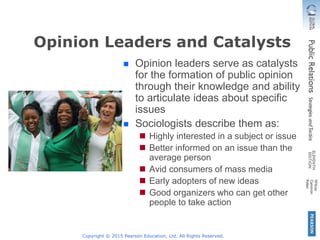
Opinion Leaders and Catalysts
 Opinion leaders serve as catalysts
for the formation of public opinion
through their knowledge and ability
to articulate ideas about specific
issues
 Sociologists describe them as:
 Highly interested in a subject or issue
 Better informed on an issue than the
average person
 Avid consumers of mass media
 Early adopters of new ideas
 Good organizers who can get other
people to take action
Copyright © 2015 Pearson Education, Ltd. All Rights Reserved.
Types of Leaders
 Formal, or power opinion leaders
 Informal opinion leaders
 “Influentials” profiled as…
 Being active in the community
 Having a college degree
 Earning a relatively high income
 Regularly reading newspapers and magazines
 Actively participating in recreational activities
 Showing environmental concern by recycling
The Flow of Opinion
 Two-step flow theory
 Multiple-step flow model
 N-step theory
 Diffusion of innovation theory
Copyright © 2015 Pearson Education, Ltd. All Rights Reserved.
The Role of Mass Media
 Via mass media, public relations practitioners
become major players in forming public opinion
 Often provide the mass media with the
information
 The following theories can help practitioners
understand mass media effects
 Agenda Setting Theory
 Media Dependency Theory
 Framing Theory
 Conflict Theory
Copyright © 2015 Pearson Education, Ltd. All Rights Reserved.
The Dominant View of
Public Relations
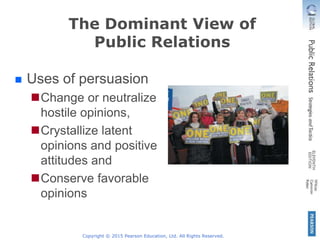
 Uses of persuasion
Change or neutralize
hostile opinions,
Crystallize latent
opinions and positive
attitudes and
Conserve favorable
opinions
Copyright © 2015 Pearson Education, Ltd. All Rights Reserved.
The Dominant View of
Public Relations, cont.
 Persuasion in negotiation
Organizations and publics want to position
themselves to be most influential
How can public relations help here?
Changes minds and behaviors or target audiences
Copyright © 2015 Pearson Education, Ltd. All Rights Reserved.
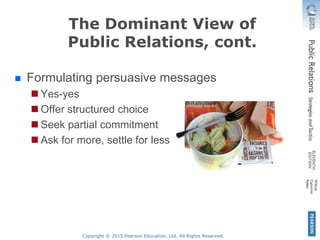
 Formulating persuasive messages
 Yes-yes
 Offer structured choice
 Seek partial commitment
 Ask for more, settle for less
The Dominant View of
Public Relations, cont.
Copyright © 2015 Pearson Education, Ltd. All Rights Reserved.
 Findings from Persuasion Research
 Positive appeals generally more effective
 Radio and TV more persuasive than print
 Strong emotional appeals best if audience has little
topical concern or interest
 Fear appeals effective only if audience can take
action to prevent threats
 Logical appeals are better for educated audiences
 Altruism can be a powerful motivator
 Celebrity spokespersons vary in effectiveness
The Dominant View of
Public Relations, cont.
Copyright © 2015 Pearson Education, Ltd. All Rights Reserved.
Factors in Persuasive
Communication
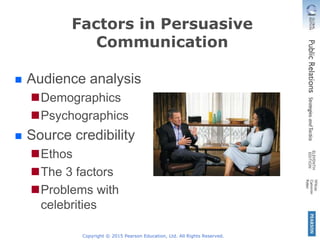
 Audience analysis
Demographics
Psychographics
 Source credibility
Ethos
The 3 factors
Problems with
celebrities
Copyright © 2015 Pearson Education, Ltd. All Rights Reserved.
 Appeal to self-interest
 Altruism and the idea of “something in return”
 People are motivated by 8 basic appeals
 Power
 Respect
 Well-being
 Affection
 Wealth
 Skill
 Enlightenment
 Physical and mental vitality
Factors in Persuasive
Communication, cont.
Copyright © 2015 Pearson Education, Ltd. All Rights Reserved.
Factors in Persuasive
Communication, cont.
 Clarity of message
 Timing and context
 Audience participation
 Suggestions for action
Copyright © 2015 Pearson Education, Ltd. All Rights Reserved.
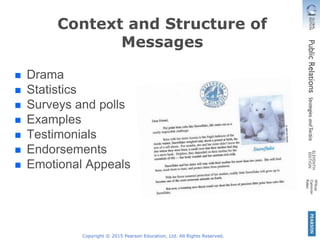
Context and Structure of
Messages
 Drama
 Statistics
 Surveys and polls
 Examples
 Testimonials
 Endorsements
 Emotional Appeals
Copyright © 2015 Pearson Education, Ltd. All Rights Reserved.
The Limits of Persuasion
 Lack of message penetration
 Competing messages
 Self-selection
 Self-perception
Copyright © 2012, 2009, 2007 Pearson Education, Inc. All Rights Reserved.
Ethics of Persuasion
 Johnannesen’s ethical criteria for using
persuasive devices
 Support claims with sound evidence and reasoning
 Do not misrepresent your level of expertise
 Only use relevant logical and emotional appeals
 Do not conceal your intentions to deceive the
audience
 Do not use half-truths to distort
 Do not oversimplify complex situations
 Be honest about uncertainties
 Do not advocate for something in which you do not
believe yourself
Copyright © 2012, 2009, 2007 Pearson Education, Inc. All Rights Reserved.
Ethics of Persuasion, cont.
 A public relations professional should be more
than a “hired gun”
 Persuasive messages require truth, honesty,
and candor

11thEd_Wilcox_PPT_Chapter09.ppt

  • 1.
    Copyright © 2015Pearson Education, Ltd. All Rights Reserved. Public Relations: Strategies and Tactics 11th Edition, Global Edition Dennis L. Wilcox Glen T. Cameron Bryan H. Reber This multimedia product and its contents are protected under copyright law. The following are prohibited by law: •any public performance or display, including transmission of any image over a network; •preparation of any derivative work, including the extraction, in whole or in part, of any images; •any rental, lease, or lending of the program.
  • 2.
    Copyright © 2015Pearson Education, Ltd. All Rights Reserved. Chapter 9 Public Opinion: Role, Scope, and Implications
  • 3.
    Copyright © 2015Pearson Education, Ltd. All Rights Reserved. Chapter 9 Objectives  Understand the implications of public opinion for public relations  Explain the crucial role of opinion leaders in public discourse  Describe key theories explaining the role of mass media  Understand the pervasive role of persuasion in modern life  Enumerate key factors in persuasion  Identify major considerations in conducting ethical persuasive campaigns
  • 4.
    Copyright © 2015Pearson Education, Ltd. All Rights Reserved. What is Public Opinion?  Elusive and difficult to measure  The collective expression of opinion of many individuals bound into a group  Formed by people who have a vested or self- interest in an issue  Opinion is determined by self-interest
  • 5.
    Copyright © 2015Pearson Education, Ltd. All Rights Reserved. Opinion Leaders and Catalysts  Opinion leaders serve as catalysts for the formation of public opinion through their knowledge and ability to articulate ideas about specific issues  Sociologists describe them as:  Highly interested in a subject or issue  Better informed on an issue than the average person  Avid consumers of mass media  Early adopters of new ideas  Good organizers who can get other people to take action
  • 6.
    Copyright © 2015Pearson Education, Ltd. All Rights Reserved. Types of Leaders  Formal, or power opinion leaders  Informal opinion leaders  “Influentials” profiled as…  Being active in the community  Having a college degree  Earning a relatively high income  Regularly reading newspapers and magazines  Actively participating in recreational activities  Showing environmental concern by recycling
  • 7.
    The Flow ofOpinion  Two-step flow theory  Multiple-step flow model  N-step theory  Diffusion of innovation theory Copyright © 2015 Pearson Education, Ltd. All Rights Reserved.
  • 8.
    Copyright © 2015Pearson Education, Ltd. All Rights Reserved. The Role of Mass Media  Via mass media, public relations practitioners become major players in forming public opinion  Often provide the mass media with the information  The following theories can help practitioners understand mass media effects  Agenda Setting Theory  Media Dependency Theory  Framing Theory  Conflict Theory
  • 9.
    Copyright © 2015Pearson Education, Ltd. All Rights Reserved. The Dominant View of Public Relations  Uses of persuasion Change or neutralize hostile opinions, Crystallize latent opinions and positive attitudes and Conserve favorable opinions
  • 10.
    Copyright © 2015Pearson Education, Ltd. All Rights Reserved. The Dominant View of Public Relations, cont.  Persuasion in negotiation Organizations and publics want to position themselves to be most influential How can public relations help here? Changes minds and behaviors or target audiences
  • 11.
    Copyright © 2015Pearson Education, Ltd. All Rights Reserved.  Formulating persuasive messages  Yes-yes  Offer structured choice  Seek partial commitment  Ask for more, settle for less The Dominant View of Public Relations, cont.
  • 12.
    Copyright © 2015Pearson Education, Ltd. All Rights Reserved.  Findings from Persuasion Research  Positive appeals generally more effective  Radio and TV more persuasive than print  Strong emotional appeals best if audience has little topical concern or interest  Fear appeals effective only if audience can take action to prevent threats  Logical appeals are better for educated audiences  Altruism can be a powerful motivator  Celebrity spokespersons vary in effectiveness The Dominant View of Public Relations, cont.
  • 13.
    Copyright © 2015Pearson Education, Ltd. All Rights Reserved. Factors in Persuasive Communication  Audience analysis Demographics Psychographics  Source credibility Ethos The 3 factors Problems with celebrities
  • 14.
    Copyright © 2015Pearson Education, Ltd. All Rights Reserved.  Appeal to self-interest  Altruism and the idea of “something in return”  People are motivated by 8 basic appeals  Power  Respect  Well-being  Affection  Wealth  Skill  Enlightenment  Physical and mental vitality Factors in Persuasive Communication, cont.
  • 15.
    Copyright © 2015Pearson Education, Ltd. All Rights Reserved. Factors in Persuasive Communication, cont.  Clarity of message  Timing and context  Audience participation  Suggestions for action
  • 16.
    Copyright © 2015Pearson Education, Ltd. All Rights Reserved. Context and Structure of Messages  Drama  Statistics  Surveys and polls  Examples  Testimonials  Endorsements  Emotional Appeals
  • 17.
    Copyright © 2015Pearson Education, Ltd. All Rights Reserved. The Limits of Persuasion  Lack of message penetration  Competing messages  Self-selection  Self-perception
  • 18.
    Copyright © 2012,2009, 2007 Pearson Education, Inc. All Rights Reserved. Ethics of Persuasion  Johnannesen’s ethical criteria for using persuasive devices  Support claims with sound evidence and reasoning  Do not misrepresent your level of expertise  Only use relevant logical and emotional appeals  Do not conceal your intentions to deceive the audience  Do not use half-truths to distort  Do not oversimplify complex situations  Be honest about uncertainties  Do not advocate for something in which you do not believe yourself
  • 19.
    Copyright © 2012,2009, 2007 Pearson Education, Inc. All Rights Reserved. Ethics of Persuasion, cont.  A public relations professional should be more than a “hired gun”  Persuasive messages require truth, honesty, and candor