Promethean Role of Advertising A philosophical approach Oana BARBU West University of Timisoara
Gilles Lipovetsky’s theory  consumer behavior in  the contemporary era is characterized by two interpretative models:   The firs one      technological revolution   the establishment of a new type of society: that of the network and informational capitalism   The second one      attitude and value changes  in  contemporary society a whole new type of society who functions “with hyper consumption and not with its decrease”
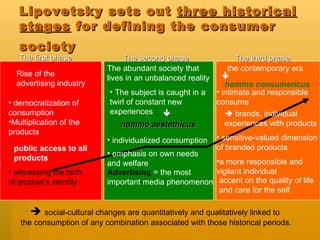
Lipovetsky sets out  three historical stages  for defining the consumer society   The first phase  The second phase  The third phase  democratization of consumption Multiplication of the products  Rise of the advertising industry public access to all products The abundant society that lives in an unbalanced reality  The subject is caught in a twirl of constant new experiences   hommo aestethicus   individualized consumption  Advertising  = the most important media phenomenon the contemporary era   hommo consumericus   intimate and responsible consume  a more responsible and vigilant individual  accent on the quality of life and care for the self     brands, individual experiences with products emphasis on own needs and welfare  witnessing the birth of product’s identity     social-cultural changes are quantitatively and qualitatively linked to  the consumption of any combination associated with those historical periods. sensitive-valued dimension of branded products
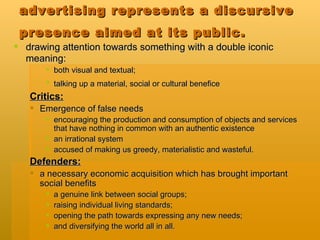
advertising represents a discursive presence aimed at its public.   drawing attention towards something with a double iconic meaning:   both visual and textual;  talking up a material, social or cultural benefice   Critics: Emergence of false needs  encouraging the production and consumption of objects and services that have nothing in common with an authentic existence an irrational system accused of making us greedy, materialistic and wasteful. Defenders:   a necessary economic acquisition which has brought important social benefits a genuine link between social groups;  raising individual living standards; opening the path towards expressing any new needs; and diversifying the world all in all.
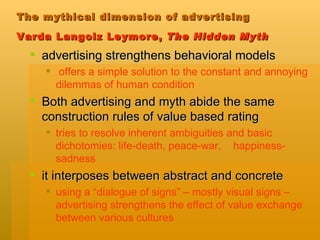
The mythical dimension of advertising  Varda Langolz Leymore,  The Hidden Myth   advertising strengthens behavioral models offers a simple solution to the constant and annoying dilemmas of human condition   Both advertising and myth abide the same construction rules of value based rating tries to resolve inherent ambiguities and basic dichotomies: life-death, peace-war,  happiness-sadness it interposes between abstract and concrete using a “dialogue of signs” – mostly visual signs – advertising strengthens the effect of value exchange between various cultures
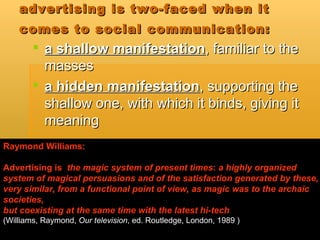
advertising is two-faced when it comes to social communication:   a shallow manifestation , familiar to the masses  a hidden manifestation , supporting the shallow one, with which it binds, giving it meaning  Raymond Williams: Advertising is  the magic system   of present times :  a highly organized system of magical persuasions and of the satisfaction generated by these, very similar, from a functional point of view, as magic was to the archaic societies,  but coexisting at the same time with the latest hi-tech   ( Williams, Raymond,  Our television , ed. Routledge, London, 1989  )
So, where is the problem???
DILEMA: a magical realm could aggravate suffering, by continuously generating dissatisfaction   Today’s satisfaction sources: a variety of experiences and the need for constant change pleasure  as “a positive good” and  comfort  as “a negative good” advertisement products: eternally repetitive pleasure, fact that makes them extremely resistant to deception numerous long usage goods, especially public services (heath, education, entertainment) produce deceptions not the advertisement’s products are the ones that disappoint,  but the values associated with them
“ Thus, advertising presents itself as a device of isomorphic, modern essence regarding revolutionary political cravings that state the full power of society over itself and its right to define itself without the need of an  exterior principal ” ( Gilles Lipovetsky  ,  Le bonheur paradoxal: essai sur la société d'hyperconsommation,  Editions Gallimard, 2006 ) All in all, because of the importance of today’s public, We need to be careful when calling advertising a  social trendsetter  under current conditions.
Narcissus of our times Due to the advertising phenomenon, nowadays we are facing a more responsible and vigilant individual    a metaphorical Narcissus  pays more attention to the information he has selected  Accent on image (body, home, circle of friends) leisure time  concerned with the quality of his experiences, his social and cultural medium  we are dealing only with  a gradual difference  among  hommo aestheticus  and  hommo consumericus “ Hommo consumericus did not miraculously change over night in a wise man: it’s just that the Dionysian chaos (of the second phase) was deposed by the Zen attitude”

Promethean Advertising. A Philosophical Aproach

  • 1.
    Promethean Role ofAdvertising A philosophical approach Oana BARBU West University of Timisoara
  • 2.
    Gilles Lipovetsky’s theory consumer behavior in the contemporary era is characterized by two interpretative models: The firs one  technological revolution the establishment of a new type of society: that of the network and informational capitalism The second one  attitude and value changes in contemporary society a whole new type of society who functions “with hyper consumption and not with its decrease”
  • 3.
    Lipovetsky sets out three historical stages for defining the consumer society The first phase The second phase The third phase democratization of consumption Multiplication of the products Rise of the advertising industry public access to all products The abundant society that lives in an unbalanced reality The subject is caught in a twirl of constant new experiences  hommo aestethicus individualized consumption Advertising = the most important media phenomenon the contemporary era  hommo consumericus intimate and responsible consume a more responsible and vigilant individual accent on the quality of life and care for the self  brands, individual experiences with products emphasis on own needs and welfare witnessing the birth of product’s identity  social-cultural changes are quantitatively and qualitatively linked to the consumption of any combination associated with those historical periods. sensitive-valued dimension of branded products
  • 4.
    advertising represents adiscursive presence aimed at its public. drawing attention towards something with a double iconic meaning: both visual and textual; talking up a material, social or cultural benefice Critics: Emergence of false needs encouraging the production and consumption of objects and services that have nothing in common with an authentic existence an irrational system accused of making us greedy, materialistic and wasteful. Defenders: a necessary economic acquisition which has brought important social benefits a genuine link between social groups; raising individual living standards; opening the path towards expressing any new needs; and diversifying the world all in all.
  • 5.
    The mythical dimensionof advertising Varda Langolz Leymore, The Hidden Myth advertising strengthens behavioral models offers a simple solution to the constant and annoying dilemmas of human condition Both advertising and myth abide the same construction rules of value based rating tries to resolve inherent ambiguities and basic dichotomies: life-death, peace-war, happiness-sadness it interposes between abstract and concrete using a “dialogue of signs” – mostly visual signs – advertising strengthens the effect of value exchange between various cultures
  • 6.
    advertising is two-facedwhen it comes to social communication: a shallow manifestation , familiar to the masses a hidden manifestation , supporting the shallow one, with which it binds, giving it meaning Raymond Williams: Advertising is the magic system of present times : a highly organized system of magical persuasions and of the satisfaction generated by these, very similar, from a functional point of view, as magic was to the archaic societies, but coexisting at the same time with the latest hi-tech ( Williams, Raymond, Our television , ed. Routledge, London, 1989 )
  • 7.
    So, where isthe problem???
  • 8.
    DILEMA: a magicalrealm could aggravate suffering, by continuously generating dissatisfaction Today’s satisfaction sources: a variety of experiences and the need for constant change pleasure as “a positive good” and comfort as “a negative good” advertisement products: eternally repetitive pleasure, fact that makes them extremely resistant to deception numerous long usage goods, especially public services (heath, education, entertainment) produce deceptions not the advertisement’s products are the ones that disappoint, but the values associated with them
  • 9.
    “ Thus, advertisingpresents itself as a device of isomorphic, modern essence regarding revolutionary political cravings that state the full power of society over itself and its right to define itself without the need of an exterior principal ” ( Gilles Lipovetsky , Le bonheur paradoxal: essai sur la société d'hyperconsommation, Editions Gallimard, 2006 ) All in all, because of the importance of today’s public, We need to be careful when calling advertising a social trendsetter under current conditions.
  • 10.
    Narcissus of ourtimes Due to the advertising phenomenon, nowadays we are facing a more responsible and vigilant individual  a metaphorical Narcissus pays more attention to the information he has selected Accent on image (body, home, circle of friends) leisure time concerned with the quality of his experiences, his social and cultural medium  we are dealing only with a gradual difference among hommo aestheticus and hommo consumericus “ Hommo consumericus did not miraculously change over night in a wise man: it’s just that the Dionysian chaos (of the second phase) was deposed by the Zen attitude”