SOCIO-CULTURE HUB
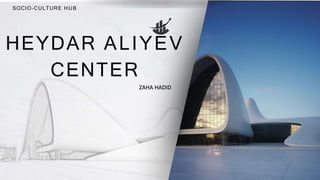
HEYDAR ALIYEV
CENTER
ZAHA HADID
INTRODUCTION
ARCHITECT
ZAHA HADIID
Area: 101801m²
FLOORS : 8
Year: 2013
LOCATION
BAKU, AZERBAIJAN
An internationally recognized architectural work
Heydar Aliyev Center has become a signature
landmark of modern Baku due to its INNOVATIVE
and CUTTING-EDGE DESIGN
This building was nominated for
the world architecture festival
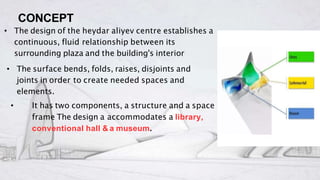
• The design of the heydar aliyev centre establishes a
continuous, fluid relationship between its
surrounding plaza and the building's interior
• The surface bends, folds, raises, disjoints and
joints in order to create needed spaces and
elements.
• It has two components, a structure and a space
frame The design a accommodates a library,
conventional hall & a museum.
CONCEPT
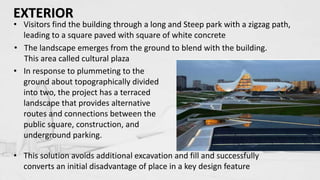
• Visitors find the building through a long and Steep park with a zigzag path,
leading to a square paved with square of white concrete
• The landscape emerges from the ground to blend with the building.
This area called cultural plaza
• In response to plummeting to the
ground about topographically divided
into two, the project has a terraced
landscape that provides alternative
routes and connections between the
public square, construction, and
underground parking.
• This solution avoids additional excavation and fill and successfully
converts an initial disadvantage of place in a key design feature
EXTERIOR
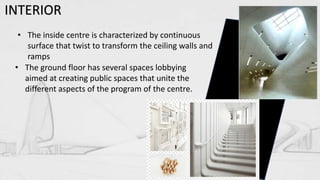
INTERIOR
• The inside centre is characterized by continuous
surface that twist to transform the ceiling walls and
ramps
• The ground floor has several spaces lobbying
aimed at creating public spaces that unite the
different aspects of the program of the centre.
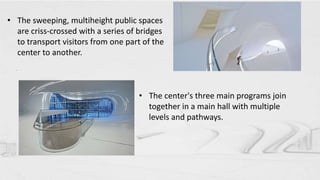
• The sweeping, multiheight public spaces
are criss-crossed with a series of bridges
to transport visitors from one part of the
center to another.
.
• The center's three main programs join
together in a main hall with multiple
levels and pathways.
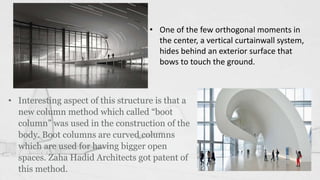
• One of the few orthogonal moments in
the center, a vertical curtainwall system,
hides behind an exterior surface that
bows to touch the ground.
• Interesting aspect of this structure is that a
new column method which called “boot
column” was used in the construction of the
body. Boot columns are curved columns
which are used for having bigger open
spaces. Zaha Hadid Architects got patent of
this method.
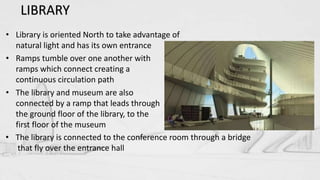
• Library is oriented North to take advantage of
natural light and has its own entrance
• Ramps tumble over one another with
ramps which connect creating a
continuous circulation path
• The library and museum are also
connected by a ramp that leads through
the ground floor of the library, to the
first floor of the museum
• The library is connected to the conference room through a bridge
that fly over the entrance hall
LIBRARY
ADITOTRIUM
• The auditorium and its associated facilities have direct access to the plaza
• The main entrance is on the void
created in the outer layer, stretching of
the volume of the museum and the
library tower
• The secondary entrance is on the North side of the building.
The backlit oak panels in the conference
center’s 1,000-seat auditorium bring
warmth to the otherwise
vividly white interior.
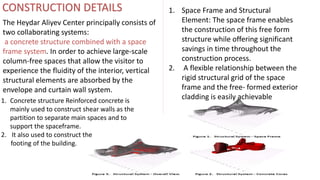
The Heydar Aliyev Center principally consists of
two collaborating systems:
a concrete structure combined with a space
frame system. In order to achieve large-scale
column-free spaces that allow the visitor to
experience the fluidity of the interior, vertical
structural elements are absorbed by the
envelope and curtain wall system.
1. Concrete structure Reinforced concrete is
mainly used to construct shear walls as the
partition to separate main spaces and to
support the spaceframe.
2. It also used to construct the
footing of the building.
1. Space Frame and Structural
Element: The space frame enables
the construction of this free form
structure while offering significant
savings in time throughout the
construction process.
2. A flexible relationship between the
rigid structural grid of the space
frame and the free- formed exterior
cladding is easily achievable
CONSTRUCTION DETAILS
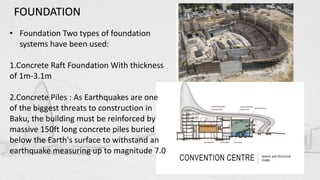
• Foundation Two types of foundation
systems have been used:
1.Concrete Raft Foundation With thickness
of 1m-3.1m
2.Concrete Piles : As Earthquakes are one
of the biggest threats to construction in
Baku, the building must be reinforced by
massive 150ft long concrete piles buried
below the Earth's surface to withstand an
earthquake measuring up to magnitude 7.0
FOUNDATION
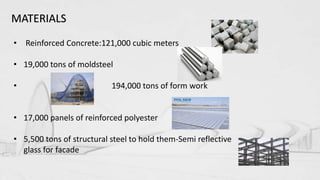
• Reinforced Concrete:121,000 cubic meters
• 19,000 tons of moldsteel
• 194,000 tons of form work
• 17,000 panels of reinforced polyester
• 5,500 tons of structural steel to hold them-Semi reflective
glass for facade
MATERIALS
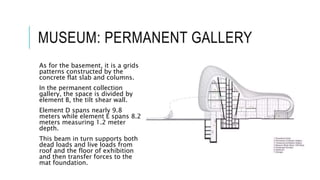
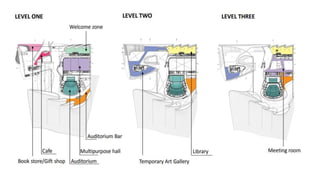
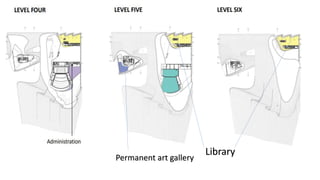
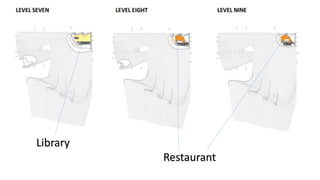
Library
Permanent art gallery
Restaurant
Library
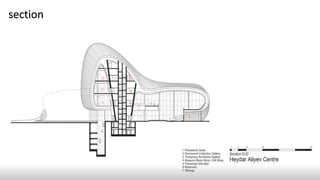
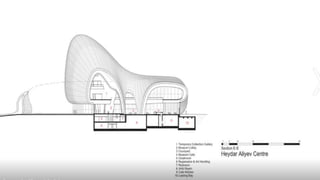
section
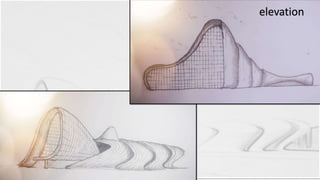
elevation
THANK YOU

ppt.pptx

  • 1.
  • 2.
    INTRODUCTION ARCHITECT ZAHA HADIID Area: 101801m² FLOORS: 8 Year: 2013 LOCATION BAKU, AZERBAIJAN An internationally recognized architectural work Heydar Aliyev Center has become a signature landmark of modern Baku due to its INNOVATIVE and CUTTING-EDGE DESIGN This building was nominated for the world architecture festival
  • 3.
    • The designof the heydar aliyev centre establishes a continuous, fluid relationship between its surrounding plaza and the building's interior • The surface bends, folds, raises, disjoints and joints in order to create needed spaces and elements. • It has two components, a structure and a space frame The design a accommodates a library, conventional hall & a museum. CONCEPT
  • 4.
    • Visitors findthe building through a long and Steep park with a zigzag path, leading to a square paved with square of white concrete • The landscape emerges from the ground to blend with the building. This area called cultural plaza • In response to plummeting to the ground about topographically divided into two, the project has a terraced landscape that provides alternative routes and connections between the public square, construction, and underground parking. • This solution avoids additional excavation and fill and successfully converts an initial disadvantage of place in a key design feature EXTERIOR
  • 5.
    INTERIOR • The insidecentre is characterized by continuous surface that twist to transform the ceiling walls and ramps • The ground floor has several spaces lobbying aimed at creating public spaces that unite the different aspects of the program of the centre.
  • 6.
    • The sweeping,multiheight public spaces are criss-crossed with a series of bridges to transport visitors from one part of the center to another. . • The center's three main programs join together in a main hall with multiple levels and pathways.
  • 7.
    • One ofthe few orthogonal moments in the center, a vertical curtainwall system, hides behind an exterior surface that bows to touch the ground. • Interesting aspect of this structure is that a new column method which called “boot column” was used in the construction of the body. Boot columns are curved columns which are used for having bigger open spaces. Zaha Hadid Architects got patent of this method.
  • 8.
    • Library isoriented North to take advantage of natural light and has its own entrance • Ramps tumble over one another with ramps which connect creating a continuous circulation path • The library and museum are also connected by a ramp that leads through the ground floor of the library, to the first floor of the museum • The library is connected to the conference room through a bridge that fly over the entrance hall LIBRARY
  • 9.
    ADITOTRIUM • The auditoriumand its associated facilities have direct access to the plaza • The main entrance is on the void created in the outer layer, stretching of the volume of the museum and the library tower • The secondary entrance is on the North side of the building. The backlit oak panels in the conference center’s 1,000-seat auditorium bring warmth to the otherwise vividly white interior.
  • 11.
    The Heydar AliyevCenter principally consists of two collaborating systems: a concrete structure combined with a space frame system. In order to achieve large-scale column-free spaces that allow the visitor to experience the fluidity of the interior, vertical structural elements are absorbed by the envelope and curtain wall system. 1. Concrete structure Reinforced concrete is mainly used to construct shear walls as the partition to separate main spaces and to support the spaceframe. 2. It also used to construct the footing of the building. 1. Space Frame and Structural Element: The space frame enables the construction of this free form structure while offering significant savings in time throughout the construction process. 2. A flexible relationship between the rigid structural grid of the space frame and the free- formed exterior cladding is easily achievable CONSTRUCTION DETAILS
  • 12.
    • Foundation Twotypes of foundation systems have been used: 1.Concrete Raft Foundation With thickness of 1m-3.1m 2.Concrete Piles : As Earthquakes are one of the biggest threats to construction in Baku, the building must be reinforced by massive 150ft long concrete piles buried below the Earth's surface to withstand an earthquake measuring up to magnitude 7.0 FOUNDATION
  • 13.
    • Reinforced Concrete:121,000cubic meters • 19,000 tons of moldsteel • 194,000 tons of form work • 17,000 panels of reinforced polyester • 5,500 tons of structural steel to hold them-Semi reflective glass for facade MATERIALS
  • 15.
  • 16.
  • 17.
  • 19.
  • 20.