Prepared by :Aysha Asaad
MarwaRizgar
 Architects ZahaHadidArchitects
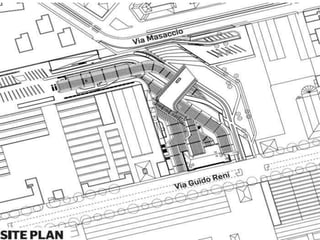
 Location Rome,Flaminio, Italy
 Structural Engineers Anthony Hunts
Associates OK Design Group
 Year Of Enchargement 1999
 Area 27000.0sqm
 Project Year 2009
October1950 – 31 March 2016) was an Iraqi-bornBritish architect. She
was the first woman to receivethe Pritzker ArchitecturePrize,in 2004.
She receivedthe UK's most prestigiousarchitectural award, the
Stirling Prize,in 2010 and 2011. In 2012, she was made a Dame by
Elizabeth II forservicesto architecture, and in 2015 she became the
first woman to be awarded the Royal Gold Medalfromthe Royal
Institute of British Architects
 After its completion, MAXXI
remains a theoretical project in the sense of projecting an architectural
manifesto demonstrating the capacityof a new architectural
style: parametricism.
What characterizes the new style are new concepts and new values, both
in terms of an expanded formal repertoire and in terms of a new
understanding
of function or performance

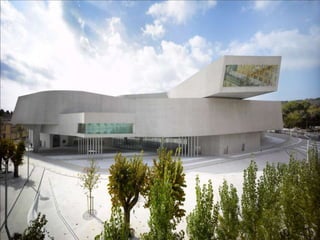
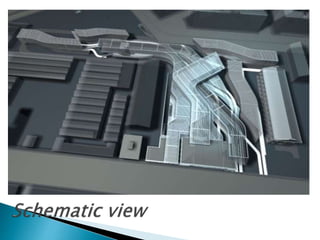
The concept behind the design by Zaha Hadid Architects
was to create a fluid building, dropping the traditional
articulation in separate, secluded, rooms typical of many
old and modern museums, as well as the rigid distinction
between interior and external space – an idea which
somehow recalls Frank Lloyd Wright’s design for the
Guggenheim museum in New York.
 Thus, as Zaha Hadid says, “MAXXI supercedes the notion
of museum as ‘object’ or fixed entity, presenting instead
‘a field of buildings’ accessible to all, with no firm
boundary between what is ‘within’ and what ‘without’.
Central to this new reality – its primary force – is a
confluence of lines – walls that constantly intersect and
separate to create indoor and outdoor spaces.”
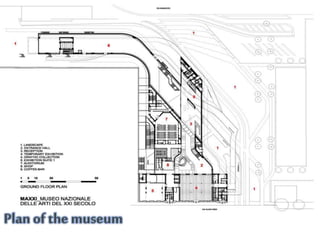
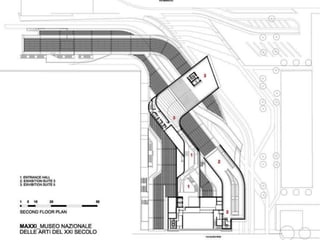
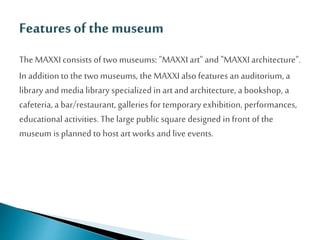
The MAXXI consists of two museums: "MAXXI art" and "MAXXI architecture".
In addition to the two museums, the MAXXI alsofeatures an auditorium, a
library and media library specialized in artand architecture, a bookshop, a
cafeteria, a bar/restaurant, galleries for temporary exhibition, performances,
educational activities.The large public square designed in front of the
museum is planned to host art works and live events.
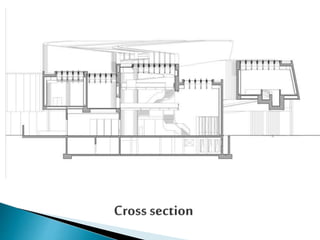
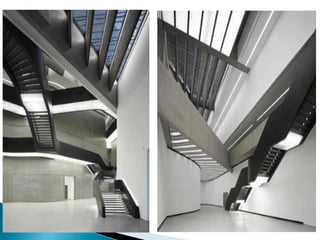
 The interior spaces, defined by the exhibition walls, are covered by a
glass roof that flood the galleries with natural light filtered by the
louvered lines of the roofing beams. These beams underline the linearity
of the spatial system, aid in articulatingthe various orientations of the
galleries and facilitatecirculation through the museum and campus.
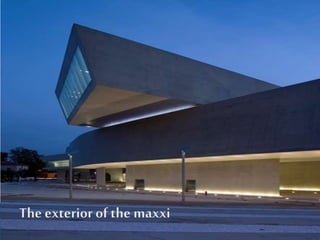
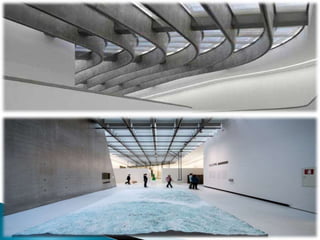
Two principle architectural elements characterize the project: the concretewalls
that define the exhibition galleries and determine the interweaving of volumes; and
the transparent roof that modulates natural light. The roofing system complies
with the highest standards required for museums and is composed of integrated
frames andlouvers with devices for filtering sunlight, artificiallight and
environmental control.
 http://www.patrikschumacher.com/Texts/The%2
0Meaning%20of%20MAXXI.html
 http://www.arcspace.com/features/zaha-hadid-
architects/maxxi-museum/
 https://www.inexhibit.com/case-studies/zaha-
hadid-the-maxxi-museum-rome-part-2/
 http://inspiration.detail.de/maxxi-museum-in-
rome-103357.html?lang=en
 https://en.wikipedia.org/wiki/Zaha_Hadid#Natio
nal_Museum_of_Arts_of_the_21st_Century_.28MA
XXI.29.2C_Rome.2C_Italy_.281998-2010.29

The Maxxi Museum

  • 1.
    Prepared by :AyshaAsaad MarwaRizgar
  • 3.
     Architects ZahaHadidArchitects Location Rome,Flaminio, Italy  Structural Engineers Anthony Hunts Associates OK Design Group  Year Of Enchargement 1999  Area 27000.0sqm  Project Year 2009
  • 4.
    October1950 – 31March 2016) was an Iraqi-bornBritish architect. She was the first woman to receivethe Pritzker ArchitecturePrize,in 2004. She receivedthe UK's most prestigiousarchitectural award, the Stirling Prize,in 2010 and 2011. In 2012, she was made a Dame by Elizabeth II forservicesto architecture, and in 2015 she became the first woman to be awarded the Royal Gold Medalfromthe Royal Institute of British Architects
  • 5.
     After itscompletion, MAXXI remains a theoretical project in the sense of projecting an architectural manifesto demonstrating the capacityof a new architectural style: parametricism. What characterizes the new style are new concepts and new values, both in terms of an expanded formal repertoire and in terms of a new understanding of function or performance
  • 6.
     The concept behindthe design by Zaha Hadid Architects was to create a fluid building, dropping the traditional articulation in separate, secluded, rooms typical of many old and modern museums, as well as the rigid distinction between interior and external space – an idea which somehow recalls Frank Lloyd Wright’s design for the Guggenheim museum in New York.  Thus, as Zaha Hadid says, “MAXXI supercedes the notion of museum as ‘object’ or fixed entity, presenting instead ‘a field of buildings’ accessible to all, with no firm boundary between what is ‘within’ and what ‘without’. Central to this new reality – its primary force – is a confluence of lines – walls that constantly intersect and separate to create indoor and outdoor spaces.”
  • 12.
    The MAXXI consistsof two museums: "MAXXI art" and "MAXXI architecture". In addition to the two museums, the MAXXI alsofeatures an auditorium, a library and media library specialized in artand architecture, a bookshop, a cafeteria, a bar/restaurant, galleries for temporary exhibition, performances, educational activities.The large public square designed in front of the museum is planned to host art works and live events.
  • 14.
     The interiorspaces, defined by the exhibition walls, are covered by a glass roof that flood the galleries with natural light filtered by the louvered lines of the roofing beams. These beams underline the linearity of the spatial system, aid in articulatingthe various orientations of the galleries and facilitatecirculation through the museum and campus.
  • 16.
    Two principle architecturalelements characterize the project: the concretewalls that define the exhibition galleries and determine the interweaving of volumes; and the transparent roof that modulates natural light. The roofing system complies with the highest standards required for museums and is composed of integrated frames andlouvers with devices for filtering sunlight, artificiallight and environmental control.
  • 18.
     http://www.patrikschumacher.com/Texts/The%2 0Meaning%20of%20MAXXI.html  http://www.arcspace.com/features/zaha-hadid- architects/maxxi-museum/ https://www.inexhibit.com/case-studies/zaha- hadid-the-maxxi-museum-rome-part-2/  http://inspiration.detail.de/maxxi-museum-in- rome-103357.html?lang=en  https://en.wikipedia.org/wiki/Zaha_Hadid#Natio nal_Museum_of_Arts_of_the_21st_Century_.28MA XXI.29.2C_Rome.2C_Italy_.281998-2010.29