FAKULTI SENIBINA PERANCANGAN DAN UKUR
UNIVERSITI TEKNOLOGI MARA (UiTM)
SHAH ALAM, SELANGOR
AP213 - Bachelor Of Science (Architecture)
Nurameir Dzakareea Azmi
2007106147
Mohamad Arif Md Zain
2007106125
Muhammad Rahmat Amir Sharippuddin
2007106157
Mohd Fikri Mohd Nor
2007106151
Ahmad Zulkamal Mohd Ziyadi
2007106123
Museum
of the
21st Century
CONTENTS
• IDEAS, CONCEPT & INTRODUCTION
• FOOTING
• METHOD OF CONSTRUCTION
• ROOF SYSTEM & SKIN SYSTEM
• MATERIALS
• SPECIAL FEATURES
• SUSTAINABILITY ISSUES
Museum of the 21st Century
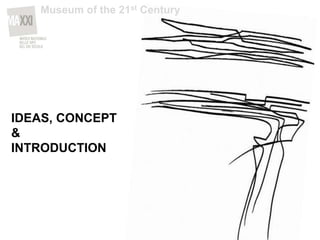
IDEAS, CONCEPT
&
INTRODUCTION
Museum of the 21st Century
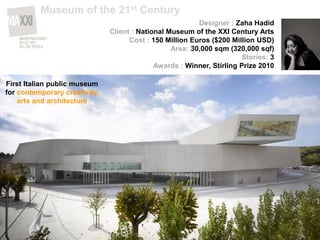
Designer : Zaha Hadid
Client : National Museum of the XXI Century Arts
Cost : 150 Million Euros ($200 Million USD)
Area: 30,000 sqm (320,000 sqf)
Stories: 3
Awards : Winner, Stirling Prize 2010
First Italian public museum
for contemporary creativity,
arts and architecture
Museum of the 21st Century
N N
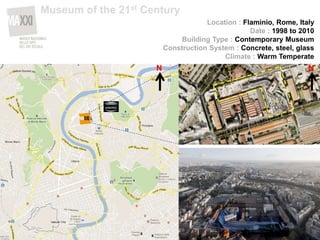
Location : Flaminio, Rome, Italy
Date : 1998 to 2010
Building Type : Contemporary Museum
Construction System : Concrete, steel, glass
Climate : Warm Temperate
Museum of the 21st Century
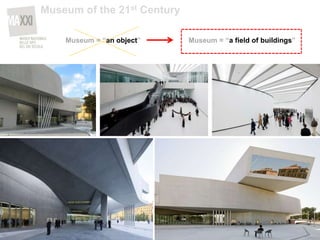
Museum = “an object” Museum = “a field of buildings”
Museum of the 21st Century
+
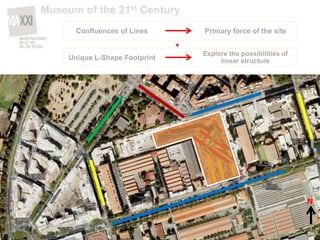
Confluences of Lines Primary force of the site
Unique L-Shape Footprint
Explore the possibilities of
linear structure
N
Museum of the 21st Century
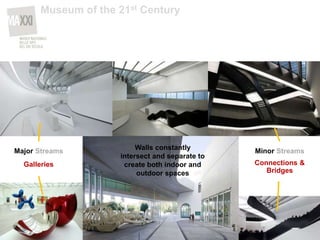
Major Streams Minor Streams
Galleries Connections &
Bridges
Walls constantly
intersect and separate to
create both indoor and
outdoor spaces
Museum of the 21st Century
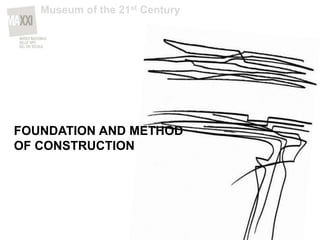
FOUNDATION AND METHOD
OF CONSTRUCTION
Museum of the 21st Century
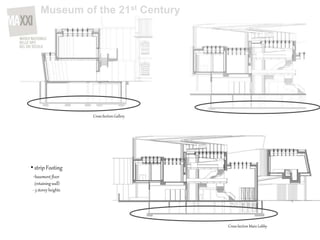
• strip Footing
-basement floor
(retaining wall)
- 3 storey heights
CrossSection Gallery
CrossSection Main Lobby
Museum of the 21st Century
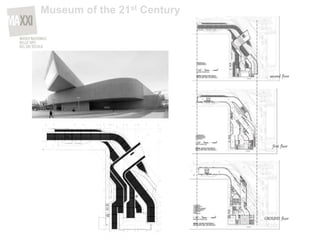
first floor
second floor
GROUND floor
Museum of the 21st Century
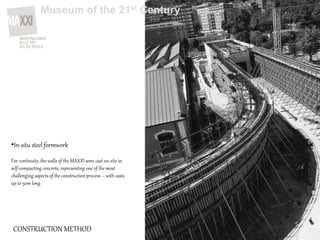
CONSTRUCTION METHOD
•In-situ steel formwork
For continuity, the walls of the MAXXI were cast on-site in
self-compacting concrete, representing one of the most
challenging aspects of the construction process – with casts
up to 50m long
Museum of the 21st Century
CONSTRUCTION METHOD
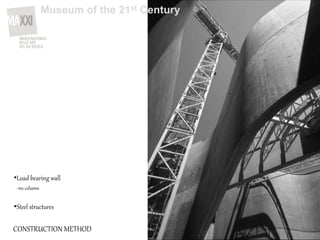
•Load bearing wall
-no column
•Steel structures
Museum of the 21st Century
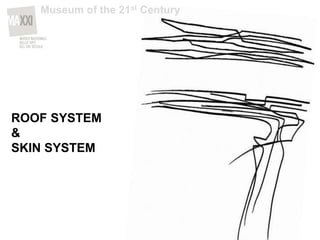
ROOF SYSTEM
&
SKIN SYSTEM
Museum of the 21st Century
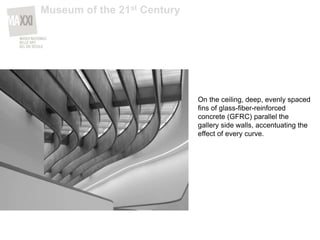
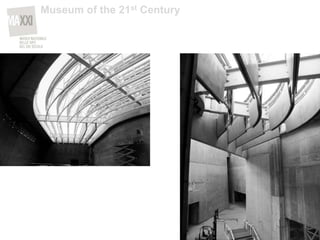
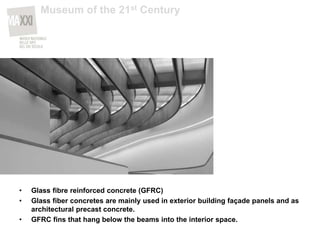
On the ceiling, deep, evenly spaced
fins of glass-fiber-reinforced
concrete (GFRC) parallel the
gallery side walls, accentuating the
effect of every curve.
Museum of the 21st Century
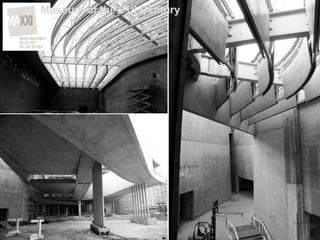
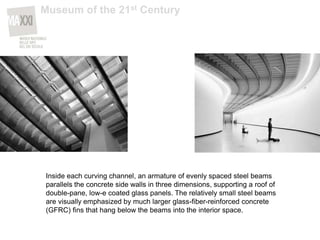
Inside each curving channel, an armature of evenly spaced steel beams
parallels the concrete side walls in three dimensions, supporting a roof of
double-pane, low-e coated glass panels. The relatively small steel beams
are visually emphasized by much larger glass-fiber-reinforced concrete
(GFRC) fins that hang below the beams into the interior space.
Museum of the 21st Century
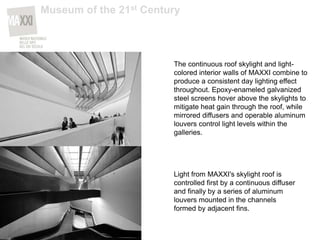
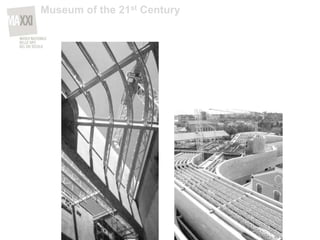
The continuous roof skylight and light-
colored interior walls of MAXXI combine to
produce a consistent day lighting effect
throughout. Epoxy-enameled galvanized
steel screens hover above the skylights to
mitigate heat gain through the roof, while
mirrored diffusers and operable aluminum
louvers control light levels within the
galleries.
Light from MAXXI's skylight roof is
controlled first by a continuous diffuser
and finally by a series of aluminum
louvers mounted in the channels
formed by adjacent fins.
Museum of the 21st Century
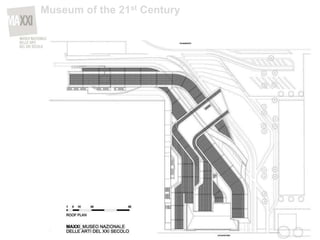
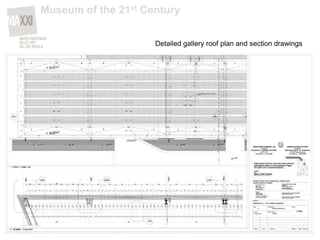
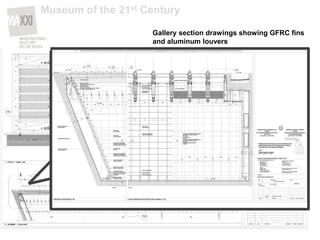
Detailed gallery roof plan and section drawings
Museum of the 21st Century
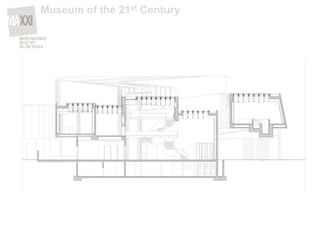
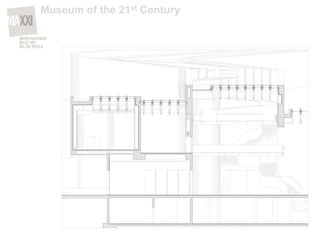
Gallery section drawings showing GFRC fins
and aluminum louvers
Museum of the 21st Century
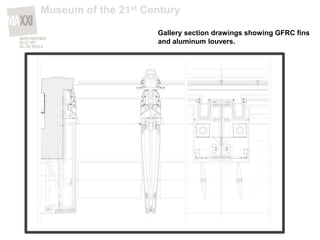
Gallery section drawings showing GFRC fins
and aluminum louvers.
Museum of the 21st Century
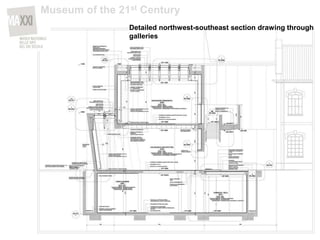
Detailed northwest-southeast section drawing through
galleries
Museum of the 21st Century
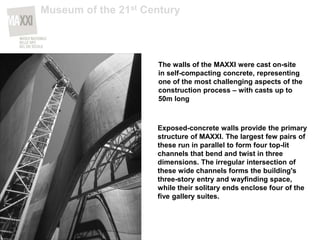
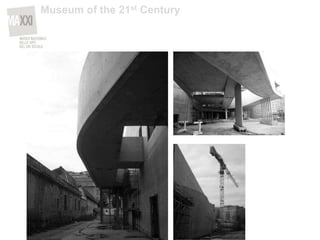
The walls of the MAXXI were cast on-site
in self-compacting concrete, representing
one of the most challenging aspects of the
construction process – with casts up to
50m long
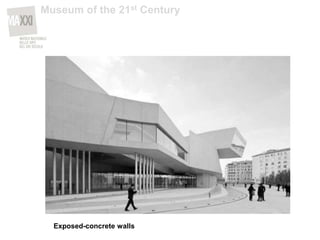
Exposed-concrete walls provide the primary
structure of MAXXI. The largest few pairs of
these run in parallel to form four top-lit
channels that bend and twist in three
dimensions. The irregular intersection of
these wide channels forms the building's
three-story entry and wayfinding space,
while their solitary ends enclose four of the
five gallery suites.
Museum of the 21st Century
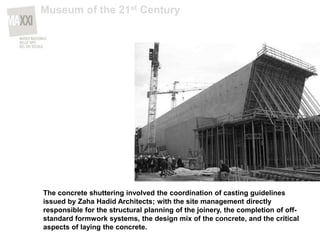
The concrete shuttering involved the coordination of casting guidelines
issued by Zaha Hadid Architects; with the site management directly
responsible for the structural planning of the joinery, the completion of off-
standard formwork systems, the design mix of the concrete, and the critical
aspects of laying the concrete.
Museum of the 21st Century
Exposed-concrete walls
Museum of the 21st Century
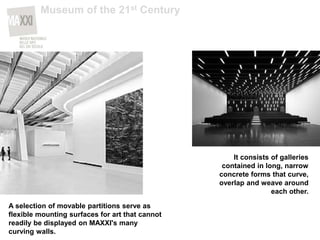
A selection of movable partitions serve as
flexible mounting surfaces for art that cannot
readily be displayed on MAXXI's many
curving walls.
It consists of galleries
contained in long, narrow
concrete forms that curve,
overlap and weave around
each other.
Museum of the 21st Century
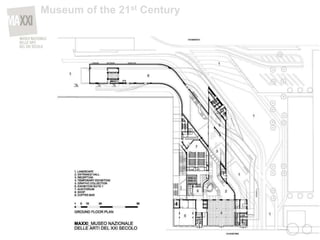
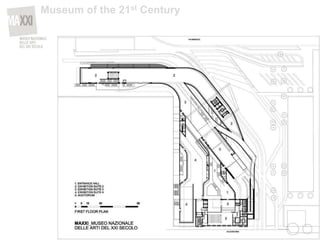
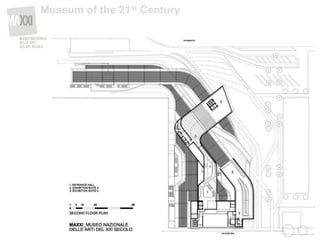
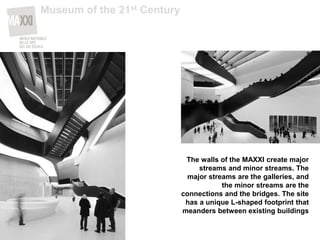
The walls of the MAXXI create major
streams and minor streams. The
major streams are the galleries, and
the minor streams are the
connections and the bridges. The site
has a unique L-shaped footprint that
meanders between existing buildings
Museum of the 21st Century
MATERIALS
Museum of the 21st Century
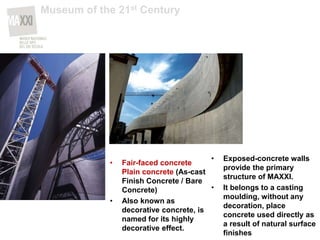
• Fair-faced concrete
Plain concrete (As-cast
Finish Concrete / Bare
Concrete)
• Also known as
decorative concrete, is
named for its highly
decorative effect.
• Exposed-concrete walls
provide the primary
structure of MAXXI.
• It belongs to a casting
moulding, without any
decoration, place
concrete used directly as
a result of natural surface
finishes
Museum of the 21st Century
• Glass fibre reinforced concrete (GFRC)
• Glass fiber concretes are mainly used in exterior building façade panels and as
architectural precast concrete.
• GFRC fins that hang below the beams into the interior space.
Museum of the 21st Century
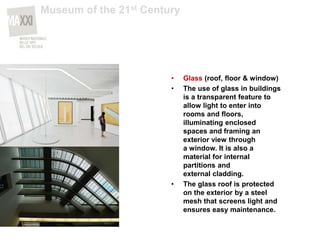
• Glass (roof, floor & window)
• The use of glass in buildings
is a transparent feature to
allow light to enter into
rooms and floors,
illuminating enclosed
spaces and framing an
exterior view through
a window. It is also a
material for internal
partitions and
external cladding.
• The glass roof is protected
on the exterior by a steel
mesh that screens light and
ensures easy maintenance.
Museum of the 21st Century
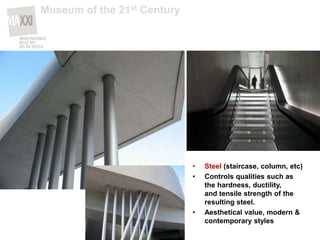
• Steel (staircase, column, etc)
• Controls qualities such as
the hardness, ductility,
and tensile strength of the
resulting steel.
• Aesthetical value, modern &
contemporary styles
Museum of the 21st Century
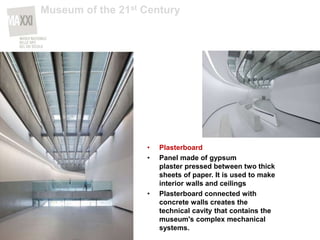
• Plasterboard
• Panel made of gypsum
plaster pressed between two thick
sheets of paper. It is used to make
interior walls and ceilings
• Plasterboard connected with
concrete walls creates the
technical cavity that contains the
museum's complex mechanical
systems.
Museum of the 21st Century
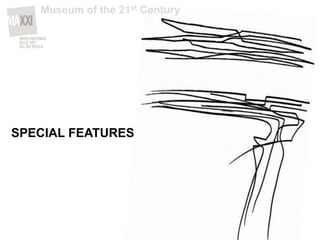
SPECIAL FEATURES
Museum of the 21st Century
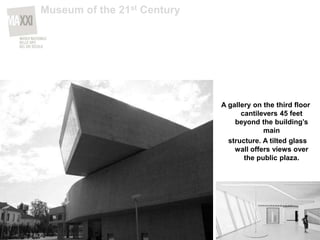
A gallery on the third floor
cantilevers 45 feet
beyond the building’s
main
structure. A tilted glass
wall offers views over
the public plaza.
Museum of the 21st Century
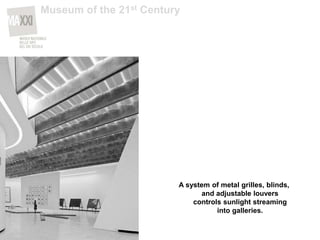
A system of metal grilles, blinds,
and adjustable louvers
controls sunlight streaming
into galleries.
Museum of the 21st Century
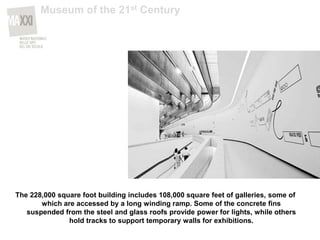
The 228,000 square foot building includes 108,000 square feet of galleries, some of
which are accessed by a long winding ramp. Some of the concrete fins
suspended from the steel and glass roofs provide power for lights, while others
hold tracks to support temporary walls for exhibitions.
Museum of the 21st Century
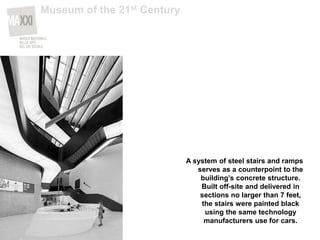
A system of steel stairs and ramps
serves as a counterpoint to the
building’s concrete structure.
Built off-site and delivered in
sections no larger than 7 feet,
the stairs were painted black
using the same technology
manufacturers use for cars.
Museum of the 21st Century
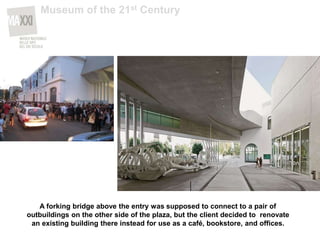
A forking bridge above the entry was supposed to connect to a pair of
outbuildings on the other side of the plaza, but the client decided to renovate
an existing building there instead for use as a café, bookstore, and offices.
Museum of the 21st Century
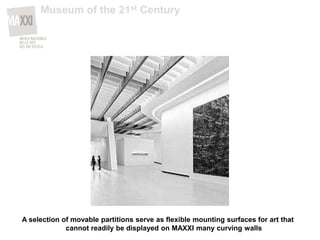
A selection of movable partitions serve as flexible mounting surfaces for art that
cannot readily be displayed on MAXXI many curving walls
Museum of the 21st Century
SUSTAINABILITY
ISSUES
Museum of the 21st Century
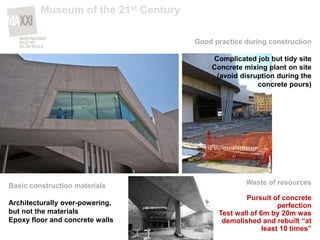
Basic construction materials
Architecturally over-powering,
but not the materials
Epoxy floor and concrete walls
Good practice during construction
Complicated job but tidy site
Concrete mixing plant on site
(avoid disruption during the
concrete pours)
Waste of resources
Pursuit of concrete
perfection
Test wall of 6m by 20m was
demolished and rebuilt “at
least 10 times”
Museum of the 21st Century
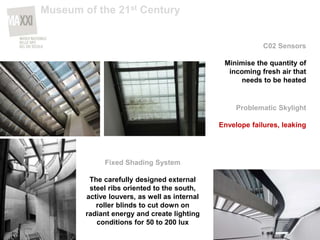
C02 Sensors
Minimise the quantity of
incoming fresh air that
needs to be heated
Fixed Shading System
The carefully designed external
steel ribs oriented to the south,
active louvers, as well as internal
roller blinds to cut down on
radiant energy and create lighting
conditions for 50 to 200 lux
Problematic Skylight
Envelope failures, leaking
Museum of the 21st Century
http://www.andreaskuefer.com/maxximum/
http://en.wikipedia.org/wiki/MAXXI_%E2%80%93_National_Museum_of_the_21st_Century_Arts
http://maps.google.com.my/
http://www.archiplanet.org/wiki/MAXXI%2C_Rome%2C_Italy
http://www.zaha-hadid.com/architecture/maxxi/#
http://civil307.blogfa.com/post-157.aspx
http://a1-optimization.com/webpromotion/2011/03/16/what_is_a_fair-faced_concrete/
http://www.archdaily.com/43822/maxxi-museum-zaha-hadid-architects/
http://archrecord.construction.com/projects/portfolio/2010/10/maxxi.asp
http://en.wikipedia.org/wiki/MAXXI_%E2%80%93_National_Museum_of_the_21st_Century_Arts
http://www.nytimes.com/2009/11/12/arts/design/12zaha.html
http://redchalksketch.wordpress.com/2010/10/03/maxxi-museum-of-xxi-century-arts-by-zaha-hadid/
http://www.architectureweek.com/2010/1117/news_4-3.html
Museum of the 21st Century

maxxi construction

  • 1.
    FAKULTI SENIBINA PERANCANGANDAN UKUR UNIVERSITI TEKNOLOGI MARA (UiTM) SHAH ALAM, SELANGOR AP213 - Bachelor Of Science (Architecture) Nurameir Dzakareea Azmi 2007106147 Mohamad Arif Md Zain 2007106125 Muhammad Rahmat Amir Sharippuddin 2007106157 Mohd Fikri Mohd Nor 2007106151 Ahmad Zulkamal Mohd Ziyadi 2007106123 Museum of the 21st Century
  • 2.
    CONTENTS • IDEAS, CONCEPT& INTRODUCTION • FOOTING • METHOD OF CONSTRUCTION • ROOF SYSTEM & SKIN SYSTEM • MATERIALS • SPECIAL FEATURES • SUSTAINABILITY ISSUES Museum of the 21st Century
  • 3.
  • 4.
    Designer : ZahaHadid Client : National Museum of the XXI Century Arts Cost : 150 Million Euros ($200 Million USD) Area: 30,000 sqm (320,000 sqf) Stories: 3 Awards : Winner, Stirling Prize 2010 First Italian public museum for contemporary creativity, arts and architecture Museum of the 21st Century
  • 5.
    N N Location :Flaminio, Rome, Italy Date : 1998 to 2010 Building Type : Contemporary Museum Construction System : Concrete, steel, glass Climate : Warm Temperate Museum of the 21st Century
  • 6.
    Museum = “anobject” Museum = “a field of buildings” Museum of the 21st Century
  • 7.
    + Confluences of LinesPrimary force of the site Unique L-Shape Footprint Explore the possibilities of linear structure N Museum of the 21st Century
  • 8.
    Museum of the21st Century
  • 9.
    Museum of the21st Century
  • 10.
    Museum of the21st Century
  • 11.
    Museum of the21st Century
  • 12.
    Major Streams MinorStreams Galleries Connections & Bridges Walls constantly intersect and separate to create both indoor and outdoor spaces Museum of the 21st Century
  • 13.
    FOUNDATION AND METHOD OFCONSTRUCTION Museum of the 21st Century
  • 14.
    • strip Footing -basementfloor (retaining wall) - 3 storey heights CrossSection Gallery CrossSection Main Lobby Museum of the 21st Century
  • 15.
    first floor second floor GROUNDfloor Museum of the 21st Century
  • 16.
    CONSTRUCTION METHOD •In-situ steelformwork For continuity, the walls of the MAXXI were cast on-site in self-compacting concrete, representing one of the most challenging aspects of the construction process – with casts up to 50m long Museum of the 21st Century
  • 17.
    CONSTRUCTION METHOD •Load bearingwall -no column •Steel structures Museum of the 21st Century
  • 18.
    Museum of the21st Century
  • 19.
  • 20.
    On the ceiling,deep, evenly spaced fins of glass-fiber-reinforced concrete (GFRC) parallel the gallery side walls, accentuating the effect of every curve. Museum of the 21st Century
  • 21.
    Inside each curvingchannel, an armature of evenly spaced steel beams parallels the concrete side walls in three dimensions, supporting a roof of double-pane, low-e coated glass panels. The relatively small steel beams are visually emphasized by much larger glass-fiber-reinforced concrete (GFRC) fins that hang below the beams into the interior space. Museum of the 21st Century
  • 22.
    The continuous roofskylight and light- colored interior walls of MAXXI combine to produce a consistent day lighting effect throughout. Epoxy-enameled galvanized steel screens hover above the skylights to mitigate heat gain through the roof, while mirrored diffusers and operable aluminum louvers control light levels within the galleries. Light from MAXXI's skylight roof is controlled first by a continuous diffuser and finally by a series of aluminum louvers mounted in the channels formed by adjacent fins. Museum of the 21st Century
  • 23.
    Museum of the21st Century
  • 24.
    Detailed gallery roofplan and section drawings Museum of the 21st Century
  • 25.
    Gallery section drawingsshowing GFRC fins and aluminum louvers Museum of the 21st Century
  • 26.
    Gallery section drawingsshowing GFRC fins and aluminum louvers. Museum of the 21st Century
  • 27.
    Museum of the21st Century
  • 28.
    Museum of the21st Century
  • 29.
    Detailed northwest-southeast sectiondrawing through galleries Museum of the 21st Century
  • 30.
    Museum of the21st Century
  • 31.
    Museum of the21st Century
  • 32.
    The walls ofthe MAXXI were cast on-site in self-compacting concrete, representing one of the most challenging aspects of the construction process – with casts up to 50m long Exposed-concrete walls provide the primary structure of MAXXI. The largest few pairs of these run in parallel to form four top-lit channels that bend and twist in three dimensions. The irregular intersection of these wide channels forms the building's three-story entry and wayfinding space, while their solitary ends enclose four of the five gallery suites. Museum of the 21st Century
  • 33.
    Museum of the21st Century
  • 34.
    The concrete shutteringinvolved the coordination of casting guidelines issued by Zaha Hadid Architects; with the site management directly responsible for the structural planning of the joinery, the completion of off- standard formwork systems, the design mix of the concrete, and the critical aspects of laying the concrete. Museum of the 21st Century
  • 35.
  • 36.
    A selection ofmovable partitions serve as flexible mounting surfaces for art that cannot readily be displayed on MAXXI's many curving walls. It consists of galleries contained in long, narrow concrete forms that curve, overlap and weave around each other. Museum of the 21st Century
  • 37.
    The walls ofthe MAXXI create major streams and minor streams. The major streams are the galleries, and the minor streams are the connections and the bridges. The site has a unique L-shaped footprint that meanders between existing buildings Museum of the 21st Century
  • 38.
  • 39.
    • Fair-faced concrete Plainconcrete (As-cast Finish Concrete / Bare Concrete) • Also known as decorative concrete, is named for its highly decorative effect. • Exposed-concrete walls provide the primary structure of MAXXI. • It belongs to a casting moulding, without any decoration, place concrete used directly as a result of natural surface finishes Museum of the 21st Century
  • 40.
    • Glass fibrereinforced concrete (GFRC) • Glass fiber concretes are mainly used in exterior building façade panels and as architectural precast concrete. • GFRC fins that hang below the beams into the interior space. Museum of the 21st Century
  • 41.
    • Glass (roof,floor & window) • The use of glass in buildings is a transparent feature to allow light to enter into rooms and floors, illuminating enclosed spaces and framing an exterior view through a window. It is also a material for internal partitions and external cladding. • The glass roof is protected on the exterior by a steel mesh that screens light and ensures easy maintenance. Museum of the 21st Century
  • 42.
    • Steel (staircase,column, etc) • Controls qualities such as the hardness, ductility, and tensile strength of the resulting steel. • Aesthetical value, modern & contemporary styles Museum of the 21st Century
  • 43.
    • Plasterboard • Panelmade of gypsum plaster pressed between two thick sheets of paper. It is used to make interior walls and ceilings • Plasterboard connected with concrete walls creates the technical cavity that contains the museum's complex mechanical systems. Museum of the 21st Century
  • 44.
  • 45.
    A gallery onthe third floor cantilevers 45 feet beyond the building’s main structure. A tilted glass wall offers views over the public plaza. Museum of the 21st Century
  • 46.
    A system ofmetal grilles, blinds, and adjustable louvers controls sunlight streaming into galleries. Museum of the 21st Century
  • 47.
    The 228,000 squarefoot building includes 108,000 square feet of galleries, some of which are accessed by a long winding ramp. Some of the concrete fins suspended from the steel and glass roofs provide power for lights, while others hold tracks to support temporary walls for exhibitions. Museum of the 21st Century
  • 48.
    A system ofsteel stairs and ramps serves as a counterpoint to the building’s concrete structure. Built off-site and delivered in sections no larger than 7 feet, the stairs were painted black using the same technology manufacturers use for cars. Museum of the 21st Century
  • 49.
    A forking bridgeabove the entry was supposed to connect to a pair of outbuildings on the other side of the plaza, but the client decided to renovate an existing building there instead for use as a café, bookstore, and offices. Museum of the 21st Century
  • 50.
    A selection ofmovable partitions serve as flexible mounting surfaces for art that cannot readily be displayed on MAXXI many curving walls Museum of the 21st Century
  • 51.
  • 52.
    Basic construction materials Architecturallyover-powering, but not the materials Epoxy floor and concrete walls Good practice during construction Complicated job but tidy site Concrete mixing plant on site (avoid disruption during the concrete pours) Waste of resources Pursuit of concrete perfection Test wall of 6m by 20m was demolished and rebuilt “at least 10 times” Museum of the 21st Century
  • 53.
    C02 Sensors Minimise thequantity of incoming fresh air that needs to be heated Fixed Shading System The carefully designed external steel ribs oriented to the south, active louvers, as well as internal roller blinds to cut down on radiant energy and create lighting conditions for 50 to 200 lux Problematic Skylight Envelope failures, leaking Museum of the 21st Century
  • 54.
    http://www.andreaskuefer.com/maxximum/ http://en.wikipedia.org/wiki/MAXXI_%E2%80%93_National_Museum_of_the_21st_Century_Arts http://maps.google.com.my/ http://www.archiplanet.org/wiki/MAXXI%2C_Rome%2C_Italy http://www.zaha-hadid.com/architecture/maxxi/# http://civil307.blogfa.com/post-157.aspx http://a1-optimization.com/webpromotion/2011/03/16/what_is_a_fair-faced_concrete/ http://www.archdaily.com/43822/maxxi-museum-zaha-hadid-architects/ http://archrecord.construction.com/projects/portfolio/2010/10/maxxi.asp http://en.wikipedia.org/wiki/MAXXI_%E2%80%93_National_Museum_of_the_21st_Century_Arts http://www.nytimes.com/2009/11/12/arts/design/12zaha.html http://redchalksketch.wordpress.com/2010/10/03/maxxi-museum-of-xxi-century-arts-by-zaha-hadid/ http://www.architectureweek.com/2010/1117/news_4-3.html Museum of the21st Century