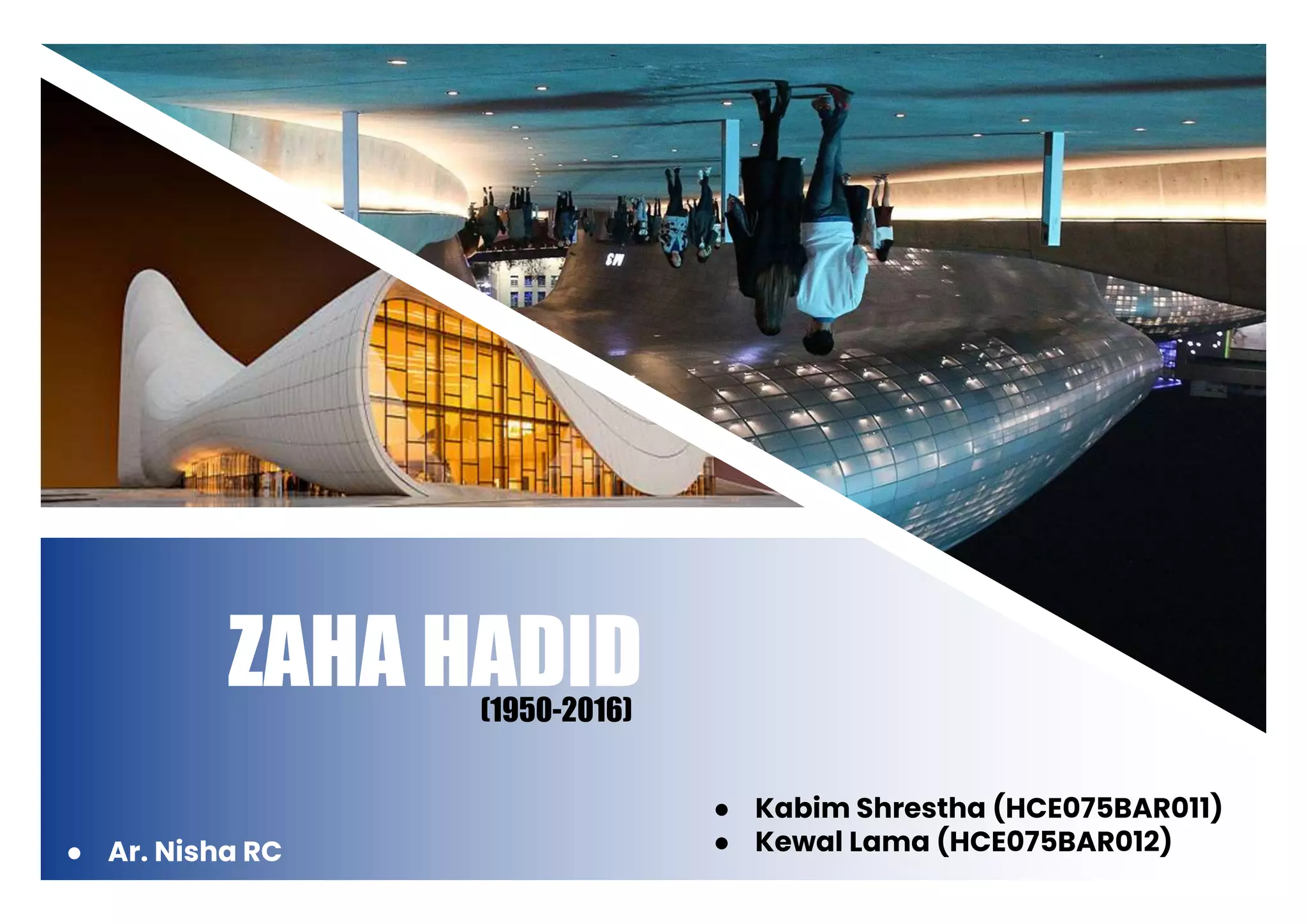
ZAHA HADID
(1950-2016)
● Kabim Shrestha (HCE075BAR011)
● Kewal Lama (HCE075BAR012)
● Ar. Nisha RC
BACKGROUND.………………..………………………………………………...……….………... 3-4
STYLE……………………………………..………………………………………………...……….………... 5-6
PHILOSOPHY………...………………...……………..…………………...…...…………………….. 7-8
TECHNIQUES..……………...……………...………...…………………….…………...…………... 9
DESIGN PRINCIPLES USED………………………………………………………………….. 10
CHARACTERISTICS OF FORM PATTERN…………………………………….... 11-17
MATERIALS………………………………………………………………………………………………… 18
CRITICAL ANALYSIS…...……...……………..………...……………………..……………... 19-21
TABLE OF CONTENT
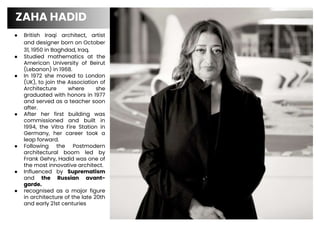
● British Iraqi architect, artist
and designer born on October
31, 1950 in Baghdad, Iraq.
● Studied mathematics at the
American University of Beirut
(Lebanon) in 1968.
● In 1972 she moved to London
(UK), to join the Association of
Architecture where she
graduated with honors in 1977
and served as a teacher soon
after.
● After her first building was
commissioned and built in
1994, the Vitra Fire Station in
Germany, her career took a
leap forward.
● Following the Postmodern
architectural boom led by
Frank Gehry, Hadid was one of
the most innovative architect.
● Influenced by Suprematism
and the Russian avant-
garde.
● recognised as a major figure
in architecture of the late 20th
and early 21st centuries
ZAHA HADID
3
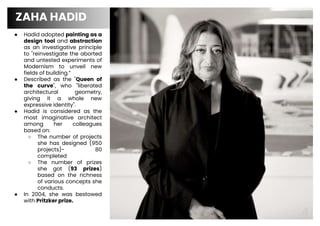
● Hadid adopted painting as a
design tool and abstraction
as an investigative principle
to "reinvestigate the aborted
and untested experiments of
Modernism to unveil new
fields of building.”
● Described as the "Queen of
the curve", who "liberated
architectural geometry,
giving it a whole new
expressive identity".
● Hadid is considered as the
most imaginative architect
among her colleagues
based on:
○ The number of projects
she has designed (950
projects)- 80
completed
○ The number of prizes
she got (93 prizes)
based on the richness
of various concepts she
conducts.
● In 2004, she was bestowed
with Pritzker prize.
ZAHA HADID
4
5
STYLE
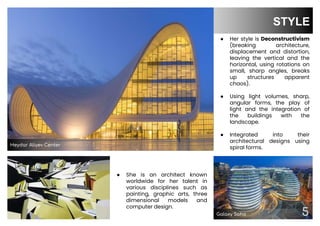
● Her style is Deconstructivism
(breaking architecture,
displacement and distortion,
leaving the vertical and the
horizontal, using rotations on
small, sharp angles, breaks
up structures apparent
chaos).
● Using light volumes, sharp,
angular forms, the play of
light and the integration of
the buildings with the
landscape.
● Integrated into their
architectural designs using
spiral forms.
04
● She is an architect known
worldwide for her talent in
various disciplines such as
painting, graphic arts, three
dimensional models and
computer design.
5
Heydar Aliyev Center
Galaxy Soho
Heydar Aliyev Centre 6
6
STYLE
● As well as creating
architecture the architect is a
celebrated painter, designer
of furniture and interior
products + fittings such as
bowls and chandeliers.
● Her favorite colour is BLACK,
but with different texture.
Bratislava Slovakia
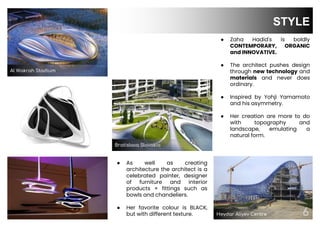
● Zaha Hadid's is boldly
CONTEMPORARY, ORGANIC
and INNOVATIVE.
● The architect pushes design
through new technology and
materials and never does
ordinary.
● Inspired by Yohji Yamamoto
and his asymmetry.
● Her creation are more to do
with topography and
landscape, emulating a
natural form.
Al Wakrah Stadium
Integration of
building with
landscape,
play of light
sharp angular forms
7
PHILOSOPHY
Vitra Fire Station
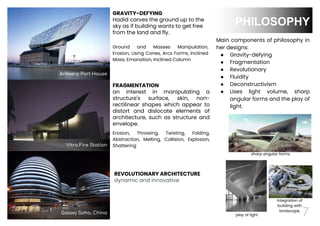
Main components of philosophy in
her designs:
● Gravity-defying
● Fragmentation
● Revolutionary
● Fluidity
● Deconstructivism
● Uses light volume, sharp
angular forms and the play of
light.
FRAGMENTATION
an interest in manipulating a
structure's surface, skin, non-
rectilinear shapes which appear to
distort and dislocate elements of
architecture, such as structure and
envelope.
Antwerp Port House
Galaxy Soho, China
GRAVITY-DEFYING
Hadid carves the ground up to the
sky as if building wants to get free
from the land and fly.
REVOLUTIONARY ARCHITECTURE
dynamic and innovative
Erosion, Throwing, Twisting, Folding,
Abstraction, Melting, Collision, Explosion,
Shattering
Ground and Masses Manipulation,
Erosion, Using Cones, Arcs Forms, Inclined
Mass, Emanation, Inclined Column
8
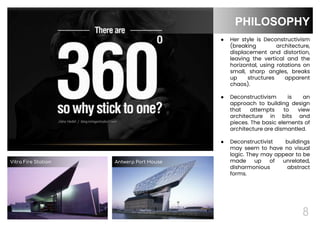
● Her style is Deconstructivism
(breaking architecture,
displacement and distortion,
leaving the vertical and the
horizontal, using rotations on
small, sharp angles, breaks
up structures apparent
chaos).
● Deconstructivism is an
approach to building design
that attempts to view
architecture in bits and
pieces. The basic elements of
architecture are dismantled.
● Deconstructivist buildings
may seem to have no visual
logic. They may appear to be
made up of unrelated,
disharmonious abstract
forms.
8
PHILOSOPHY
8
Vitra Fire Station Antwerp Port House
9
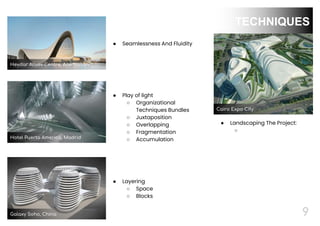
● Landscaping The Project:
○
● Play of light
○ Organizational
Techniques Bundles
○ Juxtaposition
○ Overlapping
○ Fragmentation
○ Accumulation
TECHNIQUES
● Layering
○ Space
○ Blocks
● Seamlessness And Fluidity
Heydar Aliyev Centre, Azerbaijan
Galaxy Soho, China
Cairo Expo City
Hotel Puerta America, Madrid
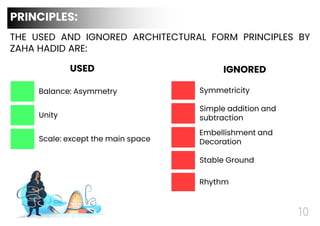
Symmetricity
Simple addition and
subtraction
Embellishment and
Decoration
Stable Ground
Rhythm
Balance: Asymmetry
Unity
Scale: except the main space
PRINCIPLES:
10
THE USED AND IGNORED ARCHITECTURAL FORM PRINCIPLES BY
ZAHA HADID ARE:
USED IGNORED
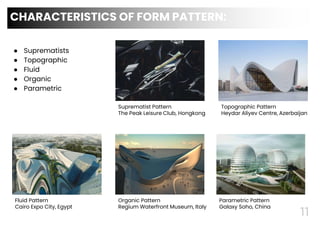
● Suprematists
● Topographic
● Fluid
● Organic
● Parametric
11
CHARACTERISTICS OF FORM PATTERN:
Suprematist Pattern
The Peak Leisure Club, Hongkong
Topographic Pattern
Heydar Aliyev Centre, Azerbaijan
Fluid Pattern
Cairo Expo City, Egypt
Organic Pattern
Regium Waterfront Museum, Italy
Parametric Pattern
Galaxy Soho, China
● Using fundamental geometric
forms
● Utilizing analogous forms
● Defying gravity
● Abstraction
● Fragmentation
● Conceiving masses in
perspective of three points
● Manipulating the ground of
different floors.
SUPREMATIST:
12
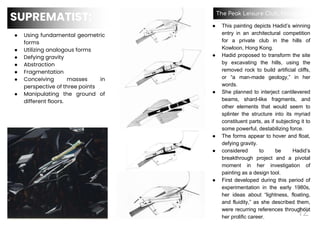
● This painting depicts Hadid’s winning
entry in an architectural competition
for a private club in the hills of
Kowloon, Hong Kong.
● Hadid proposed to transform the site
by excavating the hills, using the
removed rock to build artificial cliffs,
or “a man-made geology,” in her
words.
● She planned to interject cantilevered
beams, shard-like fragments, and
other elements that would seem to
splinter the structure into its myriad
constituent parts, as if subjecting it to
some powerful, destabilizing force.
● The forms appear to hover and float,
defying gravity.
● considered to be Hadid’s
breakthrough project and a pivotal
moment in her investigation of
painting as a design tool.
● First developed during this period of
experimentation in the early 1980s,
her ideas about “lightness, floating,
and fluidity,” as she described them,
were recurring references throughout
her prolific career.
The Peak Leisure Club, Hongkong
13
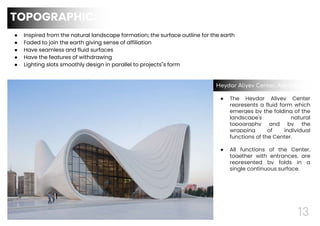
● Inspired from the natural landscape formation; the surface outline for the earth
● Faded to join the earth giving sense of affiliation
● Have seamless and fluid surfaces
● Have the features of withdrawing
● Lighting slots smoothly design in parallel to projects"s form
TOPOGRAPHIC:
● The Heydar Aliyev Center
represents a fluid form which
emerges by the folding of the
landscape's natural
topography and by the
wrapping of individual
functions of the Center.
● All functions of the Center,
together with entrances, are
represented by folds in a
single continuous surface.
Heydar Aliyev Center, Azerbaijan
14
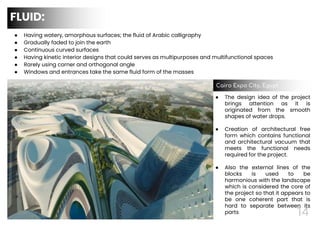
● Having watery, amorphous surfaces; the fluid of Arabic calligraphy
● Gradually faded to join the earth
● Continuous curved surfaces
● Having kinetic interior designs that could serves as multipurposes and multifunctional spaces
● Rarely using corner and orthogonal angle
● Windows and entrances take the same fluid form of the masses
FLUID:
● The design idea of the project
brings attention as it is
originated from the smooth
shapes of water drops.
● Creation of architectural free
form which contains functional
and architectural vacuum that
meets the functional needs
required for the project.
● Also the external lines of the
blocks is used to be
harmonious with the landscape
which is considered the core of
the project so that it appears to
be one coherent part that is
hard to separate between its
parts
Cairo Expo City, Egypt
15
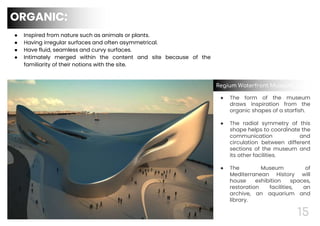
● Inspired from nature such as animals or plants.
● Having irregular surfaces and often asymmetrical.
● Have fluid, seamless and curvy surfaces.
● Intimately merged within the content and site because of the
familiarity of their notions with the site.
● The form of the museum
draws inspiration from the
organic shapes of a starfish.
● The radial symmetry of this
shape helps to coordinate the
communication and
circulation between different
sections of the museum and
its other facilities.
● The Museum of
Mediterranean History will
house exhibition spaces,
restoration facilities, an
archive, an aquarium and
library.
Regium Waterfront Museum, Italy
ORGANIC:
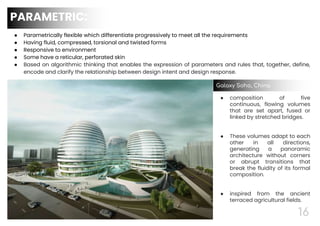
● Parametrically flexible which differentiate progressively to meet all the requirements
● Having fluid, compressed, torsional and twisted forms
● Responsive to environment
● Some have a reticular, perforated skin
● Based on algorithmic thinking that enables the expression of parameters and rules that, together, define,
encode and clarify the relationship between design intent and design response.
01 16
PARAMETRIC:
Galaxy Soho, China
● composition of five
continuous, flowing volumes
that are set apart, fused or
linked by stretched bridges.
● These volumes adapt to each
other in all directions,
generating a panoramic
architecture without corners
or abrupt transitions that
break the fluidity of its formal
composition.
● inspired from the ancient
terraced agricultural fields.
17
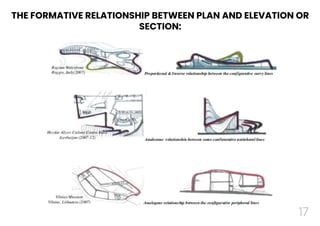
THE FORMATIVE RELATIONSHIP BETWEEN PLAN AND ELEVATION OR
SECTION:
MATERIALS
18
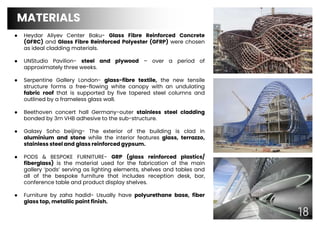
● Heydar Aliyev Center Baku- Glass Fibre Reinforced Concrete
(GFRC) and Glass Fibre Reinforced Polyester (GFRP) were chosen
as ideal cladding materials.
● UNStudio Pavilion- steel and plywood – over a period of
approximately three weeks.
● Serpentine Gallery London- glass-fibre textile, the new tensile
structure forms a free-flowing white canopy with an undulating
fabric roof that is supported by five tapered steel columns and
outlined by a frameless glass wall.
● Beethoven concert hall Germany-outer stainless steel cladding
bonded by 3m VHB adhesive to the sub-structure.
● Galaxy Soho beijing- The exterior of the building is clad in
aluminium and stone while the interior features glass, terrazzo,
stainless steel and glass reinforced gypsum.
● PODS & BESPOKE FURNITURE- GRP (glass reinforced plastics/
fiberglass) is the material used for the fabrication of the main
gallery ‘pods’ serving as lighting elements, shelves and tables and
all of the bespoke furniture that includes reception desk, bar,
conference table and product display shelves.
● Furniture by zaha hadid- Usually have polyurethane base, fiber
glass top, metallic paint finish.
19
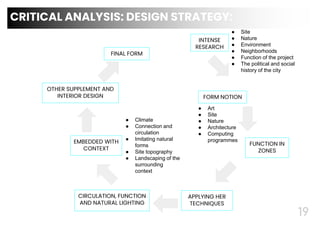
CRITICAL ANALYSIS: DESIGN STRATEGY:
FINAL FORM
INTENSE
RESEARCH
FORM NOTION
FUNCTION IN
ZONES
EMBEDDED WITH
CONTEXT
CIRCULATION, FUNCTION
AND NATURAL LIGHTING
APPLYING HER
TECHNIQUES
OTHER SUPPLEMENT AND
INTERIOR DESIGN
● Site
● Nature
● Environment
● Neighborhoods
● Function of the project
● The political and social
history of the city
● Art
● Site
● Nature
● Architecture
● Computing
programmes
● Climate
● Connection and
circulation
● Imitating natural
forms
● Site topography
● Landscaping of the
surrounding
context
CRITICAL ANALYSIS: POSITIVE
20
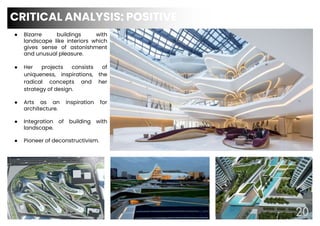
● Bizarre buildings with
landscape like interiors which
gives sense of astonishment
and unusual pleasure.
● Her projects consists of
uniqueness, inspirations, the
radical concepts and her
strategy of design.
● Arts as an inspiration for
architecture.
● Integration of building with
landscape.
● Pioneer of deconstructivism.
21
● Design critics have described her designs to be aggressive and
intractable and bitter.
● Hadid even terminated an interview when asked to her about her
problems with her stadium projects in Tokyo and Qatar.
● Her designs are of deliberate complexity and has questionable
functionality that usually surpass it's initial budget.
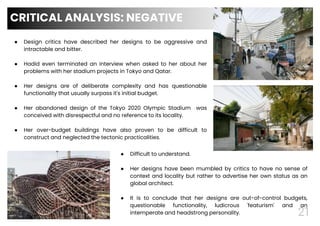
● Her abandoned design of the Tokyo 2020 Olympic Stadium was
conceived with disrespectful and no reference to its locality.
● Her over-budget buildings have also proven to be difficult to
construct and neglected the tectonic practicalities.
CRITICAL ANALYSIS: NEGATIVE
21
● Difficult to understand.
● Her designs have been mumbled by critics to have no sense of
context and locality but rather to advertise her own status as an
global architect.
● It is to conclude that her designs are out-of-control budgets,
questionable functionality, ludicrous 'featurism' and an
intemperate and headstrong personality.
22
REFERENCES:
● https://www.zaha-hadid.com/architecture/the-peak-leisure-club/
● https://www.architecturaldigest.com/gallery/buildings-beauty-deconstructed-architecture
● https://www.slideshare.net/abhishek201165/zaha-hadid-125504765?qid=3cab057f-9d49-4452-8e6e-
6a4b06fa4424&v=&b=&from_search=1
● https://www.pinterest.com/pin/318981586083696372/
● https://www.re-thinkingthefuture.com/design-inspiration/a1725-al-wakrah-stadium-doha-by-zaha-
hadid-architects/
● https://www.qatar2022.qa/en/news/al-wakrah-stadium-zaha-hadid-would-have-been-amazed
● https://www.slideshare.net/deepakraj52493499/zaha-hadid-49102718?next_slideshow=1
● https://www.archdaily.com/795832/antwerp-port-house-zaha-hadid-
architects/57e418f3e58ecef8b4000514-antwerp-port-house-zaha-hadid-architects-photo
● http://www.omraniacsbeaward.org/cairo-expo-city/content
● https://www.zaha-hadid.com/architecture/vilnius-museum-cultural-centre/
● https://www.researchgate.net/publication/304552915_Zaha_Hadid's_Techniques_of_Architectural_Form
-Making
● https://www.archdaily.com/294549/galaxy-soho-zaha-hadid-architects-by-hufton-
crow/50a642d2b3fc4b46eb000059-galaxy-soho-zaha-hadid-architects-by-hufton-crow-
photo?next_project=no
● https://www.architectural-review.com/essays/reputations/zaha-hadid-1950-2016-2
● slideshare.net/soodkartik/zaha-hadid-two-projects
● https://www.slideshare.net/renurajbahak/presentation-on-architect-zaha-hadid-and-her-work
THANK YOU

Zaha Hadid

  • 1.
    ZAHA HADID (1950-2016) ● KabimShrestha (HCE075BAR011) ● Kewal Lama (HCE075BAR012) ● Ar. Nisha RC
  • 2.
    BACKGROUND.………………..………………………………………………...……….………... 3-4 STYLE……………………………………..………………………………………………...……….………... 5-6 PHILOSOPHY………...………………...……………..…………………...…...……………………..7-8 TECHNIQUES..……………...……………...………...…………………….…………...…………... 9 DESIGN PRINCIPLES USED………………………………………………………………….. 10 CHARACTERISTICS OF FORM PATTERN…………………………………….... 11-17 MATERIALS………………………………………………………………………………………………… 18 CRITICAL ANALYSIS…...……...……………..………...……………………..……………... 19-21 TABLE OF CONTENT
  • 3.
    ● British Iraqiarchitect, artist and designer born on October 31, 1950 in Baghdad, Iraq. ● Studied mathematics at the American University of Beirut (Lebanon) in 1968. ● In 1972 she moved to London (UK), to join the Association of Architecture where she graduated with honors in 1977 and served as a teacher soon after. ● After her first building was commissioned and built in 1994, the Vitra Fire Station in Germany, her career took a leap forward. ● Following the Postmodern architectural boom led by Frank Gehry, Hadid was one of the most innovative architect. ● Influenced by Suprematism and the Russian avant- garde. ● recognised as a major figure in architecture of the late 20th and early 21st centuries ZAHA HADID 3
  • 4.
    ● Hadid adoptedpainting as a design tool and abstraction as an investigative principle to "reinvestigate the aborted and untested experiments of Modernism to unveil new fields of building.” ● Described as the "Queen of the curve", who "liberated architectural geometry, giving it a whole new expressive identity". ● Hadid is considered as the most imaginative architect among her colleagues based on: ○ The number of projects she has designed (950 projects)- 80 completed ○ The number of prizes she got (93 prizes) based on the richness of various concepts she conducts. ● In 2004, she was bestowed with Pritzker prize. ZAHA HADID 4
  • 5.
    5 STYLE ● Her styleis Deconstructivism (breaking architecture, displacement and distortion, leaving the vertical and the horizontal, using rotations on small, sharp angles, breaks up structures apparent chaos). ● Using light volumes, sharp, angular forms, the play of light and the integration of the buildings with the landscape. ● Integrated into their architectural designs using spiral forms. 04 ● She is an architect known worldwide for her talent in various disciplines such as painting, graphic arts, three dimensional models and computer design. 5 Heydar Aliyev Center Galaxy Soho
  • 6.
    Heydar Aliyev Centre6 6 STYLE ● As well as creating architecture the architect is a celebrated painter, designer of furniture and interior products + fittings such as bowls and chandeliers. ● Her favorite colour is BLACK, but with different texture. Bratislava Slovakia ● Zaha Hadid's is boldly CONTEMPORARY, ORGANIC and INNOVATIVE. ● The architect pushes design through new technology and materials and never does ordinary. ● Inspired by Yohji Yamamoto and his asymmetry. ● Her creation are more to do with topography and landscape, emulating a natural form. Al Wakrah Stadium
  • 7.
    Integration of building with landscape, playof light sharp angular forms 7 PHILOSOPHY Vitra Fire Station Main components of philosophy in her designs: ● Gravity-defying ● Fragmentation ● Revolutionary ● Fluidity ● Deconstructivism ● Uses light volume, sharp angular forms and the play of light. FRAGMENTATION an interest in manipulating a structure's surface, skin, non- rectilinear shapes which appear to distort and dislocate elements of architecture, such as structure and envelope. Antwerp Port House Galaxy Soho, China GRAVITY-DEFYING Hadid carves the ground up to the sky as if building wants to get free from the land and fly. REVOLUTIONARY ARCHITECTURE dynamic and innovative Erosion, Throwing, Twisting, Folding, Abstraction, Melting, Collision, Explosion, Shattering Ground and Masses Manipulation, Erosion, Using Cones, Arcs Forms, Inclined Mass, Emanation, Inclined Column
  • 8.
    8 ● Her styleis Deconstructivism (breaking architecture, displacement and distortion, leaving the vertical and the horizontal, using rotations on small, sharp angles, breaks up structures apparent chaos). ● Deconstructivism is an approach to building design that attempts to view architecture in bits and pieces. The basic elements of architecture are dismantled. ● Deconstructivist buildings may seem to have no visual logic. They may appear to be made up of unrelated, disharmonious abstract forms. 8 PHILOSOPHY 8 Vitra Fire Station Antwerp Port House
  • 9.
    9 ● Landscaping TheProject: ○ ● Play of light ○ Organizational Techniques Bundles ○ Juxtaposition ○ Overlapping ○ Fragmentation ○ Accumulation TECHNIQUES ● Layering ○ Space ○ Blocks ● Seamlessness And Fluidity Heydar Aliyev Centre, Azerbaijan Galaxy Soho, China Cairo Expo City Hotel Puerta America, Madrid
  • 10.
    Symmetricity Simple addition and subtraction Embellishmentand Decoration Stable Ground Rhythm Balance: Asymmetry Unity Scale: except the main space PRINCIPLES: 10 THE USED AND IGNORED ARCHITECTURAL FORM PRINCIPLES BY ZAHA HADID ARE: USED IGNORED
  • 11.
    ● Suprematists ● Topographic ●Fluid ● Organic ● Parametric 11 CHARACTERISTICS OF FORM PATTERN: Suprematist Pattern The Peak Leisure Club, Hongkong Topographic Pattern Heydar Aliyev Centre, Azerbaijan Fluid Pattern Cairo Expo City, Egypt Organic Pattern Regium Waterfront Museum, Italy Parametric Pattern Galaxy Soho, China
  • 12.
    ● Using fundamentalgeometric forms ● Utilizing analogous forms ● Defying gravity ● Abstraction ● Fragmentation ● Conceiving masses in perspective of three points ● Manipulating the ground of different floors. SUPREMATIST: 12 ● This painting depicts Hadid’s winning entry in an architectural competition for a private club in the hills of Kowloon, Hong Kong. ● Hadid proposed to transform the site by excavating the hills, using the removed rock to build artificial cliffs, or “a man-made geology,” in her words. ● She planned to interject cantilevered beams, shard-like fragments, and other elements that would seem to splinter the structure into its myriad constituent parts, as if subjecting it to some powerful, destabilizing force. ● The forms appear to hover and float, defying gravity. ● considered to be Hadid’s breakthrough project and a pivotal moment in her investigation of painting as a design tool. ● First developed during this period of experimentation in the early 1980s, her ideas about “lightness, floating, and fluidity,” as she described them, were recurring references throughout her prolific career. The Peak Leisure Club, Hongkong
  • 13.
    13 ● Inspired fromthe natural landscape formation; the surface outline for the earth ● Faded to join the earth giving sense of affiliation ● Have seamless and fluid surfaces ● Have the features of withdrawing ● Lighting slots smoothly design in parallel to projects"s form TOPOGRAPHIC: ● The Heydar Aliyev Center represents a fluid form which emerges by the folding of the landscape's natural topography and by the wrapping of individual functions of the Center. ● All functions of the Center, together with entrances, are represented by folds in a single continuous surface. Heydar Aliyev Center, Azerbaijan
  • 14.
    14 ● Having watery,amorphous surfaces; the fluid of Arabic calligraphy ● Gradually faded to join the earth ● Continuous curved surfaces ● Having kinetic interior designs that could serves as multipurposes and multifunctional spaces ● Rarely using corner and orthogonal angle ● Windows and entrances take the same fluid form of the masses FLUID: ● The design idea of the project brings attention as it is originated from the smooth shapes of water drops. ● Creation of architectural free form which contains functional and architectural vacuum that meets the functional needs required for the project. ● Also the external lines of the blocks is used to be harmonious with the landscape which is considered the core of the project so that it appears to be one coherent part that is hard to separate between its parts Cairo Expo City, Egypt
  • 15.
    15 ● Inspired fromnature such as animals or plants. ● Having irregular surfaces and often asymmetrical. ● Have fluid, seamless and curvy surfaces. ● Intimately merged within the content and site because of the familiarity of their notions with the site. ● The form of the museum draws inspiration from the organic shapes of a starfish. ● The radial symmetry of this shape helps to coordinate the communication and circulation between different sections of the museum and its other facilities. ● The Museum of Mediterranean History will house exhibition spaces, restoration facilities, an archive, an aquarium and library. Regium Waterfront Museum, Italy ORGANIC:
  • 16.
    ● Parametrically flexiblewhich differentiate progressively to meet all the requirements ● Having fluid, compressed, torsional and twisted forms ● Responsive to environment ● Some have a reticular, perforated skin ● Based on algorithmic thinking that enables the expression of parameters and rules that, together, define, encode and clarify the relationship between design intent and design response. 01 16 PARAMETRIC: Galaxy Soho, China ● composition of five continuous, flowing volumes that are set apart, fused or linked by stretched bridges. ● These volumes adapt to each other in all directions, generating a panoramic architecture without corners or abrupt transitions that break the fluidity of its formal composition. ● inspired from the ancient terraced agricultural fields.
  • 17.
    17 THE FORMATIVE RELATIONSHIPBETWEEN PLAN AND ELEVATION OR SECTION:
  • 18.
    MATERIALS 18 ● Heydar AliyevCenter Baku- Glass Fibre Reinforced Concrete (GFRC) and Glass Fibre Reinforced Polyester (GFRP) were chosen as ideal cladding materials. ● UNStudio Pavilion- steel and plywood – over a period of approximately three weeks. ● Serpentine Gallery London- glass-fibre textile, the new tensile structure forms a free-flowing white canopy with an undulating fabric roof that is supported by five tapered steel columns and outlined by a frameless glass wall. ● Beethoven concert hall Germany-outer stainless steel cladding bonded by 3m VHB adhesive to the sub-structure. ● Galaxy Soho beijing- The exterior of the building is clad in aluminium and stone while the interior features glass, terrazzo, stainless steel and glass reinforced gypsum. ● PODS & BESPOKE FURNITURE- GRP (glass reinforced plastics/ fiberglass) is the material used for the fabrication of the main gallery ‘pods’ serving as lighting elements, shelves and tables and all of the bespoke furniture that includes reception desk, bar, conference table and product display shelves. ● Furniture by zaha hadid- Usually have polyurethane base, fiber glass top, metallic paint finish.
  • 19.
    19 CRITICAL ANALYSIS: DESIGNSTRATEGY: FINAL FORM INTENSE RESEARCH FORM NOTION FUNCTION IN ZONES EMBEDDED WITH CONTEXT CIRCULATION, FUNCTION AND NATURAL LIGHTING APPLYING HER TECHNIQUES OTHER SUPPLEMENT AND INTERIOR DESIGN ● Site ● Nature ● Environment ● Neighborhoods ● Function of the project ● The political and social history of the city ● Art ● Site ● Nature ● Architecture ● Computing programmes ● Climate ● Connection and circulation ● Imitating natural forms ● Site topography ● Landscaping of the surrounding context
  • 20.
    CRITICAL ANALYSIS: POSITIVE 20 ●Bizarre buildings with landscape like interiors which gives sense of astonishment and unusual pleasure. ● Her projects consists of uniqueness, inspirations, the radical concepts and her strategy of design. ● Arts as an inspiration for architecture. ● Integration of building with landscape. ● Pioneer of deconstructivism.
  • 21.
    21 ● Design criticshave described her designs to be aggressive and intractable and bitter. ● Hadid even terminated an interview when asked to her about her problems with her stadium projects in Tokyo and Qatar. ● Her designs are of deliberate complexity and has questionable functionality that usually surpass it's initial budget. ● Her abandoned design of the Tokyo 2020 Olympic Stadium was conceived with disrespectful and no reference to its locality. ● Her over-budget buildings have also proven to be difficult to construct and neglected the tectonic practicalities. CRITICAL ANALYSIS: NEGATIVE 21 ● Difficult to understand. ● Her designs have been mumbled by critics to have no sense of context and locality but rather to advertise her own status as an global architect. ● It is to conclude that her designs are out-of-control budgets, questionable functionality, ludicrous 'featurism' and an intemperate and headstrong personality.
  • 22.
    22 REFERENCES: ● https://www.zaha-hadid.com/architecture/the-peak-leisure-club/ ● https://www.architecturaldigest.com/gallery/buildings-beauty-deconstructed-architecture ●https://www.slideshare.net/abhishek201165/zaha-hadid-125504765?qid=3cab057f-9d49-4452-8e6e- 6a4b06fa4424&v=&b=&from_search=1 ● https://www.pinterest.com/pin/318981586083696372/ ● https://www.re-thinkingthefuture.com/design-inspiration/a1725-al-wakrah-stadium-doha-by-zaha- hadid-architects/ ● https://www.qatar2022.qa/en/news/al-wakrah-stadium-zaha-hadid-would-have-been-amazed ● https://www.slideshare.net/deepakraj52493499/zaha-hadid-49102718?next_slideshow=1 ● https://www.archdaily.com/795832/antwerp-port-house-zaha-hadid- architects/57e418f3e58ecef8b4000514-antwerp-port-house-zaha-hadid-architects-photo ● http://www.omraniacsbeaward.org/cairo-expo-city/content ● https://www.zaha-hadid.com/architecture/vilnius-museum-cultural-centre/ ● https://www.researchgate.net/publication/304552915_Zaha_Hadid's_Techniques_of_Architectural_Form -Making ● https://www.archdaily.com/294549/galaxy-soho-zaha-hadid-architects-by-hufton- crow/50a642d2b3fc4b46eb000059-galaxy-soho-zaha-hadid-architects-by-hufton-crow- photo?next_project=no ● https://www.architectural-review.com/essays/reputations/zaha-hadid-1950-2016-2 ● slideshare.net/soodkartik/zaha-hadid-two-projects ● https://www.slideshare.net/renurajbahak/presentation-on-architect-zaha-hadid-and-her-work
  • 23.

Editor's Notes

  • #2 Full cover page (image or sketch of the project)
  • #7 Yohji Yamamoto is a Japanese fashion designer