SITTIE ASIA A. MINALANG
TEACHER I
Objectives:
At the end of 60 minutes, the
learners are expected to:
1. describe mixtures based on
the number of components
present, uniformity and
composition.
Unlocking Vocabularies
1. heterogeneous mixture - a
mixture that is made up of more
than one phase.
2. homogeneous mixture - a
mixture that contains only one
phase.
3. mixture - a physical combination
of two or more substances.
4. solute - the component that is
dissolved in a solution or the
substance in a smallest amount
5. solution - a homogenous mixture
formed by the dissolution of a liquid,
solid or gas in a liquid.
6. solvent - the dissolving
component of a solution or the
substance in a largest amount.
4 Pics One Word
What common word describes the 4 pictures?
Answer: MIXTURE
Based from the given 4 pictures, give one word that is associated
with mixture.
ORPTIESPRE
FO
IXSTREMU
PROPERTIES
OF
MIXTURES
Criteria 5 points 4 points 2 point Group Score
Presentation/Delivery Group output is
presented clearly
and confidently
Group output is
presented not very
clear but
confidently
Group output is
presented not clear
and not confidently
Idea All answers are
correct
1 answer is
incorrect
2 or more answers
are incorrect
Team work All members
helped in
answering the
activity
1 member did not
help in answering
the activity
Only 1 member
answers the
activity
Timeliness Activity is done on
time
Done with the
activity 1 minute
after the allotted
time.
Done with the
activity 2 or more
minutes after the
allotted time
Total Score
20
Rubric
Activity 1.A. Homogeneous Mixture
Procedure:
1. The teacher will divide the class into 4 groups and
will let the students bring out their materials.
2. Mix marble and water.
Materials: marbles and 250 ml of water
Guide questions:
1. What have you noticed in the container?
2. Can you still see the marble in the water?
3. Are the substances have uniform appearance?
4. If one substance is distinguishable. Why it retains
its property?
5. How many components are there in the container?
Activity 1.B. Heterogeneous Mixture
Procedure:
1. The teacher will divide the class into 4 groups and
will let the students bring out their materials.
2. Mix vinegar and water.
Materials: vinegar and 250 ml of water
Guide questions:
1. What have you observed in the container?
2. Can you still see the vinegar in the water?
3. What is the phase of vinegar before it was added
with water?
4. How many components of mixture you can see in
the container?
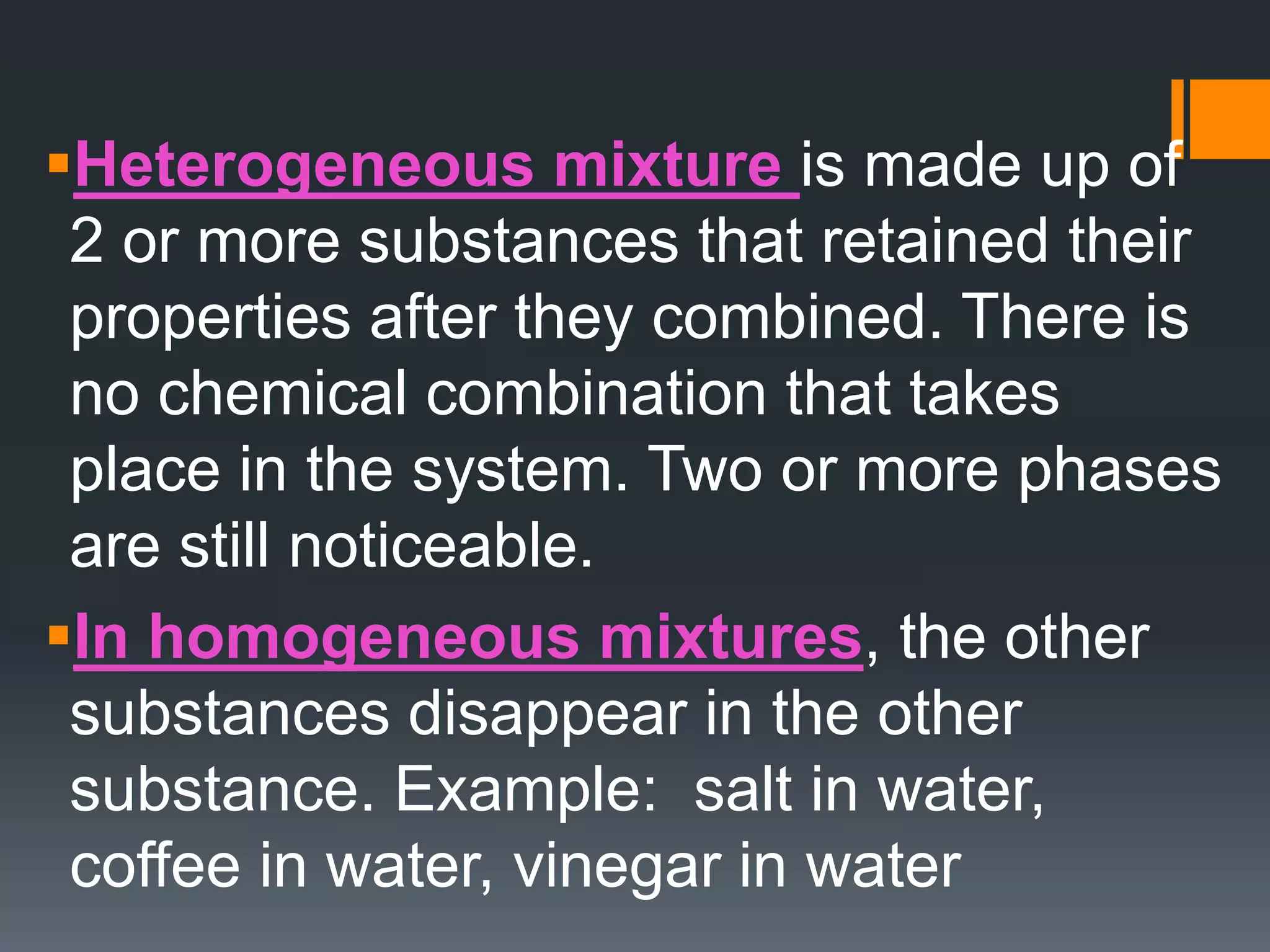
Heterogeneous mixture is made up of
2 or more substances that retained their
properties after they combined. There is
no chemical combination that takes
place in the system. Two or more phases
are still noticeable.
In homogeneous mixtures, the other
substances disappear in the other
substance. Example: salt in water,
coffee in water, vinegar in water
• To deepen more our understanding, lets have another
set of samples.
1. What have you observed on the first container
(powdered juice+ water) ?
2. Can you still see the granules separately from the
water?
3. What is the solute? solvent?
4. What have you observed on the second water container
(Salt+Water) ?
5. Can you still see the salt separately from the water?
6. What is the solute? solvent?
7. What can you observe when you shake a carbonated
drink?
8. What is the solulte? solvent?
Solution is a mixture of two more
substances in a single phase. The
substance in a largest amount is
solvent and in a smallest amount is
solute. Homogenous are classified
into three types : liquid-liquid
solution (Vinegar+water), solid-
liquid solution (Salt+water) and
gas-liguid solution (CO2+water).
Direction: TRUE or FALSE. Write T if the statement is true and F if it is
not.
_____1. Homogeneous mixtures are not uniform in composition and
appearance all throughout.
_____ 2. Heterogeneous mixtures are not uniform in composition and
appearance all throughout.
_____ 3. Coffee in a hot water is an example of mixture.
_____ 4. Solutions are example of homogeneous mixtures.
_____ 5. Mixture is a combination of a compound and an element.
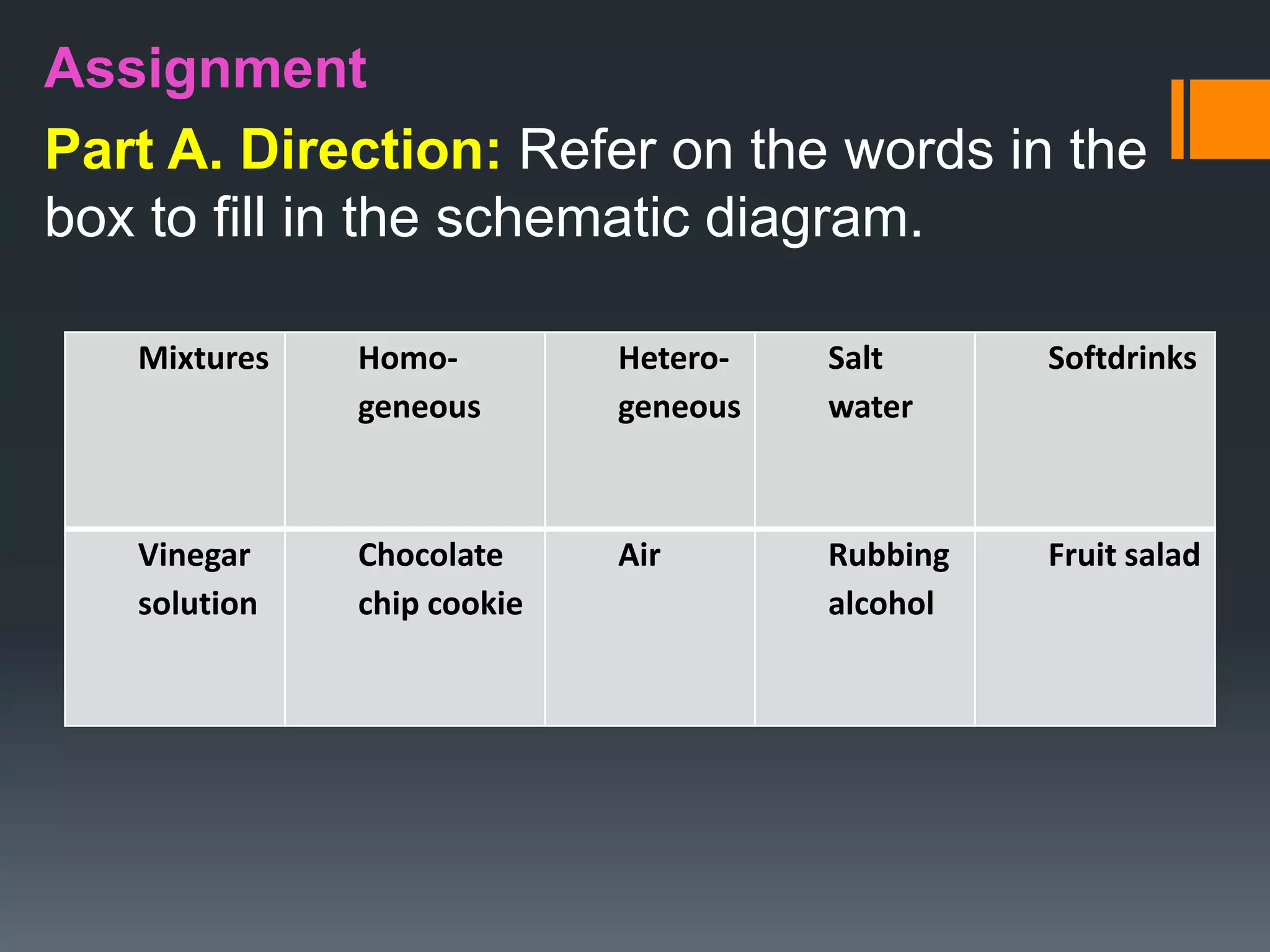
Assignment
Part A. Direction: Refer on the words in the
box to fill in the schematic diagram.
Mixtures Homo-
geneous
Hetero-
geneous
Salt
water
Softdrinks
Vinegar
solution
Chocolate
chip cookie
Air Rubbing
alcohol
Fruit salad
MIXTURES
Is the mixture
the same all
throughout? NO
YES
HETEROGENEOUS
HOMOGENEOUS
Examples:
Fruitsalad
Softdrinks
Chocolate chip cookie
Examples:
Vinegar solution
Salt water
Air
Part B. Direction: Fill in the missing
information.
Description/
definition
Examples
(at least
10)
Homogeneous
mixtures
Heterogeneous
mixtures
THANK YOU
FOR THE TIME
AND
COOPERATION.

PPT-DEMO TEACHING-SCIENCE 7.pptx

  • 1.
    SITTIE ASIA A.MINALANG TEACHER I
  • 2.
    Objectives: At the endof 60 minutes, the learners are expected to: 1. describe mixtures based on the number of components present, uniformity and composition.
  • 3.
    Unlocking Vocabularies 1. heterogeneousmixture - a mixture that is made up of more than one phase. 2. homogeneous mixture - a mixture that contains only one phase. 3. mixture - a physical combination of two or more substances.
  • 4.
    4. solute -the component that is dissolved in a solution or the substance in a smallest amount 5. solution - a homogenous mixture formed by the dissolution of a liquid, solid or gas in a liquid. 6. solvent - the dissolving component of a solution or the substance in a largest amount.
  • 5.
    4 Pics OneWord What common word describes the 4 pictures? Answer: MIXTURE Based from the given 4 pictures, give one word that is associated with mixture.
  • 6.
  • 7.
  • 8.
    Criteria 5 points4 points 2 point Group Score Presentation/Delivery Group output is presented clearly and confidently Group output is presented not very clear but confidently Group output is presented not clear and not confidently Idea All answers are correct 1 answer is incorrect 2 or more answers are incorrect Team work All members helped in answering the activity 1 member did not help in answering the activity Only 1 member answers the activity Timeliness Activity is done on time Done with the activity 1 minute after the allotted time. Done with the activity 2 or more minutes after the allotted time Total Score 20 Rubric
  • 9.
    Activity 1.A. HomogeneousMixture Procedure: 1. The teacher will divide the class into 4 groups and will let the students bring out their materials. 2. Mix marble and water. Materials: marbles and 250 ml of water Guide questions: 1. What have you noticed in the container? 2. Can you still see the marble in the water? 3. Are the substances have uniform appearance? 4. If one substance is distinguishable. Why it retains its property? 5. How many components are there in the container?
  • 10.
    Activity 1.B. HeterogeneousMixture Procedure: 1. The teacher will divide the class into 4 groups and will let the students bring out their materials. 2. Mix vinegar and water. Materials: vinegar and 250 ml of water Guide questions: 1. What have you observed in the container? 2. Can you still see the vinegar in the water? 3. What is the phase of vinegar before it was added with water? 4. How many components of mixture you can see in the container?
  • 11.
    Heterogeneous mixture ismade up of 2 or more substances that retained their properties after they combined. There is no chemical combination that takes place in the system. Two or more phases are still noticeable. In homogeneous mixtures, the other substances disappear in the other substance. Example: salt in water, coffee in water, vinegar in water
  • 12.
    • To deepenmore our understanding, lets have another set of samples. 1. What have you observed on the first container (powdered juice+ water) ? 2. Can you still see the granules separately from the water? 3. What is the solute? solvent? 4. What have you observed on the second water container (Salt+Water) ? 5. Can you still see the salt separately from the water? 6. What is the solute? solvent? 7. What can you observe when you shake a carbonated drink? 8. What is the solulte? solvent?
  • 13.
    Solution is amixture of two more substances in a single phase. The substance in a largest amount is solvent and in a smallest amount is solute. Homogenous are classified into three types : liquid-liquid solution (Vinegar+water), solid- liquid solution (Salt+water) and gas-liguid solution (CO2+water).
  • 14.
    Direction: TRUE orFALSE. Write T if the statement is true and F if it is not. _____1. Homogeneous mixtures are not uniform in composition and appearance all throughout. _____ 2. Heterogeneous mixtures are not uniform in composition and appearance all throughout. _____ 3. Coffee in a hot water is an example of mixture. _____ 4. Solutions are example of homogeneous mixtures. _____ 5. Mixture is a combination of a compound and an element.
  • 15.
    Assignment Part A. Direction:Refer on the words in the box to fill in the schematic diagram. Mixtures Homo- geneous Hetero- geneous Salt water Softdrinks Vinegar solution Chocolate chip cookie Air Rubbing alcohol Fruit salad
  • 16.
    MIXTURES Is the mixture thesame all throughout? NO YES HETEROGENEOUS HOMOGENEOUS Examples: Fruitsalad Softdrinks Chocolate chip cookie Examples: Vinegar solution Salt water Air
  • 17.
    Part B. Direction:Fill in the missing information. Description/ definition Examples (at least 10) Homogeneous mixtures Heterogeneous mixtures
  • 18.
    THANK YOU FOR THETIME AND COOPERATION.