SCIENCE
Quarter 1 – Module 1
LESSON 1: DESCRIBING MIXTURES
WHAT I KNOW
Directions: Write the letter of the correct answer. Use a
separate sheet for your answer.
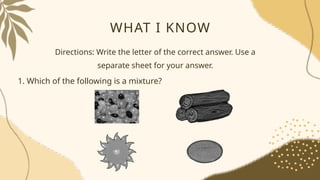
1. Which of the following is a mixture?
WHAT I KNOW
2. Mixtures can be homogenous or heterogeneous. A sachet of 3 in
1 coffee contains coffee, sugar and powdered cream. Thus,
making it heterogeneous. When hot water is being poured into
the 3 in 1 mixture, it turned homogeneous. What idea supports
the said occurrence?
a. The components of mixtures when dissolve in hot water
cannot be identified.
b. The components of mixtures mixed with hot water taste
sweet.
c. The components of mixtures form a two-layer liquid.
d. The components of mixtures can be separated.
WHAT I KNOW
3. Which of the following are homogeneous mixtures?
I. Tea with sugar
II. Buko salad
III. Nachos
IV. Alcohol
V. Air
a. I and II c. II and III
b. IV and V d. I, IV and V
WHAT I KNOW
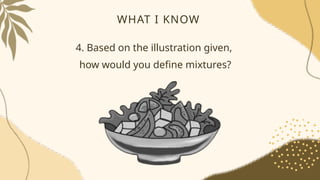
4. Based on the illustration given,
how would you define mixtures?
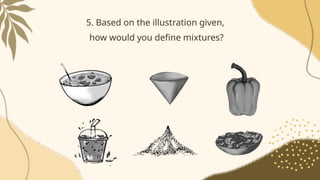
5. Based on the illustration given,
how would you define mixtures?
WHAT I KNOW
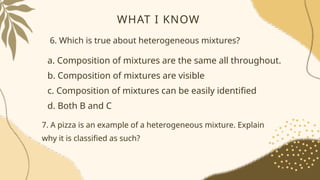
6. Which is true about heterogeneous mixtures?
a. Composition of mixtures are the same all throughout.
b. Composition of mixtures are visible
c. Composition of mixtures can be easily identified
d. Both B and C
7. A pizza is an example of a heterogeneous mixture. Explain
why it is classified as such?
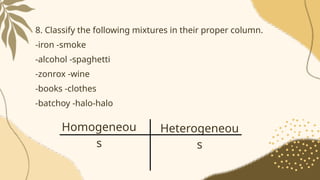
8. Classify the following mixtures in their proper column.
-iron -smoke
-alcohol -spaghetti
-zonrox -wine
-books -clothes
-batchoy -halo-halo
Homogeneou
s
Heterogeneou
s
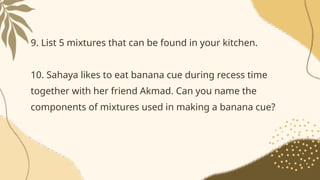
9. List 5 mixtures that can be found in your kitchen.
10. Sahaya likes to eat banana cue during recess time
together with her friend Akmad. Can you name the
components of mixtures used in making a banana cue?
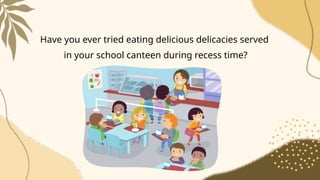
Have you ever tried eating delicious delicacies served
in your school canteen during recess time?
Have you ever thought of how these foods were prepared in
such a way that various ingredients were mixed to make it delicious and healthy?
The combination of several components or elements produce a useful end product that can be utilized and consumed for our advantage.
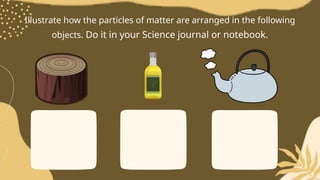
Illustrate how the particles of matter are arranged in the following
objects. Do it in your Science journal or notebook.
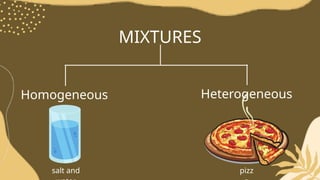
MIXTURES
Homogeneous Heterogeneous
salt and pizz
MIXTURES
Mixtures are combinations of two or more
substances that can be homogeneous or
heterogeneous.
Homogeneous mixtures appear uniform all
throughout because they have the same proportion.
Heterogeneous mixtures
are not uniform in proportion where combined substances are not evenly
spread or mixed.
Directions: From the short information that you have read about mixtures, answer
the following questions. Write the answer in your journal.
1. What is a mixture?
2. What are the 2 types of mixtures? __________ and ___________.
3. Fill in the blanks to complete the following sentences:
Homogeneous mixture appears ___________ while a heterogeneous mixture
_______________________.
4. A Homogeneous mixture is a ___________________ mixture.
While a Heterogeneous mixture is a _________________ mixture.
5. 5. In the given illustration on the previous page on homogeneous and
heterogeneous mixtures, give 1 example similar to it.
Homogeneous - __________________
Heterogeneous - __________________
What is It
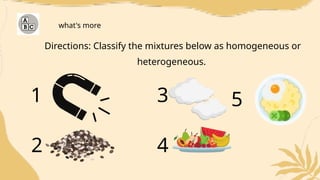
Directions: Classify the mixtures below as homogeneous or
heterogeneous.
what's more
1
2
3
4
5
6. Alum (Tawas) dissolved in water
7. Paint
8. Palabok
9. Alcohol
10. Macaroni salad
what's more
Directions: Complete the paragraph below. Do it in your Science
journal or notebook.
I learned that……. Mixtures are the combination of _____________ substances that can be homogeneous or heterogeneous. Homogeneous mixtures are ____________________ mixtures, while heterogeneous mixtures are _______________________ mixtures.
What I Have Learned
WHAT I CAN DO
Directions: Read and answer the following. Write the answers in your journal.
1. Calamansi juice is composed of calamansi extract, water, and sugar. Is
calamansi juice a homogeneous or a heterogeneous mixture? Explain
your answer.
2. What type of mixture will you form when you mix different candies in a
container? Can you still recognize the components of the mixture? Why?
ASSESSMENT
Directions: Choose the correct answer in each number.
1. Which of the following mixtures is heterogeneous?
a. salt and sugar dissolved in water
b. powdered detergent in a pail of water
c. 3 in 1 coffee dissolved in hot water
d. vegetable salad with dressing
a. It is a homogeneous mixture because it was evenly
mixed.
b. It is a heterogeneous mixture because its
components are visible.
c. It is a heterogeneous mixture because of its
uniformity.
d. It is a homogeneous mixture because it is not
uniform.
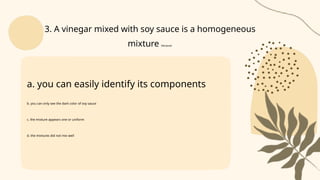
2. Your mother prepared pinakbet for lunch. How will you
describe its ingredients?
a. you can easily identify its components
b. you can only see the dark color of soy sauce
c. the mixture appears one or uniform
d. the mixtures did not mix well
3. A vinegar mixed with soy sauce is a homogeneous
mixture because:
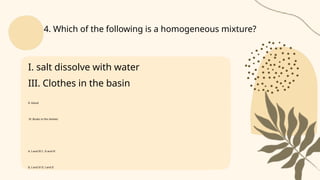
I. salt dissolve with water
III. Clothes in the basin
II. blood
IV. Books in the shelves
A. I and III C. II and IV
B. I and IV D. I and II
4. Which of the following is a homogeneous mixture?
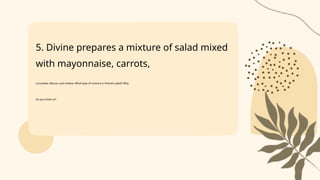
5. Divine prepares a mixture of salad mixed
with mayonnaise, carrots,
cucumber, lettuce, and cheese. What type of mixture is Divine’s salad? Why
do you think so?
5. Divine prepares a mixture of salad mixed
with mayonnaise, carrots,
cucumber, lettuce, and cheese. What type of mixture is Divine’s salad? Why
do you think so?
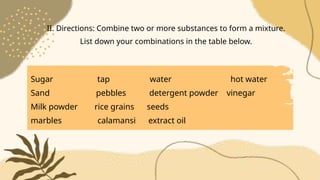
Sugar tap water hot water
Sand pebbles detergent powder vinegar
Milk powder rice grains seeds
marbles calamansi extract oil
II. Directions: Combine two or more substances to form a mixture.
List down your combinations in the table below.
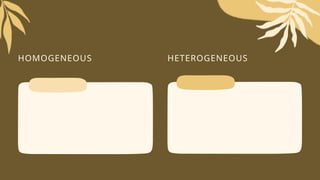
HOMOGENEOUS HETEROGENEOUS
THANK YOU
PLEASE SUBSCRIBE TO SIR BENJ
CHANNEL
CREDITS TO THE AUTHORS OF THIS
MODULE

Science Quarter 1 – Module 1.pptxxxxxxxxxx

  • 1.
    SCIENCE Quarter 1 –Module 1 LESSON 1: DESCRIBING MIXTURES
  • 2.
    WHAT I KNOW Directions:Write the letter of the correct answer. Use a separate sheet for your answer. 1. Which of the following is a mixture?
  • 3.
    WHAT I KNOW 2.Mixtures can be homogenous or heterogeneous. A sachet of 3 in 1 coffee contains coffee, sugar and powdered cream. Thus, making it heterogeneous. When hot water is being poured into the 3 in 1 mixture, it turned homogeneous. What idea supports the said occurrence? a. The components of mixtures when dissolve in hot water cannot be identified. b. The components of mixtures mixed with hot water taste sweet. c. The components of mixtures form a two-layer liquid. d. The components of mixtures can be separated.
  • 4.
    WHAT I KNOW 3.Which of the following are homogeneous mixtures? I. Tea with sugar II. Buko salad III. Nachos IV. Alcohol V. Air a. I and II c. II and III b. IV and V d. I, IV and V
  • 5.
    WHAT I KNOW 4.Based on the illustration given, how would you define mixtures?
  • 6.
    5. Based onthe illustration given, how would you define mixtures?
  • 7.
    WHAT I KNOW 6.Which is true about heterogeneous mixtures? a. Composition of mixtures are the same all throughout. b. Composition of mixtures are visible c. Composition of mixtures can be easily identified d. Both B and C 7. A pizza is an example of a heterogeneous mixture. Explain why it is classified as such?
  • 8.
    8. Classify thefollowing mixtures in their proper column. -iron -smoke -alcohol -spaghetti -zonrox -wine -books -clothes -batchoy -halo-halo Homogeneou s Heterogeneou s
  • 9.
    9. List 5mixtures that can be found in your kitchen. 10. Sahaya likes to eat banana cue during recess time together with her friend Akmad. Can you name the components of mixtures used in making a banana cue?
  • 10.
    Have you evertried eating delicious delicacies served in your school canteen during recess time?
  • 11.
    Have you everthought of how these foods were prepared in such a way that various ingredients were mixed to make it delicious and healthy? The combination of several components or elements produce a useful end product that can be utilized and consumed for our advantage.
  • 12.
    Illustrate how theparticles of matter are arranged in the following objects. Do it in your Science journal or notebook.
  • 13.
  • 14.
    MIXTURES Mixtures are combinationsof two or more substances that can be homogeneous or heterogeneous.
  • 15.
    Homogeneous mixtures appearuniform all throughout because they have the same proportion.
  • 16.
    Heterogeneous mixtures are notuniform in proportion where combined substances are not evenly spread or mixed.
  • 17.
    Directions: From theshort information that you have read about mixtures, answer the following questions. Write the answer in your journal. 1. What is a mixture? 2. What are the 2 types of mixtures? __________ and ___________. 3. Fill in the blanks to complete the following sentences: Homogeneous mixture appears ___________ while a heterogeneous mixture _______________________. 4. A Homogeneous mixture is a ___________________ mixture. While a Heterogeneous mixture is a _________________ mixture. 5. 5. In the given illustration on the previous page on homogeneous and heterogeneous mixtures, give 1 example similar to it. Homogeneous - __________________ Heterogeneous - __________________ What is It
  • 18.
    Directions: Classify themixtures below as homogeneous or heterogeneous. what's more 1 2 3 4 5
  • 19.
    6. Alum (Tawas)dissolved in water 7. Paint 8. Palabok 9. Alcohol 10. Macaroni salad what's more
  • 20.
    Directions: Complete theparagraph below. Do it in your Science journal or notebook. I learned that……. Mixtures are the combination of _____________ substances that can be homogeneous or heterogeneous. Homogeneous mixtures are ____________________ mixtures, while heterogeneous mixtures are _______________________ mixtures. What I Have Learned
  • 21.
    WHAT I CANDO Directions: Read and answer the following. Write the answers in your journal. 1. Calamansi juice is composed of calamansi extract, water, and sugar. Is calamansi juice a homogeneous or a heterogeneous mixture? Explain your answer. 2. What type of mixture will you form when you mix different candies in a container? Can you still recognize the components of the mixture? Why?
  • 22.
    ASSESSMENT Directions: Choose thecorrect answer in each number. 1. Which of the following mixtures is heterogeneous? a. salt and sugar dissolved in water b. powdered detergent in a pail of water c. 3 in 1 coffee dissolved in hot water d. vegetable salad with dressing
  • 23.
    a. It isa homogeneous mixture because it was evenly mixed. b. It is a heterogeneous mixture because its components are visible. c. It is a heterogeneous mixture because of its uniformity. d. It is a homogeneous mixture because it is not uniform. 2. Your mother prepared pinakbet for lunch. How will you describe its ingredients?
  • 24.
    a. you caneasily identify its components b. you can only see the dark color of soy sauce c. the mixture appears one or uniform d. the mixtures did not mix well 3. A vinegar mixed with soy sauce is a homogeneous mixture because:
  • 25.
    I. salt dissolvewith water III. Clothes in the basin II. blood IV. Books in the shelves A. I and III C. II and IV B. I and IV D. I and II 4. Which of the following is a homogeneous mixture?
  • 26.
    5. Divine preparesa mixture of salad mixed with mayonnaise, carrots, cucumber, lettuce, and cheese. What type of mixture is Divine’s salad? Why do you think so?
  • 27.
    5. Divine preparesa mixture of salad mixed with mayonnaise, carrots, cucumber, lettuce, and cheese. What type of mixture is Divine’s salad? Why do you think so?
  • 28.
    Sugar tap waterhot water Sand pebbles detergent powder vinegar Milk powder rice grains seeds marbles calamansi extract oil II. Directions: Combine two or more substances to form a mixture. List down your combinations in the table below.
  • 29.
  • 30.
    THANK YOU PLEASE SUBSCRIBETO SIR BENJ CHANNEL
  • 31.
    CREDITS TO THEAUTHORS OF THIS MODULE