1
Organic Chemistry, Fourth Edition
Janice Gorzynski Smith
University of Hawai’i
Chapter 3
Lecture Outline
Prepared by Layne A. Morsch
The University of Illinois - Springfield
Copyright © 2014 The McGraw-Hill Companies, Inc. Permission required for reproduction or display.
Functional Groups
• A functional group is an atom or a group of
atoms with characteristic chemical and
physical properties.
• Most organic molecules contain a carbon
backbone consisting of C—C and C—H
bonds to which functional groups are
attached.
• Structural features of a functional group
include:
Functional Groups-1
• Functional groups distinguish one organic
molecule from another.
• They determine a molecule’s:
– geometry
– physical properties
– reactivity
©2020 McGraw-Hill
Education.
Reactivity of Functional
Groups
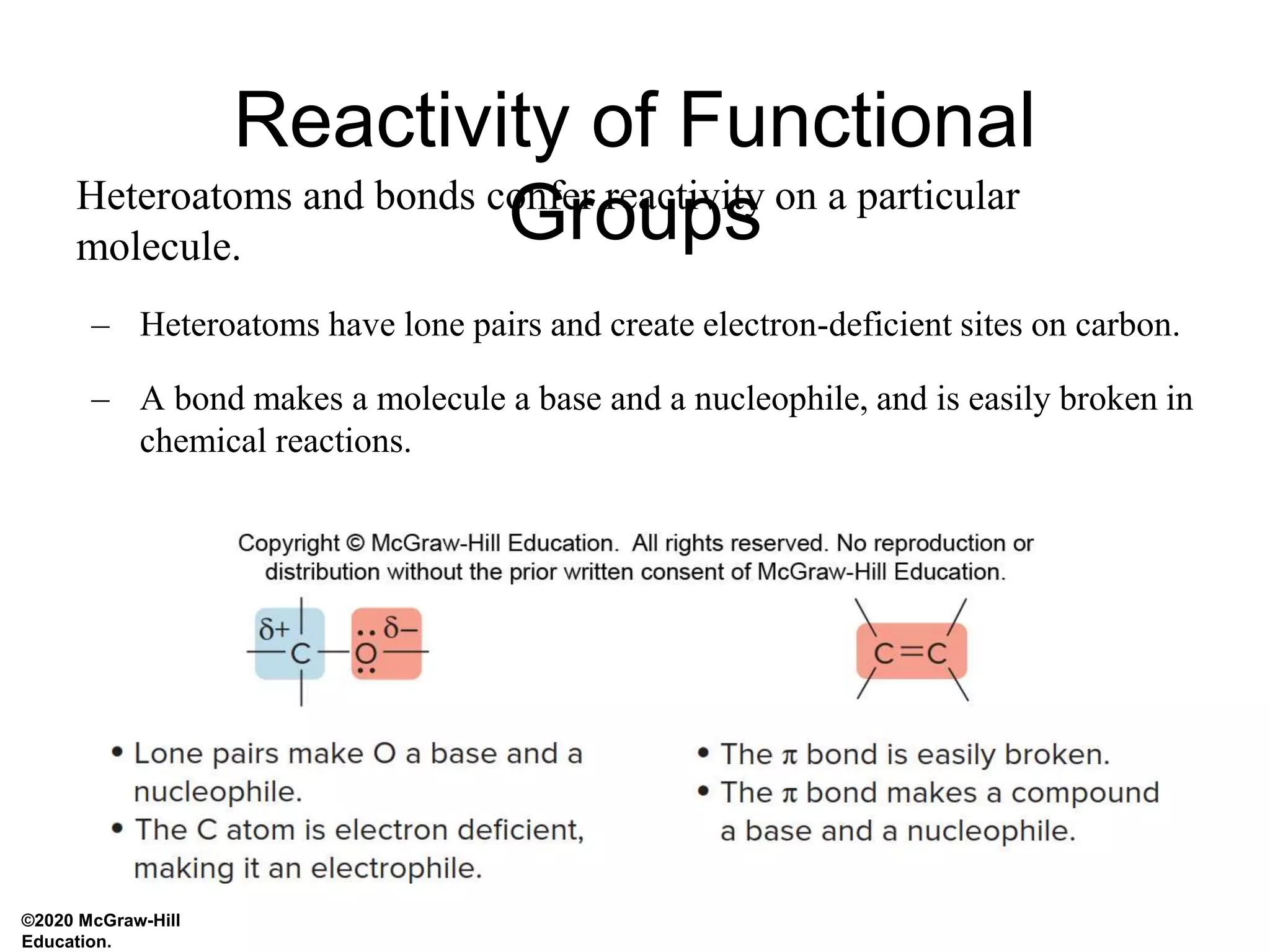
Heteroatoms and bonds confer reactivity on a particular
molecule.
– Heteroatoms have lone pairs and create electron-deficient sites on carbon.
– A bond makes a molecule a base and a nucleophile, and is easily broken in
chemical reactions.
©2020 McGraw-Hill
Education.
Parts of a Functional Group
Ethane, a Molecule with No
Functional Group
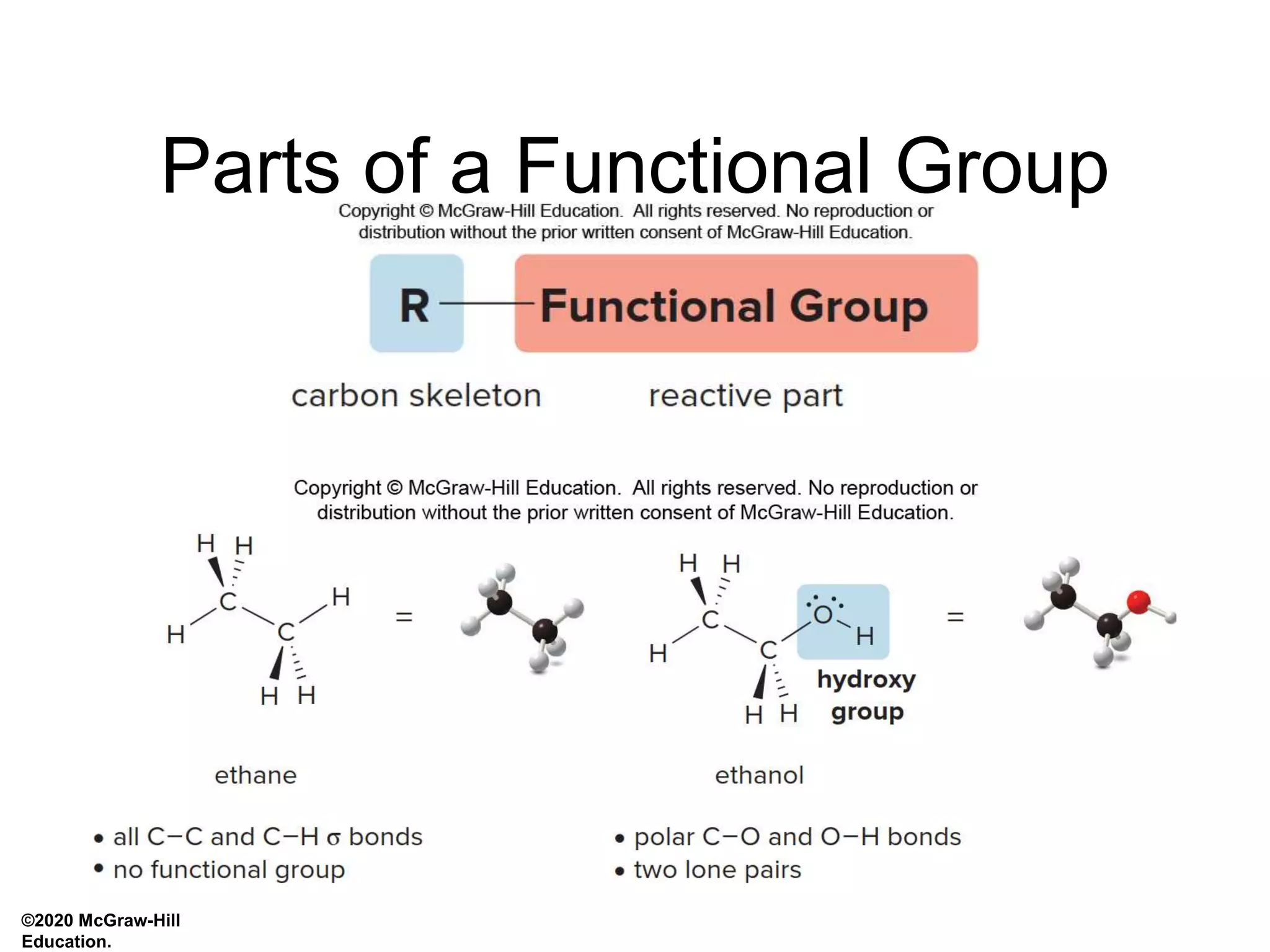
• This molecule has only C—C and C—H
bonds.
• It contains no polar bonds, lone pairs, or
bonds.
• Therefore, ethane has no reactive sites
(functional groups).
• Consequently, ethane and other alkanes are
Ethanol
• This molecule has an OH (called a hydroxy group)
attached to its backbone.
• Compounds containing an OH group are called alcohols.
• The hydroxy group makes the properties of ethanol very
different from the properties of ethane.
• Ethanol has lone pairs and polar bonds that make it
reactive.
• Other molecules with hydroxy groups will have similar
properties to ethanol.
Ethanol-1
©2020 McGraw-Hill
Education.
Hydrocarbons
Hydrocarbons are compounds made up of only
the elements carbon and hydrogen.
• They may be aliphatic (ex. alkanes, alkenes, alkynes) or
aromatic.
Aliphatic Hydrocarbons
• Aliphatic hydrocarbons have three subgroups.
• Alkanes have only C—C bonds and no
functional group.
• Alkenes have a C—C double bond.
• Alkynes have a C—C triple bond.
©2020 McGraw-Hill
Education.
Aromatic Hydrocarbons
Aromatic hydrocarbons are so named because many of the earliest known
aromatic compounds had strong, characteristic odors.
The simplest aromatic hydrocarbon is benzene.
The six-membered ring and three bonds of benzene comprise a single
functional group, found in most aromatic compounds.
©2020 McGraw-Hill
Education.
Functional Groups with
Carbon-
Heteroatom (𝐂−𝐙) 𝝈 bonds
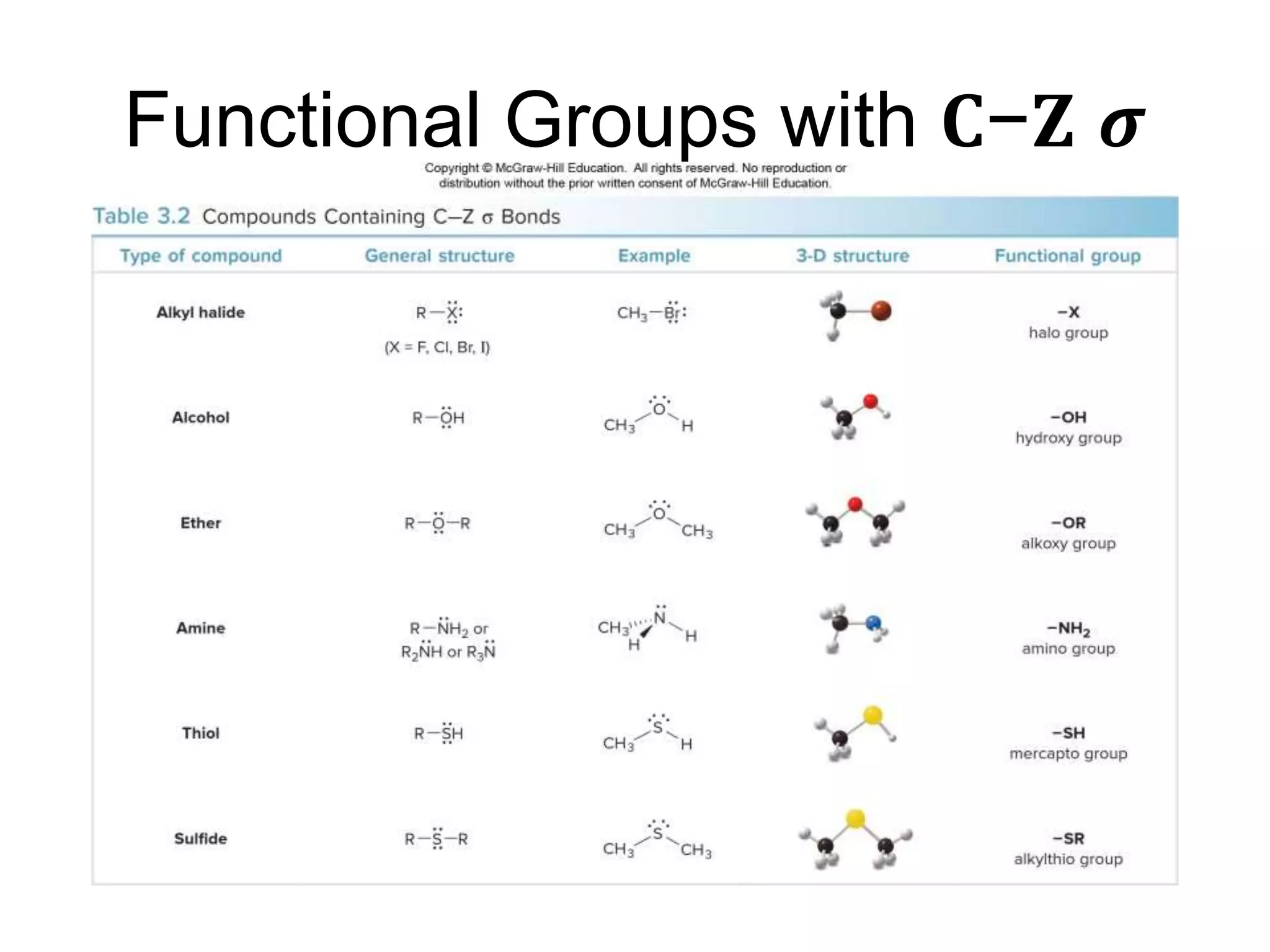
Several types of functional groups contain C—Z
bonds.
The electronegative heteroatom Z creates a polar
bond, making carbon electron deficient.
Functional Groups with 𝐂−𝐙 𝝈
bonds
©2020 McGraw-Hill
Education.
Functional Groups with 𝐂=𝐎 Group
This group is called a “carbonyl group”.
The polar C—O bond makes the carbonyl carbon an electrophile,
while the lone pairs on O allow it to react as a nucleophile and
base.
The carbonyl group also contains a bond that is more easily
broken than a C—O bond.
Functional Groups with 𝐂=𝐎
Group-1
Importance of Functional
Groups
• A functional group determines all of the
following properties of a molecule:
– bonding and shape
– type and strength of intermolecular forces
– physical properties
– nomenclature
– chemical reactivity
17
Application—Vitamins
• Vitamins are organic compounds needed in small
amounts for normal cell function.
• Most cannot be synthesized in our bodies, and must be
obtained from the diet.
• Most are identified by a letter, such as A, C, D, E, and K.
• There are several different B vitamins, so a subscript is
added to distinguish them. Examples are B1, B2, and B12.
• Vitamins can be fat soluble or water soluble depending
on their structure.
18
• Vitamin A is an essential component of the vision receptors in
our eyes.
• Vitamin A, or retinol, may be obtained directly from the diet.
• It also can be obtained from the conversion of -carotene, the
orange pigment found in many plants including carrots, into
vitamin A in our bodies.
• Vitamin A is water insoluble because it contains only one OH
group and 20 carbon atoms.
Vitamin A
19
• Vitamin C, ascorbic acid, is important in the formation of
collagen.
• Most animals can synthesize vitamin C.
• Humans must obtain this vitamin from dietary sources,
such as citrus fruits.
• Each carbon atom is bonded to an oxygen which makes
it capable of hydrogen bonding, and thus, water soluble.
Vitamin C
20
•Soap molecules have two distinct parts:
• There is a hydrophilic portion composed of ions called the
polar head.
• There is a hydrophobic carbon chain of nonpolar C-C and
C-H bonds, called the nonpolar tail.
Soap Structure
Figure 3.6
21
Figure 3.7
• Phospholipids contain an ionic or polar head, and two long
nonpolar hydrocarbon tails.
• In an aqueous environment, phospholipids form a lipid
bilayer, with the polar heads oriented toward the aqueous
exterior and the nonpolar tails forming a hydrophobic
interior.
Structure of the Cell Membrane
22
Transport Across the Cell Membrane:
• Ionophores are organic molecules that complex cations.
• They have a hydrophobic exterior that makes them soluble in
the nonpolar interior of the cell membrane, and a central
cavity with several oxygens whose lone pairs complex with a
given ion.
23
• An ionophore transports an ion across a cell membrane
(from the side of higher concentration of the ion to a side
of lower ion concentration).
Figure 3.8
Transport Across The Cell Membrane
24
• Several synthetic ionophores have also been prepared,
including one group called crown ethers.
• Crown ethers are cyclic ethers containing several oxygen atoms
that bind specific cations depending on the size of their cavity.
Crown Ethers
25
Functional Groups and Electrophiles
• All functional groups contain a heteroatom, a  bond or
both.
• These features create electrophilic sites and nucleophilic
sites in a molecule.
• Electron-rich sites (nucleophiles) react with electron poor
sites (electrophiles).
• An electronegative heteroatom like N, O, or X makes a
carbon atom electrophilic as shown below.
26
• A lone pair on a heteroatom makes it basic and
nucleophilic.
  bonds create nucleophilic sites and are more easily
broken than s bonds.
Nucleophilic Sites in Molecules
27
• An electron-rich carbon reacts with an electrophile,
symbolized as E+.
• For example, alkenes contain an electron-rich double
bond, and so they react with electrophiles E+.
Reaction of  Bonds with Electrophiles
28
Alkyl halides possess an electrophilic carbon atom, so
they react with electron-rich nucleophiles.
Reaction of Nucleophiles with Electrophiles
29
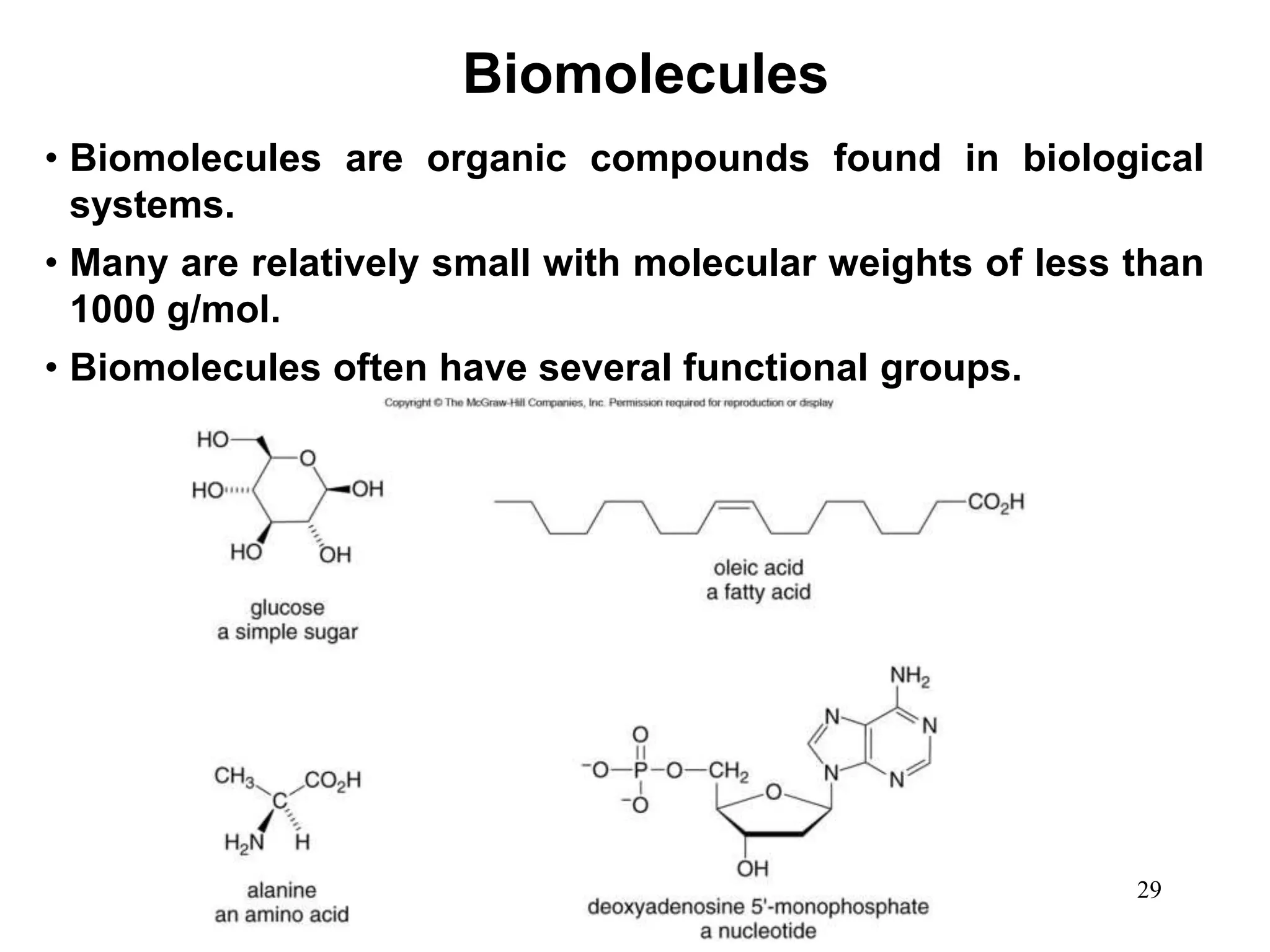
• Biomolecules are organic compounds found in biological
systems.
• Many are relatively small with molecular weights of less than
1000 g/mol.
• Biomolecules often have several functional groups.
Biomolecules
30
• There are four main families of small biomolecules:
• Simple sugars—combine to form complex carbohydrates
like starch and cellulose (Covered in Chapter 28)
• Amino acids—join together to form proteins (Chapter 29)
• Nucleotides—combine to form DNA (Chapter 28)
• Lipids—commonly form from fatty acids and alcohols
(Chapters 10, 22, and 30)
Families of Biomolecules
31
• DNA is contained in the chromosomes in the nucleus of the
cell
• Stores all the genetic information in an organism
• Consists of two long strands of polynucleotides held
together by hydrogen bonding
DNA Double Helix
Figure 3.9

[PPT SLIDE 5] Functional Groups.pptx

  • 1.
    1 Organic Chemistry, FourthEdition Janice Gorzynski Smith University of Hawai’i Chapter 3 Lecture Outline Prepared by Layne A. Morsch The University of Illinois - Springfield Copyright © 2014 The McGraw-Hill Companies, Inc. Permission required for reproduction or display.
  • 2.
    Functional Groups • Afunctional group is an atom or a group of atoms with characteristic chemical and physical properties. • Most organic molecules contain a carbon backbone consisting of C—C and C—H bonds to which functional groups are attached. • Structural features of a functional group include:
  • 3.
    Functional Groups-1 • Functionalgroups distinguish one organic molecule from another. • They determine a molecule’s: – geometry – physical properties – reactivity
  • 4.
    ©2020 McGraw-Hill Education. Reactivity ofFunctional Groups Heteroatoms and bonds confer reactivity on a particular molecule. – Heteroatoms have lone pairs and create electron-deficient sites on carbon. – A bond makes a molecule a base and a nucleophile, and is easily broken in chemical reactions.
  • 5.
  • 6.
    Ethane, a Moleculewith No Functional Group • This molecule has only C—C and C—H bonds. • It contains no polar bonds, lone pairs, or bonds. • Therefore, ethane has no reactive sites (functional groups). • Consequently, ethane and other alkanes are
  • 7.
    Ethanol • This moleculehas an OH (called a hydroxy group) attached to its backbone. • Compounds containing an OH group are called alcohols. • The hydroxy group makes the properties of ethanol very different from the properties of ethane. • Ethanol has lone pairs and polar bonds that make it reactive. • Other molecules with hydroxy groups will have similar properties to ethanol.
  • 8.
  • 9.
    ©2020 McGraw-Hill Education. Hydrocarbons Hydrocarbons arecompounds made up of only the elements carbon and hydrogen. • They may be aliphatic (ex. alkanes, alkenes, alkynes) or aromatic.
  • 10.
    Aliphatic Hydrocarbons • Aliphatichydrocarbons have three subgroups. • Alkanes have only C—C bonds and no functional group. • Alkenes have a C—C double bond. • Alkynes have a C—C triple bond.
  • 11.
    ©2020 McGraw-Hill Education. Aromatic Hydrocarbons Aromatichydrocarbons are so named because many of the earliest known aromatic compounds had strong, characteristic odors. The simplest aromatic hydrocarbon is benzene. The six-membered ring and three bonds of benzene comprise a single functional group, found in most aromatic compounds.
  • 12.
    ©2020 McGraw-Hill Education. Functional Groupswith Carbon- Heteroatom (𝐂−𝐙) 𝝈 bonds Several types of functional groups contain C—Z bonds. The electronegative heteroatom Z creates a polar bond, making carbon electron deficient.
  • 13.
    Functional Groups with𝐂−𝐙 𝝈 bonds
  • 14.
    ©2020 McGraw-Hill Education. Functional Groupswith 𝐂=𝐎 Group This group is called a “carbonyl group”. The polar C—O bond makes the carbonyl carbon an electrophile, while the lone pairs on O allow it to react as a nucleophile and base. The carbonyl group also contains a bond that is more easily broken than a C—O bond.
  • 15.
    Functional Groups with𝐂=𝐎 Group-1
  • 16.
    Importance of Functional Groups •A functional group determines all of the following properties of a molecule: – bonding and shape – type and strength of intermolecular forces – physical properties – nomenclature – chemical reactivity
  • 17.
    17 Application—Vitamins • Vitamins areorganic compounds needed in small amounts for normal cell function. • Most cannot be synthesized in our bodies, and must be obtained from the diet. • Most are identified by a letter, such as A, C, D, E, and K. • There are several different B vitamins, so a subscript is added to distinguish them. Examples are B1, B2, and B12. • Vitamins can be fat soluble or water soluble depending on their structure.
  • 18.
    18 • Vitamin Ais an essential component of the vision receptors in our eyes. • Vitamin A, or retinol, may be obtained directly from the diet. • It also can be obtained from the conversion of -carotene, the orange pigment found in many plants including carrots, into vitamin A in our bodies. • Vitamin A is water insoluble because it contains only one OH group and 20 carbon atoms. Vitamin A
  • 19.
    19 • Vitamin C,ascorbic acid, is important in the formation of collagen. • Most animals can synthesize vitamin C. • Humans must obtain this vitamin from dietary sources, such as citrus fruits. • Each carbon atom is bonded to an oxygen which makes it capable of hydrogen bonding, and thus, water soluble. Vitamin C
  • 20.
    20 •Soap molecules havetwo distinct parts: • There is a hydrophilic portion composed of ions called the polar head. • There is a hydrophobic carbon chain of nonpolar C-C and C-H bonds, called the nonpolar tail. Soap Structure Figure 3.6
  • 21.
    21 Figure 3.7 • Phospholipidscontain an ionic or polar head, and two long nonpolar hydrocarbon tails. • In an aqueous environment, phospholipids form a lipid bilayer, with the polar heads oriented toward the aqueous exterior and the nonpolar tails forming a hydrophobic interior. Structure of the Cell Membrane
  • 22.
    22 Transport Across theCell Membrane: • Ionophores are organic molecules that complex cations. • They have a hydrophobic exterior that makes them soluble in the nonpolar interior of the cell membrane, and a central cavity with several oxygens whose lone pairs complex with a given ion.
  • 23.
    23 • An ionophoretransports an ion across a cell membrane (from the side of higher concentration of the ion to a side of lower ion concentration). Figure 3.8 Transport Across The Cell Membrane
  • 24.
    24 • Several syntheticionophores have also been prepared, including one group called crown ethers. • Crown ethers are cyclic ethers containing several oxygen atoms that bind specific cations depending on the size of their cavity. Crown Ethers
  • 25.
    25 Functional Groups andElectrophiles • All functional groups contain a heteroatom, a  bond or both. • These features create electrophilic sites and nucleophilic sites in a molecule. • Electron-rich sites (nucleophiles) react with electron poor sites (electrophiles). • An electronegative heteroatom like N, O, or X makes a carbon atom electrophilic as shown below.
  • 26.
    26 • A lonepair on a heteroatom makes it basic and nucleophilic.   bonds create nucleophilic sites and are more easily broken than s bonds. Nucleophilic Sites in Molecules
  • 27.
    27 • An electron-richcarbon reacts with an electrophile, symbolized as E+. • For example, alkenes contain an electron-rich double bond, and so they react with electrophiles E+. Reaction of  Bonds with Electrophiles
  • 28.
    28 Alkyl halides possessan electrophilic carbon atom, so they react with electron-rich nucleophiles. Reaction of Nucleophiles with Electrophiles
  • 29.
    29 • Biomolecules areorganic compounds found in biological systems. • Many are relatively small with molecular weights of less than 1000 g/mol. • Biomolecules often have several functional groups. Biomolecules
  • 30.
    30 • There arefour main families of small biomolecules: • Simple sugars—combine to form complex carbohydrates like starch and cellulose (Covered in Chapter 28) • Amino acids—join together to form proteins (Chapter 29) • Nucleotides—combine to form DNA (Chapter 28) • Lipids—commonly form from fatty acids and alcohols (Chapters 10, 22, and 30) Families of Biomolecules
  • 31.
    31 • DNA iscontained in the chromosomes in the nucleus of the cell • Stores all the genetic information in an organism • Consists of two long strands of polynucleotides held together by hydrogen bonding DNA Double Helix Figure 3.9