Supply Chain Synchronization for
Effective Operation Planning


                                Group 4
                           Lek Yen Hoon
                            Koh Mei York
                             Zheng Liyue

                                    1
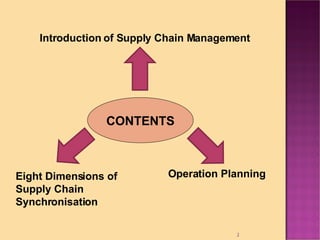
Introduction of Supply Chain Management


                CONTENTS


Eight Dimensions of        Operation Planning
Supply Chain
Synchronisation

                                        2
   Supply chain management (SCM)
    is the process of planning,
    implementing, and controlling
    the operations of the supply chain
    as efficiently as possible.

   Supply Chain Management spans
    all movement and storage of raw
    materials, work-in-process
    inventory, and finished goods
    from point-of-origin to point-of-
    consumption.


                                         3
   Supply Chain Synchronisation is
    becoming the most important way to
    develop higher levels of supply chain
    competitive advantage.

   To achieve the highest level of supply
    chain synchronization benefit, you must
    address eight different dimensions of
    the supply chain.


                                        4
5
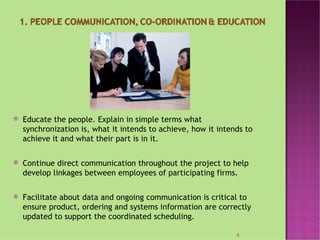
   Educate the people. Explain in simple terms what
    synchronization is, what it intends to achieve, how it intends to
    achieve it and what their part is in it.

   Continue direct communication throughout the project to help
    develop linkages between employees of participating firms.

   Facilitate about data and ongoing communication is critical to
    ensure product, ordering and systems information are correctly
    updated to support the coordinated scheduling.

                                                                6
   Develop the supply chain schedule
   Have realistic expectations
   Map the current process
   Allow for variances
   Err on the safe side
   Overlay volume and density information
   Inform the participants


       Collecting data is streamlining the process to minimize
        additional work.
       Data collection should be a by product of the supply
        chain process, not activity unto itself.

                                                        7
   Order Timing – Map and understand current supply chain
    flows and timings by developing a new, optimized supply
    chain synchronization model.
   Unitization - taking production at the locations and rates it
    is most efficient to take it, without disruption of the
    scheme by the legal rights inhering in competing
    properties


   This is partially completed by the barcode symbology
    (or RFID in advanced cases) and the purchase order.
   These two key data streams can be easily integrated
    into the supply chain synchronization processes.


                                                         8
   Collect information about each exception for
    monitoring and improvement purposes

   Exceptions should be manageable to prevent flaws in
    the information used to build the synchronized system


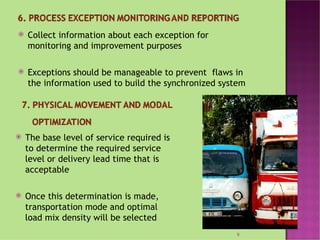
   The base level of service required is
    to determine the required service
    level or delivery lead time that is
    acceptable

   Once this determination is made,
    transportation mode and optimal
    load mix density will be selected
                                                      9
   Rules and methods for ongoing adjustment and
    optimization of the process should be defined
   Integrate the ability to switch to varying size and
    capacity of containers
   Careful monitoring of these optimization
    opportunities will make the appropriate timing for
    such initiatives readily apparent


                                                          10
   Operations Planning is a process where the executives of an
    organization gather monthly to review previous performance
    against plans and if necessary create new plans.

   The input to the process is the forecast and the output of the
    S&OP is the production plan, the demand plan, as well as the
    many other plans that are derived from these.

   The objective of Operations Planning is to arrive at a business
    "Game Plan" to help manage and allocate critical resources to
    meet the needs of the customer at the least cost to do so.

   S&OP works on pre-agreed Key Performance Indicators. It helps
    the Managers to identify the area for improvements through
    these KPI and track the plan vs. actual performance.

                                                             11
 Improved  customer service
 Reduced inventory
 Lower manufacturing & distribution costs
 Better control of overall business
  performance
 Increased team work within and across
  functions


                                      12
13
14
   Supply Chain tends to focus on purchasing and
    procurement, but not necessarily so. It can
    include materials, inventory, and production
    planning.
                                             15
16

Supply Chain Synchronisation For Effective Operations Planning (Revised)

  • 1.
    Supply Chain Synchronizationfor Effective Operation Planning Group 4 Lek Yen Hoon Koh Mei York Zheng Liyue 1
  • 2.
    Introduction of SupplyChain Management CONTENTS Eight Dimensions of Operation Planning Supply Chain Synchronisation 2
  • 3.
    Supply chain management (SCM) is the process of planning, implementing, and controlling the operations of the supply chain as efficiently as possible.  Supply Chain Management spans all movement and storage of raw materials, work-in-process inventory, and finished goods from point-of-origin to point-of- consumption. 3
  • 4.
    Supply Chain Synchronisation is becoming the most important way to develop higher levels of supply chain competitive advantage.  To achieve the highest level of supply chain synchronization benefit, you must address eight different dimensions of the supply chain. 4
  • 5.
  • 6.
    Educate the people. Explain in simple terms what synchronization is, what it intends to achieve, how it intends to achieve it and what their part is in it.  Continue direct communication throughout the project to help develop linkages between employees of participating firms.  Facilitate about data and ongoing communication is critical to ensure product, ordering and systems information are correctly updated to support the coordinated scheduling. 6
  • 7.
    Develop the supply chain schedule  Have realistic expectations  Map the current process  Allow for variances  Err on the safe side  Overlay volume and density information  Inform the participants  Collecting data is streamlining the process to minimize additional work.  Data collection should be a by product of the supply chain process, not activity unto itself. 7
  • 8.
    Order Timing – Map and understand current supply chain flows and timings by developing a new, optimized supply chain synchronization model.  Unitization - taking production at the locations and rates it is most efficient to take it, without disruption of the scheme by the legal rights inhering in competing properties  This is partially completed by the barcode symbology (or RFID in advanced cases) and the purchase order.  These two key data streams can be easily integrated into the supply chain synchronization processes. 8
  • 9.
    Collect information about each exception for monitoring and improvement purposes  Exceptions should be manageable to prevent flaws in the information used to build the synchronized system  The base level of service required is to determine the required service level or delivery lead time that is acceptable  Once this determination is made, transportation mode and optimal load mix density will be selected 9
  • 10.
    Rules and methods for ongoing adjustment and optimization of the process should be defined  Integrate the ability to switch to varying size and capacity of containers  Careful monitoring of these optimization opportunities will make the appropriate timing for such initiatives readily apparent 10
  • 11.
    Operations Planning is a process where the executives of an organization gather monthly to review previous performance against plans and if necessary create new plans.  The input to the process is the forecast and the output of the S&OP is the production plan, the demand plan, as well as the many other plans that are derived from these.  The objective of Operations Planning is to arrive at a business "Game Plan" to help manage and allocate critical resources to meet the needs of the customer at the least cost to do so.  S&OP works on pre-agreed Key Performance Indicators. It helps the Managers to identify the area for improvements through these KPI and track the plan vs. actual performance. 11
  • 12.
     Improved customer service  Reduced inventory  Lower manufacturing & distribution costs  Better control of overall business performance  Increased team work within and across functions 12
  • 13.
  • 14.
  • 15.
    Supply Chain tends to focus on purchasing and procurement, but not necessarily so. It can include materials, inventory, and production planning. 15
  • 16.