
z
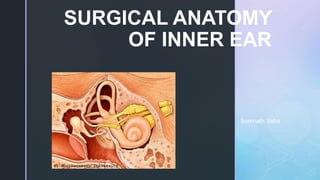
SURGICAL ANATOMY
OF INNER EAR
Somnath Saha
z
z
Components of inner ear
 Bony labyrinth
 Membranous labryinth
z
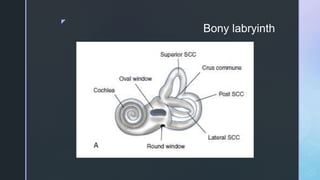
Components of bony labyrinth
 Vestibule
 Semicircular canal
 Cochlea
z
Bony labryinth
z
Components of membranous labryinth
 Cochlear duct
 Utricle and saccule
 Semicircular canals
 Endolymphatic duct and sac
z
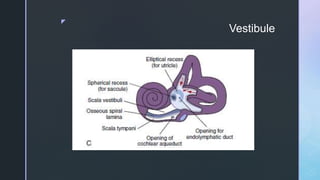
Vestibule
z
What does the vestibule have?
 Lateral Wall
 Contains oval window
 Medial Wall
 Spherical Recess
 Elliptical Recess
 Aqueduct of vestibule
 Posterosuperior part
 Openings of semicircular canals(5 in number)
z
Semicircular canals
 3 in number
 Lateral
 Posterior
 Superior
 Lie at right angles to one another
 Each canal has an ampullated end and a nonampullated end
 Nonampullated ends of posterior and superior canals form a
common channel called crus commune
z
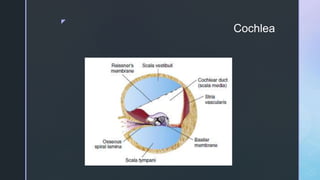
Cochlea
 Consists of an osseous spiral lamina making 2.5-2.75 turns
around a centrally placed modiolus
 Modiolus divides the bony cochlea incompletely & gives
attachment to basilar membrane
 It has three parts
 Scala Vestibuli
 Scala Tympani
 Scala Media
z
Cochlea
z
Cochlea…continued
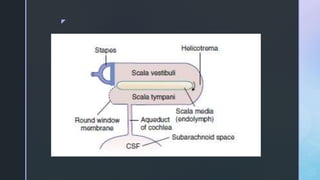
 Scala Vestibuli and scala tympani communicate via helicotrema
 Scala Vestibuli is closed by the footplate of the stapes and thus
is separated from the middle ear
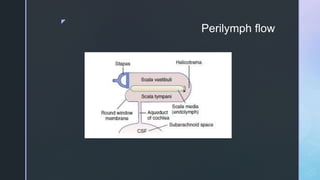
 Scala tympani is connected to subarachnoid space via duct of
cochlea(next slide)
z
z
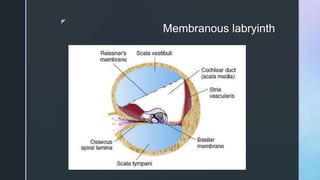
Membranous labryinth
z
Parts
 Cochlear duct
 Utricle and Saccule
 Three semicircular ducts
z
Cochlear duct
 Other names:Scala Media/Membranous cochlea
 Appears triangular on cross section
 Three walls are:
 Basilar membrane
 Reissners’ membrane
 Stria vascularis
 Length of basilar membrane increases from basal coil to apical
coil:Hence low frequencies heard at apical coil,while high at
basal
z
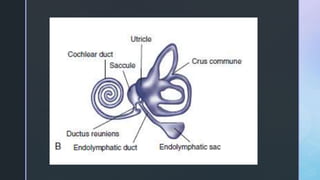
Utricle
 Lies in the posterior part of the bony vestibule
 Recieves five openings of the 3 semicircular ducts
 Connected to saccule via utriculosaccular duct
 Macula
 Sensory epithelium of utricle
 Concerned with linear acceleration and deceleration
z
Saccule
 Lies in bony vestibule
 Anterior to utricle,opposite to stapes footplate
 Its macula(sensory epithelium) is also linked to linear
acceleration and deceleration
z
z
Endolymphatic duct and sac
 Formed by union of ducts from saccule and utricle
 Terminal part dilated to form endolymphatic sac,which lies
between 2 layers of dura on posterior surface of petrous bone
z
ENDOLYMPHATIC SAC
 It is a non sensory organ of inner ear
 Main functionare regulation of pressure and vol of endolymph
,the immune response of inner ear and the eiemination of
endolymphatic waste products by phagocytosis
 Functional alteration of these programme, ieading to deficient
endolymph haemostasis and/or altered immune response may
lead to MD
z
Inner ear fluids
 Perilymph
 Endolymph
z
z
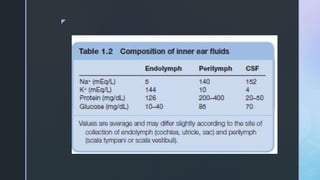
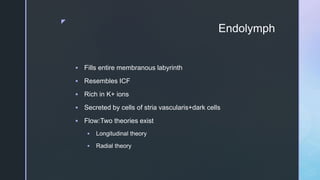
Endolymph
 Fills entire membranous labyrinth
 Resembles ICF
 Rich in K+ ions
 Secreted by cells of stria vascularis+dark cells
 Flow:Two theories exist
 Longitudinal theory
 Radial theory
z
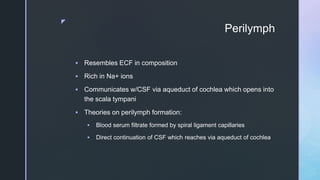
Perilymph
 Resembles ECF in composition
 Rich in Na+ ions
 Communicates w/CSF via aqueduct of cochlea which opens into
the scala tympani
 Theories on perilymph formation:
 Blood serum filtrate formed by spiral ligament capillaries
 Direct continuation of CSF which reaches via aqueduct of cochlea
z
Perilymph flow
z
Thank you

Inner ear anatomy

  • 1.
  • 2.
  • 3.
    z Components of innerear  Bony labyrinth  Membranous labryinth
  • 4.
    z Components of bonylabyrinth  Vestibule  Semicircular canal  Cochlea
  • 5.
  • 6.
    z Components of membranouslabryinth  Cochlear duct  Utricle and saccule  Semicircular canals  Endolymphatic duct and sac
  • 7.
  • 8.
    z What does thevestibule have?  Lateral Wall  Contains oval window  Medial Wall  Spherical Recess  Elliptical Recess  Aqueduct of vestibule  Posterosuperior part  Openings of semicircular canals(5 in number)
  • 9.
    z Semicircular canals  3in number  Lateral  Posterior  Superior  Lie at right angles to one another  Each canal has an ampullated end and a nonampullated end  Nonampullated ends of posterior and superior canals form a common channel called crus commune
  • 10.
    z Cochlea  Consists ofan osseous spiral lamina making 2.5-2.75 turns around a centrally placed modiolus  Modiolus divides the bony cochlea incompletely & gives attachment to basilar membrane  It has three parts  Scala Vestibuli  Scala Tympani  Scala Media
  • 11.
  • 12.
    z Cochlea…continued  Scala Vestibuliand scala tympani communicate via helicotrema  Scala Vestibuli is closed by the footplate of the stapes and thus is separated from the middle ear  Scala tympani is connected to subarachnoid space via duct of cochlea(next slide)
  • 13.
  • 14.
  • 15.
    z Parts  Cochlear duct Utricle and Saccule  Three semicircular ducts
  • 16.
    z Cochlear duct  Othernames:Scala Media/Membranous cochlea  Appears triangular on cross section  Three walls are:  Basilar membrane  Reissners’ membrane  Stria vascularis  Length of basilar membrane increases from basal coil to apical coil:Hence low frequencies heard at apical coil,while high at basal
  • 17.
    z Utricle  Lies inthe posterior part of the bony vestibule  Recieves five openings of the 3 semicircular ducts  Connected to saccule via utriculosaccular duct  Macula  Sensory epithelium of utricle  Concerned with linear acceleration and deceleration
  • 18.
    z Saccule  Lies inbony vestibule  Anterior to utricle,opposite to stapes footplate  Its macula(sensory epithelium) is also linked to linear acceleration and deceleration
  • 19.
  • 20.
    z Endolymphatic duct andsac  Formed by union of ducts from saccule and utricle  Terminal part dilated to form endolymphatic sac,which lies between 2 layers of dura on posterior surface of petrous bone
  • 21.
    z ENDOLYMPHATIC SAC  Itis a non sensory organ of inner ear  Main functionare regulation of pressure and vol of endolymph ,the immune response of inner ear and the eiemination of endolymphatic waste products by phagocytosis  Functional alteration of these programme, ieading to deficient endolymph haemostasis and/or altered immune response may lead to MD
  • 22.
    z Inner ear fluids Perilymph  Endolymph
  • 23.
  • 24.
    z Endolymph  Fills entiremembranous labyrinth  Resembles ICF  Rich in K+ ions  Secreted by cells of stria vascularis+dark cells  Flow:Two theories exist  Longitudinal theory  Radial theory
  • 25.
    z Perilymph  Resembles ECFin composition  Rich in Na+ ions  Communicates w/CSF via aqueduct of cochlea which opens into the scala tympani  Theories on perilymph formation:  Blood serum filtrate formed by spiral ligament capillaries  Direct continuation of CSF which reaches via aqueduct of cochlea
  • 26.
  • 27.