Workshop about “Alternative metrics or tailored metrics:
Science dynamics for science policy”, November 9-10, 2016
Warsaw
The new age of altmetrics: the case of
Scimago Journal & Country Rank
Theodoros Chalkidis & Panagiotis Gkioulekas, students of
the Department of Library Science and Information
Systems of Alexander Technological Educational Institute
of Thessaloniki, Greece
Acknowledgements
We would like to express our excitement and appreciation for being accepted in
this workshop of KNOWeSCAPE, funded by Cost Action. In particular, we are
deeply grateful to Dr. Andrea Scharnhorst who gave us the opportunity to
interact with this interesting field of metrics and to our Prof. Panayiota
Polydoratoy who never stops to think and care about her students...
Methodology
Literature review: we identified about 8 recent papers on the link between
citations and altmetrics, with Google scholar, the Scopus database and Web
of Science database.
Survey on Scimago Journal and Country Rank: we analyzed the citations of the
journals in subject category “Library and Information Science”, regarding the
bibliometrics and the altmetrics.
Survey on our results: we re-analyzed the results of our first survey and we
searched for the difference between bibliometrics and altmetrics, in order
to gain evidence for the discussion on the object of evaluation.
Introduction
Why citations are important within different perspectives?
● Proper credit to work and ideas of others
● Impact of a cited paper among the scholarly community
How to measure citations?
● With bibliometrics
● With altmetrics
Metrics
What metrics are:
● quantitative measurements
● statistics
● data analyzing various subject fields
● different kinds of metrics according to the field that they investigate
Types of metrics
Categories emerged over time:
● Classical metrics (librametrics, bibliometrics -citation analysis- /
scientometrics, informetrics, etc.)
● Neo-classical metrics (cybermetrics / webometrics, etc.)
● Modern metrics (wikimetrics, open source metrics, journal metrics, author
metrics, article-level metrics, altmetrics, etc.)
Altmetrics
What altmetrics are:
● complementary to traditional, citation-based metrics
● metrics using multiple forms of assessment that are derived from activity at
social media
● considered as an interesting option for measuring broader impact of
research
Altmetrics may refer to academic outputs that are:
● viewed or read in HTML or PDF formats
● saved in bibliographic reference managers or social bookmarks such as
Mendeley and CiteULike respectively
● discussed through comments in social media, science blogs and in the
website of a journal
● recommended in databases such as F1000Prime
● cited in another paper of research
Advantages of Altmetrics
● continuously up to date indicators of online impact
● multiple forms of information can be analyzed such as articles, videos,
datasets, books, slides / presentations, conference proceedings
● differentiation of impact depending on two different audiences, academic
and non-academic
● provision of results at a faster speed compared to traditional metrics
Disadvantages of Altmetrics
● statistics from social media can be manipulated by services selling likes,
tweets or blog mentions
● a highly cited output on social media does not entail its approval, negative
criticism may be applied
● creator’s popularity can affect positively the amount of citations that
receives
Scimago Journal & Country Rank
The SCImago Journal & Country Rank is a publicly available portal that includes
the journals and country scientific indicators developed from the information
contained in the Scopus database.
The Journal Rankings of Scimago
The Journal Rankings of Scimago provides numerous indicators:
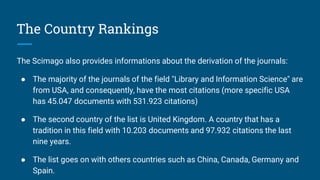
The Country Rankings
The Scimago also provides informations about the derivation of the journals:
● The majority of the journals of the field "Library and Information Science" are
from USA, and consequently, have the most citations (more specific USA
has 45.047 documents with 531.923 citations)
● The second country of the list is United Kingdom. A country that has a
tradition in this field with 10.203 documents and 97.932 citations the last
nine years.
● The list goes on with others countries such as China, Canada, Germany and
Spain.
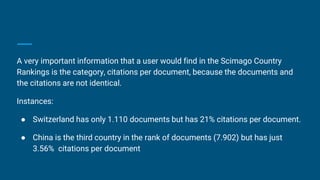
A very important information that a user would find in the Scimago Country
Rankings is the category, citations per document, because the documents and
the citations are not identical.
Instances:
● Switzerland has only 1.110 documents but has 21% citations per document.
● China is the third country in the rank of documents (7.902) but has just
3.56% citations per document
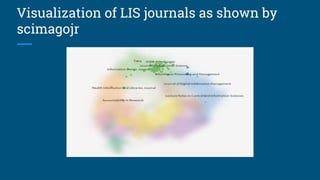
Visualization of LIS journals as shown by
scimagojr
References
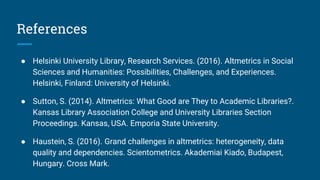
● Helsinki University Library, Research Services. (2016). Altmetrics in Social
Sciences and Humanities: Possibilities, Challenges, and Experiences.
Helsinki, Finland: University of Helsinki.
● Sutton, S. (2014). Altmetrics: What Good are They to Academic Libraries?.
Kansas Library Association College and University Libraries Section
Proceedings. Kansas, USA. Emporia State University.
● Haustein, S. (2016). Grand challenges in altmetrics: heterogeneity, data
quality and dependencies. Scientometrics. Akademiai Kiado, Budapest,
Hungary. Cross Mark.
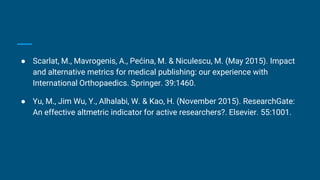
● Scarlat, M., Mavrogenis, A., Pećina, M. & Niculescu, M. (May 2015). Impact
and alternative metrics for medical publishing: our experience with
International Orthopaedics. Springer. 39:1460.
● Yu, M., Jim Wu, Y., Alhalabi, W. & Kao, H. (November 2015). ResearchGate:
An effective altmetric indicator for active researchers?. Elsevier. 55:1001.
Feel free to contact us
xalktheo@libd.teithe.gr
Thank you!

Ppt chalkidis gkioulekas.pptx

  • 1.
    Workshop about “Alternativemetrics or tailored metrics: Science dynamics for science policy”, November 9-10, 2016 Warsaw The new age of altmetrics: the case of Scimago Journal & Country Rank Theodoros Chalkidis & Panagiotis Gkioulekas, students of the Department of Library Science and Information Systems of Alexander Technological Educational Institute of Thessaloniki, Greece
  • 2.
    Acknowledgements We would liketo express our excitement and appreciation for being accepted in this workshop of KNOWeSCAPE, funded by Cost Action. In particular, we are deeply grateful to Dr. Andrea Scharnhorst who gave us the opportunity to interact with this interesting field of metrics and to our Prof. Panayiota Polydoratoy who never stops to think and care about her students...
  • 3.
    Methodology Literature review: weidentified about 8 recent papers on the link between citations and altmetrics, with Google scholar, the Scopus database and Web of Science database. Survey on Scimago Journal and Country Rank: we analyzed the citations of the journals in subject category “Library and Information Science”, regarding the bibliometrics and the altmetrics. Survey on our results: we re-analyzed the results of our first survey and we searched for the difference between bibliometrics and altmetrics, in order to gain evidence for the discussion on the object of evaluation.
  • 4.
    Introduction Why citations areimportant within different perspectives? ● Proper credit to work and ideas of others ● Impact of a cited paper among the scholarly community How to measure citations? ● With bibliometrics ● With altmetrics
  • 5.
    Metrics What metrics are: ●quantitative measurements ● statistics ● data analyzing various subject fields ● different kinds of metrics according to the field that they investigate
  • 6.
    Types of metrics Categoriesemerged over time: ● Classical metrics (librametrics, bibliometrics -citation analysis- / scientometrics, informetrics, etc.) ● Neo-classical metrics (cybermetrics / webometrics, etc.) ● Modern metrics (wikimetrics, open source metrics, journal metrics, author metrics, article-level metrics, altmetrics, etc.)
  • 7.
    Altmetrics What altmetrics are: ●complementary to traditional, citation-based metrics ● metrics using multiple forms of assessment that are derived from activity at social media ● considered as an interesting option for measuring broader impact of research
  • 8.
    Altmetrics may referto academic outputs that are: ● viewed or read in HTML or PDF formats ● saved in bibliographic reference managers or social bookmarks such as Mendeley and CiteULike respectively ● discussed through comments in social media, science blogs and in the website of a journal ● recommended in databases such as F1000Prime ● cited in another paper of research
  • 9.
    Advantages of Altmetrics ●continuously up to date indicators of online impact ● multiple forms of information can be analyzed such as articles, videos, datasets, books, slides / presentations, conference proceedings ● differentiation of impact depending on two different audiences, academic and non-academic ● provision of results at a faster speed compared to traditional metrics
  • 10.
    Disadvantages of Altmetrics ●statistics from social media can be manipulated by services selling likes, tweets or blog mentions ● a highly cited output on social media does not entail its approval, negative criticism may be applied ● creator’s popularity can affect positively the amount of citations that receives
  • 11.
    Scimago Journal &Country Rank The SCImago Journal & Country Rank is a publicly available portal that includes the journals and country scientific indicators developed from the information contained in the Scopus database.
  • 12.
    The Journal Rankingsof Scimago The Journal Rankings of Scimago provides numerous indicators:
  • 13.
    The Country Rankings TheScimago also provides informations about the derivation of the journals: ● The majority of the journals of the field "Library and Information Science" are from USA, and consequently, have the most citations (more specific USA has 45.047 documents with 531.923 citations) ● The second country of the list is United Kingdom. A country that has a tradition in this field with 10.203 documents and 97.932 citations the last nine years. ● The list goes on with others countries such as China, Canada, Germany and Spain.
  • 14.
    A very importantinformation that a user would find in the Scimago Country Rankings is the category, citations per document, because the documents and the citations are not identical. Instances: ● Switzerland has only 1.110 documents but has 21% citations per document. ● China is the third country in the rank of documents (7.902) but has just 3.56% citations per document
  • 15.
    Visualization of LISjournals as shown by scimagojr
  • 16.
    References ● Helsinki UniversityLibrary, Research Services. (2016). Altmetrics in Social Sciences and Humanities: Possibilities, Challenges, and Experiences. Helsinki, Finland: University of Helsinki. ● Sutton, S. (2014). Altmetrics: What Good are They to Academic Libraries?. Kansas Library Association College and University Libraries Section Proceedings. Kansas, USA. Emporia State University. ● Haustein, S. (2016). Grand challenges in altmetrics: heterogeneity, data quality and dependencies. Scientometrics. Akademiai Kiado, Budapest, Hungary. Cross Mark.
  • 17.
    ● Scarlat, M.,Mavrogenis, A., Pećina, M. & Niculescu, M. (May 2015). Impact and alternative metrics for medical publishing: our experience with International Orthopaedics. Springer. 39:1460. ● Yu, M., Jim Wu, Y., Alhalabi, W. & Kao, H. (November 2015). ResearchGate: An effective altmetric indicator for active researchers?. Elsevier. 55:1001.
  • 18.
    Feel free tocontact us xalktheo@libd.teithe.gr
  • 19.