Electronic Commerce
        Eighth Edition


              Chapter 3
Selling on the Web: Revenue Models
    and Building a Web Presence
Learning Objectives
In this chapter, you will learn about:
• Revenue models
• How some companies move from one revenue
   model to another to achieve success
• Revenue strategy issues that companies face when
   selling on the Web
• Creating an effective business presence on the Web
• Web site usability
• Communicating effectively with customers on the
   Web
Electronic Commerce, Eighth Edition                2
Revenue Models
• Web business revenue generating models
      –   Web catalog
      –   Digital content
      –   Advertising-supported
      –   Advertising-subscription mixed
      –   Fee-based
• Can work for both sale types
      – Business-to-consumer (B2C)
      – Business-to-business (B2B)
• Can work with one Web site, separate sites, or
  separate pages
Electronic Commerce, Eighth Edition                3
Web Catalog Revenue Models
• Adapted from traditional catalog-based model
      – Seller established brand image
      – Sold through printed information
           • Mailed to prospective buyers
• Web sites expand traditional model
      – Replace or supplement print catalogs
      – Offer flexibility
           • Order through Web site or telephone
           • Payment though Web site, telephone, or mail
• Creates additional sales outlet

Electronic Commerce, Eighth Edition                        4
Web Catalog Revenue Models (cont’d.)
• Computers and consumer electronics
      – Apple, Dell, Gateway, Hewlett-Packard, IBM, Sun
        Microsystems
           • Sell full range of products
      – Dell
           • Allows product configuration; creates value
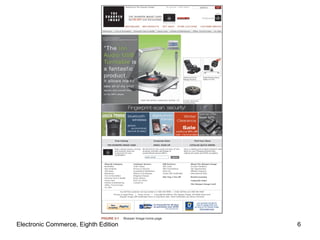
      – Crutchfield and The Sharper Image
           • Successful mail order expansion includes Web sites
      – Best Buy, Circuit City, J&R Music World, Radio Shack
           • Successful retail store presence expansion
           • Sell same products
Electronic Commerce, Eighth Edition                               5
Electronic Commerce, Eighth Edition   6
Web Catalog Revenue Models (cont’d.)
• Books, music, and videos
      – Most visible electronic commerce examples
      – Amazon.com Web-only retailer
           • Originally sold only books
      – Barnes & Noble, Blackwell’s, Books-A-Million,
        Powell’s Books
           • Well-established physical book stores
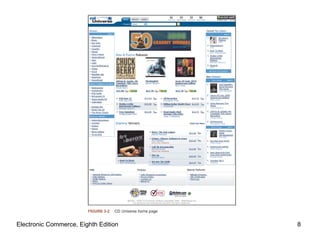
      – CDnow Web-only online music store
      – Tower Records, Sam Goody retail stores
           • Created Web sites to compete with CDnow
      – CD Universe copied CDnow approach

Electronic Commerce, Eighth Edition                     7
Electronic Commerce, Eighth Edition   8
Web Catalog Revenue Models (cont’d.)
• Luxury goods
      – Clientele reluctant to buy through Web
      – Vera Wang and Versace
           • Web sites provide information
           • Shopper purchases at physical store
           • Heavy use of graphics and animation
      – Evian
           • Uses flash animation
      – Tiffany & Co
           • Graphics and animation require broadband connection


Electronic Commerce, Eighth Edition                                9
Web Catalog Revenue Models (cont’d.)
• Clothing retailers
      – Adapt catalog sales model to Web
      – Display clothing photos
           • Prices, sizes, colors, tailoring details
      – Customers examine clothing online
           • Place orders through Web site
      – Lands’ End online Web shopping assistance
           • Lands’ End Live (1999)
      – Text chat and call-back features
      – Lands’ End personal shopper agent (more recent)
           • Learns preferences and makes suggestions
Electronic Commerce, Eighth Edition                       10
Web Catalog Revenue Models (cont’d.)
• Clothing retailers (cont’d.)
      – My Virtual Model (customers try clothes)
           • Graphic image built from customer measurements
      – Lands’ End
           • Two shoppers using different computers
           • Simultaneously browse Web site together
      – Online overstocks stores
           • Reaches more people than physical store
      – Problem with varying computer monitor color settings
           • Send fabric swatch on request
           • Offer generous return policies
Electronic Commerce, Eighth Edition                           11
Web Catalog Revenue Models (cont’d.)
• Flowers and gifts (gift retailers)
      – 1-800-Flowers
           • Online extension to successful telephone business
           • Competes with online-only florists
      – Godiva
           • Offers business gift plans
      – Hickory Farms and Mrs. Fields Cookies
           • Offer familiar name brands on Web
      – Harry and David
           • Original Web site for informational purposes
           • Promoted catalog business
           • Added online ordering feature
Electronic Commerce, Eighth Edition                              12
Web Catalog Revenue Models (cont’d.)
• General discounters (completely new businesses)
      – Buy.Com
           • Borrowed Wal-Mart and discount club sales model
      – Many sites sold advertising (originally)
           • Subsidized extremely low prices
           • Most sites now out of business
      – Rely on volume purchasing strategy (now)
           • Keeps prices low
      – Fiercely competitive (thin margins: little profits)
      – Traditional discount retailers
           • Costco, Kmart, Target, Wal-Mart
           • Slow to introduce electronic commerce Web sites
Electronic Commerce, Eighth Edition                            13
Digital Content Revenue Models
• Highly efficient distribution mechanism
      – Firms own written information or information rights
•    LexisNexis: variety of information services
•    Lexis.com: traditional research product
•    ProQuest: sells published documents’ digital copies
•    Dow Jones newspaper publisher subscriptions
      – Digitized newspaper, magazine, and journal content
• Association for Computer Machinery: digital library
• Sellers of adult digital content
      – Pioneered online credit card payment processing
Electronic Commerce, Eighth Edition                           14
Advertising-Supported Revenue
                      Models
• United States network television
      – Provides free programming and advertising messages
           • Supports network operations sufficiently
• Site visitor views problem (measuring and charging)
      – Stickiness
           • Keeping visitors at site and attracting repeat visitors
           • Exposed to more advertising in sticky site
• Obtaining large advertiser problem
      – Demographic information
           • Characteristics set used to group visitors

Electronic Commerce, Eighth Edition                                    15
Advertising-Supported Revenue
                  Models (cont’d.)
• Successful sites attract specific groups
      – About.com, HowStuffWorks, Drudge Report
• Web portals
      – Yahoo!
           • First Web directory
           • Search engine results presented on separate page
           • Search term triggered advertising
      – Main portal sites (AOL, Excite, Google, MSN)
      – Smaller general-interest sites (refdesk.com)
           • More difficulty attracting advertisers
           • C-NET (offers items to a specialized group)

Electronic Commerce, Eighth Edition                             16
Advertising-Supported Revenue
                  Models (cont’d.)
• Newspaper publishers
      – Publish print content on Web
      – Internet Public Library Online Newspapers page
           • Links to worldwide newspaper sites
      – Newspaper’s Web presence
           • Provides greater exposure and advertising audience
           • Print edition sales loss (difficult to measure)
           • Operating costs not covered by advertising revenue


Electronic Commerce, Eighth Edition                               17
Advertising-Supported Revenue
                  Models (cont’d.)
• Targeted classified advertising sites
      – More successful at generating adverting revenue
      – Web site profit potential
           • Specialize in classified advertising
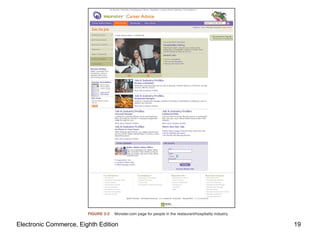
      – Web employment advertising (CareerBuilder.com)
           • Web directory and search engine advertising approach
           • Topics of interest; short articles (increases stickiness)
           • Monster.com


Electronic Commerce, Eighth Edition                                  18
Electronic Commerce, Eighth Edition   19
Advertising-Supported Revenue
                  Models (cont’d.)
• Targeted classified advertising sites (cont’d.)
      – Used vehicle sites
           • AutoTrader.com, CycleTrader.com, BoatTrader.com
           • Accepts paid advertising and charge listing fee
           • Seller ad options: Web site only, print version inclusion
      – Dedicated following product sites (VetteFinders)
           • Caters to small audiences
      – Product sites useful to buyer after use
           • Musicians Buy-Line, ComicLink.com, The Golf
             Classifieds


Electronic Commerce, Eighth Edition                                  20
Advertising-Subscription Mixed
                  Revenue Models
• Subscribers
      – Pay fee and accept advertising
      – Typically less advertising
           • Compared to advertising-supported sites
• Web sites offer different degrees of success
      – The New York Times (today)
           • Bulk of revenue derived from advertising
      – The Wall Street Journal (mixed model)
           • Subscription revenue weighted more heavily
      – Print edition and online editions
           • Different model versions

Electronic Commerce, Eighth Edition                       21
Advertising-Subscription Mixed
             Revenue Models (cont’d.)
• The Washington Post , Los Angeles Times
      – Mixed revenue model variation
           • No subscription fee charges
           • Current stories free
           • Pay for archived articles
• Business Week
      – Mixed revenue model variation
           • Free content at online site
           • Requires paid subscription to print magazine
           • Archived article additional charge (over five years old)


Electronic Commerce, Eighth Edition                                     22
Advertising-Subscription Mixed
             Revenue Models (cont’d.)
• ESPN
      – Leverages brand name from cable television business
      – Sells advertising, offers free information
      – Collects Insider subscriber revenue
• Consumers Union (ConsumerReports.org)
      – Subscriptions and charitable donations
      – Not-for-profit organization
           • No advertising
      – Free information
           • Attracts subscribers and fulfills mission

Electronic Commerce, Eighth Edition                      23
Fee-for-Transaction Revenue Models
• Service fee based on transaction number or size
• Web site offers visitor personal service
      – Formerly, human agents provided service
• Value chain
      – Disintermediation
           • Intermediary (human agent) removed
      – Reintermediation
           • New intermediary (fee-for-transaction Web site)
             introduced


Electronic Commerce, Eighth Edition                            24
Fee-for-Transaction Revenue Models
                 (cont’d.)
• Travel agents
      – Receive fee for initiating transaction
      – Replaced by computers
• Online travel agents
      – Saber system (Travelocity)
      – Expedia, Hotels.com, Hotel Discount Reservations
           • All profitable
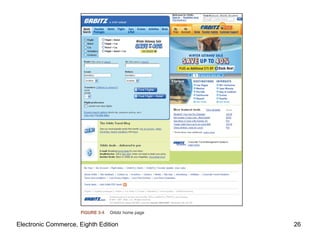
      – Orbitz
           • Five major U.S. airlines consortium
           • Generates advertising revenue

Electronic Commerce, Eighth Edition                        25
Electronic Commerce, Eighth Edition   26
Fee-for-Transaction Revenue Models
                 (cont’d.)
• Travel agents (cont’d.)
      – Traditional travel agents being squeezed out
           • Reduced or eliminated fees
      – Smaller travel agents specializing (cruises, hotels)
      – Reintermediation strategy
           • Travel agents focus on groups
      – Cruise Web sites
           • VacationsToGo.com, Cruise Specialists
      – Group travel Web sites
           • WaveHunters.com, WannaSurf

Electronic Commerce, Eighth Edition                            27
Fee-for-Transaction Revenue Models
                 (cont’d.)
• Automobile sales
      – Web site removes salesperson negotiation
           • Reduces costs
           • Provides buyers information service
      – CarsDirect.com model
           • Customers select specific car, site determines price
             and finds local dealer
      – Autoweb.com and Autobytel model
           • Site locates local dealers, car sells at small premium
             over dealer’s nominal cost
      – Car salesperson disintermediated
      – Web site: new intermediary (reintermediation)
Electronic Commerce, Eighth Edition                                   28
Fee-for-Transaction Revenue Models
                 (cont’d.)
• Stockbrokers
      – Charge customers trade execution commission
      – Web-based brokerage firms (E*TRADE and Datek)
           • Offer investment advice, fast trade execution
           • Creates competition
      – Discount brokers and full-line brokers
           • Web sites opened for stock trading and information
           • Transaction cost reductions (like online auto buying)
           • Stockbrokers disintermediated


Electronic Commerce, Eighth Edition                                  29
Fee-for-Transaction Revenue Models
                 (cont’d.)
• Insurance brokers
      – Quotesmith
           • Internet policy price quotes direct to public (1996)
           • Independent insurance agents disintermediated
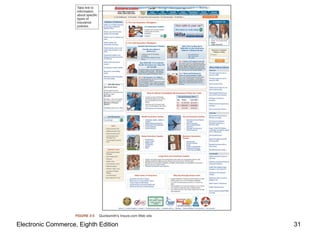
      – Insurance policy information, comparisons, sales sites
           • InsWeb, Answer Financial, Insurance.com,
             YouDecide.com
      – Progressive Web site
           • Provides quotes for competitors’ products too
      – Major insurance company Web sites
           • Offer information or policies for sale
Electronic Commerce, Eighth Edition                                 30
Electronic Commerce, Eighth Edition   31
Fee-for-Transaction Revenue Models
                 (cont’d.)
• Event tickets
      – Event promoters use Web
           • Ticketmaster, Tickets.com, TicketWeb
           • Sell original tickets
           • Customers reside anywhere worldwide
      – Secondary market tickets
           •   StubHub, TicketsNow
           •   Operate as brokers
           •   Connect ticket owners with buyers
           •   Reduce transaction costs


Electronic Commerce, Eighth Edition                 32
Fee-for-Transaction Revenue Models
                 (cont’d.)
• Real estate and mortgage loan brokers
      – Web sites provide all traditional broker services
           • Coldwell Banker, Prudential
      – National Association of Realtors Web site
           • Realtor.com
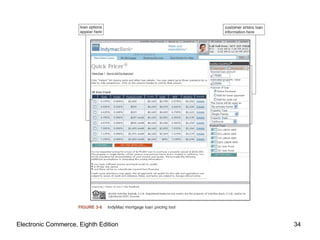
      – IndyMac Bank Home Lending
           • Offers online credit review, decision in minutes, printing
             approval letter
      – Successful Web mortgage brokers
           • Ditech and E-LOAN


Electronic Commerce, Eighth Edition                                  33
Electronic Commerce, Eighth Edition   34
Fee-for-Transaction Revenue Models
                 (cont’d.)
• Online banking and financial services
      – No physical product
           • Easy to offer on Web
      – Web financial transactions concerns
           • Trust and reliability of financial institution
      – Solutions
           • Use existing bank’s identification and reputation
             (Citibank Online)
           • Start online bank not affiliated with existing bank (First
             Internet Bank of Indiana)
           • Use different name (Bank One used Wingspan)

Electronic Commerce, Eighth Edition                                       35
Fee-for-Transaction Revenue Models
                 (cont’d.)
• Online music
      – Amazon MP3, Apple’s iTunes, eMusic, Microsoft’s
        MSN Music, Napster, Rhapsody, Yahoo!,
        Walmart.com Music Downloads
      – Sell single songs (tracks) and albums
      – Sales revenue source
           • Fee-for-transaction model
           • Some sites offer subscription plans


Electronic Commerce, Eighth Edition                       36
Fee-for-Transaction Revenue Models
                 (cont’d.)
• Online music (cont’d.)
      – Problems
           •   Digital products easily copied
           •   Stores promote own music file format
           •   Buyers required to download and install software
           •   Software limits number of audio file copies
           •   Software does not prevent illegal copying
      – Solution
           • Adopting one standard file format
           • No copying restrictions
           • DRM-free MP3 format (Amazon)
Electronic Commerce, Eighth Edition                               37
Online Video
• Copying control
      – Use DRM software
• Three issues hampering sales
      – Large file size
           • Reduced by higher Internet connection speeds
      – Fear of online sales impairing other sales types
           • Potential serial release pattern impact
      – Inability to play on variety of devices
           • DRM not platform compatible


Electronic Commerce, Eighth Edition                         38
Fee-for-Service Revenue Models
• Companies offer Web service
      – Fee based on service value
           • Not broker service
           • Not based on transactions-processed number or size
• Online games
      – Sales revenue source
           • Advertising (older concept)
           • Pay-to-play premium games
           • Subscriptions
      – Frequent player demographics
           • 40% over age 35

Electronic Commerce, Eighth Edition                               39
Fee-for-Service Revenue Models
                    (cont’d.)
• Professional services
      – Limited Web use
           • State laws prohibit extension of practice
           • Patients may set appointments
      – Major concern
           • Patient privacy
      – Significant barrier
           • Patient diagnosis difficult without physical examination


Electronic Commerce, Eighth Edition                                 40
Revenue Models in Transition
• Need to change revenue model
      – When Web users’ needs change
• Conditions after 2000
      – Funding became scarce
           • Unprofitable growth phase
      – Change model or go out of business


Electronic Commerce, Eighth Edition          41
Subscription to Advertising-Supported
                   Model
• Slate magazine (e-zine)
      – Upscale news and current events
• Success expectations were high
      – Experienced writers and editors
      – Acclaim for incisive reporting and excellent writing
• Initial revenue source
      – Annual subscription
           • Did not cover operating costs
• Now an advertising-supported site
      – Part of MSN portal
           • Increases stickiness

Electronic Commerce, Eighth Edition                            42
Advertising-Supported to Advertising-
        Subscription Mixed Model
• Salon.com
      – Acclaim for innovative content
• Initial revenue source
      – Advertising-supported site
      – Needed additional money to continue operations
           • Investors did not provide
• Now offers optional subscription version
      – Annual fee for Salon premium
           • Free of advertising
           • Downloadable content
           • Additional content

Electronic Commerce, Eighth Edition                      43
Advertising-Supported to Fee-for-
                 Services Model
• Xdrive Technologies
      – Free disk storage
• Initial revenue source (1999)
      – Advertising-supported
           • Pages contained advertising
           • Targeted e-mail advertising
           • Did not cover operating costs
• Now subscription-supported service
      – Monthly fee dropping
• Other similar companies (IBackup and Kela)

Electronic Commerce, Eighth Edition            44
Advertising-Supported to Subscription
                  Model
• Northern Light
      – Search engine (includes own database)
           • Results include Web site links and abstracts
• Initial revenue source
      – Combination (advertising-supported and fee-based)
           • Individual article payment
           • Search results page advertising
      – Did not cover operating costs
• Now subscription model
      – Annual, large clients

Electronic Commerce, Eighth Edition                         45
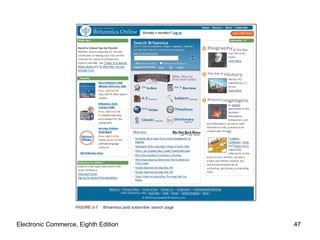
Multiple Transitions
• Encyclopedia Britannica
      – Initial Web offerings
           • Britannica Internet Guide
           • Encyclopedia Britannica Online
• Initial revenue source
      – Paid subscription site
           • Low subscription sales
      – Converted to free advertiser-supported site
           • Sold educational and scientific products
• Returned to mixed model
      – Subscription plan and free content

Electronic Commerce, Eighth Edition                     46
Electronic Commerce, Eighth Edition   47
Revenue Strategy Issues
• Implementations issues
      – Channel conflict and cannibalization
      – Strategic alliances and channel distribution
        management
      – Mobile commerce


Electronic Commerce, Eighth Edition                    48
Channel Conflict and Cannibalization
• Channel conflict (cannibalization)
      – Company Web site sales activities interfere with
        existing sales outlets
• Retail distribution partner issues
      – Levis: stopped selling products on company Web site
           • Site now provides product information
      – Maytag: incorporated online partners into Web site
           • Site now provides product information
      – Eddie Bauer
           • Online purchases returnable at retail stores
           • Required compensation and bonus plans adjustments
             to support Web site
Electronic Commerce, Eighth Edition                              49
Strategic Alliances and Channel
             Distribution Management
• Strategic alliance
      – Two or more companies join forces
           • Undertake activity over long time period
      – Joining Web sites with channel distribution
        management firms
• Yodlee
      – Relationship with portal site clients
• Amazon.com
      – Joined with Target, Borders, CDnow, ToyRUs
• Handleman Company
      – Manages music inventories (Walmart, KMart)
Electronic Commerce, Eighth Edition                     50
Mobile Commerce
• Few companies successful generating significant
  revenues
      – NTT’s DoCoMo I-Mode service (Japan cell phone)
           • Send short messages, play games, obtain weather
             forecasts
      – AvantGo (United States)
           • Offers channels of information as PDA downloads
• Mobile commerce: $400 billion by 2012
      – Requires larger memory, easier-to-use interfaces,
        higher screen resolutions
           • E-mail, telephone, Web access, entertainment services
             convergence
Electronic Commerce, Eighth Edition                              51
Creating an Effective Web Presence
• Organization’s presence
      – Public image conveyed to stakeholders
      – Usually not important
           • Until growth reaches significant size
      – Stakeholders
           • Customers, suppliers, employees, stockholders,
             neighbors, general public
• Effective Web presence
      – Critical
           • Even for smallest and newest Web operating firms

Electronic Commerce, Eighth Edition                             52
Identifying Web Presence Goals
• Business physical space
      – Focus on very specific objectives
           • Not image driven
           • Must satisfy many business needs
           • Fails to convey good presence
• Web business site intentionally creates distinctive
  presence
• Good Web site design
      – Provides effective image-creation features
      – Provides effective image-enhancing features
           • Serves as sales brochure, product showroom, financial
             report, employment ad, customer contact point
Electronic Commerce, Eighth Edition                              53
Identifying Web Presence Goals
                       (cont’d.)
• Making Web presence consistent with brand image
      – Different firms establish different Web presence goals
      – Coca Cola pages
           • Usually include trusted corporate image (Coke bottle)
           • Traditional position as a trusted classic
      – Pepsi pages
           • Usually filled with hyperlinks to activities and product-
             related promotions
           • Upstart product favored by younger generation


Electronic Commerce, Eighth Edition                                      54
Achieving Web Presence Goals
• Effective site creates attractive presence
      – Meets business or organization objectives
• Objectives
      – Attract visitors to the Web site
      – Make site interesting
      – Convince visitors to follow site’s links
      – Create impression consistent with organization’s
        desired image
      – Build trusting relationship with visitors
      – Reinforce positive image
      – Encourage visitors to return
Electronic Commerce, Eighth Edition                        55
Achieving Web Presence Goals
                     (cont’d.)
• Profit-driven organizations
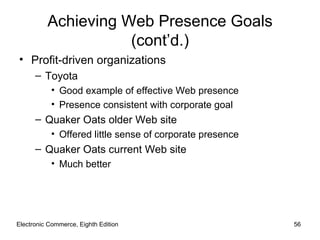
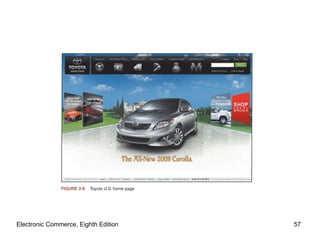
      – Toyota
           • Good example of effective Web presence
           • Presence consistent with corporate goal
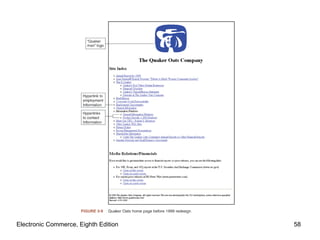
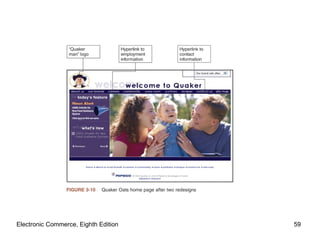
      – Quaker Oats older Web site
           • Offered little sense of corporate presence
      – Quaker Oats current Web site
           • Much better


Electronic Commerce, Eighth Edition                       56
Electronic Commerce, Eighth Edition   57
Electronic Commerce, Eighth Edition   58
Electronic Commerce, Eighth Edition   59
Achieving Web Presence Goals
                     (cont’d.)
• Not-for-profit organizations
      – Web presence effort goals
           • Image-enhancement capability
           • Provide information dissemination
      – Successful site key elements
           • Integrate information dissemination with fund-raising
           • Provide two-way contact channel
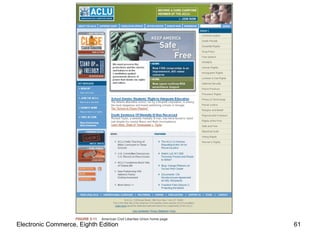
      – American Civil Liberties Union (ACLU)
           • Serves many different constituencies
      – Political party Web sites

Electronic Commerce, Eighth Edition                                  60
Electronic Commerce, Eighth Edition   61
Web Site Usability
• Current Web presences
      – Few businesses accomplish all goals
      – Most fail to provide visitors sufficient interactive
        contact opportunities
      – Improve Web presence
           •   Make site accessible to more people
           •   Make site easier to use
           •   Make site encourage visitors’ trust
           •   Develop feelings of loyalty toward organization


Electronic Commerce, Eighth Edition                              62
How the Web Is Different
• Simple mid-1990s Web sites
      – Conveyed basic businesses information
      – No market research conducted
• Web objectives achievement failure
      – Not understanding Web presence-building media
• Web objective achievement success
      – Sites create organization’s presence
      – Sites contain standard information set
           • History, objectives, mission, product information,
             financial information, two-way meaningful
             communication
Electronic Commerce, Eighth Edition                               63
Meeting the Needs of Web Site Visitors
• Successful Web businesses:
      – Realize every visitor is a potential customer (partner)
• Crafting Web presence is an important concern
      – Know visitor characteristic variations
• Visitor at site for a reason


Electronic Commerce, Eighth Edition                           64
Meeting the Needs of Web Site Visitors
               (cont’d.)
• Web site visitor motivations
      –   Learning about company products or services
      –   Buying products or services
      –   Obtaining warranty, service, repair policy information
      –   Obtaining general company information
      –   Obtaining financial information
      –   Identifying people
      –   Obtaining contact information
• Visitors have:
      – Various needs, experience, expectations, technology

Electronic Commerce, Eighth Edition                                65
Meeting the Needs of Web Site Visitors
               (cont’d.)
• Making Web sites accessible
      – Build interface flexibility
           •   Optional to use frames
           •   Offer text-only version
           •   Option to select smaller graphic images
           •   Option to specify streaming media connection type
           •   Option to choose among information attributes
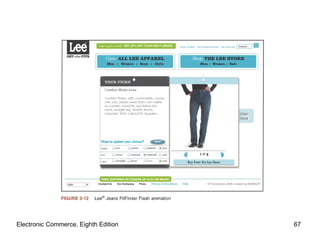
      – Controversial Web site design
           • Animated graphics software use
           • Some tasks lend themselves to animated Web pages


Electronic Commerce, Eighth Edition                                66
Electronic Commerce, Eighth Edition   67
Meeting the Needs of Web Site Visitors
               (cont’d.)
• Making Web sites accessible (cont’d.)
      – Offer multiple information formats
      – Web site constructions goals
           •   Offer easily accessible organization facts
           •   Allow different visitor experiences
           •   Provide meaningful, two-way communication link
           •   Sustain visitor attention and encourage return visits
           •   Offer easily accessible information about products,
               services, and their use


Electronic Commerce, Eighth Edition                                    68
Trust and Loyalty
• Creates relationship value
• Good service leads to seller trust
      – Delivery, order handling, help selecting product, after-
        sale support
• Satisfactory service builds customer loyalty
• Customer service in electronic commerce sites
      – Problem
           • Lack integration between call centers and Web sites
           • Poor e-mail responsiveness
      – Unlikely to recover money spent to attract customers

Electronic Commerce, Eighth Edition                                69
Rating Electronic Commerce Web Sites
• Review electronic commerce Web sites
      – Usability, customer service, other factors
      – Gomez.com
           • No longer publishes most scorecards
      – BizRate.com
           • Comparison shopping service
           • Links to low price and good service ratings sites


Electronic Commerce, Eighth Edition                              70
Rating Electronic Commerce Web Site
                 (cont’d.)
• Usability testing
      – Helps meet Web site goals
      – Avoids Web site frustration
           • Customers leave site without buying anything
      – Simple site usability changes
           • Include telephone contact information
           • Staff a call center
      – Learn about visitor needs by conducting focus groups
      – Usability testing cost
           • Low compared to Web site design costs

Electronic Commerce, Eighth Edition                         71
Rating Electronic Commerce Web Site
                 (cont’d.)
• Customer-centric Web site design
      – Important part of successful electronic business
        operation
      – Focus on meeting all site visitors’ needs
      – Putting customer at center of all site designs
           • Follow guidelines and recommendations
           • Make visitors’ Web experiences more efficient,
             effective, memorable
      – Usability
           • Important element of creating effective Web presence


Electronic Commerce, Eighth Edition                                 72
Connecting with Customers
• Important element of a corporate Web presence
• Identify and reach out to customers


Electronic Commerce, Eighth Edition               73
Connecting with Customers (cont’d.)
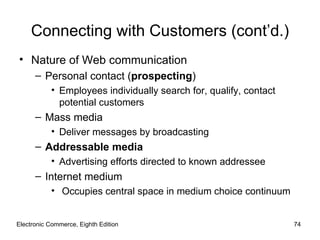
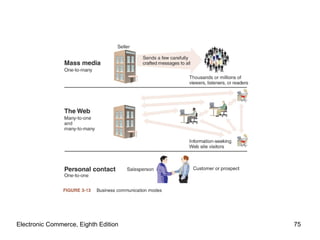
• Nature of Web communication
      – Personal contact (prospecting)
           • Employees individually search for, qualify, contact
             potential customers
      – Mass media
           • Deliver messages by broadcasting
      – Addressable media
           • Advertising efforts directed to known addressee
      – Internet medium
           • Occupies central space in medium choice continuum


Electronic Commerce, Eighth Edition                                74
Electronic Commerce, Eighth Edition   75
Summary
• Six main approaches to generate Web revenue
      – Models work differently
      – Different business types use different models
      – Learn more about customers, business environment
           • Change models
• Channel conflict and cannibalization challenges
      – Form strategic alliances with other companies
      – Contract with channel distribution managers
• B2C mobile commerce not widely successful
• Create effective Web presence to deliver value
• Must understand Web communication
Electronic Commerce, Eighth Edition                        76
PPT ch03

  • 1.
    Electronic Commerce Eighth Edition Chapter 3 Selling on the Web: Revenue Models and Building a Web Presence
  • 2.
    Learning Objectives In thischapter, you will learn about: • Revenue models • How some companies move from one revenue model to another to achieve success • Revenue strategy issues that companies face when selling on the Web • Creating an effective business presence on the Web • Web site usability • Communicating effectively with customers on the Web Electronic Commerce, Eighth Edition 2
  • 3.
    Revenue Models • Webbusiness revenue generating models – Web catalog – Digital content – Advertising-supported – Advertising-subscription mixed – Fee-based • Can work for both sale types – Business-to-consumer (B2C) – Business-to-business (B2B) • Can work with one Web site, separate sites, or separate pages Electronic Commerce, Eighth Edition 3
  • 4.
    Web Catalog RevenueModels • Adapted from traditional catalog-based model – Seller established brand image – Sold through printed information • Mailed to prospective buyers • Web sites expand traditional model – Replace or supplement print catalogs – Offer flexibility • Order through Web site or telephone • Payment though Web site, telephone, or mail • Creates additional sales outlet Electronic Commerce, Eighth Edition 4
  • 5.
    Web Catalog RevenueModels (cont’d.) • Computers and consumer electronics – Apple, Dell, Gateway, Hewlett-Packard, IBM, Sun Microsystems • Sell full range of products – Dell • Allows product configuration; creates value – Crutchfield and The Sharper Image • Successful mail order expansion includes Web sites – Best Buy, Circuit City, J&R Music World, Radio Shack • Successful retail store presence expansion • Sell same products Electronic Commerce, Eighth Edition 5
  • 6.
  • 7.
    Web Catalog RevenueModels (cont’d.) • Books, music, and videos – Most visible electronic commerce examples – Amazon.com Web-only retailer • Originally sold only books – Barnes & Noble, Blackwell’s, Books-A-Million, Powell’s Books • Well-established physical book stores – CDnow Web-only online music store – Tower Records, Sam Goody retail stores • Created Web sites to compete with CDnow – CD Universe copied CDnow approach Electronic Commerce, Eighth Edition 7
  • 8.
  • 9.
    Web Catalog RevenueModels (cont’d.) • Luxury goods – Clientele reluctant to buy through Web – Vera Wang and Versace • Web sites provide information • Shopper purchases at physical store • Heavy use of graphics and animation – Evian • Uses flash animation – Tiffany & Co • Graphics and animation require broadband connection Electronic Commerce, Eighth Edition 9
  • 10.
    Web Catalog RevenueModels (cont’d.) • Clothing retailers – Adapt catalog sales model to Web – Display clothing photos • Prices, sizes, colors, tailoring details – Customers examine clothing online • Place orders through Web site – Lands’ End online Web shopping assistance • Lands’ End Live (1999) – Text chat and call-back features – Lands’ End personal shopper agent (more recent) • Learns preferences and makes suggestions Electronic Commerce, Eighth Edition 10
  • 11.
    Web Catalog RevenueModels (cont’d.) • Clothing retailers (cont’d.) – My Virtual Model (customers try clothes) • Graphic image built from customer measurements – Lands’ End • Two shoppers using different computers • Simultaneously browse Web site together – Online overstocks stores • Reaches more people than physical store – Problem with varying computer monitor color settings • Send fabric swatch on request • Offer generous return policies Electronic Commerce, Eighth Edition 11
  • 12.
    Web Catalog RevenueModels (cont’d.) • Flowers and gifts (gift retailers) – 1-800-Flowers • Online extension to successful telephone business • Competes with online-only florists – Godiva • Offers business gift plans – Hickory Farms and Mrs. Fields Cookies • Offer familiar name brands on Web – Harry and David • Original Web site for informational purposes • Promoted catalog business • Added online ordering feature Electronic Commerce, Eighth Edition 12
  • 13.
    Web Catalog RevenueModels (cont’d.) • General discounters (completely new businesses) – Buy.Com • Borrowed Wal-Mart and discount club sales model – Many sites sold advertising (originally) • Subsidized extremely low prices • Most sites now out of business – Rely on volume purchasing strategy (now) • Keeps prices low – Fiercely competitive (thin margins: little profits) – Traditional discount retailers • Costco, Kmart, Target, Wal-Mart • Slow to introduce electronic commerce Web sites Electronic Commerce, Eighth Edition 13
  • 14.
    Digital Content RevenueModels • Highly efficient distribution mechanism – Firms own written information or information rights • LexisNexis: variety of information services • Lexis.com: traditional research product • ProQuest: sells published documents’ digital copies • Dow Jones newspaper publisher subscriptions – Digitized newspaper, magazine, and journal content • Association for Computer Machinery: digital library • Sellers of adult digital content – Pioneered online credit card payment processing Electronic Commerce, Eighth Edition 14
  • 15.
    Advertising-Supported Revenue Models • United States network television – Provides free programming and advertising messages • Supports network operations sufficiently • Site visitor views problem (measuring and charging) – Stickiness • Keeping visitors at site and attracting repeat visitors • Exposed to more advertising in sticky site • Obtaining large advertiser problem – Demographic information • Characteristics set used to group visitors Electronic Commerce, Eighth Edition 15
  • 16.
    Advertising-Supported Revenue Models (cont’d.) • Successful sites attract specific groups – About.com, HowStuffWorks, Drudge Report • Web portals – Yahoo! • First Web directory • Search engine results presented on separate page • Search term triggered advertising – Main portal sites (AOL, Excite, Google, MSN) – Smaller general-interest sites (refdesk.com) • More difficulty attracting advertisers • C-NET (offers items to a specialized group) Electronic Commerce, Eighth Edition 16
  • 17.
    Advertising-Supported Revenue Models (cont’d.) • Newspaper publishers – Publish print content on Web – Internet Public Library Online Newspapers page • Links to worldwide newspaper sites – Newspaper’s Web presence • Provides greater exposure and advertising audience • Print edition sales loss (difficult to measure) • Operating costs not covered by advertising revenue Electronic Commerce, Eighth Edition 17
  • 18.
    Advertising-Supported Revenue Models (cont’d.) • Targeted classified advertising sites – More successful at generating adverting revenue – Web site profit potential • Specialize in classified advertising – Web employment advertising (CareerBuilder.com) • Web directory and search engine advertising approach • Topics of interest; short articles (increases stickiness) • Monster.com Electronic Commerce, Eighth Edition 18
  • 19.
  • 20.
    Advertising-Supported Revenue Models (cont’d.) • Targeted classified advertising sites (cont’d.) – Used vehicle sites • AutoTrader.com, CycleTrader.com, BoatTrader.com • Accepts paid advertising and charge listing fee • Seller ad options: Web site only, print version inclusion – Dedicated following product sites (VetteFinders) • Caters to small audiences – Product sites useful to buyer after use • Musicians Buy-Line, ComicLink.com, The Golf Classifieds Electronic Commerce, Eighth Edition 20
  • 21.
    Advertising-Subscription Mixed Revenue Models • Subscribers – Pay fee and accept advertising – Typically less advertising • Compared to advertising-supported sites • Web sites offer different degrees of success – The New York Times (today) • Bulk of revenue derived from advertising – The Wall Street Journal (mixed model) • Subscription revenue weighted more heavily – Print edition and online editions • Different model versions Electronic Commerce, Eighth Edition 21
  • 22.
    Advertising-Subscription Mixed Revenue Models (cont’d.) • The Washington Post , Los Angeles Times – Mixed revenue model variation • No subscription fee charges • Current stories free • Pay for archived articles • Business Week – Mixed revenue model variation • Free content at online site • Requires paid subscription to print magazine • Archived article additional charge (over five years old) Electronic Commerce, Eighth Edition 22
  • 23.
    Advertising-Subscription Mixed Revenue Models (cont’d.) • ESPN – Leverages brand name from cable television business – Sells advertising, offers free information – Collects Insider subscriber revenue • Consumers Union (ConsumerReports.org) – Subscriptions and charitable donations – Not-for-profit organization • No advertising – Free information • Attracts subscribers and fulfills mission Electronic Commerce, Eighth Edition 23
  • 24.
    Fee-for-Transaction Revenue Models •Service fee based on transaction number or size • Web site offers visitor personal service – Formerly, human agents provided service • Value chain – Disintermediation • Intermediary (human agent) removed – Reintermediation • New intermediary (fee-for-transaction Web site) introduced Electronic Commerce, Eighth Edition 24
  • 25.
    Fee-for-Transaction Revenue Models (cont’d.) • Travel agents – Receive fee for initiating transaction – Replaced by computers • Online travel agents – Saber system (Travelocity) – Expedia, Hotels.com, Hotel Discount Reservations • All profitable – Orbitz • Five major U.S. airlines consortium • Generates advertising revenue Electronic Commerce, Eighth Edition 25
  • 26.
  • 27.
    Fee-for-Transaction Revenue Models (cont’d.) • Travel agents (cont’d.) – Traditional travel agents being squeezed out • Reduced or eliminated fees – Smaller travel agents specializing (cruises, hotels) – Reintermediation strategy • Travel agents focus on groups – Cruise Web sites • VacationsToGo.com, Cruise Specialists – Group travel Web sites • WaveHunters.com, WannaSurf Electronic Commerce, Eighth Edition 27
  • 28.
    Fee-for-Transaction Revenue Models (cont’d.) • Automobile sales – Web site removes salesperson negotiation • Reduces costs • Provides buyers information service – CarsDirect.com model • Customers select specific car, site determines price and finds local dealer – Autoweb.com and Autobytel model • Site locates local dealers, car sells at small premium over dealer’s nominal cost – Car salesperson disintermediated – Web site: new intermediary (reintermediation) Electronic Commerce, Eighth Edition 28
  • 29.
    Fee-for-Transaction Revenue Models (cont’d.) • Stockbrokers – Charge customers trade execution commission – Web-based brokerage firms (E*TRADE and Datek) • Offer investment advice, fast trade execution • Creates competition – Discount brokers and full-line brokers • Web sites opened for stock trading and information • Transaction cost reductions (like online auto buying) • Stockbrokers disintermediated Electronic Commerce, Eighth Edition 29
  • 30.
    Fee-for-Transaction Revenue Models (cont’d.) • Insurance brokers – Quotesmith • Internet policy price quotes direct to public (1996) • Independent insurance agents disintermediated – Insurance policy information, comparisons, sales sites • InsWeb, Answer Financial, Insurance.com, YouDecide.com – Progressive Web site • Provides quotes for competitors’ products too – Major insurance company Web sites • Offer information or policies for sale Electronic Commerce, Eighth Edition 30
  • 31.
  • 32.
    Fee-for-Transaction Revenue Models (cont’d.) • Event tickets – Event promoters use Web • Ticketmaster, Tickets.com, TicketWeb • Sell original tickets • Customers reside anywhere worldwide – Secondary market tickets • StubHub, TicketsNow • Operate as brokers • Connect ticket owners with buyers • Reduce transaction costs Electronic Commerce, Eighth Edition 32
  • 33.
    Fee-for-Transaction Revenue Models (cont’d.) • Real estate and mortgage loan brokers – Web sites provide all traditional broker services • Coldwell Banker, Prudential – National Association of Realtors Web site • Realtor.com – IndyMac Bank Home Lending • Offers online credit review, decision in minutes, printing approval letter – Successful Web mortgage brokers • Ditech and E-LOAN Electronic Commerce, Eighth Edition 33
  • 34.
  • 35.
    Fee-for-Transaction Revenue Models (cont’d.) • Online banking and financial services – No physical product • Easy to offer on Web – Web financial transactions concerns • Trust and reliability of financial institution – Solutions • Use existing bank’s identification and reputation (Citibank Online) • Start online bank not affiliated with existing bank (First Internet Bank of Indiana) • Use different name (Bank One used Wingspan) Electronic Commerce, Eighth Edition 35
  • 36.
    Fee-for-Transaction Revenue Models (cont’d.) • Online music – Amazon MP3, Apple’s iTunes, eMusic, Microsoft’s MSN Music, Napster, Rhapsody, Yahoo!, Walmart.com Music Downloads – Sell single songs (tracks) and albums – Sales revenue source • Fee-for-transaction model • Some sites offer subscription plans Electronic Commerce, Eighth Edition 36
  • 37.
    Fee-for-Transaction Revenue Models (cont’d.) • Online music (cont’d.) – Problems • Digital products easily copied • Stores promote own music file format • Buyers required to download and install software • Software limits number of audio file copies • Software does not prevent illegal copying – Solution • Adopting one standard file format • No copying restrictions • DRM-free MP3 format (Amazon) Electronic Commerce, Eighth Edition 37
  • 38.
    Online Video • Copyingcontrol – Use DRM software • Three issues hampering sales – Large file size • Reduced by higher Internet connection speeds – Fear of online sales impairing other sales types • Potential serial release pattern impact – Inability to play on variety of devices • DRM not platform compatible Electronic Commerce, Eighth Edition 38
  • 39.
    Fee-for-Service Revenue Models •Companies offer Web service – Fee based on service value • Not broker service • Not based on transactions-processed number or size • Online games – Sales revenue source • Advertising (older concept) • Pay-to-play premium games • Subscriptions – Frequent player demographics • 40% over age 35 Electronic Commerce, Eighth Edition 39
  • 40.
    Fee-for-Service Revenue Models (cont’d.) • Professional services – Limited Web use • State laws prohibit extension of practice • Patients may set appointments – Major concern • Patient privacy – Significant barrier • Patient diagnosis difficult without physical examination Electronic Commerce, Eighth Edition 40
  • 41.
    Revenue Models inTransition • Need to change revenue model – When Web users’ needs change • Conditions after 2000 – Funding became scarce • Unprofitable growth phase – Change model or go out of business Electronic Commerce, Eighth Edition 41
  • 42.
    Subscription to Advertising-Supported Model • Slate magazine (e-zine) – Upscale news and current events • Success expectations were high – Experienced writers and editors – Acclaim for incisive reporting and excellent writing • Initial revenue source – Annual subscription • Did not cover operating costs • Now an advertising-supported site – Part of MSN portal • Increases stickiness Electronic Commerce, Eighth Edition 42
  • 43.
    Advertising-Supported to Advertising- Subscription Mixed Model • Salon.com – Acclaim for innovative content • Initial revenue source – Advertising-supported site – Needed additional money to continue operations • Investors did not provide • Now offers optional subscription version – Annual fee for Salon premium • Free of advertising • Downloadable content • Additional content Electronic Commerce, Eighth Edition 43
  • 44.
    Advertising-Supported to Fee-for- Services Model • Xdrive Technologies – Free disk storage • Initial revenue source (1999) – Advertising-supported • Pages contained advertising • Targeted e-mail advertising • Did not cover operating costs • Now subscription-supported service – Monthly fee dropping • Other similar companies (IBackup and Kela) Electronic Commerce, Eighth Edition 44
  • 45.
    Advertising-Supported to Subscription Model • Northern Light – Search engine (includes own database) • Results include Web site links and abstracts • Initial revenue source – Combination (advertising-supported and fee-based) • Individual article payment • Search results page advertising – Did not cover operating costs • Now subscription model – Annual, large clients Electronic Commerce, Eighth Edition 45
  • 46.
    Multiple Transitions • EncyclopediaBritannica – Initial Web offerings • Britannica Internet Guide • Encyclopedia Britannica Online • Initial revenue source – Paid subscription site • Low subscription sales – Converted to free advertiser-supported site • Sold educational and scientific products • Returned to mixed model – Subscription plan and free content Electronic Commerce, Eighth Edition 46
  • 47.
  • 48.
    Revenue Strategy Issues •Implementations issues – Channel conflict and cannibalization – Strategic alliances and channel distribution management – Mobile commerce Electronic Commerce, Eighth Edition 48
  • 49.
    Channel Conflict andCannibalization • Channel conflict (cannibalization) – Company Web site sales activities interfere with existing sales outlets • Retail distribution partner issues – Levis: stopped selling products on company Web site • Site now provides product information – Maytag: incorporated online partners into Web site • Site now provides product information – Eddie Bauer • Online purchases returnable at retail stores • Required compensation and bonus plans adjustments to support Web site Electronic Commerce, Eighth Edition 49
  • 50.
    Strategic Alliances andChannel Distribution Management • Strategic alliance – Two or more companies join forces • Undertake activity over long time period – Joining Web sites with channel distribution management firms • Yodlee – Relationship with portal site clients • Amazon.com – Joined with Target, Borders, CDnow, ToyRUs • Handleman Company – Manages music inventories (Walmart, KMart) Electronic Commerce, Eighth Edition 50
  • 51.
    Mobile Commerce • Fewcompanies successful generating significant revenues – NTT’s DoCoMo I-Mode service (Japan cell phone) • Send short messages, play games, obtain weather forecasts – AvantGo (United States) • Offers channels of information as PDA downloads • Mobile commerce: $400 billion by 2012 – Requires larger memory, easier-to-use interfaces, higher screen resolutions • E-mail, telephone, Web access, entertainment services convergence Electronic Commerce, Eighth Edition 51
  • 52.
    Creating an EffectiveWeb Presence • Organization’s presence – Public image conveyed to stakeholders – Usually not important • Until growth reaches significant size – Stakeholders • Customers, suppliers, employees, stockholders, neighbors, general public • Effective Web presence – Critical • Even for smallest and newest Web operating firms Electronic Commerce, Eighth Edition 52
  • 53.
    Identifying Web PresenceGoals • Business physical space – Focus on very specific objectives • Not image driven • Must satisfy many business needs • Fails to convey good presence • Web business site intentionally creates distinctive presence • Good Web site design – Provides effective image-creation features – Provides effective image-enhancing features • Serves as sales brochure, product showroom, financial report, employment ad, customer contact point Electronic Commerce, Eighth Edition 53
  • 54.
    Identifying Web PresenceGoals (cont’d.) • Making Web presence consistent with brand image – Different firms establish different Web presence goals – Coca Cola pages • Usually include trusted corporate image (Coke bottle) • Traditional position as a trusted classic – Pepsi pages • Usually filled with hyperlinks to activities and product- related promotions • Upstart product favored by younger generation Electronic Commerce, Eighth Edition 54
  • 55.
    Achieving Web PresenceGoals • Effective site creates attractive presence – Meets business or organization objectives • Objectives – Attract visitors to the Web site – Make site interesting – Convince visitors to follow site’s links – Create impression consistent with organization’s desired image – Build trusting relationship with visitors – Reinforce positive image – Encourage visitors to return Electronic Commerce, Eighth Edition 55
  • 56.
    Achieving Web PresenceGoals (cont’d.) • Profit-driven organizations – Toyota • Good example of effective Web presence • Presence consistent with corporate goal – Quaker Oats older Web site • Offered little sense of corporate presence – Quaker Oats current Web site • Much better Electronic Commerce, Eighth Edition 56
  • 57.
  • 58.
  • 59.
  • 60.
    Achieving Web PresenceGoals (cont’d.) • Not-for-profit organizations – Web presence effort goals • Image-enhancement capability • Provide information dissemination – Successful site key elements • Integrate information dissemination with fund-raising • Provide two-way contact channel – American Civil Liberties Union (ACLU) • Serves many different constituencies – Political party Web sites Electronic Commerce, Eighth Edition 60
  • 61.
  • 62.
    Web Site Usability •Current Web presences – Few businesses accomplish all goals – Most fail to provide visitors sufficient interactive contact opportunities – Improve Web presence • Make site accessible to more people • Make site easier to use • Make site encourage visitors’ trust • Develop feelings of loyalty toward organization Electronic Commerce, Eighth Edition 62
  • 63.
    How the WebIs Different • Simple mid-1990s Web sites – Conveyed basic businesses information – No market research conducted • Web objectives achievement failure – Not understanding Web presence-building media • Web objective achievement success – Sites create organization’s presence – Sites contain standard information set • History, objectives, mission, product information, financial information, two-way meaningful communication Electronic Commerce, Eighth Edition 63
  • 64.
    Meeting the Needsof Web Site Visitors • Successful Web businesses: – Realize every visitor is a potential customer (partner) • Crafting Web presence is an important concern – Know visitor characteristic variations • Visitor at site for a reason Electronic Commerce, Eighth Edition 64
  • 65.
    Meeting the Needsof Web Site Visitors (cont’d.) • Web site visitor motivations – Learning about company products or services – Buying products or services – Obtaining warranty, service, repair policy information – Obtaining general company information – Obtaining financial information – Identifying people – Obtaining contact information • Visitors have: – Various needs, experience, expectations, technology Electronic Commerce, Eighth Edition 65
  • 66.
    Meeting the Needsof Web Site Visitors (cont’d.) • Making Web sites accessible – Build interface flexibility • Optional to use frames • Offer text-only version • Option to select smaller graphic images • Option to specify streaming media connection type • Option to choose among information attributes – Controversial Web site design • Animated graphics software use • Some tasks lend themselves to animated Web pages Electronic Commerce, Eighth Edition 66
  • 67.
  • 68.
    Meeting the Needsof Web Site Visitors (cont’d.) • Making Web sites accessible (cont’d.) – Offer multiple information formats – Web site constructions goals • Offer easily accessible organization facts • Allow different visitor experiences • Provide meaningful, two-way communication link • Sustain visitor attention and encourage return visits • Offer easily accessible information about products, services, and their use Electronic Commerce, Eighth Edition 68
  • 69.
    Trust and Loyalty •Creates relationship value • Good service leads to seller trust – Delivery, order handling, help selecting product, after- sale support • Satisfactory service builds customer loyalty • Customer service in electronic commerce sites – Problem • Lack integration between call centers and Web sites • Poor e-mail responsiveness – Unlikely to recover money spent to attract customers Electronic Commerce, Eighth Edition 69
  • 70.
    Rating Electronic CommerceWeb Sites • Review electronic commerce Web sites – Usability, customer service, other factors – Gomez.com • No longer publishes most scorecards – BizRate.com • Comparison shopping service • Links to low price and good service ratings sites Electronic Commerce, Eighth Edition 70
  • 71.
    Rating Electronic CommerceWeb Site (cont’d.) • Usability testing – Helps meet Web site goals – Avoids Web site frustration • Customers leave site without buying anything – Simple site usability changes • Include telephone contact information • Staff a call center – Learn about visitor needs by conducting focus groups – Usability testing cost • Low compared to Web site design costs Electronic Commerce, Eighth Edition 71
  • 72.
    Rating Electronic CommerceWeb Site (cont’d.) • Customer-centric Web site design – Important part of successful electronic business operation – Focus on meeting all site visitors’ needs – Putting customer at center of all site designs • Follow guidelines and recommendations • Make visitors’ Web experiences more efficient, effective, memorable – Usability • Important element of creating effective Web presence Electronic Commerce, Eighth Edition 72
  • 73.
    Connecting with Customers •Important element of a corporate Web presence • Identify and reach out to customers Electronic Commerce, Eighth Edition 73
  • 74.
    Connecting with Customers(cont’d.) • Nature of Web communication – Personal contact (prospecting) • Employees individually search for, qualify, contact potential customers – Mass media • Deliver messages by broadcasting – Addressable media • Advertising efforts directed to known addressee – Internet medium • Occupies central space in medium choice continuum Electronic Commerce, Eighth Edition 74
  • 75.
  • 76.
    Summary • Six mainapproaches to generate Web revenue – Models work differently – Different business types use different models – Learn more about customers, business environment • Change models • Channel conflict and cannibalization challenges – Form strategic alliances with other companies – Contract with channel distribution managers • B2C mobile commerce not widely successful • Create effective Web presence to deliver value • Must understand Web communication Electronic Commerce, Eighth Edition 76