eCommerce in the Airline Industry 
Colin Lewis
eCommerce Maturity models 
• Unplanned – Uncontrolled with limited integration. Content focus. 
• Diffuse management – A more structured approach in some 
areas. Visitor acquisition focus. 
• Centralised management – Organisation level objectives and 
control. Conversion focus. 
• Decentralised operations – Execution integrated with marketing 
activities. Retention focus. 
• Integrated and optimised – A refined approach to improve digital 
marketing. Optimisation focus.
eCommerce process map: the day-to-day 
Acquisition 
Operating processes 
Conversion / 
Proposition Dvlpt 
Retention 
& Growth 
Search engine optimisation 
Pay Per Click search 
Partnerships / affiliates 
Online ads / sponsorship 
E-mail marketing 
Online PR 
Offline campaigns 
Proposition development 
Content creation 
Content management 
Merchandising 
Site usability & accessibility 
Design & Development 
Customer service 
Proposition development 
Outbound communications 
E-mail marketing 
Customer management 
Touch strategy definition 
Loyalty programmes 
Personalisation 
Management processes 
Supporting processes 
Performance improvement including Management Information, web analytics and customer analysis 
Interfacing with 
senior management 
Interfacing with marketing 
& corporate communications 
Staff development, education 
and retention 
Strategy & 
Planning 
Creating the vision. 
Assessing technological innovation. 
Market analysis 
and competitor benchmarking 
Financial analysis and 
modelling 
Defining the multichannel customer 
experience. Managing customer information 
Interfacing with IT 
Managing external relationships. 
Vendor selection & management. 
Annual planning and 
budgeting 
IT Project and campaign planning and 
management 
Managing 
relationships 
Managing improvement 
and change 
Design guidelines and operating procedures 
Technical infrastructure including service level management 
Source: eConsultancy
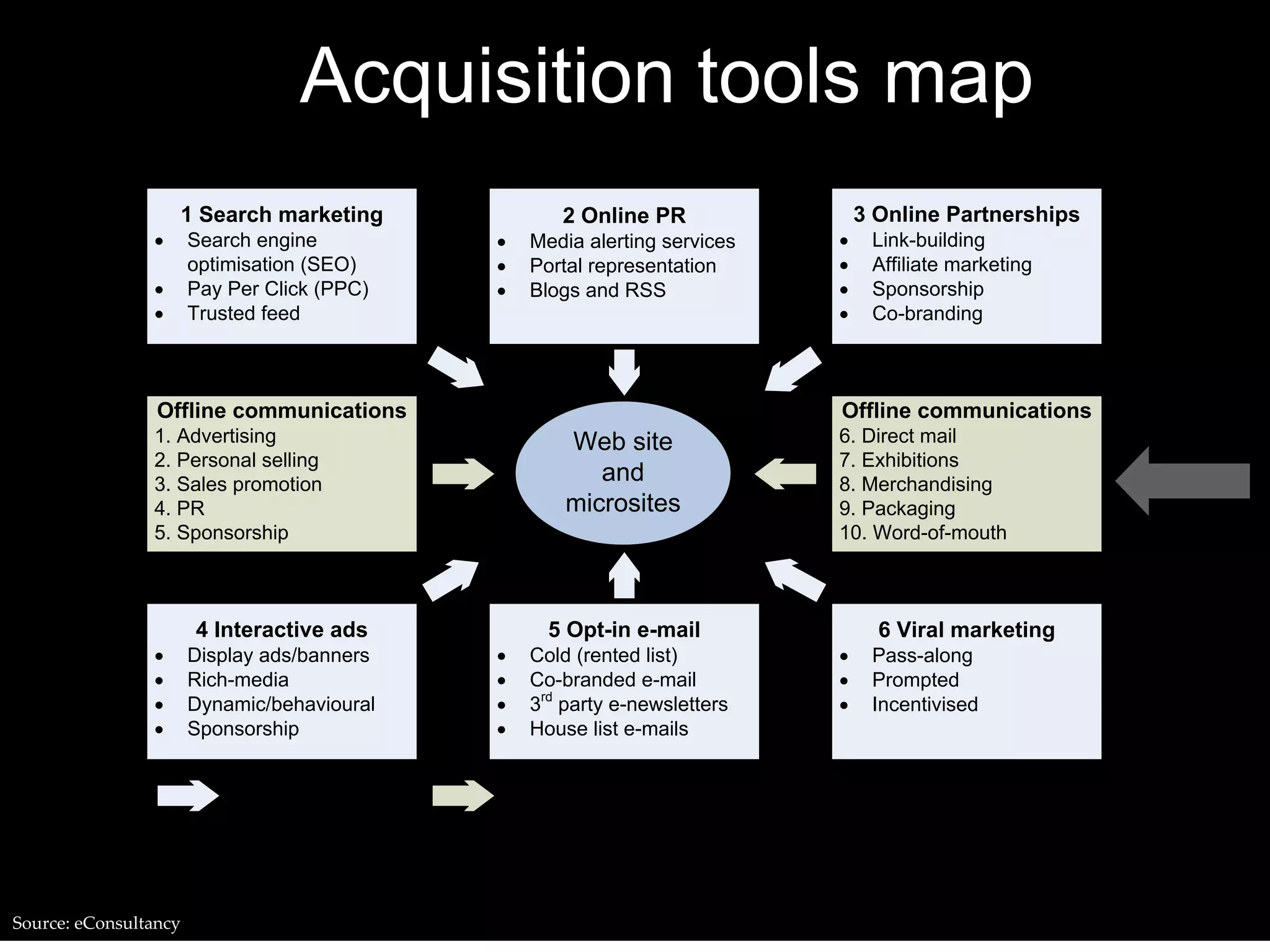
Acquisition tools map 
1 Search marketing 
· Search engine 
optimisation (SEO) 
· Pay Per Click (PPC) 
· Trusted feed 
2 Online PR 
· Media alerting services 
· Portal representation 
· Blogs and RSS 
3 Online Partnerships 
· Link-building 
· Affiliate marketing 
· Sponsorship 
· Co-branding 
4 Interactive ads 
· Display ads/banners 
· Rich-media 
· Dynamic/behavioural 
· Sponsorship 
5 Opt-in e-mail 
· Cold (rented list) 
· Co-branded e-mail 
· 3rd party e-newsletters 
· House list e-mails 
6 Viral marketing 
· Pass-along 
· Prompted 
· Incentivised 
Web site 
and 
microsites 
Offline communications 
1. Advertising 
2. Personal selling 
3. Sales promotion 
4. PR 
5. Sponsorship 
Offline communications 
6. Direct mail 
7. Exhibitions 
8. Merchandising 
9. Packaging 
10. Word-of-mouth 
Online communications Offline communications 
Source: eConsultancy
Example: Thomas Cook online strategy model 
Customer 
Acquisition 
Harvest repeat business 
• SEM 
• Affiliate Marketing 
• Display 
• Aggregators 
• Email 
• Offline 
• Online PR 
• Viral 
• Consumer generated 
content 
Customer 
Retention 
& Growth 
Measure 
& Optimise 
Customer 
Conversion 
Attracting new 
customers 
from existing 
customersers 
• Customer 
service 
• Process 
• Segmentation 
and targetting 
• Email 
• Cross-sell 
• Online PR 
• Personalisation 
• Multichannel 
Turn ‘lookers’ into 
‘bookers’ 
• Usability 
• Accessibility 
• Enhanced 
content, 
copywriting 
• Promos and 
better 
merchandising 
• Email 
• Customer 
decision support 
• Payment options 
Track & analyse every 
aspect of activity 
• Web analytics 
• Site 
performance 
monitoring 
• Market 
intellignece 
• Online surveys 
• Usability testing 
• Online panels 
• Customer 
insight 
Source: eConsultancy Thomas Cook
Customer conversion – connect site visitors and 
convert as many as possible 
• Proposition development – planning and specifying the product to appear 
• Content creation – sourcing the information used to define appropriate 
pricing and messaging, 
• Content management – managing the software and database infrastructure 
• Merchandising – product presentation 
• Site usability and accessibility 
• Design & Development
Customer retention 
• Touch strategy definition and execution can define appropriate combinations 
of timing, targeting, product: 
o Automated event-triggered messaging through customer booking cycle 
o Developed with a acceptable level of 
• Timing frequency 
• Target 
• Interval 
• Content 
• Email marketing is the keystone to retention (and further acquisition) 
o low-cost, personalised 
o integration of customer behaviour including email response patterns and 
transactional data is ideal 
o DM
Operational support processes across 
acquisition, conversion and retention 
• Performance improvement including web analytics, commercial 
analysis and providing management information 
• Design guidelines and operating procedures such as the review 
process for publishing new content or triggers for when content 
updates were required. 
• Managing the technical infrastructure including hosting in order to 
deliver the right service levels, experienced by customers as site 
performance and availability.
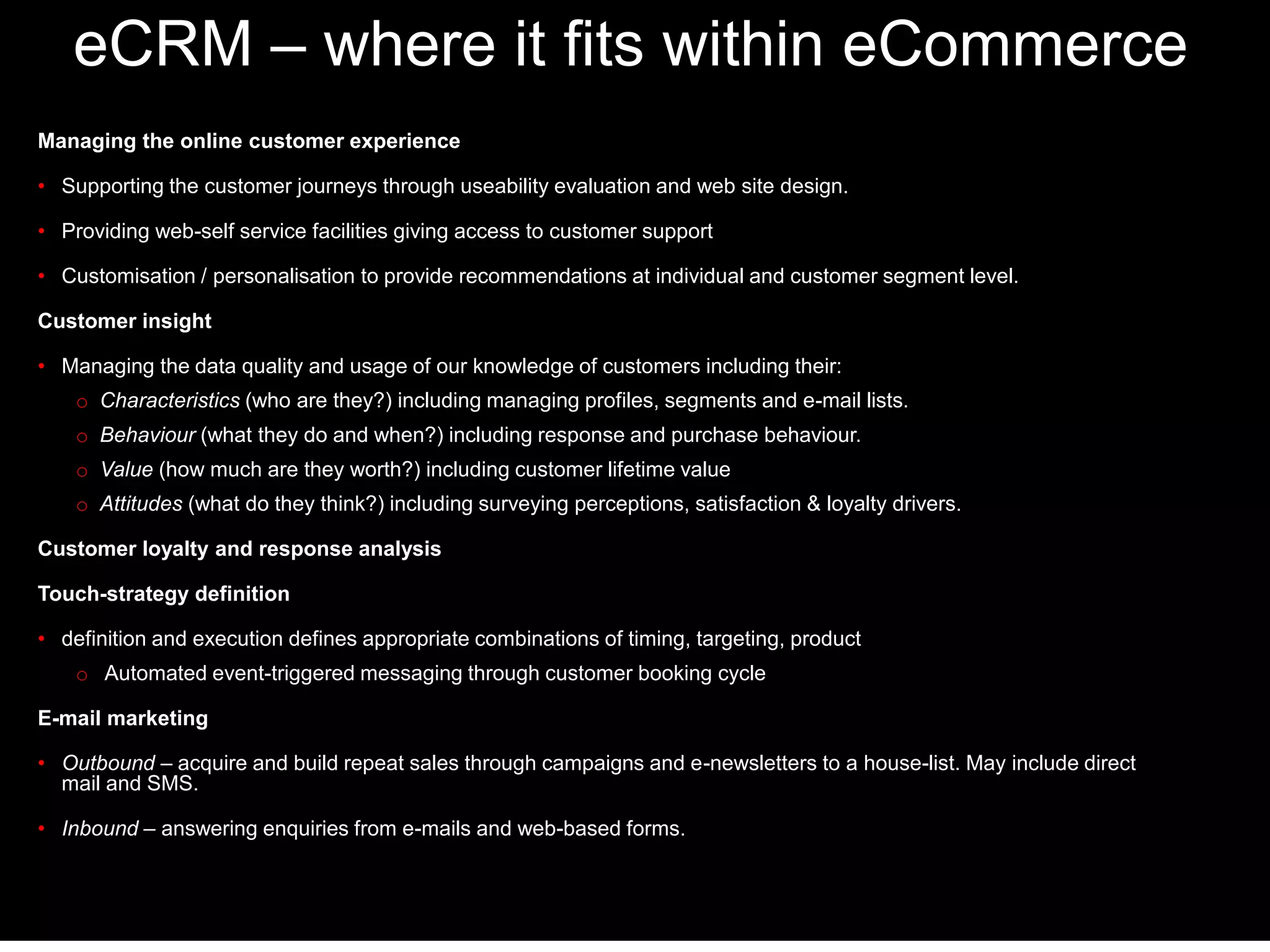
eCRM – where it fits within eCommerce 
Managing the online customer experience 
• Supporting the customer journeys through useability evaluation and web site design. 
• Providing web-self service facilities giving access to customer support 
• Customisation / personalisation to provide recommendations at individual and customer segment level. 
Customer insight 
• Managing the data quality and usage of our knowledge of customers including their: 
o Characteristics (who are they?) including managing profiles, segments and e-mail lists. 
o Behaviour (what they do and when?) including response and purchase behaviour. 
o Value (how much are they worth?) including customer lifetime value 
o Attitudes (what do they think?) including surveying perceptions, satisfaction & loyalty drivers. 
Customer loyalty and response analysis 
Touch-strategy definition 
• definition and execution defines appropriate combinations of timing, targeting, product 
o Automated event-triggered messaging through customer booking cycle 
E-mail marketing 
• Outbound – acquire and build repeat sales through campaigns and e-newsletters to a house-list. May include direct 
mail and SMS. 
• Inbound – answering enquiries from e-mails and web-based forms.
SEO Fundamentals 
Internal SEO 
- Relevant 
- Accessible 
- Keyword Rich 
- Quality Signals 
- Targeting 
External SEO 
- Quality, related 
links 
- Relevant 
- Linking speed 
- Social Media 
- Linking Signals 
Technical Spec 
- Site Architecture 
- Navigation 
- Meta data 
- XML Options 
- Quality signals
Suggested eCommerce Strategy for Airlines 
Convert 
Retain 
and Grow 
Acquire 
• Site design 
• Tracking code 
• User friendly 
content 
• Site security 
• Good calls to 
action 
• Site speed 
• Viral 
• Offers 
• 4 stage process 
• SEO 
• PPC 
• Email 
• Affiliate 
• Banner 
• Video 
• Viral 
• RSS 
• Email list 
• Buy-in 
• Customer 
service 
• Email 
• Personalisation 
• Site security 
• Referrals
Effective web design 
• Accessibility – w3C 
• User-centred design and usability 
• Linking with marketing planning 
• Information architecture and findability 
• Search engine optimisation (SEO) 
• Web standards 
• Web analytics 
• Legal requirements 
• Right fares, appealing 
• Combining these will deliver a compelling website experience
Effective web design 
• 1: Usability and Brand 
o Problem: Which way do I go? Which navigation is the right one? Which company and site am I booking 
on? Where am I? Can I trust the airline? 
o Solution: Provide consistent user experience throughout the site to avoid disorientation and create 
confidence and trust through a single, focused and consistent booking experience 
• 2: Usability 
o Problem: How many steps will booking really take? 
o Solution: Optimise the booking flow to create a & efficient 4 step process to avoid drop outs 
• 3: Brand 
o Problem: Who is the airline and are they for me? What can they offer me others don’t have? 
o Solution: Ensure site represent the company’s positioning, mission, values and personality? Enable 
customers to understand our offer by providing platform for marketing positioning 
• 4: Usability 
o Problem: Where can I quickly compare availability and prices? 
o Solution: Focus homepage on key user goals: booking, manage my booking, travel info, offers 
• 5: Experience 
o Problem: Why should I come back? Does the site cater for my needs? 
o Solution: Create an effective site structure based on target audience specific needs and provide a platform 
to manage relationships such as online check-in updates, flight updates, etc.
Number 1 rule - building a database 
• Capture customer information in terms of 
oName 
o Email address 
oMobile number 
• Through 
oWebsite 
oCompetitions 
o Business cards 
• Build a customer database 
• AND ideally – but not a deal breaker 
• Capture some related demographics helps airline build accurate and timely 
profiles about airline's customers 
• Create personalised communication.
Best practice recommendations 
• Acquisition has two meanings: 
o Using web site to acquire new customers as qualified leads that can be converted into sales 
o Encouraging existing customers to use online channels 
• Balance resources between acquisition, proposition development / conversion and retention. 
• Create detailed digital marketing plans to provide focus and direction with a structured planning 
process for E-commerce 
• Achieve senior level sponsorship and involvement in planning and review. 
o Align E-commerce objectives and resources with business objectives. 
• Be flexible 
o Have a flexible response to planning with operational reviews enabling reallocation of budget 
o Avoid the delays in “time to market” for introducing new web applications 
o Use ‘Test, learn, refine’ model 
• Allocate sufficient organisational resources for customer insight, customer data quality, customer 
satisfaction, touch-strategy definition, not just web site efficiency and effectiveness.

E Commerce And Airlines

  • 1.
    eCommerce in theAirline Industry Colin Lewis
  • 2.
    eCommerce Maturity models • Unplanned – Uncontrolled with limited integration. Content focus. • Diffuse management – A more structured approach in some areas. Visitor acquisition focus. • Centralised management – Organisation level objectives and control. Conversion focus. • Decentralised operations – Execution integrated with marketing activities. Retention focus. • Integrated and optimised – A refined approach to improve digital marketing. Optimisation focus.
  • 3.
    eCommerce process map:the day-to-day Acquisition Operating processes Conversion / Proposition Dvlpt Retention & Growth Search engine optimisation Pay Per Click search Partnerships / affiliates Online ads / sponsorship E-mail marketing Online PR Offline campaigns Proposition development Content creation Content management Merchandising Site usability & accessibility Design & Development Customer service Proposition development Outbound communications E-mail marketing Customer management Touch strategy definition Loyalty programmes Personalisation Management processes Supporting processes Performance improvement including Management Information, web analytics and customer analysis Interfacing with senior management Interfacing with marketing & corporate communications Staff development, education and retention Strategy & Planning Creating the vision. Assessing technological innovation. Market analysis and competitor benchmarking Financial analysis and modelling Defining the multichannel customer experience. Managing customer information Interfacing with IT Managing external relationships. Vendor selection & management. Annual planning and budgeting IT Project and campaign planning and management Managing relationships Managing improvement and change Design guidelines and operating procedures Technical infrastructure including service level management Source: eConsultancy
  • 4.
    Acquisition tools map 1 Search marketing · Search engine optimisation (SEO) · Pay Per Click (PPC) · Trusted feed 2 Online PR · Media alerting services · Portal representation · Blogs and RSS 3 Online Partnerships · Link-building · Affiliate marketing · Sponsorship · Co-branding 4 Interactive ads · Display ads/banners · Rich-media · Dynamic/behavioural · Sponsorship 5 Opt-in e-mail · Cold (rented list) · Co-branded e-mail · 3rd party e-newsletters · House list e-mails 6 Viral marketing · Pass-along · Prompted · Incentivised Web site and microsites Offline communications 1. Advertising 2. Personal selling 3. Sales promotion 4. PR 5. Sponsorship Offline communications 6. Direct mail 7. Exhibitions 8. Merchandising 9. Packaging 10. Word-of-mouth Online communications Offline communications Source: eConsultancy
  • 5.
    Example: Thomas Cookonline strategy model Customer Acquisition Harvest repeat business • SEM • Affiliate Marketing • Display • Aggregators • Email • Offline • Online PR • Viral • Consumer generated content Customer Retention & Growth Measure & Optimise Customer Conversion Attracting new customers from existing customersers • Customer service • Process • Segmentation and targetting • Email • Cross-sell • Online PR • Personalisation • Multichannel Turn ‘lookers’ into ‘bookers’ • Usability • Accessibility • Enhanced content, copywriting • Promos and better merchandising • Email • Customer decision support • Payment options Track & analyse every aspect of activity • Web analytics • Site performance monitoring • Market intellignece • Online surveys • Usability testing • Online panels • Customer insight Source: eConsultancy Thomas Cook
  • 6.
    Customer conversion –connect site visitors and convert as many as possible • Proposition development – planning and specifying the product to appear • Content creation – sourcing the information used to define appropriate pricing and messaging, • Content management – managing the software and database infrastructure • Merchandising – product presentation • Site usability and accessibility • Design & Development
  • 7.
    Customer retention •Touch strategy definition and execution can define appropriate combinations of timing, targeting, product: o Automated event-triggered messaging through customer booking cycle o Developed with a acceptable level of • Timing frequency • Target • Interval • Content • Email marketing is the keystone to retention (and further acquisition) o low-cost, personalised o integration of customer behaviour including email response patterns and transactional data is ideal o DM
  • 8.
    Operational support processesacross acquisition, conversion and retention • Performance improvement including web analytics, commercial analysis and providing management information • Design guidelines and operating procedures such as the review process for publishing new content or triggers for when content updates were required. • Managing the technical infrastructure including hosting in order to deliver the right service levels, experienced by customers as site performance and availability.
  • 9.
    eCRM – whereit fits within eCommerce Managing the online customer experience • Supporting the customer journeys through useability evaluation and web site design. • Providing web-self service facilities giving access to customer support • Customisation / personalisation to provide recommendations at individual and customer segment level. Customer insight • Managing the data quality and usage of our knowledge of customers including their: o Characteristics (who are they?) including managing profiles, segments and e-mail lists. o Behaviour (what they do and when?) including response and purchase behaviour. o Value (how much are they worth?) including customer lifetime value o Attitudes (what do they think?) including surveying perceptions, satisfaction & loyalty drivers. Customer loyalty and response analysis Touch-strategy definition • definition and execution defines appropriate combinations of timing, targeting, product o Automated event-triggered messaging through customer booking cycle E-mail marketing • Outbound – acquire and build repeat sales through campaigns and e-newsletters to a house-list. May include direct mail and SMS. • Inbound – answering enquiries from e-mails and web-based forms.
  • 10.
    SEO Fundamentals InternalSEO - Relevant - Accessible - Keyword Rich - Quality Signals - Targeting External SEO - Quality, related links - Relevant - Linking speed - Social Media - Linking Signals Technical Spec - Site Architecture - Navigation - Meta data - XML Options - Quality signals
  • 11.
    Suggested eCommerce Strategyfor Airlines Convert Retain and Grow Acquire • Site design • Tracking code • User friendly content • Site security • Good calls to action • Site speed • Viral • Offers • 4 stage process • SEO • PPC • Email • Affiliate • Banner • Video • Viral • RSS • Email list • Buy-in • Customer service • Email • Personalisation • Site security • Referrals
  • 12.
    Effective web design • Accessibility – w3C • User-centred design and usability • Linking with marketing planning • Information architecture and findability • Search engine optimisation (SEO) • Web standards • Web analytics • Legal requirements • Right fares, appealing • Combining these will deliver a compelling website experience
  • 13.
    Effective web design • 1: Usability and Brand o Problem: Which way do I go? Which navigation is the right one? Which company and site am I booking on? Where am I? Can I trust the airline? o Solution: Provide consistent user experience throughout the site to avoid disorientation and create confidence and trust through a single, focused and consistent booking experience • 2: Usability o Problem: How many steps will booking really take? o Solution: Optimise the booking flow to create a & efficient 4 step process to avoid drop outs • 3: Brand o Problem: Who is the airline and are they for me? What can they offer me others don’t have? o Solution: Ensure site represent the company’s positioning, mission, values and personality? Enable customers to understand our offer by providing platform for marketing positioning • 4: Usability o Problem: Where can I quickly compare availability and prices? o Solution: Focus homepage on key user goals: booking, manage my booking, travel info, offers • 5: Experience o Problem: Why should I come back? Does the site cater for my needs? o Solution: Create an effective site structure based on target audience specific needs and provide a platform to manage relationships such as online check-in updates, flight updates, etc.
  • 14.
    Number 1 rule- building a database • Capture customer information in terms of oName o Email address oMobile number • Through oWebsite oCompetitions o Business cards • Build a customer database • AND ideally – but not a deal breaker • Capture some related demographics helps airline build accurate and timely profiles about airline's customers • Create personalised communication.
  • 15.
    Best practice recommendations • Acquisition has two meanings: o Using web site to acquire new customers as qualified leads that can be converted into sales o Encouraging existing customers to use online channels • Balance resources between acquisition, proposition development / conversion and retention. • Create detailed digital marketing plans to provide focus and direction with a structured planning process for E-commerce • Achieve senior level sponsorship and involvement in planning and review. o Align E-commerce objectives and resources with business objectives. • Be flexible o Have a flexible response to planning with operational reviews enabling reallocation of budget o Avoid the delays in “time to market” for introducing new web applications o Use ‘Test, learn, refine’ model • Allocate sufficient organisational resources for customer insight, customer data quality, customer satisfaction, touch-strategy definition, not just web site efficiency and effectiveness.