Lesson 3: Using a Word Processor


Return to the student web page
Lesson Objectives
   After studying this lesson, you will be able to:
     Create     a new document using Word
     Edit   a document by inserting and deleting text
     Use    the Copy and Paste commands
     Identify   key parts of the Word Ribbon interface
     Print   documents
     Work  with Word’s Spell Check and AutoCorrect
      features


2
Defining Word Processors
   Create documents electronically
   You can insert new text anywhere you need it
   You can delete unwanted text
   New lines are started automatically as you type
   You can copy and paste text in different locations
   Spell Check and AutoCorrect features help you avoid
    typos


3
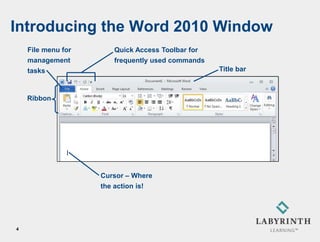
Introducing the Word 2010 Window
    File menu for       Quick Access Toolbar for
    management          frequently used commands
    tasks                                          Title bar


    Ribbon


                    Cursor – Where
                    the action is!


4
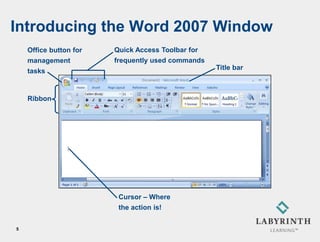
Introducing the Word 2007 Window
    Office button for   Quick Access Toolbar for
    management          frequently used commands
    tasks                                          Title bar


    Ribbon


                         Cursor – Where
                         the action is!

5
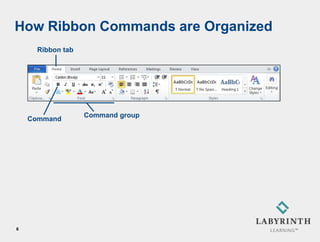
How Ribbon Commands are Organized
     Ribbon tab


                  Command group
    Command


6
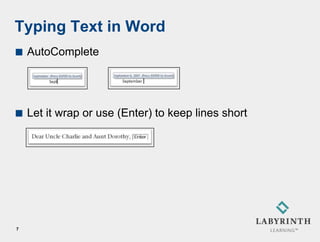
Typing Text in Word
   AutoComplete


   Let it wrap or use (Enter) to keep lines short


7
Typing Text in Word
   Line spacing
     1.15   with end of paragraph spacing (default)
                          The setting for traditional single
                          spacing between lines

                          The setting for traditional double
                          spacing between lines


                          Commands to control space
                          between paragraphs


8
Typing in Word
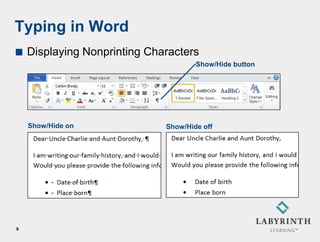
   Displaying Nonprinting Characters
                                      Show/Hide button


    Show/Hide on              Show/Hide off


9
Typing Bullets
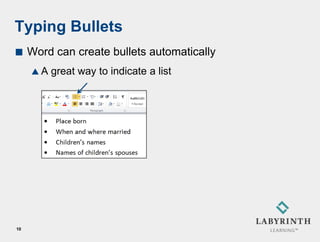
    Word can create bullets automatically
     A   great way to indicate a list


10
Saving Your Work
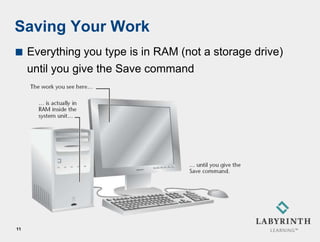
    Everything you type is in RAM (not a storage drive)
     until you give the Save command


11
Saving a Document for the First Time
    Filenames cannot contain the following characters:
     /   :*?"<>|
    Save
      Save   an existing file with the same name
    Save As
      Save   a new file for the first time
      Save   an existing file with a new name


12
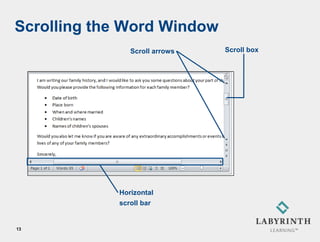
Scrolling the Word Window
               Scroll arrows   Scroll box


            Horizontal
            scroll bar


13
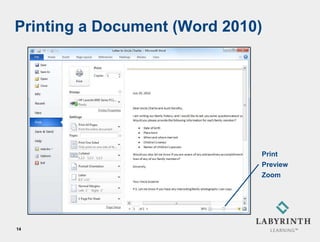
Printing a Document (Word 2010)


                              Print
                              Preview
                              Zoom


14
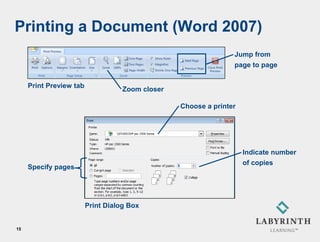
Printing a Document (Word 2007)
                                                                 Jump from
                                                                 page to page

     Print Preview tab
                                    Zoom closer

                                                  Choose a printer


                                                                     Indicate number
                                                                     of copies
     Specify pages


                         Print Dialog Box


15
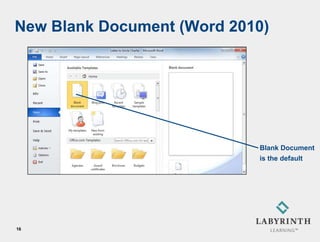
New Blank Document (Word 2010)


                            Blank Document
                            is the default


16
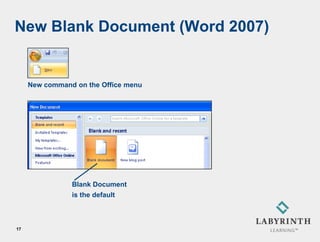
New Blank Document (Word 2007)


     New command on the Office menu


                Blank Document
                is the default


17
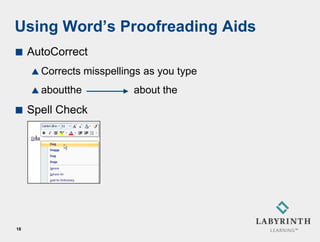
Using Word’s Proofreading Aids
    AutoCorrect
      Corrects   misspellings as you type
      aboutthe             about the
    Spell Check


18
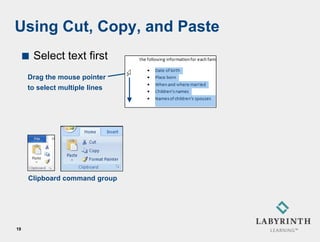
Using Cut, Copy, and Paste
        Select text first
     Drag the mouse pointer
     to select multiple lines


     Clipboard command group


19
Behind the
Screen . . .
Behind the Screen:
About Application Programs
    Software
      Operating   system: Software that controls your computer
         Windows

         Macintosh

      Application   programs: Software used to get work done
         Application   suites (Office 2010)
         Word   2010


21
Behind the Screen:
Storage Device Basics
    Units of measure       Storage Drives
        Kilobyte (KB)          Hard drive
        Megabyte (MB)          USB Flash drive
        Gigabyte (GB)          CD/DVD drive
                                Blu-Ray drive


22
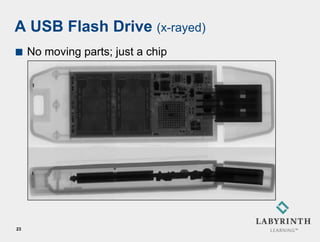
A USB Flash Drive (x-rayed)
    No moving parts; just a chip


23
Behind the Screen:
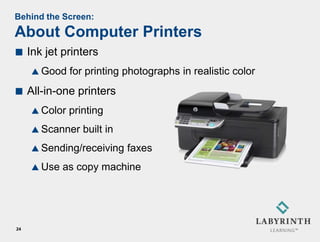
About Computer Printers
    Ink jet printers
      Good    for printing photographs in realistic color
    All-in-one printers
      Color   printing
      Scanner    built in
      Sending/receiving     faxes
      Use   as copy machine


24
Behind the Screen:
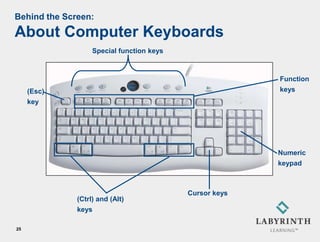
About Computer Keyboards
                   Special function keys


                                                         Function
     (Esc)                                               keys
     key


                                                         Numeric
                                                         keypad


                                           Cursor keys
              (Ctrl) and (Alt)
              keys

25
Lesson 3: Using a Word Processor


Return to the student web page

Lesson 3 (1)

  • 1.
    Lesson 3: Usinga Word Processor Return to the student web page
  • 2.
    Lesson Objectives  After studying this lesson, you will be able to:  Create a new document using Word  Edit a document by inserting and deleting text  Use the Copy and Paste commands  Identify key parts of the Word Ribbon interface  Print documents  Work with Word’s Spell Check and AutoCorrect features 2
  • 3.
    Defining Word Processors  Create documents electronically  You can insert new text anywhere you need it  You can delete unwanted text  New lines are started automatically as you type  You can copy and paste text in different locations  Spell Check and AutoCorrect features help you avoid typos 3
  • 4.
    Introducing the Word2010 Window File menu for Quick Access Toolbar for management frequently used commands tasks Title bar Ribbon Cursor – Where the action is! 4
  • 5.
    Introducing the Word2007 Window Office button for Quick Access Toolbar for management frequently used commands tasks Title bar Ribbon Cursor – Where the action is! 5
  • 6.
    How Ribbon Commandsare Organized Ribbon tab Command group Command 6
  • 7.
    Typing Text inWord  AutoComplete  Let it wrap or use (Enter) to keep lines short 7
  • 8.
    Typing Text inWord  Line spacing  1.15 with end of paragraph spacing (default) The setting for traditional single spacing between lines The setting for traditional double spacing between lines Commands to control space between paragraphs 8
  • 9.
    Typing in Word  Displaying Nonprinting Characters Show/Hide button Show/Hide on Show/Hide off 9
  • 10.
    Typing Bullets  Word can create bullets automatically A great way to indicate a list 10
  • 11.
    Saving Your Work  Everything you type is in RAM (not a storage drive) until you give the Save command 11
  • 12.
    Saving a Documentfor the First Time  Filenames cannot contain the following characters: / :*?"<>|  Save  Save an existing file with the same name  Save As  Save a new file for the first time  Save an existing file with a new name 12
  • 13.
    Scrolling the WordWindow Scroll arrows Scroll box Horizontal scroll bar 13
  • 14.
    Printing a Document(Word 2010) Print Preview Zoom 14
  • 15.
    Printing a Document(Word 2007) Jump from page to page Print Preview tab Zoom closer Choose a printer Indicate number of copies Specify pages Print Dialog Box 15
  • 16.
    New Blank Document(Word 2010) Blank Document is the default 16
  • 17.
    New Blank Document(Word 2007) New command on the Office menu Blank Document is the default 17
  • 18.
    Using Word’s ProofreadingAids  AutoCorrect  Corrects misspellings as you type  aboutthe about the  Spell Check 18
  • 19.
    Using Cut, Copy,and Paste  Select text first Drag the mouse pointer to select multiple lines Clipboard command group 19
  • 20.
  • 21.
    Behind the Screen: AboutApplication Programs  Software  Operating system: Software that controls your computer  Windows  Macintosh  Application programs: Software used to get work done  Application suites (Office 2010)  Word 2010 21
  • 22.
    Behind the Screen: StorageDevice Basics  Units of measure  Storage Drives  Kilobyte (KB)  Hard drive  Megabyte (MB)  USB Flash drive  Gigabyte (GB)  CD/DVD drive  Blu-Ray drive 22
  • 23.
    A USB FlashDrive (x-rayed)  No moving parts; just a chip 23
  • 24.
    Behind the Screen: AboutComputer Printers  Ink jet printers  Good for printing photographs in realistic color  All-in-one printers  Color printing  Scanner built in  Sending/receiving faxes  Use as copy machine 24
  • 25.
    Behind the Screen: AboutComputer Keyboards Special function keys Function (Esc) keys key Numeric keypad Cursor keys (Ctrl) and (Alt) keys 25
  • 26.
    Lesson 3: Usinga Word Processor Return to the student web page