Sumbitted by, Guided by,
R.Hanan Raj , Mrs.Tamilselvi,M.E,
M.E(CSE), Assitant Professer,
ARJ CET. Dept of CSE,
ARJ CET.
STUDY OF LINUX KERNEL
AND KERNEL MODULES
module.
AIM:
To study of linux kernel and kernel modules.
OBJECTIVE:
Linux kernel:
The Linux kernel is a Unix-like computer
operating system kernel. TheLinux kernel is a
widely used operating system kernel world-wide .
Kernel module:
A loadable kernel module (or LKM) is
object file that contains code to extend the running
kernel, or so-called base kernel,of an operating
system.
Continue…
LKMs are typically used to add support for new
hardware and/or filesystems, or for adding system
calls.
Study of linux kernel and kernel modules
divided into 4 parts:
1. Development of a reasonably size dynamically
loadable kernel module for Linux kernel.
2. Passing command line arguments to a module.
3. Building modules for a precompiled kernel.
4. Implementing module for linux kernel
History
Linux is a modern, free operating system based
on UNIX standards.
First developed as a small but self-contained
kernel in 1991 by Linus Torvalds.
run efficiently and reliably on common PC
hardware, but also runs on a variety of other
platforms.
 Linux system has many, varying Linux distributions
including the kernel,applications, and
management tools.
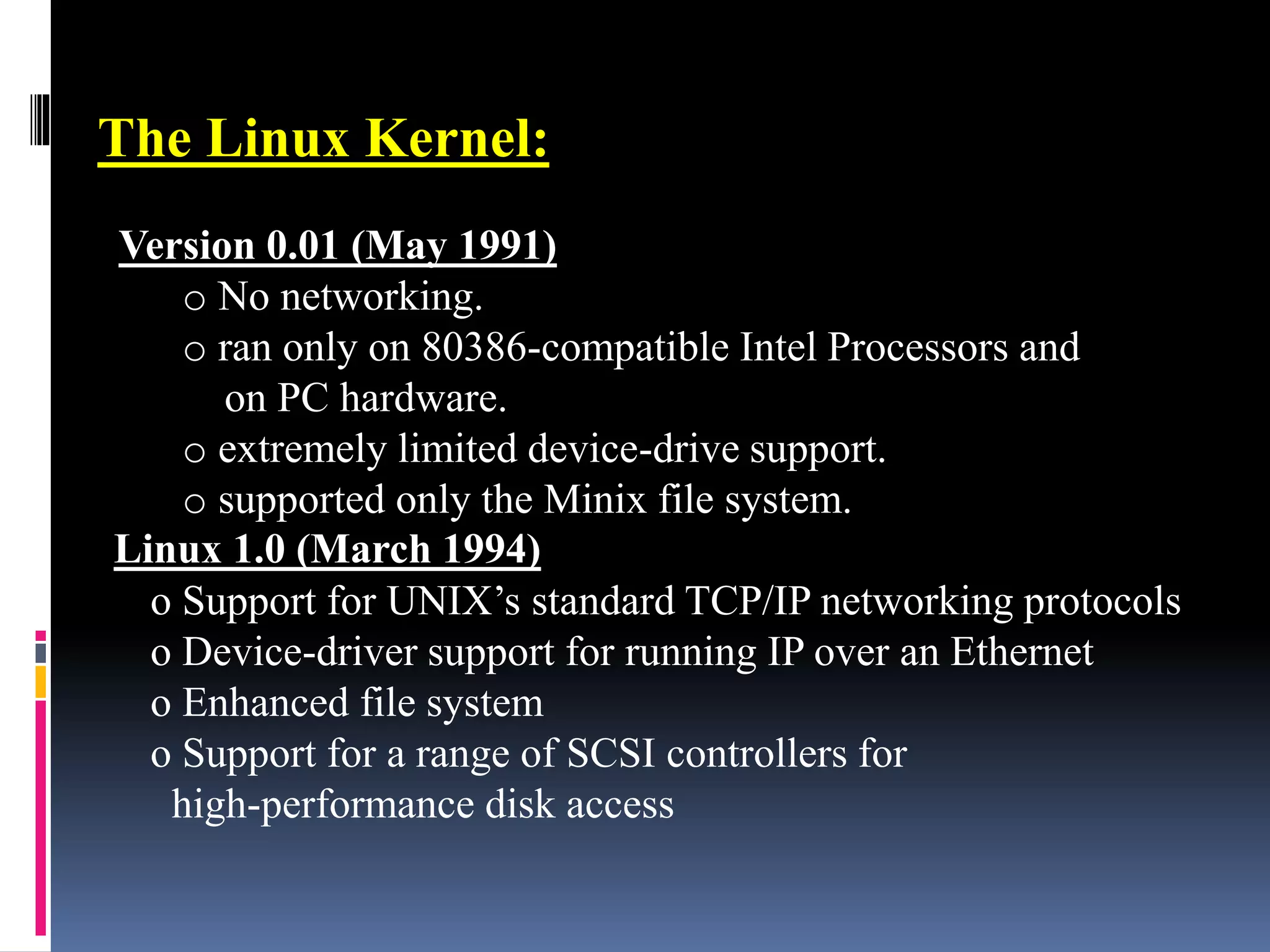
The Linux Kernel:
Version 0.01 (May 1991)
o No networking.
o ran only on 80386-compatible Intel Processors and
on PC hardware.
o extremely limited device-drive support.
o supported only the Minix file system.
Linux 1.0 (March 1994)
o Support for UNIX’s standard TCP/IP networking protocols
o Device-driver support for running IP over an Ethernet
o Enhanced file system
o Support for a range of SCSI controllers for
high-performance disk access
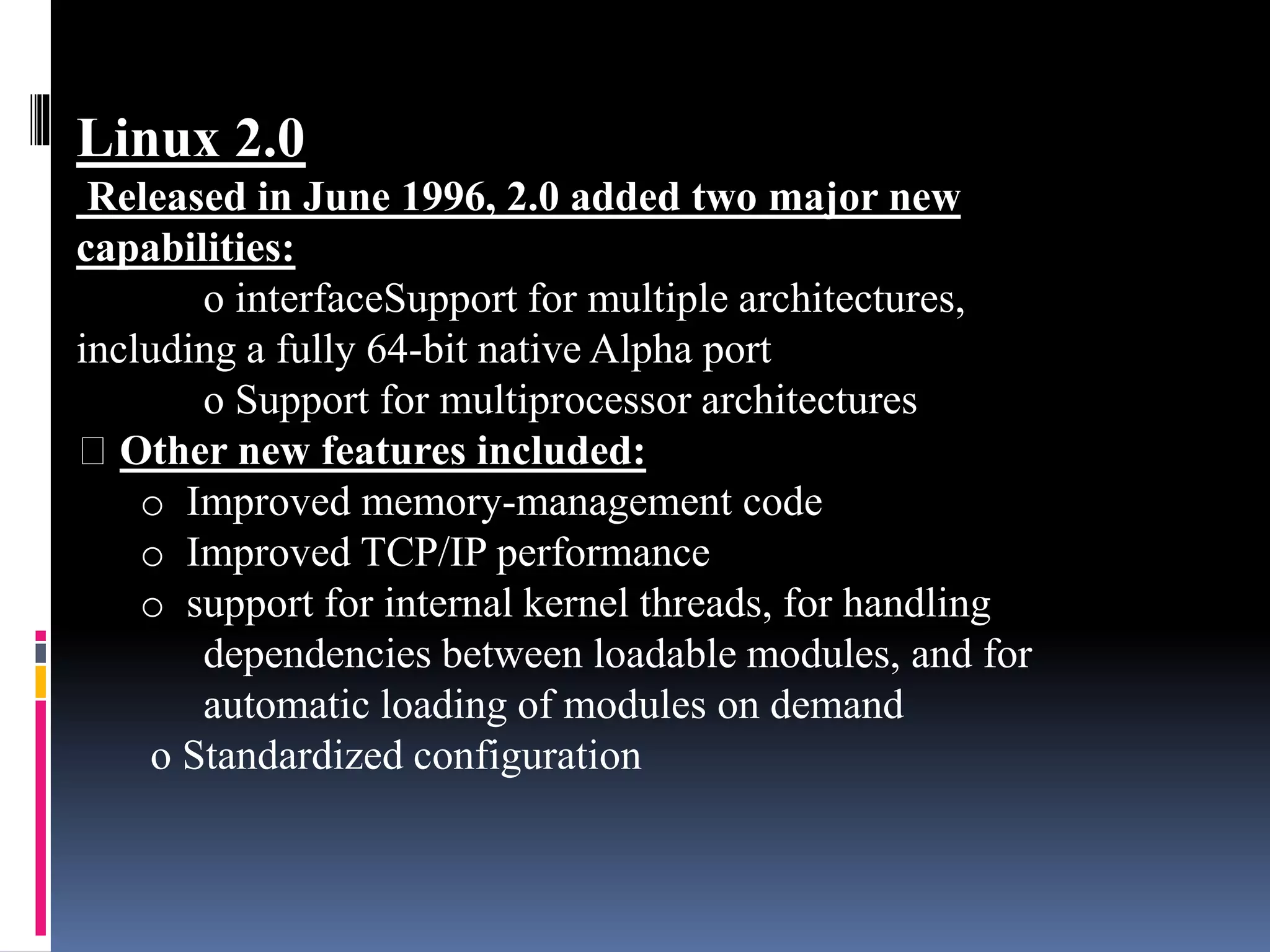
Linux 2.0
Released in June 1996, 2.0 added two major new
capabilities:
o interfaceSupport for multiple architectures,
including a fully 64-bit native Alpha port
o Support for multiprocessor architectures
Other new features included:
o Improved memory-management code
o Improved TCP/IP performance
o support for internal kernel threads, for handling
dependencies between loadable modules, and for
automatic loading of modules on demand
o Standardized configuration
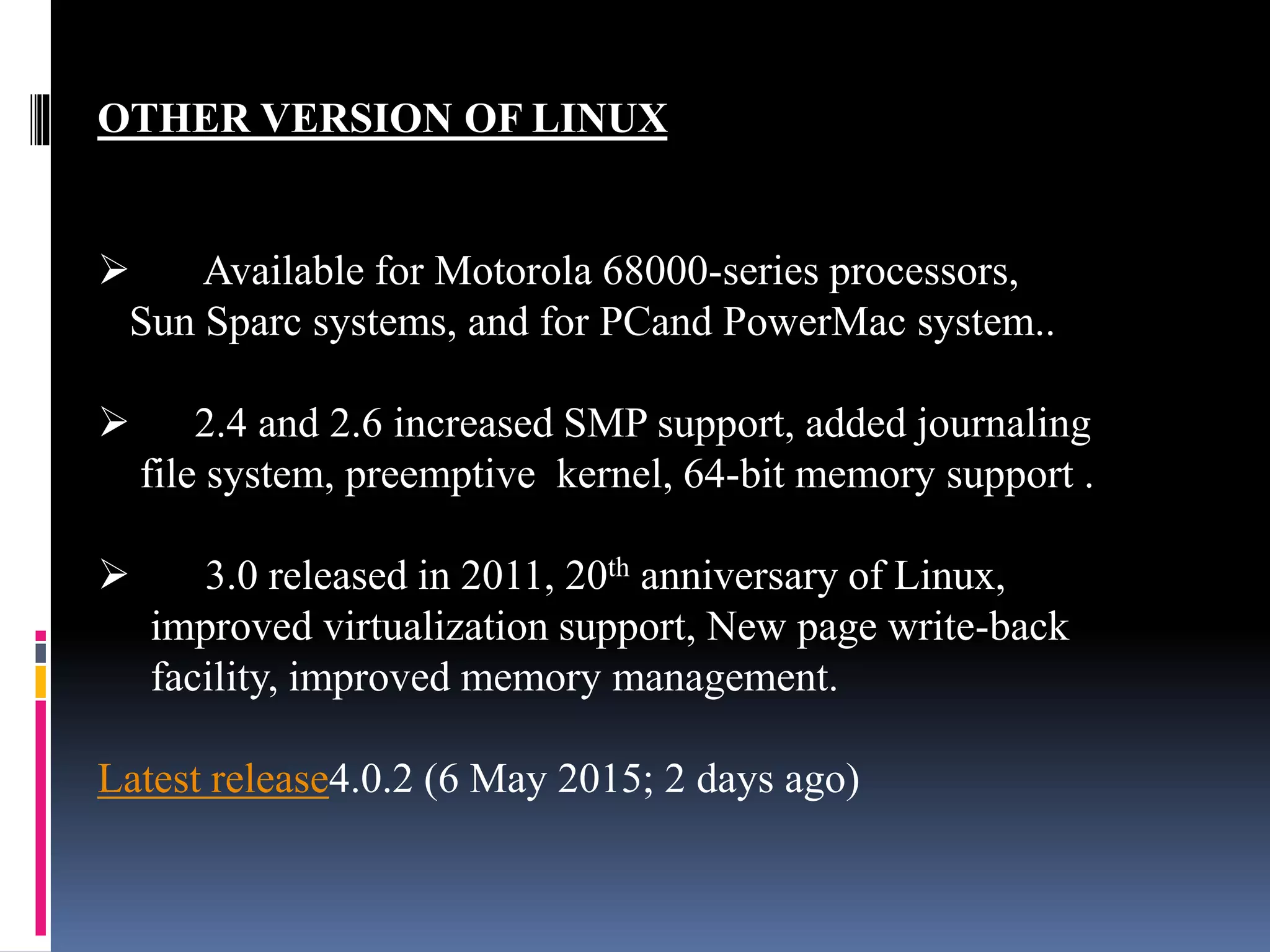
OTHER VERSION OF LINUX
 Available for Motorola 68000-series processors,
Sun Sparc systems, and for PCand PowerMac system..
 2.4 and 2.6 increased SMP support, added journaling
file system, preemptive kernel, 64-bit memory support .
 3.0 released in 2011, 20th anniversary of Linux,
improved virtualization support, New page write-back
facility, improved memory management.
Latest release4.0.2 (6 May 2015; 2 days ago)
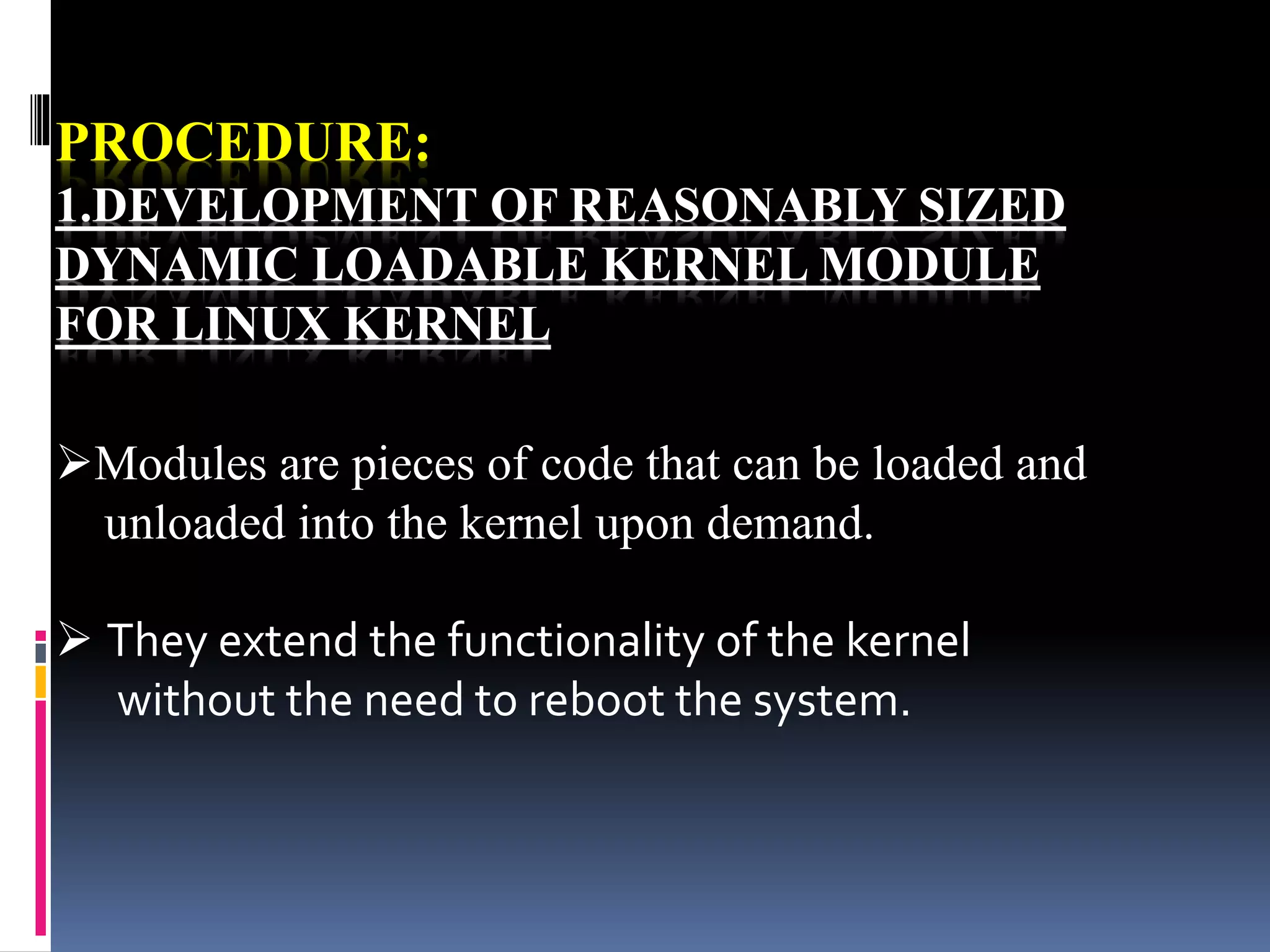
PROCEDURE:
1.DEVELOPMENT OF REASONABLY SIZED
DYNAMIC LOADABLE KERNEL MODULE
FOR LINUX KERNEL
Modules are pieces of code that can be loaded and
unloaded into the kernel upon demand.
 They extend the functionality of the kernel
without the need to reboot the system.
Continue….
 For example, one type of module is the device
driver, which allows the kernel to access hardware
connected to the system.
 Without modules, we would have to build
monolithic kernels and add new functionality directly
into the kernel image.
Coding:
#include <linux/module.h> /* Needed by all modules */
#include <linux/kernel.h> /* Needed for KERN_INFO */
int init_module(void)
{
printk(KERN_INFO "Hello world 1.n");
/*
* A non 0 return means init_module failed; module
can't be loaded.
*/
return 0;
}
void cleanup_module(void)
{
printk(KERN_INFO "Goodbye world 1.n");
Kernel modules must have at least two
functions:
 a "start" (initialization) function called
init_module() which is called when the
module is insmoded into the kernel
 and an "end" (cleanup) function called
cleanup_module() which is called just before
it is rmmoded.
Linux command:
lsmod – List Modules that Loaded
Already.
insmod – Insert Module into Kernel.
modinfo – Display Module Info
rmmod – Remove Module from
Kernel
2.PASSING COMMAND LINE
ARGUMENTS TO A MODULE:
 Modules can take command line arguments.
 To allow arguments to be passed to your module,
declare the variables that will take the values of the
command line arguments as global and then use the
module_param()to setup.
 The variable declarations and macros should be placed
at the beginning of the module.
Advantage of linux
Cost – The most obvious advantage of using Linux is the
fact that it is free to obtain, whileMicrosoft products are
available for a hefty and sometimes recurring fee .
Security – In line with the costs, the security aspect
of Linux is much stronger than that ofWindows.
Choice (Freedom) –The power of choice is a
great Linux advantage.
Disadvantages of Linux:
Understanding – Becoming familiar with
the Linux operating system requires
patience as well as a strong learning curve.
Compatibility – Because of its free
nature, Linux is sometimes behind the
curve when it comes to brand new
hardware compatibility
.
Conclusions
Linux is a flexible, robust node operating system for
Beowulf computational clusters.
Stability and adaptability set it apart from the legacy
operating systems that dominate desktop
environments.
It has spread quickly from its humble beginnings as a
student’s hobby project to a full-featured server operating
system with advanced features and legendary stability .
Pppt

Pppt

  • 1.
    Sumbitted by, Guidedby, R.Hanan Raj , Mrs.Tamilselvi,M.E, M.E(CSE), Assitant Professer, ARJ CET. Dept of CSE, ARJ CET. STUDY OF LINUX KERNEL AND KERNEL MODULES module.
  • 2.
    AIM: To study oflinux kernel and kernel modules. OBJECTIVE: Linux kernel: The Linux kernel is a Unix-like computer operating system kernel. TheLinux kernel is a widely used operating system kernel world-wide . Kernel module: A loadable kernel module (or LKM) is object file that contains code to extend the running kernel, or so-called base kernel,of an operating system.
  • 3.
    Continue… LKMs are typicallyused to add support for new hardware and/or filesystems, or for adding system calls. Study of linux kernel and kernel modules divided into 4 parts: 1. Development of a reasonably size dynamically loadable kernel module for Linux kernel. 2. Passing command line arguments to a module. 3. Building modules for a precompiled kernel. 4. Implementing module for linux kernel
  • 4.
    History Linux is amodern, free operating system based on UNIX standards. First developed as a small but self-contained kernel in 1991 by Linus Torvalds. run efficiently and reliably on common PC hardware, but also runs on a variety of other platforms.  Linux system has many, varying Linux distributions including the kernel,applications, and management tools.
  • 5.
    The Linux Kernel: Version0.01 (May 1991) o No networking. o ran only on 80386-compatible Intel Processors and on PC hardware. o extremely limited device-drive support. o supported only the Minix file system. Linux 1.0 (March 1994) o Support for UNIX’s standard TCP/IP networking protocols o Device-driver support for running IP over an Ethernet o Enhanced file system o Support for a range of SCSI controllers for high-performance disk access
  • 6.
    Linux 2.0 Released inJune 1996, 2.0 added two major new capabilities: o interfaceSupport for multiple architectures, including a fully 64-bit native Alpha port o Support for multiprocessor architectures Other new features included: o Improved memory-management code o Improved TCP/IP performance o support for internal kernel threads, for handling dependencies between loadable modules, and for automatic loading of modules on demand o Standardized configuration
  • 7.
    OTHER VERSION OFLINUX  Available for Motorola 68000-series processors, Sun Sparc systems, and for PCand PowerMac system..  2.4 and 2.6 increased SMP support, added journaling file system, preemptive kernel, 64-bit memory support .  3.0 released in 2011, 20th anniversary of Linux, improved virtualization support, New page write-back facility, improved memory management. Latest release4.0.2 (6 May 2015; 2 days ago)
  • 8.
    PROCEDURE: 1.DEVELOPMENT OF REASONABLYSIZED DYNAMIC LOADABLE KERNEL MODULE FOR LINUX KERNEL Modules are pieces of code that can be loaded and unloaded into the kernel upon demand.  They extend the functionality of the kernel without the need to reboot the system.
  • 9.
    Continue….  For example,one type of module is the device driver, which allows the kernel to access hardware connected to the system.  Without modules, we would have to build monolithic kernels and add new functionality directly into the kernel image.
  • 10.
    Coding: #include <linux/module.h> /*Needed by all modules */ #include <linux/kernel.h> /* Needed for KERN_INFO */ int init_module(void) { printk(KERN_INFO "Hello world 1.n"); /* * A non 0 return means init_module failed; module can't be loaded. */ return 0; } void cleanup_module(void) { printk(KERN_INFO "Goodbye world 1.n");
  • 11.
    Kernel modules musthave at least two functions:  a "start" (initialization) function called init_module() which is called when the module is insmoded into the kernel  and an "end" (cleanup) function called cleanup_module() which is called just before it is rmmoded.
  • 12.
    Linux command: lsmod –List Modules that Loaded Already. insmod – Insert Module into Kernel. modinfo – Display Module Info rmmod – Remove Module from Kernel
  • 13.
    2.PASSING COMMAND LINE ARGUMENTSTO A MODULE:  Modules can take command line arguments.  To allow arguments to be passed to your module, declare the variables that will take the values of the command line arguments as global and then use the module_param()to setup.  The variable declarations and macros should be placed at the beginning of the module.
  • 14.
    Advantage of linux Cost– The most obvious advantage of using Linux is the fact that it is free to obtain, whileMicrosoft products are available for a hefty and sometimes recurring fee . Security – In line with the costs, the security aspect of Linux is much stronger than that ofWindows. Choice (Freedom) –The power of choice is a great Linux advantage.
  • 15.
    Disadvantages of Linux: Understanding– Becoming familiar with the Linux operating system requires patience as well as a strong learning curve. Compatibility – Because of its free nature, Linux is sometimes behind the curve when it comes to brand new hardware compatibility .
  • 16.
    Conclusions Linux is aflexible, robust node operating system for Beowulf computational clusters. Stability and adaptability set it apart from the legacy operating systems that dominate desktop environments. It has spread quickly from its humble beginnings as a student’s hobby project to a full-featured server operating system with advanced features and legendary stability .