CRITERIA FOR USE:
HIGH DOSE ORAL
PROTON PUMP INHIBITOR
ANTONIO C. COMIA, MD
GOOD EVENING!
CRITERIA FOR USE:
HIGH DOSE ORAL
PROTON PUMP INHIBITOR
(THE PROMISE OF OMEPRON 40)
ANTONIO C. COMIA, MD
DOSING ISSUES
 STANDARD DOSE: OMEPRAZOLE 20 MG
 HIGH DOSE
 DOUBLE OR QUADRUPLE DOSE: 20 BID, 40 OD, 40 BID
 AS INITIAL THERAPY?
 IF INADEQUATE IMPROVEMENT WITH INITIAL STANDARD
THERAPY?
WHEN TO GIVE HIGH DOSE PPI
(OMEPRON 40) AS
INITIAL THERAPY
INDICATIONS FOR HIGH DOSE
PROTON PUMP INHIBITORS:
DIAGNOSIS
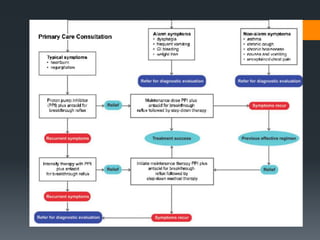
Diagnostic trial (PPI test)
 Uncomplicated GERD: no alarm symptoms
 An 8-week therapeutic or empiric trial of double-dose
PPI may be considered
 Treatment plan should be re-evaluated if there is no
response after 8 weeks.
INDICATIONS FOR HIGH DOSE
PROTON PUMP INHIBITORS:
GERD-RELATED COUGH
 GERD-related chronic nonspecific cough
 dry and non-productive cough of ≥ 3 weeks’ duration
without any other respiratory symptom, sign, or
systemic illness)
CHRONIC COUGH AND GERD
 When GERD is the cause of chronic cough there may be no
GI symptoms – silent GERD
 24 hour esophageal pH monitoring provides a sensitive and
specific test for the presence of GERD
 GERD related cough may take 2 – 3 months to resolve with
therapy
 Definitive diagnosis of cough resulting from GERD can only
be made if the cough resolves with anti-GERD therapy
CHRONIC COUGH AND GERD
 Accurate diagnosis and therapy of chronic cough due to
GERD is difficult
 Therapeutic, empiric trial with PPI is reasonable initial
diagnostic approach
 Non-response does not rule out GERD as cause of chronic
cough
 Objective investigations for GERD are suggested
(esophageal pH monitoring)
Laryngopharyngeal reflux (LPR)
 Hoarseness, throat pain, dysphagia, throat clearing, dyspnea,
chronic cough
 May not have the classic symptoms of GERD
 Also called silent reflux.
 Cause: LES dysfunction, acid reflux upwards to throat
 PPI TEST: useful in diagnosis and treatment
 Double dose, given at east 8 weeks
INDICATIONS FOR HIGH DOSE
PROTON PUMP INHIBITORS AS
INITIAL THERAPY
 Gastric Ulcers – may give Omeprazole 40 mg as initial
dose, specially in high risk NSAID patients
 Pathologic hypersecretory conditions (e.g., Zollinger-
Ellison syndrome) – up to 240 mg/day
 Helicobacter pylori eradication to reduce recurrence of
duodenal ulcers, as part of dual or triple antibiotic-based
therapy – given together with antibiotics
 Double-dose PPI therapy, typically for 1–2 weeks
INDICATIONS FOR HIGH DOSE
PROTON PUMP INHIBITORS:
 Endoscopic evidence of severe erosive esophagitis
 presence of ulceration, stricture, perforation, or bleeding
 Presence of Barrett’s
 Double-dose PPI as initial therapy
 May continue with double dose as maintenance therapy.
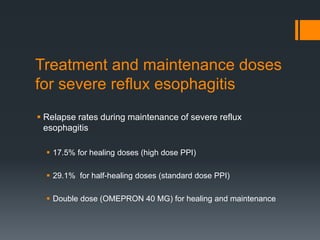
Treatment and maintenance doses
for severe reflux esophagitis
 Relapse rates during maintenance of severe reflux
esophagitis
 17.5% for healing doses (high dose PPI)
 29.1% for half-healing doses (standard dose PPI)
 Double dose (OMEPRON 40 MG) for healing and maintenance
HIGH DOSE PPI IN ULCER
REBLEEDING
 Acid suppression with PPI use significantly reduces the risk
of re-bleeding in bleeding peptic ulcers.
 The mechanism of action is thought to be related to clot
stabilization by increasing gastric pH.
 Both oral and intravenous PPIs have been demonstrated to
decrease hospital stay, re-bleeding rate and the need for
blood transfusion in patients treated with endoscopic therapy.
INDICATIONS FOR HIGH DOSE
PROTON PUMP INHIBITORS:
 Prevention of acute rebleeding of peptic ulcers after
endoscopic hemostasis
 IV PPI initially for 72 hours: 80 MG LD, 8 MG PER HOUR
 Quadruple-dose oral PPI may be given in 2 divided doses for
5 days
 Standard doses should be used thereafter.
INDICATIONS FOR HIGH DOSE
PROTON PUMP INHIBITORS:
 Reduction of risk of upper gastrointestinal bleeding in
critically ill patients (STRESS BLEEDING)
 who have documented intolerance, contraindication, or
insufficient response to intravenous H2RA therapy
 Double-dose PPI for up to 2 weeks
WHEN TO GIVE HIGH DOSE PPI:
INADEQUATE IMPROVEMENT
WITH STANDARD THERAPY
REASONS FOR LACK OF
RESPONSE
 WRONG DIAGNOSIS – MALIGNANCY, NOT ACID-
RELATED (GALLSTONES, PANCREATIC DISEASE,
COLONIC) – PPI WILL NOT WORK
 PATIENT COMPLIANCE, TIMING OF MEDICATIONS
 GERD
 NOCTURNAL ACID BREAKTHROUGH
 ESOPHAGEAL AND GASTRIC MOTILITY DISORDERS
 LES DYSFUNCTION
REASONS FOR LACK OF
RESPONSE
 BARRETT’S AND LPR – INADEQUATE RESPONSE
 PEPTIC ULCERS – CONTINUED ASPIRIN/NSAID USE
 RESISTANCE? TOLERANCE?
INDICATIONS FOR HIGH DOSE
PROTON PUMP INHIBITORS
 Insufficient improvement in OR recurrence of symptoms
of GERD or other acid-related disorders (such as high-
risk NSAID-related gastric ulcers)
 after an adequate trial (≥ 4 to 8 weeks) of standard-dose PPI
 Double-dose PPI (for ≥ 4 weeks) may be started
empirically without further diagnostic testing
INDICATIONS FOR HIGH DOSE
PROTON PUMP INHIBITORS:
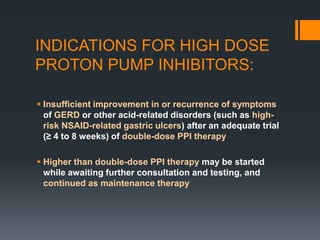
 Insufficient improvement in or recurrence of symptoms
of GERD or other acid-related disorders (such as high-
risk NSAID-related gastric ulcers) after an adequate trial
(≥ 4 to 8 weeks) of double-dose PPI therapy
 Higher than double-dose PPI therapy may be started
while awaiting further consultation and testing, and
continued as maintenance therapy
INDICATIONS FOR HIGH DOSE
PROTON PUMP INHIBITORS:
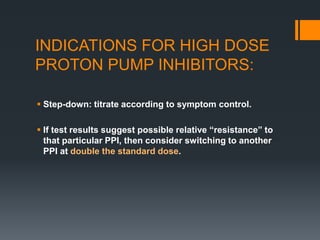
 Step-down: titrate according to symptom control.
 If test results suggest possible relative “resistance” to
that particular PPI, then consider switching to another
PPI at double the standard dose.
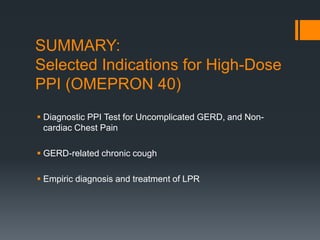
SUMMARY:
Selected Indications for High-Dose
PPI (OMEPRON 40)
 Diagnostic PPI Test for Uncomplicated GERD, and Non-
cardiac Chest Pain
 GERD-related chronic cough
 Empiric diagnosis and treatment of LPR
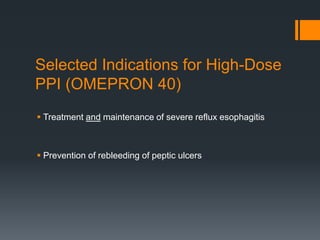
Selected Indications for High-Dose
PPI (OMEPRON 40)
 Treatment and maintenance of severe reflux esophagitis
 Prevention of rebleeding of peptic ulcers
THANK YOU!

HIGH DOSE PPI USE

  • 1.
    CRITERIA FOR USE: HIGHDOSE ORAL PROTON PUMP INHIBITOR ANTONIO C. COMIA, MD
  • 2.
  • 3.
    CRITERIA FOR USE: HIGHDOSE ORAL PROTON PUMP INHIBITOR (THE PROMISE OF OMEPRON 40) ANTONIO C. COMIA, MD
  • 4.
    DOSING ISSUES  STANDARDDOSE: OMEPRAZOLE 20 MG  HIGH DOSE  DOUBLE OR QUADRUPLE DOSE: 20 BID, 40 OD, 40 BID  AS INITIAL THERAPY?  IF INADEQUATE IMPROVEMENT WITH INITIAL STANDARD THERAPY?
  • 5.
    WHEN TO GIVEHIGH DOSE PPI (OMEPRON 40) AS INITIAL THERAPY
  • 6.
    INDICATIONS FOR HIGHDOSE PROTON PUMP INHIBITORS: DIAGNOSIS Diagnostic trial (PPI test)  Uncomplicated GERD: no alarm symptoms  An 8-week therapeutic or empiric trial of double-dose PPI may be considered  Treatment plan should be re-evaluated if there is no response after 8 weeks.
  • 7.
    INDICATIONS FOR HIGHDOSE PROTON PUMP INHIBITORS: GERD-RELATED COUGH  GERD-related chronic nonspecific cough  dry and non-productive cough of ≥ 3 weeks’ duration without any other respiratory symptom, sign, or systemic illness)
  • 8.
    CHRONIC COUGH ANDGERD  When GERD is the cause of chronic cough there may be no GI symptoms – silent GERD  24 hour esophageal pH monitoring provides a sensitive and specific test for the presence of GERD  GERD related cough may take 2 – 3 months to resolve with therapy  Definitive diagnosis of cough resulting from GERD can only be made if the cough resolves with anti-GERD therapy
  • 9.
    CHRONIC COUGH ANDGERD  Accurate diagnosis and therapy of chronic cough due to GERD is difficult  Therapeutic, empiric trial with PPI is reasonable initial diagnostic approach  Non-response does not rule out GERD as cause of chronic cough  Objective investigations for GERD are suggested (esophageal pH monitoring)
  • 10.
    Laryngopharyngeal reflux (LPR) Hoarseness, throat pain, dysphagia, throat clearing, dyspnea, chronic cough  May not have the classic symptoms of GERD  Also called silent reflux.  Cause: LES dysfunction, acid reflux upwards to throat  PPI TEST: useful in diagnosis and treatment  Double dose, given at east 8 weeks
  • 11.
    INDICATIONS FOR HIGHDOSE PROTON PUMP INHIBITORS AS INITIAL THERAPY  Gastric Ulcers – may give Omeprazole 40 mg as initial dose, specially in high risk NSAID patients  Pathologic hypersecretory conditions (e.g., Zollinger- Ellison syndrome) – up to 240 mg/day  Helicobacter pylori eradication to reduce recurrence of duodenal ulcers, as part of dual or triple antibiotic-based therapy – given together with antibiotics  Double-dose PPI therapy, typically for 1–2 weeks
  • 12.
    INDICATIONS FOR HIGHDOSE PROTON PUMP INHIBITORS:  Endoscopic evidence of severe erosive esophagitis  presence of ulceration, stricture, perforation, or bleeding  Presence of Barrett’s  Double-dose PPI as initial therapy  May continue with double dose as maintenance therapy.
  • 13.
    Treatment and maintenancedoses for severe reflux esophagitis  Relapse rates during maintenance of severe reflux esophagitis  17.5% for healing doses (high dose PPI)  29.1% for half-healing doses (standard dose PPI)  Double dose (OMEPRON 40 MG) for healing and maintenance
  • 14.
    HIGH DOSE PPIIN ULCER REBLEEDING  Acid suppression with PPI use significantly reduces the risk of re-bleeding in bleeding peptic ulcers.  The mechanism of action is thought to be related to clot stabilization by increasing gastric pH.  Both oral and intravenous PPIs have been demonstrated to decrease hospital stay, re-bleeding rate and the need for blood transfusion in patients treated with endoscopic therapy.
  • 15.
    INDICATIONS FOR HIGHDOSE PROTON PUMP INHIBITORS:  Prevention of acute rebleeding of peptic ulcers after endoscopic hemostasis  IV PPI initially for 72 hours: 80 MG LD, 8 MG PER HOUR  Quadruple-dose oral PPI may be given in 2 divided doses for 5 days  Standard doses should be used thereafter.
  • 16.
    INDICATIONS FOR HIGHDOSE PROTON PUMP INHIBITORS:  Reduction of risk of upper gastrointestinal bleeding in critically ill patients (STRESS BLEEDING)  who have documented intolerance, contraindication, or insufficient response to intravenous H2RA therapy  Double-dose PPI for up to 2 weeks
  • 17.
    WHEN TO GIVEHIGH DOSE PPI: INADEQUATE IMPROVEMENT WITH STANDARD THERAPY
  • 18.
    REASONS FOR LACKOF RESPONSE  WRONG DIAGNOSIS – MALIGNANCY, NOT ACID- RELATED (GALLSTONES, PANCREATIC DISEASE, COLONIC) – PPI WILL NOT WORK  PATIENT COMPLIANCE, TIMING OF MEDICATIONS  GERD  NOCTURNAL ACID BREAKTHROUGH  ESOPHAGEAL AND GASTRIC MOTILITY DISORDERS  LES DYSFUNCTION
  • 19.
    REASONS FOR LACKOF RESPONSE  BARRETT’S AND LPR – INADEQUATE RESPONSE  PEPTIC ULCERS – CONTINUED ASPIRIN/NSAID USE  RESISTANCE? TOLERANCE?
  • 20.
    INDICATIONS FOR HIGHDOSE PROTON PUMP INHIBITORS  Insufficient improvement in OR recurrence of symptoms of GERD or other acid-related disorders (such as high- risk NSAID-related gastric ulcers)  after an adequate trial (≥ 4 to 8 weeks) of standard-dose PPI  Double-dose PPI (for ≥ 4 weeks) may be started empirically without further diagnostic testing
  • 21.
    INDICATIONS FOR HIGHDOSE PROTON PUMP INHIBITORS:  Insufficient improvement in or recurrence of symptoms of GERD or other acid-related disorders (such as high- risk NSAID-related gastric ulcers) after an adequate trial (≥ 4 to 8 weeks) of double-dose PPI therapy  Higher than double-dose PPI therapy may be started while awaiting further consultation and testing, and continued as maintenance therapy
  • 22.
    INDICATIONS FOR HIGHDOSE PROTON PUMP INHIBITORS:  Step-down: titrate according to symptom control.  If test results suggest possible relative “resistance” to that particular PPI, then consider switching to another PPI at double the standard dose.
  • 23.
    SUMMARY: Selected Indications forHigh-Dose PPI (OMEPRON 40)  Diagnostic PPI Test for Uncomplicated GERD, and Non- cardiac Chest Pain  GERD-related chronic cough  Empiric diagnosis and treatment of LPR
  • 24.
    Selected Indications forHigh-Dose PPI (OMEPRON 40)  Treatment and maintenance of severe reflux esophagitis  Prevention of rebleeding of peptic ulcers
  • 26.