POTASSIUM-COMPETITIVE ACID BLOCKER:
A NEW ERA FOR THE TREATMENT OF ACID-RELATED DISEASES
DR.DEBPROSAD ADHIKARY
MD(GASTRO)
REGISTRAR( MEDICINE),SMCH
• Acid-related diseases (ARDs), such as PUD
and GERD represent a major health-care concern
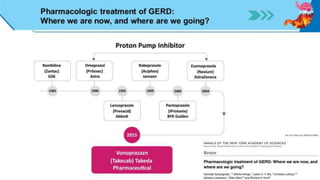
• Major milestones during the last 50 years…
Discovery of H2-receptors and development of
H2RB
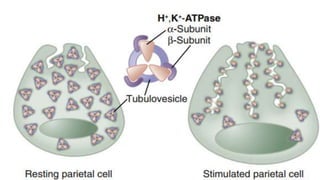
Identification of H+,K+-ATPase as the parietal
cell proton pump and development of PPIs and
Identification of H. pylori as the major cause of
PUD and development of effective eradication
regimens
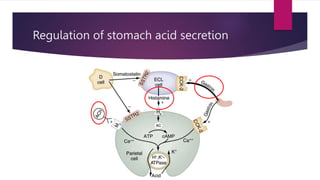
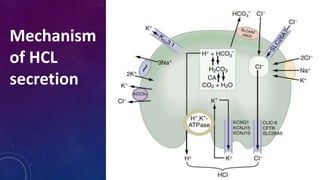
Regulation of stomach acid secretion
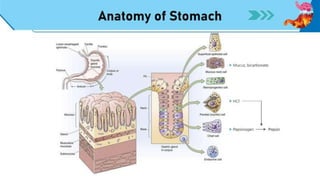
Mechanism
of HCL
secretion
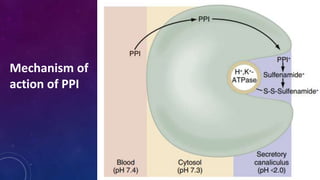
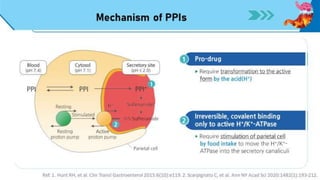
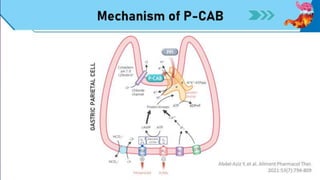
Mechanism of
action of PPI
• Although traditional PPI treatments have
been effective and successful, there are
limitations…
• Slow onset of action
• Short half-life
• Insufficient acid suppression
• Large variation in efficacy among patients due
to CYP2C19 polymorphism
• Unsatisfactory effects at night and
• Instability in acidic conditions
TO OVERCOME THESE…..
• Vonoprazan (TAK-438), a potassium-
competitive acid blocker (P-CAB), was
developed
HISTORY OF POTASSIUM-COMPETITIVE ACID BLOCKERS
(P-CABS)
• P-cabs are a group of drugs developed in early 1980s
• First drug developed was SCH28080 ,but stopped due to its toxic
effects on liver
• AZD 0865(Linaprazan),a reversible inhibitor of PP with rapid onset of
action
• In pase II and III trials showed similar efficacy to esomeprazole for
treating esophagitis
• Further trials could not be conducted as it was not superior to
esomeprazole and there was hepatotoxicity
• Revaprazan,first P-cabs used in clinical practice in South Korea
• Quick onset of action but was not superior to existing PPI
• Vonoprazan fumerate(TAK-438) second P-cab introduced in
clinical practice,marketed in Japan in early 2015s
• Became popular because of its superior properties such as
rapid onset of action,long duration of action,consistent and
potent acid suppression compared to traditional PPI
•Found to have satisfactory effects and a good
safety profile in clinical studies of…
•Gastric and duodenal ulcers
•Reflux esophagitis
•NSAID-associated ulcers and
•H. pylori eradication
•P-CABs inhibit PP in a reversible and K+-
competitive manner
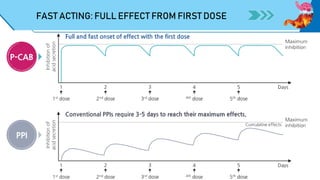
•Exhibit almost complete inhibition of gastric
acid secretion from the first dose
FAST ACTING: FULL EFFECT FROM FIRST DOSE
PHARMACOKINETICS
• Vonoprazan is orally active P-cab accumulate within acid
secretory canaliculi
• Binds to tyr 799 of alpha subunit of PP to compete with
potassium binding and thus inhibits the function of the
pump
• Its effects are reversible and dose dependent
• Meal have no effect on rate of absorption,attains Cmax in
less than 2 hours.Plasma t1/2 is more than 6-9 hours for
vonoprazan
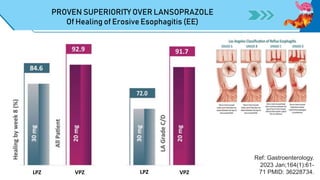
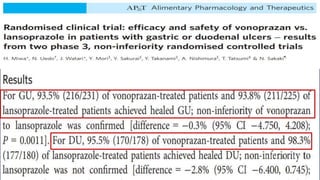
PROVEN SUPERIORITY OVER LANSOPRAZOLE
Of Healing of Erosive Esophagitis (EE)
Ref: Gastroenterology.
2023 Jan;164(1):61-
71 PMID: 36228734.
LPZ VPZ LPZ VPZ
PROVEN SUPERIORITY OVER LANSOPRAZOLE
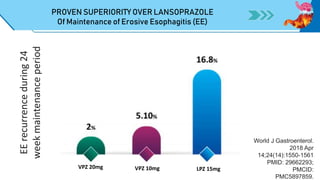
Of Maintenance of Erosive Esophagitis (EE)
World J Gastroenterol.
2018 Apr
14;24(14):1550-1561
PMID: 29662293;
PMCID:
PMC5897859.
EE
recurrence
during
24
week
maintenance
period
VPZ 20mg VPZ 10mg LPZ 15mg
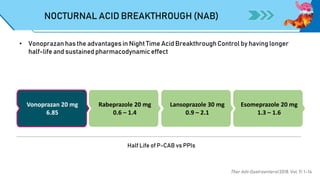
NOCTURNAL ACID BREAKTHROUGH (NAB)
Vonoprazan 20 mg
6.85
Rabeprazole 20 mg
0.6 – 1.4
Lansoprazole 30 mg
0.9 – 2.1
Esomeprazole 20 mg
1.3 – 1.6
• Vonoprazanhas the advantagesin Night Time Acid BreakthroughControl by having longer
half-life and sustained pharmacodynamic effect
Ther Adv Gastroenterol 2018, Vol.11: 1–14
Half Life of P-CAB vs PPIs
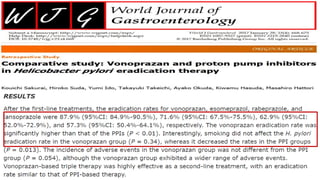
H.PYLORI ERADICATION
• On 2017, WHO listed H.pylori among 16 antibiotic-resistant
bacteria that pose the greatest threat to human health
• H. pylori infection can be eradicated by elevating intragastric
pH using an acid suppressant in combination with at least 2
antibiotics
• H. pylori enters the growth phase from a stationary phase at
intragastric pH above 5, at which point it becomes susceptible
to antibiotics
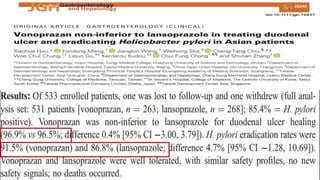
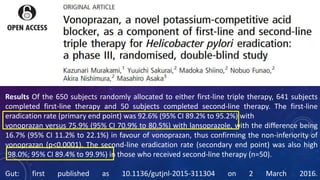
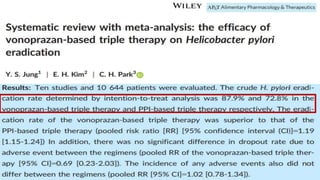
Results Of the 650 subjects randomly allocated to either first-line triple therapy, 641 subjects
completed first-line therapy and 50 subjects completed second-line therapy. The first-line
eradication rate (primary end point) was 92.6% (95% CI 89.2% to 95.2%) with
vonoprazan versus 75.9% (95% CI 70.9% to 80.5%) with lansoprazole, with the difference being
16.7% (95% CI 11.2% to 22.1%) in favour of vonoprazan, thus confirming the non-inferiority of
vonoprazan (p<0.0001). The second-line eradication rate (secondary end point) was also high
(98.0%; 95% CI 89.4% to 99.9%) in those who received second-line therapy (n=50).
Gut: first published as 10.1136/gutjnl-2015-311304 on 2 March 2016.
PREVENTION OF RECURRENCE OF LOW-DOSE
ASPIRIN/NSAIDS-RELATED ULCERS
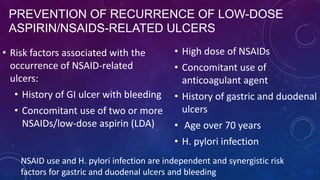
• Risk factors associated with the
occurrence of NSAID-related
ulcers:
• History of GI ulcer with bleeding
• Concomitant use of two or more
NSAIDs/low-dose aspirin (LDA)
• High dose of NSAIDs
• Concomitant use of
anticoagulant agent
• History of gastric and duodenal
ulcers
• Age over 70 years
• H. pylori infection
NSAID use and H. pylori infection are independent and synergistic risk
factors for gastric and duodenal ulcers and bleeding
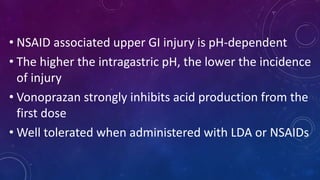
• NSAID associated upper GI injury is pH-dependent
• The higher the intragastric pH, the lower the incidence
of injury
• Vonoprazan strongly inhibits acid production from the
first dose
• Well tolerated when administered with LDA or NSAIDs
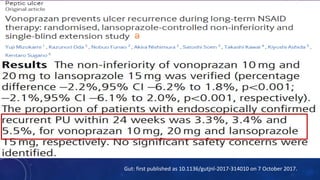
Gut: first published as 10.1136/gutjnl-2017-314010 on 7 October 2017.
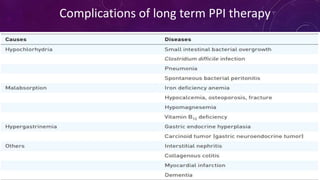
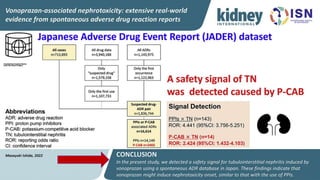
Complications of long term PPI therapy
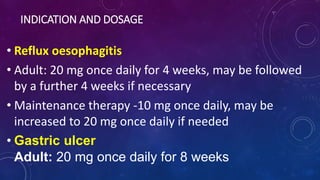
INDICATION AND DOSAGE
• Reflux oesophagitis
• Adult: 20 mg once daily for 4 weeks, may be followed
by a further 4 weeks if necessary
• Maintenance therapy -10 mg once daily, may be
increased to 20 mg once daily if needed
• Gastric ulcer
Adult: 20 mg once daily for 8 weeks
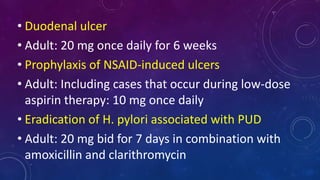
• Duodenal ulcer
• Adult: 20 mg once daily for 6 weeks
• Prophylaxis of NSAID-induced ulcers
• Adult: Including cases that occur during low-dose
aspirin therapy: 10 mg once daily
• Eradication of H. pylori associated with PUD
• Adult: 20 mg bid for 7 days in combination with
amoxicillin and clarithromycin
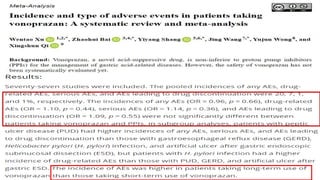
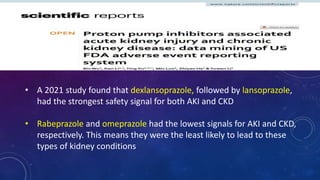
• A 2021 study found that dexlansoprazole, followed by lansoprazole,
had the strongest safety signal for both AKI and CKD
• Rabeprazole and omeprazole had the lowest signals for AKI and CKD,
respectively. This means they were the least likely to lead to these
types of kidney conditions
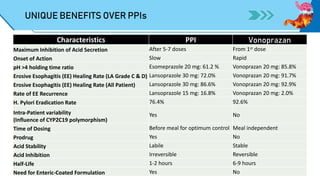
Characteristics PPI Vonoprazan
Maximum Inhibition of Acid Secretion After 5-7 doses From 1st dose
Onset of Action Slow Rapid
pH >4 holding time ratio Esomeprazole 20 mg: 61.2 % Vonoprazan 20 mg: 85.8%
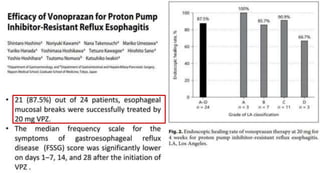
Erosive Esophagitis (EE) Healing Rate (LA Grade C & D) Lansoprazole 30 mg: 72.0% Vonoprazan 20 mg: 91.7%
Erosive Esophagitis (EE) Healing Rate (All Patient) Lansoprazole 30 mg: 86.6% Vonoprazan 20 mg: 92.9%
Rate of EE Recurrence Lansoprazole 15 mg: 16.8% Vonoprazan 20 mg: 2.0%
H. Pylori Eradication Rate 76.4% 92.6%
Intra-Patient variability
(Influence of CYP2C19 polymorphism)
Yes No
Time of Dosing Before meal for optimum control Meal independent
Prodrug Yes No
Acid Stability Labile Stable
Acid Inhibition Irreversible Reversible
Half-Life 1-2 hours 6-9 hours
Need for Enteric-Coated Formulation Yes No
UNIQUE BENEFITS OVER PPIs
BANGLADESH PERSPECTIVE
• There is lack of comprehensive clinical trials conducted within
Bangladesh itself
• Most of the data available on Vonoprazan's efficacy and safety
come from other countries
• May not fully reflect the genetic and lifestyle variations of the
Bangladeshi population
• As a result, there is an urgent need for thorough and locally-
conducted trials to find out the drug's effectiveness and
potential side effects on the people of Bangladesh
Potassium competitive acid blocker.pptx

Potassium competitive acid blocker.pptx

  • 1.
    POTASSIUM-COMPETITIVE ACID BLOCKER: ANEW ERA FOR THE TREATMENT OF ACID-RELATED DISEASES DR.DEBPROSAD ADHIKARY MD(GASTRO) REGISTRAR( MEDICINE),SMCH
  • 2.
    • Acid-related diseases(ARDs), such as PUD and GERD represent a major health-care concern • Major milestones during the last 50 years… Discovery of H2-receptors and development of H2RB Identification of H+,K+-ATPase as the parietal cell proton pump and development of PPIs and Identification of H. pylori as the major cause of PUD and development of effective eradication regimens
  • 4.
    Regulation of stomachacid secretion
  • 5.
  • 7.
  • 11.
    • Although traditionalPPI treatments have been effective and successful, there are limitations… • Slow onset of action • Short half-life • Insufficient acid suppression
  • 12.
    • Large variationin efficacy among patients due to CYP2C19 polymorphism • Unsatisfactory effects at night and • Instability in acidic conditions
  • 13.
    TO OVERCOME THESE….. •Vonoprazan (TAK-438), a potassium- competitive acid blocker (P-CAB), was developed
  • 14.
    HISTORY OF POTASSIUM-COMPETITIVEACID BLOCKERS (P-CABS) • P-cabs are a group of drugs developed in early 1980s • First drug developed was SCH28080 ,but stopped due to its toxic effects on liver • AZD 0865(Linaprazan),a reversible inhibitor of PP with rapid onset of action • In pase II and III trials showed similar efficacy to esomeprazole for treating esophagitis • Further trials could not be conducted as it was not superior to esomeprazole and there was hepatotoxicity
  • 15.
    • Revaprazan,first P-cabsused in clinical practice in South Korea • Quick onset of action but was not superior to existing PPI • Vonoprazan fumerate(TAK-438) second P-cab introduced in clinical practice,marketed in Japan in early 2015s • Became popular because of its superior properties such as rapid onset of action,long duration of action,consistent and potent acid suppression compared to traditional PPI
  • 16.
    •Found to havesatisfactory effects and a good safety profile in clinical studies of… •Gastric and duodenal ulcers •Reflux esophagitis •NSAID-associated ulcers and •H. pylori eradication
  • 17.
    •P-CABs inhibit PPin a reversible and K+- competitive manner •Exhibit almost complete inhibition of gastric acid secretion from the first dose
  • 18.
    FAST ACTING: FULLEFFECT FROM FIRST DOSE
  • 19.
    PHARMACOKINETICS • Vonoprazan isorally active P-cab accumulate within acid secretory canaliculi • Binds to tyr 799 of alpha subunit of PP to compete with potassium binding and thus inhibits the function of the pump • Its effects are reversible and dose dependent • Meal have no effect on rate of absorption,attains Cmax in less than 2 hours.Plasma t1/2 is more than 6-9 hours for vonoprazan
  • 20.
    PROVEN SUPERIORITY OVERLANSOPRAZOLE Of Healing of Erosive Esophagitis (EE) Ref: Gastroenterology. 2023 Jan;164(1):61- 71 PMID: 36228734. LPZ VPZ LPZ VPZ
  • 21.
    PROVEN SUPERIORITY OVERLANSOPRAZOLE Of Maintenance of Erosive Esophagitis (EE) World J Gastroenterol. 2018 Apr 14;24(14):1550-1561 PMID: 29662293; PMCID: PMC5897859. EE recurrence during 24 week maintenance period VPZ 20mg VPZ 10mg LPZ 15mg
  • 22.
    NOCTURNAL ACID BREAKTHROUGH(NAB) Vonoprazan 20 mg 6.85 Rabeprazole 20 mg 0.6 – 1.4 Lansoprazole 30 mg 0.9 – 2.1 Esomeprazole 20 mg 1.3 – 1.6 • Vonoprazanhas the advantagesin Night Time Acid BreakthroughControl by having longer half-life and sustained pharmacodynamic effect Ther Adv Gastroenterol 2018, Vol.11: 1–14 Half Life of P-CAB vs PPIs
  • 26.
    H.PYLORI ERADICATION • On2017, WHO listed H.pylori among 16 antibiotic-resistant bacteria that pose the greatest threat to human health • H. pylori infection can be eradicated by elevating intragastric pH using an acid suppressant in combination with at least 2 antibiotics • H. pylori enters the growth phase from a stationary phase at intragastric pH above 5, at which point it becomes susceptible to antibiotics
  • 27.
    Results Of the650 subjects randomly allocated to either first-line triple therapy, 641 subjects completed first-line therapy and 50 subjects completed second-line therapy. The first-line eradication rate (primary end point) was 92.6% (95% CI 89.2% to 95.2%) with vonoprazan versus 75.9% (95% CI 70.9% to 80.5%) with lansoprazole, with the difference being 16.7% (95% CI 11.2% to 22.1%) in favour of vonoprazan, thus confirming the non-inferiority of vonoprazan (p<0.0001). The second-line eradication rate (secondary end point) was also high (98.0%; 95% CI 89.4% to 99.9%) in those who received second-line therapy (n=50). Gut: first published as 10.1136/gutjnl-2015-311304 on 2 March 2016.
  • 30.
    PREVENTION OF RECURRENCEOF LOW-DOSE ASPIRIN/NSAIDS-RELATED ULCERS • Risk factors associated with the occurrence of NSAID-related ulcers: • History of GI ulcer with bleeding • Concomitant use of two or more NSAIDs/low-dose aspirin (LDA) • High dose of NSAIDs • Concomitant use of anticoagulant agent • History of gastric and duodenal ulcers • Age over 70 years • H. pylori infection NSAID use and H. pylori infection are independent and synergistic risk factors for gastric and duodenal ulcers and bleeding
  • 31.
    • NSAID associatedupper GI injury is pH-dependent • The higher the intragastric pH, the lower the incidence of injury • Vonoprazan strongly inhibits acid production from the first dose • Well tolerated when administered with LDA or NSAIDs
  • 32.
    Gut: first publishedas 10.1136/gutjnl-2017-314010 on 7 October 2017.
  • 33.
    Complications of longterm PPI therapy
  • 35.
    INDICATION AND DOSAGE •Reflux oesophagitis • Adult: 20 mg once daily for 4 weeks, may be followed by a further 4 weeks if necessary • Maintenance therapy -10 mg once daily, may be increased to 20 mg once daily if needed • Gastric ulcer Adult: 20 mg once daily for 8 weeks
  • 36.
    • Duodenal ulcer •Adult: 20 mg once daily for 6 weeks • Prophylaxis of NSAID-induced ulcers • Adult: Including cases that occur during low-dose aspirin therapy: 10 mg once daily • Eradication of H. pylori associated with PUD • Adult: 20 mg bid for 7 days in combination with amoxicillin and clarithromycin
  • 37.
    • A 2021study found that dexlansoprazole, followed by lansoprazole, had the strongest safety signal for both AKI and CKD • Rabeprazole and omeprazole had the lowest signals for AKI and CKD, respectively. This means they were the least likely to lead to these types of kidney conditions
  • 39.
    Characteristics PPI Vonoprazan MaximumInhibition of Acid Secretion After 5-7 doses From 1st dose Onset of Action Slow Rapid pH >4 holding time ratio Esomeprazole 20 mg: 61.2 % Vonoprazan 20 mg: 85.8% Erosive Esophagitis (EE) Healing Rate (LA Grade C & D) Lansoprazole 30 mg: 72.0% Vonoprazan 20 mg: 91.7% Erosive Esophagitis (EE) Healing Rate (All Patient) Lansoprazole 30 mg: 86.6% Vonoprazan 20 mg: 92.9% Rate of EE Recurrence Lansoprazole 15 mg: 16.8% Vonoprazan 20 mg: 2.0% H. Pylori Eradication Rate 76.4% 92.6% Intra-Patient variability (Influence of CYP2C19 polymorphism) Yes No Time of Dosing Before meal for optimum control Meal independent Prodrug Yes No Acid Stability Labile Stable Acid Inhibition Irreversible Reversible Half-Life 1-2 hours 6-9 hours Need for Enteric-Coated Formulation Yes No UNIQUE BENEFITS OVER PPIs
  • 40.
    BANGLADESH PERSPECTIVE • Thereis lack of comprehensive clinical trials conducted within Bangladesh itself • Most of the data available on Vonoprazan's efficacy and safety come from other countries • May not fully reflect the genetic and lifestyle variations of the Bangladeshi population • As a result, there is an urgent need for thorough and locally- conducted trials to find out the drug's effectiveness and potential side effects on the people of Bangladesh