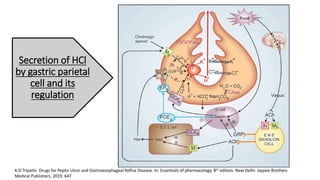
Secretion of HCl
by gastric parietal
cell and its
regulation
K.D Tripathi. Drugs for Peptic Ulcer and Gastroesophageal Reflux Disease. In: Essentials of pharmacology. 8th edition. New Delhi: Jaypee Brothers
Medical Publishers, 2019. 647
DRUGS
 Omeprazole
 Lansoprazole
 Pantoprazole
 Rabeprazole
 Esomeprazole
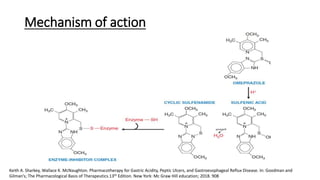
Mechanism of action
Keith A. Sharkey, Wallace K. McNaughton. Pharmacotherapy for Gastric Acidity, Peptic Ulcers, and Gastroesophageal Reflux Disease. In: Goodman and
Gilman’s; The Pharmacological Basis of Therapeutics.13th Edition. New York: Mc Graw Hill education; 2018. 908
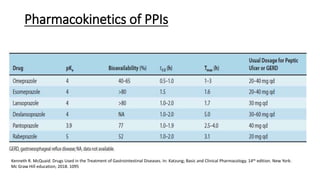
Pharmacokinetics of PPIs
Kenneth R. McQuaid. Drugs Used in the Treatment of Gastrointestinal Diseases. In: Katzung; Basic and Clinical Pharmacology. 14th edition. New York:
Mc Graw Hill education; 2018. 1095
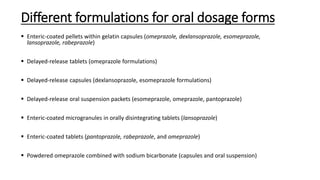
Different formulations for oral dosage forms
 Enteric-coated pellets within gelatin capsules (omeprazole, dexlansoprazole, esomeprazole,
lansoprazole, rabeprazole)
 Delayed-release tablets (omeprazole formulations)
 Delayed-release capsules (dexlansoprazole, esomeprazole formulations)
 Delayed-release oral suspension packets (esomeprazole, omeprazole, pantoprazole)
 Enteric-coated microgranules in orally disintegrating tablets (lansoprazole)
 Enteric-coated tablets (pantoprazole, rabeprazole, and omeprazole)
 Powdered omeprazole combined with sodium bicarbonate (capsules and oral suspension)
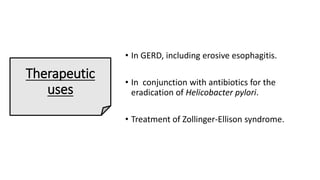
Therapeutic
uses
• In GERD, including erosive esophagitis.
• In conjunction with antibiotics for the
eradication of Helicobacter pylori.
• Treatment of Zollinger-Ellison syndrome.
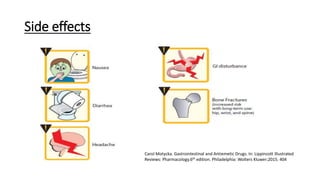
Side effects
Carol Motycka. Gastrointestinal and Antiemetic Drugs. In: Lippincott Illustrated
Reviews: Pharmacology.6th edition. Philadelphia: Wolters Kluwer;2015. 404
Side effects (Contd.)
 Other- Subacute myopathy, arthralgias, headaches, interstitial nephritis, and skin
rashes.
 Chronic use of PPIs has been reported to be associated with increased
susceptibility to certain infections (e.g., hospital-acquired pneumonia,
community-acquired Clostridium difficile)
 Hypergastrinemia
Drug Interactions
• Only omeprazole inhibits CYP2C19 (thereby decreasing the clearance of disulfiram,
phenytoin, and other drugs)
• Also induces the expression of CYP1A2 (thereby increasing the clearance of imipramine,
several antipsychotic drugs, tacrine, and theophylline)
• Some evidence that PPIs can inhibit conversion of clopidogrel (at the level of CYP2C19) to
the active anticoagulating form, but this is controversial
• Concurrent use of clopidogrel and PPIs (mainly pantoprazole) significantly reduces GI
bleeding without increasing adverse cardiac events
• Methotrexate and PPI therapy because PPIs can competitively inhibit methotrexate
elimination and thereby increase methotrexate levels
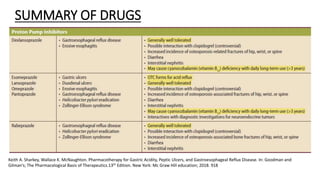
SUMMARY OF DRUGS
Keith A. Sharkey, Wallace K. McNaughton. Pharmacotherapy for Gastric Acidity, Peptic Ulcers, and Gastroesophageal Reflux Disease. In: Goodman and
Gilman’s; The Pharmacological Basis of Therapeutics.13th Edition. New York: Mc Graw Hill education; 2018. 918
REFERENCES
 Keith A. Sharkey, Wallace K. McNaughton. Pharmacotherapy for Gastric Acidity, Peptic Ulcers, and
Gastroesophageal Reflux Disease. In: Goodman and Gilman’s; The Pharmacological Basis of
Therapeutics.13th Edition. New York: Mc Graw Hill education; 2018. 909-912
 Kenneth R. McQuaid. Drugs Used in the Treatment of Gastrointestinal Diseases. In: Katzung; Basic
and Clinical Pharmacology. 14th edition. New York: Mc Graw Hill education; 2018. 1091-1094
 Carol Motycka. Gastrointestinal and Antiemetic Drugs. In: Lippincott Illustrated Reviews:
Pharmacology.6th edition. Philadelphia: Wolters Kluwer;2015. 404-405
• K.D Tripathi. Drugs for Peptic Ulcer and Gastroesophageal Reflux Disease. In: Essentials of
pharmacology. 8th edition. New Delhi: Jaypee Brothers Medical Publishers, 2019. 647-654
• Chronic renal failure does not lead to drug accumulation with once-a-
day dosing of the PPIs. Hepatic disease substantially reduces the
clearance of esomeprazole and lansoprazole. Thus, in patients with
severe hepatic disease, dose reduction is recommended for
esomeprazole and lansoprazole.

Proton pump inhibitors

  • 2.
    Secretion of HCl bygastric parietal cell and its regulation K.D Tripathi. Drugs for Peptic Ulcer and Gastroesophageal Reflux Disease. In: Essentials of pharmacology. 8th edition. New Delhi: Jaypee Brothers Medical Publishers, 2019. 647
  • 3.
    DRUGS  Omeprazole  Lansoprazole Pantoprazole  Rabeprazole  Esomeprazole
  • 4.
    Mechanism of action KeithA. Sharkey, Wallace K. McNaughton. Pharmacotherapy for Gastric Acidity, Peptic Ulcers, and Gastroesophageal Reflux Disease. In: Goodman and Gilman’s; The Pharmacological Basis of Therapeutics.13th Edition. New York: Mc Graw Hill education; 2018. 908
  • 5.
    Pharmacokinetics of PPIs KennethR. McQuaid. Drugs Used in the Treatment of Gastrointestinal Diseases. In: Katzung; Basic and Clinical Pharmacology. 14th edition. New York: Mc Graw Hill education; 2018. 1095
  • 6.
    Different formulations fororal dosage forms  Enteric-coated pellets within gelatin capsules (omeprazole, dexlansoprazole, esomeprazole, lansoprazole, rabeprazole)  Delayed-release tablets (omeprazole formulations)  Delayed-release capsules (dexlansoprazole, esomeprazole formulations)  Delayed-release oral suspension packets (esomeprazole, omeprazole, pantoprazole)  Enteric-coated microgranules in orally disintegrating tablets (lansoprazole)  Enteric-coated tablets (pantoprazole, rabeprazole, and omeprazole)  Powdered omeprazole combined with sodium bicarbonate (capsules and oral suspension)
  • 7.
    Therapeutic uses • In GERD,including erosive esophagitis. • In conjunction with antibiotics for the eradication of Helicobacter pylori. • Treatment of Zollinger-Ellison syndrome.
  • 8.
    Side effects Carol Motycka.Gastrointestinal and Antiemetic Drugs. In: Lippincott Illustrated Reviews: Pharmacology.6th edition. Philadelphia: Wolters Kluwer;2015. 404
  • 9.
    Side effects (Contd.) Other- Subacute myopathy, arthralgias, headaches, interstitial nephritis, and skin rashes.  Chronic use of PPIs has been reported to be associated with increased susceptibility to certain infections (e.g., hospital-acquired pneumonia, community-acquired Clostridium difficile)  Hypergastrinemia
  • 10.
    Drug Interactions • Onlyomeprazole inhibits CYP2C19 (thereby decreasing the clearance of disulfiram, phenytoin, and other drugs) • Also induces the expression of CYP1A2 (thereby increasing the clearance of imipramine, several antipsychotic drugs, tacrine, and theophylline) • Some evidence that PPIs can inhibit conversion of clopidogrel (at the level of CYP2C19) to the active anticoagulating form, but this is controversial • Concurrent use of clopidogrel and PPIs (mainly pantoprazole) significantly reduces GI bleeding without increasing adverse cardiac events • Methotrexate and PPI therapy because PPIs can competitively inhibit methotrexate elimination and thereby increase methotrexate levels
  • 11.
    SUMMARY OF DRUGS KeithA. Sharkey, Wallace K. McNaughton. Pharmacotherapy for Gastric Acidity, Peptic Ulcers, and Gastroesophageal Reflux Disease. In: Goodman and Gilman’s; The Pharmacological Basis of Therapeutics.13th Edition. New York: Mc Graw Hill education; 2018. 918
  • 12.
    REFERENCES  Keith A.Sharkey, Wallace K. McNaughton. Pharmacotherapy for Gastric Acidity, Peptic Ulcers, and Gastroesophageal Reflux Disease. In: Goodman and Gilman’s; The Pharmacological Basis of Therapeutics.13th Edition. New York: Mc Graw Hill education; 2018. 909-912  Kenneth R. McQuaid. Drugs Used in the Treatment of Gastrointestinal Diseases. In: Katzung; Basic and Clinical Pharmacology. 14th edition. New York: Mc Graw Hill education; 2018. 1091-1094  Carol Motycka. Gastrointestinal and Antiemetic Drugs. In: Lippincott Illustrated Reviews: Pharmacology.6th edition. Philadelphia: Wolters Kluwer;2015. 404-405 • K.D Tripathi. Drugs for Peptic Ulcer and Gastroesophageal Reflux Disease. In: Essentials of pharmacology. 8th edition. New Delhi: Jaypee Brothers Medical Publishers, 2019. 647-654
  • 14.
    • Chronic renalfailure does not lead to drug accumulation with once-a- day dosing of the PPIs. Hepatic disease substantially reduces the clearance of esomeprazole and lansoprazole. Thus, in patients with severe hepatic disease, dose reduction is recommended for esomeprazole and lansoprazole.

Editor's Notes

  • #5 IRREVERSIBLE COMPLEX -----PLASMA HALF LIFE 0.5-3 HRS BUT acid suppression 24-48hrs.
  • #7 The delayed-release and enteric-coated tablets dissolve only at alkaline pH, whereas admixture of omeprazole with sodium bicarbonate simply neutralizes stomach acid; both strategies substantially improve the oral bioavailability of these acid-labile drugs. Patients for whom the oral route of administration is not available can be treated parenterally with esomeprazole sodium or pantoprazole.
  • #9 increased susceptibility to certain infections (e.g., hospital-acquired pneumonia, community-acquired Clostridium difficile