CHAPTER 3aCHAPTER 3a
PROPERTIES OF PURE
SUBSTANCES
PROPERTIES OF PURE
SUBSTANCES
CONTENTSCONTENTS
 Pure Subtances
 Phases of a Pure Substances
 Phase Change Processes
 Property Diagrams
 Property Tables
 The Ideal Gas Equation
 Compressibility Factor
 Define a pure substance
 Explain the phase change processes
 Sketch P-v and T-v diagrams for a particular
process
At the end of the lesson, you should be able
to:
LESSON OBJECTIVESLESSON OBJECTIVES
4
PURE SUBSTANCEPURE SUBSTANCE
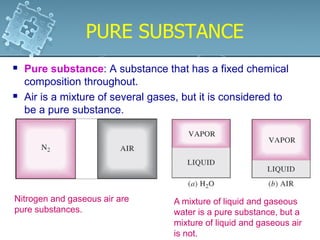
 Pure substance: A substance that has a fixed chemical
composition throughout.
 Air is a mixture of several gases, but it is considered to
be a pure substance.
Nitrogen and gaseous air are
pure substances.
A mixture of liquid and gaseous
water is a pure substance, but a
mixture of liquid and gaseous air
is not.
PHASES OF A PURE SUBSTANCEPHASES OF A PURE SUBSTANCE
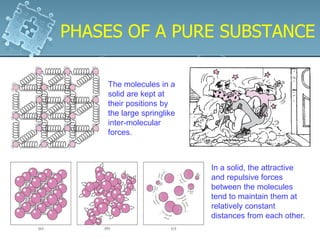
The molecules in a
solid are kept at
their positions by
the large springlike
inter-molecular
forces.
In a solid, the attractive
and repulsive forces
between the molecules
tend to maintain them at
relatively constant
distances from each other.
6
PHASE-CHANGE PROCESSES OF
PURE SUBSTANCES
PHASE-CHANGE PROCESSES OF
PURE SUBSTANCES
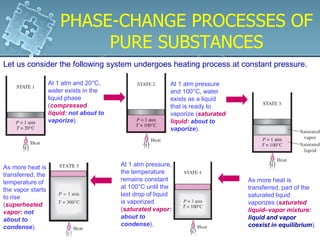
At 1 atm and 20°C,
water exists in the
liquid phase
(compressed
liquid: not about to
vaporize).
At 1 atm pressure
and 100°C, water
exists as a liquid
that is ready to
vaporize (saturated
liquid: about to
vaporize).
Let us consider the following system undergoes heating process at constant pressure.
As more heat is
transferred, part of the
saturated liquid
vaporizes (saturated
liquid–vapor mixture:
liquid and vapor
coexist in equilibrium).
At 1 atm pressure,
the temperature
remains constant
at 100°C until the
last drop of liquid
is vaporized
(saturated vapor:
about to
condense).
As more heat is
transferred, the
temperature of
the vapor starts
to rise
(superheated
vapor: not
about to
condense).
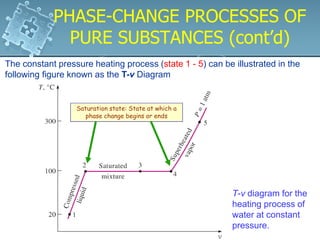
T-v diagram for the
heating process of
water at constant
pressure.
PHASE-CHANGE PROCESSES OF
PURE SUBSTANCES (cont’d)
PHASE-CHANGE PROCESSES OF
PURE SUBSTANCES (cont’d)
The constant pressure heating process (state 1 - 5) can be illustrated in the
following figure known as the T-v Diagram
Saturation state: State at which a
phase change begins or ends
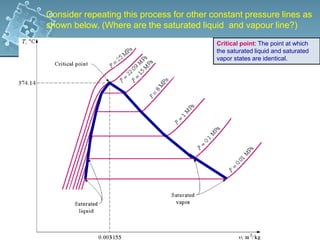
Consider repeating this process for other constant pressure lines as
shown below. (Where are the saturated liquid and vapour line?)
Critical point: The point at which
the saturated liquid and saturated
vapor states are identical.
SATURATION TEMPERATURE
AND SATURATION PRESSURE
SATURATION TEMPERATURE
AND SATURATION PRESSURE
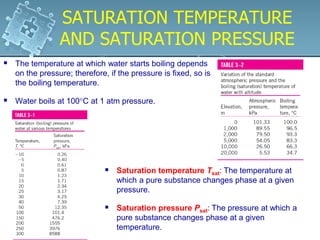
 The temperature at which water starts boiling depends
on the pressure; therefore, if the pressure is fixed, so is
the boiling temperature.
 Water boils at 100C at 1 atm pressure.
 Saturation temperature Tsat: The temperature at
which a pure substance changes phase at a given
pressure.
 Saturation pressure Psat: The pressure at which a
pure substance changes phase at a given
temperature.
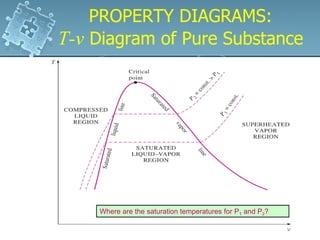
Where are the saturation temperatures for P1 and P2?
PROPERTY DIAGRAMS:
T-v Diagram of Pure Substance
PROPERTY DIAGRAMS:
T-v Diagram of Pure Substance
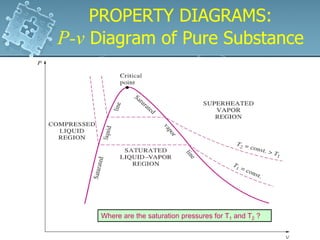
Where are the saturation pressures for T1 and T2 ?
PROPERTY DIAGRAMS:
P-v Diagram of Pure Substance
PROPERTY DIAGRAMS:
P-v Diagram of Pure Substance
Sketch T-v and P-v diagram for the following processes, with
respect to saturation lines. Show initial and final states.
1. A piston cylinder device contains (by mass) 50% liquid water and
50% water vapour in equilibrium at 800 kPa (Tsat=170.4°C). Heat
is transferred at constant pressure until temperature reaches
350°C.
2. Superheated water vapour at 15 bar, T=400°C is allowed to cool
at constant volume until it becomes saturated water vapour.
3. A piston cylinder device contains compressed liquid water. Heat is
added to the system at constant pressure until the entire liquid
is vaporized.
EXERCISESEXERCISES
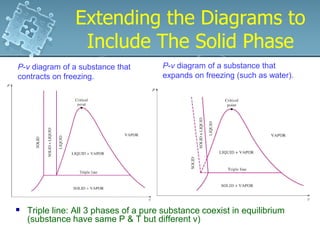
Extending the Diagrams to
Include The Solid Phase
Extending the Diagrams to
Include The Solid Phase
P-v diagram of a substance that
contracts on freezing.
P-v diagram of a substance that
expands on freezing (such as water).
 Triple line: All 3 phases of a pure substance coexist in equilibrium
(substance have same P & T but different v)
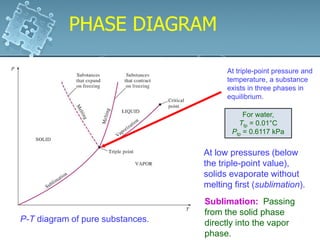
Sublimation:: Passing
from the solid phase
directly into the vapor
phase.
At low pressures (below
the triple-point value),
solids evaporate without
melting first (sublimation).
P-T diagram of pure substances.
At triple-point pressure and
temperature, a substance
exists in three phases in
equilibrium.
For water,
Ttp = 0.01°C
Ptp = 0.6117 kPa
PHASE DIAGRAMPHASE DIAGRAM
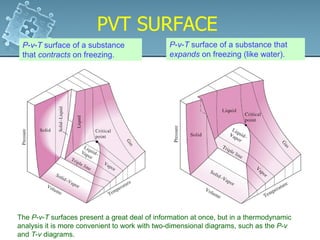
P-v-T surface of a substance
that contracts on freezing.
P-v-T surface of a substance that
expands on freezing (like water).
The P-v-T surfaces present a great deal of information at once, but in a thermodynamic
analysis it is more convenient to work with two-dimensional diagrams, such as the P-v
and T-v diagrams.
PVT SURFACEPVT SURFACE
Class TakeawayClass Takeaway
Indicate the following states of a pure substance on P-v and T-v
diagrams:
(a) Saturated liquid line
(b) Saturated vapour line
(c) Critical point
(d) Triple point line
(e) Saturation temperature lines at 1 and 10 bar
(f) Constant pressure lines at 100oC and 200oC

Chap3a jan13

  • 1.
    CHAPTER 3aCHAPTER 3a PROPERTIESOF PURE SUBSTANCES PROPERTIES OF PURE SUBSTANCES
  • 2.
    CONTENTSCONTENTS  Pure Subtances Phases of a Pure Substances  Phase Change Processes  Property Diagrams  Property Tables  The Ideal Gas Equation  Compressibility Factor
  • 3.
     Define apure substance  Explain the phase change processes  Sketch P-v and T-v diagrams for a particular process At the end of the lesson, you should be able to: LESSON OBJECTIVESLESSON OBJECTIVES
  • 4.
    4 PURE SUBSTANCEPURE SUBSTANCE Pure substance: A substance that has a fixed chemical composition throughout.  Air is a mixture of several gases, but it is considered to be a pure substance. Nitrogen and gaseous air are pure substances. A mixture of liquid and gaseous water is a pure substance, but a mixture of liquid and gaseous air is not.
  • 5.
    PHASES OF APURE SUBSTANCEPHASES OF A PURE SUBSTANCE The molecules in a solid are kept at their positions by the large springlike inter-molecular forces. In a solid, the attractive and repulsive forces between the molecules tend to maintain them at relatively constant distances from each other.
  • 6.
  • 7.
    PHASE-CHANGE PROCESSES OF PURESUBSTANCES PHASE-CHANGE PROCESSES OF PURE SUBSTANCES At 1 atm and 20°C, water exists in the liquid phase (compressed liquid: not about to vaporize). At 1 atm pressure and 100°C, water exists as a liquid that is ready to vaporize (saturated liquid: about to vaporize). Let us consider the following system undergoes heating process at constant pressure. As more heat is transferred, part of the saturated liquid vaporizes (saturated liquid–vapor mixture: liquid and vapor coexist in equilibrium). At 1 atm pressure, the temperature remains constant at 100°C until the last drop of liquid is vaporized (saturated vapor: about to condense). As more heat is transferred, the temperature of the vapor starts to rise (superheated vapor: not about to condense).
  • 8.
    T-v diagram forthe heating process of water at constant pressure. PHASE-CHANGE PROCESSES OF PURE SUBSTANCES (cont’d) PHASE-CHANGE PROCESSES OF PURE SUBSTANCES (cont’d) The constant pressure heating process (state 1 - 5) can be illustrated in the following figure known as the T-v Diagram Saturation state: State at which a phase change begins or ends
  • 9.
    Consider repeating thisprocess for other constant pressure lines as shown below. (Where are the saturated liquid and vapour line?) Critical point: The point at which the saturated liquid and saturated vapor states are identical.
  • 10.
    SATURATION TEMPERATURE AND SATURATIONPRESSURE SATURATION TEMPERATURE AND SATURATION PRESSURE  The temperature at which water starts boiling depends on the pressure; therefore, if the pressure is fixed, so is the boiling temperature.  Water boils at 100C at 1 atm pressure.  Saturation temperature Tsat: The temperature at which a pure substance changes phase at a given pressure.  Saturation pressure Psat: The pressure at which a pure substance changes phase at a given temperature.
  • 11.
    Where are thesaturation temperatures for P1 and P2? PROPERTY DIAGRAMS: T-v Diagram of Pure Substance PROPERTY DIAGRAMS: T-v Diagram of Pure Substance
  • 12.
    Where are thesaturation pressures for T1 and T2 ? PROPERTY DIAGRAMS: P-v Diagram of Pure Substance PROPERTY DIAGRAMS: P-v Diagram of Pure Substance
  • 13.
    Sketch T-v andP-v diagram for the following processes, with respect to saturation lines. Show initial and final states. 1. A piston cylinder device contains (by mass) 50% liquid water and 50% water vapour in equilibrium at 800 kPa (Tsat=170.4°C). Heat is transferred at constant pressure until temperature reaches 350°C. 2. Superheated water vapour at 15 bar, T=400°C is allowed to cool at constant volume until it becomes saturated water vapour. 3. A piston cylinder device contains compressed liquid water. Heat is added to the system at constant pressure until the entire liquid is vaporized. EXERCISESEXERCISES
  • 14.
    Extending the Diagramsto Include The Solid Phase Extending the Diagrams to Include The Solid Phase P-v diagram of a substance that contracts on freezing. P-v diagram of a substance that expands on freezing (such as water).  Triple line: All 3 phases of a pure substance coexist in equilibrium (substance have same P & T but different v)
  • 15.
    Sublimation:: Passing from thesolid phase directly into the vapor phase. At low pressures (below the triple-point value), solids evaporate without melting first (sublimation). P-T diagram of pure substances. At triple-point pressure and temperature, a substance exists in three phases in equilibrium. For water, Ttp = 0.01°C Ptp = 0.6117 kPa PHASE DIAGRAMPHASE DIAGRAM
  • 16.
    P-v-T surface ofa substance that contracts on freezing. P-v-T surface of a substance that expands on freezing (like water). The P-v-T surfaces present a great deal of information at once, but in a thermodynamic analysis it is more convenient to work with two-dimensional diagrams, such as the P-v and T-v diagrams. PVT SURFACEPVT SURFACE
  • 17.
    Class TakeawayClass Takeaway Indicatethe following states of a pure substance on P-v and T-v diagrams: (a) Saturated liquid line (b) Saturated vapour line (c) Critical point (d) Triple point line (e) Saturation temperature lines at 1 and 10 bar (f) Constant pressure lines at 100oC and 200oC