The Move Toward Modernism:  Post Impressionists:  Van Gogh and Gauguin Chapter 31 Humanities 103 Instructor Beth Camp Spring 2003
Post-Impressionists Rejected idea that art has moral purpose Decided that art should not be created in response to patrons or the public Pursued “art for art’s sake” Return to Romantic idea:  emotion, sensation, dropped “themes” and went for technique, isolation, outside convention and society
Van Gogh (1853-1890) Poverty, depression 800 paintings, 1,600 drawings Influenced by Japanese prints Painted landscapes, portraits, still lifes Used palette knife and vivid color to express emotion Brought psychological intensity to painting
Van Gogh Early years 1881-1886 The Netherlands “ I think an artist needn’t be a clergyman or a churchwarden, but he certainly must have a warm heart for his fellow men” (1883)
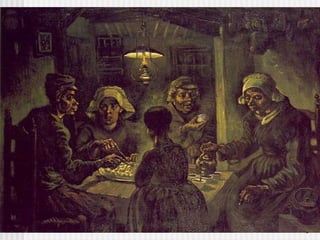
Van Gogh Avenue of Poplars in Winter,  1884 Next:  The Potato Eaters , 1885
 
Van Gogh Years in Paris (1886-1888) Eager to learn about Impressionism, Van Gogh met Toulouse-Lautrec, Paul Gauguin and Georges Seurat Painted 24 portraits in 2 years in Paris “ It is difficult to know oneself--but it isn’t easy to paint oneself either.”  (1887) Next:  Irises,  1889
Van Gogh
Van Gogh, Arles 1888-1889 Disillusioned by Paris, he moves to southern France to set up art colony “ . . . The Zouaves, the brothels, the adorable little Arlesiennes going to their first Communion, the priest in his surplice, who looks like a dangerous rhinocerous, the people drinking absinthe, all seem to me creatures from another world.”
Van Gogh Night Café , 1888 Next:  The Sower,  1888
Van Gogh
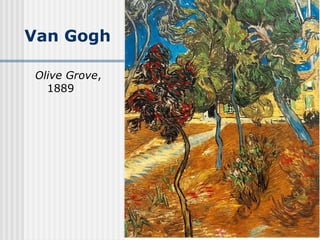
Van Gogh Olive Grove , 1889
Van Gogh “That which excites me most, much, much more than the other things in my work is the portrait, the modern portrait . . . I would like to  make portraits which will appear as revelations to people in a hundred years time.”
Van Gogh The Postman,  Joseph Roulin,   six portraits
Van Gogh M. Gauchet
Van Gogh Self-Portrait,  1889
Van Gogh Self-portrait, 1887
Van Gogh Self-portrait with Gray Felt Hat,  1887 Next:  Starry Night , 1889
Van Gogh
Wheat Field with Crows,  1890
About Van Gogh What is your impression of Van Gogh’s work? Which one or two paintings were you most intrigued by?  Why? How would you describe the “subtext” of Van Gogh’s work?
Van Gogh
Van Gogh:  The Starry Night Van Gogh painted “The Starry Night” by looking through the window of his asylum; considered earliest “expressionism” (extreme feeling). Van Gogh wrote to Theo: “Just as we take the train to get to Tarascon or Rouen, we take death to reach a star.” Two symbols to notice: Cypress tree = traditional symbol of death and eternal life links earth with stars Venus = brightest star = love What does this add to your interpretation?
Gauguin (1848-1903) French painter and woodcut artist At 35, rejected career as stockbroker Inspired by folk art (Brittany, South Seas), 1891 went to Tahiti following abortive partnership with Van Gogh 1903 died in South Seas in poverty Next:  Breton Girls Dancing, Pont-Aven,  1888
Gauguin
Gauguin “The combinations are unlimited.  The mixture of colors produces a dirty tone.  Any color alone is a crudity and does not exist in nature.  Colors exist only in an apparent rainbow, but how well rich nature took care to show them to you side by side in an established and unalterable order,  as if each color was born out of another!”
Gauguin
Gauguin
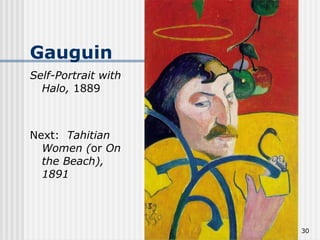
Gauguin Self-Portrait with Halo,  1889 Next:  Tahitian Women ( or  On the Beach), 1891
 
Gauguin We Hail Thee  Mary , 1891
Gauguin Contes Barbares, 1902
Where Do We Come From? What Are We? Where Are We Going?  1897
About Gauguin What is your impression of Gauguin’s work? Which one or two paintings were you most intrigued by?  Why?  How would you describe the “subtext” of Gauguin’s work?
About Post-Impressionism  Based on what you know now, how would you describe the difference between “Impressionism” and “Post-Impressionism”? What were the most memorable images from this slide show?  Why?
Sources Slides from Mark Hardin’s  Artchive

Pp Chap31 Post

  • 1.
    The Move TowardModernism: Post Impressionists: Van Gogh and Gauguin Chapter 31 Humanities 103 Instructor Beth Camp Spring 2003
  • 2.
    Post-Impressionists Rejected ideathat art has moral purpose Decided that art should not be created in response to patrons or the public Pursued “art for art’s sake” Return to Romantic idea: emotion, sensation, dropped “themes” and went for technique, isolation, outside convention and society
  • 3.
    Van Gogh (1853-1890)Poverty, depression 800 paintings, 1,600 drawings Influenced by Japanese prints Painted landscapes, portraits, still lifes Used palette knife and vivid color to express emotion Brought psychological intensity to painting
  • 4.
    Van Gogh Earlyyears 1881-1886 The Netherlands “ I think an artist needn’t be a clergyman or a churchwarden, but he certainly must have a warm heart for his fellow men” (1883)
  • 5.
    Van Gogh Avenueof Poplars in Winter, 1884 Next: The Potato Eaters , 1885
  • 6.
  • 7.
    Van Gogh Yearsin Paris (1886-1888) Eager to learn about Impressionism, Van Gogh met Toulouse-Lautrec, Paul Gauguin and Georges Seurat Painted 24 portraits in 2 years in Paris “ It is difficult to know oneself--but it isn’t easy to paint oneself either.” (1887) Next: Irises, 1889
  • 8.
  • 9.
    Van Gogh, Arles1888-1889 Disillusioned by Paris, he moves to southern France to set up art colony “ . . . The Zouaves, the brothels, the adorable little Arlesiennes going to their first Communion, the priest in his surplice, who looks like a dangerous rhinocerous, the people drinking absinthe, all seem to me creatures from another world.”
  • 10.
    Van Gogh NightCafé , 1888 Next: The Sower, 1888
  • 11.
  • 12.
    Van Gogh OliveGrove , 1889
  • 13.
    Van Gogh “Thatwhich excites me most, much, much more than the other things in my work is the portrait, the modern portrait . . . I would like to make portraits which will appear as revelations to people in a hundred years time.”
  • 14.
    Van Gogh ThePostman, Joseph Roulin, six portraits
  • 15.
    Van Gogh M.Gauchet
  • 16.
  • 17.
  • 18.
  • 19.
    Van Gogh Self-portraitwith Gray Felt Hat, 1887 Next: Starry Night , 1889
  • 20.
  • 21.
    Wheat Field withCrows, 1890
  • 22.
    About Van GoghWhat is your impression of Van Gogh’s work? Which one or two paintings were you most intrigued by? Why? How would you describe the “subtext” of Van Gogh’s work?
  • 23.
  • 24.
    Van Gogh: The Starry Night Van Gogh painted “The Starry Night” by looking through the window of his asylum; considered earliest “expressionism” (extreme feeling). Van Gogh wrote to Theo: “Just as we take the train to get to Tarascon or Rouen, we take death to reach a star.” Two symbols to notice: Cypress tree = traditional symbol of death and eternal life links earth with stars Venus = brightest star = love What does this add to your interpretation?
  • 25.
    Gauguin (1848-1903) Frenchpainter and woodcut artist At 35, rejected career as stockbroker Inspired by folk art (Brittany, South Seas), 1891 went to Tahiti following abortive partnership with Van Gogh 1903 died in South Seas in poverty Next: Breton Girls Dancing, Pont-Aven, 1888
  • 26.
  • 27.
    Gauguin “The combinationsare unlimited. The mixture of colors produces a dirty tone. Any color alone is a crudity and does not exist in nature. Colors exist only in an apparent rainbow, but how well rich nature took care to show them to you side by side in an established and unalterable order, as if each color was born out of another!”
  • 28.
  • 29.
  • 30.
    Gauguin Self-Portrait withHalo, 1889 Next: Tahitian Women ( or On the Beach), 1891
  • 31.
  • 32.
    Gauguin We HailThee Mary , 1891
  • 33.
  • 34.
    Where Do WeCome From? What Are We? Where Are We Going? 1897
  • 35.
    About Gauguin Whatis your impression of Gauguin’s work? Which one or two paintings were you most intrigued by? Why? How would you describe the “subtext” of Gauguin’s work?
  • 36.
    About Post-Impressionism Based on what you know now, how would you describe the difference between “Impressionism” and “Post-Impressionism”? What were the most memorable images from this slide show? Why?
  • 37.
    Sources Slides fromMark Hardin’s Artchive

Editor's Notes

  • #35 From Mark Hardin, Artchive: Text from " Sister Wendy's American Masterpieces ": "This is Gauguin's ultimate masterpiece - if all the Gauguins in the world, except one, were to be evaporated (perish the thought!), this would be the one to preserve. He claimed that he did not think of the long title until the work was finished, but he is known to have been creative with the truth. The picture is so superbly organized into three "scoops" - a circle to right and to left, and a great oval in the center - that I cannot but believe he had his questions in mind from the start. I am often tempted to forget that these are questions, and to think that he is suggesting answers, but there are no answers here; there are three fundamental questions, posed visually. "On the right (Where do we come from?), we see the baby, and three young women - those who are closest to that eternal mystery. In the center, Gauguin meditates on what we are. Here are two women, talking about destiny (or so he described them), a man looking puzzled and half-aggressive, and in the middle, a youth plucking the fruit of experience. This has nothing to do, I feel sure, with the Garden of Eden; it is humanity's innocent and natural desire to live and to search for more life. A child eats the fruit, overlooked by the remote presence of an idol - emblem of our need for the spiritual. There are women (one mysteriously curled up into a shell), and there are animals with whom we share the world: a goat, a cat, and kittens. In the final section (Where are we going?), a beautiful young woman broods, and an old woman prepares to die. Her pallor and gray hair tell us so, but the message is underscored by the presence of a strange white bird. I once described it as "a mutated puffin," and I do not think I can do better. It is Gauguin's symbol of the afterlife, of the unknown (just as the dog, on the far right, is his symbol of himself). "All this is set in a paradise of tropical beauty: the Tahiti of sunlight, freedom, and color that Gauguin left everything to find. A little river runs through the woods, and behind it is a great slash of brilliant blue sea, with the misty mountains of another island rising beyond Gauguin wanted to make it absolutely clear that this picture was his testament. He seems to have concocted a story that, being ill and unappreciated (that part was true enough), he determined on suicide - the great refusal. He wrote to a friend, describing his journey into the mountains with arsenic. Then he found himself still alive, and returned to paint more masterworks. It is sad that so great an artist felt he needed to manufacture a ploy to get people to appreciate his work. I wish he could see us now, looking with awe at this supreme painting."