Vincent Van Gogh
slides by Micaella Joy Gamos, information from britannica.com/biography/VIncent-van-Gogh
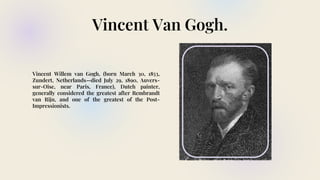
Vincent Van Gogh.
Vincent Willem van Gogh, (born March 30, 1853,
Zundert, Netherlands—died July 29, 1890, Auvers-
sur-Oise, near Paris, France), Dutch painter,
generally considered the greatest after Rembrandt
van Rijn, and one of the greatest of the Post-
Impressionists.
Early Life.
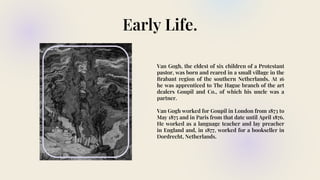
Van Gogh, the eldest of six children of a Protestant
pastor, was born and reared in a small village in the
Brabant region of the southern Netherlands. At 16
he was apprenticed to The Hague branch of the art
dealers Goupil and Co., of which his uncle was a
partner.
Van Gogh worked for Goupil in London from 1873 to
May 1875 and in Paris from that date until April 1876.
He worked as a language teacher and lay preacher
in England and, in 1877, worked for a bookseller in
Dordrecht, Netherlands.
Early Life.
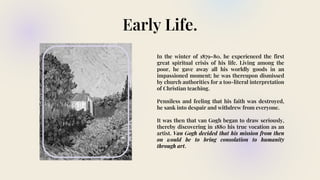
In the winter of 1879–80, he experienced the first
great spiritual crisis of his life. Living among the
poor, he gave away all his worldly goods in an
impassioned moment; he was thereupon dismissed
by church authorities for a too-literal interpretation
of Christian teaching.
Penniless and feeling that his faith was destroyed,
he sank into despair and withdrew from everyone.
It was then that van Gogh began to draw seriously,
thereby discovering in 1880 his true vocation as an
artist. Van Gogh decided that his mission from then
on would be to bring consolation to humanity
through art.
The Productive Decade.
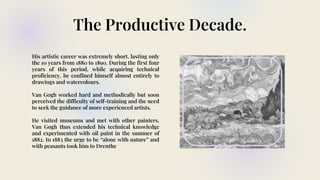
His artistic career was extremely short, lasting only
the 10 years from 1880 to 1890. During the first four
years of this period, while acquiring technical
proficiency, he confined himself almost entirely to
drawings and watercolours.
Van Gogh worked hard and methodically but soon
perceived the difficulty of self-training and the need
to seek the guidance of more experienced artists.
He visited museums and met with other painters.
Van Gogh thus extended his technical knowledge
and experimented with oil paint in the summer of
1882. In 1883 the urge to be “alone with nature” and
with peasants took him to Drenthe
The Productive Decade.
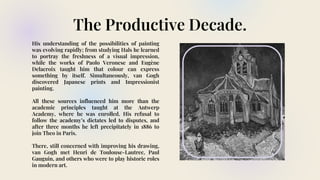
His understanding of the possibilities of painting
was evolving rapidly; from studying Hals he learned
to portray the freshness of a visual impression,
while the works of Paolo Veronese and Eugène
Delacroix taught him that colour can express
something by itself. Simultaneously, van Gogh
discovered Japanese prints and Impressionist
painting.
All these sources influenced him more than the
academic principles taught at the Antwerp
Academy, where he was enrolled. His refusal to
follow the academy’s dictates led to disputes, and
after three months he left precipitately in 1886 to
join Theo in Paris.
There, still concerned with improving his drawing,
van Gogh met Henri de Toulouse-Lautrec, Paul
Gauguin, and others who were to play historic roles
in modern art.
The Productive Decade.
After two years van Gogh was tired of city life,
physically exhausted, and longing “to look at nature
under a brighter sky.” His passion was now for “a
full effect of colour.” He left Paris in February 1888
for Arles, in southeastern France.
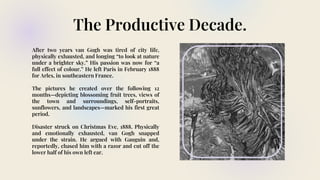
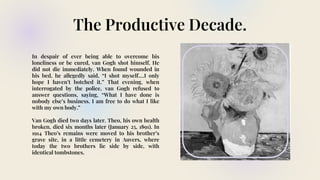
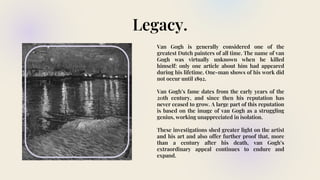
The pictures he created over the following 12
months—depicting blossoming fruit trees, views of
the town and surroundings, self-portraits,
sunflowers, and landscapes—marked his first great
period.
Disaster struck on Christmas Eve, 1888. Physically
and emotionally exhausted, van Gogh snapped
under the strain. He argued with Gauguin and,
reportedly, chased him with a razor and cut off the
lower half of his own left ear.
The Productive Decade.
Whatever transpired, van Gogh took responsibility
and was hospitalized; Gauguin left for Paris.
Van Gogh returned home a fortnight later and
resumed painting, producing a mirror-image Self-
Portrait with Bandaged Ear and Pipe.
Several weeks later, he again showed symptoms of
mental disturbance severe enough to cause him to
be sent back to the hospital. At the end of April 1889,
fearful of losing his renewed capacity for work,
which he regarded as a guarantee of his sanity, he
asked to be temporarily shut up in the asylum at
Saint-Rémy-de-Provence in order to be under
medical supervision.
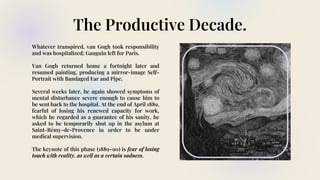
The keynote of this phase (1889–90) is fear of losing
touch with reality, as well as a certain sadness.
The Productive Decade.
In despair of ever being able to overcome his
loneliness or be cured, van Gogh shot himself. He
did not die immediately. When found wounded in
his bed, he allegedly said, “I shot myself.…I only
hope I haven’t botched it.” That evening, when
interrogated by the police, van Gogh refused to
answer questions, saying, “What I have done is
nobody else’s business. I am free to do what I like
with my own body.”
Van Gogh died two days later. Theo, his own health
broken, died six months later (January 25, 1891). In
1914 Theo’s remains were moved to his brother’s
grave site, in a little cemetery in Auvers, where
today the two brothers lie side by side, with
identical tombstones.
Legacy.
Van Gogh is generally considered one of the
greatest Dutch painters of all time. The name of van
Gogh was virtually unknown when he killed
himself: only one article about him had appeared
during his lifetime. One-man shows of his work did
not occur until 1892.
Van Gogh’s fame dates from the early years of the
20th century, and since then his reputation has
never ceased to grow. A large part of this reputation
is based on the image of van Gogh as a struggling
genius, working unappreciated in isolation.
These investigations shed greater light on the artist
and his art and also offer further proof that, more
than a century after his death, van Gogh’s
extraordinary appeal continues to endure and
expand.

Vincent van Gogh.

  • 1.
    Vincent Van Gogh slidesby Micaella Joy Gamos, information from britannica.com/biography/VIncent-van-Gogh
  • 2.
    Vincent Van Gogh. VincentWillem van Gogh, (born March 30, 1853, Zundert, Netherlands—died July 29, 1890, Auvers- sur-Oise, near Paris, France), Dutch painter, generally considered the greatest after Rembrandt van Rijn, and one of the greatest of the Post- Impressionists.
  • 3.
    Early Life. Van Gogh,the eldest of six children of a Protestant pastor, was born and reared in a small village in the Brabant region of the southern Netherlands. At 16 he was apprenticed to The Hague branch of the art dealers Goupil and Co., of which his uncle was a partner. Van Gogh worked for Goupil in London from 1873 to May 1875 and in Paris from that date until April 1876. He worked as a language teacher and lay preacher in England and, in 1877, worked for a bookseller in Dordrecht, Netherlands.
  • 4.
    Early Life. In thewinter of 1879–80, he experienced the first great spiritual crisis of his life. Living among the poor, he gave away all his worldly goods in an impassioned moment; he was thereupon dismissed by church authorities for a too-literal interpretation of Christian teaching. Penniless and feeling that his faith was destroyed, he sank into despair and withdrew from everyone. It was then that van Gogh began to draw seriously, thereby discovering in 1880 his true vocation as an artist. Van Gogh decided that his mission from then on would be to bring consolation to humanity through art.
  • 5.
    The Productive Decade. Hisartistic career was extremely short, lasting only the 10 years from 1880 to 1890. During the first four years of this period, while acquiring technical proficiency, he confined himself almost entirely to drawings and watercolours. Van Gogh worked hard and methodically but soon perceived the difficulty of self-training and the need to seek the guidance of more experienced artists. He visited museums and met with other painters. Van Gogh thus extended his technical knowledge and experimented with oil paint in the summer of 1882. In 1883 the urge to be “alone with nature” and with peasants took him to Drenthe
  • 6.
    The Productive Decade. Hisunderstanding of the possibilities of painting was evolving rapidly; from studying Hals he learned to portray the freshness of a visual impression, while the works of Paolo Veronese and Eugène Delacroix taught him that colour can express something by itself. Simultaneously, van Gogh discovered Japanese prints and Impressionist painting. All these sources influenced him more than the academic principles taught at the Antwerp Academy, where he was enrolled. His refusal to follow the academy’s dictates led to disputes, and after three months he left precipitately in 1886 to join Theo in Paris. There, still concerned with improving his drawing, van Gogh met Henri de Toulouse-Lautrec, Paul Gauguin, and others who were to play historic roles in modern art.
  • 7.
    The Productive Decade. Aftertwo years van Gogh was tired of city life, physically exhausted, and longing “to look at nature under a brighter sky.” His passion was now for “a full effect of colour.” He left Paris in February 1888 for Arles, in southeastern France. The pictures he created over the following 12 months—depicting blossoming fruit trees, views of the town and surroundings, self-portraits, sunflowers, and landscapes—marked his first great period. Disaster struck on Christmas Eve, 1888. Physically and emotionally exhausted, van Gogh snapped under the strain. He argued with Gauguin and, reportedly, chased him with a razor and cut off the lower half of his own left ear.
  • 8.
    The Productive Decade. Whatevertranspired, van Gogh took responsibility and was hospitalized; Gauguin left for Paris. Van Gogh returned home a fortnight later and resumed painting, producing a mirror-image Self- Portrait with Bandaged Ear and Pipe. Several weeks later, he again showed symptoms of mental disturbance severe enough to cause him to be sent back to the hospital. At the end of April 1889, fearful of losing his renewed capacity for work, which he regarded as a guarantee of his sanity, he asked to be temporarily shut up in the asylum at Saint-Rémy-de-Provence in order to be under medical supervision. The keynote of this phase (1889–90) is fear of losing touch with reality, as well as a certain sadness.
  • 9.
    The Productive Decade. Indespair of ever being able to overcome his loneliness or be cured, van Gogh shot himself. He did not die immediately. When found wounded in his bed, he allegedly said, “I shot myself.…I only hope I haven’t botched it.” That evening, when interrogated by the police, van Gogh refused to answer questions, saying, “What I have done is nobody else’s business. I am free to do what I like with my own body.” Van Gogh died two days later. Theo, his own health broken, died six months later (January 25, 1891). In 1914 Theo’s remains were moved to his brother’s grave site, in a little cemetery in Auvers, where today the two brothers lie side by side, with identical tombstones.
  • 10.
    Legacy. Van Gogh isgenerally considered one of the greatest Dutch painters of all time. The name of van Gogh was virtually unknown when he killed himself: only one article about him had appeared during his lifetime. One-man shows of his work did not occur until 1892. Van Gogh’s fame dates from the early years of the 20th century, and since then his reputation has never ceased to grow. A large part of this reputation is based on the image of van Gogh as a struggling genius, working unappreciated in isolation. These investigations shed greater light on the artist and his art and also offer further proof that, more than a century after his death, van Gogh’s extraordinary appeal continues to endure and expand.