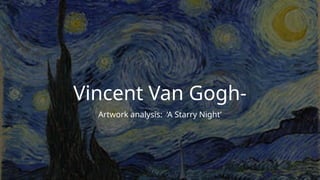
Vincent Van Gogh-
Artwork analysis: ‘A Starry Night’
An Excellent overview of Van Gogh’s ‘A Starry
Night’
https://www.youtube.com/watch?v=wk9L1N9bRRE
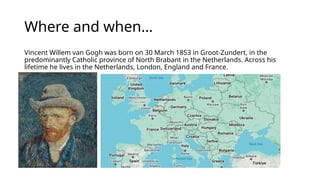
Where and when…
Vincent Willem van Gogh was born on 30 March 1853 in Groot-Zundert, in the
predominantly Catholic province of North Brabant in the Netherlands. Across his
lifetime he lives in the Netherlands, London, England and France.
Overview of his life
Vincent van Gogh (1853–1890)
Vincent Willem van Gogh was a Dutch Post-Impressionist painter who
posthumously became one of the most famous and influential figures in
Western art history. In a decade, he created about 2,100 artworks,
including around 860 oil paintings, most of which date from the last two
years of his life.
They include artworks characterized by bold colours and dramatic,
impulsive and expressive brushwork that contributed to the foundations
of modern art. Not commercially successful, he struggled with severe
depression and poverty, eventually leading to his suicide at age thirty-
seven.
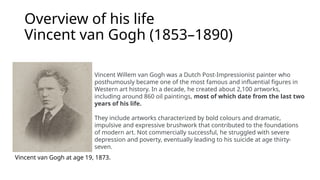
Vincent van Gogh at age 19, 1873.
The potato eaters
Vincent van GoghApril 1885 - May 1885
1885
Van Gogh deliberately chose a composition
which would challenge his growing prowess as a
painter. Like the French realist master Jean-
François Millet, Van Gogh wanted to be a true
“peasant painter.”
This meant Van Gogh tried to paint his subjects
with deep feeling, but without sentimentality.
He spoke of them leading 'a way of life
completely different from ours, from that of
civilized people.' He strove to paint the faces,
'the color of a good, dusty potato, unpeeled
naturally,' and to convey the idea that these
people had 'used the same hands with which
they now take food from the plate to dig the
earth […] and had thus earned their meal
honestly.'
1886
Van Gogh painted this in early 1886, while
studying at the art academy in Antwerp. The
painting shows that he had a good command of
anatomy. Drawing skeletons was a standard
exercise at the academy but painting them was
not part of the curriculum. He must have made
this painting at some other time, in between or
after his lessons.
Head of a Skeleton with a Burning Cigarette
Vincent van Gogh January 1886 - February 1886
Moulin de la Galette
Vincent van Gogh mid-October 1886
1886- Paris, the hub of Impressionism
Van Gogh goes to Paris, the art capital of the world in
his time, because he seeks to develop further as an
artist
The dark palette is still reminiscent of Van Gogh’s
Dutch period. But the broad brushstrokes and fluently
painted buildings and figures demonstrate an urge to
innovate inspired by Impressionism.
Paris was the capital of Impressionism, and the
influence of Impressionists artists such as Claude
Monet, Camille Pissarro, Edgar Degas, and Georges
Seurat, as well as pressure from Theo to sell paintings,
motivated Van Gogh to adopt a lighter palette.
Vincent Van Gogh in conversation with friends, 1887, Paris
Courtesan: after Eisen
Vincent van GoghOctober 1887 - November 1887
Flowering plum orchard: after Hiroshige
Vincent van GoghOctober 1887 - November
1887
1886-1888: Influence of Japanese Art
From 1856 trade relations between France and Japan
were developed, leading to a growing popularity of
Japanese art in Paris. From 1886 to 1888, Van Gogh
became acutely interested in Japanese prints and began to
avidly study and collect them, even curating an exhibition
of them at a Parisian restaurant. Vincent adopted these
Japanese visual inventions in his own work through:
• the composition
• the unusual spatial effects
• the expanses of strong flat colour
• the everyday subjects
• the attention to details from nature.
• imbuing spiritual qualities to nature
1888- The Yellow House
After two in years in Paris, Van Gogh was longing
to escape to the country. In May 1888, Van
Gogh rented four rooms in a yellow house in Arles.
Vincent had finally found a place where he could
not only paint but also welcome his friends. His
goal was to establish a “Studio of the South,”
where he and like-minded artists could work
together.
The yellow house (`The street')
Vincent van Gogh September 1888 - 1888
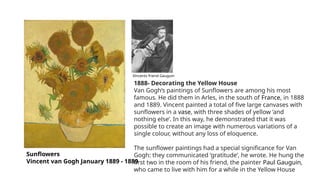
Sunflowers
Vincent van Gogh January 1889 - 1889
1888- Decorating the Yellow House
Van Gogh’s paintings of Sunflowers are among his most
famous. He did them in Arles, in the south of France, in 1888
and 1889. Vincent painted a total of five large canvases with
sunflowers in a vase, with three shades of yellow ‘and
nothing else’. In this way, he demonstrated that it was
possible to create an image with numerous variations of a
single colour, without any loss of eloquence.
The sunflower paintings had a special significance for Van
Gogh: they communicated ‘gratitude’, he wrote. He hung the
first two in the room of his friend, the painter Paul Gauguin,
who came to live with him for a while in the Yellow House
Vincents friend Gauguin
Self-Portrait with Bandaged Ear
Vincent van Gogh1889
1889
Van Gogh painted this in January 1889, a week after
leaving hospital. He had received treatment there after
cutting off most of his left ear (shown here as the
bandaged right ear because he painted himself in a
mirror). This self-mutilation was a desperate act
committed a few weeks earlier, following a heated
argument with his fellow painter Paul Gauguin.
In the background is a canvas on an easel and a
Japanese print, an important source of inspiration.
1889
On May 8, 1889, reeling from his deteriorating mental condition, Van Gogh voluntarily committed himself into a
psychiatric institution in Saint-Remy, near Arles. As the weeks passed, his mental well-being remained stable
and he was allowed to resume painting. This period became one of his most productive. In the year spent at
Saint-Remy, Van Gogh created over 100 works, including Starry Night (1889). The clinic and its garden became
his main subjects, rendered in the dynamic brushstrokes and lush palettes typical of his mature period. On
supervised walks, Van Gogh immersed himself in the experience of the natural surroundings, later recreating
from memory the olive and cypress trees, irises, and other flora that populated the clinic's campus.
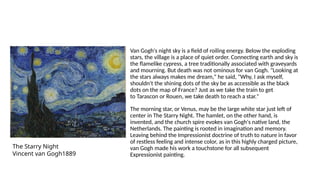
• Van Gogh's night sky is a field of roiling energy. Below the exploding
stars, the village is a place of quiet order. Connecting earth and sky is
the flamelike cypress, a tree traditionally associated with graveyards
and mourning. But death was not ominous for van Gogh. "Looking at
the stars always makes me dream," he said, "Why, I ask myself,
shouldn't the shining dots of the sky be as accessible as the black
dots on the map of France? Just as we take the train to get
to Tarascon or Rouen, we take death to reach a star."
• The morning star, or Venus, may be the large white star just left of
center in The Starry Night. The hamlet, on the other hand, is
invented, and the church spire evokes van Gogh's native land, the
Netherlands. The painting is rooted in imagination and memory.
Leaving behind the Impressionist doctrine of truth to nature in favor
of restless feeling and intense color, as in this highly charged picture,
van Gogh made his work a touchstone for all subsequent
Expressionist painting.
The Starry Night
Vincent van Gogh1889
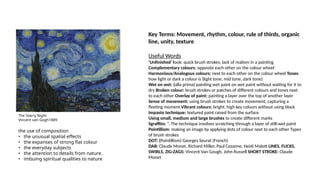
The Starry Night
Vincent van Gogh1889
Key Terms: Movement, rhythm, colour, rule of thirds, organic
line, unity, texture
Useful Words
‘Unfinished’ look: quick brush strokes, lack of realism in a painting
Complementary colours: opposite each other on the colour wheel
Harmonious/Analogous colours: next to each other on the colour wheel Tones:
how light or dark a colour is (light tone, mid tone, dark tone)
Wet on wet: (alla prima) painting wet paint on wet paint without waiting for it to
dry Broken colour: brush strokes or patches of different colours and tones next
to each other Overlay of paint: painting a layer over the top of another layer
Sense of movement: using brush strokes to create movement, capturing a
fleeting moment Vibrant colours: bright, high key colours without using black
Impasto technique: textured paint raised from the surface
Using small, medium and large brushes to create different marks
Sgraffito: ”. The technique involves scratching through a layer of still-wet paint
Pointillism: making an image by applying dots of colour next to each other Types
of brush strokes
DOT: (Pointillism) Georges Seurat (French)
DAB: Claude Monet, Richard Miller, Paul Cezanne, Heidi Malott LINES, FLICKS,
SWIRLS, ZIG-ZAGS: Vincent Van Gough, John Russell SHORT STROKE: Claude
Monet
the use of composition
• the unusual spatial effects
• the expanses of strong flat colour
• the everyday subjects
• the attention to details from nature.
• imbuing spiritual qualities to nature
Exam question:
Exam: Compare and contrast both the Formal Qualities and
Cultural Context of these two artworks:
The Starry Night
Vincent van Gogh1889
The Great Wave off the Coast of Kanagawa
Hokusai1831

Van Gogh - Starry Night Presentation.pptx

  • 1.
    Vincent Van Gogh- Artworkanalysis: ‘A Starry Night’
  • 2.
    An Excellent overviewof Van Gogh’s ‘A Starry Night’ https://www.youtube.com/watch?v=wk9L1N9bRRE
  • 3.
    Where and when… VincentWillem van Gogh was born on 30 March 1853 in Groot-Zundert, in the predominantly Catholic province of North Brabant in the Netherlands. Across his lifetime he lives in the Netherlands, London, England and France.
  • 4.
    Overview of hislife Vincent van Gogh (1853–1890) Vincent Willem van Gogh was a Dutch Post-Impressionist painter who posthumously became one of the most famous and influential figures in Western art history. In a decade, he created about 2,100 artworks, including around 860 oil paintings, most of which date from the last two years of his life. They include artworks characterized by bold colours and dramatic, impulsive and expressive brushwork that contributed to the foundations of modern art. Not commercially successful, he struggled with severe depression and poverty, eventually leading to his suicide at age thirty- seven. Vincent van Gogh at age 19, 1873.
  • 5.
    The potato eaters Vincentvan GoghApril 1885 - May 1885 1885 Van Gogh deliberately chose a composition which would challenge his growing prowess as a painter. Like the French realist master Jean- François Millet, Van Gogh wanted to be a true “peasant painter.” This meant Van Gogh tried to paint his subjects with deep feeling, but without sentimentality. He spoke of them leading 'a way of life completely different from ours, from that of civilized people.' He strove to paint the faces, 'the color of a good, dusty potato, unpeeled naturally,' and to convey the idea that these people had 'used the same hands with which they now take food from the plate to dig the earth […] and had thus earned their meal honestly.'
  • 6.
    1886 Van Gogh paintedthis in early 1886, while studying at the art academy in Antwerp. The painting shows that he had a good command of anatomy. Drawing skeletons was a standard exercise at the academy but painting them was not part of the curriculum. He must have made this painting at some other time, in between or after his lessons. Head of a Skeleton with a Burning Cigarette Vincent van Gogh January 1886 - February 1886
  • 7.
    Moulin de laGalette Vincent van Gogh mid-October 1886 1886- Paris, the hub of Impressionism Van Gogh goes to Paris, the art capital of the world in his time, because he seeks to develop further as an artist The dark palette is still reminiscent of Van Gogh’s Dutch period. But the broad brushstrokes and fluently painted buildings and figures demonstrate an urge to innovate inspired by Impressionism. Paris was the capital of Impressionism, and the influence of Impressionists artists such as Claude Monet, Camille Pissarro, Edgar Degas, and Georges Seurat, as well as pressure from Theo to sell paintings, motivated Van Gogh to adopt a lighter palette. Vincent Van Gogh in conversation with friends, 1887, Paris
  • 8.
    Courtesan: after Eisen Vincentvan GoghOctober 1887 - November 1887 Flowering plum orchard: after Hiroshige Vincent van GoghOctober 1887 - November 1887 1886-1888: Influence of Japanese Art From 1856 trade relations between France and Japan were developed, leading to a growing popularity of Japanese art in Paris. From 1886 to 1888, Van Gogh became acutely interested in Japanese prints and began to avidly study and collect them, even curating an exhibition of them at a Parisian restaurant. Vincent adopted these Japanese visual inventions in his own work through: • the composition • the unusual spatial effects • the expanses of strong flat colour • the everyday subjects • the attention to details from nature. • imbuing spiritual qualities to nature
  • 9.
    1888- The YellowHouse After two in years in Paris, Van Gogh was longing to escape to the country. In May 1888, Van Gogh rented four rooms in a yellow house in Arles. Vincent had finally found a place where he could not only paint but also welcome his friends. His goal was to establish a “Studio of the South,” where he and like-minded artists could work together. The yellow house (`The street') Vincent van Gogh September 1888 - 1888
  • 10.
    Sunflowers Vincent van GoghJanuary 1889 - 1889 1888- Decorating the Yellow House Van Gogh’s paintings of Sunflowers are among his most famous. He did them in Arles, in the south of France, in 1888 and 1889. Vincent painted a total of five large canvases with sunflowers in a vase, with three shades of yellow ‘and nothing else’. In this way, he demonstrated that it was possible to create an image with numerous variations of a single colour, without any loss of eloquence. The sunflower paintings had a special significance for Van Gogh: they communicated ‘gratitude’, he wrote. He hung the first two in the room of his friend, the painter Paul Gauguin, who came to live with him for a while in the Yellow House Vincents friend Gauguin
  • 11.
    Self-Portrait with BandagedEar Vincent van Gogh1889 1889 Van Gogh painted this in January 1889, a week after leaving hospital. He had received treatment there after cutting off most of his left ear (shown here as the bandaged right ear because he painted himself in a mirror). This self-mutilation was a desperate act committed a few weeks earlier, following a heated argument with his fellow painter Paul Gauguin. In the background is a canvas on an easel and a Japanese print, an important source of inspiration.
  • 12.
    1889 On May 8,1889, reeling from his deteriorating mental condition, Van Gogh voluntarily committed himself into a psychiatric institution in Saint-Remy, near Arles. As the weeks passed, his mental well-being remained stable and he was allowed to resume painting. This period became one of his most productive. In the year spent at Saint-Remy, Van Gogh created over 100 works, including Starry Night (1889). The clinic and its garden became his main subjects, rendered in the dynamic brushstrokes and lush palettes typical of his mature period. On supervised walks, Van Gogh immersed himself in the experience of the natural surroundings, later recreating from memory the olive and cypress trees, irises, and other flora that populated the clinic's campus.
  • 13.
    • Van Gogh'snight sky is a field of roiling energy. Below the exploding stars, the village is a place of quiet order. Connecting earth and sky is the flamelike cypress, a tree traditionally associated with graveyards and mourning. But death was not ominous for van Gogh. "Looking at the stars always makes me dream," he said, "Why, I ask myself, shouldn't the shining dots of the sky be as accessible as the black dots on the map of France? Just as we take the train to get to Tarascon or Rouen, we take death to reach a star." • The morning star, or Venus, may be the large white star just left of center in The Starry Night. The hamlet, on the other hand, is invented, and the church spire evokes van Gogh's native land, the Netherlands. The painting is rooted in imagination and memory. Leaving behind the Impressionist doctrine of truth to nature in favor of restless feeling and intense color, as in this highly charged picture, van Gogh made his work a touchstone for all subsequent Expressionist painting. The Starry Night Vincent van Gogh1889
  • 14.
    The Starry Night Vincentvan Gogh1889 Key Terms: Movement, rhythm, colour, rule of thirds, organic line, unity, texture Useful Words ‘Unfinished’ look: quick brush strokes, lack of realism in a painting Complementary colours: opposite each other on the colour wheel Harmonious/Analogous colours: next to each other on the colour wheel Tones: how light or dark a colour is (light tone, mid tone, dark tone) Wet on wet: (alla prima) painting wet paint on wet paint without waiting for it to dry Broken colour: brush strokes or patches of different colours and tones next to each other Overlay of paint: painting a layer over the top of another layer Sense of movement: using brush strokes to create movement, capturing a fleeting moment Vibrant colours: bright, high key colours without using black Impasto technique: textured paint raised from the surface Using small, medium and large brushes to create different marks Sgraffito: ”. The technique involves scratching through a layer of still-wet paint Pointillism: making an image by applying dots of colour next to each other Types of brush strokes DOT: (Pointillism) Georges Seurat (French) DAB: Claude Monet, Richard Miller, Paul Cezanne, Heidi Malott LINES, FLICKS, SWIRLS, ZIG-ZAGS: Vincent Van Gough, John Russell SHORT STROKE: Claude Monet the use of composition • the unusual spatial effects • the expanses of strong flat colour • the everyday subjects • the attention to details from nature. • imbuing spiritual qualities to nature
  • 15.
    Exam question: Exam: Compareand contrast both the Formal Qualities and Cultural Context of these two artworks: The Starry Night Vincent van Gogh1889 The Great Wave off the Coast of Kanagawa Hokusai1831