ELEMENTS OF COMPUTER SCIENCE AND
ENGINEERING
TOPIC:- INTERNET
NAME:- ANUSHA ASHRAF
H.NO:- 23L51A7205
CLASS:- 1st year,1st Sem
BRANCH:- AI&DS
INTRODUCTION
 It is the largest network in the world that connects thousands
of individual networks all
over the world, which allows the " sharing" or
"networking" of information at remote sites
from other academic institutions, research institutes, private
companies, government agencies, and individuals.
 It allows people to send and receive data
wherever they are in the world if they have internet access .
 Everyone will find that they use the internet in one way
or another, whether it is to research some information or
simply talk to friends .
 Today, the Internet allow connectivity from
literally everywhere on earth - even ships at sea and in outer
space.
 The popular term for the Internet is the “information highway”.
 Rather than moving through geographical space, it moves
your ideas and information through cyberspace – the space
of electronic movement of ideas and information.
•
HISTORY
 The internet first came about in February 1958 in America.
 ARPA – Advanced Research Project Agency. The Advanced
Research Projects Agency Network (ARPA) was the first wide-
area packet-switched network with distributed control and
one of the first computer networks to implement
the TCP/IP protocol suite. Both technologies became the
technical foundation of the Internet.
 1969 January 2 – ARPA started an experimental Computer
Network.
 First named as ARPANET.
 This is renamed as INTERNET.
 Public commercial use of the Internet began in mid-1989 with
the connection of E-Mail .
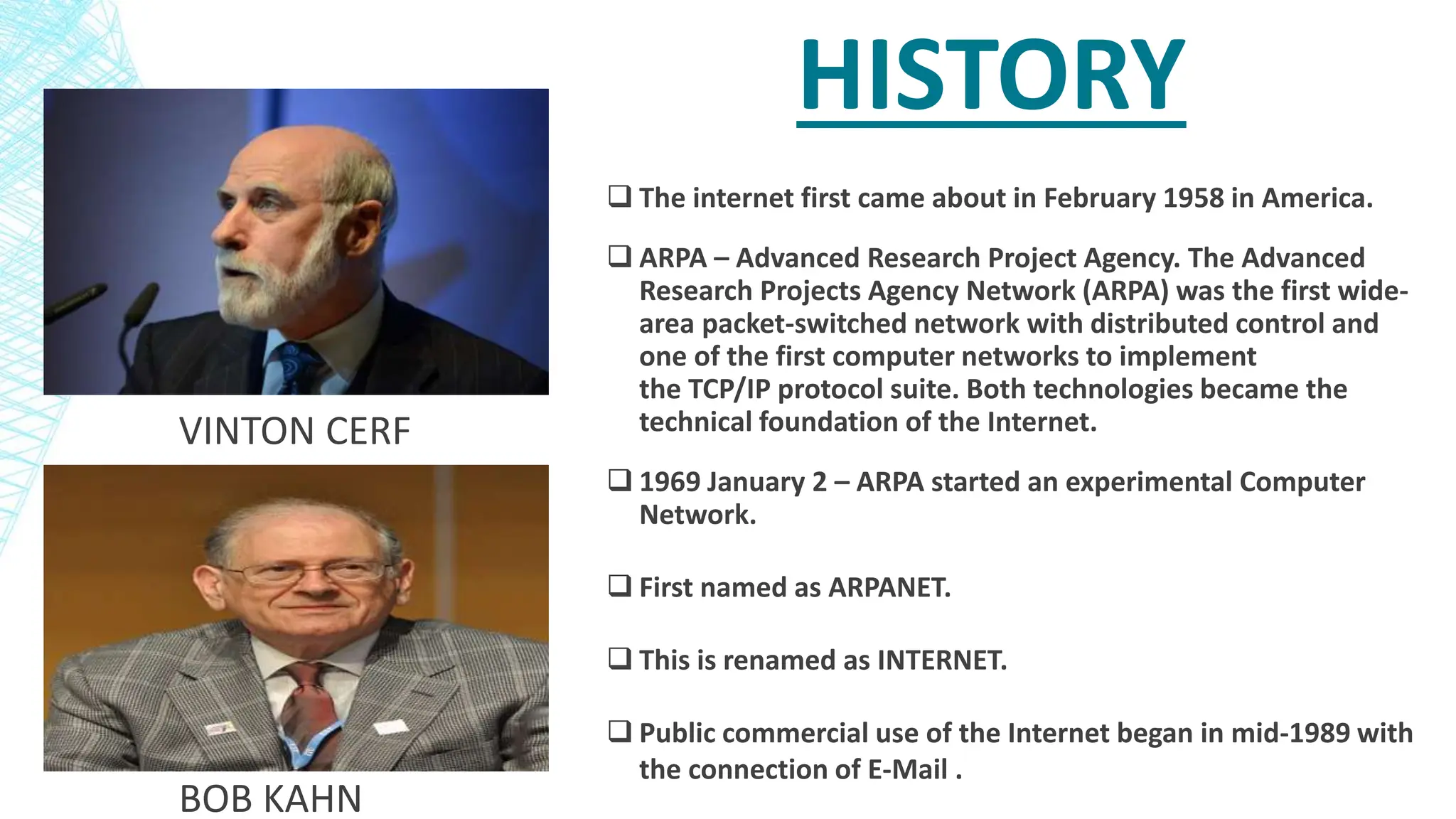
VINTON CERF
BOB KAHN
BASIC USES OF INTERNET
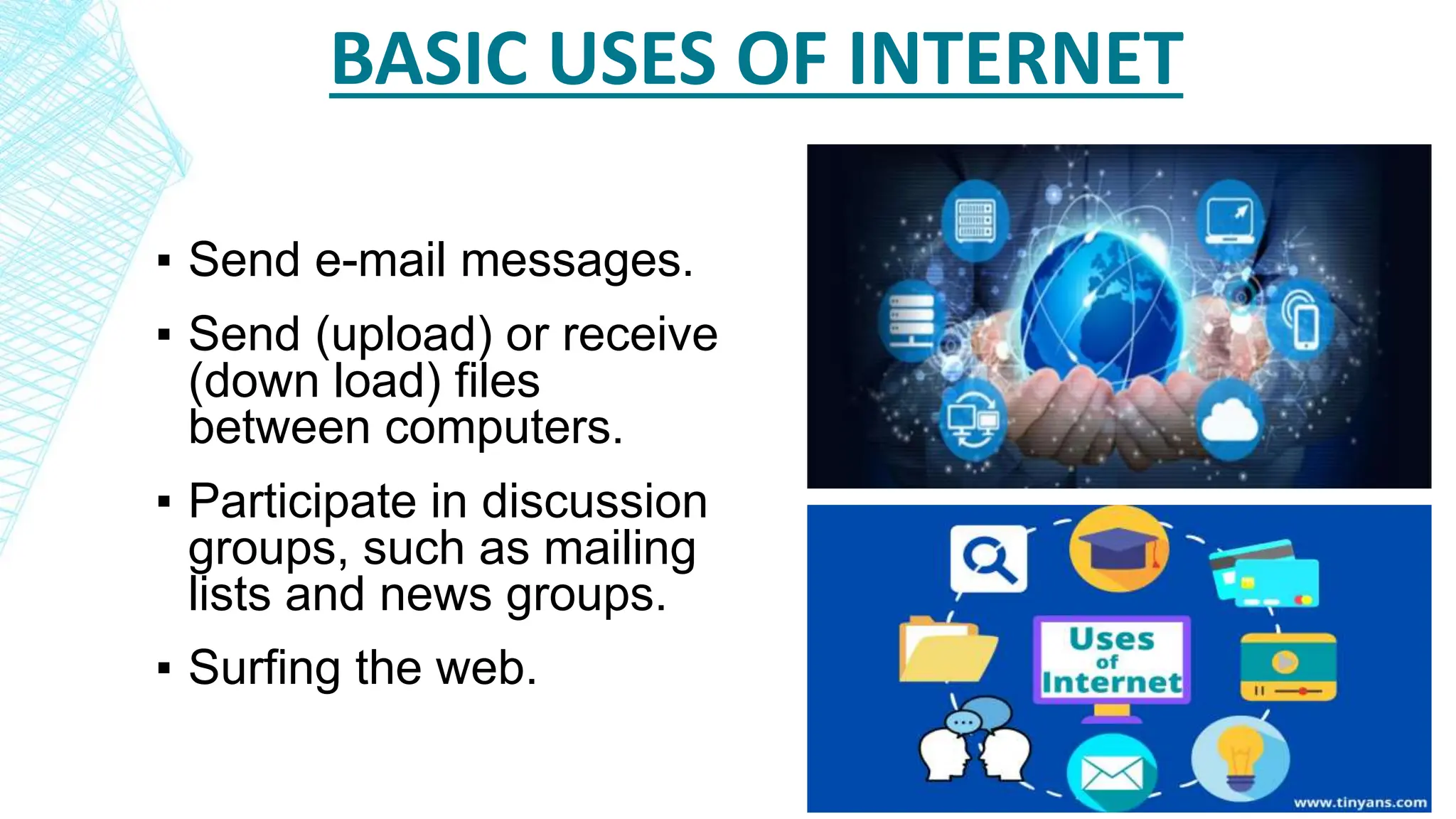
▪ Send e-mail messages.
▪ Send (upload) or receive
(down load) files
between computers.
▪ Participate in discussion
groups, such as mailing
lists and news groups.
▪ Surfing the web.
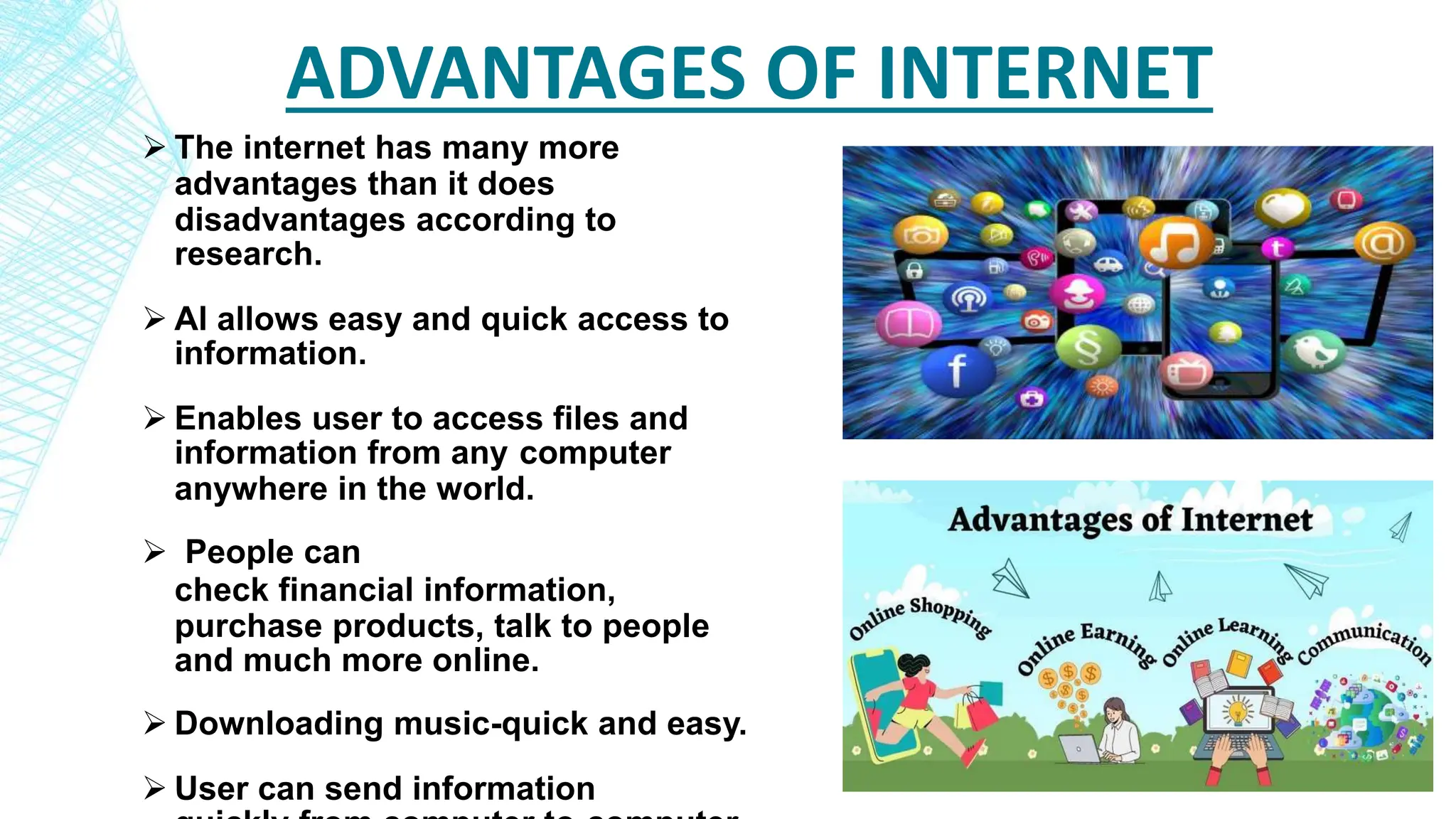
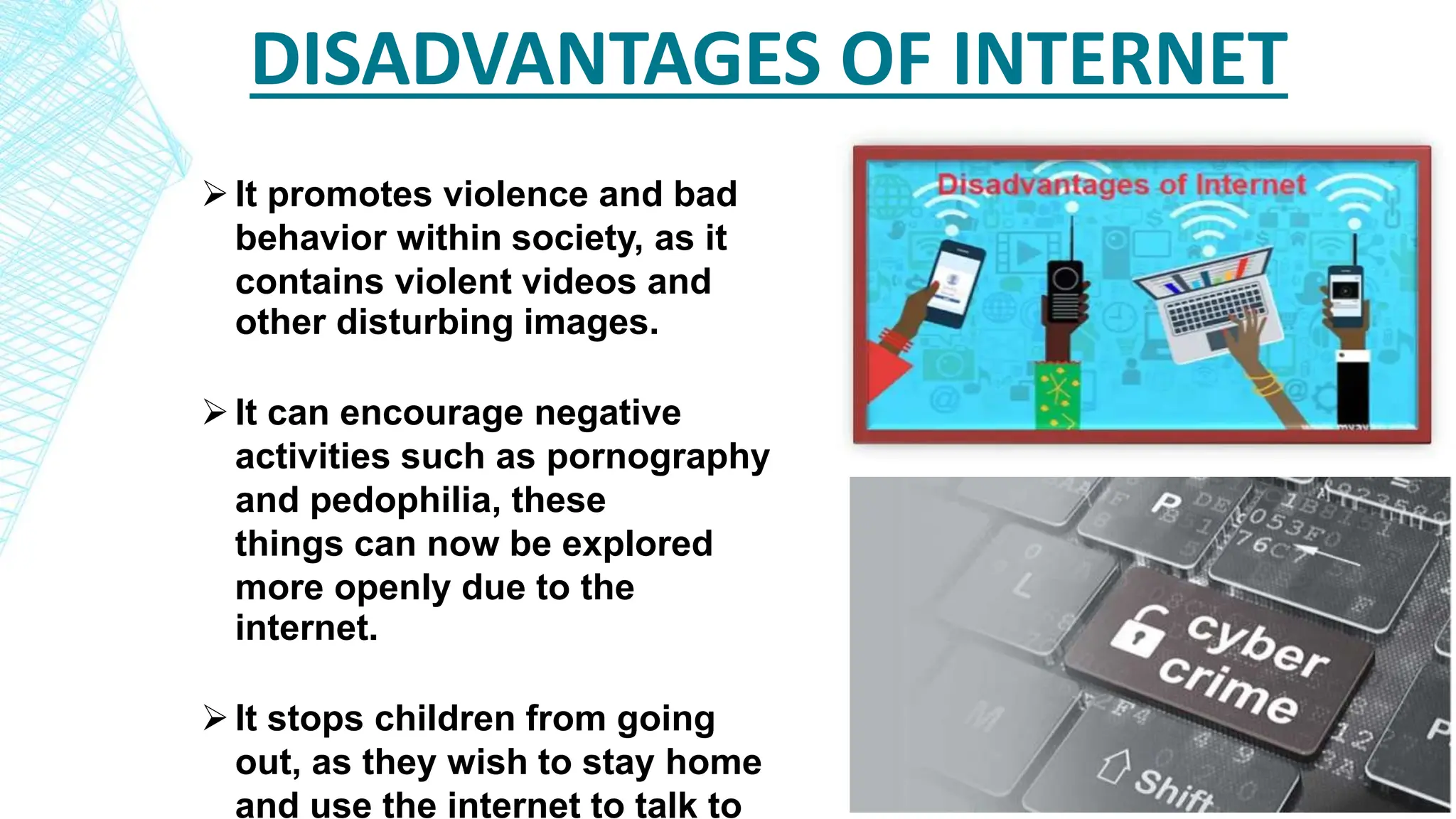
ADVANTAGES OF INTERNET
 The internet has many more
advantages than it does
disadvantages according to
research.
 Al allows easy and quick access to
information.
 Enables user to access files and
information from any computer
anywhere in the world.
 People can
check financial information,
purchase products, talk to people
and much more online.
 Downloading music-quick and easy.
 User can send information
DISADVANTAGES OF INTERNET
It promotes violence and bad
behavior within society, as it
contains violent videos and
other disturbing images.
It can encourage negative
activities such as pornography
and pedophilia, these
things can now be explored
more openly due to the
internet.
It stops children from going
out, as they wish to stay home
and use the internet to talk to
SOCIAL IMPACT
The Internet has enabled entirely new
forms of social interaction, activities,
and organizing, thanks to its basic
features such as widespread usability
and access. Social networking
websites such as Facebook, Twitter
and WhatsApp , etc.. Have created
new ways to socialize and interact.
Users of these sites are able to add a
wide variety of information to pages,
to pursue common interests, and to
connect with others. It is also
possible to find existing
acquaintances, to allow
communication among existing
groups of people. Sites like LinkedIn
IMPLICATION FOR THE FUTURE
 It will become much faster and information will be able
to be accessed more quickly.
 More and more information will be added to it, which
will make it the worlds biggest technology resource.
 It will continue to grow and as it becomes cheaper
people in less economically developed countries will
gain access to it, further developing their education
and access to information.
 Overall , the internet will become even more advanced
in technology, making it cheaper, faster and more
widely accessed.
THANK YOU

POWERPOINT PRESENTATION ON THE INTERNET.

  • 1.
    ELEMENTS OF COMPUTERSCIENCE AND ENGINEERING TOPIC:- INTERNET NAME:- ANUSHA ASHRAF H.NO:- 23L51A7205 CLASS:- 1st year,1st Sem BRANCH:- AI&DS
  • 2.
    INTRODUCTION  It isthe largest network in the world that connects thousands of individual networks all over the world, which allows the " sharing" or "networking" of information at remote sites from other academic institutions, research institutes, private companies, government agencies, and individuals.  It allows people to send and receive data wherever they are in the world if they have internet access .  Everyone will find that they use the internet in one way or another, whether it is to research some information or simply talk to friends .  Today, the Internet allow connectivity from literally everywhere on earth - even ships at sea and in outer space.  The popular term for the Internet is the “information highway”.  Rather than moving through geographical space, it moves your ideas and information through cyberspace – the space of electronic movement of ideas and information. •
  • 3.
    HISTORY  The internetfirst came about in February 1958 in America.  ARPA – Advanced Research Project Agency. The Advanced Research Projects Agency Network (ARPA) was the first wide- area packet-switched network with distributed control and one of the first computer networks to implement the TCP/IP protocol suite. Both technologies became the technical foundation of the Internet.  1969 January 2 – ARPA started an experimental Computer Network.  First named as ARPANET.  This is renamed as INTERNET.  Public commercial use of the Internet began in mid-1989 with the connection of E-Mail . VINTON CERF BOB KAHN
  • 4.
    BASIC USES OFINTERNET ▪ Send e-mail messages. ▪ Send (upload) or receive (down load) files between computers. ▪ Participate in discussion groups, such as mailing lists and news groups. ▪ Surfing the web.
  • 5.
    ADVANTAGES OF INTERNET The internet has many more advantages than it does disadvantages according to research.  Al allows easy and quick access to information.  Enables user to access files and information from any computer anywhere in the world.  People can check financial information, purchase products, talk to people and much more online.  Downloading music-quick and easy.  User can send information
  • 6.
    DISADVANTAGES OF INTERNET Itpromotes violence and bad behavior within society, as it contains violent videos and other disturbing images. It can encourage negative activities such as pornography and pedophilia, these things can now be explored more openly due to the internet. It stops children from going out, as they wish to stay home and use the internet to talk to
  • 7.
    SOCIAL IMPACT The Internethas enabled entirely new forms of social interaction, activities, and organizing, thanks to its basic features such as widespread usability and access. Social networking websites such as Facebook, Twitter and WhatsApp , etc.. Have created new ways to socialize and interact. Users of these sites are able to add a wide variety of information to pages, to pursue common interests, and to connect with others. It is also possible to find existing acquaintances, to allow communication among existing groups of people. Sites like LinkedIn
  • 8.
    IMPLICATION FOR THEFUTURE  It will become much faster and information will be able to be accessed more quickly.  More and more information will be added to it, which will make it the worlds biggest technology resource.  It will continue to grow and as it becomes cheaper people in less economically developed countries will gain access to it, further developing their education and access to information.  Overall , the internet will become even more advanced in technology, making it cheaper, faster and more widely accessed.
  • 9.