SHADAN WOMEN’S COLLEGE OF
ENGINEERING & TECHNOLOGY
(An autonomous institution affiliated to JNTUH,Telengana)
NAME : ANUSHA ASHRAF
HT.NO. : 23L51A7205
SUBJECT : DBMS
CLASS : B.TECH 2ND
YEAR 2ND
SEM
BRANCH : AI&DS
TOPIC : SYSTEM CALLS
SYSTEM CALLS
3
CONTENTS
o INTRODUCTION
o STRUCTURE OF SYSTEM CALLS
o HOW A SYSTEM CALL OCCURS
o CATEGORIES OF SYSTEM CALLS
o EXAMPLE OF SYSTEM CALL IN LINUX
INTRODUCT ION
 System Calls provide the Interface between a process and the
Operating System.
 These calls are generally available as Assembly language
instruction.
 System Calls can also be made directly through HLL programs
for certain systems.
 UNIX System calls can be invoked directly from a C or C++
program.
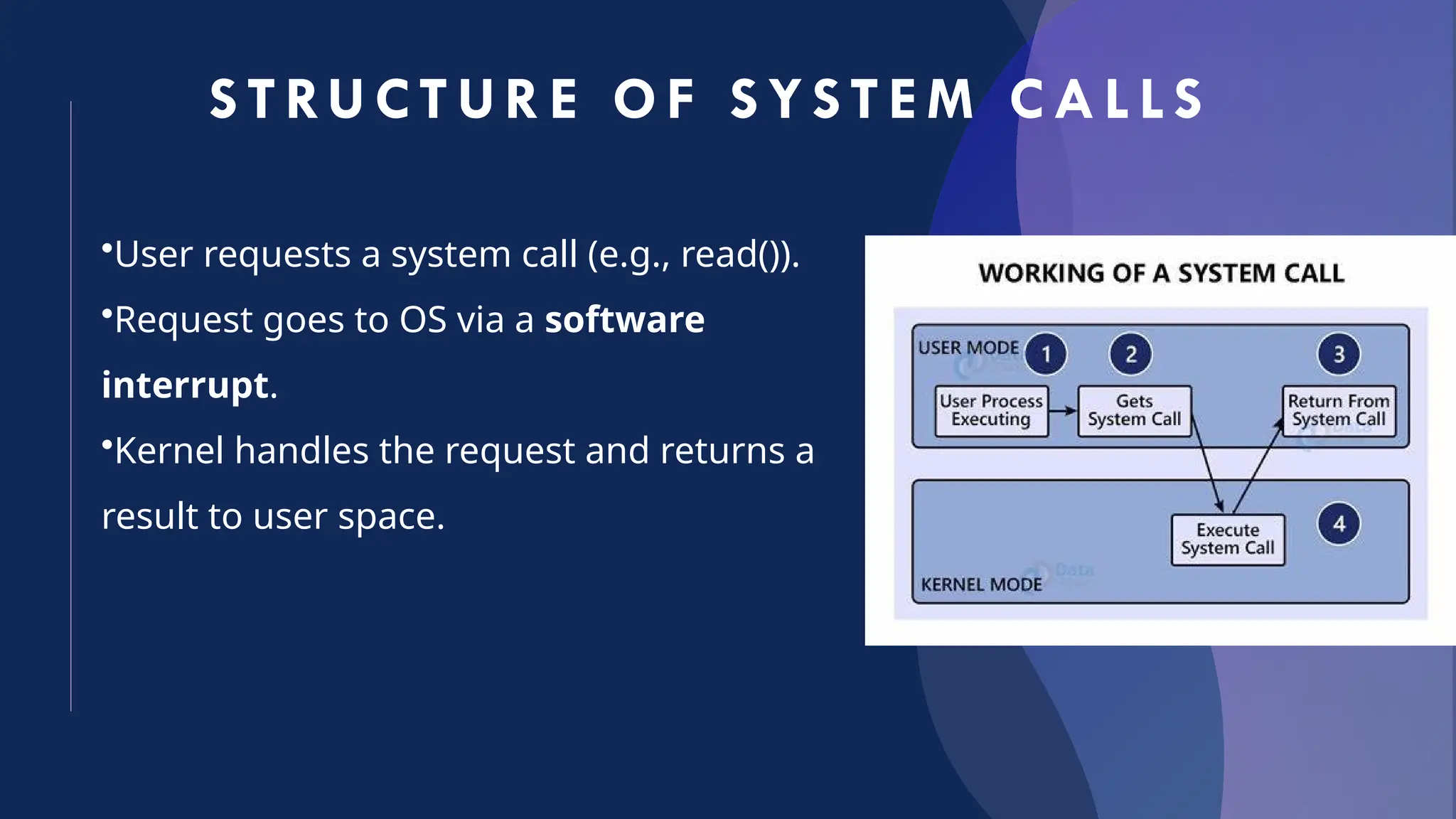
S TRUCTURE OF S YSTE M CAL LS
•User requests a system call (e.g., read()).
•Request goes to OS via a software
interrupt.
•Kernel handles the request and returns a
result to user space.
6
HOW S YS TEM CAL LS OCCUR.
System Calls occur in different ways depending on the computer
in use:
o More information is required than just the identify of the
desired System call.
o The exact type and amount of information varies according to
the operation system and call
o For instance to get an input we need to specify the file of device
to use as source and the address and length of memory buffer
7
CAT EGORIES OF SYS TEM CALL S
System calls can be grouped into five major categories as
follows.
o Process control
o File management.
o Device management
o Information Maintenance
o Communication.
8
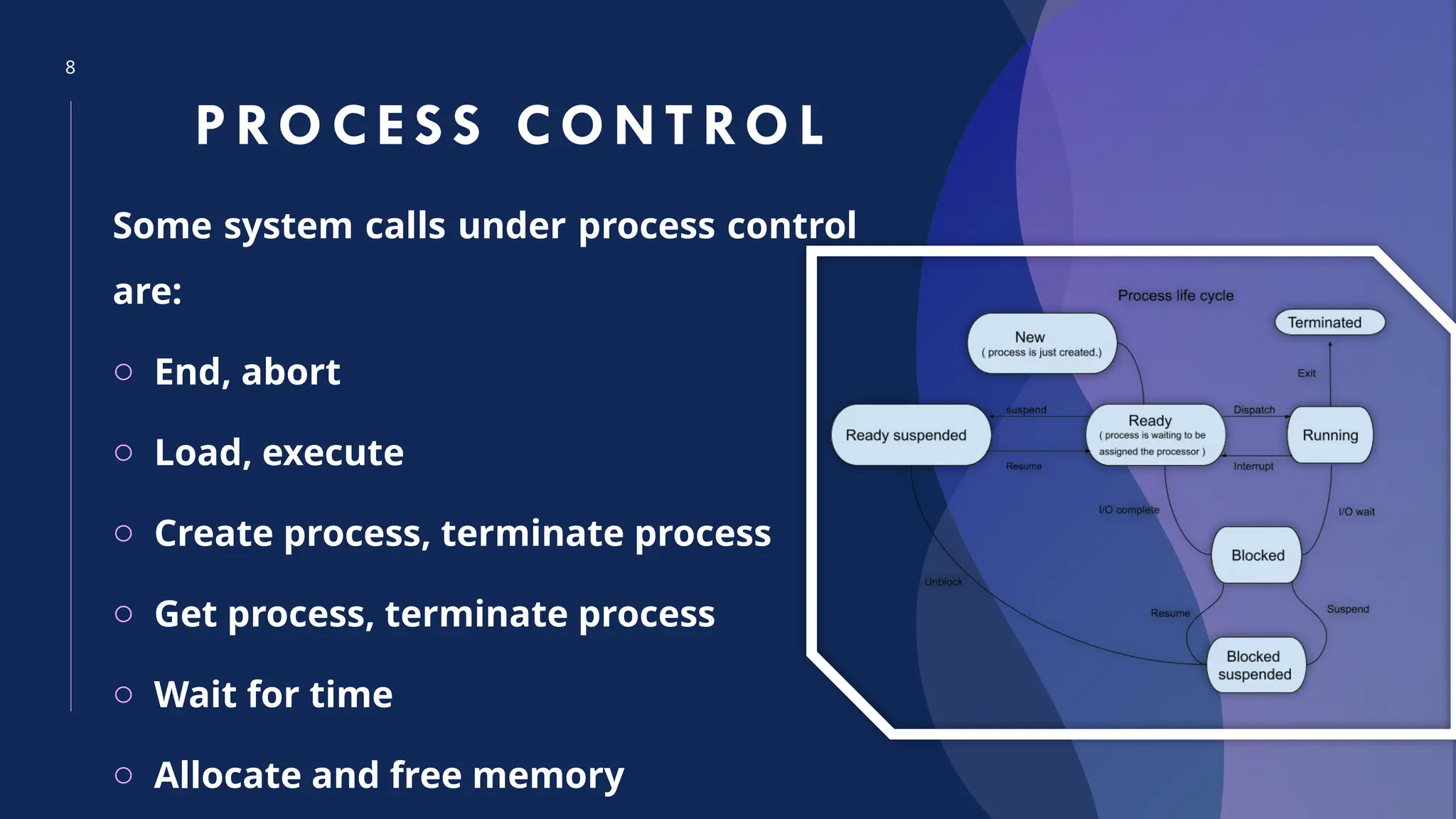
PROCES S CONTROL
Some system calls under process control
are:
o End, abort
o Load, execute
o Create process, terminate process
o Get process, terminate process
o Wait for time
o Allocate and free memory
9
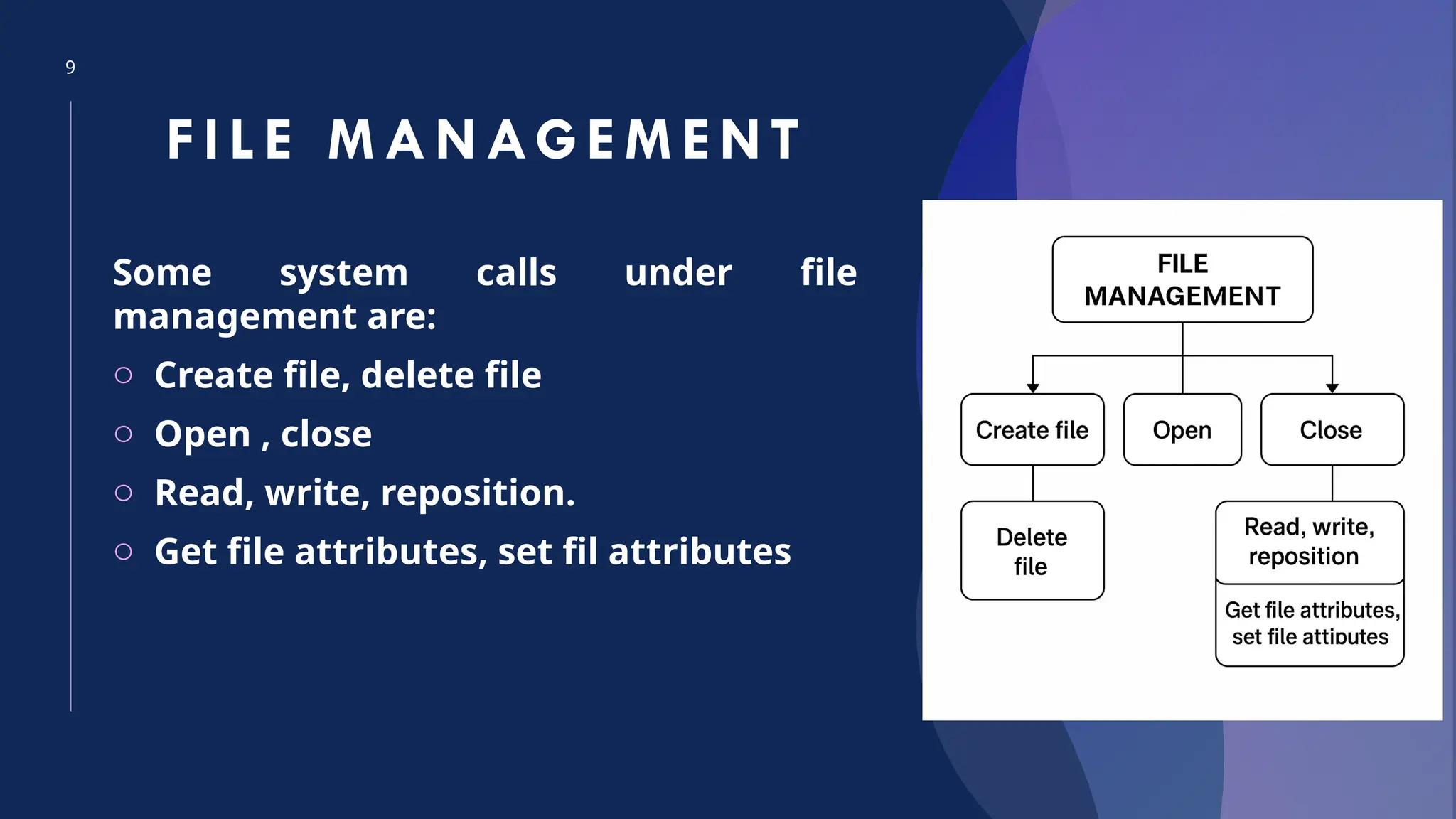
FI LE M ANAGEM ENT
Some system calls under file
management are:
o Create file, delete file
o Open , close
o Read, write, reposition.
o Get file attributes, set fil attributes
10
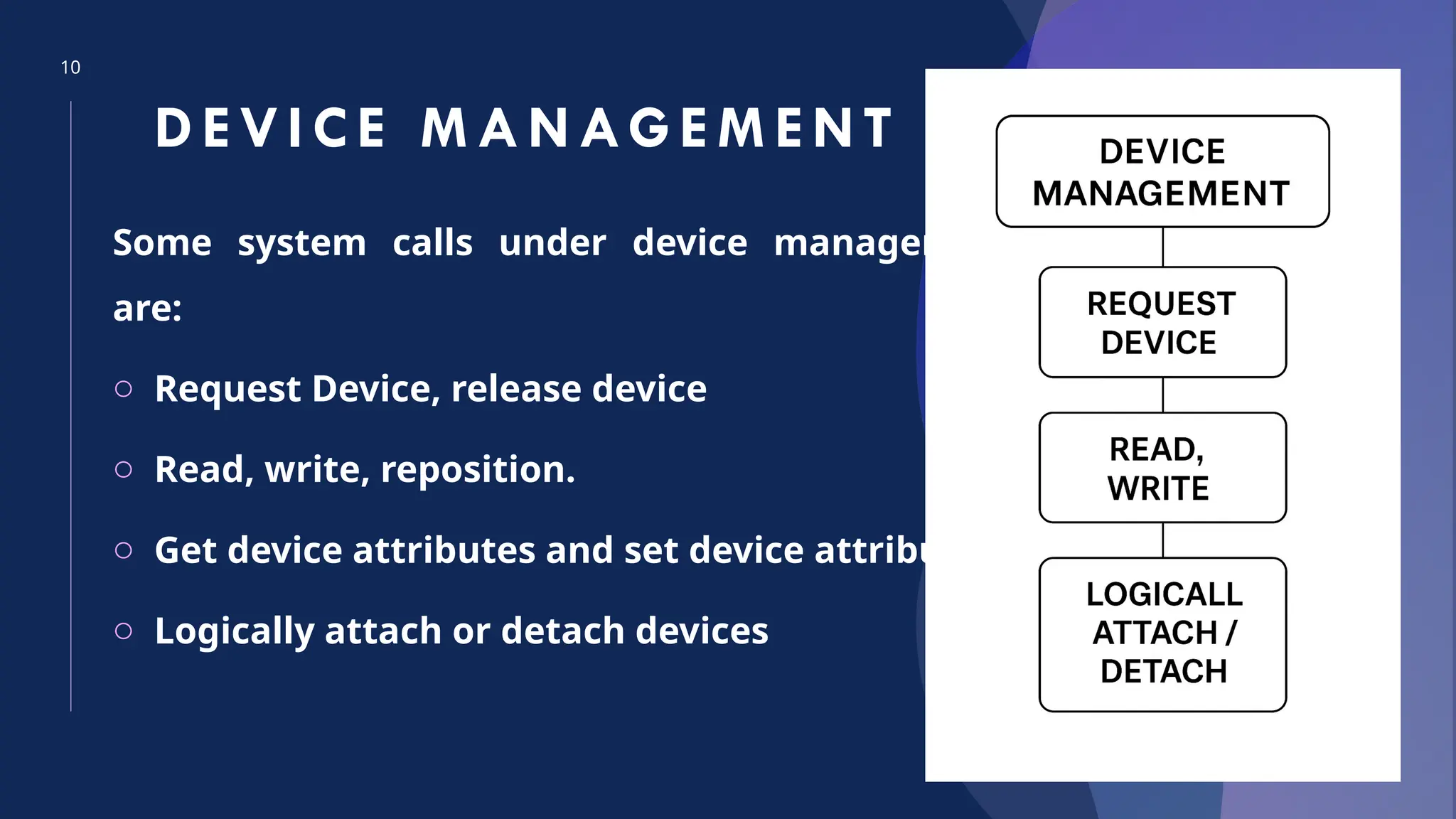
DEVICE M ANAGEM ENT
Some system calls under device management
are:
o Request Device, release device
o Read, write, reposition.
o Get device attributes and set device attributes
o Logically attach or detach devices
11
INFOR MATI ON M AINTENANCE
Some system calls under information maintenance are:
o Get time or date, Set time of date
o Logically attach or detach devices
o Information maintenance
o Get system data, Set Systems data
o Get process, file of device attributes
o Set process, file or device attributes
12
COM M UNI CATI ON
o Create, delete communication
connection.
o Send, receive messages
o Transfer status information
o Attach or detach remote devices.
13
EXAM PL E OF S YS TEM CALL S I N LI NUX
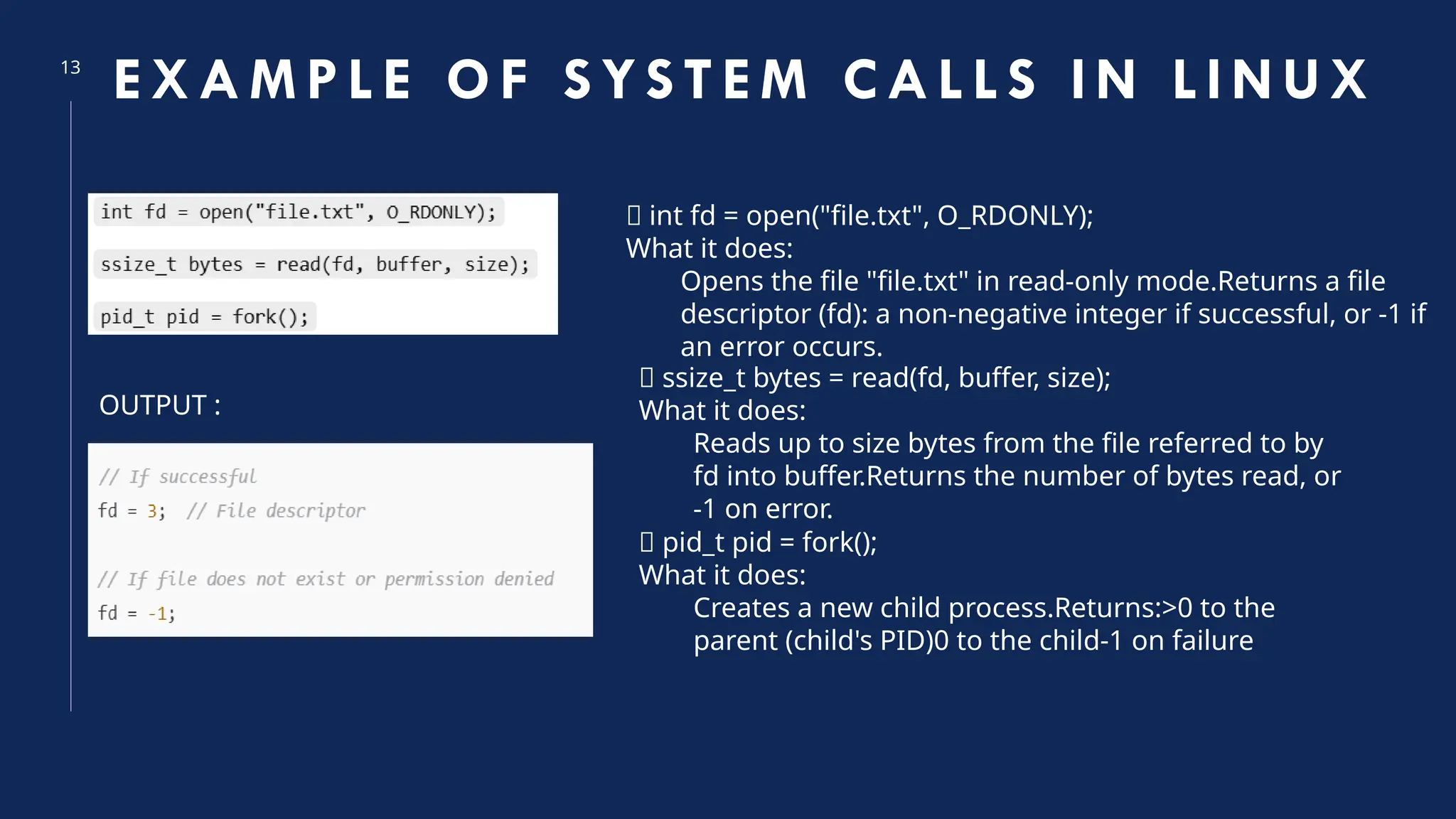
🔹 int fd = open("file.txt", O_RDONLY);
What it does:
Opens the file "file.txt" in read-only mode.Returns a file
descriptor (fd): a non-negative integer if successful, or -1 if
an error occurs.
🔹 ssize_t bytes = read(fd, buffer, size);
What it does:
Reads up to size bytes from the file referred to by
fd into buffer.Returns the number of bytes read, or
-1 on error.
🔹 pid_t pid = fork();
What it does:
Creates a new child process.Returns:>0 to the
parent (child's PID)0 to the child-1 on failure
OUTPUT :
CONCL US I ON
•System calls are essential for OS functionality.
•Provide a bridge between applications and hardware.
•Understanding system calls is crucial for low-level
programming and OS development.
THANK YOU

POWER POINT PRESENTATION ON SYSTEM CALLS

  • 1.
    SHADAN WOMEN’S COLLEGEOF ENGINEERING & TECHNOLOGY (An autonomous institution affiliated to JNTUH,Telengana) NAME : ANUSHA ASHRAF HT.NO. : 23L51A7205 SUBJECT : DBMS CLASS : B.TECH 2ND YEAR 2ND SEM BRANCH : AI&DS TOPIC : SYSTEM CALLS
  • 2.
  • 3.
    3 CONTENTS o INTRODUCTION o STRUCTUREOF SYSTEM CALLS o HOW A SYSTEM CALL OCCURS o CATEGORIES OF SYSTEM CALLS o EXAMPLE OF SYSTEM CALL IN LINUX
  • 4.
    INTRODUCT ION  SystemCalls provide the Interface between a process and the Operating System.  These calls are generally available as Assembly language instruction.  System Calls can also be made directly through HLL programs for certain systems.  UNIX System calls can be invoked directly from a C or C++ program.
  • 5.
    S TRUCTURE OFS YSTE M CAL LS •User requests a system call (e.g., read()). •Request goes to OS via a software interrupt. •Kernel handles the request and returns a result to user space.
  • 6.
    6 HOW S YSTEM CAL LS OCCUR. System Calls occur in different ways depending on the computer in use: o More information is required than just the identify of the desired System call. o The exact type and amount of information varies according to the operation system and call o For instance to get an input we need to specify the file of device to use as source and the address and length of memory buffer
  • 7.
    7 CAT EGORIES OFSYS TEM CALL S System calls can be grouped into five major categories as follows. o Process control o File management. o Device management o Information Maintenance o Communication.
  • 8.
    8 PROCES S CONTROL Somesystem calls under process control are: o End, abort o Load, execute o Create process, terminate process o Get process, terminate process o Wait for time o Allocate and free memory
  • 9.
    9 FI LE MANAGEM ENT Some system calls under file management are: o Create file, delete file o Open , close o Read, write, reposition. o Get file attributes, set fil attributes
  • 10.
    10 DEVICE M ANAGEMENT Some system calls under device management are: o Request Device, release device o Read, write, reposition. o Get device attributes and set device attributes o Logically attach or detach devices
  • 11.
    11 INFOR MATI ONM AINTENANCE Some system calls under information maintenance are: o Get time or date, Set time of date o Logically attach or detach devices o Information maintenance o Get system data, Set Systems data o Get process, file of device attributes o Set process, file or device attributes
  • 12.
    12 COM M UNICATI ON o Create, delete communication connection. o Send, receive messages o Transfer status information o Attach or detach remote devices.
  • 13.
    13 EXAM PL EOF S YS TEM CALL S I N LI NUX 🔹 int fd = open("file.txt", O_RDONLY); What it does: Opens the file "file.txt" in read-only mode.Returns a file descriptor (fd): a non-negative integer if successful, or -1 if an error occurs. 🔹 ssize_t bytes = read(fd, buffer, size); What it does: Reads up to size bytes from the file referred to by fd into buffer.Returns the number of bytes read, or -1 on error. 🔹 pid_t pid = fork(); What it does: Creates a new child process.Returns:>0 to the parent (child's PID)0 to the child-1 on failure OUTPUT :
  • 14.
    CONCL US ION •System calls are essential for OS functionality. •Provide a bridge between applications and hardware. •Understanding system calls is crucial for low-level programming and OS development.
  • 15.