PowerPoint Presentation Guidelines
• The following 37 slides present guidelines and
  suggestions for the use of fonts, colors, and graphics
  when preparing PowerPoint presentations for
  Sessions and Seminars.

• This media (PPT) is designed to ENHANCE your
  presentation, not BE the presentation.

• Remember, only you can prevent
    “Death by PowerPoint”
PowerPoint Slide
• Highlight key points or reinforce what the facilitator
  is saying

• Should be short and to the point, include only key
  words and phrases for visual, reinforcement

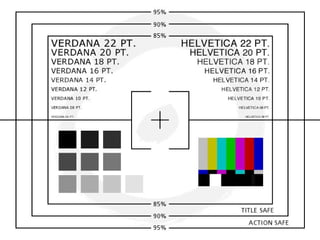
• In order for your presentation to fit on most screens,
  text and images should be placed within 95% of the
  PowerPoint slide. This “action safe” area is seen in
  the next slide.
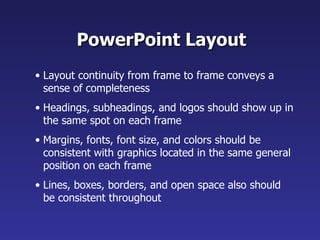
PowerPoint Layout
• Layout continuity from frame to frame conveys a
  sense of completeness
• Headings, subheadings, and logos should show up in
  the same spot on each frame
• Margins, fonts, font size, and colors should be
  consistent with graphics located in the same general
  position on each frame
• Lines, boxes, borders, and open space also should
  be consistent throughout
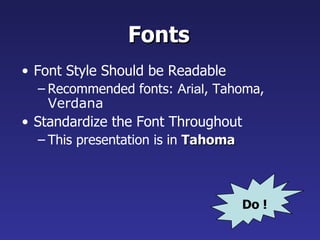
Fonts
• Font Style Should be Readable
  – Recommended fonts: Arial, Tahoma,
    Verdana
• Standardize the Font Throughout
  – This presentation is in Tahoma


                                     Do !
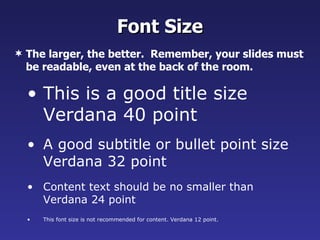
Font Size
 The larger, the better. Remember, your slides must
  be readable, even at the back of the room.

  • This is a good title size
    Verdana 40 point
  • A good subtitle or bullet point size
    Verdana 32 point
  • Content text should be no smaller than
    Verdana 24 point
  •   This font size is not recommended for content. Verdana 12 point.
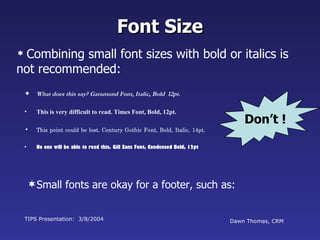
Font Size
 Combiningsmall font sizes with bold or italics is
not recommended:
     What does this say? Garamond Font, Italic, Bold 12pt.

 •    This is very difficult to read. Times Font, Bold, 12pt.
                                                                                   Don’t !
 •    This point could be lost. Century Gothic Font, Bold, Italic, 14pt.

 •    No one will be able to read this. Gill Sans Font, Condensed Bold, 12pt


     Small fonts are okay for a footer, such as:


 TIPS Presentation: 3/8/2004                                                   Dawn Thomas, CRM
Don’t !
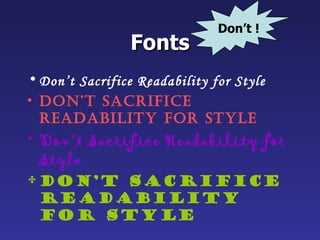
                Fonts
• Don’t Sacrifice Readability for Style
• Don’t Sacrifice
  reaDability for Style
• Don’t Sacrifice Readability for
  Style
• Don’t Sacrifice
  Readability
  for Style
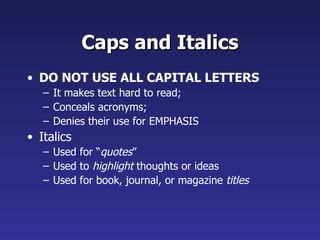
Caps and Italics
• DO NOT USE ALL CAPITAL LETTERS
   – It makes text hard to read;
   – Conceals acronyms;
   – Denies their use for EMPHASIS
• Italics
   – Used for “quotes”
   – Used to highlight thoughts or ideas
   – Used for book, journal, or magazine titles
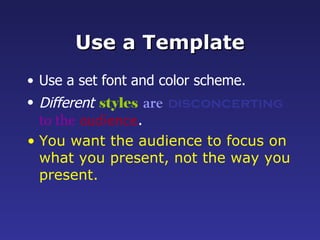
Use a Template
• Use a set font and color scheme.
• Different styles are disconcerting
  to the audience.
• You want the audience to focus on
  what you present, not the way you
  present.
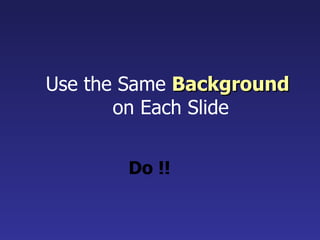
Use the Same Background
       on Each Slide


       Do !!
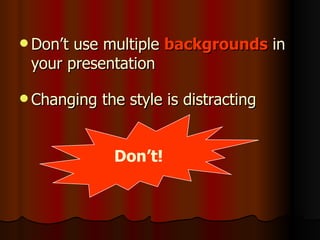
 Don’tuse multiple backgrounds in
 your presentation

 Changing   the style is distracting


              Don’t!
Colors
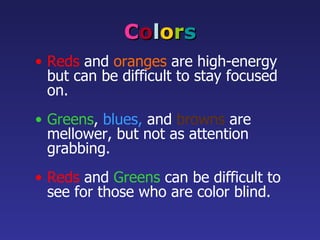
• Reds and oranges are high-energy
  but can be difficult to stay focused
  on.
• Greens, blues, and browns are
  mellower, but not as attention
  grabbing.
• Reds and Greens can be difficult to
  see for those who are color blind.
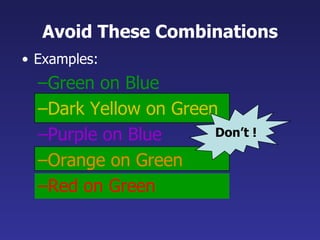
Avoid These Combinations
• Examples:
  –Green on Blue
  –Dark Yellow on Green
  –Purple on Blue      Don’t !

  –Orange on Green
  –Red on Green
Colors
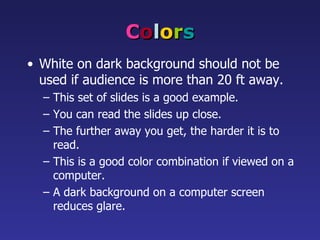
• White on dark background should not be
  used if audience is more than 20 ft away.
  – This set of slides is a good example.
  – You can read the slides up close.
  – The further away you get, the harder it is to
    read.
  – This is a good color combination if viewed on a
    computer.
  – A dark background on a computer screen
    reduces glare.
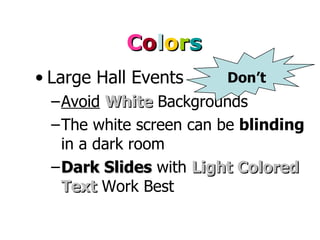
Colors
• Large Hall Events     Don’t
  –Avoid White Backgrounds
  –The white screen can be blinding
    in a dark room
  – Dark Slides with Light Colored
    Text Work Best
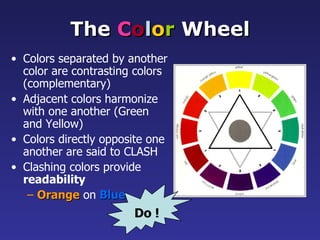
The Color Wheel
• Colors separated by another
  color are contrasting colors
  (complementary)
• Adjacent colors harmonize
  with one another (Green
  and Yellow)
• Colors directly opposite one
  another are said to CLASH
• Clashing colors provide
  readability
   – Orange on Blue
                       Do !
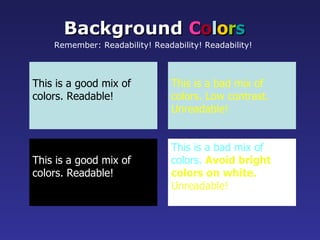
Background Colors
    Remember: Readability! Readability! Readability!


This is a good mix of           This is a bad mix of
colors. Readable!               colors. Low contrast.
                                Unreadable!


                                This is a bad mix of
This is a good mix of           colors. Avoid bright
colors. Readable!               colors on white.
                                Unreadable!
Graphs and Charts

Make sure the audience
   can read them!
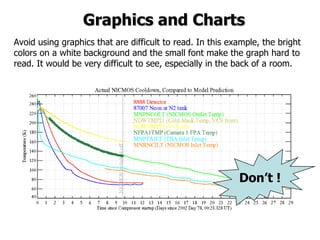
Graphics and Charts
Avoid using graphics that are difficult to read. In this example, the bright
colors on a white background and the small font make the graph hard to
read. It would be very difficult to see, especially in the back of a room.


                                                           Don’t !


                                                                          8
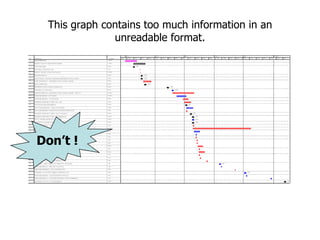
This graph contains too much information in an
              unreadable format.


Don’t !


                                                  10
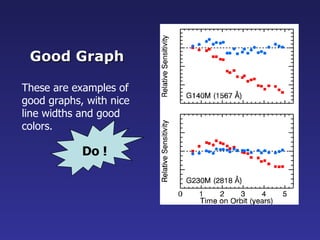
Good Graph

These are examples of
good graphs, with nice
line widths and good
colors.

            Do !
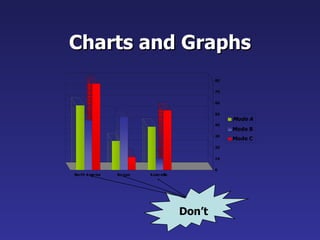
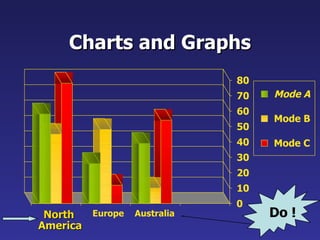
Charts and Graphs
                                                80


                                                70


                                                60


                                                50
                                                     Mode A
                                                40
                                                     Mode B
                                                30
                                                     Mode C
                                                20


                                                10


                                                0
North A merica   Europe   A ustrailia


                                        Don’t
Charts and Graphs
                             80
                             70   Mode A
                             60
                                  Mode B
                             50
                             40   Mode C
                             30
                             20
                             10
                             0
 North  Europe   Australia        Do !
America
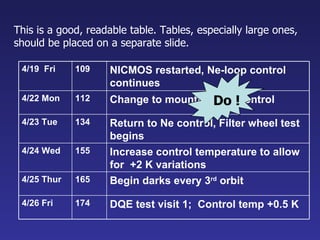
This is a good, readable table. Tables, especially large ones,
should be placed on a separate slide.

 4/19 Fri    109    NICMOS restarted, Ne-loop control
                    continues
 4/22 Mon    112    Change to mountingDo !control
                                      cup

 4/23 Tue    134    Return to Ne control, Filter wheel test
                    begins
 4/24 Wed    155    Increase control temperature to allow
                    for +2 K variations
 4/25 Thur   165    Begin darks every 3rd orbit

 4/26 Fri    174    DQE test visit 1; Control temp +0.5 K
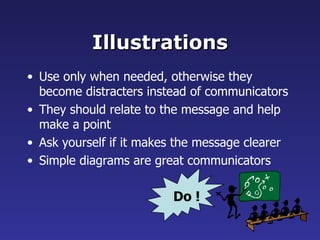
Illustrations
• Use only when needed, otherwise they
  become distracters instead of communicators
• They should relate to the message and help
  make a point
• Ask yourself if it makes the message clearer
• Simple diagrams are great communicators

                         Do !
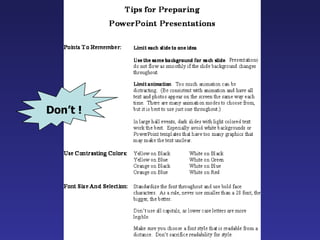
Don’t !
Limit Each Slide to One Idea

 • Use Bullet Points to Cover
   Components of Each Idea
Bullets
• Keep each bullet to 1 line, 2 at the most
• Limit the number of bullets in a screen to 6, 4
  if there is a large title, logo, picture, etc.
  – This is known as “cueing”
  – You want to “cue” the audience on what
    you’re going to say
     • Cues are a a brief “preview”
     • Gives the audience a “framework” to build upon
Bullets (con.)
• If you crowd too much text, the audience
  won’t read it
  – Too much text looks busy and is hard to read
  – Why read it, when you’re going to tell them
    what it says?
  – Our reading speed does not match our
    listening speed; hence, they confuse instead
    of reinforce
Points to Remember do Points
                      Do not
                     Limit Bullet
                                  this!

                                    To a few words
• Limit each slide to 1 idea
• Limit each bullet point to only a few words to
  avoid long sentences that go on and on!
• Limit animation – Too much animation can be
  distracting. Be consistent with animation and
  have all text and photos appear on the screen the
  same way each time. There are many animation
  modes to choose from, but it is best to use just
  one throughout.
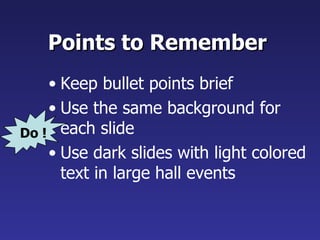
Points to Remember
    • Keep bullet points brief
    • Use the same background for
Do ! each slide
    • Use dark slides with light colored
      text in large hall events
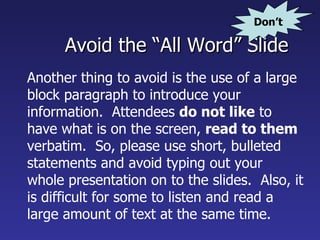
Don’t

      Avoid the “All Word” Slide
Another thing to avoid is the use of a large
block paragraph to introduce your
information. Attendees do not like to
have what is on the screen, read to them
verbatim. So, please use short, bulleted
statements and avoid typing out your
whole presentation on to the slides. Also, it
is difficult for some to listen and read a
large amount of text at the same time.
• To make a slide stand out,
  change the font,
  background, or add
  animation.
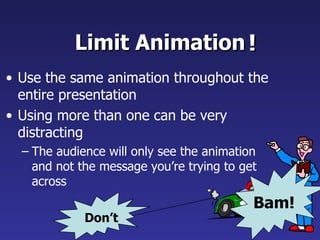
Limit Animation !
• Use the same animation throughout the
  entire presentation
• Using more than one can be very
  distracting
  – The audience will only see the animation
    and not the message you’re trying to get
    across
                                           Bam!
             Don’t
Limit Animation!
• Use the same animation throughout the
  entire presentation
• Using more than one can be very
  distracting
  – The audience will only see the animation
    and not the message you’re trying to get
    across
                     Do !
YOU
• Do not use the media to hide you
• The audience came to SEE you
• The media should ENHANCE the presentation,
  not BE the presentation
• If you’re only going to read from the slides, then
  just send them the slides!
• Remember, only you can prevent
      “Death by PowerPoint”

PowerPoint guidelines

  • 1.
    PowerPoint Presentation Guidelines •The following 37 slides present guidelines and suggestions for the use of fonts, colors, and graphics when preparing PowerPoint presentations for Sessions and Seminars. • This media (PPT) is designed to ENHANCE your presentation, not BE the presentation. • Remember, only you can prevent “Death by PowerPoint”
  • 2.
    PowerPoint Slide • Highlightkey points or reinforce what the facilitator is saying • Should be short and to the point, include only key words and phrases for visual, reinforcement • In order for your presentation to fit on most screens, text and images should be placed within 95% of the PowerPoint slide. This “action safe” area is seen in the next slide.
  • 4.
    PowerPoint Layout • Layoutcontinuity from frame to frame conveys a sense of completeness • Headings, subheadings, and logos should show up in the same spot on each frame • Margins, fonts, font size, and colors should be consistent with graphics located in the same general position on each frame • Lines, boxes, borders, and open space also should be consistent throughout
  • 5.
    Fonts • Font StyleShould be Readable – Recommended fonts: Arial, Tahoma, Verdana • Standardize the Font Throughout – This presentation is in Tahoma Do !
  • 6.
    Font Size  Thelarger, the better. Remember, your slides must be readable, even at the back of the room. • This is a good title size Verdana 40 point • A good subtitle or bullet point size Verdana 32 point • Content text should be no smaller than Verdana 24 point • This font size is not recommended for content. Verdana 12 point.
  • 7.
    Font Size  Combiningsmallfont sizes with bold or italics is not recommended:  What does this say? Garamond Font, Italic, Bold 12pt. • This is very difficult to read. Times Font, Bold, 12pt. Don’t ! • This point could be lost. Century Gothic Font, Bold, Italic, 14pt. • No one will be able to read this. Gill Sans Font, Condensed Bold, 12pt Small fonts are okay for a footer, such as: TIPS Presentation: 3/8/2004 Dawn Thomas, CRM
  • 8.
    Don’t ! Fonts • Don’t Sacrifice Readability for Style • Don’t Sacrifice reaDability for Style • Don’t Sacrifice Readability for Style • Don’t Sacrifice Readability for Style
  • 9.
    Caps and Italics •DO NOT USE ALL CAPITAL LETTERS – It makes text hard to read; – Conceals acronyms; – Denies their use for EMPHASIS • Italics – Used for “quotes” – Used to highlight thoughts or ideas – Used for book, journal, or magazine titles
  • 10.
    Use a Template •Use a set font and color scheme. • Different styles are disconcerting to the audience. • You want the audience to focus on what you present, not the way you present.
  • 11.
    Use the SameBackground on Each Slide Do !!
  • 12.
     Don’tuse multiplebackgrounds in your presentation  Changing the style is distracting Don’t!
  • 13.
    Colors • Reds andoranges are high-energy but can be difficult to stay focused on. • Greens, blues, and browns are mellower, but not as attention grabbing. • Reds and Greens can be difficult to see for those who are color blind.
  • 14.
    Avoid These Combinations •Examples: –Green on Blue –Dark Yellow on Green –Purple on Blue Don’t ! –Orange on Green –Red on Green
  • 15.
    Colors • White ondark background should not be used if audience is more than 20 ft away. – This set of slides is a good example. – You can read the slides up close. – The further away you get, the harder it is to read. – This is a good color combination if viewed on a computer. – A dark background on a computer screen reduces glare.
  • 16.
    Colors • Large HallEvents Don’t –Avoid White Backgrounds –The white screen can be blinding in a dark room – Dark Slides with Light Colored Text Work Best
  • 17.
    The Color Wheel •Colors separated by another color are contrasting colors (complementary) • Adjacent colors harmonize with one another (Green and Yellow) • Colors directly opposite one another are said to CLASH • Clashing colors provide readability – Orange on Blue Do !
  • 18.
    Background Colors Remember: Readability! Readability! Readability! This is a good mix of This is a bad mix of colors. Readable! colors. Low contrast. Unreadable! This is a bad mix of This is a good mix of colors. Avoid bright colors. Readable! colors on white. Unreadable!
  • 19.
    Graphs and Charts Makesure the audience can read them!
  • 20.
    Graphics and Charts Avoidusing graphics that are difficult to read. In this example, the bright colors on a white background and the small font make the graph hard to read. It would be very difficult to see, especially in the back of a room. Don’t ! 8
  • 21.
    This graph containstoo much information in an unreadable format. Don’t ! 10
  • 22.
    Good Graph These areexamples of good graphs, with nice line widths and good colors. Do !
  • 23.
    Charts and Graphs 80 70 60 50 Mode A 40 Mode B 30 Mode C 20 10 0 North A merica Europe A ustrailia Don’t
  • 24.
    Charts and Graphs 80 70 Mode A 60 Mode B 50 40 Mode C 30 20 10 0 North Europe Australia Do ! America
  • 25.
    This is agood, readable table. Tables, especially large ones, should be placed on a separate slide. 4/19 Fri 109 NICMOS restarted, Ne-loop control continues 4/22 Mon 112 Change to mountingDo !control cup 4/23 Tue 134 Return to Ne control, Filter wheel test begins 4/24 Wed 155 Increase control temperature to allow for +2 K variations 4/25 Thur 165 Begin darks every 3rd orbit 4/26 Fri 174 DQE test visit 1; Control temp +0.5 K
  • 26.
    Illustrations • Use onlywhen needed, otherwise they become distracters instead of communicators • They should relate to the message and help make a point • Ask yourself if it makes the message clearer • Simple diagrams are great communicators Do !
  • 27.
  • 28.
    Limit Each Slideto One Idea • Use Bullet Points to Cover Components of Each Idea
  • 29.
    Bullets • Keep eachbullet to 1 line, 2 at the most • Limit the number of bullets in a screen to 6, 4 if there is a large title, logo, picture, etc. – This is known as “cueing” – You want to “cue” the audience on what you’re going to say • Cues are a a brief “preview” • Gives the audience a “framework” to build upon
  • 30.
    Bullets (con.) • Ifyou crowd too much text, the audience won’t read it – Too much text looks busy and is hard to read – Why read it, when you’re going to tell them what it says? – Our reading speed does not match our listening speed; hence, they confuse instead of reinforce
  • 31.
    Points to Rememberdo Points Do not Limit Bullet this! To a few words • Limit each slide to 1 idea • Limit each bullet point to only a few words to avoid long sentences that go on and on! • Limit animation – Too much animation can be distracting. Be consistent with animation and have all text and photos appear on the screen the same way each time. There are many animation modes to choose from, but it is best to use just one throughout.
  • 32.
    Points to Remember • Keep bullet points brief • Use the same background for Do ! each slide • Use dark slides with light colored text in large hall events
  • 33.
    Don’t Avoid the “All Word” Slide Another thing to avoid is the use of a large block paragraph to introduce your information. Attendees do not like to have what is on the screen, read to them verbatim. So, please use short, bulleted statements and avoid typing out your whole presentation on to the slides. Also, it is difficult for some to listen and read a large amount of text at the same time.
  • 34.
    • To makea slide stand out, change the font, background, or add animation.
  • 35.
    Limit Animation ! •Use the same animation throughout the entire presentation • Using more than one can be very distracting – The audience will only see the animation and not the message you’re trying to get across Bam! Don’t
  • 36.
    Limit Animation! • Usethe same animation throughout the entire presentation • Using more than one can be very distracting – The audience will only see the animation and not the message you’re trying to get across Do !
  • 37.
    YOU • Do notuse the media to hide you • The audience came to SEE you • The media should ENHANCE the presentation, not BE the presentation • If you’re only going to read from the slides, then just send them the slides! • Remember, only you can prevent “Death by PowerPoint”