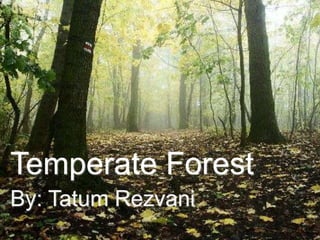
Temperate Forest
By: Tatum Rezvani
On the Map

Temperate
forests are
located in the
eastern
United
States,
eastern Asia,
and most of
Europe.
Facts about the
Temperate Deciduous
Forest
 The temperate deciduous forest biome is an area
that is very cool and rainy most of the year. In the
fall the leaves will fall off of the trees, and in the
spring they reemerge. It can also snow during the
winter in this particular biome. This biome
experiences brief, but hot summers.
 Latitude/Longitude: 23.5 degrees to 60 degrees
latitude in both the Northern and Southern
hemispheres
Yearly Precipitation
Yearly Temperature
Plants and Animals
 American Bald Eagle
(Haliaeetus
leucocephalus)
 American Black Bear
(Ursus americanus)
 Coyot (Canis latrans)
 Duckbill Platypus
(Ornithorhynchus
anatinus)

 European Red Squirrel
(Sciuridae)
 White-tailed Deer
(Cervidae)

 American Beech
(Fagus grandifolia)
 Carpet Moss
(Bryophyta)
 Maple Tree (Acer)
 Lady Fern
(Pteridophyta)
 Northern Arrowwood
(Viburnum dentatum)
 White Oak (Quercus)
American Black Bear
Temperate forest animals
have have a variety of
adaptations that allow
them to deal with the
constantly shifting
temperatures. During the
winters, the American
black bear goes into
hibernation (a deep,
sleeplike state) in order to
store its energy.
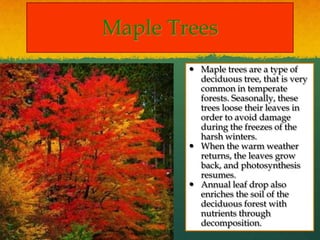
Maple Trees
 Maple trees are a type of
deciduous tree, that is very
common in temperate
forests. Seasonally, these
trees loose their leaves in
order to avoid damage
during the freezes of the
harsh winters.
 When the warm weather
returns, the leaves grow
back, and photosynthesis
resumes.
 Annual leaf drop also
enriches the soil of the
deciduous forest with
nutrients through
decomposition.
Human Impacts
Negative

Positive
 Recent managing of timber
production
 Replanting of trees



Deforestation



Logging for wood and timber



A lot of deciduous forests have
lost land to farms and towns.



Urbanization.



Although people are trying to
protect the forests some
poachers are trying to kill the
animals in the forests.



The animals are losing their
homes because of people
building on their homes.
Works Cited
Content

Pictures



. "Temperate Deciduous Forest
Biome ." Bio Expédition . Bio
Expédition , 2013. Web. 21 Nov
2013.
<http://bioexpedition.com/tem
perate-deciduous-forestbiome/>.



Nasa , . "Temperature and
Precipitation Graphs." Earth
Observatory . NASA, 2011. Web. 21
Nov 2013.
<http://earthobservatory.nasa.go
v/Experiments/Biome/graphs.ph
p#temperate>.



T, Connie . "Deciduous Forest
Biome ." Blue Plant Biomes . N.p.,
2001 . Web. 21 Nov 2013.
<http://www.blueplanetbiome
s.org/deciduous_forest.htm>.



. "Temperate Deciduous Forest ."
Biomes of The World. N.p., 2009.
Web. 21 Nov 2013.
<http://417542058272067887.wee
bly.com/temperate-deciduousforest.html>.



Withgott, Jay. Environmental
Science. Upper Saddle River, NJ:
Pearson Education , 2011. Print.



. "Red Maple Tree." Fairly
Landscape. Ornamental Plants,
6/26/2011. Web. 21 Nov 2013.
<http://www.fairylandscape.net
/red-maple-tree/>.

PowerPoint

  • 1.
  • 2.
    On the Map Temperate forestsare located in the eastern United States, eastern Asia, and most of Europe.
  • 3.
    Facts about the TemperateDeciduous Forest  The temperate deciduous forest biome is an area that is very cool and rainy most of the year. In the fall the leaves will fall off of the trees, and in the spring they reemerge. It can also snow during the winter in this particular biome. This biome experiences brief, but hot summers.  Latitude/Longitude: 23.5 degrees to 60 degrees latitude in both the Northern and Southern hemispheres
  • 5.
  • 6.
  • 7.
    Plants and Animals American Bald Eagle (Haliaeetus leucocephalus)  American Black Bear (Ursus americanus)  Coyot (Canis latrans)  Duckbill Platypus (Ornithorhynchus anatinus)  European Red Squirrel (Sciuridae)  White-tailed Deer (Cervidae)  American Beech (Fagus grandifolia)  Carpet Moss (Bryophyta)  Maple Tree (Acer)  Lady Fern (Pteridophyta)  Northern Arrowwood (Viburnum dentatum)  White Oak (Quercus)
  • 8.
    American Black Bear Temperateforest animals have have a variety of adaptations that allow them to deal with the constantly shifting temperatures. During the winters, the American black bear goes into hibernation (a deep, sleeplike state) in order to store its energy.
  • 9.
    Maple Trees  Mapletrees are a type of deciduous tree, that is very common in temperate forests. Seasonally, these trees loose their leaves in order to avoid damage during the freezes of the harsh winters.  When the warm weather returns, the leaves grow back, and photosynthesis resumes.  Annual leaf drop also enriches the soil of the deciduous forest with nutrients through decomposition.
  • 11.
    Human Impacts Negative Positive  Recentmanaging of timber production  Replanting of trees  Deforestation  Logging for wood and timber  A lot of deciduous forests have lost land to farms and towns.  Urbanization.  Although people are trying to protect the forests some poachers are trying to kill the animals in the forests.  The animals are losing their homes because of people building on their homes.
  • 12.
    Works Cited Content Pictures  . "TemperateDeciduous Forest Biome ." Bio Expédition . Bio Expédition , 2013. Web. 21 Nov 2013. <http://bioexpedition.com/tem perate-deciduous-forestbiome/>.  Nasa , . "Temperature and Precipitation Graphs." Earth Observatory . NASA, 2011. Web. 21 Nov 2013. <http://earthobservatory.nasa.go v/Experiments/Biome/graphs.ph p#temperate>.  T, Connie . "Deciduous Forest Biome ." Blue Plant Biomes . N.p., 2001 . Web. 21 Nov 2013. <http://www.blueplanetbiome s.org/deciduous_forest.htm>.  . "Temperate Deciduous Forest ." Biomes of The World. N.p., 2009. Web. 21 Nov 2013. <http://417542058272067887.wee bly.com/temperate-deciduousforest.html>.  Withgott, Jay. Environmental Science. Upper Saddle River, NJ: Pearson Education , 2011. Print.  . "Red Maple Tree." Fairly Landscape. Ornamental Plants, 6/26/2011. Web. 21 Nov 2013. <http://www.fairylandscape.net /red-maple-tree/>.

Editor's Notes

  • #3 We are currently located in a Temperate Forest here inVerneuil!
  • #5 The Temperate forest is well known for its broad leafed deciduous trees. Deciduous refers to trees that lose their leaves and regrow them.
  • #6 Temperate Deciduous Forest
Staunton, Virginia, United States.Temperate forests occur in areas where precipitation is spread relatively evenly throughout the year. The average annual precipitation is 30 to 60 inches.
  • #7 Temperate Deciduous Forest
Staunton, Virginia, United StatesOrganisms in temperate forests experience a range of temperature conditions throughout the year, having to survive through all four seasons.Average Annual Temperature Ranges: 50 degrees F
  • #11 American Bald Eagle, black bear, red squirrel, deciduous tree, lady fern, and oak tree.